NOS – New Old Stash

I don’t know what your listening habits are…

While cleaning my office/studio/listening room, I found a cache of unopened and hence, unplayed records.  It gave me pause for a second, perusing through the stack, thinking that I was not only feeling nostalgic on this particular day of record shopping, but pretty lucky as well. A little bit of old school hip hop, some classic jazz and some major heaviness from the 60s. I even found a few vintage MoFi’s lurking in the pile.  Where were they when I was thinking of listening to them?

I realize that we all find our joy in a different place.  Some enjoy being completist collectors, some enjoy searching rarities, while others just dig hanging out in a record store and smelling the vinyl.

But I suggest that for a day or two (maybe even longer) you step back and enjoy the collection you’ve already acquired.  I’ll bet that you too have some hidden treasure!

-Jeff Dorgay

The Wadia Intuition

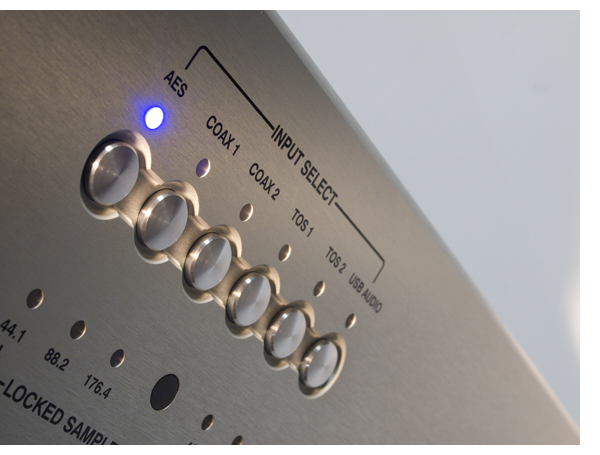
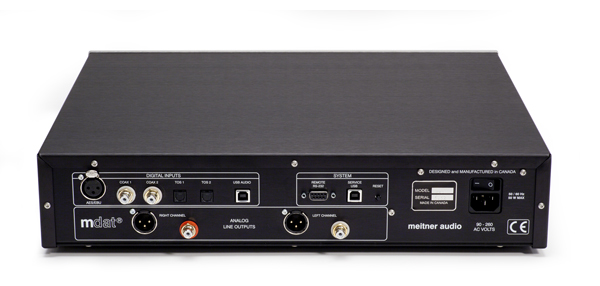
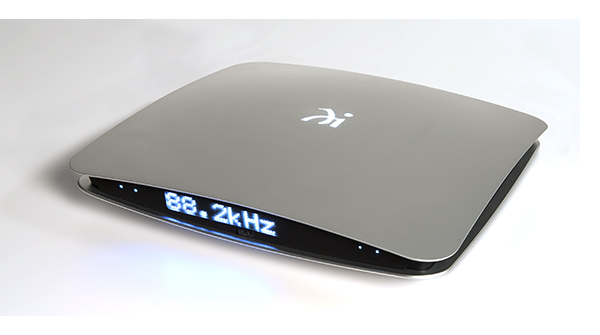
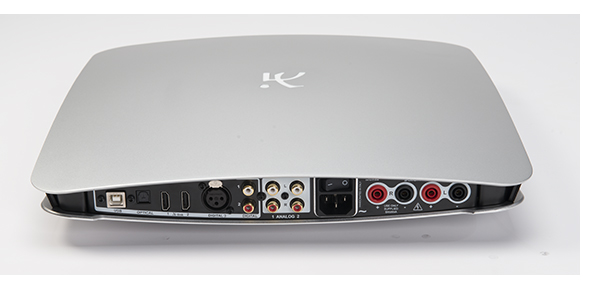
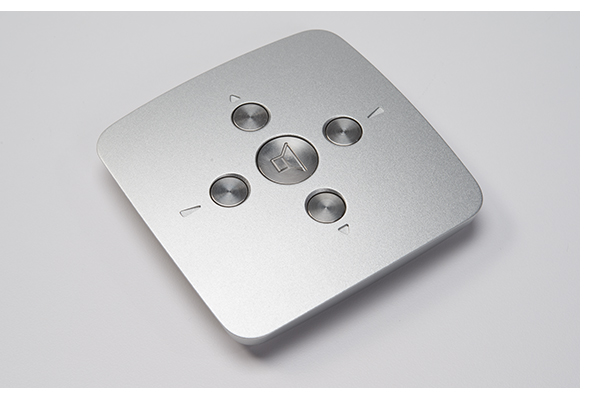
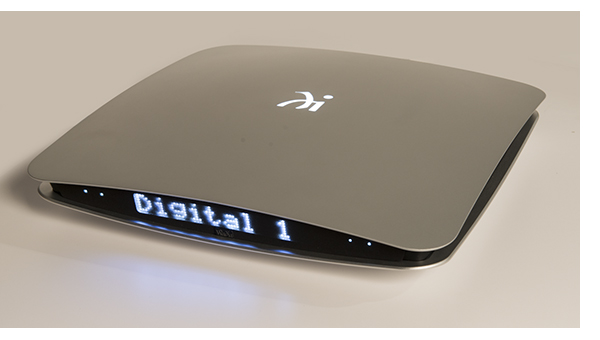
One of the most exciting products to hit this January’s Consumer Electronics Show, Wadia’s Intuition combines their latest DAC technology, combining the current version of their award winning Digimaster algorithm, a digital preamplifier, and a 350 watt per channel (into 4 ohms) high efficiency power amplifier.
It is capable of processing 192khz/24 bit files via the coax, optical and AES inputs, while offering 384khz/32bit and native DSD playback through the USB input.

We will have a full review in a few weeks, which will be the world’s first in-depth review of the Intuition.  We’ve got a wide range of speakers to pair it up, from KEF (Blades and LS-50), Dynaudio (Evidence Platinum), Focal (Maestro Utopia), and GamuT (S9), so stay tuned.  Even after a few days, the Intuition continues to impress in every way.

www.wadia.com

My Favorite Picture of You

As a young man, Guy Clark made his name as an edgy, new-breed country songwriter along with the likes of Townes Van Zandt and Mickey Newbury. Now 71, he’s taken on the mantle of lion in winter.

My Favorite Picture of You is a finely wrought, late-in-the-day statement. The centerpiece is the title track written for his wife, Susanna, who died in 2012. On the album cover, Clark holds a Polaroid of her as a young woman. The song is a shattering ode to that photo and all it represents: the good times, the bad times, and the woman who stuck with him through it all.

Clark displays a deep social conscience in several songs. The bright Tex-Mex melody of “El Coyote” belies the darker story at its heart: undocumented Mexican workers exploited and abandoned by the “coyote” they’ve paid to smuggle them across the border. “Heroes” spotlights a damaged Iraq War veteran after they’ve come home. Employing old-school country recitation, Clark tells the story of a scarred young man going off the rails: “A silver star and a pistol in a drawer/The morphine just ain’t workin’ no more.” Like John Prine’s classic “Sam Stone,” “Heroes” cuts with scalpel precision, focusing on the raw specifics of one soldier’s story.

The singer’s songs are built on mournful cello, quietly burbling banjo, sweet fiddles, and warm acoustic guitars. Melodies are memorable and winning. But the lyrics, delivered in Clark’s weather-beaten voice, that resonate most of all. Like a gifted short-story writer, Clark is all about details honed to a razor’s edge. “Rain In Durango” is a shrewdly observed character study of a rambling girl: “She wound up with a backstage pass/Was hangin’ with the pickers in the band/Till her heart got broke by a banjo man/Now she’s had all the bluegrass she can stand.”

Every cut is a smart, distinctive gem. The riveting western story-song “The Death of Sis Draper” would make the late Marty Robbins smile. Clark also casts a sharp eye on the dangerous, addictive life of an artist in “The High Price of Inspiration.” And he offers up a cheeky take on life in “Good Advice.”

“Don’t give me no advice that rhymes/I’ve heard it all a thousand times/Don’t start preachin’ between the lines/Give me somethin’ I can use.” What Clark gives us is thoughtful art. My Favorite Picture of You is a quiet treasure. —Chrissie Dickinson

Focal XS Book goes wireless

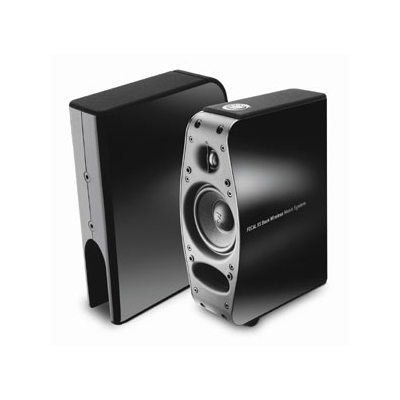
Focal has just added Bluetooth APT-X Wireless capability to their award winning XS Book loudspeaker range, making a great compact speaker system even better – and certainly more versatile.
The XS Book Wireless allows wireless digital source transmission in a full range, user friendly pair of powered desktop monitor speakers that are equally at home with the desktop music lover and hobbyist music creator.

Equipped with an aluminum dome tweeter and 4-inch Polyglass woofer, these speakers have a wide bandwidth of 50hz – 22khz and can achieve a 97db SPL at one meter.  We are using a pair of these speakers in the TONEAudio studio to produce our upcoming video clips, so we can vouch for their high quality.

At $399 a pair, the XS Book Wireless is a perfect back to school gift, and comes with all the necessary cables you will need to integrate it into your system:  a 1.5m RCA cable, 1.5m extension cable, a 3.5mm jack going from computer to XS Book and a stylish carrying case.  Those not needing wireless functionality can achieve the same sound with the $299/pair XS Book system.

www.focal.com

www.audioplusservices.com

Issue 56

Features

Old School:
The Harman Kardon Rabco St-7 Turntable

By Jerold O’Brien

995: Sounds that Won’t Break the Bank
The Ortofon 2M Red and Grado Black1 Prestige Cartridges

By Jaime Lee Fritze

Journeyman Audiophile

Peachtree Audio Nova 125

By Mark Marcantonio

A Candid Conversation With Jason Isbell

By Andy Downing

Tone Style

Wino:
Art Meets The Grape
By Monique Meadows

Cardas Earspeaker 1

Johnny Cash Postage Stamps

DEVO Throbblehead

The KISS Van

The Sentinel Loudspeaker

The Moo Mat

The iPad TP Holder

Ryobi P260 Impact Drill


Leica’s M Monochrom

By Jeff Dorgay

Music

Current Releases:

Fresh Releases in the Pop/Rock World
By the TONE Staff

Live Music:
She & Him
By Bob Gendron

Audiophile Pressings

Jazz & Blues
By Jim Macnie

Previews

AURALiC Merak Power Amplifiers

Nagra 300P Amplifier

Audionet PAM G2 Phonostage

Boulder 865 Integrated Amplifier

Peachtree deep blue Bluetooth Music System

Reviews:

Light Harmonic DaVinci DAC
By Jacob Heilbrunn

Wilson Benesch Full Circle Turntable
By Paul Rigby

Coincident Statement Phono Preamplifier
By Jeff Dorgay

IQ Audio 300M Amplifiers
By Rob Johnson

Pass Xs300 Monoblocks
By Jeff Dorgay

AVA Ultravalve Amplifier
By Jeff Dorgay

Viola Bravo Amplifier
By Jeff Dorgay

Rogers EHF-200 Mk.2
By Jeff Dorgay

Slummin’

Nagra 300p

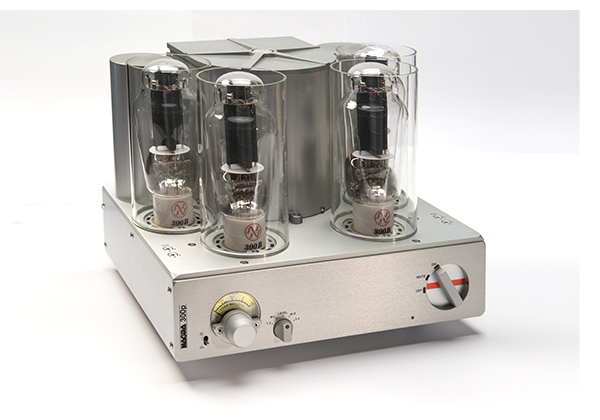
The long awaited 300B amplifier from Nagra is here….
And it is wonderful.  The 300P produces 20 watts per channel with a “polarized push pull configuration,” and features output taps for 4, 8, and 16 ohm speakers.  Thus far, we’ve been flabbergasted at what this mighty, yet minimalistic amplifier can drive.  Having seen the prototypes on the drawing board on our visit to Nagra years ago, it is truly exciting to see this amplifier on the dealers shelves.

MSRP is $16,995.

Full review in process, and for more information, click here for the Nagra website.

Audionet PAM G2 Phono

Just in from Audionet:   The PAM G2 phonostage, with EPC external power supply.

This two input phono stage from Audionet has two inputs that can be configured as MM or MC, with adjustable gain settings of 38db, 48db, 58db and 68db. Loading ranges from 100, 150, 470, 1000, 23k, 47k and 68k ohms, with the ability to achieve custom settings as well.  It’s built like a Porsche Turbo, with 280,000uf of power supply capacitance, providing major energy storage.

We’ve just put this one in the rack and begun listening, so stay tuned.

For more information, click here:

http://www.audionet.de

Hanging at VPI

Always a fun day to visit the VPI factory, in Cliffwood, New Jersey.

This is American made at its finest.  VPI combines new and old school manufacturing with careful hand assembly to create turntables known all over the world for their sonic attributes.

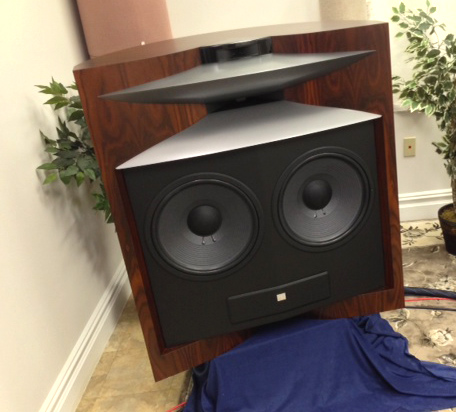
The most fun however, is back in the sound room, where now retired principal, Harry Weisfeld has just unpacked a pair of JBL Everest speakers.  As we listen to Way Out West, via VPI’s new 3D printed arm and a Lyra Atlas cartridge, the lifelike sound is unmistakable.  Harry smiles and says, “they need a few months to really break in, then we’ll have some magic.”  An audiophile to the end.

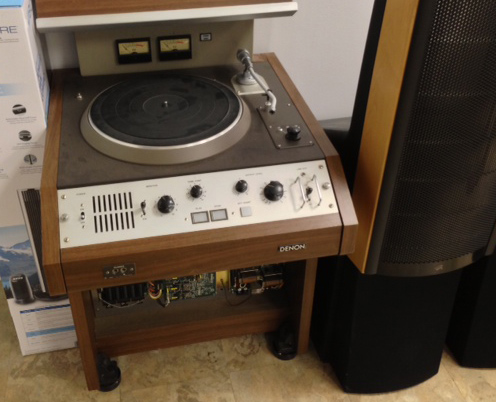
And lurking off in the distance is a vintage Denon direct drive table, that Weisfeld is holding “for a friend…” Pretty cool.

Free JPlay from AURALiC

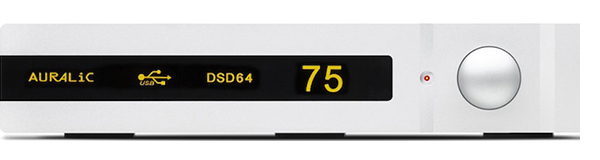
AURALiC, Limited has announced it will begin offering a free copy of JPLAY, a high-end audio player plug-in for the Windows operating system, to all purchasers in North America of AURALiC’s advanced VEGA Digital Audio Processor.

JPLAY, a $130 value, is an award winning, audiophile-grade software player designed to transform Windows PCs into high-end digital transports. With a laser-like focus on musical performance quality, JPLAY’s features include memory-based playback, zero disk activity during playback, superior memory management, a large page memory, and minimal operating system noise through the elimination of dozens of jitter-inducing processes. JPLAY is easy to install and use, and compatible with any audio player that supports the ASIO digital audio protocol.

AURALiC’s VEGA is a next-generation processor that delivers uncompromising high-resolution sound. Compact and elegant, it combines a digital-to-analog converter with a preamplifier that supports all high-resolution music formats, including Direct Stream Digital (DSD) and Digital eXtreme Definition (DXD PCM). Its sound is rich and smooth with great signal transparency and minimal distortion and noise.

The promotion applies to all VEGA purchases in North America directly from AURALiC or its authorized dealers, starting today. Existing VEGA owners in North America are also eligible if they have made their purchases within the last three months and registered their products on AURALiC’s website. VEGA buyers in other countries may purchase a full-function version of JPLAY at a 50 percent discount off the retail price though AURALiC.

The VEGA Digital Audio Processor is available now from AURALiC and authorized dealers at a suggested price of $3,499.

High On Fire: LIVE!

The biggest metal story of the first half of the year belongs to Black Sabbath.

More than three decades after his original departure from the band, vocalist Ozzy Osbourne reunited with most of his former mates to finally his first new studio album with the group since 1978’s embarrassing Never Say Die. All didn’t go as planned. Drummer Bill Ward sat out over reported contractual disputes and ceded his throne to Rage Against the Machine skin-pounder Brad Wilk. Osbourne also owned up to binging on drugs and alcohol, leading some to predict a divorce from his wife would follow. In the end, the revelation seemed like a publicity stunt.

As comebacks by Social Security-eligible musicians go, Black Sabbath’s 13 represents a respectable attempt at recapturing former glories. The chemistry is better than that on a similar ensemble’s return—Van Halen’s 2012 A Different Kind of Truth—and guitarist Tony Iommi still hasn’t encountered a giant riff he couldn’t slay. The involvement of big-name producer Rick Rubin coupled with an ad blitz helped give the English legends their first-ever number-one album. Granted, attaining such a feat is much easier in 2013. But numbers don’t lie.

Akin to every other heavy band to pick up instruments, turn up amplifiers, and conjure apocalyptic feelings, High on Fire owes much of its existence to Sabbath. Yet like every great artist, the Oakland trio managed to long ago transcend its influences and leave its own mark on its métier. In terms of consistency, aggressiveness, ambition, skill, and intensity, no metal collective dominated the past decade more than High on Fire.

Led by guitarist/vocalist Matt Pike, the threesome utilizes pace, power, and physicality in brazen arrangements stargazing psychedelia to village-pillaging sludge. Metal—as susceptible as any genre to spikes and lulls—is currently in a creatively dormant stage, but anyone curious about the style’s progressive evolution and modern strengths since its last peak (circa 2006) can turn to Spitting Fire Live Volume I and II for a Cliffs Notes summation.

While Osbourne and Co. kept busy last fall orchestrating a high-priced publicity rollout, High on Fire played gigs at a pair of revered New York venues shortly after Pike’s emergence from alcohol rehabilitation. Selections from those performances, which document a reinvigorated and even stronger-willed band than that of pre-treatment Pike, fill these concert LPs. High on Fire comes on looser than it does on its tight-as-a-clenched-fist studio efforts. Then again, Pike takes extra liberties with axe-wielding solos and by extension, pushes his mates to even greater heights. Songs such as “Frost Hammer,” “Devolution,” “Speedwolf,” “Fury Whip,” and “Rumours of War” sound true to their titles. Not for the faint of heart, High on Fire thrives on in-the-red energy and mantle-hot rhythms that shake harder than a revved-up Harley-Davidson.

Raw, ferocious, uptempo, tough, violent, growling, sweaty, beautifully ugly: Fine portraits of underground metal heroes that, to paraphrase Stanley Cup-winning Chicago Blackhawks goalie Corey Crawford, play their nuts off.

AVA Ultravalve Amplifier

With so much excitement over tubes these days, here’s one that might have flown under your radar…
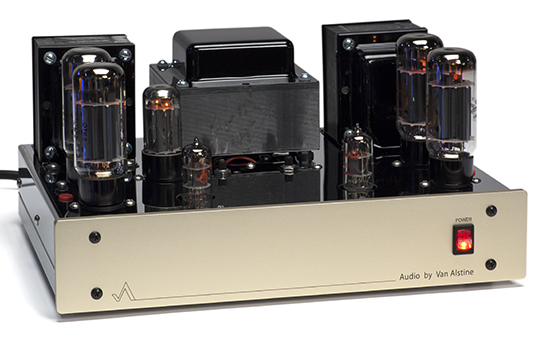
Van Alstine’s Ultravalve has been around for years, starting as their original Super 70, which was an upgrade kit for the legendary Dynaco Stereo 70, then morphing to the Super 70i before finally becoming the Ultravalve.  It’s a simple, elegant design with exposed tubes and transformers; a perfect way to display a classic tube amplifier.

Our full review will be in issue 56, but to let the cat out of the bag, this amplifier is stunning.  If you have an inkling that a modest tube amplifier would suit your needs, this is the one we suggest.  And for $1,995, nothing else can touch it in terms of performance.

www.avahifi.com

Neil Young Visits Meridian…

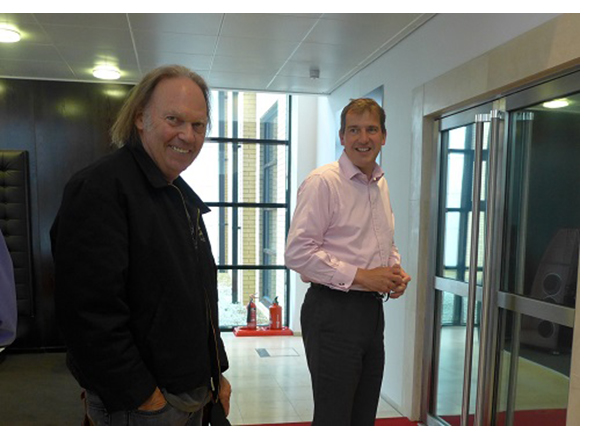
On a recent visit to the UK, Neil Young stopped by the Meridian facility in Cambridgeshire.
You can read more here:

http://www.meridian-audio.com/en/meridian-world/Neil_Young_Visit_to_Meridian_Audio/46/

We Visit Audio Arts NYC

Audio Arts NYC provides an oasis of chill, just four floors above the hustle and bustle of New York City’s Fifth Avenue, in the Flatiron District.

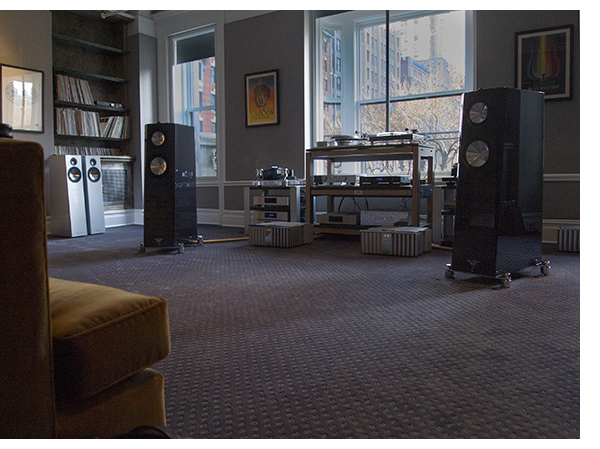
Owner Gideon Schwartz buzzes me up to his suite, where the main listening room, about 20 x 30 feet, features a comfy couch, a wonderful view of the city, Madison Square Park and a big fireplace. When was the last time you saw a fireplace in a hifi shop?  Instantly, your blood pressure takes a big dip for the better and it’s easy to relax. This is not a typical retail environment in any sense of the word.

The central room showcases one main system, with a variety of turntables from Holborne Swiss Audio, Simon York and a beautifully restored Thorens TD-124 from Schopper.  Off to the left the massive Kalista CD transport from Metronome Technologie sits, waiting to make magic from the often criticized compact disc.  A single pair of Zellaton speakers is placed to perfection in this acoustically correct space.  Well off to the side, are some neatly arranged components from Nagra, waiting for audition by another customer, along with electronics from  CH Precision (Switzerland), Malvalve (Germany), Lavardin (France) and Kora-Eda (Japan) flanked by a pair of Stenheim speakers.

“Want to hear a record?”  Schwartz cues up a Teddy Pendergrass, via the Holborne table and the sound from what some audiophiles might consider an average pressing comes to life on the big Zellatons, powered by the Burmester 911 mk. 3, an amplifier that I also use as a reference.  The sound is infinitely familiar on one level, yet a few clicks beyond what I’m used to, as the Zellaton speakers provide such a clear window into the music.  If I didn’t know better, I’d think that we were listening to an expensive remaster of this recording. Fortunately, there are no audiophile standards in his record collection on display.

Switching to digital, we listen to Musica Nuda, by Petra Magoni and Ferruccio Spinetti, the delicacy of analog remaining.  It’s hard to believe we are listening to digital, and again, the combination of excellent music and system synergy allows the listener to forget about the left-brain stuff that often gets in the way of enjoying their system.

The magic that this system offers sums up what Audio Arts NYC brings to the table. Purchasing components at this level requires a well versed guide, someone capable of hand picking things that work well together for maximum effect and demonstrating them in a comfortable environment, lacking in clutter makes it easy to unwind and take it all in.
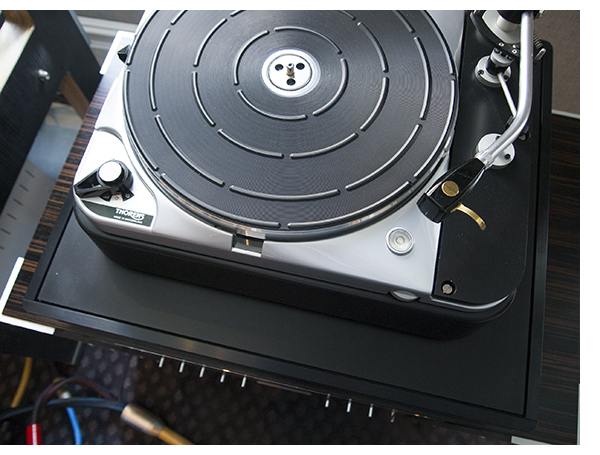
At the time of our visit, a second, smaller room is nearing completion, to showcase other components, primarily speakers more suited to clients with a similar sized listening space. Here, I see components from Swissonor, Shopper Thorens, Wavelength and the new Midnight Blue series from 47 Labs.

While some of the names on the roster, like Burmester and Nagra are well known to American audiophiles, others like Zellaton and Stenheim are new to our shores. And while some of these components carry a lofty price tag, many do not. All too often, hifi salons become myopic and militant, offering potential customers few choices, which can be detrimental to those wishing to engage this hobby.  Everything here has been hand picked by Schwartz for sound quality, build quality and uniqueness.  “It’s really about the overall sound.  I put a very strong emphasis on the greatest possible fidelity for every approach.  This results in a musical consistency in my products regardless of cost.” Schwartz says. And whether your interest is in solid state, single ended triodes, or anything in between, Audio Arts NYC has an interesting solution.

Schwartz underlines the importance of this process. “Sometimes, it takes months for us to put just the right system together for a client.  I’m not in a hurry.” Right in the heart of New York City, he understands the stress that many of his clients face, and the importance a music system plays in their lives.

Wonderful as Audio Arts NYC is, perhaps the highest compliment I can pay Gideon Schwartz is that I heard four albums that were completely new to me.  This is the direction that high-end audio has to take if it is to survive. Having just returned from Tokyo, reflecting back on my visit to Audio Arts, it reminds me of the Leica store in the Ginza shopping district, where photography and the gear to create those photographs is equally respected, showcased in a soothing environment.

This deliberateness, and attention to detail, all the while celebrating the music that makes it all possible is what makes Audio Arts NYC so unique. I highly suggest an appointment.
-Jeff Dorgay

Audio Arts NYC

www.audioarts.co

Bowers & Wilkins Partners with Maserati

The two European manufacturers get together for the audio system in the new Quattroporte sedan, a dressed-up pair of 805 speakers, and a global DJ tour.

Maserati is far from the first luxury carmaker to market with a premium sound system in its cars—but pair that with the new 805 Maserati Edition speakers from B&W, which provides the stereo for the Italian carmaker’s 2013 Quattroporte sedan, and a DJ throw-down at a hanger in Hollywood, and you’ve most certainly got our attention. (The Hollywood event in early June was part of the global Seven Notes tour. For these events, DJ/producer Howie B, who has worked with Björk and U2, among other acts, spins music inspired by the seven tones of a Maserati engine in action, with B&W delivering the chest-thumping sonic goods. Click here for more details on the tour: www.sevennotes.com)

The Quattroporte audio system is no mere car stereo, and I’ve heard similar systems from

Naim (for Bentley), Bang & Olufsen (for Audi and Aston Martin) and Burmester (for Porsche). The B&W system in Maserati’s roughly $130,000 Quattroporte easily holds its own in this competitive market. With B&W drivers and tweeters and Harman-sourced electronics, the 15-speaker, 1,280-watt stereo produces an audiophile-grade listening experience from any of the car’s four seats. The system offers a big display panel in the dash with intuitive touchscreen control, and easy synchronization with your digital-music device of choice.

B&W’s 805 Maserati Edition speakers aren’t too shabby either. The stand-mounted monitors are basically B&W’s flagship 805 Diamond speakers dressed up with the same materials used in the cabin of a Maserati, including bird’s-eye maple veneer, black Italian leather, and the Maserati trident symbol. The cost of the speakers, which will be available this fall, are likely to come at a premium over the $5,000 price tag of the standard 805s—but if you’re paying well over six figures for a Maserati, you might as well throw in a few extra bucks for matching speakers.

-Bailey S. Barnard

The Latest From The Oblivians

Minutes into their first album in more than 15 years, the Oblivians sing about waking up in a police car.

Guitars faintly double as sirens while insouciant vocals indicate more than just casual indifference. When you hear the trio’s offhand deliveries, you know these guys have been there before. There’s no faking, no pretense, no make-believe about what it’s like to be aroused from a drunken slumber only to smell the plastic vinyl of a worn bench seat, look up, and realize you’re headed to jail.

The band’s nose for cheap thrills, thirst for even cheaper drinks, and lust for back-street pursuits permeates Desperation, a raw garage-rock album recorded live to a one-inch Scully eight-track recorder at Dan Auerbach’s Easy Eye Sound studio. Polished and pristine it is not. But immense fun lies within the 14 tracks, which include a jump-and-jive cover of Paul Butterfield’s “Loving Cup” that’s held together by salvaged instruments and sweaty desire. A similarly strong-willed do-it-yourself spirit comes to fore on a majority of the set, which resides in the same territory populated by seedy bars, glue-sniffing characters, and dark alleys.

Songs mirror the shady environments. Overdriven rhythms strut akin to alluring streetwalkers; charged tempos and stripped-back instrumentation hint at the campy shock sequences of 50s B-horror movies; simple percussive beats dig in and sway as if leading a parade of stiletto heels. Almost everything is caked in motor-oil grime, but the fuzz-box distortion never becomes overbearingly heavy or claustrophobic. Rather, the Oblivians honor their Memphis hometown by way of classic soul and stylish R&B figures that aren’t far removed from those preferred by Wilson Pickett or the Mar-Keys. The latter musicians’ legacies live on in the party anthem “Call the Police,” a collaboration with Mr. Quintron and Miss Pussycat that both gets down by way of a steaming-hot organ and makes good on its promise to “tear it down.”

Trashy, basement-reared rattling—as well as a penchant for sniffing around places and people your mother warned you about—also informs the wiry “Little War Child” and ringing “Pinball King.” Each contagious tune is evidence the Oblivians know their way around British Invasion hooks and surf-pop choruses as well as they do dive establishments most groups are too timid to visit.

And you can purchase it from SoundStageDirect right here…

Issue 55

Features

Old School:
The ARC SP-11 Preamplifier

By Ken Kessler

995: Sounds that Won’t Break the Bank
The Dynavector DV-20X2 Cartridge

By Lawrence Devoe

Macro: Sound for Small Spaces

Digital vs. Vinyl (Part one)
By John Darko

Journeyman Audiophile

The Funk Firm LSD Turntable

Tone Style

Wino:
Exploring South Africa’s Bounty
By Monique Meadows

LaCie Blade Runner Hard Drive

Definitive Technology Sound Cylinder

Kohler Moxie Bluetooth Showerhead

Fiat 500e

Symbol Audio Tabletop HiFi

By Rob Johnson

Music

Desert Drifter:

A Conversation with Bombino

By Andy Downing

Current Releases:

Fresh Releases in the Pop/Rock World
By the TONE Staff

Live Music:
Infected Mushroom
By Connor Willemsen

Club Mix:
By Connor Willemsen

Audiophile Pressings

Jazz & Blues
By Jim Macnie

NEW!  M on Classical

Previews

D’Agostino Momentum Stereo Amplifier

Rogers EHF-200 Mk. 2 Integrated Amplifier

Nagra Jazz Preamplifier

Sonus faber Guarneri Evolution Speakers

From The Web:

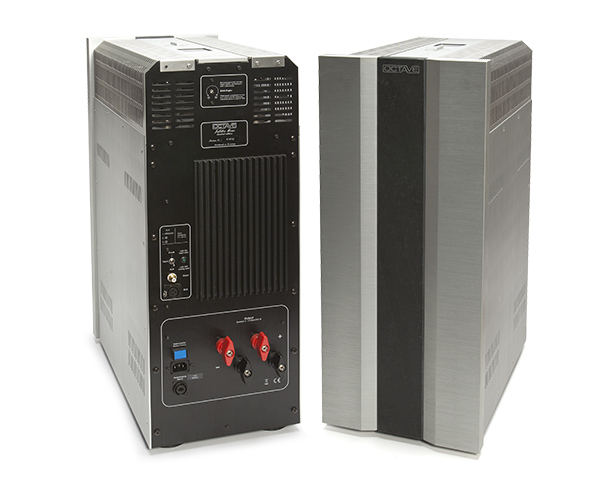
Octave Jubilee Monoblocks

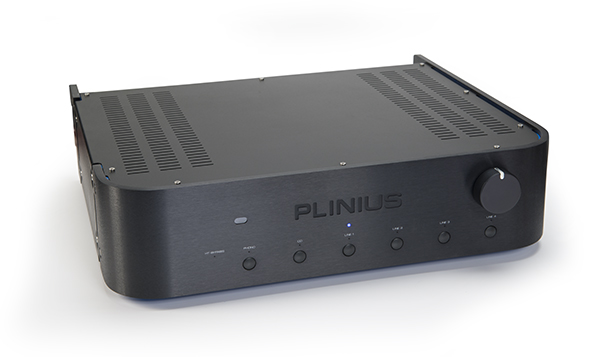
Plinius Hautonga Integrated Amplifier

Reviews:

The Chord Chordette Qute HD DAC
By Rob Johnson

Music First Audio Classic V.2 Preamplifier
By Andre Marc

Oppo BDP-105 Universal Player
By Jeff Dorgay

Parasound Halo CD1 Player
By Rob Johnson

Simaudio MOON 850P Evolution Preamplifier
By Jeff Dorgay

Unison Research Phono One Phonostage
By Jerold O’Brien

Slummin’

Long Term Review: The Octave Jubilee Monoblocks

It’s easy to become smitten with a pair of large, high-powered, German tube monoblocks at first listen.
There’s always something incredibly cool about amplifiers that have the delicacy, the airiness and that extra dimensional palpability that tubes bring to the listening experience, yet have the weight and sheer dynamic thrust that only comes with high power.  The Octave Jubilee monoblocks have been here for the better part of a year now, paired with many speakers large and small. They’ve excelled with every speaker I’ve had the pleasure to connect them to, with no loss of magic.  If anything, I’m more enthusiastic about these amplifiers than the day they arrived.

Elvis Costello and Burt Bacharach’s collaboration “I Still Have That Other Girl,” illuminates the Jubilees’ ability to take a strictly mediocre recording and, with a bit of help from a top-quality source (in this case, the $110,000 dCS Vivaldi stack), extract the maximum amount of detail from it without crossing the line to become overly analytical – striking a perfect balance of tonality and dynamics.  As they should, for $67,500 per pair.

Control in the lower register is difficult for all but the world’s finest vacuum tube amplifiers – again, the Jubilees convey a sense of reality that usually requires a high-current solid-state amplifier.  The big beats on Eric B. & Rakim’s “Put Your Hands Together” hit hard without losing control instead of just coming across as boom, boom, boom – no one-note bass here.  A lost day to unearthing the best bass-laden tracks I can find fails to make the Jubilees falter.  Everything from Daft Punk to Pink Floyd is served up with gusto.

Getting Down to Business

Powering the KEF Blades in room one (with a sensitivity of 90db) is a splendid experience – even at eardrum-shattering levels, the Jubilees show no sense of strain.  It feels as though Alx Rose is right there in the room, whistling the intro to “Patience” from the G N’ R Lies album. The illusion continues further as Rose’s lead vocal comes in with barely a whisper, amidst a pair of acoustic guitars that stay sorted left and right of center.  Perhaps the enchantment is relayed best of all tracking through Use Your Illusion I and II, at near maximum volume, proving that these monoblocks – with eight 6550 power tubes per channel (KT88s can be substituted, while KT120s are not recommended) and massive power supplies – are up to the task of whatever program material you love to play loud. I cannot drive the Jubilees to clipping with the Blades in the system.

They prove an equally excellent match for the GamuT S9 speakers.  With a -3db low frequency limit of 17hz, they easily illuminate shortcomings in an amplifier’s ability to go deep. Again the Jubilees show what they are made of, both with extension and textural ability.  Tal Wilkenfield’s rapid-fire bass playing on Jeff Beck’s Live at Ronnie Scott’s is a perfect example of the way the Jubilees take hold of the GamuTs multiple woofer cones, without haze or hangover, picking up every nuance brilliantly. Yet when asked to go deep, digging up the beats buried in Bombay Dub Orchestra’s 3 Cities disc, the Jubilees feel as if they have a silicon output stage, offering better grip than any power amplifier I’ve had the pleasure of using with tubes under the hood. And Daft Punk’s controversial new album is a true treat, chock full of ’70s and ’80s disco beats rattling my insides at club level, courtesy of the Jubilees.

Inner Space

Moving the amplifiers to room two, now partnered with the Sonus faber Guarneri Evolution speakers, provides another intoxicating experience.  These compact speakers only have a sensitivity of 86db, and while they will play with a 40-watt per channel tube amplifier, they need big power to come alive and energize the room. The intro of Bauhaus’s “Bela Lugosi’s Dead” becomes a massive three-dimensional cube of distorted, in-your-face guitars, surrounded by jangly guitars floating on the periphery of the room boundaries.  “Heathen Child” from the Grinderman 2 album is equally well decoded.  This recording is somewhat dense, yet playing it through the Jubilees lays it bare, filling it with space and texture.

The small but mighty Sonus fabers sound as if the flagship Aidas, which we reviewed in December 2012, have been placed in a shrink machine: they provide a similar amount of detail and finesse, yet in the context of a smaller room.  Supreme Beings of Leisure’s “The Light” expands wide and deep with electronic effects buoyant above the rock-solid bass line and sultry lead vocal, all having their own distinct space.  Having used the Jubilees with the Aidas during that review, this combination feels like it has returned to my smaller room – the presentation is stunningly lifelike.

And while the Jubilees produce 250 watts per channel, those subscribing to the “first watt” theory (i.e., if the first watt doesn’t sound great, why bother with the rest) can rest assured that even at low volume, the Jubilees excel.  The Rolling Stones’ version of “Like a Rolling Stone” from their Stripped LP remains engaging at light conversation level, with plenty of weight and a massive soundstage, providing a highly convincing rendition of the Stones playing in a small club – all of the spatial cues, from Charlie Watts drumming to the sound of the applause bouncing off of the club walls, are reproduced perfectly in my 13-by-16-foot listening room.

When Clint Eastwood whispers “You don’t listen, do you asshole?” on the Pretenders tune “Bad Boys Get Spanked,” it sounds as if he’s sitting right there on the couch, whispering in my ear.  Fantastic.

The Long Game

It’s always a rare privilege to listen to an amplifier for a long period of time, as manufacturers can’t always spare a flagship product in this manner.  However, it’s highly revealing when they can, as it provides the opportunity to experience a wider range of musical selections, far beyond the favorite tracks often used in the context of a normal review.

A wide variety of speaker and system configurations reveal that the Jubilees are infinitely flexible.  Thanks to XLR and RCA inputs, switchable from the rear panel, the Jubilees should work well with any type of preamplifier – all of the combinations auditioned here work perfectly.  They produce more than enough power for all but the most inefficient speakers, and they are even able to power my power hungry Magnepans without strain.  While none of my speakers prove problematic, the manual specifies a load no less than two ohms, so there may be a few speakers that the Jubilees will not drive.

While the Jubilee monoblocks do absolutely nothing wrong, their greatest triumph is truly a natural tonal rendition, combined with the ability to render layer upon layer of musical detail effortlessly.  Much like the Simaudio 880M monoblocks we just reviewed, the Jubilees paint an almost identical palette, yet offer up slightly more space and sparkle than their solid-state counterparts.  Ultimate system matching will come down to personal preference.

Tube and Reviewer Bias

Tonally, the Jubilees come right smack in the middle of CJ and ARC, two of my favorite tube amplifiers.  The ARC REF amps are a bit more in the “just the facts, ma’am” category, where the current CJ ART series tends to embellish somewhat in a more saturated kind of tonality. (A personal favorite and definite bias for this reviewer)

The Jubilees add only the lightest touch of “tube warmth,” yet remain highly dynamic and incredibly quiet as well.  A full tube design, they use four ECC82 (12AU7) tubes as drivers, and eight 6550 or KT88 tubes for output.  The owners manual states that they can also use EL34 tubes, with a slight rebias adjustment, which could be incredibly intriguing.  What the owner’s manual doesn’t state is that a decrease in power is probably likely, as the EL34 tube has a much lower plate dissipation than the KT88 or 6550 tubes.

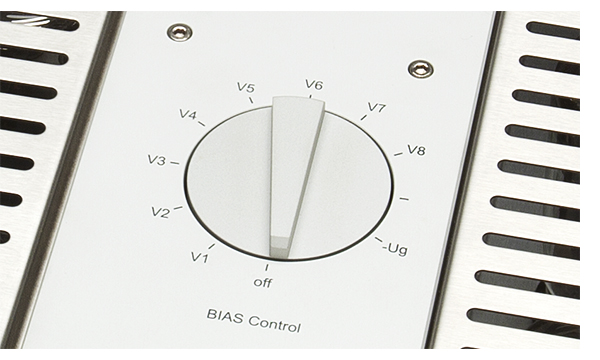
The Jubilees each use a single bias adjustment per amplifier, yet you can check bias on each individual tube via the rotary switch on the top panel.  The downside to this configuration is that each bank of tubes will have to be as closely matched as possible.  When they deviate by more than 15%, it’s replacement time. Each mono amplifier includes two extra tubes, so that should one go out of spec, you can easily replace it without having to get another fully matched set.  Octave claims a 3-5 year lifespan on the power tubes, and 10 years for the drivers. A set of 10 per amplifier when you do replace them would be prudent, just to be sure to have a couple of spares on hand, because one never knows when catastrophic tube failure will occur. Fortunately, the Jubilees have a very elaborate, yet unobtrusive, protection circuit; when I did have a tube failure, the amplifier gently shut down without clicks, pops or any other bother.  The Jubilees make no spurious sounds of any kind during normal power up or power down either; they quietly go about their business.

That touch of tubeyness is usually in the background, but makes itself known immediately when listening to acoustic music.  The gentle interplay of Pat Metheny and Charlie Haden on “He’s Gone Away” from the Beyond the Missouri Sky album reveals the Jubilees’ ability to let the notes hang on the vine, ever so slightly longer than they do when played through a solid-state power amplifier.  A similar sense of dimensionality is experienced with the Portland Cello Project’s current album, A Thousand Words.

Quite the Destination

The Octave Jubilee mono amplifiers are not for the faint of heart, back or wallet.  However, they deliver a fantastic musical experience that is commensurate with the price asked and are built to last a lifetime.  This has truly been an enjoyable long-term test drive!

The Octave Jubilee Monoblock Amplifiers
MSRP:  $67,500

www.octave.de

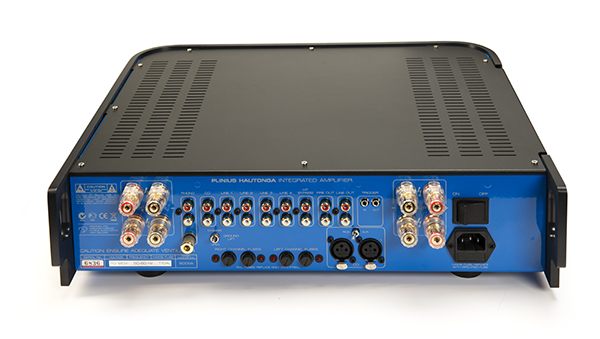
Plinius Hautonga

In case Plinius is a company that has slipped under your radar, they hail from New Zealand, and have been making incredible products for years now.
However, those that do know about the brand are doggedly loyal.  It’s a brand that I don’t think I’ve ever heard anyone slag out on the various internet forums, so they are doing something right.

Something indeed.  Having built their reputation on big, class-A power amplifiers, the Hautonga you see here is an integrated amplifier (with phono stage, no less) that features a 200-watt per channel class AB power amplifier.  Yet, much like the Burmester 911 mk. 3 and the new D’Agostino Momentum, the Plinius comes up with a remarkably grain free sound, that just might fool you that this understated beauty has a class-A amplifier under it’s cover.  Yet the MSRP is only $5,750.

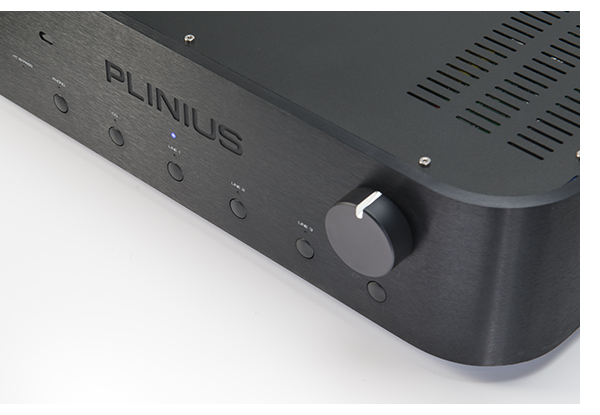
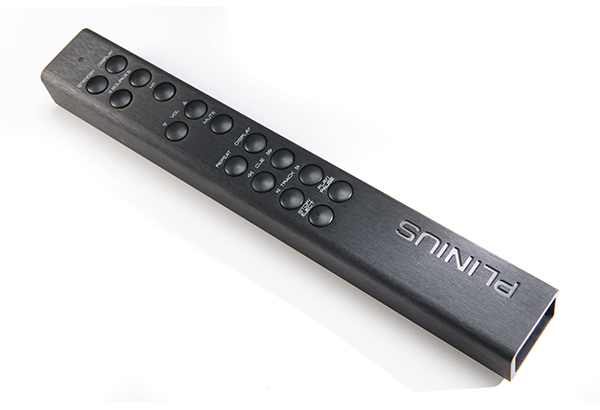
It’s a very understated box, with gently rounded corners and an asymmetrical top plate, yet the rear panel is bright blue, similar to the French racing blue you’ve seen on factory Renault race cars.  It makes for a nice accent stripe where the top panel meets the casework.  The Hautonga is beautifully machined and is available in black or silver.  The control layout is the ultimate of simplicity; a large volume control and gently rounded push buttons to control the inputs.  Oddly, a balance control is absent – no big whoop for digital music enthusiasts, but this might be somewhat inconvenient for analog lovers.  Even if it were implemented from the remote – and the Hautonga has a sleek, stylish, yet commanding remote.

A complete integrated

In the tradition of the best integrateds, the Hautonga features an on board phono stage – handy for those wanting to keep rack clutter to a minimum. It does feature adjustable gain with two settings via on board jumpers, however loading is fixed at 47k ohms.  Though I’m not a fan of running most MC cartridges at this setting, there are still some great alternatives.

The cartridges in my arsenal that mate particularly well with the 47k/high gain combination are the Sumiko Blackbird, a moderately high output (2.5mv) that works fine with 47k loading, and the Grado Statement 1 moving iron cartridge.  With a .5mv output and 47k loading, this is a perfect, if slightly overpriced match (the Statement 1 is $3,500) for the Hautonga.  Keep in mind that Grado does make a series of wood bodied moving iron cartridges, all having a .5mv output, from $500 on up.  I’m guessing one of these on your favorite table will prove equally enticing.

Tracking through a handful of recent favorites from MoFi and Music Matters Jazz, I submit that the onboard phono is probably equivalent to something you might purchase as an outboard phonostage in the $750 – $1,000 range.  Not bad, considering the Hautonga is an awesome deal without the phono stage.  Highs are smooth and well sorted, the overall tonal balance neutral and background noise very low.  And then there’s the necessity for another set of interconnects and power cord; another reason a built in phono is such an awesome idea.

Entry level and Journeyman vinyl enthusiasts will probably never need more analog capability than the Hautonga’s on board stage provides.

Maybe on the next version of the Hautonga, they will open this up to adjustment, or offer a $5,000 version with no phono stage.  Bypassing the onboard stage, utilizing the Aesthetix Rhea phonostage, paired with the SME 10 turntable and Sumiko Palo Santos cartridge, (an analog front end worth about $20k) the Hautonga easily resolves the difference in analog front ends – again showing off what a great amplifier this is.

Further listening

After a few days of being powered up, the Hautonga opens up to a full-bodied sound.  Ever so slightly on the warm side of neutral, the more you listen to this amplifier, you’ll psyche yourself out thinking that it is class-A after all.  It’s also on the warm side when in operation as well, suggesting relatively high bias current.  The Hautonga actually sounds more like my Burmester 011/911 combination than the Simaudio 850P/880M electronics.

Whether paired with their own Tiki streaming audio player (review in process) or any of the digital players at my disposal, the Hautonga is a pleasure to listen to, regardless of source.  While lacking the last bit of resolution available with cost no object gear, dynamics and tonality have not taken a back seat in the design process.  Listening to the title track from Gary Numan’s latest album, Dead Sun Rising, the Hautonga powers the Sonus faber Guarneri Evolution speakers in room two with conviction. This record is full of deep, deep, synth bass lines and the Hautonga sails through effortlessly, even at high volume.

These are speakers that require a lot of current and control to deliver maximum performance and this proves to be a great combination.  Going for the ultimate torture test, swapping in a pair of Acoustat 1+1 speakers, which are usually tough to drive because of their wacky impedance curve and the highly capacitive load they present, was another easy task for the Hautonga.

Thomas Dolby’s The Flat Earth proves spacious, controlled and full of punch.  The rapid-fire bass riffs on the opening track, “Dissidents,” is tough to nail on a pair of Acoustats if the amplifier lacks current drive.  Yet cranking this up, the Hautonga handles it in stride, which leads to some more bass laden tracks from Peter Gabriel and Genesis. Again, this amplifier’s ability to provide controlled bass, full of texture on a set of speakers known for “”one note bass” is highly impressive.

Moving the amplifier out to room one and the KEF Blades is a ton of fun – and again reveals this amplifiers ability to provide a high quality musical experience with ancillaries much more expensive than you might pair it up with.  The Blades 90db sensitivity proves an easy load for this amplifier to drive allowing for plenty of dynamic range and showing off the bass control and drive. While fairly efficient, the Blades also need a fair amount of current to reproduce bass well.  This prompted a long playlist of Deadmau5, Skrillex, Daft Punk and Infected Mushroom, pushing the amplifier to its limits.  Even after hours of this treatment, the Hautonga stayed slightly warm to the touch but no more.

Subtlety beyond its pricetag

While the Hautonga can really rock out when required, what makes it a top performer is the level of resolution and inner detail it provides.  Tracking through the MoFi gold CD of Todd Rundgren’s Something/Anything, a number of small details come up in the mix that normally require more expensive electronics to extract – again convincing this writer that the integrated is one of the best ways to achieve high performance without breaking the bank.   With so many choices to damage the synergy between amplifier and preamplifier, having it all on one chassis saves the day for all but the most geeky – and patient end user.  An integrated is the fast track to great sound.

Vocals and solo acoustic instruments feel right played through the Hautonga.  Revisiting some early Windham Hill recordings from Alex DeGrassi and Liz Story illustrate subtlety, tonal nuance and a wonderful sense of decay.  The old audiophile classic, Solid Colors paints a great picture of Ms. Story and her Steinway, awash in detail rendered perfectly by the Hautonga/Blade combination.

The Jung Trio’s rendition of Dvorak’s Piano Trio in F Minor, Op.65, is another treat showcasing the fantastic tonal contrast and neutrality that the Hautonga has to offer.  Perhaps two of the toughest instruments to reproduce cleanly, the amplifier sails through, with the interplay between the sisters well intact.

Rounding out the picture

The Hautonga also features the other common niceties to round out the package, with four additional RCA line inputs in addition to the Phono and CD player inputs, along with a single XLR input.  A ground lift switch is also provided, which came in handy using a vintage tape deck that had a bit of a hum problem.

Preamplifier in and outputs, 12v trigger, and a HT Bypass assure that you can integrate the Hautonga into any possible system configuration.  They even provide a pair of speaker outputs for those wishing a fully biwired speaker connection.  So no stone really goes unturned.

Nits to pick:  very few, and well under what we’d expect at this price point.  All staff members that used the Hautonga, young and old complained about two things – while very stylish, the remote was fairly hard to read in black and when using the volume control button, it has too much torque, making fine volume adjustments via remote nearly impossible at worst and frustrating at best.  And last, the phono stage loading.  It’s a shame that a phono stage that sounds this good is limited to a handful of cartridges.

Neither of these are a deal breaker, and the Plinius Hautonga is such a stellar performer in so many ways, we are all in agreement that it is highly deserving of one of our Exceptional Value Awards for 2013.

The Plinius Hautonga Integrated Amplifier
MSRP:  $5,750

www.pliniusaudio.nzld.com

And you can peruse their Facebook page here:

Peripherals

Analog Source                        Rega RP8/Sumiko Blackbird,  SME 10/Sumiko Palo Santos

Digital Source                                    Plinius Tiki, dCS Vivaldi, OPPO BDP-105

Speakers                                Dynaudio Confidence C1 II, Sonus faber Guarneri Evolution, KEF Blade, KEF LS-50

Cable                                      Cardas Clear

Tubey goodness from ALO Audio

Stop the presses.

In progress for some time, ALO Audio has just released their new headphone amplifier and will be showing it at THE Show in Newport Beach this weekend.   So if you are a headphone enthusiast, this is the one thing you should not miss while attending the show.  Hitting the block at “just under $5,000,” their masterpiece can drive four pairs of headphones at once, AND it drives the torturous HiFi Man HE-6 with ease…

This all tube design features 0B2 voltage regulators and a pair of 6V6GT output tubes, driven in single-ended, class A mode, with a power supply and output transformers worthy of a 20wpc power amp.  Can you say headroom and dynamics?

And, for hardcore headphone lovers that love to spin vinyl, there is a phono stage module on the way shortly, which we will also report on.

And this is fresh out of the box!  The ALO team tells me it takes 200 hours to reach full bloom, so it’s going to be running 24/7 until I get home from the show, then I will report back.

www.aloaudio.com

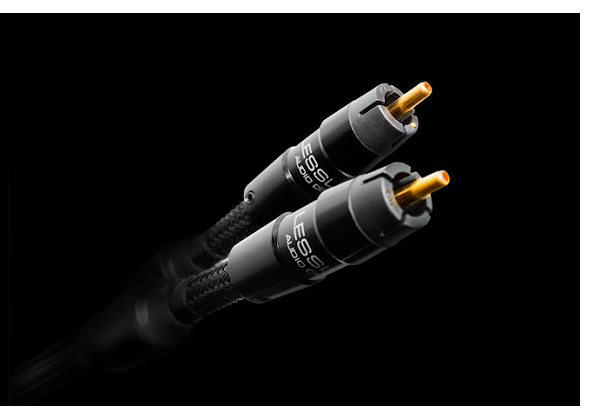
From Mono & Stereo: LessLoss digital cable

Mono & Stereo’s Matej Isak has been very excited about the entire LessLoss line of cable products, but here
he focuses his energy on their digital cable.

You can follow his observations here…
http://www.monoandstereo.com/2013/05/lessloss-digital-cable-review-test.html#more

Further listening with the Unlimiteds

The entire line of German Physiks speakers, due to their omnidirectional nature, are incredibly easy to place, not requiring a tuned room to give their best performance.

This was readily apparent from the minute we unboxed them, making for the shortest set up we’ve ever encountered.  The major upside here is that the Unlimiteds will sound just as good, if not better than what you’ll hear at your dealer.

After a few months of enjoying the Unlimiteds, we took them on a quick, local road trip to confirm this theory, sharing them with a few staff members and a couple of traditionally difficult rooms, as well as a wide range of amplification.  As hinted at in the first segment of this review, the Unlimiteds really only require about 25-40 watts to get busy, thanks to a very gentle, unobtrusive crossover network that separates the down-firing woofer and their DDD omnidirectional driver, that covers the frequencies from 200Hz[RK1] on up.

First stop:  My living room

You might laugh, knowing that the publisher of TONEAudio probably has one of the worlds most dreadful sounding living rooms on Earth.  However, this room’s[RK2] wooden plank floors, large glass coffee table and highly reflective surfaces provides a great torture test, because most speakers usually require a lot of fiddling to even achieve passable sound quality.

This was the first big revelation with the Unlimiteds, and the reflective nature of this 11 x 17 foot room actually played to the strength of the speakers.  As I mentioned earlier in the review, the key to setting up the Unlimiteds (and I suspect all GP speakers) is to optimize for smooth, solid bass response.  Once accomplished, the rest falls into place nicely.  Powered by a Simaudio MOON 700i integrated (150 wpc) and matching CD player, the Unlimiteds create a gigantic soundfield in what is normally a troublesome room.  Gato Barbieri’s soundtrack from The Last Tango In Paris has his signature horn floating effortlessly, sounding larger than life, the speakers virtually invisible in the room.

Next stop:  Anechoic chamber

Well, not really, but one of my neighbors has a particularly dead room, full of rough hewn siding and an angled wood ceiling (much like staff member Jerold O’Brien) that sucks the life out of most of the speakers we’ve tried there.  Because of its absorptive nature, this room presents an equal challenge to my living room that is wildly reflective.

Should you possess a room like this, I suggest placing the Unlimiteds a bit closer together than normal, we achieved a coherent balance with the speakers about 6 feet apart rather than the normal 8-12 foot spread used everywhere else.  Due to the room absorbing the reflections that provide much of the spatial information, I also suggest listening in closer than you might in a normal to reflective room.

While the presentation sounded a bit small at the normal ten foot couch to speaker distance, pulling it in to 7 feet from the speakers brought the life and imaging performance back to life, providing an almost nearfield setup.  After hearing the Jung Trio’s recent disc of piano and violin, my neighbor also remarked that this was the most lifelike he’d heard acoustic instruments in his troubled space.

The last ingredient for a more benign environment is amplifier power.  Where the Unlimiteds could rock the house with 35 wpc in a highly reflective space, it took a couple hundred watts per channel to light them up in this sonically dense environment.  My neighbor had this well in hand with a pair of Parasound JC1 monoblocks at the ready.  Before long, we were playing Edgar Winter’s “Frankenstein” and clinking beer bottles in triumph[RK3] .

Final stop:  House party

A short road trip to a somewhat large room of 20 x 30 feet (with average acoustic properties) quenched my fears that these speakers could not play to a larger room.  Again, a little more power helps, but not as necessary as in the dead room.  The new Rogers EHF-200 that we have in for review (with 110 watts of KT120 power per channel) proves an exquisite match here, giving the Unlimiteds enough weight and control to really rock some house music.

Thunderball’s “To Sir With Dub” fills the room with solid beats, and after a little bit of experimentation, 11 feet apart is the magic spot for the speakers.  Placing the Unlimiteds in a large room provides an excellent listening position everywhere.  The image shifts slightly, but nowhere near what it would if you were listening to box speakers.  Whether sitting on the couch, standing off to the side or even sitting on the floor, well off axis, a great stereo perspective is achieved.  On many levels, these could be the ultimate speakers for your next party, because everyone can enjoy the music.  The Unlimiteds wide dispersion and smooth response also allows enjoyment of the music at a lower level than you would need from a pair of box speakers.

Mid way through the party, when someone got carried away with the volume control, reminiscing college days (and for me, that’s the late 70s) and cranking up Styx’ The Grand Illusion, we all got a chance to see that these speakers could deliver high sound pressure levels without fatigue and not lose their composure.

At the evening’s close, many of my host’s friends asked about the speakers, which were surprising, as there was, not an audiophile in the crowd.  Proof positive that you don’t have to be an audiophile to appreciate great sound.

Wrapping up

Living with the German Physiks Unlimited II loudspeakers has proved illuminating in many ways.  This is a pair of speakers that can be used in virtually any environment with a wide range of amplification, and requires minimal set up fuss.  Their tiny footprint and contemporary shape should also help them to blend into any décor situation as well.

Highly recommended.

And, after speaking with Robert Kelly, GP’s director of sales, they will be showing these speakers at the Rocky Mountain Audio Fest again this year, with a show special price, for those interested.  Tell them we sent you!

www.german-physiks.com

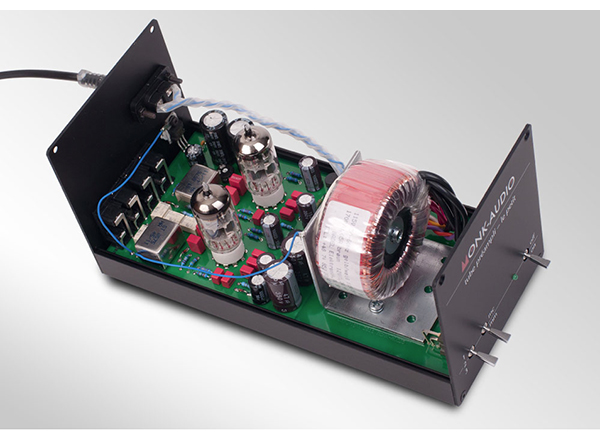
First Impression: Monk-Audio Tube Preampli-le petit

We were so impressed with the Monk-Audio three input phonostage that we’ve made it part of our permanent reference collection.

Their latest effort, labeled the “tube preampli-le petit, still features three inputs, though this time utilizes a pair of 12AX7 tubes instead of the solid-state construction of their larger model.  Gone is the ability to adjust gain, loading and EQ, but the pricetag is very attractive – about $1,300. With the cost of the EAR 834P ever increasing, this could very well be its replacement.

Initial listening with a Denon DL-103r cartridge mounted on an SME 309 tonearm with the AVID Ingenium turntable reveals, a lively, dynamic sound with a very low noise floor.  In the weeks to come, we’ll be trying a handful of MM and MC cartridges, and report back with a full review.

Stay tuned!

Funk Firm Little Super Deck

Things that reference hallucinogenic drugs tend to pique my interest.  And the Little Super Deck (or LSD) from the Funk Firm will indeed take you on a trip to vinyl bliss, doing so for a lot less money than you’d expect—$1,995 to be exact.

Our review unit arrived in a very THX 1138–esque shade of white, but the table is also available in black or red, or with a black top and wooden base.  You can also dress it up with a different colored Achromat for an extra $99.  Brian Tucker of Pro Audio Ltd., Funk Firm’s U.S. distributor, suggests using only the 3-mm Achromat, as the 5-mm version raises the arm too far for the correct vertical tracking angle to be established and bumps the arm up against the dust cover.  A standard felt mat, similar to the one on a Rega or Linn table, is included at no charge.

Dropping the stylus on the record is a revelation, pure and simple.  After a few long evenings of playing records until the wee hours, I still find myself shaking my head, wondering how this much performance can be had for two grand.  As I listen to the records from the large pile of my Music Matters Blue Note collection, it becomes clear that this table gets to the heart of the music—it’s a master of tone.  Whether I’m listening to Herbie Hancock or Lee Morgan, the LSD delivers acoustic instruments with a level of tonal body and contrast that I’m not used to from a $2,000 turntable.

Though the sky is the limit for turntables these days, the $2,000-to-$3,000 range has so many excellent choices, with the playing field being upset on a regular basis.  Rega, Clearaudio, AVID, VPI and Pro-Ject (just to name a few) all have strong offerings that provide a major improvement in performance over tables costing about half as much.  With so much competition at this level, it’s a pretty exciting time for analog lovers who have a bit of spending money but who don’t want a table costing as much as a new car.

Some Assembly Required

A cursory look at the LSD doesn’t arouse suspicion, meaning that it looks fairly generic from a distance.  Closer inspection reveals just how much engineering has gone into this little marvel.  The LSD does not provide the same plug-and-play install that a Rega deck does, and there isn’t much similarity between the LSD and a Rega beyond the glass platters.  And, unless you’ve got good mechanical aptitude and are fairly intuitive, have your dealer set this baby up.

Unfortunately, the instructions for the LSD, which requires a fair amount of unintuitive assembly, are somewhat dreadful.  I understand that the cost of printing a manual like the one that accompanies a pair of Sonus faber speakers is prohibitive for a $2,000 turntable, but a high-resolution PDF file showing some actual pictures of the damn thing during each stage of the setup process should be considered essential.  I’m not singling out Funk Firm here, though:  I’ve yet to read a great turntable setup manual.

The photo included in the manual does illustrate the three-pulley “vector” system, which uses two additional free-spinning pulleys, so that the drive belt goes around the platter in a triangular formation, minimizing the need for multiple motors.  This is an ingenious solution for a table at this price, and a further example of how over engineered this product is—not to mention he fact that this system provides tremendous benefits when reproducing stringed instruments, particularly the violin.  Keep in mind that this is the same system used in Funk Firm’s flagship table, as well as the company’s $4,500 upgrade to the Linn LP12.

Just to see if this was all marketing hype or not, I used a shorter belt, driving the platter only with the motor pulley (returning to the Jung Trio for the same violin passages).  While you might not notice the difference the pulleys make when listening to your favorite rock records, those loving acoustic music will really appreciate the additional pitch stability this setup provides.

The LSD features a DC motor, similar to what designer Arthur Khoubesserian introduced decades earlier with his highly successful Pink Triangle table, powered by a small wall wart.  You can change speeds between 33 and 45 rpm using the switch on the plinth, which is handy for those having large record collections.

Moving Right Along

Those who are Jedi master enough to assemble the LSD will be highly impressed with how it implements some of its features.  Funk Firm takes a unique approach (patent applied for) to setting the anti-skate, using a weight attached by fishing line to a sliding rod. This allows for ultra-fine tuning of the anti-skate force, which couldn’t be achieved by simply putting the loop in a rung marked in ¼-gram increments.

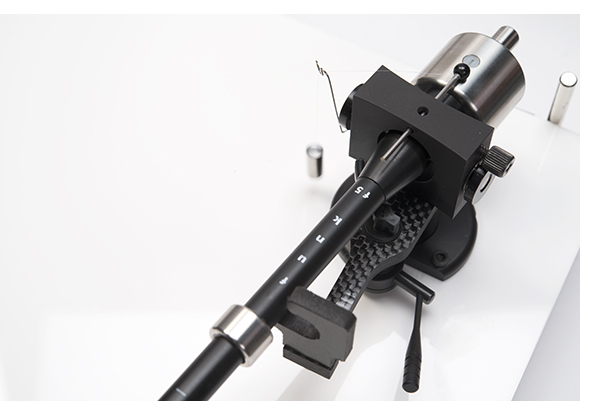
Funk Firm also has a unique way to set the tracking force:  Using a combination of an under-hung counterweight and a vertical-track-force slider, located right on the arm tube, allows for a better optimization of mass on the table than merely adjusting the weight on the back end of the tonearm.  You can slide the collar up towards the headshell to increase effective mass for your favorite MC cartridge, and slide it back for the opposite effect when using MM carts.

The single screw holding the headshell in place allows adjustment of overhang and azimuth, and it is also a little tricky.  Keep the screw snug but not tight while making minor adjustments, or this will drive you bonkers.

This worked perfectly with my favorite MM, a NOS Ortofon VMS 20 Mk II, and the Lyra Kleos MC.  Dialing in the mass optimizes each cartridge better and ultimately eliminates that “thin” feeling that seems to accompany most budget turntables.  On the other side of the spectrum, my standard-issue late-’80s LP12 sounds slow and out of time by comparison—it lacks the sheer jump and acceleration on musical transients that this table possesses.  Some of this can be attributed to the F5 arm using the same Swiss Abec 7 bearings that my $5,500 SME V arm does.

Because of the F5’s ability to extract information from the black grooves, mating it with a cartridge that costs 50 percent more than the table still makes sense—though a cartridge at this level is probably at the limit of what most LSD owners will consider purchasing.  Lyra’s more reasonably priced Delos ($1,695) is a super partner for the F5 and LSD, as is the $850 Dynavector DV-20X2 and the $1,195 Sumiko Blackbird.  I also had excellent results with the $379 Denon DL-103R cartridge; the variable mass aspect of the F5 tonearm really comes in handy with this classic cartridge.

A Great Pickup Arm, All by Itself

As the F5 pickup arm is available separately for $1,295, the LSD seems like the ideal upgrade for a Rega table.  And, as we just happen to have a pair of P3s on hand, it makes perfect sense to take one for a spin, mounting an Exact 2 on each table. Those of you possessing a P25, P3, or P5 and wanting a serious upgrade should seriously consider an F5—everything improves dramatically.  The arm (sold separately) features the newer, three-point Rega mount.  The one supplied with the LSD is compatible with older Rega tables, and the mounting plate is similar to those of AVID tables.

My P3, already equipped with a Groovetracer subplatter, is now somewhat of a “Frankentable” with the F5 installed, but it’s a blast.  Bass weight increases dramatically:  Going back to The Art of Noise’s Who’s Afraid of the Art of Noise? reveals bass that goes deeper and hits harder.  However, the biggest improvement is that of inner detail.

When listening to George Harrison’s guitar on “Taxman,” there is definitely more bite and decay compared to the standard Rega arm, and overall pace is improved, as well—no more cowbell required.  A similar effect is realized with “Eleanor Rigby,” in that the violins now have more separation and body, and less grain.

Finally, we gave the F5 a spin on the new AVID Ingenium, with similar results.  As good as the LSD is, the F5 is the star of the show.

It’s Like Buying a Pickup Arm and Getting a Free Turntable.

Putting the Funk Firm LSD through its paces with a handful of cartridges proves that this table is a steal for $2,000.  When compared to equally priced competitors from SME and Rega, the F5 pickup arm makes the LSD an even better bargain, with some innovative features that the competition doesn’t have.  But remember, this table will need a good dealer or good skills to set up properly.

But once it was setup, I could not find fault with the LSD, no matter what kind of music I listened to.  Going back to a few of the higher-dollar tables in my collection, I could see what I wasn’t getting in terms of dynamics and resolution, but the LSD combines it all so well, it won’t leave you wanting much more, no matter how good your system is.

The LSD strikes such a good equilibrium of basic, balanced aesthetics and the ability to reveal a lot of music that it may actually be a destination turntable for many analog aficionados.  Those stepping up from anything in the $500-to-$1,000 range will be shocked at how much music is lurking in their record collection.

And because of this, we are happy to award it one of our Exceptional Value Awards for 2013.

The Funk Firm’s Little Super Deck

MSRP:  $1,995

www.thefunkfirm.co.uk

How does he do it?

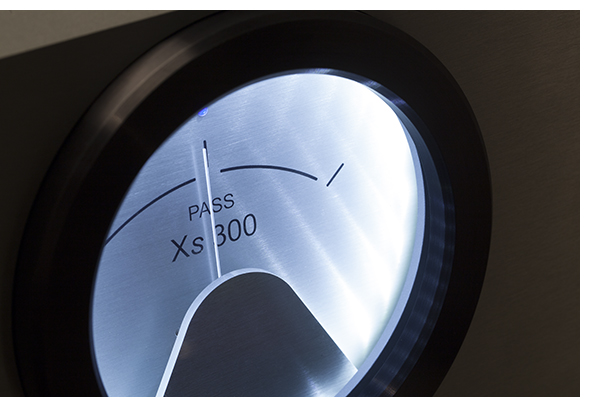
After listening to the D’Agostino Momentum stereo amplifier for a couple of weeks, with a variety of systems, I am convinced that this thing really does have some pixie dust of something from Area 51 under the hood.
It sounds like a class A amp, but it isn’t – it only uses 3 watts of power in standby mode!

Even connected to my Sonus faber Guarneri Evolution speakers, with a sensitivity of 86db, it’s tough to get those power meters (that look like a vintage watch dial) to budge much.  Even cranking Slayer doesn’t seem to make them move much.  Maybe that green light from inside is from Kryptonite.

I’m glad I’m not Superman.

But this amplifier is something special.  Watch for our review, on the horizon.

The Simaudio MOON 850P

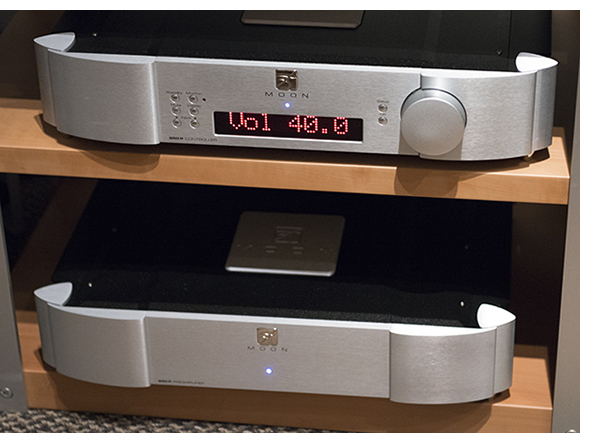
In issue #53, we reviewed the Simaudio Moon 880M monoblocks, that produce a staggering 800 watts per channel, with the delicacy and control of a small amplifier.
To make a long story short, the pair makes one of the best high power amplifiers we’ve ever heard at any price. To make a long story long, download #53 and read our review….

The matching flagship, MOON 850P preamplifier is equally stunning.  It’s two chassis design maximizes power supply design and minimizes noise, be it electrical or vibrational. It goes without question that the 850P and the 880Ms make quite a statement.

Stay tuned for issue #55, where we will have a full report.  But they are good. Oh, so very good.

In Progress: Review of the Pass Xs300 Monos…

After about three years, I’ve worked my way to the top of the Pass Labs food chain.
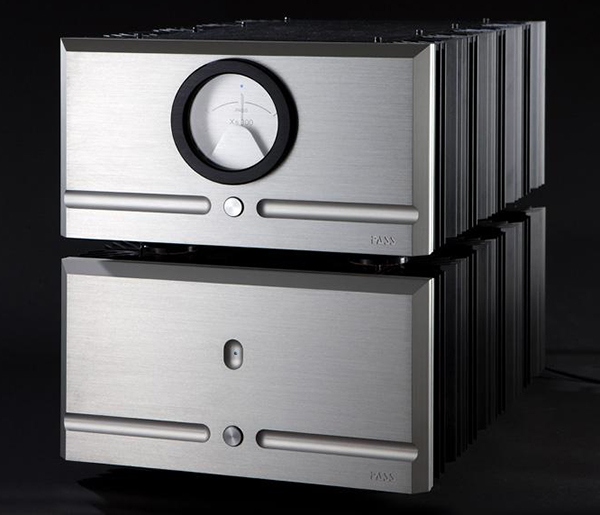
While the Xs 300 monoblocks are not for the faint of heart, or bicep for that matter, weighing in at about 300 pounds per side and costing about $40k per side, from the minute we unboxed them, it was apparent that these amplifiers were indeed one step beyond.  Having spent a year with the incredible XA200.5 that I just recently reviewed in issue #53, it seemed hard to believe that Pass could create two boxes that could reveal even more music.

It took four boxes.

Expanding the concept of Pass’ patented Supersymmetry amplifiers and the single ended, Class A design of the original Aleph, they have created a true masterpiece with the Xs300s.  As each channel draws 1000 watts of current per channel, all the time, I left them off on Earth Day, but they are back at full song today.  I walk to work, so my carbon footprint is still intact.

And what a better way to use electricity that these?

As we were taking the photos for the upcoming review, we hooked the first stack to the GamuT S9 speakers, and staff member Jerold O’Brien said, “Dude, your system sounds better in mono with one of these than it did with the pair of XA200.5s”  And the XA200.5s are no slouch.

Stay tuned for further adventures and our full review of the Xs300s.

Nelson Pass has created yet another masterpiece.

You can read more about the Xs300 here at the Pass Website.

Wyred4Sound mINT

Central California’s Wyred4Sound has taken the high end by storm with their extensive line of Class D based amplifiers, DAC’s, and music servers.
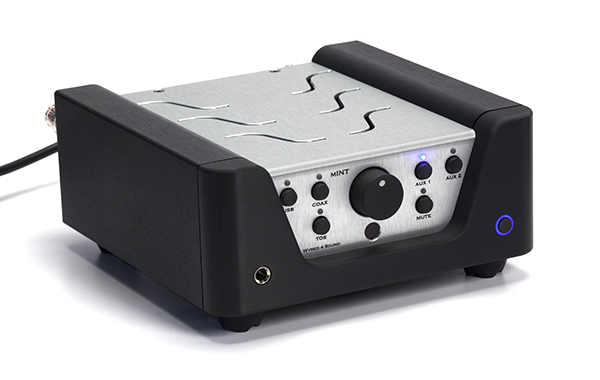
The Wyred4Sound mINT, short for Mini Integrated Amplifier ($1,499), is indeed a half sized component that interestingly, looks at once both retro and modern. The mINT boasts 100 wpc, and is a custom Class D design based on the ICE power modules. Wyred4Sound goes out of their way to stress the refinements found in the mINT that are usually regulated to much more expensive components. One aspect of the design they are especially proud of is the volume control. According to W4S, it is “a true-resistive ladder which results in linear control, excellent channel matching, and impressive sonic quality.”

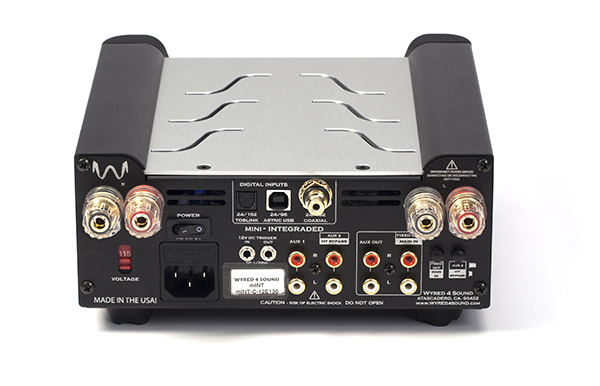
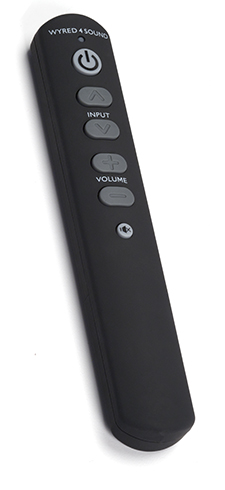
But wait, there is more. A lot more.  Along with two analog inputs, the mINT is also a three input DAC, with TosLink and Coaxial inputs that handle 24 bit, 192 Khz data. There is also an asynchronous USB input that handles up to 96 Khz. Rounding off the list of features is a fixed output for a recording device, a variable output, an HT bypass, and a very nice, full function attractive remote control. And, the mINT is fully designed and built in California.

Down to business

The mINT was paired with Harbeth Compact 7 ES3 and the Opera Mezza speakers, proving a wonderful match for both, with more than enough power to drive both speakers to their limits. To put it another way, my listening rooms suffered from overload well before the mINT could even break a sweat.

The mINT is equally capable when fed analog sources, like a CD player or a file streamer, offering a spacious, precise, and untarnished presentation that I find wonderfully balanced. If anything, the tonal presentation of this amplifier is slightly tilted to the warm side, unlike the Class D amplifiers of a few years ago, that offered great bass performance at the expense of a smooth top end.  That bleached feeling is no longer a line item with Class D, and certainly not the mINT.  It proves very nimble on top, balancing dynamic contrast with brass instruments, staying delicate and finessed on strings and vocals.

The three digital inputs work equally well, and performance is on par with many outboard DAC’s that are similarly priced.  Eliminating some of the extra buffers and gain stages required with separate components pays big dividends here, giving the mINT high performance at a very reasonable cost.  You could easily spend $1,499 on power cords and interconnects between a separate power amplifier, preamplifier and DAC, making this little marvel a major bargain. In addition, the mINT offers a headphone jack on the front panel, upping the fun and the value factor even further.
The relaxed tonality the mINT provides, makes it highly enjoyable across a wide range of musical genres.  The opening track of Imelda May’s Love Tattoo album, “Johnny Got a Boom Boom,” combines a fast, dynamic slap bass line, snare drum and cymbal crashes, combined with May’s sultry, often screaming vocals.  Legendary salsa singer Hector Lavoe’s La Vos provides more of the same.  Percolating with layers of bass, percussion, brass and heavily syncopated rhythms, the mINT never loses its cool, throwing a large soundstage.  The mINT does an excellent job keeping these densely packed, explosive recordings well sorted and three dimensional – a perfect torture test for any amplifier.

Digital functionality

Windows users will need to install the proper USB drivers form the Wyred4Sound Website, and Mac users can just plug and play, selecting the the mINT in their sound control panel. All in all, an easy task, no matter what platform you choose.

The internal DAC proves equally balanced and on par with the amplifier section of the mINT.  Tunes from my Windows 7 laptop using Jriver’s Media Center 18 and FLAC files were spacious and engaging. Emmylou Harris’ Hard Bargain for a wide range of bluesy folk tunes and instrumental dexterity again reveals the mINTs ability to unravel delicate tracks without getting overly grainy or “digital” sounding.

The only area that left me wanting was the USB input being limited to 24/96.  The S/PDIF and optical inputs claim full 24/192 resolution, so those purchasing tracks in this format will have to search for a good USB converter to take full advantage of the mINTs digital performance.

However, this type of digital input flexibility offers a world of convenience to those who have ripped their CD collections to a hard drive or purchase high resolution downloads.

The mINT is a clever package, and if this is an indication of the rest of their line, I look forward to hearing more from this company.  It offers enough resolution to show what a higher quality power cord can do as well as better interconnect and speaker cables – a great sign.  But more refinement will cost quite a bit more money, perhaps twice as much, making the mINT an excellent bargain.
Additional listening

The Wyred4Sound mINT is the perfect solution for music lovers wanting great sound that have a reasonable budget and want to maximize space, i.e. not have a giant rack full of audio gear. Its ability to work with analog and digital sources means you can keep your turntable in the mix, or add one if you’re curious.  Thanks to its tiny form factor, the mINT, a turntable and a compact phonostage can fit on a shelf or tabletop nicely. The Rega RP3, Exact cartridge and Naim StageLine phonostage make a perfect match for the mINT, combining to make a system any analog lover will enjoy.

Its 100-watt per channel power rating opens the door to a much wider range of speaker choices that many of the small, desktop integrateds from Naim, Rega and others don’t drive as easily with 25-50 watts per channel.  The mINT was even able to drive the Magnepan MMG to adequate volume, and thanks to the variable output can take advantage of a small powered subwoofer – again increasing versatility.

Having tried it with a number of great speakers at my disposal, my favorite, hands down was the pairing with the Sonus faber Venere 3.0 speakers reviewed in issue #54 of TONEAudio.  Their 90db sensitivity makes for house party volume when you need it and great dynamics the rest of the time.

Equally intriguing is the built in headphone amplifier.  Starting with the ultimate torture test, the HiFi Man HE-6, the mINT falls down a bit, but to its credit, so does just about everything else, no black marks here.  Moving to a suite of much easier phones to drive (Grado, Sennheiser and Denon) proves enlightening.  Decent control and tonal balance overall makes the mINT a great way to get into the headphone game. Rocking some headphone favorites, it throws a wide and deep soundstage with Pink Floyd’s Wish You Were Here, and Low’s The Invisible Way.

The Wyred4Sound mINT is easier to set up and listen to than it is to spell correctly.  For many, this will be a destination product, offering flexibility and performance unheard of five years ago.  We are happy to give the mINT one of our Exceptional Value Awards for 2013.  – Jeff Dorgay

The Wyred 4Sound mINT amplifier

MSRP: $1,495

www.wyred4sound.com

Associated Equipment:

Opera Mezza Loudspeakers

Harbeth Compact 7 ES3

Musical Fidelity CDT transport

Marantz NA7004 streamer/DAC

Darwin Cables silver interconnects

QED Genesis Silver Spiral speaker cables

QED digital cables

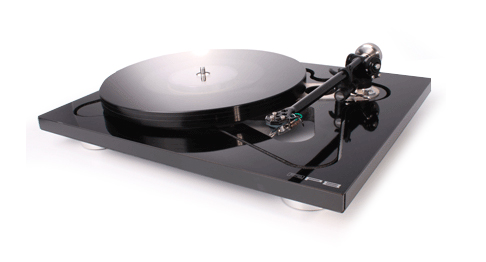
Rega RP8 Turntable

Five years ago, when visiting the Rega factory in the UK, I joined a group of Rega dealers to witness something very special at Rega founder Roy Gandy’s house.

A new skeletal plinth design that was supposed to be a step above the flagship P9, featuring a one off, ceramic platter and what appeared to be an RB1000 tonearm.  Needless to say the sound was fantastic and the following day, back at the factory, we saw more.  Gandy and staff were coy, referring to it as a “prototype,” and a “work in progress,” tempering our enthusiasm, telling us that “it could be out in a few months, a few years, or not at all.”  So, I returned to the States empty-handed, but I did learn how to play cricket.

But time flies when your having fun, and we now have the RP8, looking surprisingly like that prototype I saw years ago, but for a few minor changes.  And, on one level the RP8 is a pretty big jump forward for Rega.  They have always championed a low mass plinth design as the path to analog greatness and the website hints that “this is the first of the skeletal plinth designs.”

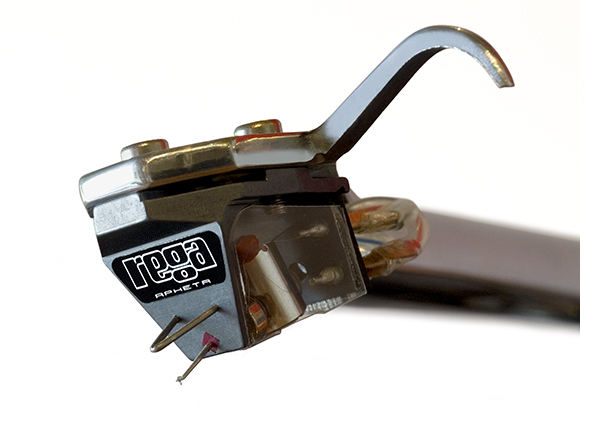
Featuring a new RB808 tonearm, which looks like a further refinement of the direction taken with the RB303 on the RP6 turntable, introduced last year, and also features new, lower capacitance tonearm cables, that look very audiophile-like in nature. The RP8 has an MSRP of $2,995, however US customers can purchase one with Rega’s $1,800 Apheta MC cartridge attached and set up for $3,995.  A major bargain, if you have the right phono stage.

The hub/subplatter features a machined aluminum cap, extending all the way down so the belts can contact the full surface. Rega claims that this, combined with the new tonearm provides for increased resolution, and the first record auditioned, Herbie Hancock’s Empyrean Isles brings a new perspective on this Blue Note classic, and illustrates a turntable, tonearm and cartridge all working together as a system.

One of the toughest things facing an analog enthusiast is getting this combination correct, so that the optimum trackability, resolution and stereo separation can be achieved.  Freddie Hubbard’s Coronet bleats out of the left channel, completely occupying the left half of the listening room, with the proper height and spatial relationships – is both beguiling and convincing. The drum kit is miked equally hard right, with Hancock on piano, gently floating in the middle, with Ron Carter’s bass keeping the bass on track, yet dissolved into the stereo image.

Quick Comparisons – up and down the range

Utilizing the Audio Research REF Phono 2SE, with two identical inputs and the ability to load both phono cartridges at the 50 ohms required for utmost HF smoothness (and honestly, my ARC SP11 mk.2, with it’s 30 ohm setting is pure bliss with the Apheta moving coil cartridge, but alas only one input) makes it a snap to compare the RP8 to both the RP6 and P9 to see just how much higher the bar has been raised.

The MoFi version of Aimee Mann’s Lost In Space underscores the improvements on two levels.  This densely layered record needs a first rate analog rig to lay bare all the intriguing textures and spatial cues, which the RP8 aces.  Perhaps even more intriguing is the LF performance of the RP8 – it’s very close to that of the P9.  If you haven’t experienced the P9, it’s not like the rest of the Rega range.   It possesses incredible weight and body.  The RP8 has a similar weighty feel, you almost don’t expect this kind of locked in bass response to come from a table that is the opposite of some of todays massive record players.

That machined aluminum subplatter pays another big dividend; much better pitch stability, and consequently revealing more low level detail.  Where Mann’s delicate voice wavers ever so slightly during “Guys Like Me” on the RP6, it is rock solid when switching to the RP8.  This doesn’t mean the RP6 is rubbish, you don’t notice the difference as easily until you play it right next to the RP8, and let’s face it, the RP8 costs twice as much.

The biggest surprise comes in a side-by-side comparison with the P9.  While the $5,000 P9 still has more LF weight and an even dreamier, more defined high end, the RP8 closes the gap tremendously, leaving this reviewer to wonder what Rega has on the horizon with the RP10.  An urge to spin the recent remaster of Devo’s Q: Are We Not Men? A: We Are Devo! Illustrates the huge soundstage the Apheta is capable, with synthesizers and special effects everywhere.  Moving up to the P9 offers an even bigger soundfield, yet pace and timing are equally enticing with both decks, yet the P9 takes the lead, with the opening, distorted bass line of “Mongoloid,” offering more grunt and more texture.

Ticking the necessary boxes

It wouldn’t be an audiophile review without some female vocals, eh?  The Low + Dirty Three In the Fishtank 7 LP seemed the perfect place to start, with it’s dreamy, ethereal vocals, fading way off into the distance of the soundstage on the opening track, “I Hear…Goodnight,” with Mimi Parkers gentle brushwork on the drums so faint, it would be lost on a budget rig.  This record also clearly illustrates the ease by which the Rega combo handles the violin – exquisite.

Going up in tempo to Me’Shell Ndegeocello’s Plantation Lullabies proves that the RP8 and Apheta can rock in a major way; Ndegeocello’s thunderous bass riffs command authority with this table and cartridge anchoring her sensuous vocals all the while.

We covered the Apheta in detail in issue 10 at it’s introduction.  In five years, it’s only gone up in price $300 and my opinion hasn’t changed.  This is a fantastic cartridge with a lightnening fast response, but it must be loaded properly or it will sound harsh and thin.  With comparisons to the RP6 and P9 out of the way, I could go back to in-depth listening through the ARC SP-11 mk.2, which has an incredible on board phono stage that just happens to have a loading setting of 30 ohms – perfection for the Apheta.

This allows the cartridge to have maximum dynamics, smoothing out the HF response at the same time.  Keith Richards “You Don’t Move Me,” From his Talk is Cheap album features great acoustic playing by the riff meister that hangs between the speakers.   Richard’s voice has never been his strong suit, yet it is rendered with plenty of body here.

Regardless of the program material chosen, the RP8/Apheta combination delivers the goods. Though you’ll save a few bucks should you choose an Exact 2 cartridge, if you have a phonostage up to the task, the extra $500 for the Apheta upgrade is the smartest $500 you’ll ever spend in the world of analog.

The nitty gritty

For those not familiar with Rega turntables and phono cartridges, they are the ultimate in simplicity, when it comes to setup.  The Apheta cartridge uses three screws instead of the usual two and this provides perfect alignment.  Your RP8 can arrive with the Apheta already installed, so all you need to do is five minutes of basic assembly (fit the belt, the platter and set tracking force/anti skate) Analog bliss is about 15 minutes away, if you’re really poking.

Personally, I love the skeletal plinth and as I have no children or furry creatures to threaten my analog world, I can bask in the RP8s high tech glory.  Those less fortunate, fear not.  The RP8 comes with a traditional plinth and dust cover that will protect it from the environment.  I could not discern any audible advantage or disadvantage to the extra hardware, but congratulate Rega for providing it.  My audiophile buddies were polarized, they either thought the RP8 was really cool, or tried to explain to me how it couldn’t work.

We could discuss techie bits in further detail, but you can read about that here, on Rega’s website.  Suffice to say they all work together brilliantly and the RP8/Apheta combination reveals more music than most in its class, if not all.  Mounting the Apheta on the VPI Classic 1 gives a warmer, slightly more bass heavy presentation, but it does not offer up the resolution that the RP8 does.  It’s like the difference between a Mini Cooper S and my Fiat Abarth.  You either prefer the more nimble ride of the Abarth or the somewhat more posh ride of the Cooper.  There’s no wrong choice.

However, if you want a high performance record player with next to zero fuss required, I can think of no better choice.

My Rega journey began with the Planar 3 in 1982, and somehow over thirty years later, I have the feeling it’s not over.  Roy Gandy and his crew are a clever group, and as long as they keep refining their turntables, there will be new vinyl adventures from this fine British company.  I’m very happy to award the RP8/Apheta combination one of our Exceptional Value Awards for 2013.

-Jeff Dorgay

The Rega RP8 Turntable

MSRP:  $2,995   ($3,995 bundled with Rega Apheta MC cartridge)

www.rega.co.uk (factory)

www.soundorg.com (US importer)

Peripherals

Cartridge Rega Apheta MC
Phonostage Audio Research REF Phono 2SE
Preamplifier Audio Research REF 5SE, Audio Research SP-11mk. 2
Power Amplifier Octave Jubilee Monoblocks
Speakers Sonus faber Guarneri Evolution
Cables Cardas Clear
Power IsoTek Super Titan
Accessories Furutech DeMag, DeStat, GIK acoustic treatments

Issue 54

Features

Old School:
The Thorens TD-125 Turntable

By Ken Kessler

995: Sounds that Won’t Break the Bank
The Lounge Audio Phonostage

By Jeff Dorgay

Macro: Sound for Small Spaces

Ferrari Cavallino T350 and Denon AH-D340 Phones
By Mike Liang

Bryston BHA-1 Headphone amplifier
By Jeff Dorgay

Tone Style

Single Malt Shootout:
Kirkland 20 vs. Macallan 18
By Bailey S. Barnard

Joey Roth Ceramic Speaker and Subwoofer
By Mark Marcantonio

Gumby Shot Glasses

Camera Lens Coffee Mug

Vicoustic Omega Wood Acoustic Panels

Tape Deck Stand

Music

Current Releases:

Fresh Releases in the Pop/Rock World
By the TONE Staff

Live Music:
Richard Thompson, Emmylou Harris & Rodney Crowell
By Bob Gendron

Low
By Jeff Dorgay

Audiophile Pressings

Jazz & Blues
By Jim Macnie

Previews

KEF Blade Speakers

Music First Audio Classic Preamplifier

Audio by Van Alstine Ultravalve Amplifier

Simaudio MOON 850P Preamplifier

From The Web:

AVID Pellar Phonostage

NewClear NC1000L Power Amplifier

Rega RP8 Turntable

Wyred 4 Sound mINT Integrated Amplifier

Reviews:

Sonus faber Venere 3.0 Speakers
By Rob Johnson

Polk Audio LSiM703 Speakers
By Andre Marc

Boulder 3050 Monoblocks
By Jeff Dorgay

Dynaudio XEO 3 Wireless Speakers
By Rob Johnson

Qualia Indigo Phonostage
By Jeff Dorgay

Paradigm Reference Signature 8 Speakers
By Jeff Dorgay

KEF R300 Bookshelf Speakers
By Jerold O’Brien

Slummin’

How about Record Store Month?

Seriously, how about it?

With so many vinyl enthusiasts, new and old excited about this event, Record Store Day is growing to the point where it’s becoming more exclusive than inclusive.  Here in Portland, Oregon, my favorite record store owner, Terry Currier, of Music Millennium told me that “the line around the building started at 10 last night.”

A few other stores I know echoed the same sentiment, receiving so many titles that they got two or three copies of that could have easily sold a 100 copies, possibly more. Another store owner, preferring to remain anonymous, was a bit more bleak. “The limited edition model worked better when people weren’t aware of vinyl – it helped to build enthusiasm.  Now that the demand is there, customers go away from the store crabby when they can’t get the RSD goodies.”

So how about it Record Companies?  While you might lose a buck or two, making a few less RSD collectibles, you’d make a lot more money and achieve a lot more good will if those of us that actually listen to the records we purchase could get our hands on it.  Maybe compromise with Record Store Week? It appears the demand is there.

A Three-Letter Word For Fun: MAD

If I had to make a bet, I’d put my money on the Brits taking the prize for understatement.
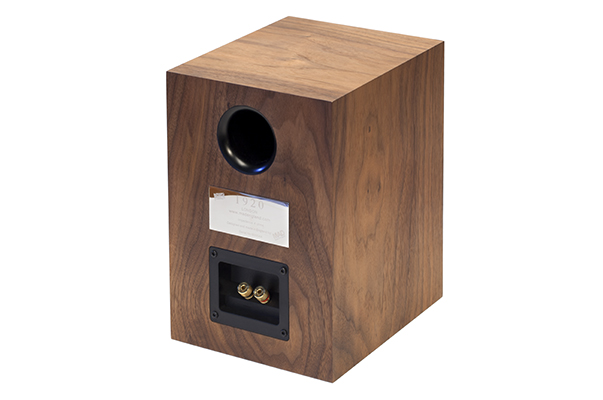
Unpacking the 1920 loudspeakers from British manufacturer MAD (for “My Audio Design”), it’s tough not to have an internal dialog that goes something like, “Two and a half grand for these?  They are mad!”  But, looking past the relatively simple-looking box speakers, one soon notices gorgeously mitered corners and an exceptional attention to detail paid on behalf of the craftsmen behind these.  Hmmm.  Some understated British artistry, perhaps?  I take the necessary photos and roll the speakers into listening room two, which, at 13 feet by 16 feet, is perhaps even a bit on the large side for a pair of small speakers—truly mini-monitors, in this case.  The next thought that comes to mind is “LS3/5a clone,” until I turn the speaker around and see a rear-facing port.

At $2,650 per pair, the 1920s are towards the high end of the price scale for this category.  Their obvious competitors are the KEF LS50 ($1,499/pair), which we haven’t reviewed yet; the Harbeth P3ESR ($2,200/pair); and the Stirling Broadcast LS3/5a V2 ($1,999/pair).  A mint pair of original LS3/5a speakers can command up to $2,000 per pair.  While the originals do have a certain vintage charm, they are notably woolly sounding in the world of 21st-century monitors.  Colleen Cardas Imports is handling US distribution and now has three dealers, with more on the way.

A mini-monitor, properly optimized in a small room, is one of audio’s guilty pleasures.  Paired with a great amplifier, these speakers will provide ample bass quantity and well-above-average bass quality, going a long way to convince you that you won’t ever need a subwoofer.  But don’t forgo good stands, as they are essential to getting the maximum output from the 1920s.  Just place these on a pair of high-mass stands (sand filled Sound Anchors are my choice) after applying your favorite sticky substance to couple the speakers to said stands, and expect to be wowed.

Jumping Right In

Auditioning the 1920s begins with the Zombies’ classic, “Time of the Season.”  What better way to audition a British speaker than with some of the best of the British Invasion?  Immediately, the spatial characteristics of these speakers reveal a massive soundstage in the small room, with things clearly delineated and with solid bass—and rock-solid pace.  The added dynamics of the original mono record is an absolute blast with these speakers.  Rod Argent’s keys leap from the speakers.  When mated to the Conrad Johnson MV-50C1 power amplifier, the 1920s confirm the manufacturer’s spec sheet:  These little speakers are incredibly easy to drive.  Even the 20-watt-per-channel Carver Black Magic amplifier has no problem playing these speakers to maddening levels.  (Pardon the pun.)

Ry Cooder’s light touch on the acoustic guitar at the beginning of “The Very Thing That Will Make You Rich (Makes Me Poor),” from the Bop Till You Drop album, hovers just above the speakers, with Cooder well out in front of them.  Cat Power’s “Nothin’ But Time,” from Sun, her current album, has a more modern feel, laden with weighty synth bass riffs, again allowing the 1920s to sound so much larger than they seem capable.  Closing your eyes to concentrate on the presentation, it’s easy to think you are listening to much bigger speakers, only to open your eyes and find this pair of tiny audio morsels before you.  An equally spacious presentation is had with Little Village’s “Don’t Think About Her When You’re Trying to Drive.”

Tonality + Dynamics = Bliss

The performance of the 1920s is especially excellent during playback of a slew of acoustic standards.  But, while the speakers are not as rolled-off sounding on the top end as either the Harbeths or the vintage LS3/5as on hand, they are not quite as extended as the Penaudio Cenya or Dynaudio Confidence C1 IIs that I have here for comparison.  (To be fair, the Cenyas and C1 IIs are considerably more expensive.)  With the 1920s, it’s a nice, gentle roll-off, which will not be noticed on all but the best audiophile recordings and that, more often than not, goes a long way at making digital files and budget solid-state amplifiers considerably more listenable.

The only time I found the tonal characteristic of the 1920s a bit too soft for my taste was when using certain vintage tube amplifiers.  With the Dynaco ST-70 or Harman Kardon A500 integrated amp, for example, even digital files come across as slightly dull.  But, having drawn that line in the sand, the combination of vintage tube amplification and 320-Kb/sec MP3 files sounds much better than it has a right to.

All things considered, the extra efficiency, slam and bass weight are what separate the MAD 1920s from their comparably priced brethren.  You won’t mistake these for a pair of floorstanders, but they open up and breathe so much more than the other small speakers we’ve experienced at this price level.  While the Harbeth and Stirlings both present a benign enough load to drive with a 20-watt amplifier, they are still rated in the range of 83 to 84 dB—which means that a low-power amp can’t deliver the dynamic peaks like it can with a speaker rated at 90 dB.

Crazy Imaging

If you are new to the small British monitor thing, the sonic image that the 1920s present will spoil almost everything else for you.  From the first tap of the hi-hat on the title track to Donovan’s Mellow Yellow, the term “pinpoint imaging” takes on a new meaning, especially if you dim the lights just a bit to keep your eyes from sending visual information to your brain that might otherwise distract processing power from your auditory nerves.  Donovan sounds as if he’s singing just in front of your face, with his overdubs floating in a sea of handclaps and horns.  And the separation between the flute and the oboe in “Jennifer, Juniper” is magnificent.

Maybe it’s the stunning imaging that these old studio records present, or perhaps it’s the strong British heritage thing, but I just kept going back for more British Invasion records to play on these speakers.  I swear I was having flashbacks during Donovan’s “Hurdy Gurdy Man.”  But then, a brief detour spent on a number of Duran Duran and Thompson Twins tracks from the ’80s transitioned me back to the 21st century—and it was still good.

On the deep-bass side of the musical universe, Dungen and Dr. Dre are both off the menu at all but modest levels.  You can only cheat physics so far, and the 1920s pull off a major sonic feat already.  But heavy rock and hip-hop are simply not a match for these speakers, should you really want to crank it up.  But I’m guessing that, if this stuff happens to be at the top of your music menu, you’re not looking at mini-monitors anyway.  To use an old audiophile cliché, the 1920s are mostly guilty of omission.  They remind me of a first-generation VW Golf GTI or Mazda MX5—they’re tons of fun to drive between 20 and 80 mph, which is where we’re stuck living most of the time.  But if you have a modest amplifier, a medium- to small-sized room and few pipe-organ records in your collection, you won’t even know what you’re missing.

Smart is the New Sexy

A quick visual once-over of the 1920s and you might just pass them by.  While the small box is well executed, these aren’t head-turners.  But inside it’s a completely different story—an abundance of high-grade audiophile parts lurk: ultra-pure silver internal wiring on the tweeter, plus point-to-point wiring with equally zooty copper wire.  Best of all, these are hand assembled in the UK, with all components hand tested and matched before the construction process begins.

Don’t think of the MAD 1920 as a clone of the LS3/5a, nor as an update or replacement for it.  It will just raise your dander.  But do pay close attention to them—they are sleepers.  And don’t let the understated box fool you.  These speakers are the new standard for small monitors.

The MAD 1920 loudspeakers

MSRP: £1,500   (US pricing, $2,650)

US Distributor:  Colleen Cardas Imports  www.colleencardasimports.com

Peripherals

Preamplifier                Burmster 011

Power Amplifier         Conrad Johnson MV-50C1, Pass Aleph 3, Carver Black Magic 20.

Analog Source             Rega RP6/Exact, SME 10/Sumiko Blackbird

Digital Source              Sooloos Control 15, Aurender S10, Light Harmonic DAC

Cable                           Cardas Clear

Accessories                 GIK Room Treatments, Audience aR6-TSS Power Line Conditioner, Furutech DeMag and DeStat, Audio Desk Systeme RCM

Acoustic Geometry helps the noise battle…

As part of an ongoing effort to help children and young adults get the best music education possible, Acoustic Geometry made a donation to the Brennan Rock & Roll Academy in Sioux Falls, SD, involving multiple Studio 3D Doors and Studio 6 Windows, the finest soundproof doors and windows available.
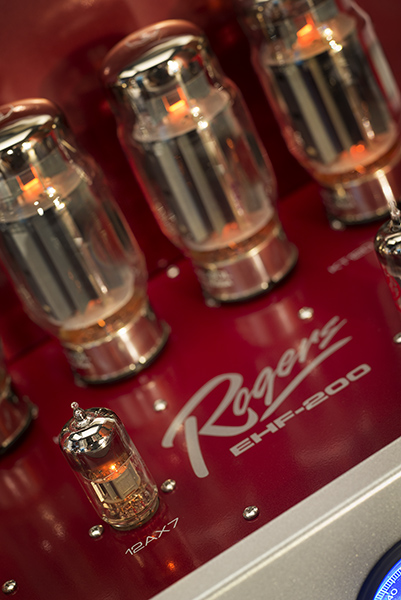
Each Studio 3D Door featured custom viewing windows as part of the package, and the Studio 6 Windows were custom-built to fit the live recording area in the Main Room of the Academy.

Brennan Rock & Roll Academy’s own Rock & Roll Ambassador/Designer Kory Van Sickle said: “These doors are amazing! They’re not only beautiful; they’re also super soundproof as proven during our Grand Opening week. Lots of really great and really loud rock bands performed (all personal friends of Mr. Brennan), and I couldn’t believe how quiet the practice rooms were when the doors were closed. They truly are works of art and I can’t say enough about how great everyone from Acoustic Geometry was to work with.”

Acoustic Geometry’s Retail Sales Director John Calder, who attended the Grand Opening, remarked on the new Academy: “For anyone who loves music, this is a truly welcoming environment for learning how to ‘play well with others’. The Brennan Academy team has done a wonderful job of engaging the community with state-of-the-art resources for the Boys and Girls Club in Sioux Falls – I haven’t seen a better learning space for music. And the “entertainment-biz royalty” – like Alice Cooper, Gene Simmons, George Lopez, Louie Anderson, Vince Neil and Night Ranger – who gave their time and talent to kick off the event, were terrific!”

Acoustic Geometry (http://www.acousticgeometry.com/), the retail brand of Acoustical Surfaces, Inc., works with community-based organizations like the Brennan Rock & Roll Academy (http://brennanrockandrollacademy.com/) to help advance music education.

Contact:

Acoustic Geometry

123 Columbia Court North

Chaska MN 55318

952-448-5300

Brennan Rock

Rogers: Tubed Excellence

It arrived just before I jumped on a plane for the NY Audio Show.  It’s big, red and beautiful.
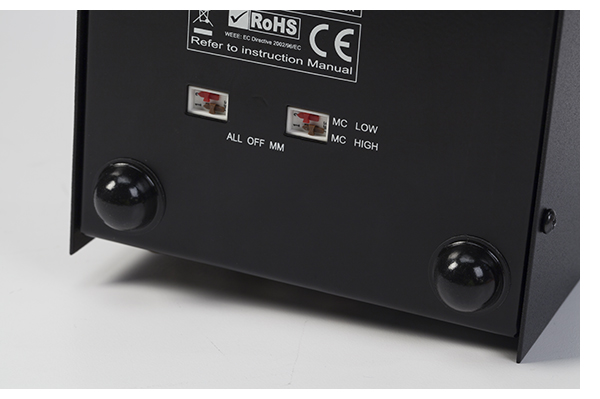
We’ve got the EHF-200MK2 integrated amplifier from Rogers High Fidelity here for a while and after hearing it at Stereo Exchange in New York this weekend, I’m anxious to put it through its paces with a wide variety of speakers.  Featuring a pair of KT120 output tubes per channel, this amplifier puts out 120 watts per channel in Ultralinear mode, but can be switched into triode mode as well.

The EHF-200MK2 is packaged like a piece of fine jewelry, homage to the luxury product it is.  The remote is gorgeous, the manual concise and easy to read – but best of all each one comes with a little note enclosed from the person who built it, adding a bit of humanity to the process. When I caught up with Roger Gibboni I thanked him for the extra car, but he said “We do that with every amplifier, we want people to know the care that goes into each one.” So, Trish, thank you very much for building this amplifier…

Stay tuned for our listening impressions and the world’s first review shortly.

Update: NYC Show

I certainly had a lovely time at this years HiFi Show in New York City…

Put on by the Chester Group, the same folks that sponsored last years show, things went incredibly smoothly for the UK based firm, considering they overcame a few major hurdles. First, there was a lot of hotel construction that was in progress, that no one expected during show week, when it was being organized almost a year ago, and there were a few water and power failures that necessitated some major jackhammering during the day on Saturday as well as some tenant evacuations on Sunday evening.  Yikes.

However, the show was not only well attended, it was a diverse crowd, perhaps the most diverse crowd I’ve seen at an audio show in the US.  Montreal and Munich do an excellent job at attracting kids and women to the party, but the US shows tend to be more often than not, a high percentage of beard tuggers.

It was nice to see a few groups of younger people, like the ones pictured in the VPI Industries room, not only grooving on the music, but asking to “turn it up…”  It was also nice to talk music and audio with some of our female readers and get their feedback on things.

The Chester Group and their US liasons, Sally Goff (formerly the face of McIntosh) and Christina Yuin (our director of sales) made an excellent effort to bring some seminars and events that were a lot more music centric, and wider ranging than I’ve seen in a long time.

SoundStageDirect and The SoundOrganisation, along with PMC Speakers contributed with their “Studio to You” series of lectures, bringing in some famous recording and mastering engineers, to discuss their part of the process.

And, speaking of music, this was the first show in memory that also did not consist primarily of audiophile standards. I did avoid a couple of rooms (still) playing “Keith Don’t Go,” but by and large, it was a much more musical show overall.  The Rutherford Group was rocking everything from Swedish House Mafia to Elvis on acetate, AudioArts NYC had a wide range of jazz, classical and blues, on vinyl, and Johan Coorg of KEF was a mixmaster – spanning a very wide range of music as well.

Rounding things out, Stereophile’s Michael Fremer was there, with his turntable setup seminar, and Art Dudley (also of Stereophile) and I held a spirited panel discussion about vintage hifi, which I am told by the folks at the Chester Group, had the highest attendance of all the seminars.

Again a thanks to the Chester Group for performing above and beyond the call of duty, and all of you that attended.  I hope to see you again next year.

For those of you craving more room by room coverage, stop by Stereophile’s website, where they have done their usual concise job.

AVID Pellar Phonostage

AVID, a Kimbolton, UK-based firm has been turning out some mighty impressive turntables for more than a decade now, and their recent pursuit of phono preamplifier designs, equally so.

AVID’s mission statement is simply this: “The truth, nothing more, nothing less.”  Of course, the “truth” is one of the most elusive subjects in the audio world. Is it the sonic realism of a live performance, the accurate reproduction of a studio master tape or something else? If beauty lies in the eye of the beholder, then audio truth resides in the ear of the listener.  From my perspective, audio truth is told when the essence of a recording, good, bad or indifferent, is revealed without additions or subtractions. Having lived with many (and I mean many) phonostages at widely ranging price points, I now investigate the baby of the AVID family, and see how much truth the Pellar serves up.

AVID: A Very Interesting Design.

Before getting the Pellar phonostage into my system, a look under the hood reveals a straightforward, unbalanced circuit, and high quality parts on the circuit board of this all solid-state design.  The compact chassis (2.75” (H) x 4” (W) x 9” (D)] has a single power switch on the front panel and is a rather solid little brick, weighing 3.5 pounds.  The rear panel has a power cord receptacle, stereo RCA outputs, and a tandem of RCA inputs, with the upper pair of RCA jacks used for impedance loading, much like the Naim Superline does.

The Pellar arrives with two 500 Ohm RCA plugs for this purpose, and this should work with a wide range of phono cartridges. Other values are available on request, or you can make your own. The default impedance without the plugs installed is 47K ohms. The turntable is connected to the Pellar via the lower set of inputs. Gain can be easily adjusted by sliding a pair of dipswitches from 40 dB (adequate for most MM cartridges) to 60 dB or 70 dB (adequate for most lower output MC cartridges).  Considering the complexity of many high-end phonostages, the Pellar is simplicity itself, resulting in a very quick unbox to enjoy music time.

Staging the Phonostage

Since the Pellar is billed as AVID’s entry level phonostage at $1,149 (the top-of-the-heap two-box Pulsare II will set you back $7,000), I mated it with my modified VPI Aries with outboard flywheel and JMW 10.5i tonearm.  For this review, I alternated two stereo MC cartridges, the higher output Clearaudio Stradivari (0.8 mv @ 5 cm/sec) and the low output Dynavector DV-20×2 (0.3 mv @ 5 cm/sec).  A Benz Micro Ruby 3H (0.7 mv @ 5 cm/sec) handled the mono LPs.   After a  48 hour power up, serious listening began in earnest.

Retrieval of detail is a good measure of a phonostage’s noise floor. Simply put, the lower the noise floor the more detail you get from the grooves.  Sheila, an intimate duet between jazz vocalist Sheila Jordan and bassist Arild Andersen (SteepleChase), is an easy way to evaluate this aspect of phonostage performance.  The proof in the pudding is hearing Sheila’s husky voice move toward and away from the mike and catching the short breaths that she takes between phrases. Meanwhile, you should also hear the varying harmonics of Andersen’s finger work on his bass.  The Pellar does a fantastic job on musical fundamentals.

Ry Cooder’s Jazz, an unabashed homage to ragtime and Dixieland music is a great example of a studio recording not victim of excess tweaking and one with with great recreation of voice and each of the small group of instruments involved. The opening track “Big Bad Bill (Is Sweet William Now) clearly illustrates the Pellar’s ability to keep the vocals on track with all of the horns spread out across the soundstage, giving the illusion of these players in the room.

Encouraged by the ease at which the Pellar handled this favorite, the big stuff was next.  The classic recording of the Verdi Requiem with Sir Georg Solti leading a fabulous quartet of soloists, the Musikverein chorus  and the Vienna Philharmonic Orchestra proved another excellent challenge that the Pellar aced.  The Decca tonmeisters have always known how to get the most out of a huge surge of orchestral and vocal music.  The Pellar never feels overwhelmed with “Kyrie” section, one of the most dynamic choral passages ever written – a tough challenge for any analog front end.

If I had to pick one mono LP to demonstrate how good a phonostage can make mono records sound, it would be the 45 RPM reissue of Ella and Louis (Analogue Productions). Not a dud cut on the record and what presence Ella Fitzgerald and Louis Armstrong have! The Pellar mated to the Benz Micro Ruby 3H gets me very close to the vocal cords of these two jazz legends, and excited

What Do You Get For A G-Note?

Occasionally one of my audio buddies will ask me, “hey, I’m getting back into analog, so how much should I spend on a phonostage?” The Pellar’s resolving power and soundstage recreation might not reach the highest sound realms of my reference Pass XP-25 (to be had at ten times the price!) but it does provide a genuine peek at what audio heaven sounds like.  You get a lot of what the audio in-crowd venerates with enough coin left over to buy… a whole bunch of vinyl records. The AVID Pellar becomes my definite contender for one of the audio bargains of the year and an easy, suggestion for a friend who wants to rediscover the magic residing in those black vinyl grooves, that won’t break the bank.   – Lawrence Devoe

Second Listen:

Having spent a fair amount of time with both of AVID’s more expensive phono stages, the Pulsus and the first generation Pulsare, there is definitely a family resemblance here.  All three phonostages have a similar sound: a natural tonal balance with good dynamics and a low noise floor.  Much like the AVID turntables, each phonostage in the range has increasingly more dynamic punch, low level detail and low frequency heft.

That being said, the Pellar is remarkably good for $1,149.  I gave it a spin with a few of the tables in my stable here, the Linn LP-12/Shure V15 mxvr and the AVID Ingenium/SME 309/Ortofon 2M Black, both a good fit for the MM side of the equation.  As for MC, the Pellar works phenomenally well with the $379 Denon 103DL.  Combined with the Ingenium, this is a tough combination to beat for a prudent audiophile.  You will need to get 100-ohm loading plugs or get out the soldering iron, however.

Perhaps the best part of owning the AVID Pellar is that you can just turn it on, forget about it, and enjoy your vinyl collection, no matter what turntable you have.   Highly recommended.   -Jeff Dorgay

AVID Pellar Phono Preamplifier

MSRP: $1,149 (USD)

Manufacturer: AVID HIFI

Contact: www.avidhifi.co.uk (UK and Europe)
www.musicdirect.com (US)

PERIPHERALS

  • Preamplifier: Pass Labs X-30
  • Amplifier: Pass Labs XA-100.5
  • Speakers: Martin Logan CLX
  • Power Conditioner: Running Springs Audio Dmitri, Maxim
  • Cables: Nordost Valhalla, Odin
  • Power Cords: Nordost Valhalla, Odin

Sonus faber Guarneri Evolution

It’s as if Sonus faber put the $120,000 Aida speakers in a shrink machine…

Finished to the same high standard as their flagship speakers, the new Sonus faber Guareri Evolution speakers retail for $22,000 per pair with the matching Evolution floor stands.  You can delete them and save $2,000, but you’ll never find a stand this inert or this beautiful, so just order both.

Our review pair arrives in the dark grey “Graffit” finish and is beautifully hand polished to a glass – like surface, as is the shiny nickel plated top and bottom plates.  But best of all, these speakers sound better than they look.  Not a pair of mere mini monitors, these are a world class speaker system, perhaps better suited to our readers that want cost no object sound, but don’t have a 20 x 30 foot listening room.

They are currently mated to a Burmester 011 preamplifier, Aesthetix Rhea phonostage, and the SME10 turntable, with Sumiko’s Palo Santos Presentation phono cartridge.  To say we’re in analog heaven would be an understatement.  Power is via the highly capable Burmester 911 mk. 2 power amplifier, capable of 350 watts per channel into 4 ohms, the impedance of the Evos.

You can read more about the Evos here…

Or better yet, head down to your Sonus faber dealer and experience them for yourself.

NewClear NC1000

While vacuum tube and solid-state amplifiers continue to improve, the gains have been for the most part evolutionary rather than revolutionary at this stage of the game.

Class D amplifiers are a whole different game – much like the introduction of the compact disc, early efforts were harsh and highly unmusical.  But Class D has matured.  Perhaps not into the voluptuous shape of a pair of giant VTL or ARC monoblocks, but not the skinny runway models they used to be.

The NC1000L is a dual mono design, built around the latest ICE Power modules and is essentially two power supplies and two separate mono amplifiers sharing the same chassis.  It features balanced XLR and single ended RCA inputs, both going in via a pair of high quality Lundahl transformers. The NC1000L delivers 501 watts into an 8-ohm load and doubles that into 4 ohms.  Magnepan lovers, this amplifier is your new best friend.  And that’s exactly where I began this review, with my Magnepan 1.7s.  This amplifier’s enormous power reserves light up these wonderful, but power hungry speakers – giving them a true semblance of dynamics, even playing fairly heavy rock.  Led Zeppelin’s “No Quarter” never sounded better on the 1.7s.

Oodles of power

Many say the “first watt” is the most important, however I feel they are all important.  I also prefer a lot of power to not so much.  There are a number of classic low power amplifiers, all of which have a tonal magic about them: the Wavac EC-300, the Pass Aleph 3, the McIntosh MC-30, etc., etc.  And as much fun as they’ve been at very low levels, if you don’t have efficient speakers, those amps run out of steam fast. Ultimately, dynamics are just as important as tonal accuracy, or any of the audiophile parameters that try to convince us that we are hearing reality through our stereo systems – even with music that you don’t think demands it.

Low powered amplifiers are always fun to take for a spin, but I always go back to high power at the end of the day, and the NC1000L delivers the goods.  I mentioned Magnepans at the beginning of the review, and after about a month with both the 1.7 and 3.7, unless you are going to drop upwards of $15k on an amplifier, the NC1000L is the amplifier for you – at an introductory price of $2,600.

We can argue the merits of a “dealer direct” product versus one sold through normal distribution channels and whether a $2,600 amplifier sold this way really needs to be compared to a $5,000 amplifier sold with the costs of distribution attached to be fair.  No problem.  The NC1000L stands up handily to everything we’ve heard in this price category. It doesn’t have the sweetness of say, a McIntosh MC275, but you can’t drive a pair of inefficient speakers with an MC275 either. No disrespect intended to either manufacturer, the amount of clean power available with the NC1000L easily justifies its price.  With this much power on tap, I could not play the NC1000L loud enough (without risk of brain damage) to explore the boundaries of their claimed “graceful rounded waveforms at clipping.”

Under the hood

Popping the top of the thick, 14-gauge chassis and thick front panel reveals a tidy layout.  Each amplifier has it’s own separate board, with power supply and ICE module self contained.  The layout is tidy, and my only concern for sonic degradation over time is the screw terminals used to bring in power an input signal.  However, I have seen this approach taken in much more expensive amplifiers and speakers, some ten times the cost of this amplifier.

The NC1000L doesn’t take long to settle into a groove – it doesn’t need hundreds of hours to sound its best. The slight bit of solid-state haze at initial power up vanishes after about three days of 24/7 operation at modest volume.  Its miserly 28 watt current draw at idle lends itself to leave powered up continuously without guilt.

A real pleasure

Thanks to the NC1000Ls balanced XLR and single ended RCA inputs, it will work with whatever linestage or preamplifier you have handy.  After trying about ten different examples from my recently rebuilt Conrad Johnson PV-12 up to the $60,000 Indigo Qualia linestage, the NC1000 merely revealed the character of what was in front of it, with plenty of resolution to discern the differences between front end components with ease.

The NCl000L does fall short of spendier competitors is resolving last bit of detail in the upper registers, but this is not a fair comparison.  Auditioning similarly priced products in the 50-100 watt per channel range, the NC1000L is without peer.  The presentation is very neutral and if like, me you desire a bit more warmth or romance, you can always mate the NC1000L with your favorite tube preamplifier and season to taste.  I did just that with my vintage Conrad Johnson PV-12 (recently rebuilt by the CJ factory with a full compliment of CJD Teflon caps, so it’s not that vintage sounding) and was in affordable hifi heaven.  Man I wish I could have had this amplifier back in the days of my Magnepan Tympanis or Acoustat 2+2s!

This amplifier throws a very wide soundstage, thanks in part to it’s dual mono design, with well delineated imaging, but again not quite as much front to back depth as something with vacuum tubes in the circuit, yet low level detail is excellent.  Listening to the title track on Joni Mitchell’s The Hissing of Summer Lawns is fantastic, with the gentle percussion bits floating well outside of the speakers with Mitchell’s multi-layered vocals well separate from the bass line anchoring the tune.

Timbral complexity is also well represented, as Mitchell gets a bit shrieky on “Shadows and Light.”  This is a track that can deteriorate into a ball of midrange on an amplifier unable to handle complex passages.  The NC1000 does an equally good job with the violin, reproducing this delicate image with aplomb.

The NC1000s ability to drive speakers with a low impedance or a complex load is better than any Class D amplifier we’ve yet sampled, where many early Class D designs were more like an SET amplifier with many speakers, horribly rolling off the top end when the match was less than stellar.  The B&W 802 Diamond speakers always prove tough for the Class D amps we’ve reviewed in the past, but he NC1000L passes with flying colors.  There really was no speaker at our disposal that was problematic for this amplifier.

As with many ICE powered designs, the NC1000L excels at the low frequency part of the audio spectrum. Cranking up Bassnectar’s “Boomerang” with the 802 Diamonds felt like a subwoofer was added to the system now offering a serious punch to the chest at high volume levels.  Ditto with Prince’s “Billy Jack Bitch.”  And of course, the heartbeat at the beginning of Dark Side of the Moon was pretty cool too.  The massive power is well controlled, giving bass instruments a natural response that does not sound overdamped.

Speaking of cool, the NC1000 stays nice and cool, even when pushed to punishing SPL levels, and under normal operation, shouldn’t use much more electricity than a light bulb.

Nod to the new guys

If the market is an indicator, it will be tough for the crew at NewClear to keep building these amplifiers for this price forever.  Other manufactures have done incredibly well with the factory direct approach, and considering this amplifier is so underpriced at this point, our hope is that as NewClear grows and has to amortize those costs, this amplifier will still be a solid product.  But for now, this understated black box has to be one of the year’s best bargains.  If 500 watts per channel sounds like your way to party, get in on the ground floor.

The NC1000 does its job simply and effortlessly, serving the music all the while.  It easily earns one of our Exceptional Value Awards for 2013.

The NewClear NC1000 power amplifier

MSRP:  $2,600

www.newclearaudio.com

Peripherals

Analog Source             AVID Volvere/SME V/Sumiko Palo Santos Presentation

Digital Source              dCS Paganini, Sooloos Control 15

Preamplifiers               Conrad Johnson PV-12, ARC REF5SE, Burmester 011

Phonostage                  Simaudio MOON LP810

Speakers                      Magnepan 1.7 & 3.7, GamuT S9, Dynaudio Confidence C1 II, B&W 802D

Cable                           Cardas Clear

KEF and Matrix Sound & Vision Present Fabrizio Sotti

KEF, the renowned manufacturer of innovative, reference-quality loudspeakers, will celebrate its participation in the New York Audio Show 2013 by hosting a special evening with lauded Italian jazz guitarist and music producer/songwriter Fabrizio Sotti on Friday, April 12.

Sponsored by New York-based Matrix Sound & Vision, the event featuring Sotti will be held from 9-10 p.m. ET at the New York Palace Hotel in Hubbard II Room.

Sotti, who has collaborated with an impressive range of artists from all genres, including Cassandra Wilson, Q-Tip, the late Whitney Houston and many others, will treat attendees with a special free performance to celebrate the upcoming release of Right Now, Sotti’s latest album which was mixed and mastered using KEF’s LS50 Mini Monitor Loudspeakers.

During the evening presented by KEF and Matrix Sound & Vision, Sotti will bring together musicians from around the world to treat attendees to a sampling of new tracks from Right Now and other works. Shareese Ballard, better known as Res, will accompany Sotti with her beautiful combination of soul, rock and Indie pop vocals. Also performing alongside Sotti will be accomplished bassist Tony Grey and internationally renowned drummer Francisco Mela.

The LS50s helped Sotti and an exciting and unexpected ensemble of guest on Right Now deliver a truly unique mix of original songs and covers of timeless classic songs, like an interpretation of “The Wall” featuring Ice-T, M-1 of Dead Prez and Res.

To attend the event, which will include an open bar, show attendees must stop by the KEF suite (No. 926) at the show to pick up a free pass. There, attendees will have the luxury of experiencing first-hand how the LS50 delivers a rich, multi-dimensional soundstage for the ultimate studio experience—even in the smallest of spaces.

KEF will also present attendees to the New York Audio Show with the opportunity to demo the new X300A, a premium powered loudspeaker system developed to offer the highest resolution digital music reproduction from a PC/MAC desktop or laptop computer via distortion-free USB input, as well as the legendary KEF Reference 207/2 and KEF R Series.  You can read the world’s first review of the X300A here.

For more information on KEF, please visit http://www.kef.com.

Emotiva XDA-2 Review

John Darko from Digital Audio Review takes an in-depth look and listen at Emotiva’s latest DAC/digital preamp, the XDA-2…

My first slice of Emotiva DAC coverage appeared nearly two years ago. In 2011, I found the XDA-1 to be a bit of a bargain – US$399 for a (then) better-than-average sound atop a killer feature set: remote controllable digital pre-amp with balance outputs. Back then, very few DACs in the shallow end of the budget market could compete with such a high value proposition. More crucially, the XDA-1 offered a sound that didn’t screech or scratch its nails down the chalkboard despite being solid with detail dig and widescreen musical staging.  After teasing with 12 months of trade show demos, the XDA-2 (US$399) finally drops.

Please click here to read the rest of his review:

The Virtue of Vintage

If you happen to be at the New York Audio show this weekend, please stop by and sniff around.

And, if you feel so inclined, I invite you to sit in on “The Virtue of Vintage,” a presentation Stereophile’s Art Dudley and I are putting on at  11am on Saturday.

Art’s tales of restoration have certainly inspired me over the years, so it’s an honor to be sharing the stage with him.  He’s invited some other vintage restoration experts, who will help you walk through the joys of using some of the best of audio’s past.

We look forward to seeing you there!

The latest from Plinius…

We’ve just received a pair of Plinius Audio’s newest separates, and they are quite impressive.

The Hautonga Integrated amplifier features a 200 watt per channel class AB power amplifier, preamplifier and phono stage on board for $5,750 and the Tiki digital music player offers full streaming capabilities from a NAS for $4,750. This device has a network input only and is not meant as a standalone DAC.

Built to the same quality level of Plinius’ top reference components, the Hautonga and the Tiki both offer top performance and functionality in a somewhat compact package. They are available in silver or black and you can read more about Plinius here….

So far, the sound quality is exquisite and the Tiki very easy to use.  We’ll have a full report in Issue 55.

Rega RP9 and Apheta Cartridge

This is a review from way back, issue 10 to be exact.  But, as we are just getting our hands on the current RP8, it might be interesting for some of you to revisit our thoughts on the P9 and the excellent Apheta phono cartridge.

We usually review cartridges as separate items, but because this is Rega’s first moving coil cartridge (and it has been in development for a few years)designed to mate perfectly with a Rega arm, especially their flagship RB1000 arm featured here on the P9, a joint review it is.

In case you are not familiar with this turntable and cartridge, the P9 has a suggested retail of $4495 and the Apheta Moving Coil cartridge is $1695.  The accessory Tungsten counterweight is an additional $100.  This is definitely a serious turntable, folks.  Rega has been steadily moving upmarket with their P5 and P7 models, which are great turntables in their own right, but the P9 is the flagship and having spent time with both of them I feel that the P9 is really in a class all its own. (Ed. Note: These are now $4,995 and $1,995 respectively and the P9 has just been discontinued)

I enjoy Regas understated elegance.  If you want a big, bulky turntable, that screams “dig me”, the P9 is not going to be your cup of tea.  At first glance the P9 looks like a P25 with a larger wood base, but that would be missing the boat. Don’t let the subtle styling fool you; a peek under the traditional felt mat reveals a high tech ceramic platter, with a machined sub platter beneath.  The plastic part in the P3 and P25 is gone.

Cast your glance aside to the RB1000 tonearm.  According to Rega, it takes one technician as much time to hand assemble and adjust an RB1000 arm as it does to make 30 RB300’s and it shows the first time you pick that tonearm and set it down on a record.  Definitely a work of art.

And the idea that Rega has a moving coil cartridge, is also pretty exciting.  Designed from the ground up, they have eliminated the tie wire and foam damper found in conventional moving coil designs.  The result is indeed, very clean sounding with a tremendous amount of detail on tap.  As much as I like the sound, I love the clear body, allowing you a peek inside, a nice touch!­  A more in-depth technical analysis of the new arm and power supply, can be found on the Rega website.
Thanks to a power supply that is the same size as a Rega integrated amplifier, you no longer have to pop that platter and move the belt on the pulley to get 45rpm playback.  Just plug in the umbilical cord, turn it on and choose the speed you want.

I can’t imagine that there is anyone out there who hasn’t heard of Rega, or even owned one at one point in time.  My guess is if you did, it was probably a P2 or P3.  Aside from the Linn LP-12, the Rega P3 is probably one of the best selling turntables in history; certainly if we are talking about belt drive tables.  (NO Surly emails from Technics SL-1200 owners!!)

Like anything that has been around for a long time, there are a number of misconceptions, urban myths and other bits of misinformation floating around.  So let’s get the BS out of the way and clear the air.  Here are the Rega myths exposed and explained once and for all:

Rega turntables don’t have good speed accuracy, they tend to play a little fast.

Way back in the beginning of the companies tenure, some of their tables did play a smidge fast but that has not been an issue for many years now.  The engineering staff at Rega has painstakingly worked to rid themselves of this problem and they are so particular, they actually measure speed with a record playing to take the drag from tracking a groove into account.

Even with the P1, this issue is LONG a thing of the past and our review sample has perfect speed accuracy.  A new belt solved the slight speed issue with my own P25, so check this first if you are having an issue on an older table.  Most turntable manufacturers suggest changing the belt yearly or at least every other year.

Rega turntables don’t have deep bass, they sound a little thin.

This one is a matter of personal taste.  I have always found the P2, P3 and P25 to have more of a “fast” sound compared to other tables in its price range, with fantastic detail retrieval and smooth midrange.  One mans fast is another mans thin.  In all fairness, my bias is towards minimonitors and panel speakers so I’m not a big bass freak to begin with.  However even on a full range system, Rega tables have always come across as well balanced and bass has never been an issue.  Perhaps those complaining of thin bass response did not have the VTA set correct – this can be an issue with other manufacturers cartridges, but easy to remedy.

You can’t adjust VTA on a Rega and hence can’t use other manufacturers cartridges very easy.

Again, not true.  Granted, it’s not as easy to adjust the VTA on a Rega table as it is on an SME, but should you decide that you would like a cartridge other than Rega (which have a 14mm stylus to top of the cartridge body distance) there are a few options.  You can use one of the aftermarket VTA adjustment devices or if you measure this distance on your cartridge, chances one of Rega’s tonearm shims will do the trick.  They now have these available for the RB250/300/600 arms as well as the RB700/900/1000 arms and you can just order whatever combination you require from your dealer in 2, 4 or 10mm thicknesses.

That felt mat drives me nuts, I’ve had way better luck with (insert mat of the week here)…

Just shut up and use the felt mat.  It works just fine, especially when you are spinning a lot of records in a listening session.  You can just leave the platter spin and change records, fantastic! Let’s get back to the job at hand and talk about the P9. Right.

Initial setup

The P9 arrived with the new Apheta moving coil cartridge installed, but it can be set up in a jiffy yourself, should the need arise, thanks to Regas three point mounting system.  Attach the wires, insert the screws and you are good to go!  No adjustments to make, just tracking force (1.75g) and Anti-skate; not quite as easy as putting a CD in the drawer, but the easiest turntable setup you’ll ever experience.  Five minutes and you will be playing records!  I dare you to accomplish that with any other $6000 record player.

Loading is the secret to making the Apeheta sing.  At least 100 ohms, 50-75 if you can and a touch lower if you’ve got it.  If you only have a 1000 ohm setting on your phono stage, there is a high probability that you will find the Apheta bright.  Anything higher than that and you will definitely find it bright and possibly way too bright.

Setting the Modwright 9.0 SWLP to 50 ohms and the BAT VK-10SE  at 33 ohms was perfect.  Down here, the cartridge can still breathe and the top end is smoothed out very nicely.  All of my serious listening was spent with the ModWright, because I felt that this was a good match financially as well – a $3k phono stage is probably a more realistic combination for a $6k turntable than a 7k phono stage.  However, the P9/Apheta combination has enough resolution to justify it, should you decide to go there.

A great first impression

Often times, first impressions really do stick with you and getting the P9 out of the box was quite a surprise.  I was very impressed with the table right away, with the P9 offering a much bigger and more powerful presentations than past Regas I’ve listened to.  If you were on the bubble and in the “Rega tables sound a bit thin” camp, you can flush that misconception down the toilet.  The P9 has a very authoritative presentation, especially in the lower registers.

The first record I put on that familiar felt mat was Patti Smiths Trampin’.  The first song on side two, Cartwheels has some very deep bass riffs that were reproduced with the usual Rega texture but a lot more weight than I’m used to.  The next cut, Ghandi has a lot of air and some very tasty drum fills over the top of some very strong bass parts too.  What the P9/Apheta combination excelled at was keeping everything placed about the soundstage, without losing focus or grip.  Some cartridges I have heard in this price range get mushy when the music gets texturally complex, but not the Apheta.

This is when you know that you are listening to first class analog, the sense of air and texture is there along with plenty of detail, yet lacking in grain.  The more I listened, the more I was impressed with the Apheta cartridge and marveled at how it had a speed, extension and clarity that I would normally associate with CD, yet with the smoothness I would expect from analog.  Quite anomalous behavior from a company that didn’t even start making digital products until recently.

And their top of the line digital player has an amazing amount of the positive attributes of good analog.  Very interesting indeed, but you will have to wait until our next issue to read about the Saturn!

It’s getting better all the time

The P9 ticks all the boxes at its price point; smooth, even frequency response, plenty of LF weight and definition, and enough PRAT to satisfy that crowd as well. Getting comfy with the Apheta only requires a short break in period – a few days will do the trick. Moving it out to the main reference system with the ASR Basis phono stage (again, loaded at 50 ohms) it was easy to compare to the SME 10.  The Apheta is a fantastic match for the ultra low noise floor of the ASR, providing CD quiet backgrounds on pristine vinyl surfaces.

Moving through the gamut, listening began in earnest with the recent Willie Nelson album, Songbird, which was produced by Ryan Adams. This is a great album, with a lot of depth and spatial cues. Definitely one of those “delicate space between the notes” kind of records that really conveys Nelson’s vocals in a more soft-spoken manner.  Same with the Johnny Cash American Recording album; the presentation of Delia was RIGHT THERE.

The P9/Apheta has such a good combination of resolution and ease, it makes for fatigue-free extended listening sessions. Load this baby wrong and you will curse it forever.  Get it right and it is a very nice dose of analog bliss.

The Apheta works well with dense musical passages, regardless of whether it was ten layers of overdubbed guitars or the violin section in an orchestra, meaning the heavy metal fan and the orchestra lovers will be able to find peace here.

Exploring other options

Just to be thorough, I did spend some time mounting other cartridges to the P9 to see how well it would perform.  Again, it passed with flying colors.  My Sumiko Celebration has a 14mm stylus to top measurement, so it did not require any spacer, just a quick HTA adjustment and a rebalance of the tonearm.  A bit more on the lush side than the Apheta, this might be a good combination for those needing a bit less detail than the Apheta offers.  A pair of  2mm spacers made it easy to mount the Shelter 90x – another excellent choice for those wanting a more romantic presentation.

Tough to beat

Once you get to this price range in turntables, there is quite a bit to choose from and every table has its own characteristic sound.  Right now I have an Oracle and an AVID Volvere here in the studio which are similarly priced and while I don’t believe in shootouts, I will say the P9 holds its own with the others in it’s class that I have at my disposal.

If I could change one thing on the P9, I would love to see it offered with a set of balanced connectors so those of us running a fully balanced phono stage could take advantage of the additional noise reduction this configuration offers. That’s my only gripe and it probably only applies to 2% of the people who might buy this table.

The Rega P9 excels by offering a mega analog experience with none of the hassle that you might expect from a high performance turntable.  This is as close as you can get to close and play ease of use with this level of musicality and detail.  Yes there are tables (at this price point) that might reveal a little more of this or that, but if there is another table for this kind of money that offers up this much music, yet requires NO setup expertise, Ill eat that felt mat.

An old friend of mine used to say, “Dude, why do you want a Rega, you can’t tweak it!”  To which I would reply “Dude, that’s why I want a Rega, I don’t want to tweak it, I want to listen to records!”

And I still feel that way 28 years later.  This one’s a keeper.  Highly recommended.

The Rega P9 Turntable and Apheta moving coil cartridge

MSRP:  Table:  $4,995, Cartridge:  $1,995   (tungsten counterweight, $100)

Manufacturer:

www.rega.co.uk (Factory)

www.soundorg.com (US Distributor)

Peripherals

Cartridge Shelter 90x, Sumiko Celebration, Dynavector 17D3
Phonostages Aesthetix Rhea, BAT VK-10 SE,  ModWright 9.0SWLP, ASR Basis Exclusive
Preamplifier Conrad Johnson ACT2/series 2
Power Amplifier Conrad Johnson Premier 350, Nagra PSA, McIntosh MC275
Speakers Martin Logan Vantage, Tetra 506 Custom, Penaudio Serenade
Cables Tara Labs The One, Cardas Golden Reference
Accessories Furutech DeMag, DeStat, GIK acoustic treatments

German Physiks Unlimiteds: Further Listening

Living with the Unlimiteds for a few more weeks continues to reveal treasure.

The resolving nature of these speakers continues to impress everyone that hears them and their chameleon – like character should charm solid state and valve amplifiers lovers equally. They provide equally stunning performances with either.

Perhaps the highest compliment I can pay these speakers after extended listening is that they will improve in sound quality as you keep upgrading your equipment and are not out of place in a mega system, making them perfect for the audiophile not having a large room, not wanting to give up sound quality.

They are not at all finicky and great results are achieved with entry-level electronics; so this is a speaker you can buy with long-term system aspirations even if you don’t have the spare change to buy the whole system in one go.  And spinning vinyl, fantastic!  In room two with six turntable/tonearm/cartridge combinations at my disposal, it is easy to discern the nuance of each.  Most of my final listening sessions centered around the VPI Classic 1 turntable, fitted with an Eminent Technology ET2.5 tonearm and Grado Statement 1 cartridge.  The Aesthetix Rhea phono stage and Burmester 011 preamplifier fed the Jubilee monoblocks for a breathtaking analog experience.

Rock till you drop

The 10cc classic, Deceptive Bends instantly reveals the cinemascope like soundstage painted by the Unlimiteds.  The engaging studio trickery, full of layer upon layer of texture, overdubbed vocals and a wall of guitars comes alive through these speakers, feeling highly psychedelic, indeed. The opening beats of “Good Morning Judge” pin me back in the listening chair, neither the Unlimiteds nor the Jubilees any worse for the wear and tear.

This prompted playing the band’s most noteworthy hit “I’m Not in Love,” from The Original Soundtrack, harkening back to the Crème and Godley days of this wonderfully witty band.  In the middle of the track, as the female vocal wispily claims “big boys don’t cry, big boys don’t cry,” there’s yet another group of layered vocals set well behind the speakers main axis with a handful of tinkly bits floating all over the room as if I were wearing a giant pair of headphones.  Brilliant.

Turning the clock even further back (and turning the volume way up) to the Ten Years After masterpiece, A Space in Time, Alvin Lee’s acoustic guitar intro almost feels larger than life.  No matter how dense the mix, the Unlimiteds are masters of keeping the pace rock solid – something my favorite electrostats struggle with when there is a heavy bass line present.  Because these speakers can play so loud without distortion, I advise a bit of prudence – if you have a high power amplifier, you’ll find yourself constantly turning it up because the clarity of the presentation is so intoxicating.

Resolving reality

The Unlimiteds high resolution makes listening sessions fun, re-discovering favorite recordings mining low level details that may have been lost or diminished via other speakers.

As much fun as the Unlimiteds can be rocking out, they provide an extremely convincing look at acoustic music as well.  Thad Jones trumpet fills the room, playing the 45-rpm copy of Music Matters, The Magnificent Thad Jones. The wide, spacious sound of these speakers gives real instruments more room to breathe.  The lightening fast attack of the DDD driver does not blur drums and percussion in the least and cymbals fade out with an ease that fools you into thinking you are hearing the real thing.

Slowing down the pace much further to take in Bax’ Sonata For Flute and Harp illustrates the delicacy that these speakers provide, even at low volume.  The harp hovers between the speakers, allowing the flute it’s own space, with neither of these faint instruments polluting the sound of the other.

This clarity extends to the vocal range, male and female.  Again, the extreme clarity these speakers provide give vocals a sense of immediacy that is tough to beat.  Thanks to that low 200hz crossover, the DDD driver handles it all, not breaking up the coherency with a crossover network.

Whether you’re listening to Tom Jones, Tom Petty or Tom Waits, the Unlimiteds will satisfy and yes, female vocals are equally intoxicating.  Ella Fitzgerald’s “My Cousin in Milwaukee” is absolutely slinky.

Great dynamics

Visiting some of my favorite hip hop and electronic tracks, I had to push the Unlimiteds really hard to find their limits with the 600 watt per channel Burmester 909 power amplifier that we recently reviewed.  Anyone who is less than punishing will find they play incredibly loud without strain.  Much like a ceramic driver, the DDD is so clean it doesn’t go easily into distortion like a cone or dome speaker, it just kind of flattens out.  Again, this is way beyond the point of reason.

Romping through the driving beats in Thievery Corporation’s The Mirror Conspiracy poses no problems for these speakers, regardless of volume, again underlining their ability to reproduce a powerful bass line and maintain a huge spatial perspective with everything else.  Investigating a few classic dynamic tracks from Pink Floyd, Yello and Genesis are all handled with equal ease, making these incredibly well rounded speakers.

As well as the German Physiks Unlimited speakers perform on a wide variety of music, one of their best attributes is how user friendly they are, as I mentioned in part one of this review.  This is a speaker system that requires precious little fuss to setup, so you go instantly to enjoying your music when you bring a pair home.

The final part of this review will cover using the speakers with a wider range of electronics, and a couple of different environments, probing the rest of their limits.

Visit the German Physiks website here:

Tour of Zu Audio

Hi-fi isn’t just about boxes and wires – it’s about people.

Meet Christian Drecksel – paint shop guru and today’s tour guide of Zu Audio’s factory floor. I’m here to talk Union, a new loudspeaker that’s pitched sonically closer to Zu’s A-game Soul Superfly (right) than their entry-level Omen (left).  I’m keen to see the build process from woe to go.  First up: Drecksel drives me ’round to meet one of the local box cutters.

Zu outsource the cutting to a triumvirate of woodshops.  A rigid three-ply composite is cut to strict build specifications. CNC cutting tables ensure precision.  I get a sense that error-tolerance amongst team Zu is super low.  The factory itself has a feeling of long hours spent in the pursuit of high standards – everyone seems dedicated to a team outcome.  Music is nearly always playing downstairs and rarely does five minutes pass without my hearing someone, somewhere laugh hard.

For the rest of John Darko’s journey, please click here…..

Room Treatment From Vicoustic

Whether you’ve spent a small, medium or super size pile of cash on your system, chances are good that it’s not delivering the maximum performance that it’s capable of.

I’m guessing that many of you that have invested in great racks, cables and other accessories have not invested time in properly addressing the sound of your listening environment.

And for good reason, most of the products look at home in a recording studio at best, or a garage sale at worst: not at home in even a modestly design conscious environment.  But there’s an answer.  We’ve teamed up with the people at Vicoustic USA to show you just how painless and attractive a properly designed acoustic space can be.  Their products are beautiful and easy to install, and not prohibitively expensive.  We start the process next week.  We’ll be capturing video and taking a ton of pictures to document it all, so stay tuned. (pun intended)

Once finished, we will be doing a makeover of a lucky TONEAudio reader’s room later on this year, so you can see just for yourself just how much more enjoyable your system can be.

For those of you outside the USA, please go to www.vicoustic.com for dealer and product information.

Audio Additives – Dig. Stylus Force Gauge

Here’s the answer for those wanting a digital stylus force gauge on a tight budget.

Music Direct’s Audio Additives Digital Stylus Force Gauge tips the scale at $79.99. About three times what the reliable Shure balance gauge will set you back, but much more precise.  Of course, if you’re going to set your table up once and forget it until you buy a cartridge in a few years, or if you bought a VPI table, in which case they include a Shure gauge at no charge, this is probably not for you.

However, with more analog enthusiasts sporting multiple turntables and tonearms with removable headshells, the thought of having two or more cartridges in your collection isn’t as crazy as it used to be.  And a digital scale to keep things precise makes it that much easier.

Setup is quick, a pair of AAA batteries keep this gizmo going, and once the scale settles down to all zeros, calibration is checked with a supplied reference weight.  Everything is tucked neatly in a foam lined box, making it easy to keep tidy.

Comparing the AA gauge to my reference Clearaudio Weight Watcher, the new contender proves spot on, with the ten turntables at my command.  The only question left to answer is long term stability, which we will answer somewhere down the road, as this handy gauge will be used on a daily here.

For now, this looks like the one to beat, and you can purchase one from Music Direct here.

A Visit to Simaudio

Perhaps the most important thing you need to know about Simaudio is that the entire company has only one person in its service department; he’s not terribly busy – and that’s a good thing.

When I compare Sim’s service guy, Mark Catalfamo, to the famous Maytag repairman, he laughs and points out that two thirds of the “repair” work executed on his test bench is just to confirm the performance of various review units that have been returned from around the world.

“We need to be sure that everything is still up to spec,” he says, “and that there has been no physical damage.”

This confirms that breakdowns with Simaudio gear is a rarity, precisely the reason the company offers a 10-year warranty on all of its products.  You don’t stay in business for thirty-plus years if you’re mired in constant repair issues.  Yet, should the need for service ever occur, the company has a substantial parts inventory on hand.

“We don’t have metal casework parts for all of our oldest models anymore,” says Costa Koulisakis, the company’s VP of Sales and Marketing.  “But we do have electrical parts—resistors, capacitors, transistors, etcetera—on hand to repair or refurbish practically everything we’ve ever made.”

This is something to strongly consider when making a purchase decision.  As additional evidenced, a cursory look at the secondary market reveals few Simaudio components for sale—and when you do find a pre-owned Sim unit, it commands a high price.  We at TONE have a number of Simaudio products in service as staff-member reference components, not to mention friends and family members who have enjoyed long, trouble-free relationships with their gear.  Koulisakis goes on to note that his customers are the same way.  “We tend to get customers for life,” he says.  “When they buy an amplifier, the old one is often moved to another room for a second system.”

Proudly Made in Canada

Simaudio has been in business since 1980 and has been running under the guidance of its current CEO, Jean Poulin, since 1993.  He is responsible for the company’s growth in recent years, having expanded the Sim product line, made major circuitry upgrades and upgraded the casework to the world-class design those components now enjoy.  All of this, he says, has regrettably kept him too busy to play his piano located upstairs at the company’s headquarters, just to the left of the main listening room.  “Once the move is complete I am hoping to find a bit more time to play,” Poulin says with a smile.

Every day, Poulin hangs his hat on the fact that, as more and more of the audio industry’s manufacturing heads to China, every aspect of Simaudio products is realized in Canada, either in the company’s factory or within a very tight radius.  The company has just moved into its current facility, which is just over 45,000 square feet and home to 42 employees.  It is more than just a factory, however:  In addition to all of the component-production facilities, it includes two state-of-the-art listening rooms and a performance space.  Sim has made great effort to keep the building as green as possible, going so far as to grow strawberries on the roof!

As far as audio parts go, the original extrusions that become product faceplates and heat sinks are produced near the Sim factory, but machined to their final forms at the company’s five-axis Haas CNC work center.  Going through the machine shop reveals a second, four-axis machine nearby.  Boards are stuffed only a few blocks away from the Sim facility, with all testing completed on Sim’s factory floor.  The company even takes an artisan approach with its front and rear product panels, which are silk-screened one at a time in an area of the shop dedicated to this process.  And to bust a common audiophile myth, the exquisite casework of a Simaudio product does not constitute a majority of its final price, thanks to having it everything produced in-house.

The design team at Simaudio feels that this high-quality casework adds to the finished product in more ways than one.  The billet-aluminum enclosures minimize vibration, which results in better performance, but there remains a stringent eye on quality and pride of ownership.  Simaudio uses 6063-T5 aluminum, which is not as hard as 6061-T6 aircraft-grade aluminum, but that is superior in appearance, since it can be more finely finished.

Koulisakis is quick to point out that, while the T6 aluminum has a higher tensile strength than the T5 they use, it is actually detrimental to the sound, because the extra stiffness makes it ring much more.  “The T5 aluminum is very stable and provides a surface that is easy to machine, anodize and brush, ” he says, also noting that any Simaudio piece you buy today will maintain its attractive look, without any fading or discoloration.

The Difference is in the Details

The vibe at the Simaudio factory is relaxed, right down to the desk in the reception room, which has been custom-machined to look like the face plates on Sim’s gear, right down to the blue LED in the center—a nice touch.  Many of the company’s employees have been there longer than 15 years, which is another key to product success and low failure rates.

While many of the engineering changes made over the years were to refine sonic performance, others were made in the name of reliability.  The most noticeable of these changes is that Sim now produces its own CD transport for the 650D and 750D DACs.

Upon close inspection, it’s easy to see that a number of parts inside Simaudio components are completely custom-made. Simaudio’s Marketing Manager Lionel Goodfield points out that the output transistors used in the company’s power amplifiers are also custom-made, in batches of 100,000, specifically for Simaudio.  “Once here, we sort and match these transistors to an even tighter tolerance for use in our amplifiers,” he says.  “It adds a few extra steps, but insures quality and product uniformity.”

Power transformers are also custom-made by a small firm nearby, for which Simaudio is the main customer.  “Jean’s background was in power supply and transformer design,” says Goodfield of Sim’s CEO, “so it was easy to design something unique to Simaudio.  Not having to rely on off-the-shelf parts has made it easier for us to achieve the low noise floor of our designs.”

By Music Lovers for Music Lovers

As mentioned earlier, there are two separate listening rooms at the Simaudio HQ: one about 20 feet by 30 feet and one about 20 feet by 15 feet, both of which help the staff simulate how Sim’s products will be used by customers.  With about a dozen speakers queued up in the entryway from Dynaudio, Thiel, MartinLogan, Wilson and others, it is obvious that the company makes every effort to be sure that its products work well with as many different varieties of speakers as it is practical to keep around.

During my visit, the second room was not quite finished, but the main room is most certainly a testament to what great gear can sound like when properly set up.  Here, Sim’s latest 850P Dual-Mono Reference Preamplifier, a pair of its 880M Mono Reference Power Amplifiers, the 810LP phonostage and the 750D DAC/CD Transport were driving a pair of Dynaudio Confidence C1 II speakers.  As a C1 owner, I came away with a new appreciation for not only how much the room contributes to the overall sound of a system, but also how much more sound lurks in a pair of great speakers when premium electronics are supporting them.  The equal level of resolution, tonal purity and ease this system provides again underscores how much care with which Sim builds its components.

This attention to detail is perhaps what best defines Simaudio’s approach to audio-product manufacturing.  The company’s designers, engineers and factory workers make some of the world’s finest-sounding gear.  But it is Simaudio’s attention to the minutest of details—not only in its manufacturing but also in its pursuit of a level of reliability that keeps its products performing at their best long after the sale—that gives the company’s components true heirloom value.  And, after a visit to the factory in Montreal, it is quite apparent that these guys love music, which takes the company’s gear beyond manufacturing.

www.simaudio.com

Issue 53

Features

995: Sounds that Won’t Break the Bank
AVA Media Maestro-50 Digital Amplifier

By Mark Marcantonio

Macro: Sound for Small Spaces

Motorheadphones
By Bob Gendron

Ressonessence Labs Concerto DAC
By John Darko

Dealers That Mean Business
Audio Arts NYC: An Oasis on 5th Avenue

Tone Style

Bang & Olufsen’s Beo Play A9
An Audio UFO
By Jeff Dorgay

Peter Roberts “Concentrique”
By Ken Kessler

Big Brother and the Holding Co. T-Shirt

CharLi USB Charger

Chocolate USB Stick

Fiat 500 Abarth w/Beats Audio

Scottvest Fleece 7.0

The Beer Snob: A look at Deschutes
By Bob Gendron

Music

Current Releases:

Fresh Releases in the Pop/Rock World
By the TONE Staff

Live Music:
David Byrne & St. Vincent
By John Darko

Leni Stern
By Jeff Dorgay

Audiophile Pressings

Jazz & Blues
By Jim Macnie

Classic Album Sundays
By Colleen “Cosmo” Murphy

Previews

Rega RP8 Turntable

Oppo BDP-103 and 105 Universal Players

Thorens TD-125 via Vinyl Nirvana

Boulder 3050 Monoblocks

From The Web:

Meridian Explorer

iRiver Astell&Kern AS100

Reviews:

PrimaLuna ProLogue Premium Stereo Power Amplifier
By Jerold O’Brien

Penaudio Sinfonietta Loudspeaker
By Rob Johnson

Simaudio MOON 880M Monoblocks
By Jeff Dorgay

Bob Carver Black Magic 20 Amplifier
By Andre Marc

Pass Labs XA200.5 Monoblocks
By Jeff Dorgay

Burmester 909 mk.5 Power Amplifier
By Jeff Dorgay

Slummin’

The iRiver AK100 High Res Player

Just when you thought the world of high performance personal audio couldn’t get any more crowded, with a plethora of great DAC’s and headphone amplifiers, iRiver released the AK100 music player.

It plays FLAC files and has the new Wolfson WM8740 DAC chip under the hood – allowing playback of up to 24bit/192khz files.

For those not of the nerd intelligentsia, suffice to say the AK100 is a major jump in performance over the iPod or for that matter anything else you’ve got in your pocket to play music. Initial response to the AK100 is good.  It’s wonderful to load some HD Tracks files and some DVD-a rips that can be enjoyed on the go.

But the fricking thing costs $700.  Awesome or insanity?  So just how good is the AK 100? As Pee Wee Herman said in Pee Wee’s Big Adventure, “Some questions get answered, other questions pop up.”

We’ll do our best to uncover the rocks in the road, if any, and we will also explore the modded AK100 from Red Wine Audio, that promises to take this portable player even further.  Vinni Rossi’s iMod for the iPod has proved fantastic, and I still use the one he modded for me years ago.

And what about PONO, the new high resolution player that is the brainchild of Meridian Audio and Neil Young?  When it comes to high quality digital, don’t rule out Bob Stuart (ceo of Meridian) he’s a rock star in his own right.

Those are the questions we will answer in the weeks to come as we put the AK100 through its paces with as many top quality headphones as we can get our hands on, and use it as a source component in everything from a desktop system to a half million dollar hifi system.

Stay tuned for more, and feel free to comment here and on our facebook page.

Meridian Audio’s Explorer

Desktop audio and portable audio have been two of the fastest growing segments in the audio world for the past few years.

For every twentysomething who’s bought a turntable recently, 100 have bought a pair of headphones.  While outboard USB DACs have been gaining popularity, there really haven’t been any that handle 24-bit/192-kHz files with gusto—and with more and more online vendors offering these higher-resolution files, a quality outboard USB DAC is a must.

Bob Stuart, the man behind Meridian, was demonstrating the Explorer at this year’s Consumer Electronics Show in January to a limited audience, and it was obvious that this is a pet project of his. Of course, the sound is fantastic, but the big surprise is the price: This portable Meridian 24/192 DAC (and headphone amplifier) is just $299.

“Now you can have the Meridian experience everywhere you go,” says Stuart with a wily grin, “from your Range Rover equipped with Meridian sound, to your home with one of our systems, to wherever your laptop takes you.”

Beauty on the Inside and the Outside

Made at the Meridian factory in Cambridge, England, the Explorer is a marvel of miniaturization and a shining example of design elegance, from its clean circuit-board layout to its machined-aluminum outer shell.  By not following the USB-stick form factor, Meridian eliminates problems that could result from repeatedly plugging and unplugging said item from your laptop and the resulting damage—a clever move.

“We are trying to avoid the twisting of the USB socket in the computer that headphones plugged into a USB stick risks,” adds Stuart.  “Also, having a USB cable, short or long, gives flexibility on the desk.  A longer USB cable allows the audio to happen nearer the point of use.”

Three pale-white LED lights alert you to the Explorer’s sampling rate:  One indicates standard 16/44.1 files, one indicates 24/88 or 24/96 files and the third lights up when taking advantage of the highest resolution 24/176 or 24/192 files.

Jumping in Headfirst

Heading straight for the files I couldn’t play with any of my other portable DACs, I go first for Neil Young’s Harvest in 24/192, which quickly tells me almost everything I need to know about this jewel.  The piano intro from “A Man Needs a Maid” floats gently between my ears through the Audeze LCD3 phones.  This $2,000 pair of headphones truly reveals just what the Explorer can do.  Equally breathtaking results are achieved with Grado SR500, Sennheiser HD 650 and HiFiMan HE-400 phones, proving that the Explorer is equally competent as a headphone amplifier.

The 24/96 version of “Don’t Let it Bring You Down” (from Neil Young’s Live at Massey Hall 1971) lays bare the fine tonal gradation the Explorer is capable of.  It paints an accurate picture of this famous hall’s sonic signature as much during the track as at the end, when the applause comes up—the depth is incredible.  This no longer feels like budget digital; the Explorer is a serious contender.

Start Your Digital Journey Here

Those looking for a great portable DAC and headphone amplifier in a sleek, stylish case will love the Explorer’s performance, but using it as the digital hub in a home-playback environment is equally impressive.  Combining the Explorer with a laptop or desktop and feeding its 2V fixed line-level output to your amplifier is an audibly rich experience.  But don’t plug your headphones (or a power amplifier) into this output, as there is no volume control!

Though I still treasure my vinyl, there’s just no way you can achieve anywhere near this level of sound quality with a budget turntable or with discs purchased from your local audiojumble—forget it.  Get your hands on an Explorer, load up some high-res files and mothball the budget turntable.  This is miles ahead in every way.

Even those loving high-resolution digital audio on a major system now need not be without a fix for great sound—you can take the Explorer anywhere.  Thanks to being self-powered by your computer’s USB port, you never need to worry about losing (or having the wrong) wall wart to power it.  The only thing that could make the Explorer more intriguing is if M fitted one with a laser.  Who knows, maybe we’ll see the Explorer in the next Bond movie—it’s certainly that cool.

Plugging the Explorer into a more traditional system (via the line-level output) consisting of the Burmester 011 preamplifier, 911 power amplifier and a pair of Dynaudio Confidence C1s, the Meridian DAC still holds its own.
Switching the program from rock to some classical, jazz and primarily acoustic titles underscores the level of sophistication available here for 300 bucks.  The Explorer is un-digital to the extent you’d expect from a serious four-figure DAC.  Whether listening to Herbie Hancock’s “Dolphin Dance” (from the Maiden Voyage album) or Keith Jarrett’s The Köln Concert, the sound now possesses a sophistication that bridges the resolution gap at such a high level that you can forget about the equipment.  The attack of stringed instruments, as well as decay and sustain, are all highly convincing through the Explorer.

Excellent, Regardless of Sampling Rate

Don’t think that you need high-res files to enjoy the Explorer:  CD resolution files (16/44.1) are equally marvelous.  Bass is tight and snappy, while the upper registers come through with an unmistakable cleanliness and lack of grain.  No doubt, the lack of a small, switching power supply (that accompanies many budget, sub-$1,000 DACs) helps here.

Revisiting the Beatles mono remasters, with “Good Day Sunshine” from Revolver, is a treat.  The big, weighty vocal textures, which are lovelier in mono, have so much texture and depth through the Explorer that you’ll mistake them for stereo, provided you have a highly resolving system.  A number of my audiophile friends were fooled into thinking I was using a much more expensive DAC than the Explorer.

The Crash Test Dummies’ “Just Chillin’,” from the band’s Give Yourself a Hand disc, is a torture test for budget players, thanks to the song’s layered vocal tracks and myriad synthesizer and sound effects.  A mediocre DAC flattens this to the point of sounding like XM radio, but yet again the Explorer recreates a wonderful, three-dimensional soundstage, with overblown guitars feeling larger than life and lead vocalist Ellen Reid’s voice sounding equally haunting.

Pushing the Envelope

Most of you will buy the Explorer, plug it in to your computer and enjoy it.  The enthusiast fringe can do two things to extract more performance from the Explorer:  Get the Pure Music software and get a higher-quality USB cable.

I can’t suggest highly enough that Macintosh users that don’t already have it should download the free 15-day demo of Pure Music (the full version is $129) and investigate the multiple playback options available.  Remember, this is geek extra credit.  Playing tracks directly from the memory of your computer bumps the believability index even higher, peeling one more layer of grain from the overall presentation.  And while the debate over whether or not upgrading to a higher-quality USB cable truly improves digital playback, we’ll stick our collective necks out and vote for this inexpensive upgrade.  The $99 Wireworld Starlight USB cable added as much palpability to the midrange presentation of the Explorer as did switching from iTunes to Pure Music.

Revisiting the Neil Young tracks from the beginning of the review, quickly swapping the cable in and out of the system, proved convincing to everyone taking the time to listen—from experienced audiophiles (perhaps the most skeptical audience of all) to uninitiated music lovers.  One thing they all agreed on was the amazing experience that the Explorer provides.  Meridian Audio couldn’t have picked a more appropriate name for this amazing little device:  Regardless of where you are in your digital audio journey, the Meridian Explorer will serve you well.

Progress in the world of computer audio is advancing briskly, but for the moment, Meridian is at the top of the heap.  The Explorer offers the most versatility, reveals more music than its competitors and possesses the most stunning industrial design—a more-than worthy recipient of one of our Exceptional Value Award for 2013.  It’s an exciting time to be a music lover.

The Meridian Audio Explorer

MSRP: $299

www.meridian-audio.com