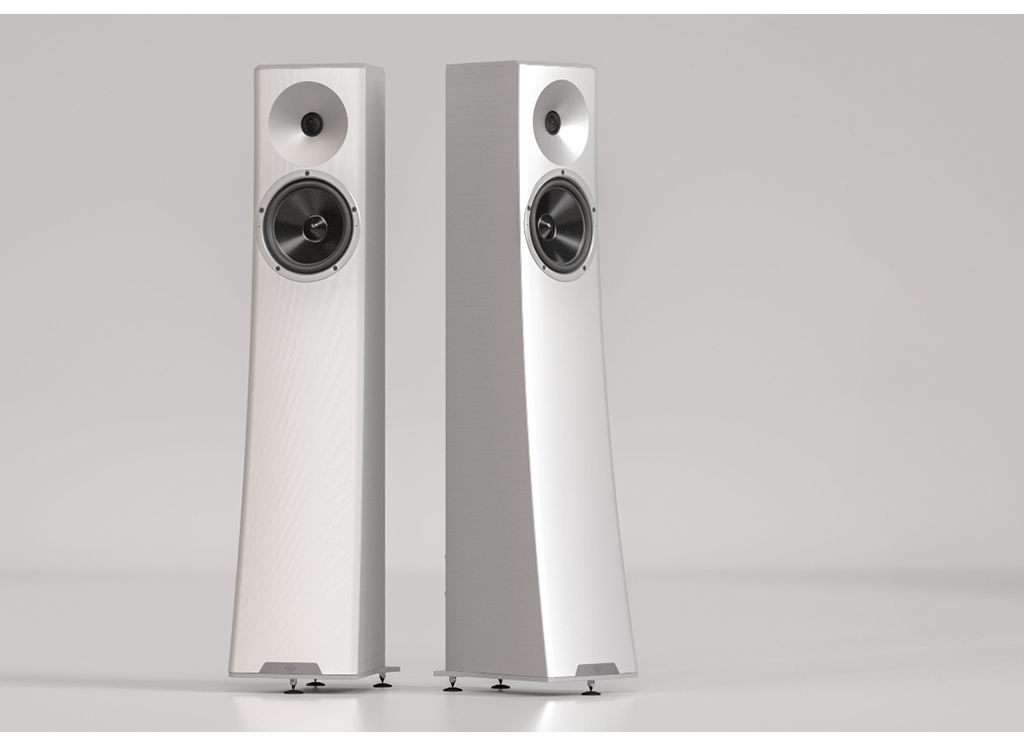
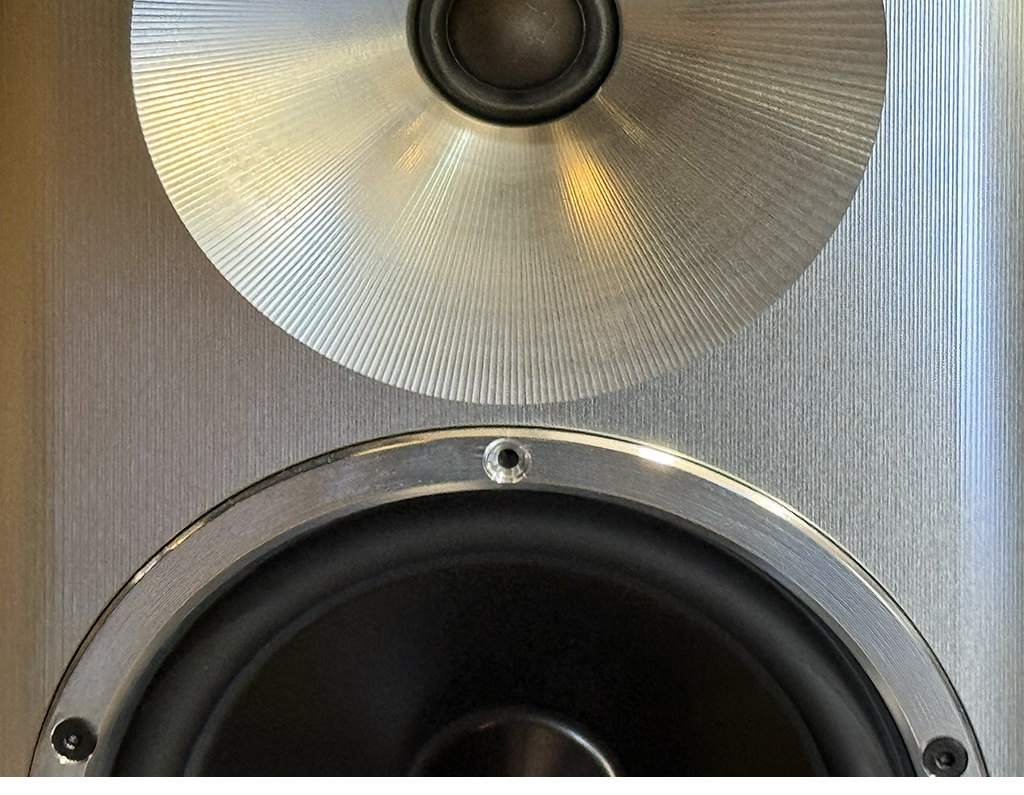
As we’re winding up the review on the YG Descent (a three-way floorstander), that is coming in at right about $30k per pair, and is the top of their Peaks range, the two-way, all-aluminum Carmel 3 has also landed. We thank YG’s new distributor Hiram Toto of Supreme Acoustic Systems for being kind enough to leave the Descents a few more weeks so we can compare and contrast, as they are similarly priced.
While YG is well known for their aluminum-bodied speakers, it is a controversial aesthetic choice, one that usually polarizes potential customers. Because the Carmel 3 is the entry level speaker in YG’s Reference lineup, we were curious to reveal the differences, as a potential buyer might.
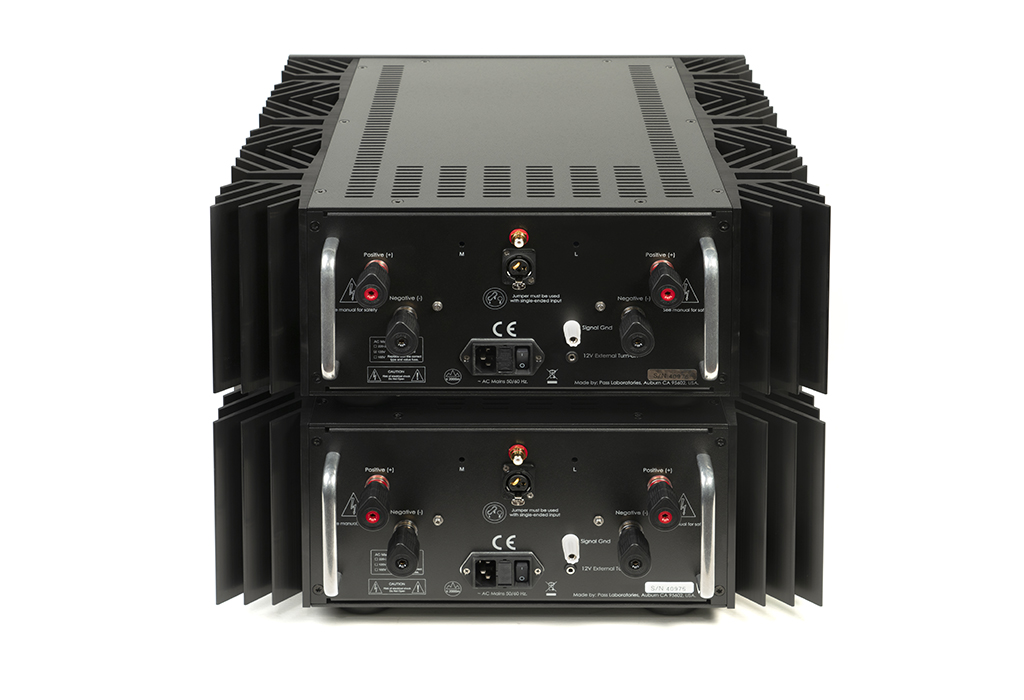
You’ll have to read or full review for that, as it is outside the scope of a distilled piece. Suffice to say that the Carmel 3 on it’s own is a brilliant design, one that combines the tech of the XV, Sonja, and Hailey 3 (reviewed here) in a more compact cabinet. Even in our 24 x 36 foot room, the Carmel 3 delivers impressive bass response, and creates a massive soundfield, driven by the Pass Labs X600.8 power amplifiers.
The Carmel 3 delivers incredibly high performance, in a compact enclosure, and for those not having a room big enough to house the top YG’s, leaves precious little on the table in terms of ultimate resolution. Our test pair came fresh out of the box, and Toto tells us that good as they are already, they will continue to improve over the next week or so.
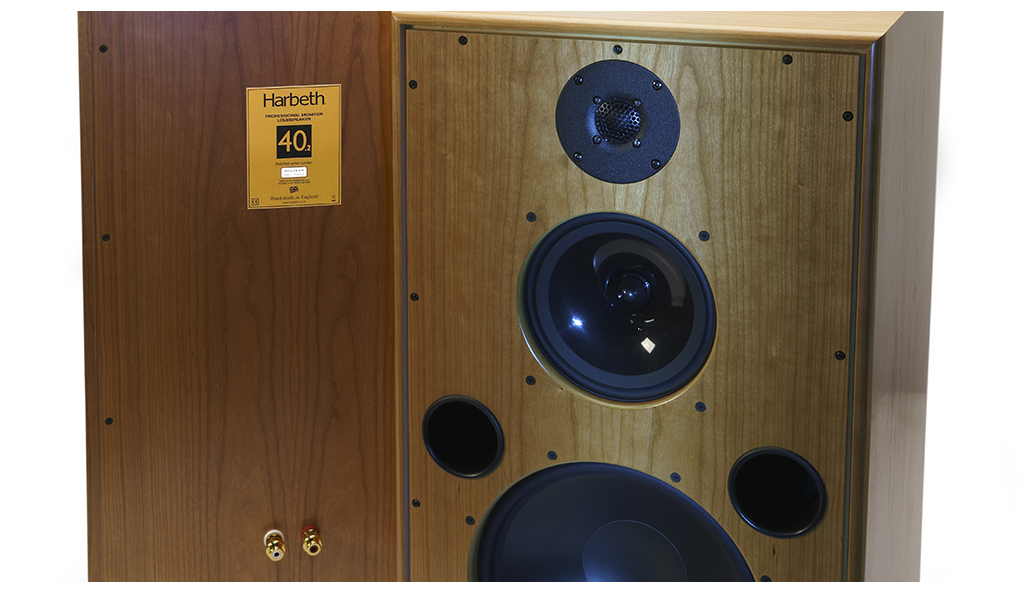
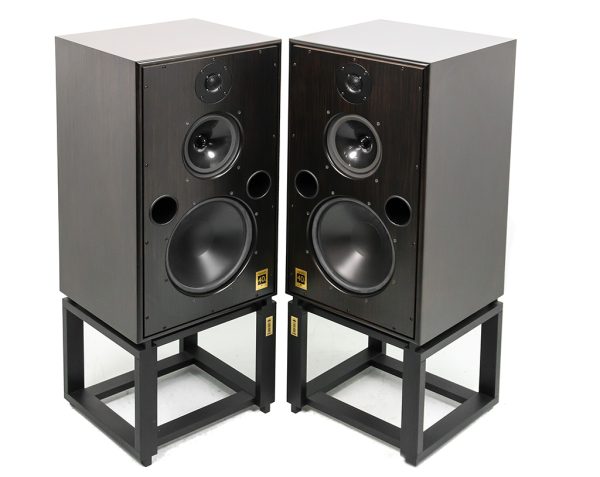
While the new Harbeth 40.5XD is a fantastic speaker (we’ve got a review going live any day…) don’t discount the 40.2s, especially when you can buy this pair, complete with stands for just over $10k at TMR.
If you’ve never heard the big Harbeths, they are quite special. Though these speakers are fairly large at about 30″ tall, 17″ wide and 15″ deep. They weigh about 85 pounds each, so tiny British monitors they are not.
But with big speakers comes big sound. If you’ve ever listened to a pair of smaller Harbeths and thought “If only I could get more of this…” The monitor 40 is the answer to your wishes. Even though the cabinet has a fairly large frontal area, these big monitors disappear in your room like a pair of LS3/5a’s, but with big bass and slam.
With an 87dB/1-watt sensitivity rating, anything beyond about 40 watts per channel will work, but if you can pair them up with a big solid-state amplifier, it’s a completely different movie. They take another big leap.
The top photo is merely for illustration, but this black pair complete with a pair of Tronger stands (A $2,000 value by themselves) is on the block at TMR for $10,499 in ebony. You know you want em!
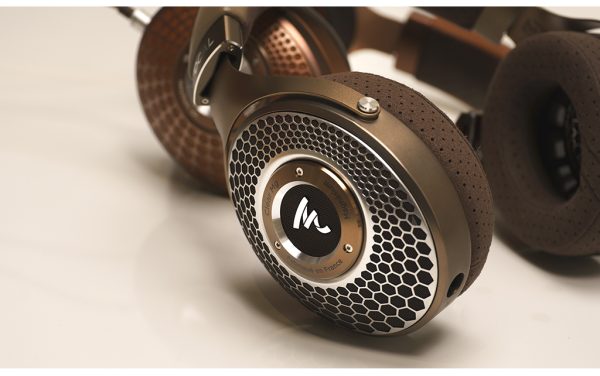
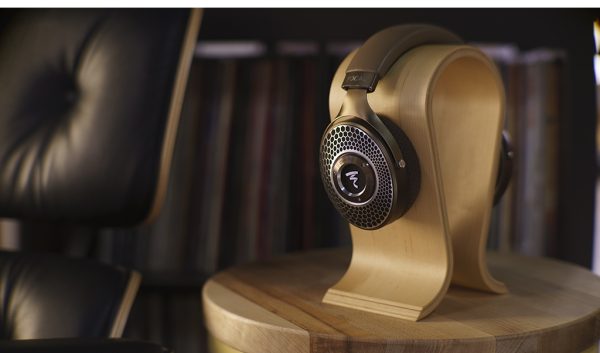
If you are itching for a pair of crazy money headphones, but don’t have crazy money, check out the Focal Clear Mg. Now pushing close to $2,000 brand, spanking new, you can pick up this pair from TMR for $929. They even include a fresh pair of ear pads. (No small bargain, these are about $200 a pair all by themselves)
Where Focal’s top of the line Utopia phones use a beryllium driver, as their top range Utopia speakers, the Clear Mg uses a magnesium driver. (hence the Mg moniker) The biggest differences between these and the $4,000 Utopias is in ultimate tonal balance, and low level resolution. Both phones have great bass response and are super comfy for long term listening sessions.
The magnesium driver lacks a tiny bit of ultimate low level resolution compared to the Utopia, and the overall tonal balance is slightly warmer as well. Like me, you may actually prefer this sound to the Utopia regardless of price. The Clear is easy to drive with whatever you have, but you will be rewarded as your headphone amplifier gets better. We’ve used these with everything from a gen 6 ipod up to the dCS Lina stack. Not all top phones are this easy to drive – a definite bonus.
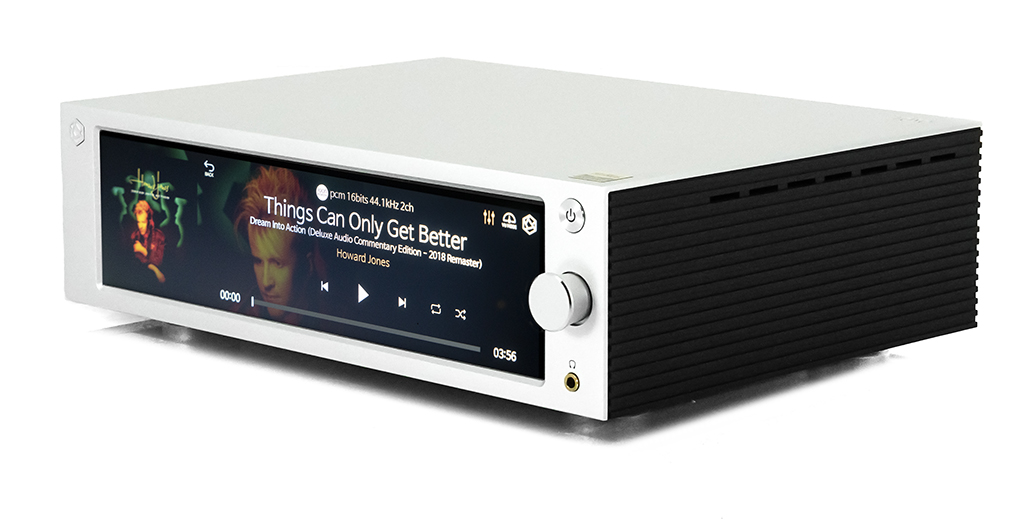
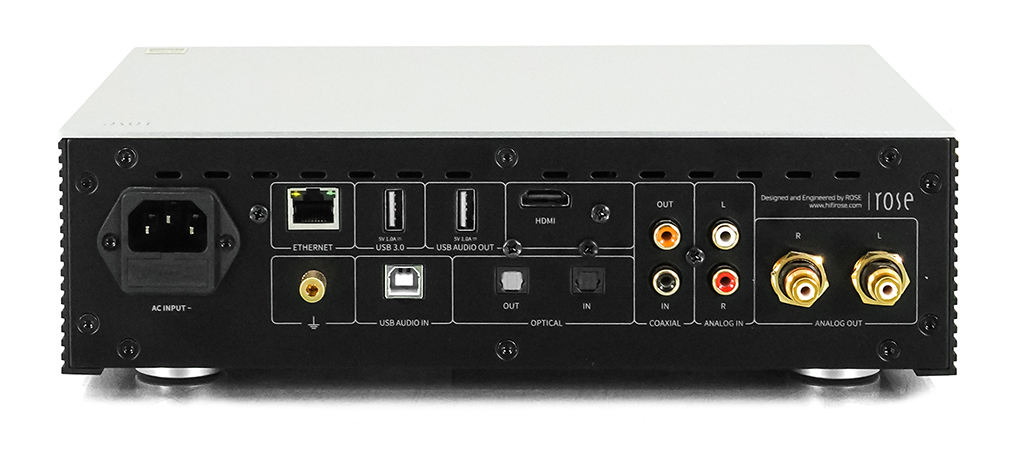
If you’ve been looking for a great streaming DAC that’s reasonably priced, look no further than the HiFi Rose RS250. This gently owned piece sounds great, and accommodates Ethernet, USB and optical inputs with HDMI, USB, and SPDIF digital outputs as well.
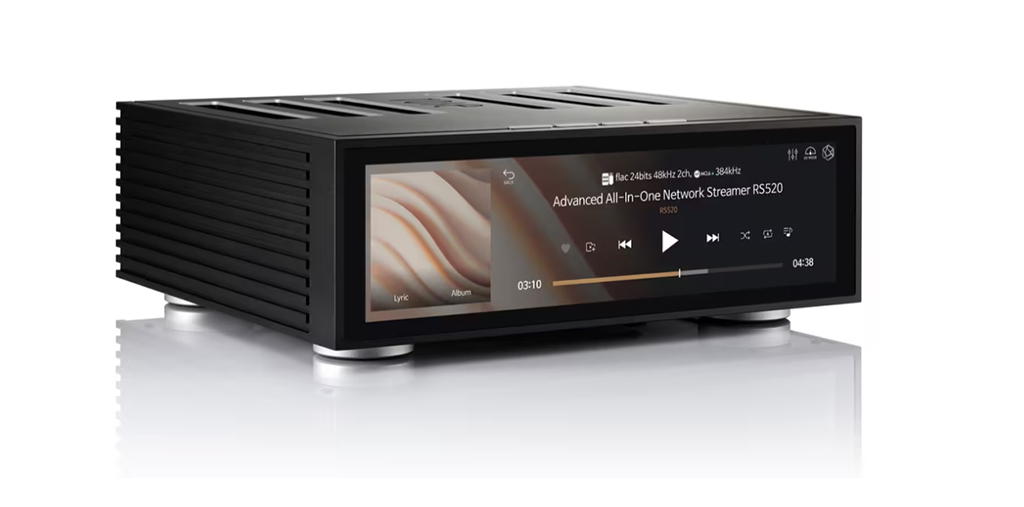
In case you don’t have a DAC, the RS520 does have an onboard DAC, taking advantage of the ESS/Sabre chipset and features a pair of RCA analog outputs. In addition, you can upgrade the internal 500GB disc to 8TB if need be, and have a complete music server solution.
Like all of the HiFi Rose products we’ve used, reviewed, and own – build quality is fantastic, sound quality is top shelf, and functionality as good as it gets. If that’s not enough, there is also an excellent headphone amplifier, with a jack on the front panel. Perfect for a personal listening station!
This gently pre-owned RS250 is tough to beat for $1,499.
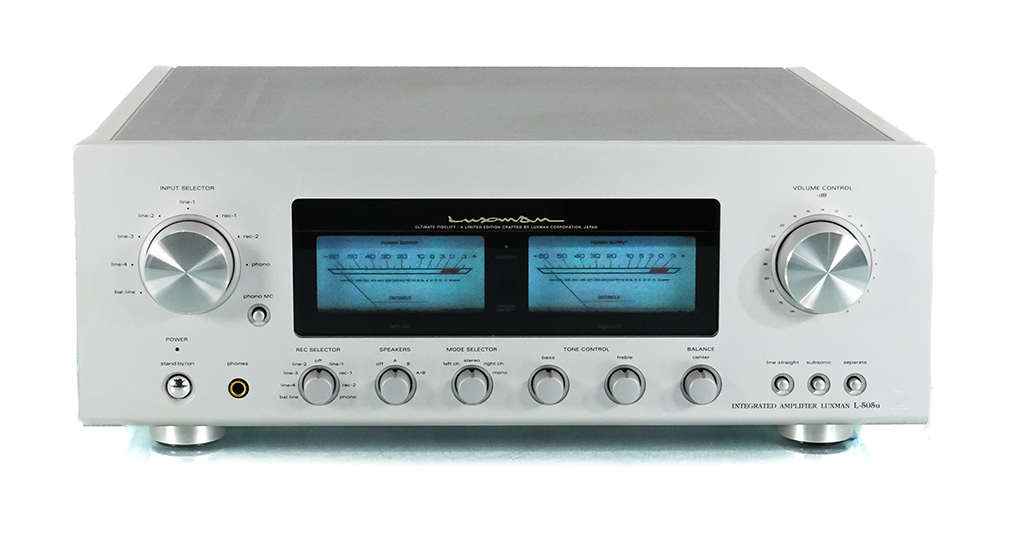
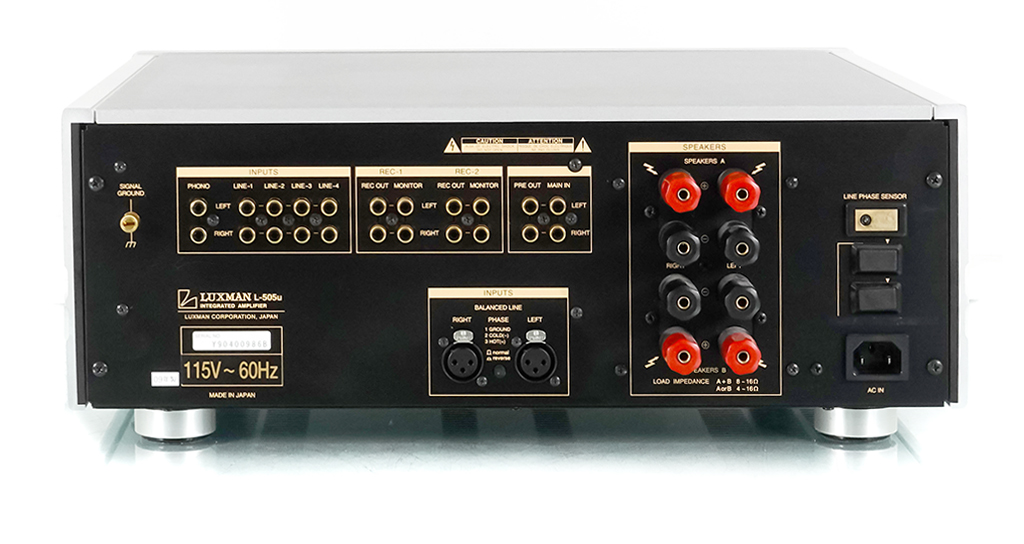
The Luxman L-505u is a fantastic anchor for a high quality, no fuss, hifi system. With 100 wpc on tap, multiple inputs (including a single balanced input) tone controls, and an on board MM/MC phono, you’re on your way. Even if you aren’t doing a starter system – add a streamer, a turntable and your favorite speakers. Call it a day and enjoy.
These Luxman receivers have to be seen and heard to be believed. Being that Luxman is an evolutionary company, even though there is a new version of the 505u, this one still sounds fantastic. The built in power amplifier section can produce 100 wats per channel into 8 ohms and 140 into 4 ohms. What you aren’t getting here that you get in the bigger receivers is the bigger power supply and additional headroom they provide, due to larger power supplies and a more robust output stage.
However, matched to a nice pair of moderate sensitivity speakers, if you don’t need to blast your music to concert hall levels, the sheer quality of the music delivered by the 505u with really surprise you. The phono stage is excellent, and the overall build quality is identical to the $10k Luxman amplifiers.
And those meters! Super cool. What’s not to enjoy? This might be one of the best values going for a tick under $2,600.
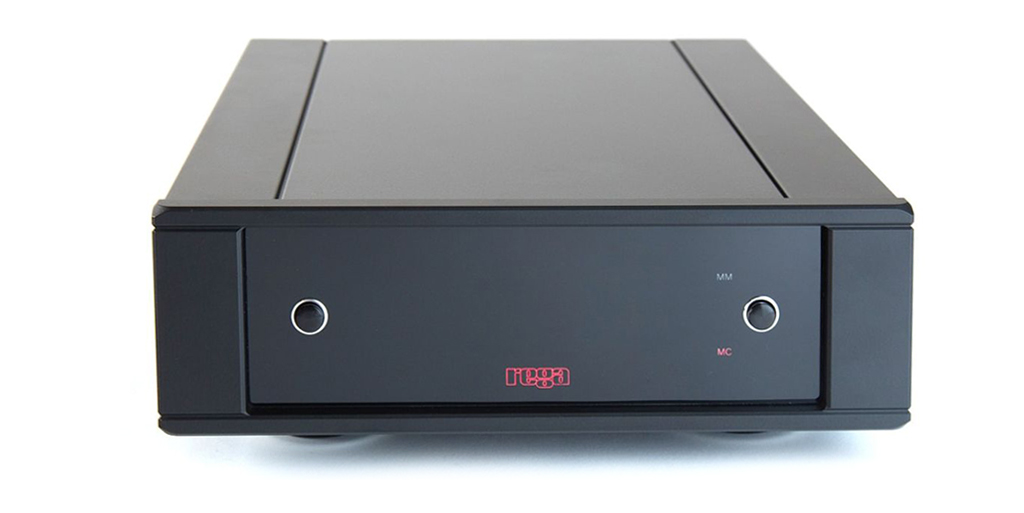
There are so many things to like about the Aria Mk.3 from Rega. This small but capable solid-state MM/MC phono preamplifier does it all.
At the original MSRP of $1,695, Rega’s Aria Mk.3 is one of the best values going in analog. (As is nearly everything Rega makes) However, this slightly pre-owned example at $1,149 should be at the top of your list, if you are searching for a high-performance phono stage that’s reasonably priced – more money for records!
We’ve only reviewed the Mk.2, but the Mk.3 is on the way. Having heard the Mk.3, we can attest that everything that made the Mk.2 great is improved in the new model – and that’s the Rega way. Constant refinement.
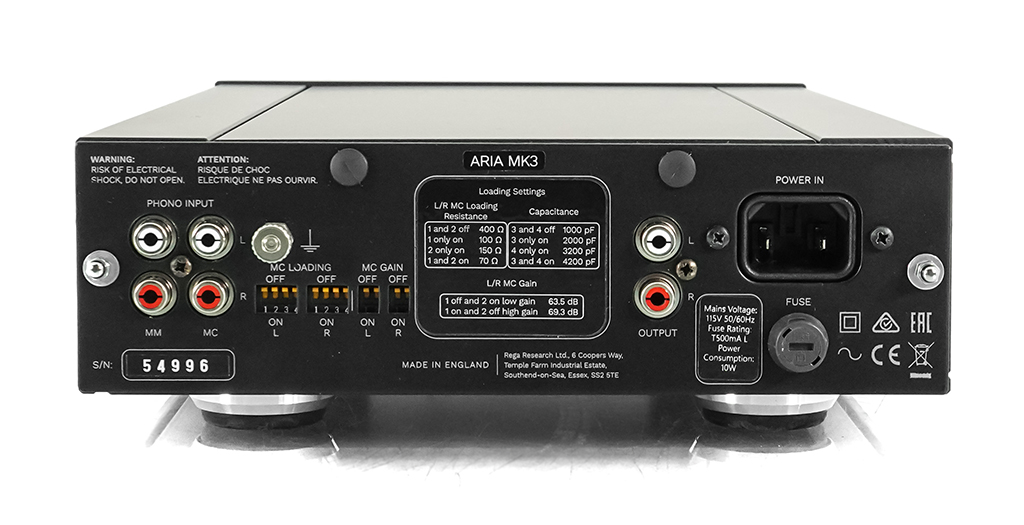
The sound is natural and dynamic. Fortunately, the MC side of the Mk.3 has loading adjustments from 70 ohms to 400 ohms – which should cover nearly everything. Should you have one of the Rega MC cartridges, start at the 70 ohm setting and see what you think. Our experience has been that these cartridges are incredible loaded down low…
Aria’s half-width chassis makes it a perfect fit on the shelf for a Rega outboard power supply and speed controller. However, the thing we find the most exciting is the Aria’s ability to handle two turntables. Instead of just a gain switch, there are two seperate inputs – which makes this a fantastic way to plug two turntables into your system. The more you get into vinyl, the more useful this feature becomes.
Finally, the Aria Mk.3, like the Mk.2 has all discrete components in the signal path – no op amps. This is a big part of what makes this compact phono stage sound bigger and more dynamic than you might expect for the price. Definitely a class leader, even at full retail. But this one is a killer bargain.
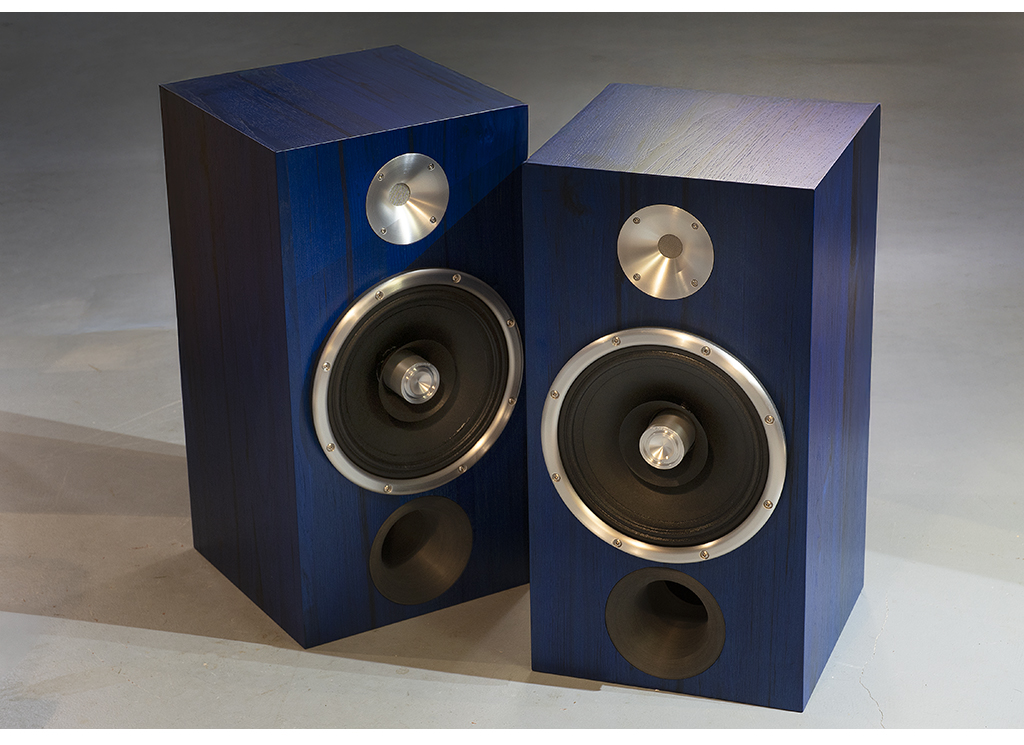
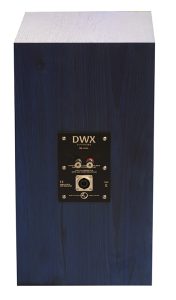
The DWX Supreme is a high-sensitivity, high-fun-factor speaker – in every way.
If you’ve ever been to a Zu Audio room at a hifi show, you know they always have one of the most engaging rooms in the house. Sean Casey, Zu’s founder, and his crew serve up great music and put together systems that engage and offer high value.
And for the current future, with all the tariff monkey business in place, they are an even better, shall we say, supreme value – being all American-made? Zu says the DWX has “the same driver and guts” as the DW-6 floor-standing speaker. Thanks to the small size and front port, they can take advantage of room gain because they can be placed closer to the walls and room corners.
Everything centers around Zu’s own 10-inch Zu260 full-range driver, which extends up to 12 kHz; the rest is handled by their super tweeter. Nothing else sounds like a Zu, and that’s a great thing. With a 95dB/1-watt sensitivity rating, you can easily make use of a 9wpc SET amplifier or your favorite low-powered tube amplifier! Pass Labs First Watt amps crush it with Zu speakers, and if you have a vintage, low-power solid-state receiver (like a Marantz 2215 or a Pioneer SX-424/434), you’ll be blown into the weeds at how great this combo is as well.
The DWX is dynamic and articulate, featuring a front-firing port that makes setup as easy as it gets. The sound is unique – nothing else sounds quite like a Zu. And that’s a great thing, by the way. Our old pal Art Dudley often talked about audio gear being able to get (and keep) the groove. While this is somewhat ambiguous, Zu speakers do an excellent job of capturing the tonal contrasts and variations within a performance. They offer up a slightly saturated presentation – and that’s a great thing without being slow or soft in response. Actually, it’s quite the opposite.
The highest compliment we can pay Zu Audio is that no one is ever having a bad time in one of their rooms, and rarely, if ever, will you hear people blathering on and on about specs and such. If you love music – you’ll love owning a pair of these.
The full review is almost done. However, we suggest pushing the buy button on a pair of these. The only remaining questions are what color, and what upgrades? (Again, we suggest the Supreme version!)
$1,500 – $2,700/pair (finish and upgrade dependent)
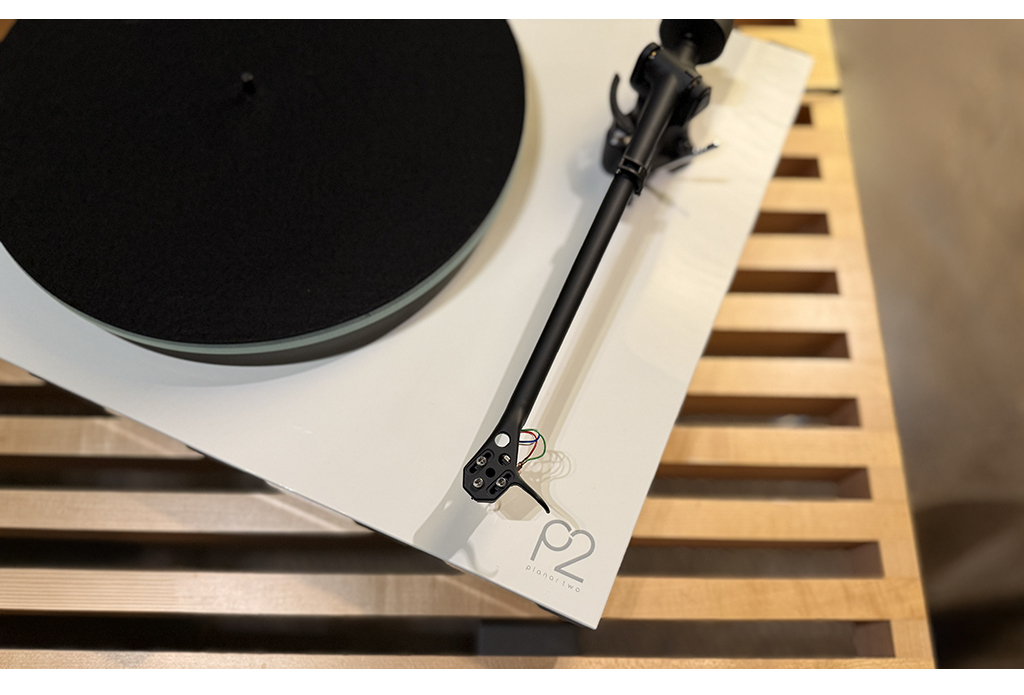
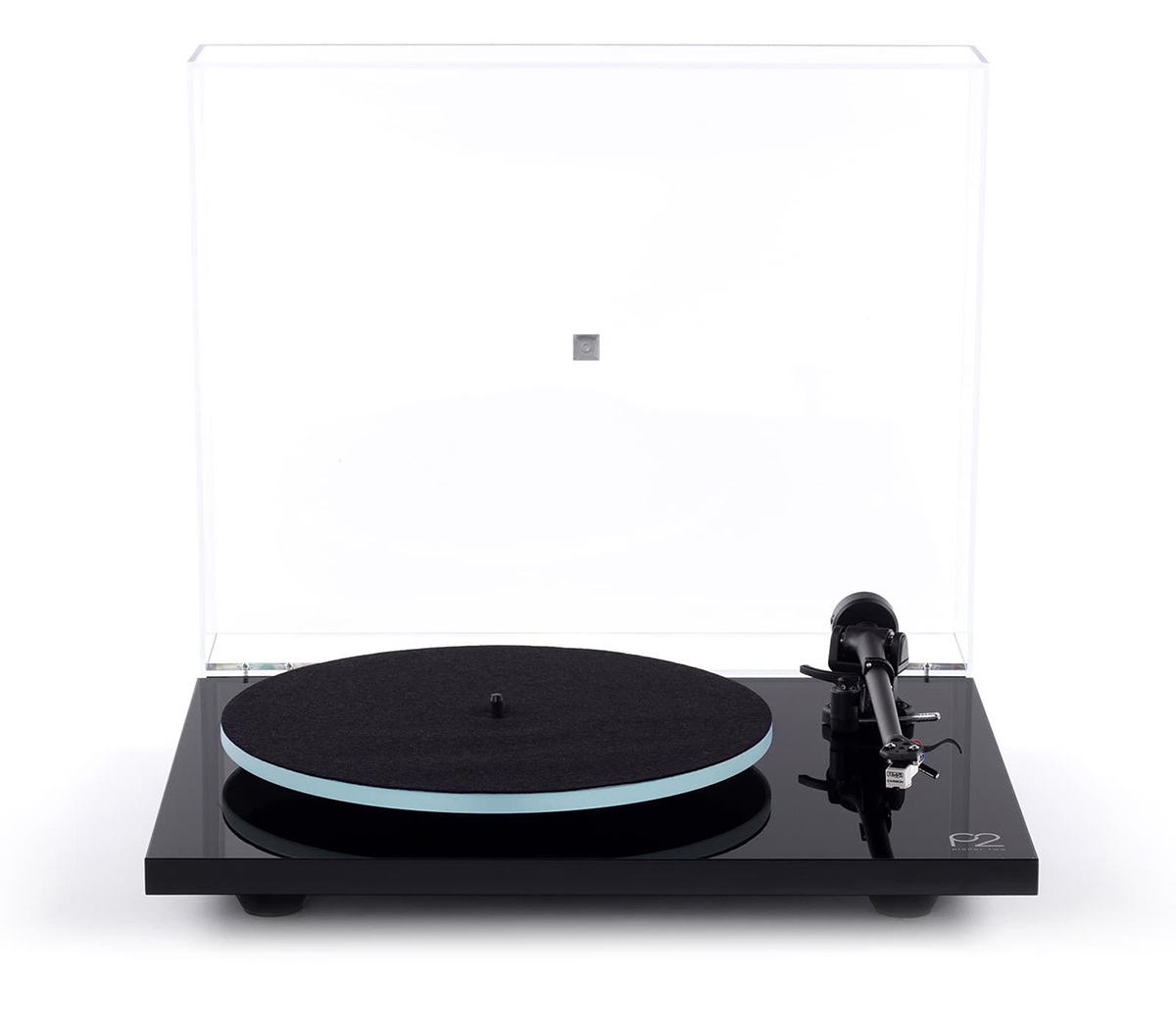
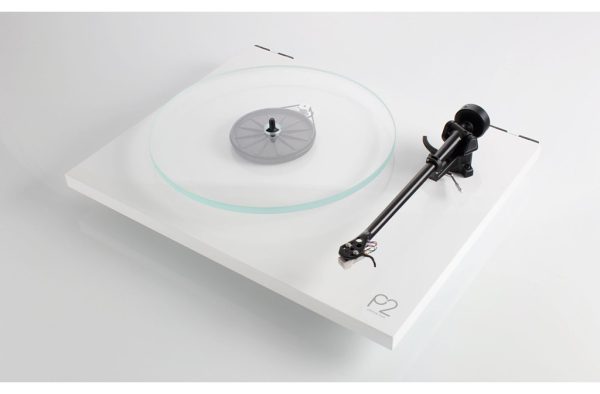
Whether you stay in the family forever or not, a Rega turntable truly has to be part of your audiophile journey if you enjoy analog.
For over 40 years now, they’ve been quietly going about the business of making turntables that deliver class-leading performance at a price that music lovers can afford. They have offered their own line of MM and MC cartridges for a long time, and thanks to their three-hole alignment on the cartridge and headshell – setting a Rega table up with a Rega cartridge is the easiest in the vinyl world.
The release of their new ND3, ND5, and ND7 MM cartridges, which utilize neodymium magnet assemblies, has brought their in-house sound to a new stratosphere. The updates made to the P2 show just how serious Rega is when it comes to delivering a favorable price-to-performance ratio.
A direct comparison of the current P2 with the ND3 cartridge to a ten-year-old P3 with Rega’s former competitor, the Elys 2, reveals that the new combination delivers even more musical information. The bass is deeper with more definition, the highs are more accurately rendered, and there’s more texture in the midrange as well. The new P3 with ND3 has also been equally improved, but that’s another story.
Rega’s US Importer, The Sound Organisation, has held the line on pricing and is keeping this $795 combo aggressively priced, though this may change slightly in the months to come. Our advice: buy it now. Why would you not?
The P2 is easy to use, requiring almost no setup. Now, with the ND3 MM cartridge, you’ll swear you spent a lot more on a turntable. What’s not to love? It’s time to start your Rega journey.
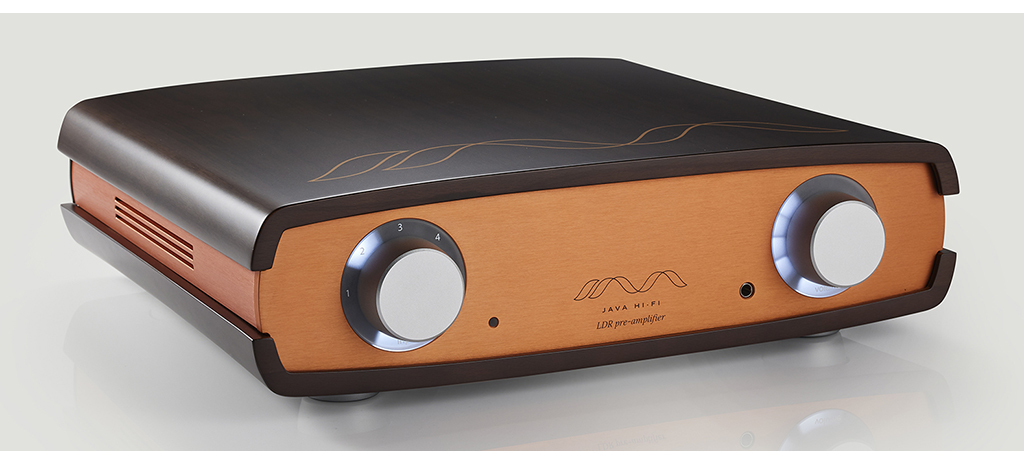
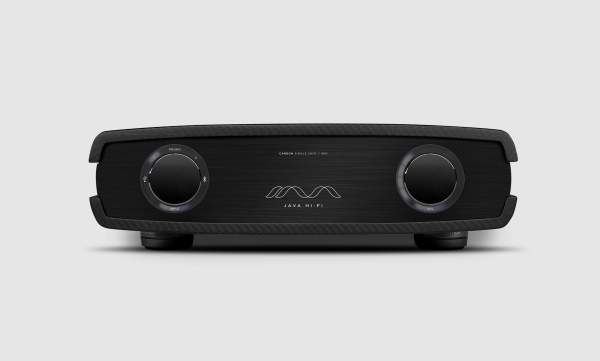
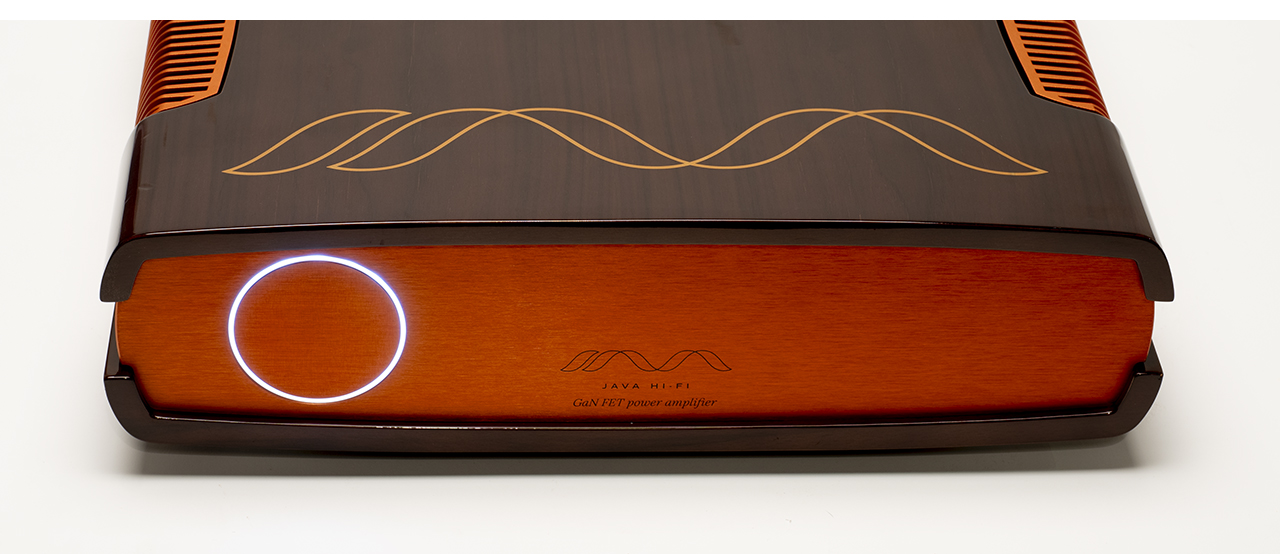
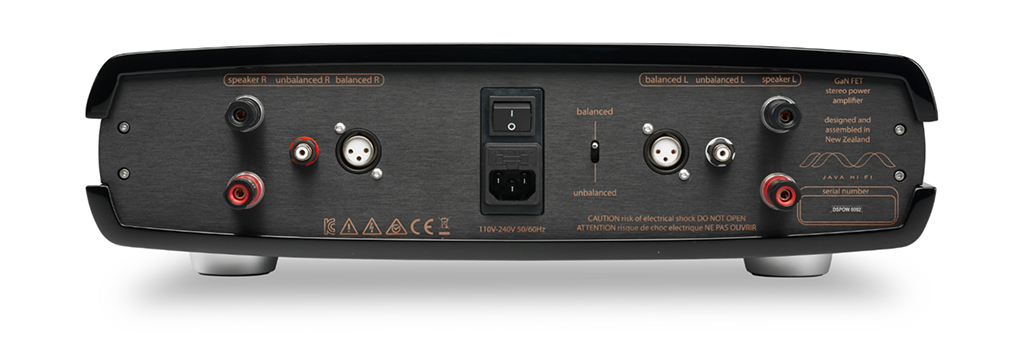
This is the third product we’ve reviewed from Java HiFi, and we are definitely looking at three for three in terms of sound quality, build quality, and stylish excellence.
Matching the casework of their other designs, this solid-state preamplifier’s uniqueness comes from the LDR attenuator. Nearly all other preamplifiers use either a stepped attenuator with fixed resistors at each point or a very high-quality potentiometer.
The LDR circuit actually uses the volume control on the front panel to vary the light intensity of an LED striking a light-dependent resistor (hence the name) that changes value with the amount of light cast upon it. There are no mechanical parts to add noise or degrade over time.
Designer Martin Bell says it’s the quietest way to handle this function. Though we don’t have a non-LDR version of his preamplifier to compare, it is damn quiet. Like their power and integrated we reviewed, the Java pre features a neutral tonal balance, with smooth, grain-free high frequency response. Bass is tight and powerful.
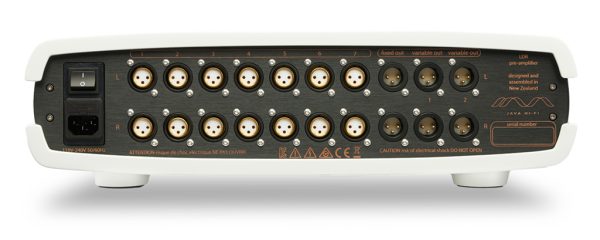
Beyond the great sound, this preamplifier is tremendously flexible. With seven pairs of XLR inputs and three pairs of XLR outputs (two variable, one fixed), you can connect multiple power amplifiers, a powered sub, or even a tape deck! How great is that? However, there are no RCA inputs or outputs, so it will need to be in an all-balanced system. Finally, there is an onboard headphone amplifier that worked well with all of the phones we had at our disposal.
It looks super stylish. It has several different faceplate and casework options, so it should look great in any décor.
Now that it’s official that the CD is making a bit of a comeback, TMR has an incredible selection of slightly used players from OPPO (!!) under a thousand bucks, all the way to some more serious hardware like an EMM Labs player around $12k.
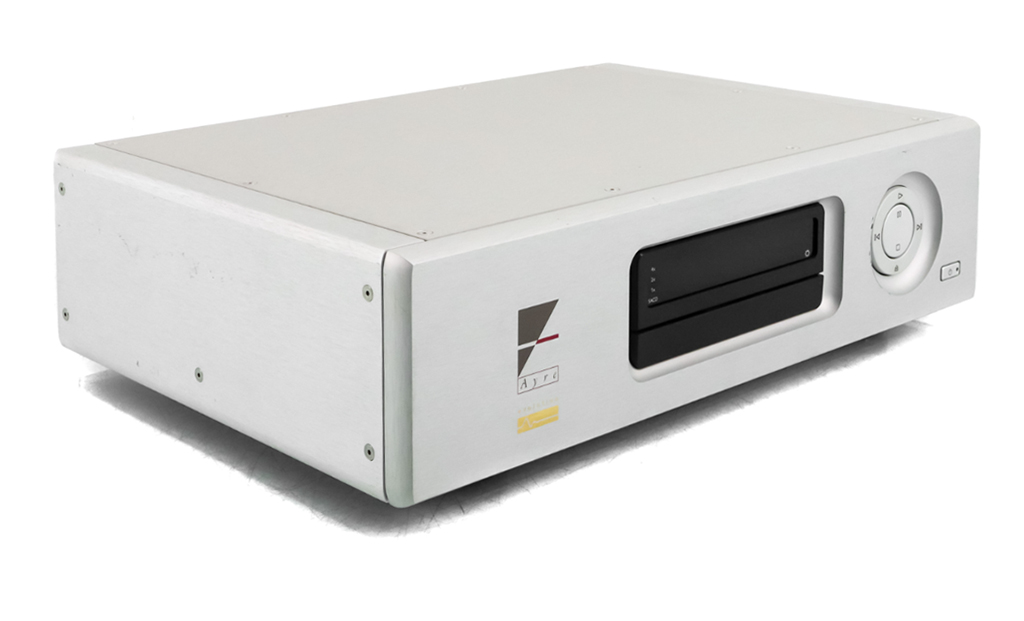
If you still have a collection of SACDs and DVD-a discs, this player is the droid you need. Not only does it sound fantastic, it plays all shiny disc formats. There are still some decent titles out there on DVD-a to be found and usually at a reasonable price, with so few players left in the field. This one of my personal favorites – and you can pick it up for a fraction of it’s original price. TMR has gone over it (as they do everything) to be sure all is right functionally.
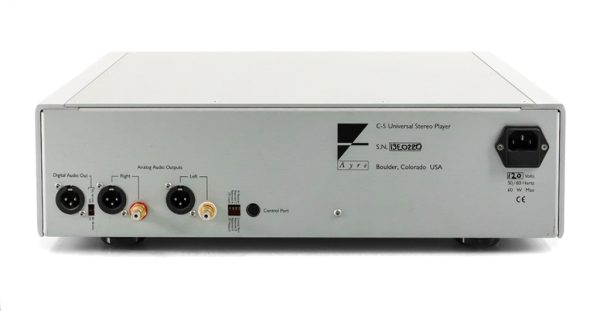
This one has a few little scrapes, hence the great price. With balanced XLR and RCA outputs, you can put it in any system, and there is a digital output as well – it’s a very versatile performer. A recent call to Ayre confirms that they can still service this one down the road. Good to know on a digital player.
Here’s your chance to get a huge helping of what the big Focal Utopias deliver at a fraction of the price.
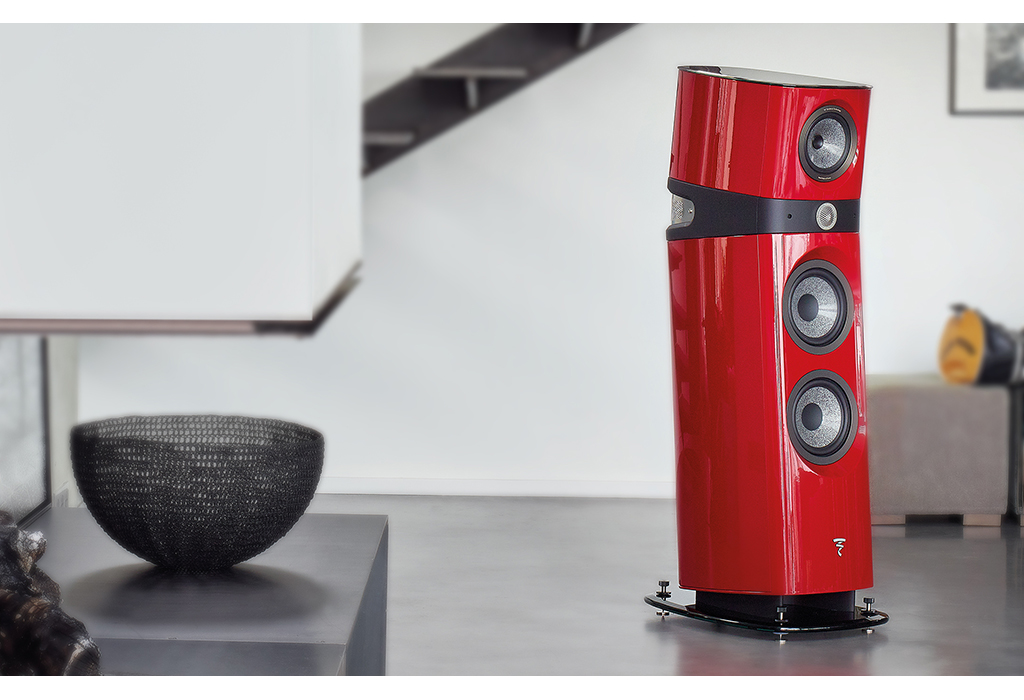
With price increases over the last couple years and the tariffs looming, this is your chance to get a gently used pair of Sopra 3’s for a fraction of a new pair. And they are red. Remember, Sammy Hagar said “Green ain’t me compared to red.”
The Sopra no.3 takes full advantage of Utopia technology in a more modest sized cabinet (though still about 150 lb. each!) These sexy French floorstanders go all the way down to 26Hz – more than enough to capture the lowest bass notes, regardless of your musical tastes, thanks to a pair of 8-inch woofers and a floor-facing vent. This also makes the Sopra no.3 that much easier to place in your listening environment.
These speakers feature a 91.5 sensitivity rating, so anything above 35 watts per channel will drive them, and from hands-on experience, they are very tube friendly.
A bit of time at a friends’ house listening to the Sopra no. 3 for the better part of a day led me to revisit my review, written some time ago, when the bright orange Sopra no.3 graced our cover, and became my personal reference for a few years. Staffer Earle Blanton still uses his Sopra no.3’s as his reference, along with a pair of REL 212SX subwoofers. A formidable combination.
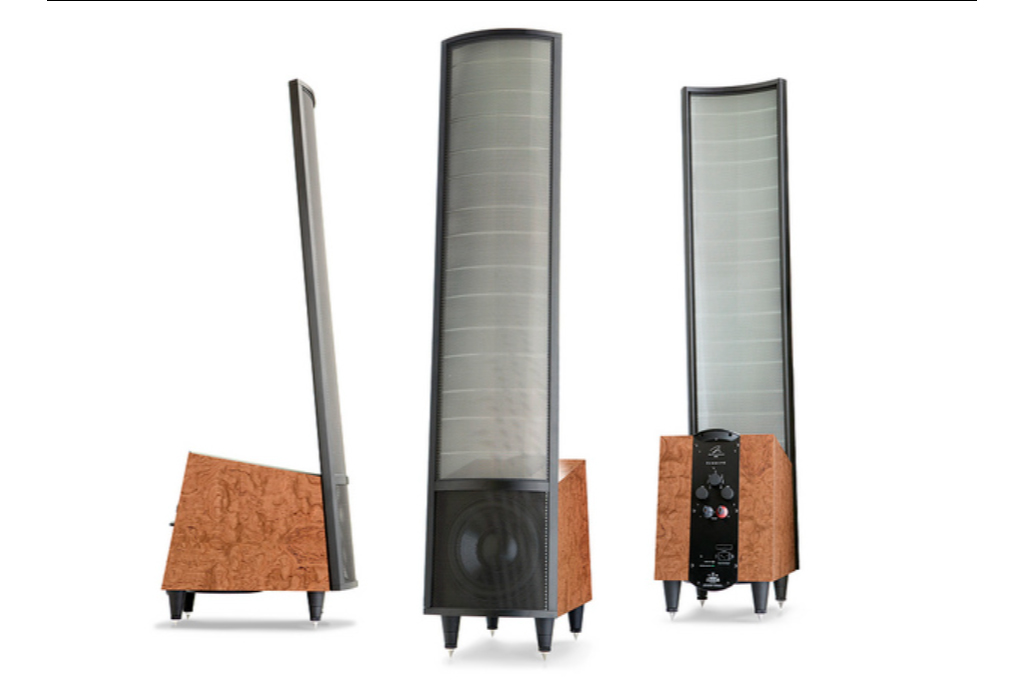
For a few years, MartinLogan’s Summit was their flagship speaker, and it received worldwide praise. At the beginning of 2009, MartinLogan combined what they’d learned building the new flagship CLX full-range electrostatic speaker system and the Spire hybrid to arrive at the Summit X. Just like the Summit, it features a pair of powered 10-inch woofers, one facing toward you and the other firing toward the floor.
Though it looks similar to the original, the Summit X is an entirely different product. MartinLogan’s Devin Zell tells me, “We scrapped the CAD drawings for Summit X. The panel is new, the woofers are new, and the crossover is new.” ML also adds cool light-blue lights that fire from underneath, giving the speakers a glowy feeling in your room. “We just did that for fun,” Zell laughed on the phone as we discussed the added bling.
This may not be your bag if you prefer listening in complete darkness. But put me on the list of people who like it. I’d like it even more if they could only make them glow lime green to match the LEDs on my Naim and Burmester gear. One handy addition to the lighting is the added LED that lights up the 25 and 50hz settings on the woofer modules and works quite nicely. This makes fine adjustment on the speaker easier than it was with the standard Summit. And yes, you can shut it all off, which should keep all the mole men in the audience happy.
The Subtle and Not-So-Subtle Differences
For those of you not familiar with the MartinLogan product line, the Summit X has a rated frequency response of 24-23,000 Hz (+/- 3 db) comprised of an electrostatic panel mated to a pair of powered 10-inch aluminum coned woofers at a crossover frequency of 270hz. It also features a pair of bass level controls at 25 and 50Hz, making the Summit X easy to adapt to your room. The specs are identical to the original Summit it replaces on paper.
MartinLogan finished the production run of the Summit in 2008, and the Summit X became available in the spring of 2009. The Summit X carried a price increase of $3,000 over the Summit. Despite rumors that the Summit would be upgradeable to X status, this was not the case by the final release of the new speaker. Quite a few people at MartinLogan anguished over this, but by the time the design on the Summit X was finalized, there were too many physical changes in the new speaker to make the upgrade possible and cost effective for the customer as well as ML.
Where the last version of the Summit started at $10,995, the Summit X’s base price is $13,995. As in the past, a wide range of custom finishes is available through the MartinLogan custom shop.
Straightforward setup with care
The enclosed manual with the Summit X helps you set them up in short order. Legacy MartinLogan owners probably don’t need much input from me, and many of you have your own theory on how you like your Logans set up. Personally, I like ’em as far away from the side walls as possible.
While this is not convenient for everyone, the further you can get these babies from the side wall, the greater reward in soundstage width. The Summit X worked much better on the short wall (16 feet) of my studio than my reference CLX’s, when on the long wall (24 feet). With each speaker about seven feet from the side walls, they really opened up. If you can’t achieve this in your listening room, some modest room treatment just behind the panel and about two feet in front of the panel on the side wall helps tremendously.
Again, this is optional but well worth it if possible: get everything out from between your speakers. Because they radiate from the front and back, the stereo image really suffers with a big rack of gear and giant flat-screen TV between the Summit X—or any other panel speaker, for that matter.
The final listening position had the speakers just over nine feet apart, with the front surface of the panel 42 inches from the rear wall, slightly toed-in. This puts ear-to-speaker distance just shy of 10 feet. Consider purchasing at least a Radio Shack sound-level meter and a test tone disc to fully adjust the 25hz and 50hz controls on the back. Careful positioning will help smooth out the bass response of the Summit X giving you their maximum drive.
Identical to the last three MartinLogan Hybrid speakers I’ve used, the Summit X requires about 200-300 hours before sounding its best and achieving the maximum amount of integration between the dynamic woofers and the electrostatic panel. When you first fire them up out of the shipping cartons, the bass will sound somewhat slow and bloated, no matter where you have the woofer controls set. The biggest improvement will be in the first 100 hours, with incremental smoothness happening thereafter.
Not as sensitive to placement as the CLX, the Summit still benefits from careful adjustment. Once you have the speakers where you feel is the proper place, use your measuring devices of choice to get them identically placed from the rear wall in terms of toe-in and rake. If you can get each speaker within one-quarter to one-half inch of the other, this will help the image size and focus. Thanks to longer spikes than the Summit, the Summit X offers a wider range of adjustment on the speaker rake, making them easier to adapt to your listening position. If you like your seating position further back, angle the speakers backwards more. If you like to sit closer, you can now angle these speakers from 11 degrees to -1 degree.
The sound
All of the top-range MartinLogan electrostatic speakers share a similar sound; big, open, airy and very dynamic. As mentioned in the original Summit review, this is an electrostat on which you can play Metallica if you have enough clean amplifier power. They are not as dynamic as a pair of Wilson Maxx 3s or large horns, but the slice of musical heaven these speakers offer cannot be had by cone speakers.
The Summit X continues this tradition and improves on all of the Summit’s strengths with no downside (other than the increased price). Even though the frequency response specs are the same, this is a much improved speaker, primarily in the quality of the bass response and the integration of the cone drivers.
MartinLogan calls it “Controlled Dispersion PoweredForceTM Bass” (Say that ten times as fast as you can). You can read the full technical details on their website at:
The bottom line: it works very well. While the Summit X comes up a bit short in comparison to the flagship CLX in terms of upper bass speed and articulation, it takes hybrid speaker design to a new plateau.
Regardless of music you like to listen to, the Summit X will deliver the goods. The main strength of the Summit X is that it throws a huge soundfield in all directions, giving the listener a very immersive experience. This is the MartinLogan magic at its best. You will love them, or they will not be your cup of tea.
Thanks to that low 270Hz crossover point, the panel reproduces most of the music, and this coherency is what gives the Summit X its appeal. Male and female vocals are both reproduced exquisitely, and the speaker does an amazing job of disappearing in the room for its size.
When the low-frequency controls are properly adjusted, the Summit X has a substantial amount of deep, controlled bass that should satisfy 98 percent of its owners. If you listen to a lot of pipe-organ music or club music with a lot of deep bass and the 24Hz cutoff of the Summit X is not enough, you can add one or two Descent i subwoofers. When adding the Descent i to the system and, letting the Summit Xs run full range and crossing over the Descent at 35Hz, I was getting solid, wall-shaking output when playing the 20Hz test tone on the Stereophile Test Disc.
The Burning questions
Analysis paralysis is setting in but people want answers. I’m going to put my head on the chopping block. The Summit X is definitely an improvement over the original Summit and definitely worth $3,000 more than the earlier model. Listening to them side by side in the same system, the X model does a better job at bass integration with the panel. Thanks to the dual woofers, it should not need a subwoofer except for all but the most demanding applications, or for heavy-duty home-theater systems.
Just like the Spire, the midrange in the Summit X is slightly less colored than that in the original Summit, though you don’t notice it until you hear both side by side. The Summit X also edges out the Summit in terms of low-level detail retrieval and microdynamics. Cymbals and percussion instruments fade out with longer gradations than they did before, and very dense musical pieces are unraveled more easily. Both versions can play equally loud without fatigue, so this is an evolutionary upgrade.
This builds on the strength of the original Summit – the Summit X is a highly resolving speaker that can be used to judge source components costing considerably more. While $13,995 is not a budget loudspeaker, the Summit X holds its own in a six-figure system.
Tubes or transistors?
The other big question with the Summit X is what to drive them with, and there is a fairly wide range of discussion on this topic. Many people swear by “tubes and stats,” and I used to use my CLS’s with the legendary Audio Research D-79. But the current MartinLogan speakers dip to .7 ohms at 20khz, so if you have a tube power amplifier, audition with your amplifier before buying the Summit X, even if it means lugging your amp to your MartinLogan dealer.
The tube amplifiers with which I’ve achieved the best results with current MartinLogan speakers have been the BAT VK-55SE and PrimaLuna Dialog Monoblocks. Even though these are medium-powered amplifiers in the 50-60 watt per channel range, they offer low-output impedance taps, which improve the power transfer to these speakers. The Manley 250 monoblocks are another, albeit higher-powered amplifier that mates well with the MLs.
Mating tubes with the Summit X is a case-by-case situation. You’ll know when it’s wrong immediately. If your favorite tube amp doesn’t have the juice, the speakers that sounded great at the dealer will sound like they have blankets over them in your listening room. Don’t say I didn’t warn you. Though these speakers have a fairly high sensitivity rating of 91db/1-watt, the more clean power you can throw at them, the better. The bigger amps offer more dynamic contrast.
A worthy successor
The Summit X is the Charles Barkley of loudspeakers. It plays better than it will probably ever get credit for and it would have been a superstar if Michael Jordan (the CLX) hadn’t come along at about the same time. But it’s still able to mop up everyone else on the court. Well, I can’t compare speakers to cars all the time, can I?
The good news is that the Summit X is about $10,000 less than the CLX, it has a lot more flexibility and it doesn’t require a pair of subwoofers to really give its all. It is a better value for all but the most demanding listener. The Summit was one of my favorite speakers of all time, and the new Summit X is even better. Properly setup with electronics to match, these speakers will paint a huge musical canvas for you to enjoy.
If you currently have the Summit, I’m guessing you will probably pass on the upgrade unless you can easily absorb the price difference. For those new to MartinLogan or trading up from further down the range, it is truly a fantastic speaker and a very worthy competitor in its price range.
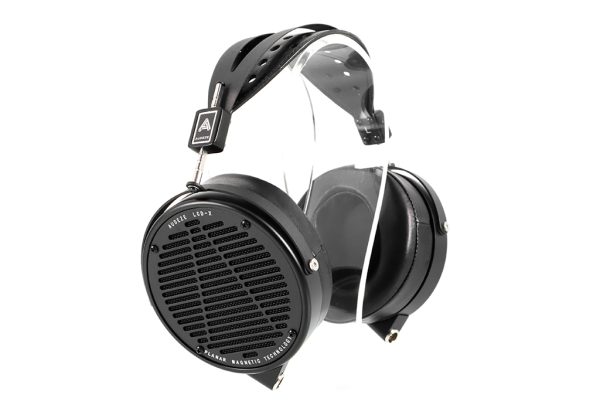
About a decade ago, Audeze hit the scene with their original LCD-2 headphones that used planar magnetic technology. It was an instant success.
Up till then, the highest performance you could attain in the world of headphones was with electrostatic designs. These were bigger, bulkier, and above all much more costly, because they had to come with a power supply to keep those tiny ESL membranes charged. Just like a pair of Quads or MartinLogans.
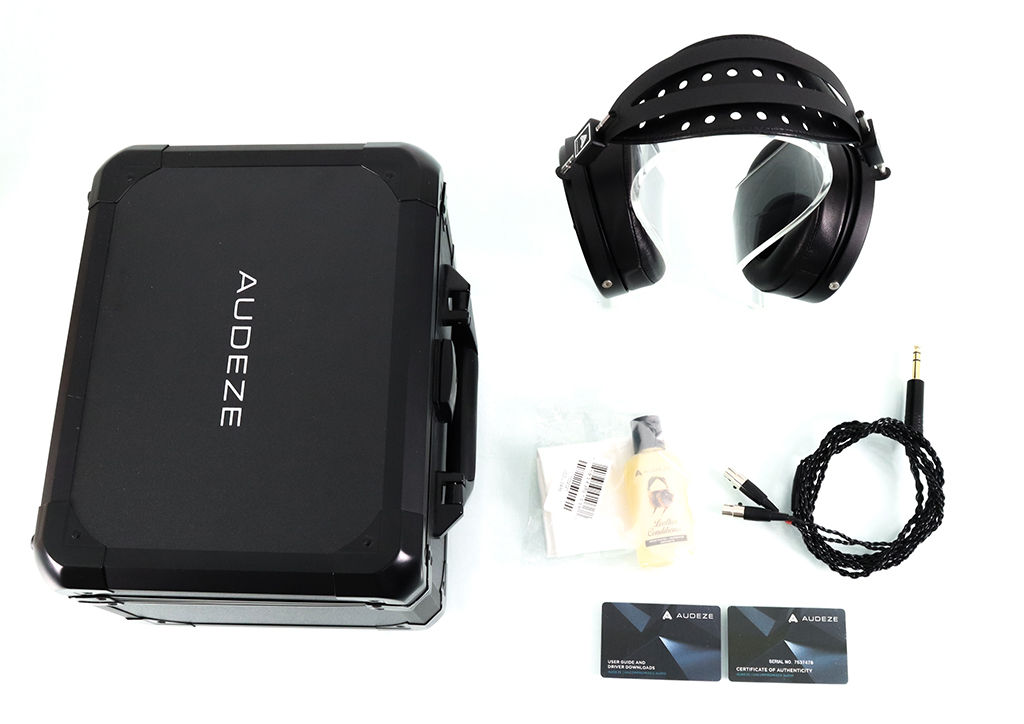
While the Audeze phones are somewhat on the large side, they do manage to keep the weight down, and are always a comfy fit – even for long term listening sessions. The LCD-X here at TMR is a great buy at $899, with all the accessories and carrying case.
I still use a pair of Audeze LCD-2s and the LCD-X is a bit more resolving, yet still has that unmistakable clarity that comes with this brand. Also – they are extremely easy to drive, so whether you have an older iPad, a dCS LINA, or anything inbetween the LCD-X is a winner.
They provide a massive soundstage, delicate, defined highs, and extremely detailed bass. It’s almost like wearing a pair of Magnepans on your head! Well, that’s kinda what you are doing. This is an easy sound to get hooked on, whether you are a panel speaker fan or not.
Old School: The Focal XS Desktop system Audiophile Apartment: The SVS Ultra Evolution Tower Review: The Finale 300B EVO Integrated Amplifier Review: The Voodoo Labs Witchcraft™ cables Review: The Luxman D-07x DAC
Cover Review:
The Clarisys Auditorium Plus SpeakersMusic
MINE – It Should Be Yours:
Assorted fun things we think you’d like
Music
Playlists: We share our readers choices from around the world
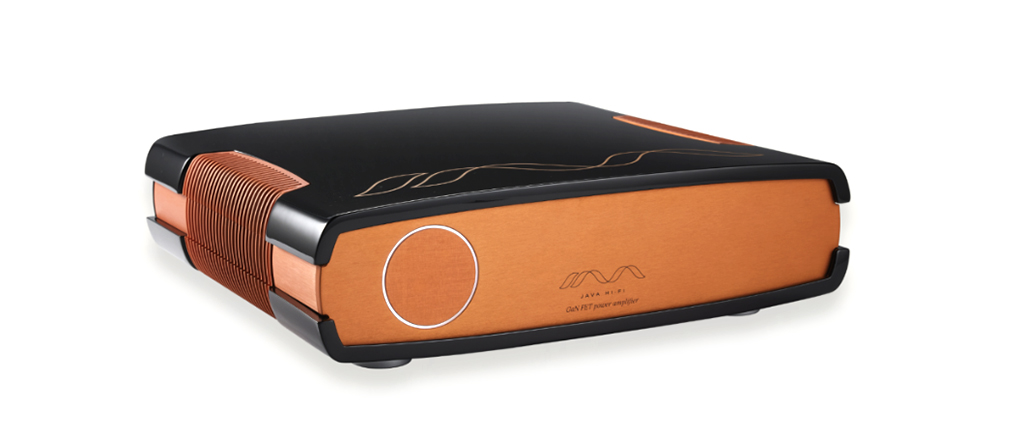
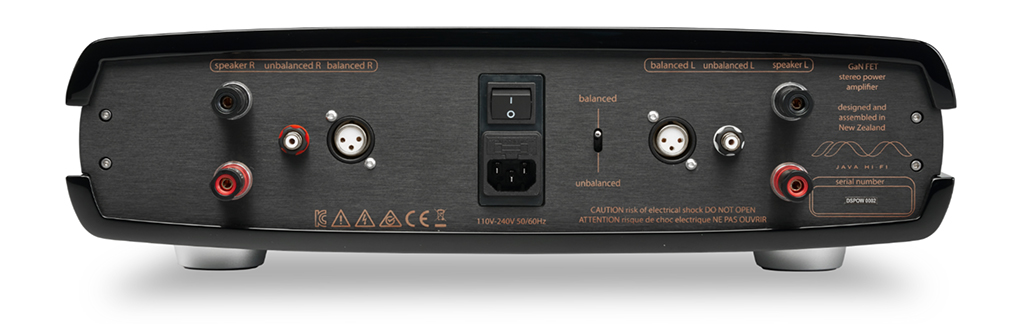
New Zealand high-end audio manufacturer, JAVA Hi-Fi, is introducing six new models to its award-winning amplifier range in the coming months. Additionally, from May it will be updating its Single Shot and Double Shot LDR GaN FET integrated amplifiers with a new high-performance R2R ladder DAC.
JAVA Hi-Fi Founder and CEO Martin Bell says its CARBON edition integrated amplifiers have become the best-selling products in its line-up, even though they only launched in January 2024. The global interest from customers prompted JAVA to look at how it could apply this material to other products.
“A number of customers have asked whether we were planning to produce a CARBON version of our pre-amplifiers and power amplifiers. They spoke and we listened!”, says Bell.
Like the CARBON editions of the integrated amplifiers, the JAVA CARBON pre-amplifiers and power amplifiers feature several notable innovations that elevate the JAVA listening experience to new heights. These include:
Carbon fibre outer casework (9mm thick) for superior vibration damping and to mitigate the influence of RFI and EMI on circuitry
ETI Research Silver RCA connectors
ETI Research Kryo speaker binding posts (both models of GaN FET Power Amplifier)
Revised and upgraded circuit design on both models of the LDR Pre-Amplifier
IsoAcoustics Gaia IV feet for improved vibration isolation of circuit boards and other internal components
The new models are an extension of JAVA’s current amplifier range and will include:
JAVA CARBON Single Shot LDR Pre-Amplifier (MSRP US$8,495)
JAVA CARBON Single Shot GaN FET Power Amplifier (MSRP US$9,995)
JAVA CARBON Double Shot GaN FET Power Amplifier (MSRP US$11,995)
The CARBON editions of the pre-amplifier and power amplifier will begin shipping in June this year.
Range Expansion
Also new from JAVA Hi-Fi are several additions to its integrated amplifier range.
The JAVA Single Shot 400 doubles the power of the current Single Shot integrated amplifier from 200W/8ohms to 400W/8ohms. Meanwhile the Double Shot 200 keeps the fully-balanced configuration of the Double Shot integrated, but delivers 200W/8ohms (compared to 400W/8ohms for the existing Double Shot) at a lower price point.
Pricing for the expanded 8-strong integrated amplifier starts at US$8,995 for the JAVA Single Shot 200 and is rounded out by the flagship JAVA CARBON Double Shot 400 at US$16,995.
“These new models plug an important gap in our amplifier range and provide customers with the ultimate flexibility in terms of input options, power and price”, says Bell.
The other notable feature of the refreshed integrated amplifier range is a new high-performance R2R ladder DAC driven by its own dedicated linear power regulator.
Replacing the current Burr-Brown-based DAC, the new USB DAC features dual AD1865 chips from Analog Devices. These 18-bit non-oversampling chips can play files up to 768kHz and are renowned for their natural, organic and non-fatiguing sound. Digital glare, begone!
MSB adjustment is handled natively on the AD1865 DAC, fine-tuning the most significant bit (MSB) to improve the DAC’s linearity, particularly around the zero-crossing point. This ensures smooth transitions and allows any residual distortion error to be eliminated.The Double Shot models feature a dedicated DAC board for each channel in a fully balanced configuration to eliminate cross-talk and further improve measured performance.
The complete integrated amplifier line-up comprises:
JAVA Single Shot 200 (MSRP from US$8,995 in standard finishes)
JAVA Double Shot 200 (MSRP from US$9,995 in standard finishes)
JAVA Single Shot 400 (MSRP from US$11,995 in standard finishes)
JAVA Double Shot 400 (MSRP from US$12,995 in standard finishes)
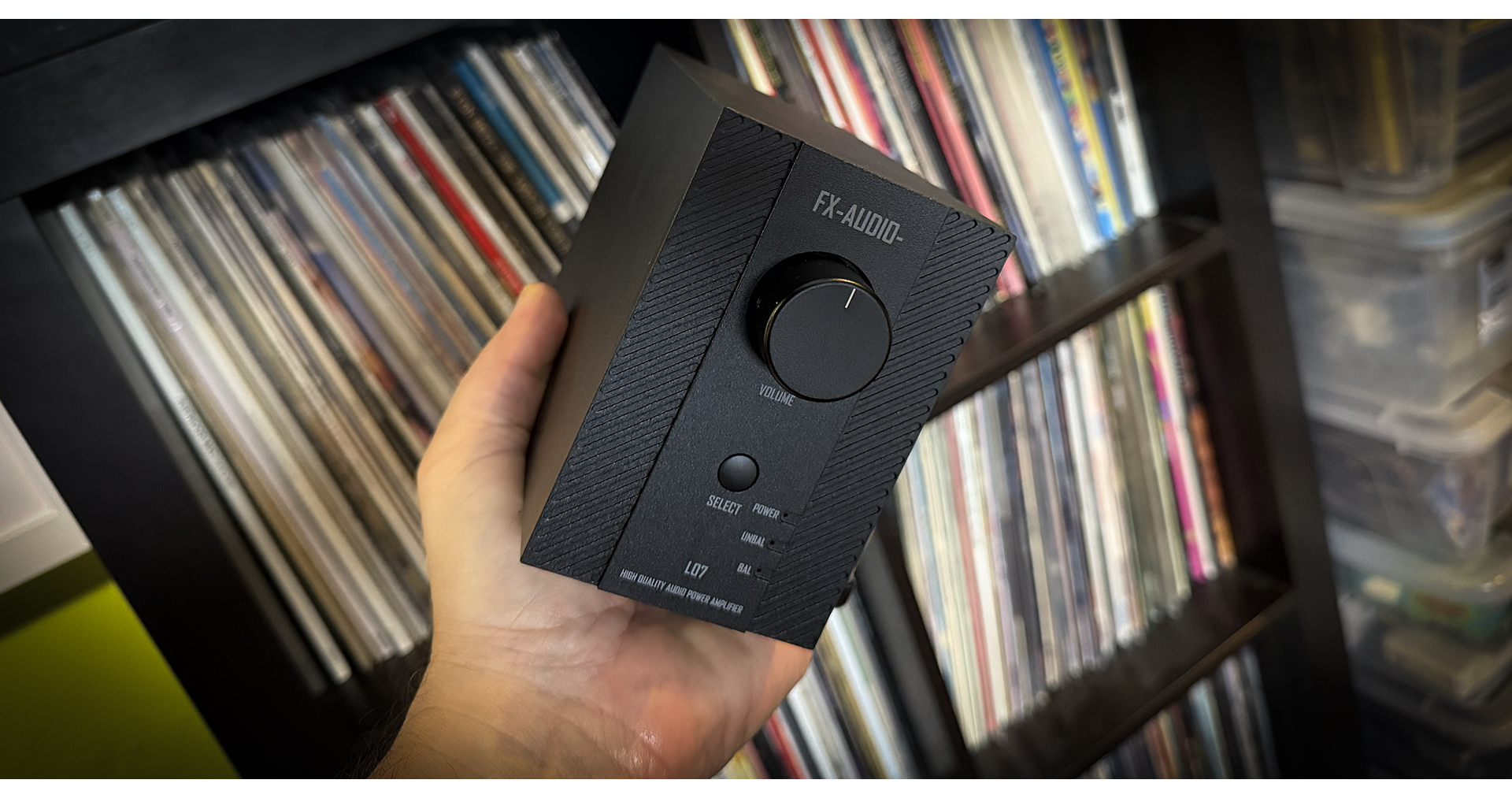
$200 for a 200-watt per channel integrated? That you can hold in the palm of your hand? Really? And it will drive a pair of Magnepans? You bet.
I was really excited about the FX-Audio DS-07 DAC/PRE. We’ve just finished up a Distilled “first look,” and I have listened to both of these enough to give them a Product of the Year award in the upcoming issue.
The L-07 checks off more than the normal number of boxes for an entry-level component. It sounds great, looks great, and is easy to use. It’s easy to get carried away with mega-expensive gear, but what so many of us forget is that we all started our audio journey considerably further down the food chain. I know I did.
This amplifier is a model of design and engineering efficiency. It’s class-D, so the sound is more neutral than warm, but that’s a great place to start. With plenty of power to spare, you should be able to use any speakers with it and get great results – as I mentioned, it drives my Magnepan 2.7X speakers just fine. While you probably won’t pair this amp up with a $10k pair of Magnepans, you might pair it up with a nice pair of used $1,200 Magnepans and have a very musical system.
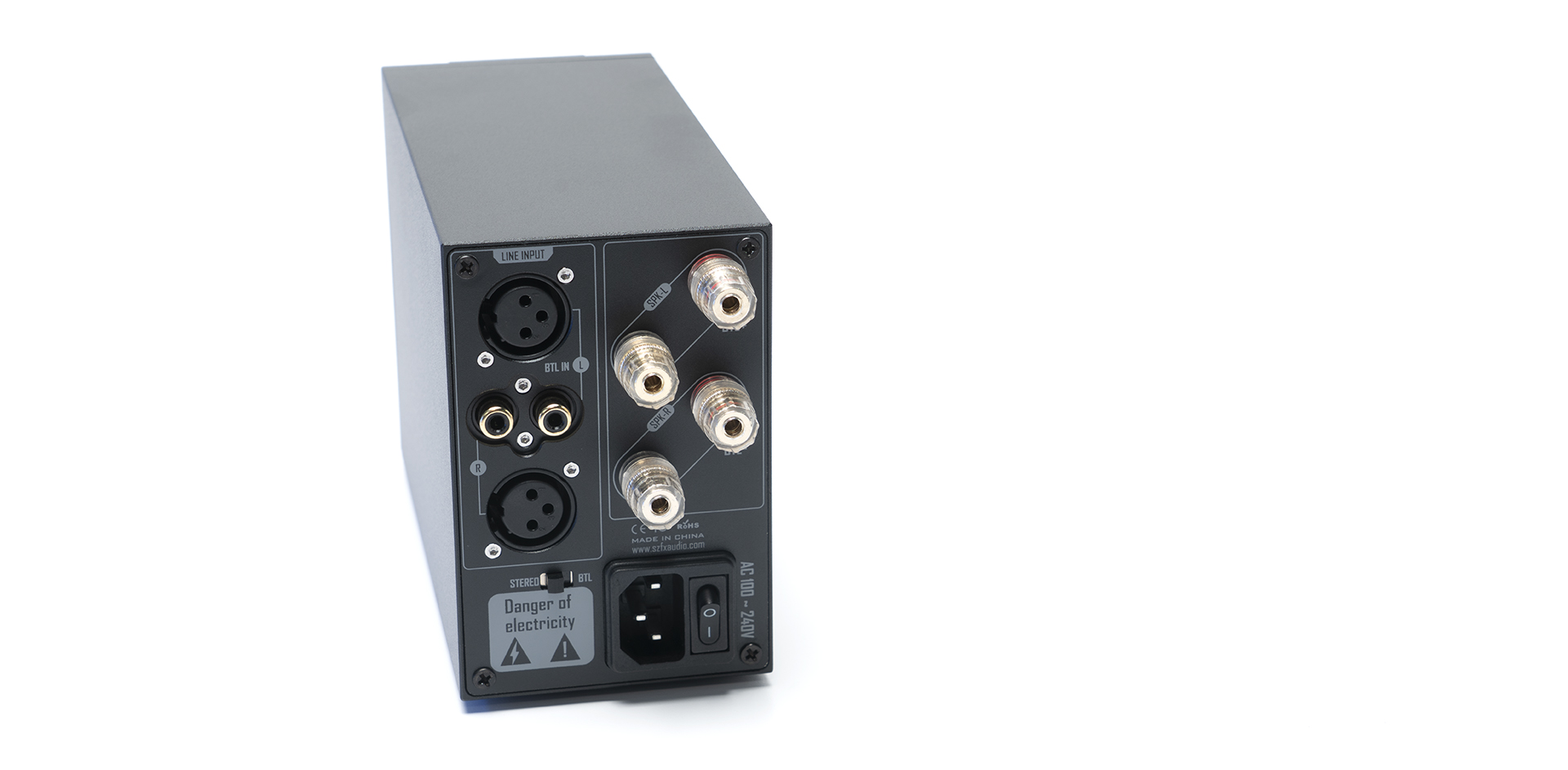
With one balanced and one unbalanced input, it’s easy to connect a phono preamplifier and your favorite DAC (or the great L-07). It also proved to be a great match for my vintage ESS AMT-1b’s out in the garage system. Bass is tight and controlled, and the highs are reasonably smooth. The amplifier also manages to throw a very wide soundstage. We’ll go into further detail and explore some more speaker combinations in the full review.
I love the L-07 because it’s a great place to start your audiophile journey on a reasonable budget. I bought the review samples to keep around as an example of what can truly be accomplished at this level. If you’re a well-heeled audiophile and want to get a friend or a friend’s kid into the game – buy them one of these, and away you go.
If you happen to be a moving coil cartridge enthusiast or are thinking about stepping up (pun intended), you’ll need a way to raise that signal to a level that your current MM stage can handle.
Inexpensive ($400 and under) cartridges usually sound dreadful, with only a few exceptions. However, there are a handful of great $300-$500 MC cartridges. Two of our favorites are the Denon DL-103R ($499) and the Ortofon Quintet Red ($399).
Another interesting option is a Step-Up Transformer (SUT), but again, good ones tend to be between $1,000 and $2,000. For these ears, the SUT option always presents a slightly softer (not that that’s a bad thing) presentation than an active gain stage because there is a lot of wire for that tiny signal to go through. Every approach has its fans.
Recently, some great trans-impedance phono stages have come to market that work in current mode instead of voltage mode. If you’re not super geeky about vinyl, what this means is the current stage frees your MC cartridge from impedance matching and associated resonance effects. The bottom line is that they sound cleaner and more alive. The bad news is that it’s usually a pretty expensive solution.
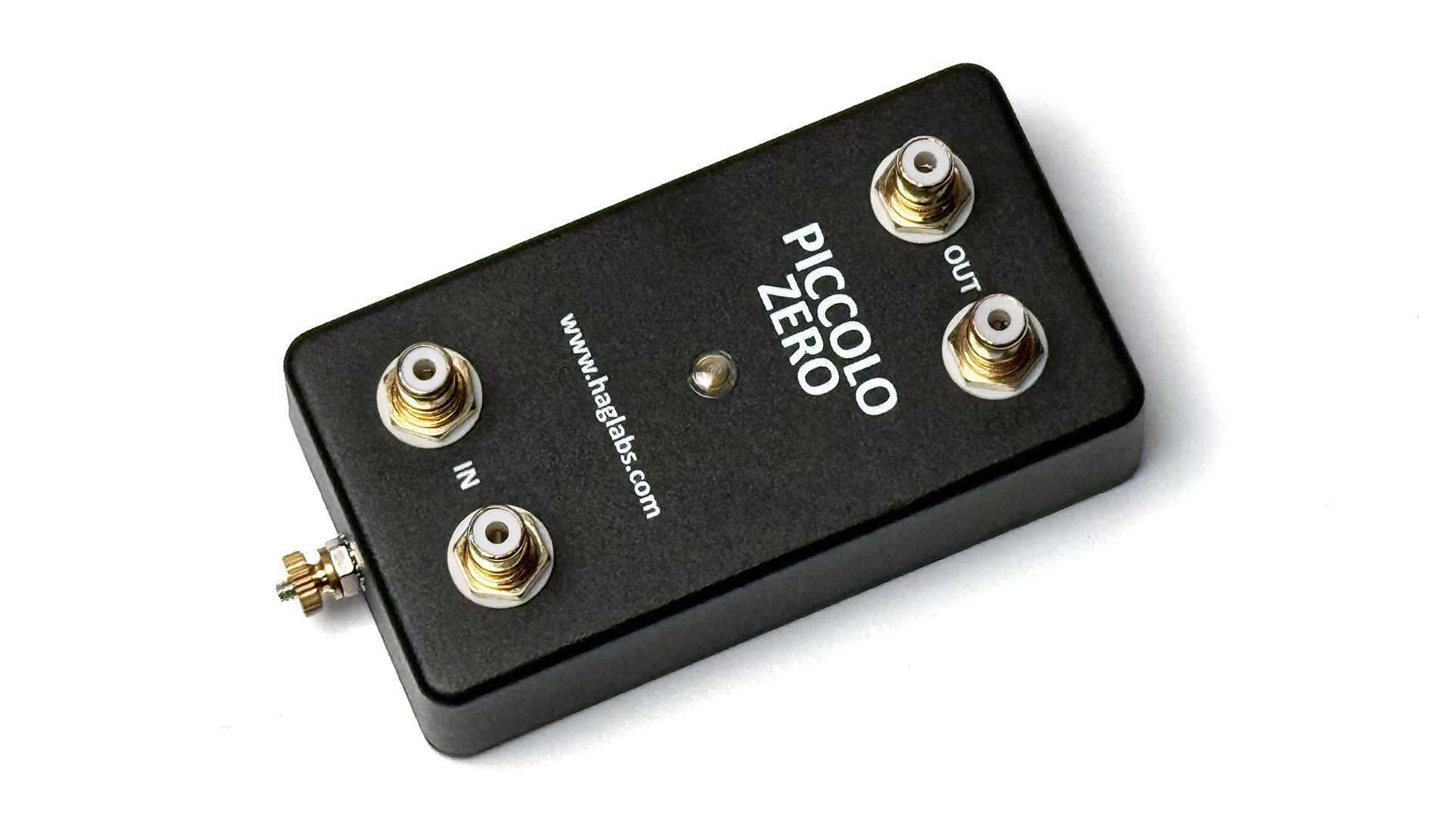
Jim Hagerman is a clever guy known for bringing high-quality, reasonably priced preamplifiers to the world of audio. He keeps costs to the bone by using simple, elegant circuits and casework to a minimum. No one will ever accuse his products of being “audio jewelry.” But we want performance. Right?
$269 gets you a current mode first stage that certainly is the equal or better of all the SUTs I’ve had the pleasure of auditioning. (But I only have so many data points, so keep an open mind)
Plug this into your MM phono preamplifier or MM phono section of your preamp/integrated and get ready for a major audio experience. The PZ is big, dynamic, and quiet. We tried this with the above-mentioned MCs and had amazing results, yet this thing is no slouch with higher-buck cartridges either, plugged into a couple of other tube MM preamplifiers, as well as some vintage gear. Or perhaps, a Hagerman MM phono stage.
Definitely a TONEAudio Exceptional Value Award Winner. You won’t be sorry.
Here’s a link to the Hagerman site, where the shopping cart is. We do not get any compensation from this. Jim is a cool guy, and deserves all the business he gets. We’re happy to pass the good word along!
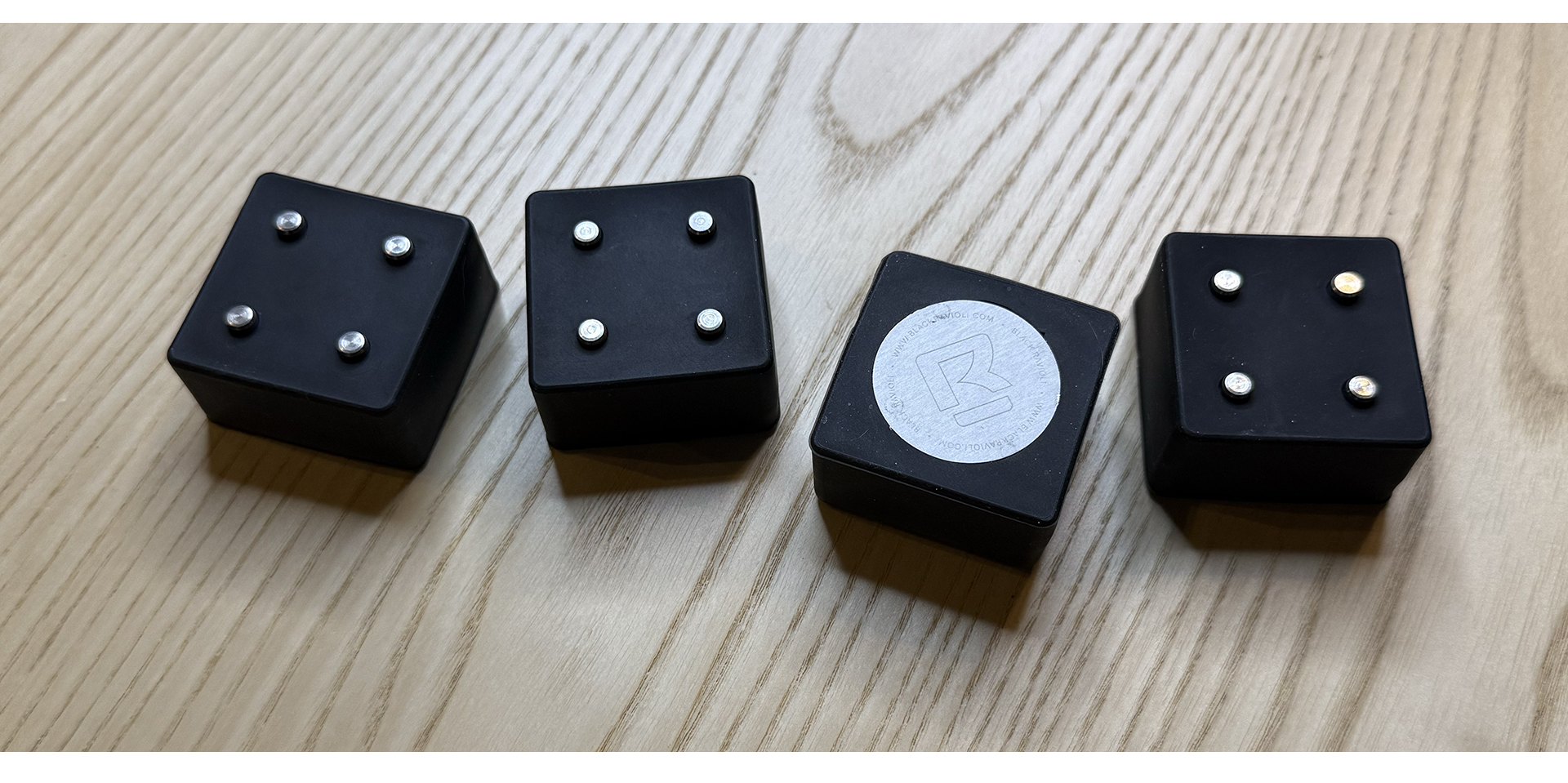
We’re huge fans of Black Ravioli products; over the years, they have kept improving their process.
The latest Big Pad Plus is more efficient at isolating your components from vibrations in the environment that subtly blur the ultimate resolution of your system.
The best thing about a set of these pads is that you don’t know you need them until you have them and take them away. After putting them under about a dozen components in various sizes and levels of performance, they tend to do even more for tube components than solid-solid state. But we still suggest trying a pair under your favorite solid-state component. They also make a nice change for the better under a solid plinth turntable.
However, even placing a set under a used Dynaco PAS-3 significantly improves image focus and lowers the noise floor. Ditto for the PrimaLuna ProLogue ONE and EVO 100 integrated amplifiers.
BR suggests using the pads “pin up,” but our limited experience suggests they work better with components pin up and turntables pin down. Again, try both ways to see what delivers the best result in your system. We also noticed that they offer immediate improvement but improve further after settling in for a day or so. Try your favorite track or two upon installation, 12, 24, and 48 hours later, and see what you think. Do the same thing if you reverse them. A more detailed analysis is coming soon, but we suggest you try a set.
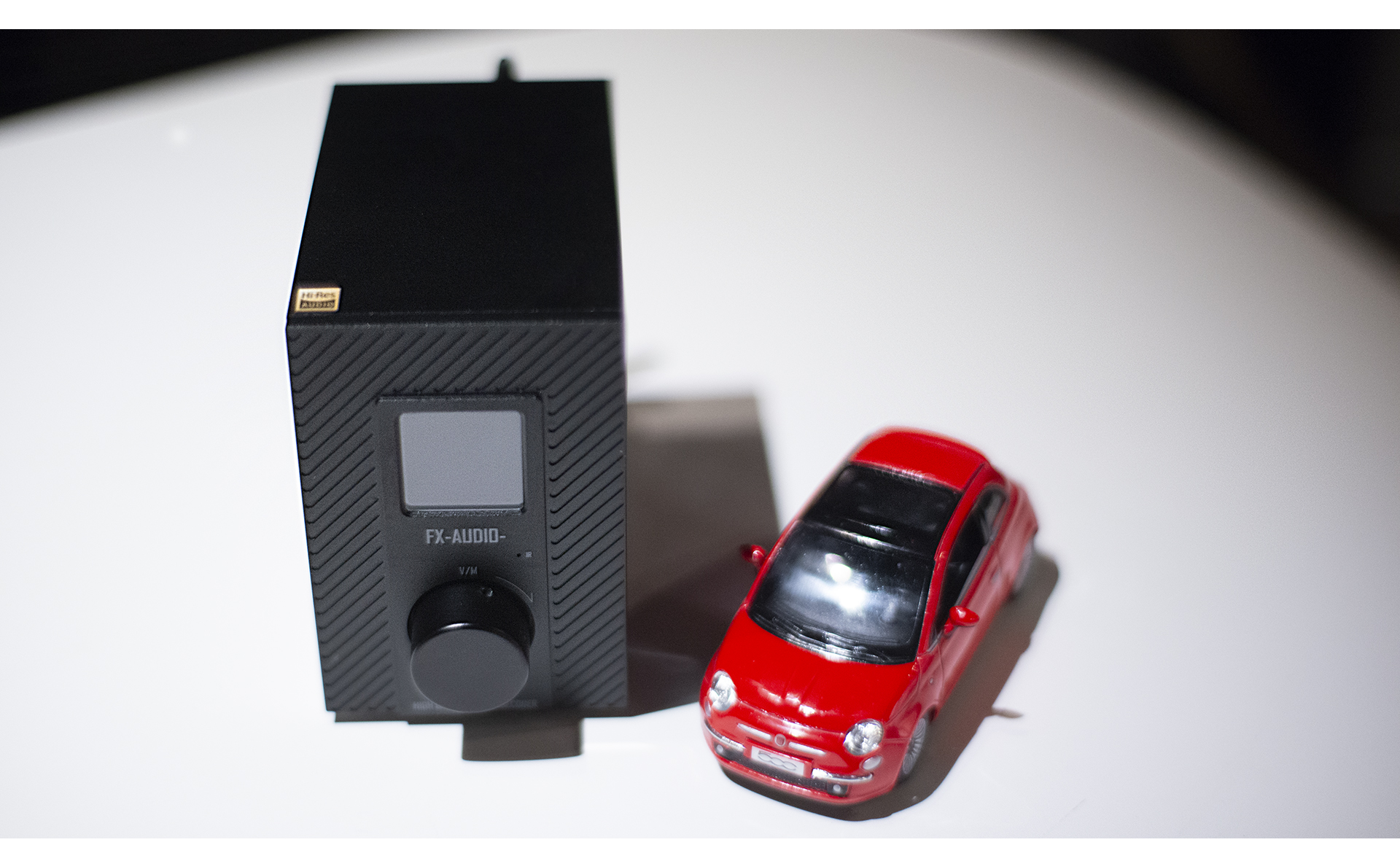
What we’ve got here is a very cool, very compact DAC and Preamplifier that is only about 5 inches tall, 3 inches wide, and 7 inches deep. (125mm x 80mm x 176mm to be exact)
What is so exciting about this mighty little DAC is the performance it delivers for such an approachable cost. Can it deliver 98% of the sound that my dCS Vivaldi does? Of course not, but that’s not the point. What it does offer is an incredible taste of true high-end sound for $199.
Why is that so awesome? Because for $199, you can get in the game. That’s exciting. If you’re new to hifi, you’re probably on a limited budget, and the more sound you can get for your budget, the more you will enjoy your music. Add the FX-Audio L07 amplifier (same price) and a pair of speakers, and you can be rocking for under $1,000 all in. Stream your tunes from your computer or laptop via the built-in USB.
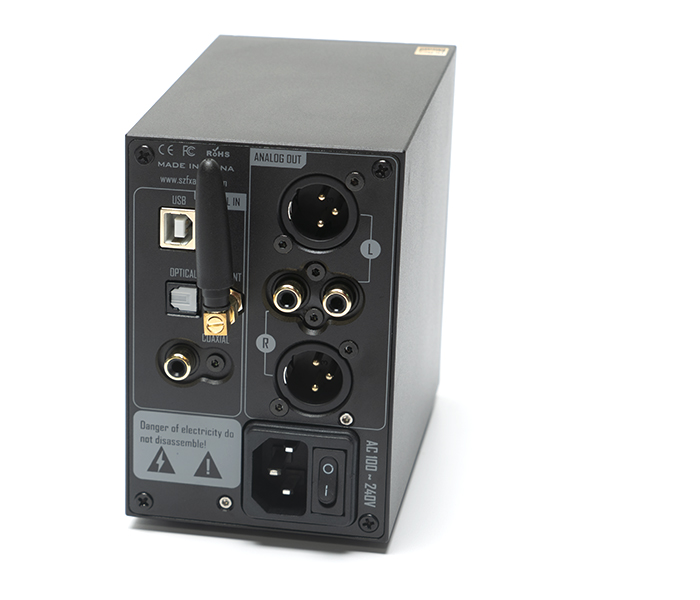
The DS-07 decodes PCM files up to 24/768 and DSD up to DSD512 via the USB input. The coaxial and optical inputs, up to 192kHZ and DSD 64, are still very impressive. It even decodes MQA. The heart of this DAC is an ESS 9068AS chipset, and the analog stage features RCA and XLR outputs.
Overall, sound quality is excellent and on par with a handful of other budget DACs we have here that cost more. Plus, that optical input is a great upgrade for that old CD player you’ve got hanging around. Using it in our garage system with a vintage Sony ES player was a real ear-opener!
We’ve got a full review on the horizon. The DS-07 and the L07 have received Product of the Year awards in the upcoming TONE issue because they deliver so much value. To put this in perspective, back in 1980, when I was finishing college, a Pioneer SX424 was $199. $199 in 2025 dollars is about $43 in 1980. Let that sink in for a minute.
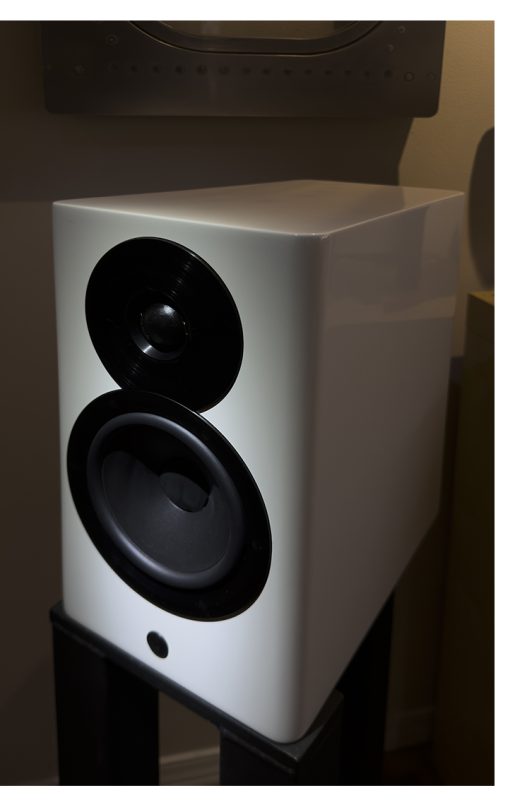
They only come in black. And I’m guessing that’s a part of how Dynaudio can offer this much speaker for this price – they don’t have to build four color combinations. Utilizing the same Esotar 3 tweeter as the $13k/pair Confidence 20 that is a personal favorite and a personal reference here at TONE, the Contour 20 has a similar but unique (to this model) 7-inch woofer.
Playing material with limited bass extension, it might be tough to tell the two apart at first listen, but the more expensive Confidence 20 plays louder, deeper, and with more authority. Let’s suffice it to say that Dynaudio has given you as much of the Confidence 20 in a similarly styled (but lighter) cabinet as they can at this price. Dynaudio’s top qualities: ease and smoothness, while retaining a high level of resolution – combined with the ability to create an enormous soundstage are all intact here. Also worth noting, these speakers are designed and built in Denmark.
As with every Dynaudio monitor we’ve reviewed, we suggest adding their stands to the package. They are custom-fit to the speakers, easily filled with sand or your favorite media to increase mass (suggested), and they look great. Why dilute that Danish style with something else?
The Contour 20s have only been here for a few days, but playing 24/7 to get hours on the clock reveals a highly musical character that should be ideally suited to small to medium-sized rooms. Do you need a subwoofer? That depends on the size of your room, how much drive your amplifier has, and how loud you need to listen. Though the sensitivity spec (86dB/1-watt) might have you guessing these require big power – it’s all about quality. With excellent results, they have already been used with a few integrated amplifiers in the 30wpc to 80wpc range.
We’ll have a full review shortly, but the initial take is highly recommended.
$8,000/pair Stand 20 stands/ adapter plate $599/pair (optional)
These are our picks in the last 14 months or so for our favorite products to go in smaller environments where space is at a premium, and an extra splash of style is a bonus. A few of these products’ full reviews will be posted in the next couple of weeks, but we wanted to get this out there to start the year on a positive. Stop by the TONE Facebook page (or email) and let us know what you think.
Nothing is better for the smallest of spaces than no components at all – just a pair of powered speakers. And Dynaudio’s Focus 10s (the smallest of the Focus series) not only fit anywhere, they deliver top quality sound. This is the sound you’d expect from separate components, and you could easily spend what a pair of Focus 10s will set you back on cables for an amp, preamp, and streaming DAC. They are available in the walnut you see here, black, and (our favorite) white. Bonus features include a subwoofer output, and inputs for an analog source as well as HDMI. In addition to the built in DSP to optimize for your room size and speaker placement, these will also work with a DIRAC subscription for the ultimate in room optimization. https://dynaudio.com/home-audio/focus/focus-10
Vera-Fi Audio Caldera 10 and 12 subwoofers $199, and $399
Speaking of subwoofers, if you need more bass in your limited space – and you’re on somewhat of a limited budget, these Vera-Fi subs both deliver top in class performance. Both are robustly constructed, with top quality drivers. The 10 delivers 200 watts, while the 12 offers up 500 watts. And they both feature Class AB linear amplifiers, with adjustments for phase, output level and crossover. https://verafiaudiollc.com/products/vanguard-caldera-10-active-subwoofer
Rega Planar 2 with ND3 cartridge $795
There may be a few P2’s left out there bundled with Rega’s Carbon cartridge, but for $25 more, you can have the ND3 MM cart, featuring a Neodymium magnet structure. Trust us, it’s WAY better and more involving. And just when you thought Rega couldn’t make the P2 any better. This is the perfect place to begin your vinyl journey – and it comes in a few more colors too. https://www.rega.co.uk/products/planar-2
HIFI Rose RS 520 Integrated Amplifier $3,695
We love integrateds, and the HiFi Rose RS 520 does nearly everything. With a built in streamer, DAC, 200 watt per channel power amplifier, and an internal bay for NAS storage, what else could you ask for? Well, it’s got an analog input to connect a turntable, and a parametric EQ. Awesome. In addition to native support for every digital file going (and it’s a ROON endpoint) the RS 520 also works as a 4k video streamer. Looks great, sounds great, and thanks to that big 12.6″ touch panel display is incredibly easy to use. Just add your favorite speakers. https://hifirose.com/RS520
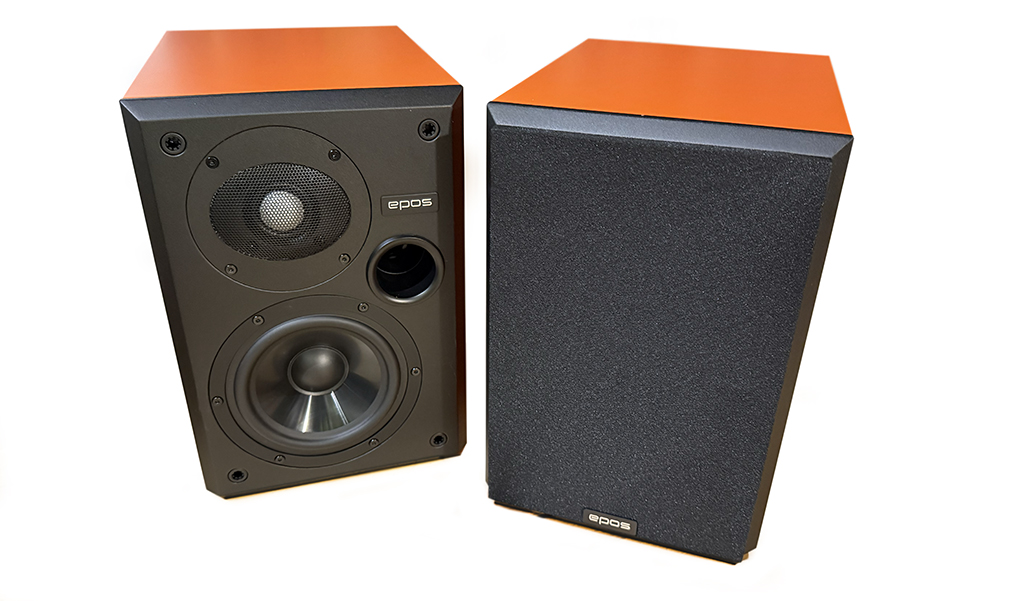
EPOS ES-7N speakers $2,195/pr. (stands extra)
Speaking of great small speakers – the EPOS ES-7Ns come from the team of Karl-Heinz Fink, the man who designed the Fink team Kim and Borg. Both award winners at TONEAudio and outstanding speakers. The ES-7Ns show what can be accomplished with careful attention to details and construction – resulting in an incredibly high-quality speaker that doesn’t take up much space. Or do too much damage to your credit card balance. Plus, our publisher always has a soft spot for anything orange. https://epos-loudspeakers.com/products/es-7n/
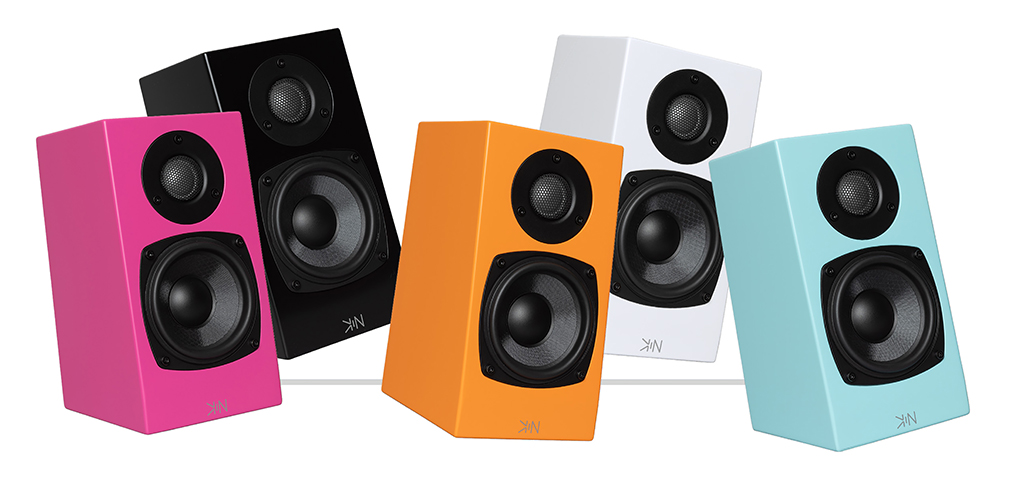
Totem Kin One Speakers $595/pr. (stands extra)
We are huge fans of the powered Kin Play speakers from Totem, and this year they’ve made a smaller, unpowered version for those wanting to use their own amplification. As you can see by the bold color choices, these tiny 4-inch, two way speakers are all business – using the same tech as Totem’s flagship speakers. They may be small, but there are no compromises in their performance. (and free shipping!) https://kinbytotem.com/
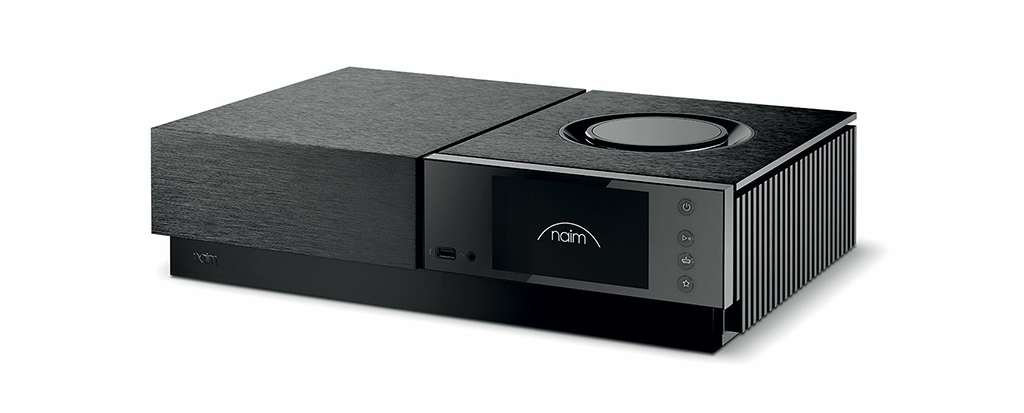
Naim Uniti NOVA PE $9,995
Naim’s Uniti series just keeps getting more diverse as the years go by. Twice the footprint of the smaller Uniti models, the PE (Power Edition) serves up 250 watts per channel with Naim’s latest class D amplification along with your favorite digital files. Every aspect of the NOVA PE bears the influence of Naim’s top of the line Statement components, from the display to the industry’s most sumptuous volume control. Not to mention the cool factor when you turn it on. Of course, it’s a perfect match for a pair of Focal speakers (we’d suggest a pair of Sopra 3s) but it plays well with anything you care to connect it up to. And there are four analog inputs (two 5-pin DIN and two RCA) so you can add any other sources you might have in mind. https://www.naimaudio.com/products/nova-power-edition
Audio Art Copper Cryo Interconnects and Speaker cables $500/1M Pair (IC) $600/8ft Pair (speaker)
We crossed paths with Audio Art Cables back in the first year of TONE’s existence, and proclaimed their original interconnects and speaker cables Exceptional Value Awards immediately. They’ve grown tremendously over the years, building their reputation on amazing performance, top value, and excellent customer service as well. We are very happy to say that their AAC Copper Cryo cables are an even better value – delivering high performance wire at a very realistic price point. https://audioartcable.com/
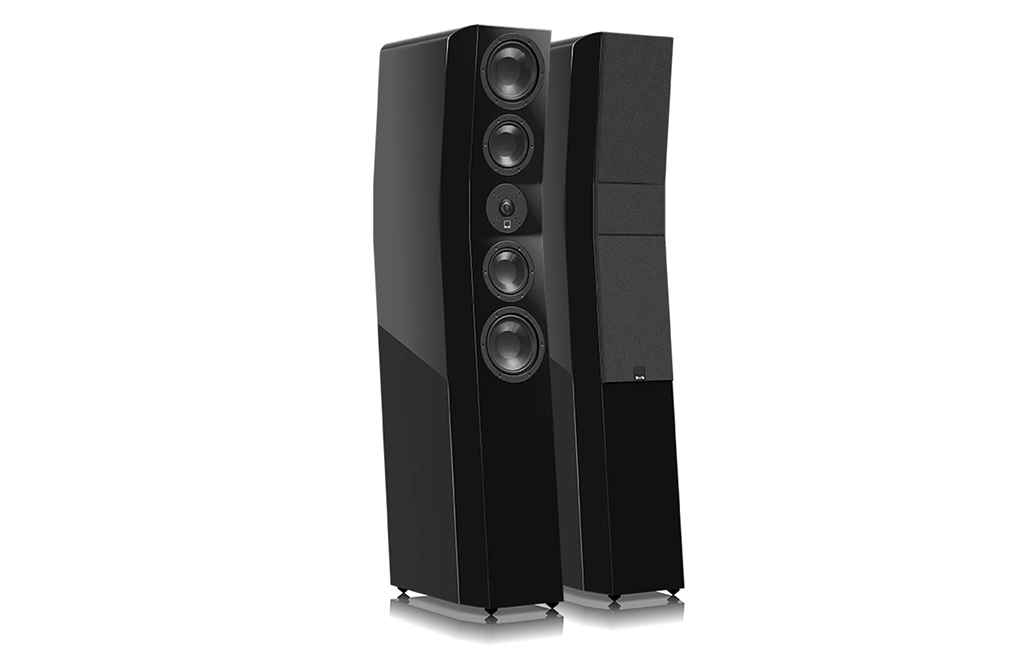
SVS Ultra Evolution Tower $1,499.99 (each)
We have always been fans of SVS, but their latest crop of Ultra Evolution speakers make this company a serious competitor for some major audiophile brands that charge considerably more for less. Add a level of customer service that is way better than you get from the Porsche dealer, and it all adds up to a winning combination. Highly recommended as a fantastic anchor to your system. And if you need more bass, you can step up to one of the bigger models, or get a sub. (or two) You know where to go for that, right? https://www.svsound.com/products/ultra-evolution-tower
Think about cables for a few minutes. Then think about having only a pair of power cords in your system. If you’re in a small space, less is usually more, so this is not a bad thing for you.
The Dynaudio Focus 10 speakers only need a pair of power cords. You can link the two speakers together to get slightly higher performance from the high resolution digital input if you’d like, and you can add a turntable to the analog input. However, if you only want to stream digital files up to 24/96 resolution, two power cords is all you need. Nice.
Fortunately, these compact (7 1/8″ W x 12 3/8″ H x 10 1/4″ D) speakers, weighing 16 1/2 pounds each will fit nearly anywhere.
They also come with a built-in wireless (or wired) streaming DAC that is also a ROON – approved endpoint. This makes them the perfect powered music system. A subwoofer out jack is also included to use them with a sub to make a formidable 2.1 system. Even without a sub, Dynaudio’s built-in DSP delivers solid bass down to about 40hZ, and if you take advantage of DIRAC room correction, a little lower at moderate volume levels. These do not disappoint in any way – though we really like them with a sub. While we used them with a REL sub, Dynaudio makes their own subs that will be a perfect match with the Focus 10s.
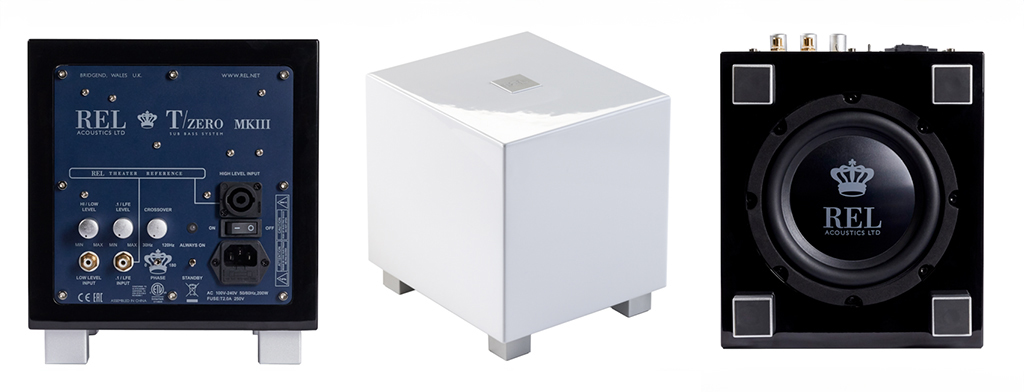
In our 13 x 18 foot listening room, the combination of the Focus 10s with a (white, of course) REL S/510 subwoofer, we were able to play our favorite hip-hop, and electronica tracks louder than you probably need to listen to them without fatigue.
Thanks to Dynaudio’s expertise in the powered studio monitor world, the Focus 10s deliver a huge soundstage in a moderate sized room that will have you swearing you’re listening to a big pair of floorstanders. Considering we used the massive, 7-foot tall Dynaudio Evidence Platinum speakers as our reference for a couple of years, we say with confidence that the Focus 10s play BIG.
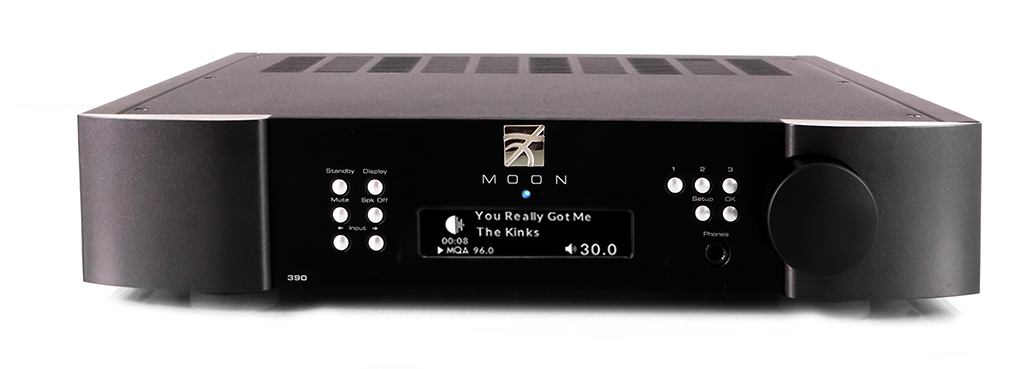
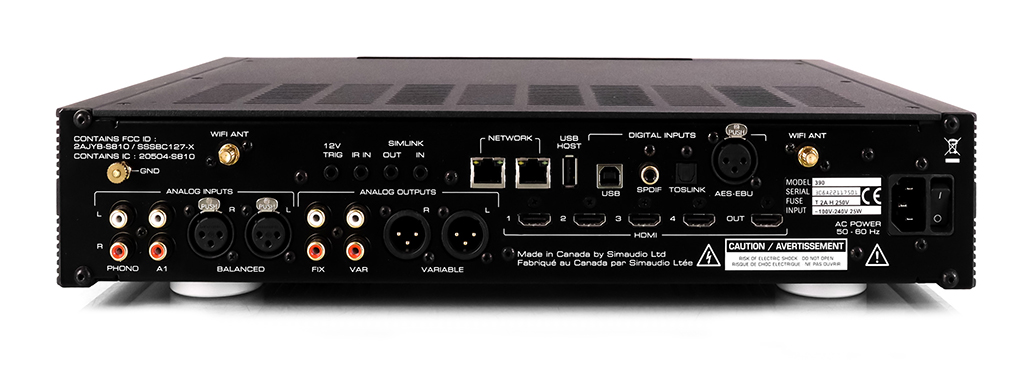
If you’d like a high-performance system with a minimal box count, consider the Sim Audio 390.
It’s a line preamplifier, streaming DAC, headphone amplifier and MM/MC phono preamplifier. It even has Bluetooth and HDMI inputs. Sim gear is as bulletproof as it comes. Having visited their factory twice now, the service department was not busy at all – so that’s a great sign.
Here at TONE, we’ve used a number of Sim pieces as reference components and always give them a thumb up when friends and readers ask the inevitable question.
Thanks to balanced and RCA outputs, you can combine the 390 with anyone’s power amplifier. All those digital inputs mean you can plug anything in to the 390 too. It’s ROON ready, should you need that functionality, and the headphone amplifier section is very good.
Overall, the sound quality is dynamic, neutral, and very quiet. We paired our review sample up (when we had one of these in house) with a number of different amplifiers from other manufactures’ with excellent result. Personally, I love this pre with a great tube amp, but that’s me. The phono stage works as well as anything you’d get in a $1,000 external box, and when you consider you are getting four components on one chassis that all work great together, you just saved a tidy sum not buying three more sets of interconnects and power cords.
For what it’s worth, when we did test the 390 at TONE, we were able to run a 25 foot pair of balanced interconnects with no problem, so if you wanted to place your 390 (and maybe a turntable) one place in your living/listening room, and a power amplifier down near the speakers, it’s no problem at all.
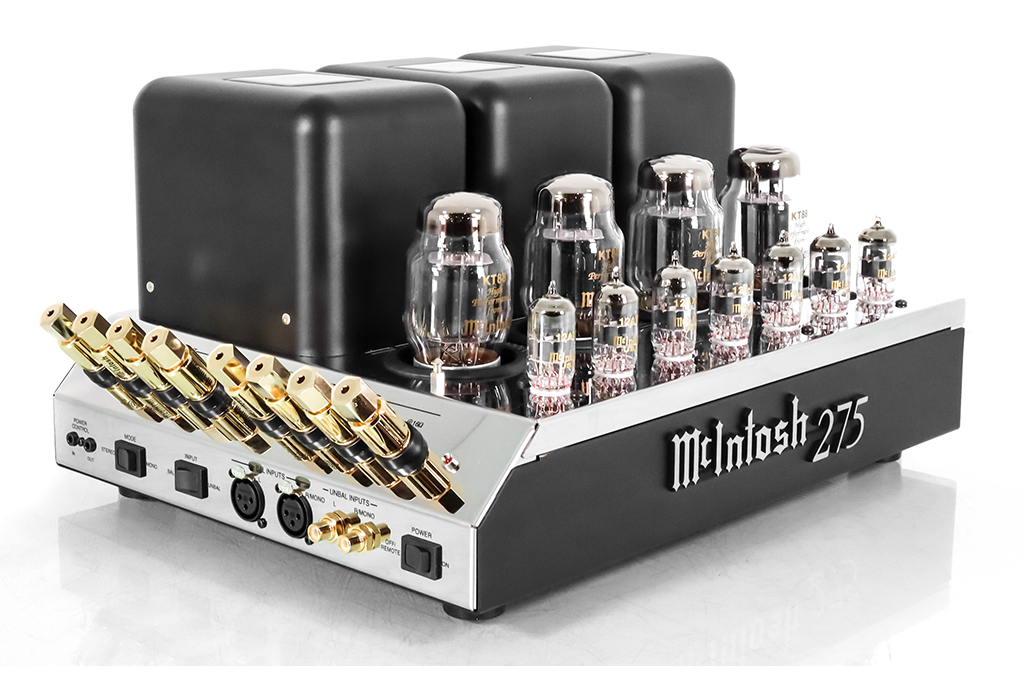
The MC275 from McIntosh is not only one of the all time classics, when it comes to vacuum tube amplifiers, it is quite possibly one of (if not the best) of their tube amps, in terms of value, sonics, and build quality.
This amplifier on so many levels is a king, because while it is not the very last word in dynamics or extension, it’s so darn good everywhere it’s impossible to fault. The 275 can also be bridged to become a 150 watt monoblock, adding to its versatility. The early versions of this amplifier had crazy barrier terminals for your speakers, inline level controls and RCA jacks only. Forget one of those unless you just want a museum piece.
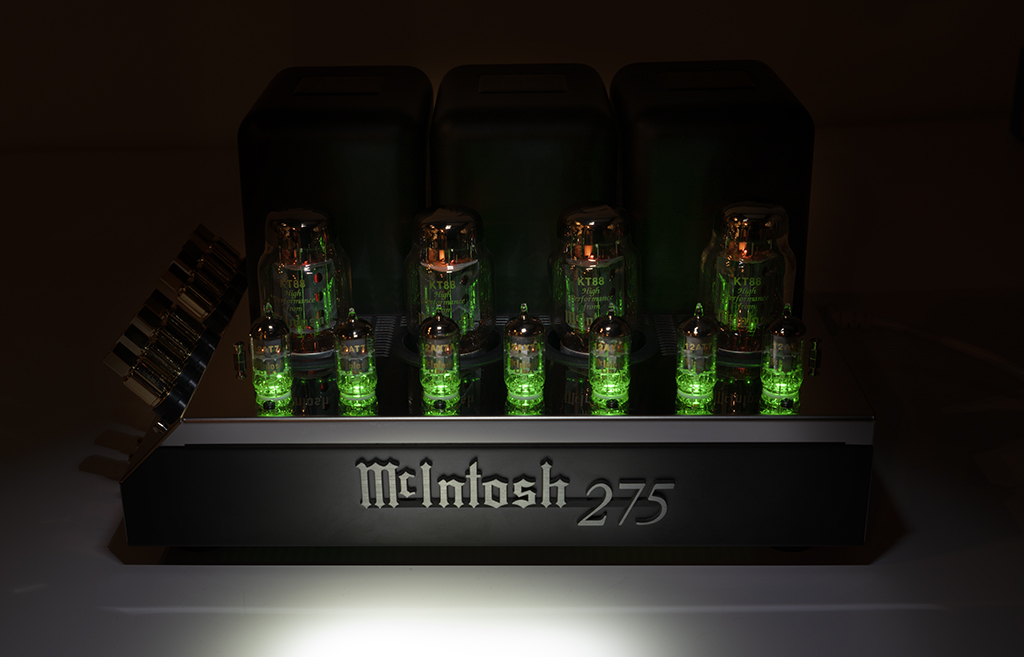
A current model like this is definitely the droid you want. Thanks to a fixed bias setup, the four KT88 tubes will never need adjustment, and while rated at 75 watts per channel, I’ve never read a review with measurements where this amplifier didn’t produce 90-95 per. Best of all, Mac tube amps are always easy on tubes, so you won’t be changing them often. There is a tube cage, should you need to protect kids, dogs, and cats, but if you can get away without it, bask in the tube glow!
One thing that will be a love or hate, is the way the tubes glow green from underneath, thanks to LEDs. Think stanced Hondas drifting around in a parking lot glow. Fortunately, if you’d like your MC275 to be OG and just see the tube filaments, you can switch the LEDs off.
This amplifier has an ease about it, that few other tube power amplifiers do, and regardless of speakers chosen, the dedication to a natural, slightly on the warm side overall sound shows you why so many people all over the world love the MC275.
Build quality is top shelf, and McIntosh still winds their transformers in-house, in the Binghamton, NY facilities. By the same experts that have been doing it for decades. Another part of Mc that makes these amps so desireable.
TMR has two of these in stock right now, and this is a killer price. You’ll want to keep it forever.
Phil Sklar, Co-Founder and CEO of the National Bobblehead Hall of Fame and Museum has just let me know that tomorrow, January 7, is National Bobblehead Day.
Located in my home town of Milwaukee, Wisconsin, they’ve introduced three new Margaritaville Bobbleheads: The Parrot, Shark and LIzard.
Feel free to click on this link to visit their shop!
With just over three months to go, I’ve been asked to give an hour talk about vintage audio at this years Axpona.
I’ll be talking about your vintage journey, what to expect if you’re new to all this, repair issues, and whatever else comes to mind. I look forward to seeing you there – it will be on Saturday, April 12.
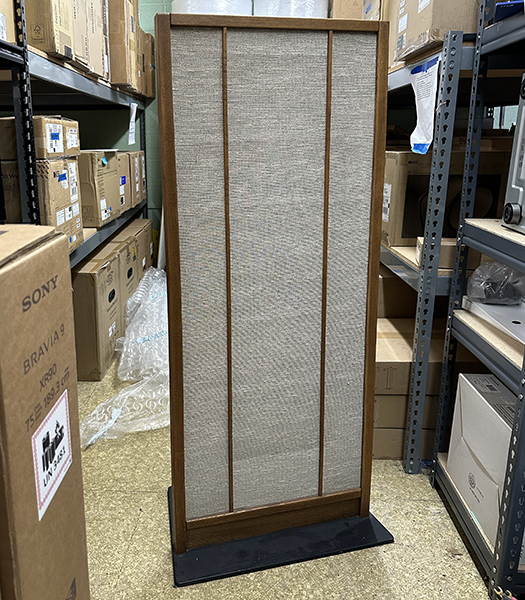
Visiting Echo Audio in Portland, Oregon always turns up something intriguing from my audio journey, and this day would be no different. Lurking in the back room was a pair of Magnepan MGII speakers that a customer had recently traded in. As Philip J. Fry in Futurama says, “take my money.” But I was a day too late, they had already been snagged by another customer.
Back in the early 80s when selling JBL L-100s (the originals) was a big part of my day job, and a pair of ESS AMT-1 Towers were my reference speakers, these big panels from a relatively new company in Minnesota redefined my perspective on what a speaker was capable of. Little did I know at the time that those Heil AMT tweeters I was digging would prepare me for what was to come.
Back in Milwaukee, Wisconsin my local high-end dealer, Audio Emporium was an amazing place just to hang out and take in all the latest and greatest things at a time that the industry was growing at a rapid pace. At one end of their main listening room was a pair of three panel speakers that looked like a Herman Miller room divider – the mighty Tympani. I’m pretty sure these were $1,995 a pair and were being driven by a big Threshold amplifier, either the 400A or the 4000A.
The sound was breathtaking and huge. I made the salesman, Jonathan Spelt (now co-owner of Ultra Fidelis in Milwaukee, Wisconsin) play “Pimp” by The Tubes from their recently released Young and Rich album. Classical music was playing earlier, so Spelt rolled his eyes at my taste in music. (as he often did back then)
While a $1,995 pair of speakers was out of reach that day, a customer had just traded in his MGIIs in for a pair of Tympanis, and they had a three- or four-hundred-dollar price tag affixed. Perfect. I honestly don’t remember how I got those nearly six-foot-tall speakers home, but I was excited. Unfortunately, at home they did not sound as breathtaking through my Nakamichi 600 series components as they did at AE. This would result in many more trips to AE and a radical shift in my personal priorities – but that’s another story for another day.
Today’s Magnepans
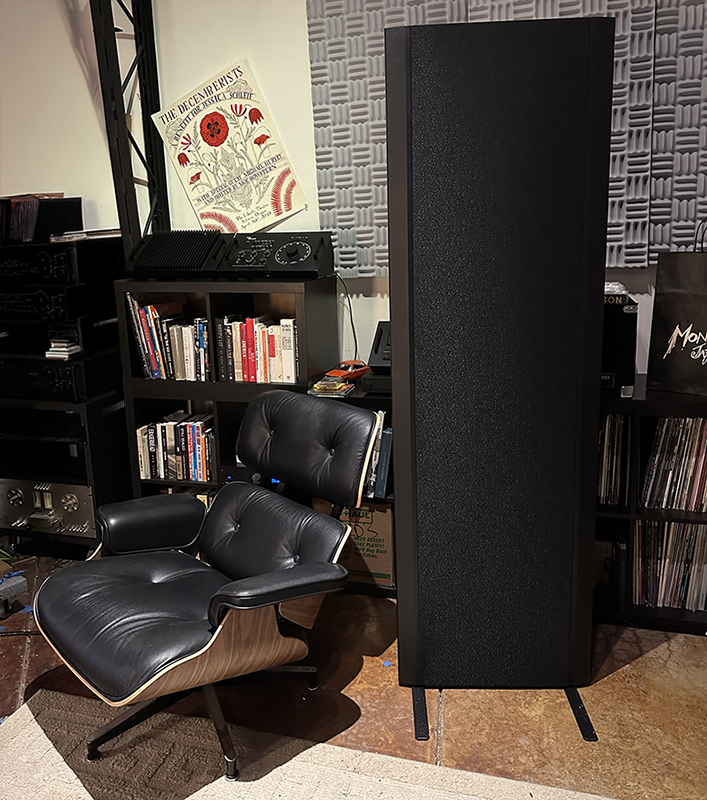
Forty-five years later, Magnepans are still built in Minnesota, not too far away from Audio Research, and they are still the champions of high-end audio value. Their basic look has been subtly refined, but much has gone on underneath the grille cloth.
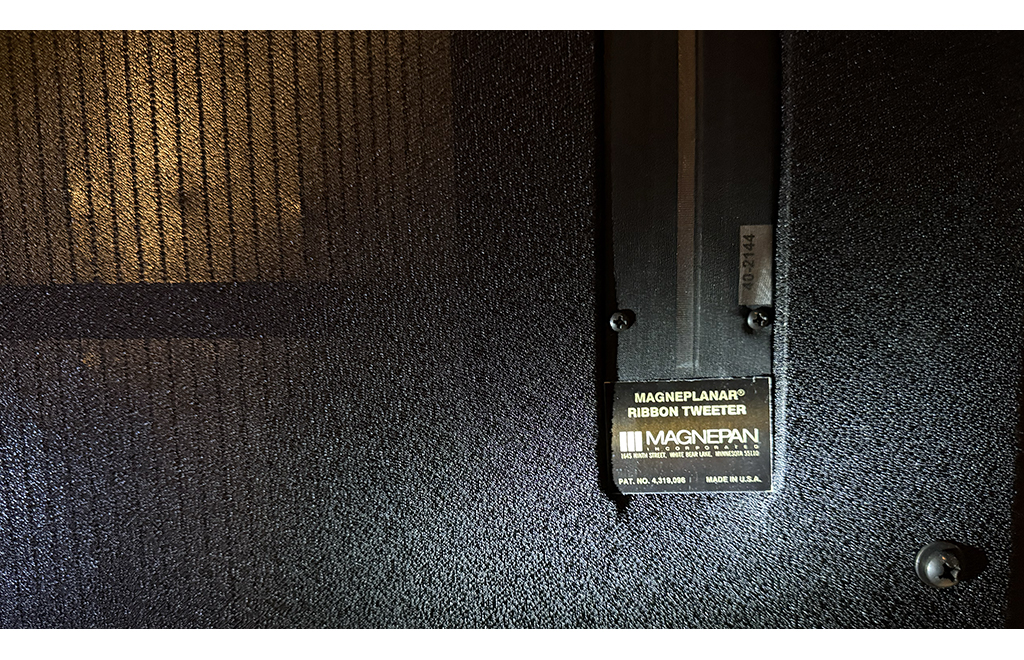
Where an electrostatic speaker (think MartinLogan or Quad) uses a thin membrane coated with a conductive material, suspended between two charged panels (a grid in the Quads and the perforated metal in the ML) moving back and forth to push air, the Magnepans use a membrane bonded with a foil very similar to that in a ribbon driver, pushed and pulled by a fixed traditional magnet. Magenpan refers to this as a “quasi-ribbon design.” The 2.7x uses a quasi-ribbon woofer and midrange, mated to a 40-inch-tall ribbon tweeter, going nearly the full height of the 2.7.
The original Magnepan speakers had wires embedded into the membrane, which produced a slower sound than current Magnepans, and were prone to separation if owners placed them too close to windows with direct sunlight. A testament to Magnepans longevity and customer service, you can still get most vintage Magnepan speakers repaired and brought back to spec. In a world of new speaker companies emerging that merely source box, crossover and components from a Chinese factory, this is value few companies of any kind provide today. It’s another reason that Magnepans are a long-term purchase for so many music lovers. I’ve met a lot of audio enthusiasts over the years that started out with their Dad’s Magnepans.
Auto enthusiasts often quip, “there’s no replacement for displacement.” I’ve always felt the same way with panel speakers – the more panel area, the more lifelike they sound. That’s not quite as cool, is it? Exciting and dynamic as ribbon tweeters sound, they often come across as directional because they just don’t have the surface area that the Magnepan tweeter has.
Setup
If you are someone that does not read manuals or quick start guides, listen up:
When unpacking your Magnepans, you will notice a thin metal strip covering the ribbon tweeter on the rear side. Remove this extremely slowly with extreme care. Otherwise the pressure will destroy the ribbon tweeter element! (And I’m guessing this isn’t covered by warranty.). You’ve been warned.
Magnepan says to face the tweeters to the inside of the setup; moving them to the outside edges will make the stereo image more diffuse. This has always been my experience with the speakers as well. Much like other speakers, they suggest forming an equilateral triangle with your listening position, and more than three feet from the back wall.
In most rooms you will get a wider, more open sound stage if you can take advantage of the large wall. Once they start getting closer together, they start to sound like a big mono speaker, losing their ability to image as well. The triangle is a great place to start but optimizing the rear wall placement for the best balance of bass reinforcement with bass to midrange smoothness first and then moving them wider apart until the image just falls apart will make for the maximum stereo image. Having mine on a 24 foot wall allowed for a slightly wider setup, because the side walls were still not coming into play.
Magnepan claims response from 40-30kHz =/- 3db, and while we don’t do formal measurements, listening to a series of test tones sweeping down from 100 to 30 Hz, 10 Hz at a time the 50Hz tone is solid, the 40 tapers off a bit, and by 30Hz, no meaningful output.
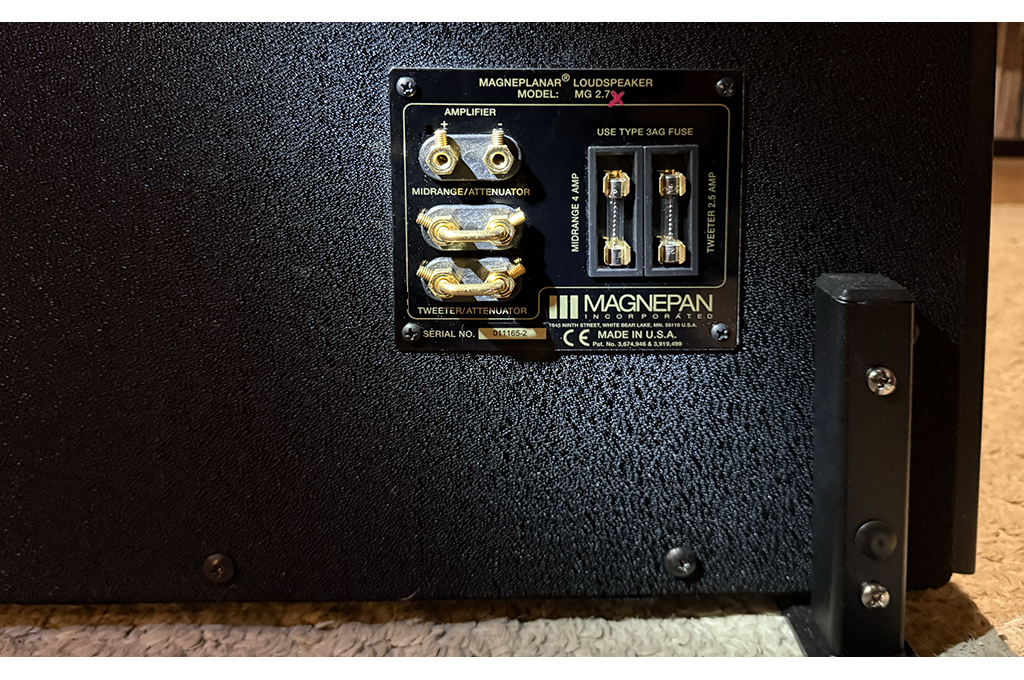
There are jumpers between the woofers and midrange drivers, as well as the midrange and tweeter, so that they can be wired with single conductor speaker cables, but you will need bananas, (or adaptors) and they will have to be relatively small. The jacks that are used to plug the speakers in use a small set screw, so use the supplied hex wrench to screw them all the way out and insert the bananas with extreme care. Do not wiggle them side to side, or you may damage the circuit board they are attached to.
Amplifier choices
The 2.7x has a claimed sensitivity of 86dB/1-watt, so they are moderately inefficient. However, unlike some of the early Magnepan ribbon and quasi-ribbon designs, these speakers are very easy to drive. Great results are achieved with any fairly robust amplifier, tube or solid-state with about 80 watts per channel or more. Listening began with the BAT VK80i power amplifier which delivers about 75 watts per channel, but has speaker taps to accommodate lower impedance speakers. The PrimaLuna EVO 400 monos with KT150s deliver close to 200 watts per channel, and their ever so slight warmth in the mid bass region really suits the Magnepans well.
With three versions of Pass Labs amplifiers on hand (the XA60.8 monos, the XA200.8 monos, and the X600.8 monos) all provide excellent but different results. The XA amplifiers are full class A designs and sound more like tubes, where the X-series amplifier runs class A for about the first 50 watts, and AB for the rest. Personal preference, I’d probably choose the AB amp and give up a little warmth for the extra snap the AB amplifier provides.
Fantastic results was also achieved with the CH Precision i1 integrated, and the Java Hifi Double Shot Class D power amplifier (400 wpc) This too was a snappy, dynamic choice. Where I was Class D adverse for years, these amplifiers with their large power reserves really make the Magnepans come alive in a way they do not with lower powered amplifiers.
As always, experiment!
Listening
For old times’ sake, critical listening had to begin with The Tubes. Aural memory is often considered fleeting, yet when you’ve listened to several components from a manufacturer over decades, a generational memory evolves. And, it wasn’t that long ago I had a pair of Tympanis. (Purchased from Echo, of course)
The original Magnepans because of higher mass drivers, are not as agile with fast transients as the current models. Yet, when they were introduced, were lightning fast compared to cone and box designs of the time. The lightness of the quasi-ribbon driver removes the mid-bass flatness that Magnepans used to have. Listening to kick drums, and various other instruments reveals a very lifelike rendition, and the blend with the full ribbon tweeter is a lovely match indeed.
The signature Magnepan sonic size is still there in abundance, providing room filling sound, and while box and cone speakers have improved tremendously, there’s still something incredible about the sound field that a big panel can create in a room.
Moving along to more favorite tracks, weighing heavily on layered vocals, acoustic instruments, and smaller scale classical music plays to the spacious strength of the 2.7x. Listen to Joni Mitchell or CSN and you might never need to hear a mini monitor again. That sheer sonic size is captivating.
The current Magnepans go deeper with more clarity than past models as well. These still aren’t speakers you’re going to play Cardi B on at club level, but I did listen to a lot of Lenny Kravitz without an issue. Good as todays speaker manufacturers have become at eliminating cabinet-related effects, no cabinet at all is a unique experience.
More tech
While I haven’t heard the stock 2.7i ($6,000/pair) I have spent plenty of time with the 1.7 and it’s not as much about one particular virtue, the x delivers clarity, resolution, and tonal accuracy that the I does not. Is it worth another $4,000? I think it does. Some might ask the question “why not just eliminate the I,” and leave crazed audiophiles with only one choice?
To Magnepan’s credit, I feel leaving both models makes it a lot easier to approach their products. You may just not have ten grand for speakers right now. Being able to get into the i model and get started, leaves you an upgrade path, buying into the form factor you want right now.
Because the 2.7s are only about 50 pounds each, when you want to upgrade to the x model, (which is a straight $4,000 upgrade) you’re only out the cost of shipping them back to the factory. If by some chance you’ve managed to pick up a used pair, the x model becomes an even better value proposition.
As with every other panel speaker I’ve owned, which model to pick is usually more about room size. The more volume your room has, the more panel area you’ll need to fill it. This is why you might prefer a 2.7 to one of the larger or smaller models. That said, the 2.7s do a very good job creating a large three-dimensional image in my 24 x 36-foot room. They seemed slightly constricted in my 13 x 18-foot living room – I remember having excellent luck with the 1.7s in that room.
The magic of the x model is the attention paid to the upgrades over the i model. Enthusiasts have been making their own modifications to their Magnepans for years, installing better crossover components (resistors, capacitors, inductors, and wire) that hasn’t been sanctioned by the factory. Just as Mercedes-Benz eventually bought AMG and made their tweeks factory standard models (with full warranty) the x model Magnepans have this level of attention to parts quality, component matching, and assembly detail to bear. I know what I’d rather have.
This proves a couple of things – we were on to something all along, and the robustness of the actual Magneplanar driver is over engineered and capable of much more performance that what is delivered in stock form. Either way you win.
I have only two minor complaints with the 2.7x, and they may not be practical to address. I’d love to see these speakers with much better binding posts. They still use the same tiny binding posts the originals did, and cables have become bigger and heavier. I’d love to see more robust legs, even if it meant an additional upcharge. Should I end up purchasing the review pair, I may just get one of my car buddies to fire up the tig-welder and build some stronger stands that can be filled.
Equally important, one aspect of Magnepan design that they have improved dramatically is the stiffness of the speakers’ frame. If you owned earlier models, you know they were a little bit floppy, and this contributed to a slight loss in imaging specificity. There have been a few aftermarket solutions, but all unattractive. The new speakers have a simple elegance about them and Magnepan offers about 16 different frame/grille cloth combinations.
More listening
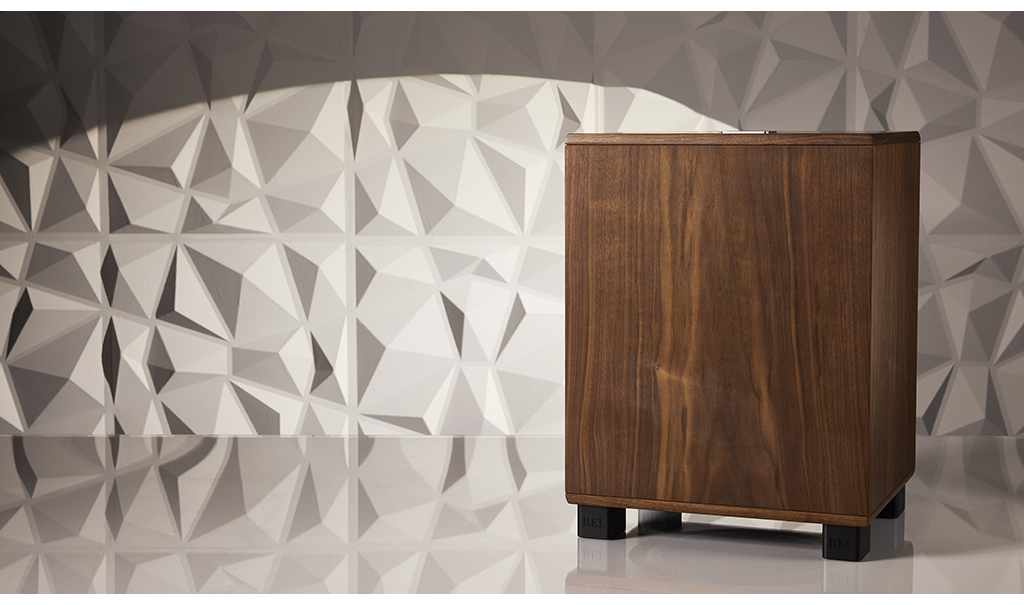
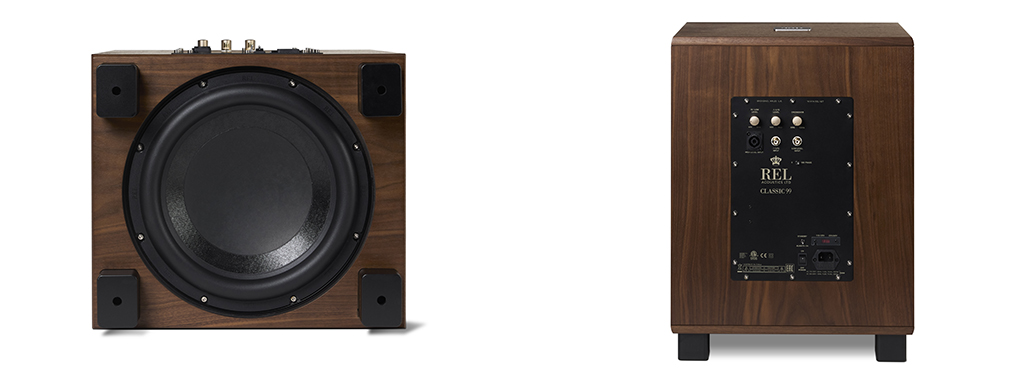
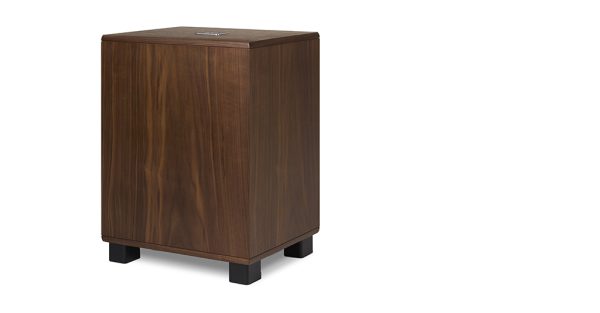
Going through a wide range of musical styles, the 2.7x plays a lot more music in a much more immersive way than past models, though they still have a few minor shortcomings. This still isn’t a speaker that you can play Tool, Slayer, Zeppelin, or other really heavy rock tracks at moderately high to really high levels, as you can with a cone speaker. Adding a high quality subwoofer will bridge that gap somewhat, and we will address the match up of the 2.7x with a pair of REL Classic 99s in another article. However, I’m guessing that if Tool and Slayer are a major staple in your musical diet, you’re not a panel speaker person to begin with. And remember there are a ton of small monitor speakers that can’t do this either, no disrespect to the Magnepans.
I only present this caveat to the uninitiated. At the end of the day, you still owe it to hear a pair of these, and decide for yourself. I suspect those with a wide range of musical taste will find the strengths of the 2.7x will far outweigh their few weaknesses.
The only other one is the speakers needing to get up above whisper level to come alive. And again, this is something nearly all panel speakers need to do, so they can move a bit more air. That big, planar surface isn’t moving a lot, so it has to get going!
Listening to a wide range of David Bowie’s late 70s/early 80s work is a joy. The discordant piano in “Aladdin Sane” delivers goosebumps, and “Scary Monsters” serves up an exciting level of pace. Closing it up with the three King Crimson records from that period, Discipline, Beat, and Three of a Perfect Pair take advantage of KC’s dense sonics but could use a touch more down deep. Switching program material for the etherial vocals of Kim Deal’s latest release, Nobody Loves You More, brings me right back into the rapture zone.
In the end
Keep the Magnepan 2.7x speakers operating in their optimum zone with music that plays to their strengths delivers an experience few speakers can match. There’s a truth in the mid 85% of the musical spectrum that is hard to ignore. Where similarly priced MartinLogans will play louder and go deeper (because they are a hybrid design with a DSP crossover and two active woofers) but that’s not really an apples to apples comparison, just as comparing an older Porsche Boxster with a six-cylinder normally aspirated engine to the current model with a higher-torque, four cylinder turbo model. They are still the same car from the same company, but the way they deliver the experience is very different – though each will be highly satisfying to a certain customer.
And if they are, you’ll probably never have another speaker. These are by far an exceptional value, though we are actually awarding these speakers one of our Masterpiece Awards at the end of the year. This award (and we only hand out two or three per year) is reserved for companies that make incredible products – delivering performance, value, and customer support, but have provided this for decades.
I can’t think of a company and product more deserving.
And on that tip, Dave Holmes is still selling Magnepans to happy customers. You can visit his site here:
Further exploration… By Chris Harr and Jeff Dorgay
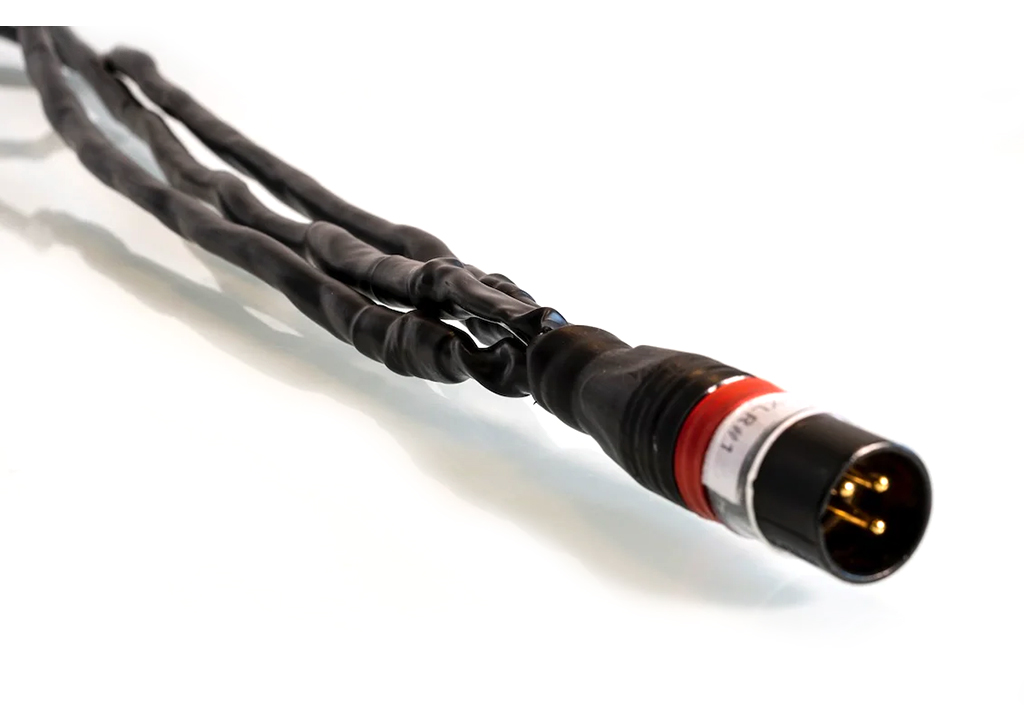
One of the most over used cliches in the world of audio writing is that a cable delivers a “component level” upgrade. However, after Chris spending a ton of time with these evaluating and comparing – and me just stepping in at the last minute for a victory lap, I must say the Voodoo Labs Carbon Age Standard interconnects at $8,200 for a .8m pair are definitely at the top of what I’d pay for a set of cables, but to be very fair to Jan Geschke, the owner and designer of Voodoo Labs, worth the investment if you have a system that warrants it.
The grouchy ones in the crowd are going to freak out at this, however in perspective there are far more expensive cables than this offering far less improvement in system performance. A good comparison would be the jump in performance you hear from a mid-level Clearaudio MC cartridge to the Goldfinger.
Chris has a fantastic system, anchored by a pair of Focal Scala Utopia EVO speakers (with a REL Carbon Special sub), powered by the latest Mola Mola Perca power amplifier, and Audio Research LS-28SE linestage. Analog duties are handled by the Mola Mola Lupe phono stage, driven by the AVID Acutus table with a Kuzma 4-point tonearm and the Hana Umami Blue cartridge. Digital duties are handled by the dCS Vivaldi One.
Define better
What we look for in any component, especially a cable, is something that reveals more music in every way without merely being a tone control. Not that there’s anything wrong with that, but in this instance especially – the increased ease and ability of the system from changing two sets of interconnects was not one of those moments where we sat straining to hear a maybe difference. This was a dramatic difference – all for the better.
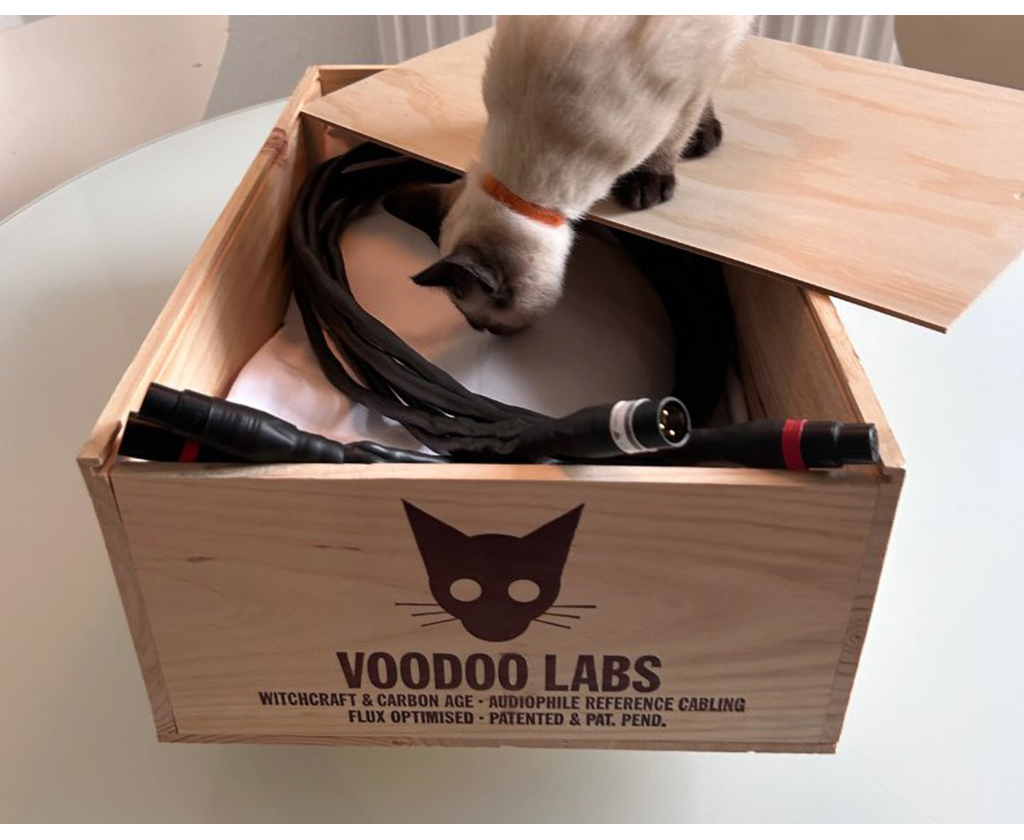
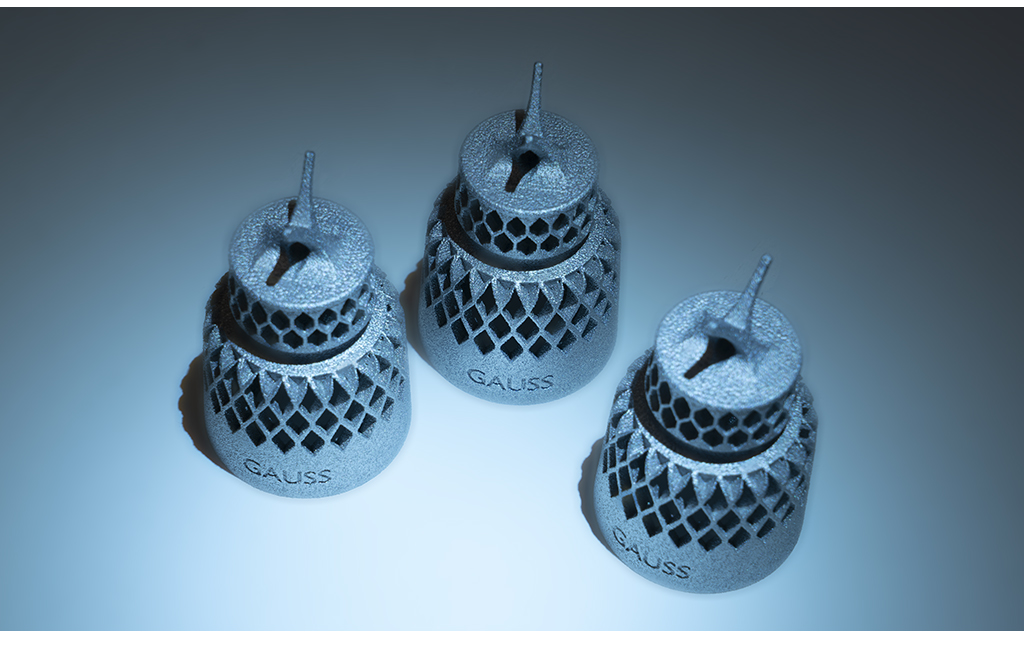
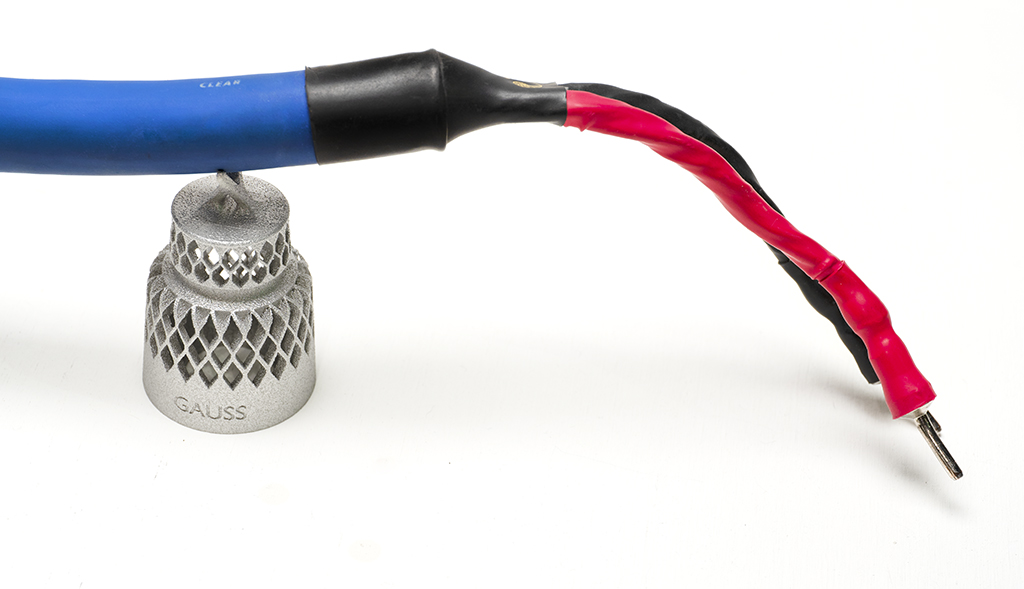
Just as we were skeptical of VL’s unusual Gauss Magnesium Alloy cable lifters, (as we are with all of these types of system tweaks) we came away positively surprised and our independent observations were consistent. While we are focusing primarily on the two pairs of interconnects, the Voodoo Labs wine crate (made of made from NIMP 15 certified pine wood from sustainable forestation, by the Bordeaux casemaker working for Chateau Petrus.) also included a 2m pair of their VL Witchcraft speaker cable.
It always helps tremendously when one person can switch cables while the other can listen, and here, Chris gets the credit for doing all the legwork. This time we started in the opposite direction; I had spent about an hour listening to various favorite tracks I’m familiar with and then the cables were switched back.
Major clarity
As Chris listens to more Techno/Electronica than I do, he noticed the immediate increase in energy in the lower bass region, especially after downsizing slightly from a pair of REL Carbon Specials to one. I was working late and getting a lot of late night texts on his listening impressions. And after hearing them myself, I concur with all of his conclusions.
When tracking through some choice Thomas Dolby cuts, the snappiness and weight of his synth-bass lines are heaver, faster, and more well defined tonally. Chris notices the same thing with Massive Attack’s Heligoland, finding the lower octaves much more tactile, instead of feeling like one note bass.
Yet the increase in resolution is everywhere. We both notice the way the MA vocalists’ voices are present and three-dimensional, providing a realistic recreation in between the Focals. That sounstage size is everywhere, with synthesizer effects in “Flat of the Blade” sometimes appearing straight up and nine and three o’clock, while others feeling in front and behind the listening position. My fall back position of Aimee Mann’s Lost in Space offers a similar level of dimensionality, in ways I haven’t heard to that extent.
We both concur that this is an intoxicating experience, both with audiophile pressings and music we love that is not necessarily one-step material. Tracks like “Your Mine” from Portishead, and “Mary, Mary” both from RUN-DMC and The Monkees are less sibilant and more tolerant, without being muted or rolled off. Chris winds the listening sessions up by saying, “these cables provide a pleasing tonal balance, tonal density without bloat, air without blur or brightness and resolution without sounding dry.” What could I possibly add to that?
We’ll talk about the speaker cables in another review, but suffice to say they offer tremendous improvement as well – however not quite as dramatically as the interconnects.
The secret
The secret to these cables is their use of carbon nanotubes to pass the signal. There is no metal in the signal path, save the connectors. Mr. Geschke has obtained a German patent for his technology, so this isn’t a random attempt to merely extract money from our audience.
Cables at this price will not make sense for everyone’s system, just as a pair of the latest carbon fiber wheels and Michelin Cup Sport 2R tires make sense for everyone’s car. But if you have a highly resolving system, or a Porsche GT3RS, these are essentials to extracting the maximum performance.
The Carbon Age cables do just that, they extract maximum performance from your components without any penalty. And they don’t wear out in a couple thousand miles like a $3,000 set of Cup Sport 2R tires! Highly recommended.
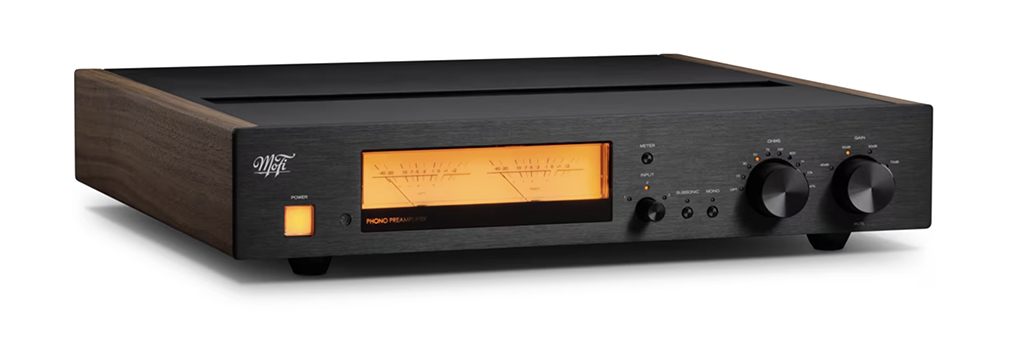
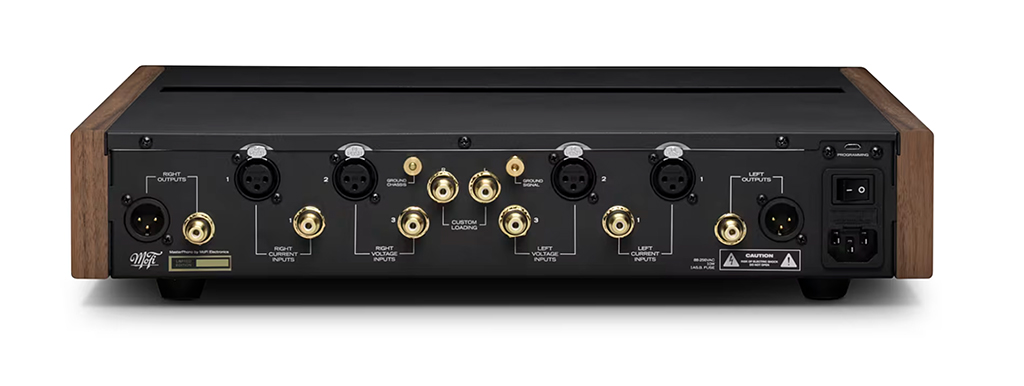
You might think that hyperbole, but MoFi’s Master Phono is aptly named. It features two voltage gain inputs (what every other phono stage has) and a current gain input. These have recently become the rage, and also some of the most expensive phono stages going, from companies like CH Precision and a few others.
The crack design team at MoFi Electronics, headed by Peter Madnick (a man behind many of audio’s best designs) delivers a $5,995 phono stage that goes head to head with others costing 2-4 times as much. Sonically, this solid-state design is dead quiet, super dynamic, and very musical; painting an enormous sonic landscape in all three dimensions.
It offers incredible flexibility, with a wide range of gain and loading options, balanced and RCA inputs (and outputs) and looks awesome. The aesthetic is a perfect blend of current and classic audio design. The power switch has a 70s Yamaha feel, while the switches and knobs feel almost like vintage Levinson, and those incredibly cool meters look they were raided from the parts bin at Revox, wrapping it up with wood side panels. GORGEOUS and tasteful. This is a piece of gear you’ll want to show off.
And best of all, you can connect three turntables. Again, something you usually can’t have until you spend a lot more money. The Master Phono is truly a top phono preamplifier for the analog lover wanting more than one turntable in their system. There’s nothing we’ve seen yet that comes close to offering the combination of value, build quality, sonic performance and total versatility at anywhere near this price.
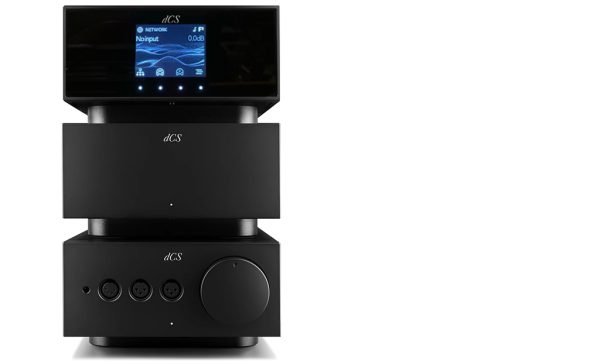
This one is way overdue… I’ve had the Lina from dCS for a long time. Long enough that I bought the review sample, yet it’s been a lot of exploration and comparisons.
If you are into premium headphone amplifiers, you’ve no doubt heard of the Lina by now. It’s a three piece, modular setup to be used as a headphone amplifier, with it’s own DAC and word clock. You can purchase the stack for $31,150 or the individual components. The Amp is $9,750, the DAC $13,650 and the Master Clock $7,750.
As strictly a headphone amplifier, with its own dedicated DAC, this is probably a bit on the spendy side, but when you consider what a Warwick Aperio system costs ($40,000) and good as it is, you can only use it with their headphones, the dCS doesn’t stack up so badly after all. And this is nowhere near close to what the big Sennheiser system is – nearly $100k these days.
The sound is pure dCS, neutral, dynamic and resolving.
The headphone amplifier will drive anything you’ve got to plug in, and is on par if not more revealing than a handful of other premium headphone amplifiers we’ve tried. The DAC and clock remind me a lot sonically of what was going on with my past Bartok, though the clock takes things to another level.
It also is capable of playing every streaming source possible (including MQA), with a plethora of digital inputs as well as an Ethernet input so it can be a streamer as well.
The big choices are would you like yours modular or all at once, or do you prefer black or silver?
When the Lina first arrived, it was only available with fixed outputs, but now that has changed to allow the Lina stack to have a variable output, so it can drive a power amplifier directly. And thanks to a single analog input, you can plug a phono stage in. This is the true value proposition here. We’ve used the Lina now with a number of great power amplifiers, tube and solid-state with excellent result.
So while nearly thirty two thousand dollars is a lot for a three box headphone player, it is not insane money for a premium DAC/Streamer, headphone amplifier and linestage. Especially if you purchase the headphone amp and DAC first, adding the clock later. But once you hear the Lina clock, you are going to want it, because the level of coherence it adds to the presentation can’t be ignored.
If you’re absolutely sure you don’t need a turntable (and I wont call you a bad Smurf if you don’t) the D1100 from McIntosh is a great way to roll.
With a built in headphone amplifier, and nine digital inputs consisting of three optical, one USB, three coaxial (1-BNC, 2-RCA) an AES/EBU balanced, and a proprietary MCT input. It features balanced and RCA outputs that are variable (to use the D1100 as a preamplifier) and fixed, in case you want a DAC with tons of digital sources.
Around front is the headphone socket and those gorgeous blue meters we all love.
The sound is pure MAC, though this is a solid-state component. It uses McIntosh’s top DAC at the time with an advanced chipset (8 channel 32-bit, but no mfr is listed) so it will decode everything you have in your music library – except MQA, which is now pretty much off everyone’s radar.
The true draw to all McIntosh components is their flexibility and a highly evolved style that you either embrace or don’t. But whether you’re a “mc person” wanting to add a great DAC to your pile of boxes with blue meters, or seriously considering not wanting to bother with vinyl – this is an excellent choice.
Fortunately, McIntosh has stopped making those remotes with the textured feel that get really sticky and gooky after some use. Just like the radios in a 987 series Porsche 911 or Boxster. Some salesman made a fortune selling whatever that coating is to a ton of people! This remote is smooth and shiny. Awesome.
All kidding aside, at a few pennies under $3,920, this is a great value. That’s the best reason to purchase current classics at The Music Room. It’s fully checked out, ready to go, and they’ve included the manual and remote. Just as good as buying new.
Here’s a purchase link to save you a little time. JUST CLICK HERE
Yep, gotta admit being a fanboy of MartinLogan. Having owned and/or reviewed nearly every MartinLogan panel speaker made since the CLS in the 80s, these panels are not only easy to deal with but easy to incorporate into your room without a lot of placement issues.
The ESL11A’s are part of MartinLogan’s Masterpiece series, and incorporate an internal DSP that utilizes Anthem’s ARC room correction for the dual powered 8″ woofers. Just as with subwoofer placement, these powered woofers really benefit from ARC if you can’t put the speakers exactly where they need to go for perfect audiophile sound. Setup suggestion: try and place the speakers to achieve the best balance of bass output and upper bass/midrange clarity before engaging the ARC.
With a nominal impedance of 4 ohms, and a 91dB/1-watt sensitivity, these speakers are very easy to drive and are tube friendly. They do have a high maximum power handling capability, so these panels ROCK. You can play Tool and Metallica with these at any level you want. Yet, the electrostatic panel is a master of nuance, so your favorite vocals and acoustic tracks will come alive in your room.
Speaking of rooms, you will probably need a room that is at least 12 x 15 feet, with more space delivering better results if you’ve got it. Back when I reviewed these, they worked fine in my 13 x 18 foot living room, but provided a larger sound field in my main listening room, which was 16 x 24 feet. Like nearly all panels, they will deliver a wider soundfield if you can place them on your long wall, and a slightly deeper front to back soundfield on the short wall. Again, the DSP for the woofers is your best friend.
This DAC is the perfect example of a great, slightly used product. Having just finished my review on the Weiss 502, they explain the difference between the 501 and 502 is the latter having a balanced, 4 pin headphone output on the rear face of the unit. This is the $1,000 difference in the retail prices of the new units at $11k and $12k respectively.
The $10k-ish DAC market may well be the most highly competitive, because there are a lot of great DACs at this level. The Weiss serves up a very neutral tonal balance, is incredibly dynamic, and major weight. If you love heavy rock, large scale classical music, and hip-hop or electronica, you’ll be excited. It also serves up any kind of streaming service at your disposal and is ROON ready. Merely plug your Ethernet cable in the back and you’re rocking.
The rear panel view reveals SPDIF inputs (RCA and Optical) along with USB, and AES/EBU. Analog output is via RCA or XLR. This is one very versatile DAC.
As you can see from the front panel, there’s a 1/4″ headphone jack for personal listening. Weiss has done an excellent job here as well. Giving my review sample a spin with Focal, Audeze, Meze and Grado phones proved excellent – so I’m guessing whatever cans you have at your disposal should work equally well.
However, what makes the Weiss DACs (remember the 501 and 502 both share identical circuitry in this respect) is it’s additional functions available in the digital domain. There is a parametric EQ, the usual selection of digital filters, a “Vinyl Emulation” mode, and a De-esser, all adjustable in fine increments. Personally, the De-esser is lovely for those early 80s digital recordings that more often than not, a little on the crunchy side. Go easy with this control and you will be highly rewarded.
Finally, like every pre-owned TMR product for sale, this Weiss DAC has been thoroughly checked out by the service staff and will arrive in perfect working order. Oh yeah, there’s a great, compact remote control too! What’s not to love?
From the click of the super stylish power button that merely needs your touch to illuminate a diffuse white circle of light, the Double Shot power amplifier from Java gets you going.
To illustrate just how serious I am, listening begins with Jon Astley’s “Jane’s Getting Serious” on 12-inch maxi-single no less. Those Yamaha DX7 keyboard pitch bends never sounded better. This amplifier, is excellent in every way.
So lovely, in fact, that when tracking through BTO’s “Blue Collar,” I’m not even wishing for more cowbell. If that’s not musical perfection, what is? While the amplifier delivers more in spatial terms once it’s been on for about an hour, the tight, coherent musical pace delivered is stellar. Good as the Double Shot integrated is, the power amplifier takes clarity and pace further, because of its larger, dedicated power supply.
It is a magnificent experience to play the Peak Consult Sinfonias at a high volume level, taking advantage of the sheer dynamics these speakers are capable of with enough power. Having mighty monoblocks from Pass Labs (X600.8s – 600 WPC), the PS Audio BHK Signature monos (also 600 WPC), and the PrimaLuna EVO 400 monos (almost 200 WPC with KT150 tubes) all offer their own sonic portrait. Being able to achieve a sizeable amount of the three-dimensional characteristics that the tubes offer, with the sheer sonic slam and control that the big solid-state amplifiers deliver in the compact box that is the Java Double Shot, is nothing short of amazing.
Martin Bell, owner of Java HiFi, sent us his Single Shot integrated amplifier last year, which was fantastic. Fantastic in the same way that we’re not saying “it sounds pretty good for class-D,” like we used to say “it sounds pretty good for digital” when referring to the world’s finer DACs. It just sounds fantastic. Like some of the current crop of class-D designs adopting GaN FET topology, the Single Shot (and all the Java amplifiers) brings a natural, un-electronic sonic signature to the presentation. Eyes closed, you might think you were listening to a Boulder or Constellation amplifier. I pick these two premium designs as a comparison, because in the range of all the amplifier data points in my experience bank, these two have the least colored tonality in either direction. The current crop of Audio Research vacuum tube amplifiers are also in this dimension, but we all know the care, feeding, and cooling requirements of tubes.
It’s not what it used to be
Class D has always promised to be the best of all worlds: high power, high efficiency, and lighter weight. Until just recently, this was the case except for the flat, somewhat harsh, and moderately to severely uninvolving sonics, at least in terms of the best amplifiers.
The Double Shot Power delivers 400 watts per channel into 8 ohms – and while it doesn’t completely double into 4 ohms, it still produces way more power than most should ever need. All in a very stylish package that only weighs 20.3 pounds! The matching LDR preamplifier is arriving very soon, and I’m guessing that, like most other components, the only real reason to buy the amplifier and preamplifier separately from Java is to get the additional fidelity coming from having these components on separate chassis and perhaps a bit more input/output flexibility. And there’s nothing like a bit of matchy – matchy going on in the personal style arena either.
The overall character
However, you may have a preamplifier in place that you already love and don’t want to change things around that much. Or perhaps you’d like just a touch of warmth added to the overall sonics of your system, maybe a tube preamplifier? I did just that, using the Double Shot with the Pass Labs XS Pre (slightly warm), the BAT VK-80 (a little warmer), a vintage conrad-johnson PV-12 (very warm), and the digital preamp/front end of the I1 integrated, which is much closer in sonic character to the Java.
With such a neutral presentation from the power amplifier, you can easily fine-tune everything to your liking. All four combinations were excellent, and thanks to the balanced inputs (as well as single-ended RCAs), every preamplifier is in your grasp.
I apologize for repeating myself. Dynamics are indeed the fourth dimension when it comes to musical reproduction. Unless you are solely listening to small-scale chamber music, big power, properly expressed, yields big results unless you have super-efficient speakers. With many of today’s speakers having sensitivity ratings in the 85-90dB/1-watt range and typically being closer to a 4-ohm nominal impedance than 8-ohms, the Double Shot’s power delivers tremendous dynamic range and reserve.
The Java difference
Mr. Bell says it best, when asked what makes the GaN FET design (and Java in particular) a more musical sounding Class D design. “Many older silicon transistor-based Class D amplifiers will have typical switching speeds of around 100 kHz. The switching frequency of our amplifier modules is in the 400-450 kHz range (Closed Loop).
Together with our partners, we have carried out extensive research on the contribution of switching frequency to both efficiency and performance (both measured and in listening tests), and have found that the ‘sweet spot’ is around 400kHz-500kHz. Beyond that frequency and performance is reduced (due mainly to ‘dead-band’ contribution and Output Filter contribution) and efficiency is significantly reduced. With the GaN modules in our amplifiers there is a switching speed sweet spot where everything is “just right” (as Goldilocks would say).
However switching speed alone is not the sole reason why GaN-based systems can deliver enhanced audio performance vs Si-based alternatives.
A well-executed GaN design can also deliver lower distortion (THD), less noise (both electrically and audibly), faster, cleaner transitions and reduced “dead time” and reduced crossover distortion. In general terms, faster switching speeds are also beneficial for reducing electromagnetic interference (EMI). But as noted above, if switching speeds are increased too much, the efficiency and measured/sonic performance of the modules decreases. Science aside, this is one natural sounding power amplifier.
Back to the music
Without delving into too many of my personal music choices (which may not suit you at all), suffice to say that an incredibly wide range of music was auditioned during this review. This amplifier scales well, delivering subtle texture and nuance when required and high sound pressure levels without losing composure. Stream the cannons at the end of the 1812 Overture or AC/DC’s “For Those About to Rock,” and you’ll see what I mean.
What may really surprise you about recordings you might have thought overly dense and compressed is how they come alive with this much power. It might have just been your 60-100 WPC amplifier running out of dynamic range. I’m just sayin’. Like horsepower, way more amplifier power than you think you need is a good thing, more often than not.
Like the Single-Shot reviewed before, this amplifier excels at small sonic details. Think of your favorite acoustic guitarist, and the sound of fingers sliding across the strings. In this case, the standby is always Michael Hedges Aerial Boundaries, an album full of guitar pluckiness, and harmonic activity. Another great album illustrating this aspect of reproducing complex acoustic instruments together is Charlie Hunter’s Ready, Set, Shango! a mixture of bop and modern jazz. Of course, any classic Blue Note record will always do the job.
High-powered amplifiers don’t always excel at revealing the most minute aspects of the music – again, this amplifier does a tremendous job. Breathy singers, male and female, come through with authority at both ends of their vocal range, making for an intimate presentation.
Huge power reserves mean endless speaker choices
This amplifier’s ability to keep instruments locked in their own spaces without ever losing focus, no matter how wacky you get with the volume control, is something few amplifiers can accomplish. The Double Shot excels here. Swapping the Peak Consults for the Clarisys Audio Auditorium Plus ribbons is very exciting, because even though these are so much easier to drive than the Apogees they are based on, they still are a 3.7- ohm speaker, delivering their all with a lot of power.
The Auditorium Plus speakers play well with a 60 wpc amplifier. Still, their lovely, spatial nature shrinks a bit, and the lowest of low frequencies lack the authority and control that a big amplifier delivers. Again, the Double Shot makes these $150k speakers come alive. Because of their wide range, Electronica, Hip Hop, and a lot of current music really comes alive because so much of it has a strong bass groove. No Taylor Swift for me, but Charli xcx’s “Talk Talk” suits the power this amplifier delivers. That bass groove is killer, and the louder, the better.
Ditto for the drums in Beth Gibbons’ “Burden of Life.” Again, at moderate to high listening levels, Gibbons’ voice isn’t clobbered by the drums, losing its way. These types of musical excursions don’t feel the same without big power, but the clarity, pace, and texture the Double Shot has is equally important. It’s not a double shot of crap coffee; it’s a double shot of fantastic coffee!
Moving on to the Mon Acoustics standmount speakers we reviewed earlier this year, a pair of MartinLogan ESL 9s, and the new Magnepan 2.7x speakers all make for an excellent match with the Double Shot. The same characteristics that are easily discernable in the more refined speakers are available here. Nothing makes even a speaker like the compact MONs come alive like plenty of reserve power. If you’re a Magnepan lover, you know that extra power helps these speakers deliver their all. I’ll be discussing the Java amps more in an upcoming review of the Magnepan 2.7x’s, and this double shot is one of the most exciting pairings I’ve ever heard with a Magneplanar speaker at any price. The synergy with MartinLogan speakers is equally thrilling.
The finer points
When you unpack your Java, you’ll notice the rounded corners and the fine detail work on wood and metal surfaces. All Java products have a signature style that is somewhere between modern art and a mid-century modern look about them. In addition, the Java website offers the option of choosing from multiple faceplate colors and outer casework. This is an amplifier that deserves to be in full view in your listening room to be sure.
Around back, the uncluttered panel has a single pair of speaker output posts and the ability to switch between RCA and XLR input jacks. The power socket is in the middle of the chassis, making it easier to configure in an equipment rack. A small point, but telling of how much thought went into this product. The front panel is equally sparse – it is a power amplifier, after all, but the circular main power button that begins to glow when you touch it is certainly one of the best design elements in high-end audio.
Highly recommended
The Double Shot offers high power and resolution in a package easily competing with amplifiers costing considerably more. This makes it the perfect amplifier to anchor your system as it develops over the years. Its neutral tonality encourages excursions into components and speakers all over the range. You can season the mix to taste, and you won’t have to replace everything if you decide a change is in order (as so many audio enthusiasts do).
Just as the world’s finest DACs stand out in the way they can render music in a non-electronic, unglazed way so that you can just swim around in the music, so it goes for the best Class – D amplifiers. In hundreds of hours of listening, not once did I stop to think about what kind of amplifier I was listening to. This is the ultimate compliment I can pay to the Java Double Shot power amplifier. That and an Exceptional Value award.
Revox announced today, the launch of their new B-77 Mk.III reel to reel tape deck. This is not a discussion about the validity of the format. We know there are plenty of tape enthusiasts, and if you want higher fidelity than a late 70s tape deck can deliver, you’ve had to go to great lengths to have a vintage deck rebuilt/refurbished.
Some of you have spent WAY more than the $15,950 MSRP listed here.
Think about it, this gets you a brand new Revox deck, in the box, with perfect cosmetics and electronics to match. It’s like a Singer Porsche 911, but it’s built by the factory (Who knows more about a Revox tape deck than the people who made them?) and it’s not crazy money.
While you might be freaking out, ponder this: Back in 1977 when the B was introduced they were about $2,000 USD. That’s about $11,000 in today’s money. Also, for those interested, Revox still offers refurbished B-77 Mk.I decks for $7,999.
However, if you’ve longed for a new Revox, they will be making about 20 per month. I suggest getting on the list.
REL calls the new T/9x SE “A Carbon Special for the rest of us…”
This new addition to the top of the T-Series features obvious visual upgrades, in three new super-cool colors (Le Mon Yellow, Tangerine Dream and Italian Racing Red) and a new driver offering faster response and more ultimate dynamic output.
At REL top sonics and visual refinement always go hand in hand, to produce a subwoofer that delivers incredible performance beyond it’s modest physical size.
They may look very similar to the outgoing models, but the new 17-Ultra R|Evolution series has had nearly every molecule changed and upgraded to the latest tech SVS has to offer.
Starting with an all new high-excursion 17-inch driver featuring a glass-fiber composite cone, long-throw catenary SBR rubber surround, and toroidal ferrite electromagnetic motor allow these two subs to generate massive sound pressure levels well below the threshold of human hearing. (15Hz for SB17-Ultra and 12Hz for PB17-Ultra)
Generating the sonic muscle behind the most powerful and highest fidelity SVS subwoofers ever is a unique dual mono-block STA-2800D Class-D amplifier with MOSFET output stage. Each amplifier drives one of the dual voice coils to increase the power into the motor while asserting pinpoint control and maximizing output potential. Eight 60 Amp 200 Volt MOSFETs deliver extreme high current for reference-level output with maximum efficiency.
SVS integrated the most sophisticated DSP ever to optimize all aspects of performance and usability. The 295MHz Analog Devices DSP orchestrates every function of the amplifier to shape in-room response and stabilize AC voltage delivery while managing a multi-point thermal and current monitoring system for optimal performance and efficiency. In addition, advanced digital audio processing and DACs (Digital-to-Analog Converters) with 120 dB Signal-to-Noise Ratio provide greater headroom, lower noise, and pristine fidelity.
Calibration of the 17-Ultra R|Evolution series is managed via the most comprehensive subwoofer control smartphone app available. The SVS app features controls for volume, low pass filter, phase, polarity, six parametric equalizers, room gain compensation, port tuning (PB17-Ultra R|Evolution only), power management settings, and more. There are also three convenient memory presets for fast and easy system adjustments to match your listening preferences.
Also new to the 17-Ultra R|Evolution subwoofers is the intuitive Auto EQ Subwoofer Room Correction. Using the SVS app and the built-in microphone on a user’s smartphone, the feature applies equalization filters, capitalizes on available room gain, and optimizes in-room frequency response at main listening positions for optimal in-room performance. The simple process requires just a few steps and achieves pristine fidelity by resolving all the acoustic issues caused by your room in a few easy steps. Auto EQ Subwoofer Room Correction will be available via an over-the-air app and firmware update coming soon.
Today, Naim/Focal announce their new DIVA Utopia speakers.
They are an “active, connected, wireless hi-fi speaker system.” With 400 watts per channel of class A/B power designed by Naim, (250 for the woofers. 75 for mid and 75 for tweeter) major dynamic range is assured. You can stream every kind of file available, and there is an RCA/analog input as well – to connect your turntable!
While these speakers can be used wirelessly, you can also connect them directly to your Ethernet network, and connect each speaker to each other via a cable using NaimLink.
With four 6.5-inch side firing W-cone woofers per enclosure (2 on each side) with a front firing 6.5 inch mid-bass driver and pure beryllium tweeter, you can be assured to have the Focal sound you are accustomed to. With 8 colors of sustainable fabric on the sides, there should be a color to suit your taste and decor.
Weighing in at 141 pounds each, you can leave your Diva Utopias on the supplied casters, or use spiked feet. Their footprint is small at 16.5″ W x 22″ D and just shy of 48 inches tall, so it will be easy to incorporate them into your environment.
On board DSP room correction will make it even easier to fit these speakers wherever your room dictates, and of course it is all app-driven and can be set via your phone.
All this awesomeness isn’t cheap, with a pair of DIVA Utopias coming in at $39,999 a pair. However, taking into account what an amp, preamp, DAC, processing unit and three stereo amplifiers would cost (as well as all the cables for this stuff) for the right customer, this will be a great bargain.
Will it get legacy audiophiles to de-clutter and get rid of all those boxes and cables? That’s yet to be seen, but for those of you that want true high performance sound and 21st century convenience, the DIVA Utopias may be the only game going. Focal is being tight lipped about smaller models on the horizon, so we’ll have to wait and see there.
Focal says these are available now at qualified stores in their Focal Powered by Naim network.
Not everyone wants or can afford brand new gear. Perhaps you like the older stuff better, or just want go get more gear for your hard earned dollar. An older car with “certified pre-owned” instills just as much confidence as a brand new one straight off the showroom floor, yet at a more approachable price.
The reasons for this “collab” are numerous.
I’ve always wanted more gear than I could afford and have always searched for great, slightly pre-owned gear to build more system for the dollar. However, it always had a big question mark, because now and then, you get a piece of gear that is either DOA, or fails (with a large repair bill) sooner than later.
Having worked with TMR as a buyer and a seller, I am happy to give them TONE’s full endorsement. They are straight up to work with, the staff is very knowledgable about the gear they sell, and they pack gear even better than I do. And if you’ve ever bought a piece of vintage gear from me, you know the extent that I go to, to make sure it arrives in perfect shape. So you don’t get that socks instead of toys on Christmas morning feeling!
Knowing that their techs have gone over a piece thoroughly, takes all the guesswork out of the purchase. Yeah, their prices are about 10% more than buying on Audiogon or EBay from a random stranger is well worth it.
Best of all, you’re helping make a sale of a new pice of gear for someone else. How many times have you heard the phrase “you can’t have a new one, until you get rid of the old one?” Everybody wins.
I’ll be placing some short reviews up here, showcasing some of my personal favorites and they will include a purchase link to TMR if they have the gear in question currently for sale. In the spirit of full transparency, TMR is an advertiser with TONE, however the “Current Classics” are not part of an affiliate program – we don’t get paid extra for doing this – it was completely my idea.
I hope it’s one that will lead to your enjoyment of high end audio further.
Last year we reviewed PrimaLuna’s EVO 300 hybrid integrated amplifier with excellent result. (You can read THAT review HERE.)
It’s the perfect choice for those not wanting an all-tube amplifier, but still dig the PrimaLuna sound. Here are the high points, straight from PrimaLuna:
Tube Sound with Power and Control: Experience tube magic enhanced by the power and efficiency of MOSFET technology.
Advanced Design: Features JFETs, hand-matched transistors, and dual MOSFET pairs, all driven by a generously sized power supply.
Superior Components: PrimaLuna Silver Label tubes, Swiss DuRoch tin foil capacitors, and Japanese Takman resistors for unmatched sound quality and reliability.
Versatility: The mono function allows users to use two EVO 300 Hybrid power amplifiers as monoblocks, doubling power output and enhancing channel separation and soundstage.
This should be available in late September and MSRP will be $7,195. We should have one in for review very soon.
Analog purists might be screaming “Aaaah, Bluetooth! No one is digitizing my precious vinyl,” when they look at Cambridge’s Alva TT V2.
But let’s take another look. Think system building, think convenience. With a built in phono stage (derived from Cambridge’s Alva Duo), you can use the Alva three ways – via Bluetooth to powered speakers or headphones, with the built in phono stage to an integrated amplifier lacking a phono stage, or you can bypass the built in phono stage altogether if you have a better option for phono playback. So, you it can grow with you as you get more involved in hifi.
The table features a direct drive motor system, an excellent tonearm and factory installed installed high output MC cartridge, only requiring you to set the tracking force. It’s even on sale right now for $1,499 instead of the usual $1,999.
This is a lot of analog capability for the price. Those on a tight budget can choose the $599 Alva ST, which is belt drive, and features a less sophisticated drive system and standard MM cartridge – though still offering Bluetooth and built in phono preamplification.
Even at the full $1,999 price, the Alva TT V2 is an attractive package for anyone wanting substantially above entry level turntable performance, yet plug and play functionality. While vinyl snobs might pooh pooh the Bluetooth option, if you happen to have small children or aggressive pets, the option to put your table out of harms reach and still enjoy your vinyl collection is an incredibly thoughtful option. And it doesn’t sound half bad either.
The Cambridge Alva TTV2 is the easiest way to add vinyl playback to your system we’ve seen. (photo courtesy of Cambridge audio)
Many audio enthusiasts forget that power and dynamic range are the fourth dimension when it comes to achieving natural sound reproduction.
With 400 watts into 8 ohms, doubling into 4 ohms, the Java never runs out of power. They really should call this one a “quad-shot.” At $8,995, it certainly is an Exceptional Value (hint, hint)
Thanks to the DS’s GAN FET architecture, and major attention paid to every detail this amplifier can drive any speaker with ease. If that’s not enough, there are several different ways to mix and match three different front panel finishes with seven different case finishes to have a truly unique looking amplifier as well. In addition to the sublime visuals this amplifier serves up, power on and off is handled by a gentle touch power switch on the front panel that glows when you touch it. The CNC-machined casework is as beautiful to look at as it is to listen to.
The Double Shot has an incredibly neutral/natural overall sonic signature, and with all that power, dynamics to rattle anything in your room that isn’t fastened securely to the walls and floors. It has the level of grip you’d expect from a Class – D amplifier, with a level of refinement everywhere else on the sonic spectrum, not possible with this type of amplification a few years ago. If you absolutely must have more warmth, pair it with a tube preamplifier. We tried both and enjoyed both, so you can fine tune to your taste for absolute perfection.
That being said, we can’t wait to get the companion preamplifier in to give a full Java system a go from an all-Java separates perspective. When Java’s integrated amplifier was here a while back, it was a major hit. Even the most stubborn audiophiles could not argue with the sound, and the most anti gear (not in my living room) roommates agreed that this beautiful amplifier deserved a place in their home. What else could you ask for?
The Double Shot power amplifier from Java is stunning in every way, and if you want higher power without the penalty of 100+ pound monoblocks, or needing mass quantities of tubes on a regular, this is a great way to roll. We’ve got an in-depth review in progress. (Photos courtesy of Java Hi Fi)
If you’ve been hunting for a premium vacuum tube integrated amplifier, the Octave V80SE should be at the top of your list. All previous Octave amplifiers we’ve used are built like a mid-80s S-Class Mercedes, i.e. to last forever, and have a slick, stark aesthetic that’s at home anywhere. Available in matte black or silver, the V80SE has an MSRP of $13,500. You can add the Black Box ($1,500) or the Super Black Box ($3,500) for even more performance.
This amplifier delivers 120 watts per channel into 4-ohms, and while it’s been here, we found it able to drive every speaker at our disposal with ease, from traditionally power hungry Magnepans to the extremely efficient Zu and Heretic speakers.
Taking advantage of a quartet of KT150 tubes to deliver the music, Octave amplifiers (including our reference V110SE/Super Black Box) are manually biased and offer long tube life as well. There is a complex protection system built in, should there ever be a tube failure, so there’s no chance of speaker damage in the unlikely event of a tube failure.
While not sterile like some of today’s current tube designs trying to sound like solid-state amplifiers, the V80SE is not overly warm sounding either. It has the tonal saturation and airiness that you go to tubes for, yet has tremendous bass extension and grip.
A mixture of single-ended and balanced inputs make it easy to incorporate into your system, and straightforward controls, along with an awesome remote control (only volume up and down) make it a great listening partner.
The Black Box and Super Black boxes offer more power supply capacitance and connect via umbilical cord to the back of the amplifier, giving it more dynamic ability, and more control over lower impedance speakers. We’ve got an extensive review out shortly, but for all but those having the most expensive tastes, you can build an incredible system around this integrated.
The V110SE is a staff favorite (and a reference component) and the V80SE takes every aspect of the V110SE to an even higher level of performance. (photos courtesy of Octave.de)
We just received a pair of the latest Ultra Evolution Towers from SVS, which is the smallest of three new floorstanding speakers that reflect their latest design upgrades: Time aligned drivers, diamond coated tweeters, and much more!
Of course, the big news is that now you can get Pass components in black. This is a good thing considering how many people have passed on conrad-johnson gear over the years because the champagne color does not match anything else in their system.
The more significant news is how great these amplifiers sound. though these are Pass Labs’ smallest monoblock amplifiers, they still weigh about 90 pounds per chassis. If you aren’t familiar, each Pass amplifier always has its own unique sonic character, and the XA60.8s is no different – with the pair having much of the lush, texture-laden presentation of the XA25, combined with the LF grip and control, offered by the larger Class-A monoblocks.
Incidentally, this is what the “A” designation means. The XA60 monos are claimed to deliver 60 watts per channel into an 8-ohm load in full class-A
conditions. Other magazines that produce measurements confirm this to be true, revealing these amplifiers can produce over double this amount of power before distortion sets in.
The catch? They gently switch their bias current to class-AB operation. The big, blue circular meter on the front panel stays in the middle of its range while the amplifier stays in class-A mode, bouncing to the right as it exits into class-AB.
When driving MartinLogan ESP 9s, the Team Fink Borg (episode 2), and the Clarisys Audio Auditorium Plus speakers, the meters never left the center position. Only when driving the new power-hungry Magnepan 2.7X speakers were we able to push the XA60.8s into class-AB mode.
In short, the definition throughout the frequency range is incredible, with an equally sublime rendition of higher frequencies to match. Pass Labs’ class-A amplifiers all have a mid-band rendition that nearly fools you into thinking you’re listening to tubes, and these amplifiers even a bit more. The level of detail, layering, and ability to create a three-dimensional sound field is incredible – the lessons learned in creating the flagship XS Monos certainly are at work here.
Having used nearly all of the big Pass amplifiers over the last decade, there’s a sweetness here that doesn’t even exist in the mighty (nearly 100k/pair) XS Monos. As mentioned earlier – each Pass amplifier has its own sonic signature.
These are absolutely lovely and, at this price, a tremendous value as well. If you’d like to read an in-depth review, these amplifiers are featured in our current issue.
While this may sound like one of those AI-generated comments, if you’ve seen, heard, or read about REL’s recent addition, the Classic 98, you know that this is something different than the standard bill of fare from REL. The Classic 98 takes the punchy, linear, extended, and tuneful sound that REL is famous for, but tunes the vibe more to that of a vintage, or perhaps even (dare we say it) classic British sound.
Before REL, subwoofers often had a tough time keeping up with the main speakers in terms of musical pace. Some would refer this to speed, as in the woofer wasn’t fast enough to keep up with the mains, delivering an over extended, often bloated, one note bass – leading so many to proudly exclaim they would never use a subwoofer. Duly noted and often correct, because a subwoofer that does not integrate seamlessly with the main speakers often feels like that person in the marching band playing way too loud for the rest of the musicians. When the sub is too fast and articulate for the main speakers, a similar effect occurs – but now the mains sound foggy and bloated.
As mentioned in the Classic 98 review, John Hunter, the designing force behind REL has a love for vintage speakers, just as many of you do, and if you’ve tried a modern sub with them, sometimes it doesn’t sound quite right. With the Classic 98s slightly mellower sound, connecting a pair of Vintage JBLs, a pair of Harbeths, or my favorite – a vintage pair of Acoustat 2+2 Electrostatics is just right.
The Classic 98 features a 10” down-firing woofer and will set you back $1,399.
The all-new Classic 99 has a 12” down-firing woofer and is $1,899. With that bigger driver comes a 500-watt amplifier (limited to 450 watts in this application) vs. 300 for the 98. PRO TIP: if you bought a Classic 98 and still feel you need just a little more juice, the Classic 99 looks exactly the same, even though the cabinet is over 45% bigger. If you live with someone who is slightly gear adverse, just sneak home on your lunch hour, swap ‘em out and no one will know. I did this to my ex-wife once when I went from Vandersteen 1s to 2s. Works like a charm.
The walnut cabinet stays tastefully in the vintage/mid-century vibe and is built robustly, like every other REL we’ve used, with the same functionality on the rear panel. This means connecting it to your system via the REL Speakon connection at the speaker outputs of your amplifier, via RCAs from your preamplifier, or wirelessly with REL’s adaptors. I’ve always had the best result with the high-level speaker outputs, because that feeds your REL what’s coming right out of the power amplifier and going to the speakers, but you may need other options.Because of that REL supplies a single channel of Low Level via RCA (uses the same filter as the High Level uses) plus a dedicated theater LFE input, also RCA but this one has its own dedicated Level control.
A more in-depth review is on the near horizon, but for now, the Classic 99 delivers another scoop of what you love about the 98. The bigger woofer, bigger cabinet feels even more effortless than the 98, and will probably suit itself more to bigger rooms than the 98, but again, we’re going to compare the two closely in three different room sizes for the final review.
Using the Classic 99 in a 24 x 36 foot room with the Acoustats about 12 feet apart on the 24 foot wall with the 99 in the right corner works incredibly well, but a second one is probably in the cards. With the crossover set relatively low (my guess about 40hz) the blend with the Acoustatsis perfect. Fortunately, having set up a number of RELs in the past and getting a lot of tips from Mr. Hunter has me in sonic bliss very quickly.
Running through some familiar 60s, 70s, and 80s tracks is absolutely lovely. Those ‘stats still sound as good as they did years ago, but with the extra foundation that the Classic 99 provides, so much more inviting.
At higher listening levels (right before the ESL panels bottom) the presentation is much more dynamic, yet at low to medium levels, the soundstage expands in all directions and it’s easier to be involved thanks to the additional low frequency energy now present. While it’s easy to look to a subwoofer for “more bass, dude,” what REL always brings to the table, is an increase in midrange resolution and a much bigger sound field as a result.
Tracks that don’t have as much low frequency information impress just as much as the ones that do. That’s the magic of the REL Classic 99. Perfect for those of you who love the Classic 98 but feel you needed significantly more due to either using larger speakers or having a bigger room than the 98 could handle. The Classic 99 reminds me a lot of the old Stentor II of the late 90’s, though that old heavyweight weighed in at around 100 pounds and cost $6,000 back then. Highly Recommended.
Oddly enough, this product is backed up by quite a bit of science, but I love the name. I’ve known Jan Geschke for a while now, and between our love for Porsche automobiles and fine audio, I agreed to give these a try. Yep, cable elevators.
As you may or may not know, we’ve covered precious few tweaks in 20 years of TONE. Talk about expectation bias, I have a reverse expectation bias when it comes to things like this. I EXPECT it not to work, but in the spirit of fairness, need to call it out when it does. The Furutech DE-Mag is like that. Everyone I’ve exposed it to, audiophile or not can hear the difference it makes, and they all describe it the same way – including a few industry people who’s hearing I really trust.
While I fully expected to send a note to Jan, saying “sorry mate, this is BS,” I notice an exciting increase in system clarity in the main system (with Cardas Clear cable) so I examine it with Nordost, Audience and Tellurium Q cables. Same result.
Knowing Chris Harr is even more skeptical than I am, I hand them over at the bar while we are having a beer and it looks like a drug deal in plain sight. A couple days later, he confirms what I’m hearing too. We’ll have a longer review soon, but for now, this is an exciting product. The Voodoo site will explain the physics and the tech way better than I can (https://voodoolabs.myshopify.com/) and how to purchase.
The ones you see here are produced under license for Audionet, but Voodoo has their own product as well using the same technology, materials, construction process.
A set of six will run you about $3,500. Yes, that’s expensive, but again if you have a fairly resolving system, I’m confident you’ll experience enough of a delta to want a set. Remember, McIntosh is charging $1,500 for a lighted box with a logo on it and NOTHING inside.
Should you be attending the Munich High End show this week, stop by the Audionet/Voodoolabs room and say hello. Tell Jan we sent you, and he’ll point you to the other rooms where his products (he makes cables too) are being demonstrated. #toneaudioapproved. We both got a set!
We spent some time with The Music Room and saw how much they’ve grown since our last visit! The best place to buy and sell used gear with total confidence. And a super helpful crew too!
We’ve put a lot of emphasis on REL’s larger sub bass systems, but their smallest offering is affordable, approachable, and easy to use.
The new TZero MKIII is the current iteration of their 6.5″ sub, featuring a 100 watt class-D amplifier, in a cabinet that is only 8.5 x 9.5 x 10.5 inches. The perfect size for smaller spaces and smaller speakers. And they just might be the perfect thing to add a little life to your favorite pair of vintage electrostats – we’ve used these with our Acoustat 1+1 ESLs to great effect, and a number of sub-$1000/pair mini monitors.
Of course they don’t have the sheer output or extension of the mighty no.31 or no.32, but the way they capture detail and nuance proves they are a REL through and through.
A fantastic choice for a compact, high performance system where space is at a premium. Available in gloss black or gloss white.
If you are not reading this content in your news aggregator, RSS reader, or direct, then the site you are looking at may be guilty of copyright infringement. If you locate this anywhere, please contact [email protected] so we can take action immediately.