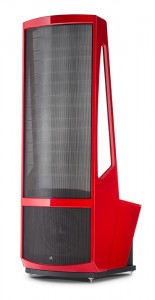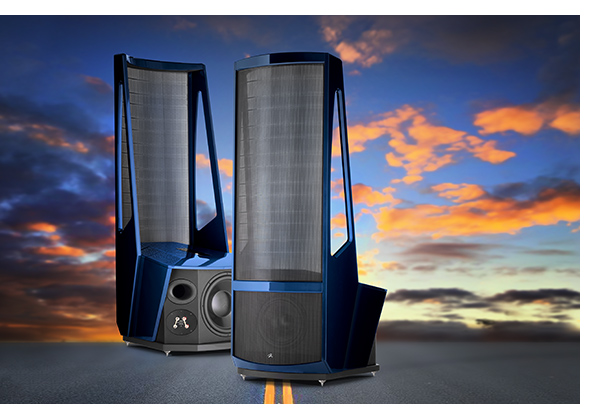






GamuT Audio’s RS3i

At TONEAudio, we’ve had the chance to review several GamuT products, including the marvelous RS5 floorstanding speakers. The RS5s certainly set a high bar, and we eagerly awaited the opportunity to test the smallest sibling in the RS line, the stand-mounted RS3. Would the more diminutive Danish beauties blow our socks off like their bigger brothers?

GamuT’s chief designer, Benno Meldgaard, shared his top goals for the company’s flagship RS Series. First, he wanted exceed the capability of their previous “S” series in every way. After poring over every aspect of the design and build, GamuT gave the revised “RS” Superior moniker to the new speakers. Secondly, rather than focusing on charts, graphs, and numbers defining the RS prowess, Meldgaard’s speaker design escaped further scrutiny and tweaking only when the RS voice met the GamuT team’s unanimous agreement in listening tests. Subjective judgements count. Statistics may represent accuracy, but beautiful music is judged in the ears of the beholder.

In my own room, the speakers exhibit a flat frequency response, but the level of musical engagement they provide certainly reinforces the achievement of GamuT’s overriding design mission: delivering great music.

Stunning Surfaces

Twin RS3s arrive together in a single wooden crate, weighing in at about 250 lbs. Our backs certainly were better off because of the attached wheels, allowing ease of movement in our environment. Inside the mammoth crate, a carefully constructed and padded cradle supports and protects the speakers from damage in transit. As with the other GamuT speakers we’ve used, you simply pop the crate out, remove the two bars holding them in place and slide them out. Where a few premium speakers can take hours to get unboxed and in place, this is a five-minute operation with GamuT. Impressive.

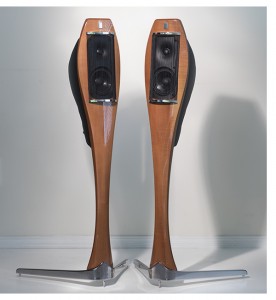
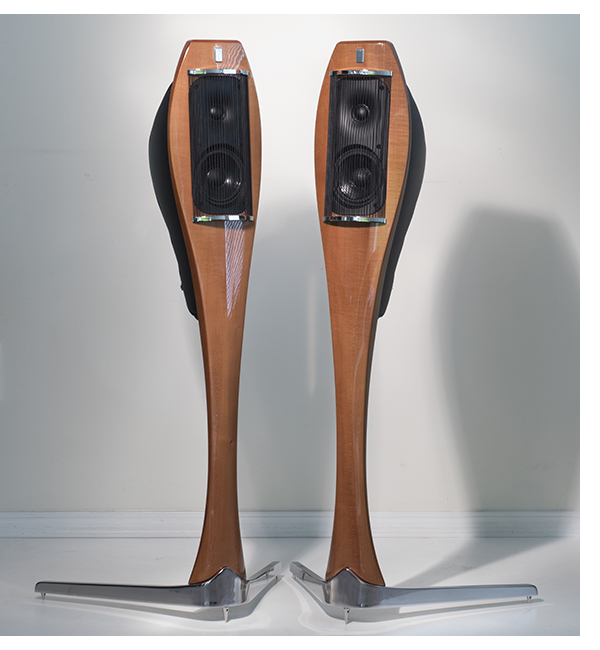
The matching stands arrive attached to the monitors, so there’s no assembly required. Some potential buyers might want to use their own stands to cut acquisition cost, but that’s not an option with the RS3. Stands and speakers come as a package deal. The integrated stands serve two purposes: one functional, and one aesthetic. First, they provide a rock-solid base for the speakers, including a metal outrigger stand at the bottom for added stability. Threaded spikes facilitate adjustments necessary for ideal speaker placement. Secondly, the accompanying stands are a stunning part of the overall speaker package. The beautiful wood finish matches the speaker set perfectly, and the cantilevered appearance of the speaker-stand combination offers a stunning visual draw complementing the requisite functionality.

The speakers feature a sloped, time-aligned face placing the tweeter a little further back from the listener than the woofer. Since higher frequencies travel faster than their lower counterparts, this design gives the low notes a head start toward the listener, and all the frequencies arrive at his or her ears simultaneously to achieve the greatest sonic cohesion.

Other than the ruby finish of our sample pair, a prospective GamuT owner has a choice of three other wooden finishes: onyx, ivory, or maroon. Regardless of color choice, the external façade of the speaker is a marvel to behold. Beneath the outer finish, each speaker body is comprised of an amazing 21 layers of wood. Various types and thicknesses of wood reduce cabinet resonance and add rigidity to supplement the internal bracing. Such a hefty build comes with an equally substantial weight. Each speaker tips the scale at 101 lbs. (46 Kg). Dimensions, including stands, are 41.6” (1059mm ) tall, with a width and depth of 8.9” (226mm) and 18” (456mm) respectively. The depth measurement includes binding posts and grilles.

A two-way RS3 design includes a one-inch tweeter assembly, described by GamuT as a ring-radiator, silk cone Neodymium Magnet system. Lower frequencies are delivered by a seven-inch combined midrange/woofer driver featuring a paper cone doped with natural oils. The RS3 front grille features a minimalist configuration, comprised of 10 black elastic-like strands stretching horizontally across the speaker front, and connected to vertical metal bars near the speaker edges. If you have small children who may be tempted to touch the speakers, be warned that the grilles will do little to protect the sensitive woofer and tweeter beneath.

Standing Symmetrically

Every listener’s room is different, so GamuT includes some helpful instructions to optimize speaker placement. In addition to written recommendations, GamuT provides an Excel spreadsheet allowing an RS3 owner to plug in the length and width of their listening space. An immediate calculation returns measurements for ideal RS3 placement. When placed at those coordinates, GamuTs perform their best for imaging and accurate frequency response. This calculator is a real time-saver, giving a new owner a substantial head start toward audio nirvana.

After general placement is complete, two more setup steps must be executed for the best possible sound. These must be completed by ear. First, toe-in adjustments help get the most from the speakers. In my case, twisting the speakers about 30 degrees inward offers the best combination of detail, musicality, and holographic imaging. As a final step, GamuT suggests leaning the speakers slightly forward toward the listening seat for the best possible sound. The outrigger base of the speakers, and the threaded spikes built in, make this process simple using an Allen wrench. Applying the same number of twists to left and right side spikes ensures the speakers remain vertical while the rear is elevated and the front is lowered. As a final check, a carpenter’s level (or phone app) can help ensure the speaker pair are locked in at an identical, forward-leaning angle.

The RS-series speaker binding posts are unique, and frankly, rather frustrating. Thick, knob-like structures conceal a very wide, cone-like post underneath. With this post design, spade-terminated speaker cables are rendered unusable. Banana terminations, or spade-to-banana adapters are necessary. The speakers do not include jumpers either, so be prepared to use your own jumpers or a bi-wired configuration.

Stunning Sonics

Once the speakers start playing, put on your seatbelt. Wow. Just…wow. From the get-go, the RS3s impress. There’s nothing slow, laid back, or overly romantic about the RS3’s sonics. However, there’s nothing strident, etched, or overly accentuated either. There’s simply a high level of realism when voicing a performance. It’s easy to enjoy these speakers for all-day listening sessions without any ear fatigue.

No matter what musical genre is played, the RS3s achieve a miraculous balance of characteristics that leave this listener craving nothing. Sonic chameleons, the RS3s can portray with equal aplomb the warmth of a lush vocal performance, the dynamic swings of an orchestral ensemble, or the punch and speed of a vibrant rock track. Few speakers I’ve encountered seem to excel to this degree with any recording thrown at them.

Specified to reproduce frequencies as low as 34Hz, the RS3s are not quite full range. However, bass is a surprising strength of these monitors. In my own listening space, I find little roll-off at the lower limits of the RS3’s claimed range. Bass is taut, tuneful, and true. Even with the subterranean notes inherent in Bill Laswell and Jah Wobble’s Radioaxiom, the speakers never exhibit strain in producing satisfying bass. Yes, the sofa and kitchen cabinet doors did rumble. That said, those craving the deepest growling bass may desire the addition of a subwoofer, or perhaps one of the full-range speakers in the RS lineup.

Highs are rendered with similar delight. RS3s boast frequency extension up to 60 kHz, well beyond human hearing and into the sonic realm of the beluga whale. Not having any sea creatures on hand, I’ll have to take GamuT’s word for that. The frequencies I can hear, like the subtleties of cymbal rides and crashes, are portrayed with both force and delicacy as the recording dictates. Shimmer and decay float effortlessly into the room. Piano notes render with both a firm strike and ambient reverberation. Soprano vocal crescendos may coax forth a shiver down the spine, but never a wince from stridency.

The upper and lower frequency extremes sandwich an equally beguiling midrange, which frankly left me stunned. Vocals like k.d. lang’s on Ingenue have such a natural and unveiled sound, it’s easy to be immersed in an experience like having a private concert. While each breath a vocalist takes can be perceived due to the RS3’s command of subtle audio cues, that detail never distracts from the bigger-picture performance.

Imaging through the RS3 speakers is among the very best I’ve experienced. When placed correctly, the speakers manage the feat of wrapping audio elements far beyond the speaker boundaries. That, combined with the realism of the RS3’s sound, admittedly caused me on occasion to twist my head in surprise toward a stray, unexpected sound projected into the periphery of the room.

The RS3s blend in with the soundstage so well, with eyes closed and a finger extended, I have difficulty pinpointing the speaker bodies. Sound seemingly floats around the speakers, rather than emitting from them. Sonic elements extend into the distance behind the rear room wall, up to the ceiling, and wrap well into the room. It’s a truly immersive and three-dimensional experience that left me tethered to the listening seat for many late night RS3 listening sessions.

Summing Strengths

To answer the question posed at the beginning of this review: Yes, my socks were blown off by the RS3, landing in a smoldering heap in the corner of the room. The RS3s are among the most engaging speakers I have experienced.

I remain adamant there is no such thing as a universally “best speaker” since listener preferences, upstream equipment, and room acoustics all weigh into the equation. Taking those variables into account in my own case, I have not yet encountered another speaker that achieves such a Goldilocks-like “just right” balance for my own sonic preferences. RS3s offer a perfect combination of detail, soundstaging, speed, realism, and overall musicality. It’s a fantastic achievement.

In short, these speakers are keepers. If you are in the lucky position of having $20k in your speaker budget, I cannot recommend the GamuT RS3 speakers highly enough. Be sure to put the GamuT RS3 on your shortlist for audition. I plan to start saving now for both the RS3s and a new pair of socks.

GamuT RS3 Loudspeakers

MSRP: $19,900

www.gamutaudio.com (Factory)

www.audioskies.com (US Distributor)
PERIPHERALS:

Analog Source: SME Model 10 with SME V and Model 10 tonearms. Dynavector 17D3 and Denon DL-103R cartridges

Digital Sources: Mac Mini, Roon Music Service, dCS Debussy

Amplification: Burmester 911 mk3

Preamplification: Coffman Labs G1-B

Speakers: Sonus faber Olympica III, JL Audio Dominion Subwoofers

Cables: Jena Labs

Power: Torus AVR 15 Plus,  RSA Mongoose power cords

Accessories: ASC tube traps, Mapleshade Samson audio racks, Coffman Labs Equipment Footers, AudioQuest Jitterbug, Atomic Audio Labs Mac Mini stand

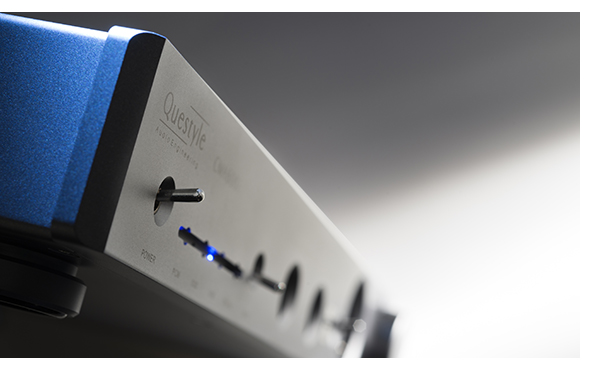
Questyle CMA600i

I’ve been a huge fan of Bruce Ball’s Questyle gear for some time. They’ve made quite a splash at all the shows and their gear offers a combination of mega performance, value and an elegantly understated visual style to boot.

All of their products look much more expensive than their price tags, (having them assembled in the Foxconn factory doesn’t hurt!) and deliver top functionality as well.

With so many people pinched for space, multi-function components are all the rage, and in addition to offering a pure DSD DAC and outputs for every headphone termination imaginable, the CMA600i has RCA and balanced XLR line outputs so it can be used as a 2 channel line stage. Regular readers know this is one of our publisher’s hot buttons. The CMA600i retails for $1,295.

You can read all the techie goodness about the CMA 600i here.

Reviews are in process here and over at The Audiophile Apartment, so stay tuned!

Reimyo DAP 999EX DAC and CDT 777 transport

If you think digital audio is merely bits being decoded and there isn’t any difference between players, you haven’t been listening.

Much like your favorite phono cartridges, all digital players have their own personalities, too. They all take a different approach, and it’s not necessarily better or worse, but it is certainly different – with each manufacturer putting a different emphasis on the part of the player they find the most important. This DAC and transport combination from Reimyo is a perfect example.

With so much emphasis on high resolution digital audio, Reimyo’s Kauzo Kiuchi (the founder of Combak) chooses to optimize his player, in this case, as a separate DAC and transport, for 16 bit/44.1kHz playback, and incorporate his take on fine tuning the combination; two sets of their Combak tuning plugs are included to deliver the digital goods. They also suggest using a bevy of their signal and power cables to achieve the ultimate result.

In the day of DSD and high res files, this may seem like an anachronism to some. But let’s face it, unless you started collecting music three weeks ago, the bulk of your collection is probably redbook files, or even compact discs. Should you be the music lover that really doesn’t care all that much about high resolution audio files, the Reimyo pair could be your destination, at least for the foreseeable future. Back when I traded my Naim CD555 for a dCS stack, I had remarked more than once that I could have lived happily ever after with the CD555 if it had a digital input on the rear panel. But computer audio dragged me down another path.

Un-digital digital

Listening to the ease at which the vibes and violin in the introduction of Elvis Costello’s “This House is Empty Now” are rendered, it’s clear that Kiuchi-san has created a masterpiece for music lovers. Forget everything you think you know about digital if you haven’t heard this player. Years ago it was very hip to have a first generation Play Station to play CDs, because it had a very warm and involving, yet unresolving sound that masked many of digitals errors of omission.

The Reimyo pair gives this same warmth without loss of resolution. I wanted to open the cover and look for vacuum tubes, but photos on the internet reveal that there are none inside. Another review of this player mentions the effect, comparing it to photography, saying that this player lacks the “sharpening” often associated with image processing. As a photographer, I agree with this analysis, but as digital camera sensors have improved with more dynamic range and resolution, that precious little sharpening is not required anymore. And thanks to the 999EX’s approach, it’s not needed here either. For those that remember film, the Reimyo feels much more like Kodachrome than an unsharpened digital image, with a wide tonal scale that seems to fade out almost to infinity that to the uninitiated seems soft. The longer you listen to this combination the more under its spell you fall. You’ll be stunned at just how much musical detail exists in those standard resolution discs of yours.

While both components are excellent on their own, the pair together is where the glamour lies. Using the CDT 777 with Simaudio, dCS and Gryphon DACs all proved excellent, and vice versa using Simaudio and dCS transports with the Reimyo DAC, the combination takes the relaxed analog-like effect to the ultimate level. I’m always great at spending your money, but in this case I highly suggest buying the two as a pair instead of working your way up. Unfortunately, we weren’t able to get the full complement of Combak cables, so the thought of even more resolution and ease lurking with this pair is indeed compelling.

More music

This player will really shift your paradigm in terms of worrying about high resolution downloads. With so many of these files just being upsampled redbook, it’s tough to know where the rocks in the road lie, and it’s often too late to turn back once you’ve bought a bum album. Anyone having a huge CD collection should really give the Reimyo combination serious consideration as a destination player and call it a day. There was never a time during the review period that I found myself craving the high resolution files lurking on my Aurender W20 server.

Listening to Dave Stewart’s understated masterpiece from the ’90s, Greetings From The Gutter, there was so much subtle spatial information lurking on what has always seemed like a brilliant album that was only mediocre in the recording department, it was a revelation. Even The Monkees’ Then and Now, which has to be the worst sounding CD ever, sounded fantastic with this player. Songs that felt hopelessly compressed to the point of being unlistenable are now palatable.

Which means well-recorded CDs sound brilliant. Tracking through Neil Larsen’s Orbit, mastered by Bernie Grundman, is full of percussive attack, a massive soundstage and weight that feels like a 24/192 recording, as do all of the best sounding CDs in my collection.

Single purpose player

The CDT777 transport links to the Reimyo DAC via a single coaxial output, where the DAC features coax, BNC, AES and optical inputs, so those streaming music will not be left out. Unfortunately, the only input lacking is a USB connection, but with so many good, reasonably priced outboard converters, this will not stop you from using your computer with the Reimyo DAC. Though precious few audiophiles will need the Toslink input, it is incredibly well implemented, should you need to use it, proving that not even the smallest detail is overlooked in the design of the Reimyo DAC. As mentioned, files are kept in their original format without being converted to higher resolution before digital conversion, which is done at a 24 bit/16x rate.

A Phillips CDM-Pro 12 mechanism, with clamp (very similar to the Naim 555…) is used to spin the discs with excellent results. This transport is robustly built and at this point in the game, should outlive you. A very basic remote is offered to control machine functions and switch digital inputs, so the rest is really installing the various Combak bits and getting down to business.

It’s really all about tonality

If you’ve ever been taken under the spell of a great SET amplifier, a well-presented single driver loudspeaker, or the original Quad 57 loudspeaker, these devices all present a “continuous tone” type of musical reproduction, because of the simple signal path, lack of crossover effects and the lack of interaction between multiple drivers or output devices.

There is a certain signal purity that accompanies any of these that is unmistakable and, once you hear it, it will either become your holy grail, or it will not be detailed (a.k.a. “audiophile enough”) for you. Add the Reimyo combination to this list of components that has an all encompassing, musical feel to its presentation. At first blush, you might even find it slightly dull, but the more time you spend listening, the more difficult it is to leave the couch or chair in front of your speakers.

This continuous tone nature really starts to pull you into the music after a few minutes, especially with vocal tracks and acoustic instruments. The piano takes on a new life through the Reimyo, and it’s tough to believe that you are actually experiencing digital music, let alone redbook CD.

Is it for you?

In the day of multiple, high resolution digital formats that change like the wind, there will always be a steady supply of compact discs to play, much like the massive collections of analog records still floating about. Should you be a music lover with a substantial collection of CDs, in search of a better rendition of your library, the Reimyo CDT777 and DAP 999EX will be your grail.

MSRP:  $12,500, transport and $11,500 DAC

www.combak.net (manufacturer)

www.wynnaudio.com (NA distributor)

Pass HPA-1 Headphone Amplifier

Listening to Thomas Dolby’s “Ability to Swing,” the Acoustats in my living room have dramatically increased their ability to swing in every way: these vintage ESLs known for their somewhat loose and flabby bass now stand up and deliver Dolby’s snappy synth bass lines with authority.

The low level resolution that this preamplifier brings forth unearths minute details normally only heard on the TONEAudio reference system costing almost a hundred times more; all three dimensions of the sound field painted now expanded to the point of being psychedelic. In 35 years of listening to the Acoustats, they’ve never sounded this exciting. The slow sax fade in on Traffic’s “The Low Spark of High Heeled Boys” becomes conscious so deliciously, so delicately, as the accompanying instruments fold into the mix, it’s creepy the way these vintage ESLs wrap you up in sound.

But this isn’t Pass’ $38,000 Xs preamplifier; it’s their new HPA-1 headphone amplifier. This thing sounds so damn good twenty minutes out of the box, the thought of plugging a pair of headphones in is frightening, fearing my head will either melt or serious flashbacks will be triggered. So for the next few days, it merely does duty as the anchor of a modest 2-channel system, logging some hours on the listening clock. Before you start griping about the unobtainable price, the HPA-1 retails for $3,500 – hardly unobtainable at all.

Sheer genius

Wile E. Coyote lists himself as “super genius” on his business card, but I can’t think of guys more deserving of this title than Nelson Pass and his crew at Pass Labs. I’ve been buying his designs since his days at Threshold circa 1980, and I’ve never heard one I didn’t love. Not like. Love. Personal bias, maybe, but I keep trying everything else, finding plenty of lovely things, but when I come back to a Pass product, it just feels––or should I say sounds––perfect. So in case you haven’t been reading my reviews for years now, I confess my personal bias here, openly.

The HPA-1 is the brainstorm of the newest addition to the Pass team, Jam Somasundram. Speaking with him on the phone is highly enjoyable and he makes it a point to tell me that he “designed the HPA-1 as a linestage first,” giving it the necessary oomph to drive a power amplifier, so that driving headphones would be no problem. A man of major understatement, this thing is fantastic.

Even if you aren’t a headphone enthusiast, but have been shopping for a linestage in the $15,000 range, consider the HPA-1. (Remember, it’s only $3,500…) If you have a minimalist, yet high performance system and can live with two single-ended inputs and a lone single-ended output to your power amplifier, get your hands on an HPA-1 and spend the rest of the money on your system.

Pairing the HPA-1 with everything in the studio and at home from bare-bones vintage amplifiers up to the Pass Xs300 monoblocks used as the anchor to our main system is a treat. Comparing it to a number of other preamplifiers in the $5,000–$10,000 range, the Pass holds its own or outperforms them in terms of quietness, dynamic range and tonality. Once powered up for a few days, and played for about 100 hours, it opens up further, exhibiting a level of refinement you would expect from a $10k preamplifier. Remember, only two inputs, no remote and one set of outputs. But purely from a sonic standpoint, it is stellar.

From a visual standpoint, it looks like an Xs Pre put in a shrink machine. Its diminutive size is less than half of a standard component, making it great for a compact, yet high performance system, or the perfect desktop headphone amplifier.

Oh yeah, it’s a great headphone amplifier

Pass keeps the minimalist thing going here too. With only a single ¼-inch jack on the front panel, they haven’t addressed the balanced thing, or multiple outputs, merely concentrating on the one way of connecting that most headphones offer. Forget about that; this thing sounds awesome.

The Pass press release mentions that it will easily drive planar phones, and this is instantly confirmed with a quick test drive of HiFiMan, Audeze, and Oppo phones. Even the notoriously tough-to-drive AKG phones pose no threat to the HPA-1.

For those who haven’t had the Pass experience, Nelson Pass has said on more than one occasion, he “likes the sound of tubes, without the hassle,” that is, replacing tubes and the occasional catastrophic failure that can accompany high voltage and high heat. The HPA-1 sounds just like the current crop of Xs gear: refined, dynamic and quiet, with a tonal balance a few molecules to the warm side of neutral. Never a bad thing with today’s current crop of headphones, especially the top of the line Sennheiser phones.

After running through a wide gamut of phones to confirm no rocks in the road, most serious listening was done with the Audeze LCD-2s (current version) and the OPPO PM-1s. While this is a very well-balanced amplifier, its strongest suit is the sheer dynamic range it offers. Much like the Xs300 monoblocks we use daily, this extra dynamic range and grip helps whatever headphones you might have, fully controlling their diaphragm, resulting in quite possibly the most wonderful experience you will have with your current phones. Even my late ’70s vintage Koss Pro4aa’s took on new life with the HPA-1 driving them.

If you’ve ever been in a hifi show room, or trade show where the speaker manufacturer uses a massive power amplifier to drive a small pair of speakers with great result, you know what I’m talking about. It also gives whatever phones you are listening to extra oomph in the bass department. Favorite EDM tracks now really feel weighty, especially with the Audeze phones.

As you might expect, the stereo image produced by this amplifier on a premium pair of headphones is big, bold and exciting. A couple of times I caught myself getting up out of the chair, ready to walk away, thinking that I didn’t even have headphones on.

A $3,500 headphone amp with free preamp or vice versa?

Rather than bore you with audiophile cliché after cliché, let’s break it down. The Pass HPA-1 is on the top tier of the world’s finest headphone amplifiers, regardless of cost, end of story. If you can live with the single-ended functionality and a single output, you’ll have a tough time getting better sound anywhere. It is an expensive headphone amplifier, but delivers the goods. If you are only looking for a headphone amplifier, this is the top of the heap.

As the control center of a minimalist hifi system, it offers performance far beyond what you’d expect to get from a $3,500 linestage, and it has a world-class headphone amplifier thrown in for free. Again, if the topology fits your needs, even the most crazed audiophile could live the rest of their days with the HPA-1. It’s that good. Even if you never plug a pair of phones into the front panel and merely use it as a preamplifier, this is one of the best values in high-end audio today. And swing it does.

The Pass HPA-1

$3,500

www.passlabs.com

Issue 78

Features

Old School:

Recapping the HH Scott 357

By Erik Owen

995:

A Mini Miracle From Totem Audio

By Mark Marcantonio

Journeyman Audiophile:

Wharfedale Diamond 250  Loudspeakers

By Jeff Dorgay

Personal Fidelity:

Quad PA-One Headphone Amplifier and Audioengine HD6 Speakers

By Rob Johnson

TONE Style

Anker SoundCore Bluetooth Speaker

Bald Eagle Skull Shaver

Eunique Jean’ster and Ride’ster Jeans

DJ Pillows

Hot Wheels Yellow Submarine

Muss Cobblestone

StarTrek Communicator Net Phone

Music

Spin the Black Circle: Reviews of New Pop/Rock and Country Albums
By Bob Gendron, Todd Martens, Chrissie Dickinson, Andrea Domanick and Aaron Cohen

Jazz & Blues: Florian Weber Trio, Julian Lage, Avishal Cohen and More!
By Aaron Cohen and Jim Macnie

Gear Previews

Audio Research PH-9 Phono, DAC 9 and LS 28

Reviews

Audio Classics 9b Amplifier
By Richard H. Mak

System Audio Pandion 30 Speakers
By Jeff Dorgay

Conrad Johnson CA 150SE
By Jeff Zaret

Torus AVR 15 Plus Isolation Transformer
By Rob Johnson

Pass Labs XA30.8 Power Amplifier
By Rob Johnson

Rega’s Planar 3 Turntable

When you see the new Rega Planar 3, take a close look. It’s changed. The journey has become a destination. Nearly 40 years of constant refinement makes the Planar 3 the best in its class; no one does it better. Whether you’ve been a fan for years or this is your first go, this table defines elegant simplicity at an approachable price.

Lots of new bits, top to bottom

Starting as a Planar 3, then becoming a P3 and then an RP3, the Planar 3 designation returns. Rega claims that there are “only two bits in common with the outgoing RP3,” and according to Phil Freeman from Rega those are the two hinges holding on the dust cover, so it has been a total redesign. First time and legacy Rega fans will be equally astonished at how much music this table reveals.

Further conversation with Freeman reveals exactly how much has changed. He tells me that they have been going “aggressively” back to Rega’s original values and that they have done something “quite special” with the new Planar 3. While Rega has always been about evolution over radical change, a quick look around the new Planar 3 shows it to be overall much crisper than the outgoing table. To the untrained eye, the older P3 doesn’t look all that much different, until you look closely and put the close up view of the Macro lens to bear.

You’ll notice the feet underneath the table are different, with a wider profile, providing a more stable platform. The braces that goes from the tonearm pivot to the bearing are now 3mm thicker and the plinth is finished to a much higher level as well. Freeman makes it a point emphasizing that much of what they learned building the cost no object Naiad turntable filtered into the Planar 3. “We’ve streamlined, updated and optimized our manufacturing process, so part of the way we’ve kept the cost down is by eliminating assembly time. Yet the end result is more consistent than ever before.”

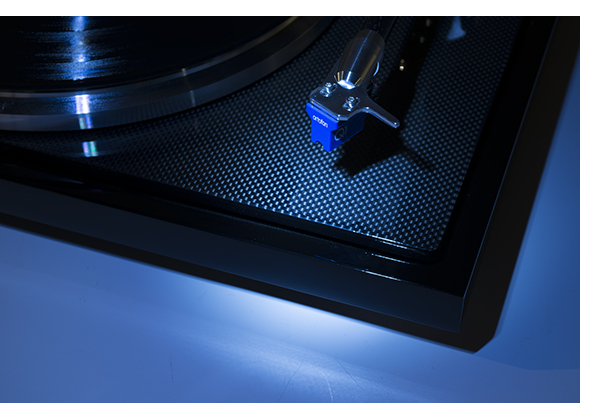
Even the glass platter is different. Now made out of a special, clear glass called “Optiwhite,” the 12mm platter is made to a tighter tolerance than past models. Comparing it to past platters, they all look green in comparison. This is referred to as a technical glass with no iron content. Rega polishes the edge cleaner, and now you can see all the way through to the center hole. Overall, the table has a much more expensive, refined feel in addition to better sound quality.

There’s plenty of stuff you can’t see contributing to the improved sound. Better CNC technology makes for a more precise main bearing hub, with no visible fixing into the plinth. The nut and washer of Rega’s past are now gone, claiming a much lower noise level and our listening confirms this. Microscopically the bearing is compressed somewhat.  You can hear this instantly in the much lower noise level provided when comparing directly to the old model. Freeman laughs as we end the conversation, reflecting on this journey, pointing out that Rega has not shipped any of their manufacturing away from the factory; “We’re control freaks, we have to have control. When you make something 6,000 miles away you can’t control them.  And we love making things.”

My long Rega journey

It seems like only yesterday I was leaving the world of mass-market hifi and entering the wacky world of high-end audio. Conventional wisdom at the time was that direct drive (i.e. my Technics SL-1200) was bad, and a British belt drive table was good. Not quite able to make the stretch to a Linn LP-12 back in 1982, Rega’s Planar 3 seemed the obvious choice. A chance visit to The Audio Emporium in Milwaukee, Wisconsin had them in the process of unpacking a crate full of Planar 3s as I walked in the door. Salesperson Jon Spelt happened to be pulling a lime green Planar 3 out of a box, remarking, “What idiot would buy a turntable this color?”

Well, I was that idiot, and thus began a very long path with Rega and the world of high-end audio. 34 years later here we are. Who knew? All I can remember was bringing that table home, setting it up next to the Technics and spinning the MoFi copy of Poco’s Legend. Hey, it was 1982, cut me some slack. The only thing I remember was that it provided a significantly more engaging experience than my Technics and I was pretty excited to finally be part of the club.

Capturing some of that lost memory, it seems appropriate to dig out that Poco album from the vault and test drive it for old time’s sake. At first listen the new table sounds fantastic, but memory has a way of romanticizing. The Rega Planar 3, at $945 without cartridge has only gone up about 2.5 times in that period and has made a major jump in performance and build quality. And by combining it with the table at time of purchase, you save $100. Not bad at all.

Getting down to the business of listening, the first thing to check is speed accuracy. About twenty years ago, it was common for Rega tables to run ever so slightly fast and once a few reviewers got wind of this, it was like the Audi sudden acceleration effect that dogged the carmaker for years after (yet no one could successfully duplicate). During the 12-year history of TONEAudio, we’ve yet to have a Rega table measure anything but perfect speed and the Planar 3 you see here is no different.

Back to the listening chair

To really get a firm handle on just how much Rega has accomplished, a 36-year-old model is commandeered to compare to the current table side by side in real time. Freeman confirms the serial number, saying the table was built in the fall of 1980, adding, “I probably built that deck.” Steve Daniels at The Sound Organisation, Rega’s US importer was kind enough to send another Elys 2 cartridge for the older table, making for a direct comparison. Pass Labs new $45,000 Xs Phono makes it a breeze to compare the tables as well as limit any equipment limitations. A quick speed check on the older P3 reveals that it is right on spec for turntable speed, so the analog gods are clearly smiling on us this day.

Identical copies of Bob Dylan’s Blonde on Blonde (well, two pressing numbers apart) bring the Rega engineers efforts to bear immediately. The jangly guitar at the beginning of “Leopard Skin Pill Box Hat” push further out from the imaginary line between the speakers, painting a broader, more three dimensional picture via the new Planar 3, with the older table sounding much more two dimensional as a result.

Other LPs with nearly identical pressings reveal the same thing, regardless of which pressing is on which table – the new table is much more dynamic, with a lot more jump than the old. After a few direct comparisons are made to get a baseline, it’s tough to go back to the older table, showing how far the engineering staff at Rega has come with this new design.

The P3 has never been famous for bass extension, yet the new Planar 3 offers more weight, more control and more texture than ever. Rifling through bass heavy tracks shows how much of a contender this table has become. Bouncing back to that totally 80s groove, the synth bass line in Paul Young’s version of “I’m Gonna Tear Your Playhouse Down” now rattles the room, where the old table politely offers up some bass.

Thanks to the capability of the Xs Phono, it’s easy to hear a much lower noise floor on the new table compared to the old, but even through a vintage Marantz 2245 receiver, the difference is still discernable, even playing though a pair of JBL L100s. This won’t do you a ton of good spinning your favorite Motorhead disc, but if you’re listening to anything in the acoustic or solo vocal genres, it’s an entirely new ballgame.

Should you order your Planar 3 with a Rega cartridge, setup will take all of five minutes. Attach the belt, fit the cartridge screws and set tracking force to 1.75 grams. Job done. This is not a terribly tweekable table. However, if you want to get into the tweak zone, consider Rega’s Reference Drive Belt. For $59, it’s made from a higher quality rubber and machined to a tighter tolerance, giving a better belt to platter and drive pulley interface. No, it doesn’t make the heavens part, but again those listening to classical and acoustic music will notice an extra degree of smoothness in the upper registers. Take a peek at our video clip to see just how easy this all is.

This more robust, more stable platform makes fitting a better cartridge to the current Planar 3 a better value proposition. If you can find a cartridge that has a similar stylus tip to top of cartridge body measurement, it will pop right in. For other cartridges, Rega makes a 2mm stainless steel spacer, or a step adjustable 2/4/6/8mm spacer that will adjust the back of the tonearm for proper VTA. Stepping up to a Sumiko Blackbird 2 was exciting, showing just how much more music this new table is able to reveal.

And, if you want to take your Planar 3 even further, Rega’s TT-PSU 2 (an additional $395) not only lowers the noise floor even further, controlling the motor better than the stock wall wart power supply, it lets you change speed from 33 to 45 on the fly, at the push of a button. Back when the original Planar 3 roamed the Earth, most records were only 33 1/3 r.p.m., so removing the platter and moving the belt on the pulley manually wasn’t a big deal. Now, with so many audiophile pressings being produced in the two disc, 45 r.p.m. format, it’s a major time saver. Not to mention how much easier playing those 45 r.p.m. maxi-singles will be!

When you really listen to the Rega Planar 3, listen close. It’s changed a lot. And we’re happy to give this perennial favorite one of our Exceptional Value Awards for 2016. We defy you to find a better executed turntable at this price.

The Rega Planar 3 Turntable

$945 without cartridge

$1,145 with Elys 2 cartridge installed (Elys 2 is $295 separately)

www.rega.co.uk (factory)

www.soundorg.com (US importer)

Peripherals

Preamplifier              Pass Xs Pre

Phonostage                Pass Xs Phono

Amplifier                    Pass Xs300 monos

Speakers                    MartinLogan Neolith

Cable                          Tellurium Q Silver Diamond

**  Ed. Note: while the system listed here was used for ultimate comparison between the new Planar 3 and old to eliminate that from the equation, the majority of review listening was done with the new Simaudio NEO ACE integrated and a pair of Rogers LS5/9 speakers to keep this a bit more “real world,” if you will.

Issue 77

Features

Old School:

The dCS Elgar DAC: Where they started!

By Jeff Dorgay

Journeyman Audiophile:

Paradigm Prestige 75F Loudspeakers

By Mark Marcantonio

New Column! Timbre Tantrum

Cat Parkay looks at the Big Ego DAC from Emotiva

Personal Fidelity:

The Cardas A8 Ear Speakers

By Rob Johnson

TONE Style

Wino: Riesling – The Misunderstood Sensational Wine

Hamster Maturity- Kia Soul with Harman/Infinity Sound

Vintage Mic Showered

Apple Pencil for iPad Pro

Base Qi Micro SD Adaptor

Green Tea Kit Kat

Atomic Audio Mac Mini Platform

McIntosh RS100 Wireless Speakers

Kangaroo Pro Portable PC

Music

Spin the Black Circle: Reviews of New Pop/Rock and Country Albums
By Bob Gendron, Todd Martens, Chrissie Dickinson, Andrea Domanick and Aaron Cohen

Jazz & Blues: Florian Weber Trio, Julian Lage, Avishal Cohen and More!
By Aaron Cohen and Jim Macnie

Gear Previews

MartinLogan Neolith Loudspeakers

McIntosh C1100 Preamplifier

Rega Planar 3 Turntable

Meridian 818v3 Reference Audio Core

Pass Labs Xs Phono

Reviews

dCS Rossini DAC and Rossini Clock: Raising the Bar
By Jeff Dorgay

Rotel RB-1590 Power Amplifier: Big box, big sound
By Jerold O’Brien

ModWright SWL 9.0 Anniversary Preamplifier – Time Flies!
By Jeff Dorgay

MOON by Simaudio Neo 280D DAC – Stunning Simplicity
By Andre Marc

JL Audio Dominion D110 Subwoofers – Low Down (in a Good Way)
By Rob Johnson

PrimaLuna’s HP Integrated Amplifier – Beyond Bitchin’

Tellurium Q Silver Diamond Speaker Cables!

Not having made changes to my system in a long time proves a double-edged sword; I know it intimately to the point where a minute change will be easily spotted and I was ripe to draw the cable review card.

A number of industry friends have been raving about Tellurium Q in person and out on the web, and this, too, is a double-edged sword because sometimes one wants desperately to believe the positive expectation.

The cables come packaged in a nice but not overly ostentatious box. Our review sample came equipped with locking banana connectors and a set of bi-wire jumpers similarly finished. Also enclosed is THE DISC, offering tracks chock full of randomly generated white noise, pink noise, pulses and sweep signals that go up and down the sonic spectrum.  There are three tracks on the disc. Track one is a system check for proper phase, etc.  Track two is an hour-long conditioning track which serves to not only condition the speaker cables but every other component in the chain. Track three is a ten-minute conditioning “warm up” to be played each time you decide to listen to your system.

By rights, I should hate these cables. I say that because it is silver-plated but that’s only the beginning of this product’s story. To make my personal bias clear, I have rarely heard solid silver cables that swept me off my feet, and silver-plated cables have always been tossed out of the system with great disdain since they sounded too horrible. You know the drill: overly etched, harsh, irritating, etc. Never completely musical. Well, now all that has changed. At least for this listener with this product.

Perusing the Tellurium Q website, I didn’t see a lot of detail regarding the exact construction, metal plating or dielectric materials used in these cables, but there is a lot of information regarding the process by which they arrive at their final design. Most of it has to do with combating phase distortion, which causes smearing of the musical signal.  Within each cable, different geometries are employed, different dielectrics are used, and the plating is matte instead of shiny and has a specific thickness. This witches’ brew of manufacturing results in the product at hand.  One interesting side note, the matte silver plating on the banana connectors is exactly the same as the input connectors on my speakers.

After installing the cables carefully, with attention to phase, the provided jumpers serving to ensure signal continuity between the low and high inputs, I followed up with the hour-long track of the test disc to make sure I was completely set up. Immediately, the greater sense of depth and width presented by my reference components exceeded that of what I was previously experiencing. This is not a subtle change, it is more like someone opened a huge door at the back of the room that I hadn’t known was there, causing me to immediately relax and enjoy what followed. So much for user bias. Vigilance to find that harsh-etched sound that silver always gave me, but it simply isn’t there with the Silver Diamond speaker cables. The overall high frequency character is presented in an utterly clear but completely musical fashion. This, added to the sense of space I mentioned earlier, combined with exacting bass extension and definition makes for a thoroughly enjoyable session.  It doesn’t matter whether I play symphonic music with massed violins or bass and drum jams, the result is always the same…..simply music.

Enough time has passed now that I continue to be amazed at the positive change the Tellurium Q speaker cables have made to my system – so much so that our publisher had to literally pry them out of my system to get them back! I think we both are anticipating a full system review of their cables at a future point. We’ll keep you posted.

Further Listening – Jeff Dorgay

Our staff curmudgeon Mr. O’Brien is rarely, if ever, impressed with cables of any kind, and that’s not to say he’s anyone that mighty, it’s just his mindset. He’d rather talk to you for hours about the intricacies of setting the mechanical fuel injection on a BMW 2002tii than entertaining the thought that a piece of wire could make that much of a difference, but that’s the wide range of attitudes that makes the wheel go ’round here at TONEAudio.

Being that he is as excited as he is about these cables, I wanted to get them back ASAP to run them through their paces here, on a wide variety of speaker setups to see, or rather hear what I could hear. I would also like to give a nod of appreciation to Stuart Smith of HiFi Pig for not only telling me about these, but keeping on me until we got a set in for review.

Though a bit more open-minded to the cable thing than Jerold, I still stick to what I know for the most part, using Cardas Clear, Clear Light and now Clear Reflection in my two main systems, and Nordost Frey in system three. We can argue till the cows come home about this, but at least you know what I like and use on a daily. And I too bristle at the thought of silver-coated copper (for that matter, anything coated over anything else) cables, but we have to try and maintain some objectivity in this wacky world of high-end audio.

As Jerold mentions, there isn’t much specific “tech” on the Tellurium Q website, but director Geoff Merrigan makes it a point that his cables are designed to preserve the phase relationships in the audio signal. While I am not remotely qualified to comment on this, I do know that every speaker I have heard with the same engineering goal has always sounded the most natural to my ears, so I think Mr. Merrigan is indeed on to something.

I too have not changed anything in my reference system one for quite some time so it was easy to ramp up on a trial of the Tellurium Q speaker cables. I must admit, it was an

“oh wow” moment when plugging them in to the Quad 2812s. These speakers, in concert with the Pass Xs300 monos throw such a massive soundstage already, and resolve fine detail so well, anything good or bad is instantly brought to bear. So I ran the hour long break-in track and went for a coffee. This done, the delta was much wider. Rather than bore you with a barrage of audiophile clichés, the Tellurium Q cables paint a more vivid picture than what I was listening to before.

Rather than blather

If you’re looking for a major jump in your system’s performance, I’d suggest buying a pair of these instead of considering a hardware upgrade. Before you write this advice off to cable delusion, expectation bias, or the recent Mercury retrograde phase, please take note: I have never said this in TONE’s 11-year history. There are a number of times I’ve swapped a good $5,000 preamplifier or DAC for a good $10,000 unit and not had this level of increased musical involvement.

Every aspect of my system’s presentation is improved; the soundstage grows markedly in every direction, transients are faster and cleaner, with a quieter overall presentation. The comment that everyone else hearing these cables, with no idea what they are or what they cost, said the same two things: “it sounds bigger,” and “it sounds louder.” I didn’t expect how much smoother, yet more resolving, everything sounds. I’ve never heard the Quads sound this enveloping.

$7,500 is a lot of money for wire, but the Tellurium Q Silver Diamond Cables deliver the goods. In the context of a six-figure system, this is merely a punctuation mark and the well-heeled customer won’t even blink. However, even in a much more modest system consisting of a Prima Luna integrated, Simaudio CD player and the Rogers LS5/9s, with a $10k price tag total, these cables still provide a dramatic enough improvement to be worth the price asked. In every possible system configuration I could scratch together, the results are the same.

Value is a highly relative subject; cable is nearly always a hotspot and I admit to being more prejudiced against spending big money on it, yet the Tellurium Q Silver Diamond speaker cables deliver more music than anything I’ve yet experienced. I highly suggest auditioning them the next time you’re considering spending some money on a system upgrade.

Produced and distributed in the UK, these cables are more readily available in the rest of the world. Walter Swanborn at Fidelis AV in the US is the sole outlet for now, but he’s an affable and easy guy to find. I guarantee you’ll be surprised!

The Tellurium Q Silver Diamond Speaker Cables

$7,500 (2m pair)

www.telluriumq.com (manufacturer)

www.fidelisav.com (US outlet)

The Melco N-1a

We’ve been toying with the Melco N-1a for a few months now and it is superb. For $1,999 you can use it as a music server, renderer, as well as a few other things. I prefer to use it as a supercharged, mega high quality NAS.

We’ll have the rest of the review up in a day or two so please stay tuned!

In the meantime, visit our friends at The Sound Organisation for more information:

Why MQA?

I gave Meridian’s co-founder Bob Stuart a difficult time a little over two years ago as he first told me about MQA, making it clear that I wasn’t going to tell you, my readers to buy Kind of Blue, again, no matter how compelling the demo he was about to show me would be.

The demo was amazing, and you wouldn’t expect anything less from Bob Stuart, undoubtedly one of high end audio’s most clever guys. Though Stuart is a confessed digital guy, it’s incredible that his latest creation is so analog sounding. A number of early reports on MQA have been less than bombastic, but like so many incredible things, the magic is in the details – in this case the fine details.

What Mr. Stuart has developed is certainly a paradox. As someone raised on fine analog, hearing MQA for the first time comes across as brilliant, but not in a hit your head with a mallet way. Yet the more analog you have heard, the more easily you’ll appreciate what MQA brings to the table. Music rendered via MQA has an ease and smoothness that you would normally associate with the best analog record and tape playback, in terms of musicality, with the dynamic range and speed accuracy you’d expect from digital. Sound like the best of both worlds? Well, it is.

Though Stuart started development work at Meridian, MQA is a separate company. As he mentions, “We had to set it up this way. First, it’s now a full-time job. Second it’s a completely different type of activity and in MQA we genuinely firewall our licensee activities from each other and that includes Meridian”.

It’s important to keep in mind that MQA is not really a new format, per se. Stuart and his staff say that MQA captures subtle timing information that is lost in the digital encoding process by creating a digital footprint of the recording chain of the album being played. In essence, they eliminate the sonic fingerprint of the gear going from the microphone to the DAC. Those worried that the sonic choices made by the artist and engineer to get said sound will be lost, have no fear. As much or little of the recording chain as the artist and/or producer want to leave in the mix can remain. This is why these recordings are referred to a “Master Authenticated.” They are all signed off on by the artist, so you know this is the record that the artist and producer intended you to hear in the first place.

A Sooloos server full of MQA files, from the 2L label and Warner Music, makes it easy to compare MQA to non MQA files in a relevant way. Good as the recordings from the 2L label are, these are not albums like Chicago V, Roberta Flack & Donny Hathaway, or Harvest; records that I’ve been listening to for most of my life, and also are available in nearly every format you can think of. Yet with all these classics at my disposal, the shootout begins with Metallica’s black album. Notoriously squashed of life and dynamics, this rock staple comes alive via the MQA process. The beginning of “Wherever I May Roam” is now full of life; rather than being met by a giant wall of overly compressed guitar crunch, the MQA version uncloaks layer after layer of information, providing more listening enjoyment, and illuminating the amount of care made in the recording session. Metallica has never sounded better in my system.

Multiple comparisons to the existing standard and high resolution files I have of the Warner classics on file, via Meridian’s latest 818v3 Reference Audio Core, which acts as a MQA compatible DAC, preamplifier and control system and a pair of 7200SE active speakers prove enlightening. Stuart tells me that this pair of 7200s is very special, because it is the same pair of speakers that he dragged around the world, doing all of the MQA demos for various label heads, artists and producers… Yet, you don’t have to spend $16,000 on a DAC to enjoy MQA. A number of hardware partners are now available (check www.mqa.co.uk for the latest count) and Meridian’s $299 Explorer 2 DAC gives a highly convincing demonstration.

Moving the 818v3 from my home listening room to main listening room at TONEAudio proves equally illuminating, where a direct comparison between MQA and a few other very good DAC’s but to make the ultimate comparison; MQA and vinyl. Again, this is where MQA really shines. For all the vinyl lovers in the audience (myself included), constant comparison between the recent 45 rpm LP remasters of the Neil Young catalog and the tracks available on MQA are nearly a dead heat. Nearly all of my non audiophile friends with no predisposed agenda prefer the sound of the MQA files to even LP, yet the same comments are made by everyone with no audiophile language; MQA sounds more relaxing, more real, more like music. So Mr. Stuart has hit a home run.

Again, is it a night and day difference? Not necessarily. Listening to great 24/192 vs. MQA is like going from a 7 Series BMW or S Class Mercedes to a Bentley. High quality versus very high quality, yet the difference is still there and as Mr. Stuart is fond of saying, “once you hear it, you can’t un-hear it.”

However, I think the even bigger difference or improvement that MQA brings besides another level of refinement is the way it will bring higher resolution to everyone. The main problem with 24/192 files is the size of the data pipe required to facilitate it. An MQA stream is right around 1100kb/sec, actually a bit smaller than uncompressed CD resolution files. This will be tremendous for those of us wanting high res to go, streaming from Tidal and eventually others. Stuart was kind enough to let me stream some beta files on Tidal and the results are excellent.

And this is what I like most about MQA, you won’t have to buy Kind of Blue or any of your legacy audiophile pressings again to enjoy the benefit of MQA. That’s what makes this really cool. Those that do want to purchase these titles will be able to very soon, but linking MQA with Tidal makes it a lot more diplomatic and cost effective.

In addition, files encoded with MQA will still sound better, cleaner on your standard digital setup even if you don’t have a DAC capable of decoding MQA. For now, let’s call the difference about 20% in terms of revealing more music in a less imposing (i.e. digital artifacts, etc) way than a non-MQA file.

The biggest hope for MQA is that as recording studios around the world adopt MQA as a standard and invest in MQA encoding hardware, forgoing the need to send the files to Meridian for encoding as they do now, future generations of musicians work will sound much better; that’s a triumph for everyone. That’s why MQA.

And Kind of Blue sounds pretty awesome too. Touche, Mr. Stuart.

From the mixing console: A chat with 2L’s Morten Lindberg and Bob Stuart

Morten Lindberg of 2L Recordings in Norway, has created some of the world’s finest recordings before MQA was introduced, and he has been a very early adopter of Bob Stuart’s technology, taking things even further. Both of these gentlemen were kind enough to give me an hour of their time, right on the tail end of the Munich High End show to discuss their relationship and process.

TA:  Do you feel that thanks to MQA, music going forward is going to sound a lot better?

ML:  When you’re talking about a well-done setup to a perfectly done MQA setup, yes it is, but comparing to many people with a standard digital setup it will be huge. So many users have shitty playback. There are some major differences.

BS: It depends on what kind of listener you are. Some listen to MQA and say it’s very subtle, others say it’s extraordinary, listening to different aspects of the sound.

TA: For me, MQA was an a-ha moment, but I was listening to a lot of tracks that I’ve been listening to for years, so it was easy. I recently hosted about 40 people in my home to A-B MQA and all but one not only preferred the difference, but heard the same thing. The one who did not prefer MQA said it was “too smooth.” I keep noticing that smoothness, which reminds me more of analog, because of the long tonal gradation that MQA processed recordings possess.

BS:  Exactly, it’s a back to analog, closed loop system now. When you take out the “problems” of digital, you get sounding back to the original. Yet when you hear it on a cell phone with earbuds, MQA still sounds much better and that’s what’s exciting.

TA:  Because the bitstream of an MQA file is much smaller than that of a 24/192 file it’s going to be that much easier for everyone to enjoy high resolution audio?

BS:  Yes, it’s smaller than a CD stream and much smaller than a high res file.

ML: Two years ago I didn’t know anything about Bob or MQA, and this is what first attracted me to the format. I felt our original high res files sounded just fine, but this might make it easier to distribute our high resolution files in a smaller container without losing anything. That was actually the entrance to MQA, the “origami” part of the MQA file. I had to prepare sometimes 8 or 9 master file sets, tailoring dithering and filtering for each sample rate the customer might use, so now just using one file that would unfold and work with multiple end users really attracted me. Originally Bob and I were to sit and talk for an hour, but after our first meeting went seven hours, it still took a while to understand the total philosophy of how we could implement it into our work.

TA: Are you recording your new projects in MQA format? Does it add or subtract from your digital workflow?

ML:  We’ve been meeting regularly in our studio, listening to music, talking about audio and recordings, defining what are we searching for, other than just redistributing our files. There are not yet easily available production tools, so we’ve been figuring out how to work together. While in production, I send raw files to Bob, he does his processing and I get options back. I’m used to turning a knob or pulling a fader and having something happen. This is different. Me listening to the files not knowing what was done and describing what I’ve experienced has been very helpful and taken my level of hearing to a new level.

BS:  And we’ve developed a common language for all of this.

ML:  Remarkably, it’s not very technical; more about color and emotions. We aren’t talking about frequency spectrums that much!

TA: So for now, you’re not really working with an MQA encoder per se, you’re using your current workflow then sending it off to Bob to process.

ML:  Yes, but we are looking forward to a more efficient process very soon. What Bob and I are doing is fine tuning.

TA: So if I understand both of you correctly, MQA essentially removes the “digital fingerprint” of the recording chain.

BS:  That’s what we are trying to do, and soon Morten will have a full MQA setup in his studio, but this process has helped both of us tremendously.

ML: We’ve done quite a lot of projects together and our catalog goes back to 2002, and we’ve gone back to eliminate that “digital fingerprint” from all of our files.

BS: One of the best things about even a great encoder is that you can still improve it further.

ML: It’s really difficult to describe this process, as it isn’t always one process requiring one action. When we listened to my Mozart recording in its original shape from 2006, we’ve now made some major and many minor actions to get it where it is today. We tend to refer to digital as one curse word. A lot has happened since the 80s and 90s and what has evolved from converter to converter as our process has evolved.

BS: The magic here is that by taking out the sound of the converters, even this recording done ten years back is a great recording!

JD: Now having MQA, and as the tools keep changing, changes your process as well. Using this going forward, does it then change how you setup in the studio? Mic choices, mic placement.

ML:  Even though we don’t employ the MQA process when recording (Stuart chimes in “Not yet”) I would like to have MQA in my listening at the venue, it’s embedded in my brain so I know what slight differences I can change when recording.

JD: The parallel to photography stays in my mind, it seems to be a lot like pre visualizing what the end result will be.

ML:  Yes, definitely

BS: We find that Morten’s recordings with two mics, are the cleanest ones we’ve encountered. With other multitrack digital recording you have more blurring because more mic feeds are being processed. With more channels, there’s more blurring, hence the need to turn it up louder. You have to use brighter colors. Once you clean the picture, you don’t have to make the colors as bright to be seen. You can’t expect to make a great recording with 200 microphones.

ML: But they keep trying! This really goes to my heart. Most engineers are more concerned with abuse afterward from the producer or artist. I’m sorry if I seem harsh.

TA: Morten, with this being said, is there any chance of you working outside the current genres of music you now work in?

ML: Of course. It doesn’t matter what kind of music it is, it comes down to my craft and my approach to recording music. Part of the production is finding the right venue, the right room for any given type of music. Instruments balancing in a natural way is a big part of what I do. And this would be more than you might think.

TA: I agree with you gentlemen on all counts. Morten you offer your digital test bench so people can actually hear not only the difference between file formats, and resolution. How long has this been going on and whose idea was this?

ML:  It was my idea from the moment we started to distribute our original masters. About 2008 and it’s a simple web server, delivering about a terabyte a week of different samples.

TA: So back to our original topic somewhat; MQA is helping to simplify the process of downloading high resolution digital music files.

BS: Yes.

ML: Our job is to deliver the best sounding original recording we can in the final format that the customer wants to hear.

Conclusion

The digital process continues to advance, and both Bob Stuart and Morten Lindberg are major players on both sides of the console. With guys this passionate working for us, music delivery will continue to evolve and improve. You may hear a number of arguments on the internet or at the pub, but in the end, we at TONEAudio feel MQA is a huge step forward in digital music fidelity and delivery. We urge you to experience it at your convenience.

www.mqa.co.uk

The Newest Rega!

The Sound Organisation is excited to announce the new Rega Planar 3 turntable and RB330 tonearm.

Arriving at the TSO headquarters by the end of May, the Planar 3 has improved sonic performance, aesthetics and usability. The new ‘Planar 3’ is completely redesigned for 2016, carrying over just two components from the previous model.

The UK based Rega team of designers, directed by Rega founder Roy Gandy, devoted two years of intensive development to perfect the Planar 3, and is the most intensive redesign of the iconic ‘three’ model ever. Complimenting the Planar 3 is the new RB330 tone arm. Engineered alongside the Planar 3, the RB330 is the culmination of 35 years of tonearm design experience.

Building on the success of the RP3, the new Planar 3 uses a lightweight acrylic laminated plinth utilizing an improved double brace system mounted specifically where the increased rigidity is required (between the tonearm mounting and the main hub bearing) forming a structurally sound “stressed beam” assembly. Rega’s low mass, high strength design directly addresses the issue of energy absorption and energy transmission, reducing unnatural distortions to the music.

Every aspect of the previous model was examined, exploring all options to extract more performance from this iconic turntable. As a result, the new Planar 3 shares almost no parts with the RP3 it replaces, all the way down to the clips at the end of the tonearm leads!

The Rega Planar 3 turntable is available June 2016, at all authorized Rega retailers.

$1,145.00 with pre-fitted Elys 2 MM cartridge; $945.00 without cartridge

RB330 will be available separately in a retail package for $595.00.

Watch for a full review at TONEAudio soon, as well as some sexy photos on our new site, The Analogaholic as well.

www.soundorg.com
www.facebook.com/thesoundorganisation

The Truth According to Whammerdyne

Walking past Pat Hickman’s pristine vintage 600SL on the way to his listening room, I already know I’m going to be in for something special.

The car is perfect from top to tires, with no attention to even the smallest detail overlooked. After about an hour of car talk, we make it up to his listening room to hear his creation; it’s equally well sorted. As with his SL, no stone is left unturned in the quest for perfection. Even the casework, as you can see, is influenced by Apple and his Truth amplifier has an uncanny resemblance to my old G5 tower.

Hickman stresses that the Truth makes homage to the past, yet brings the circuit design forward into this century. It succeeds brilliantly and he jokes “the only complaint we’ve had is that a few potential customers said it might not fit on a rack.” Neither will my Pass Xs300s, so I can’t see that as being a deal breaker.

The Truth is a single ended triode design, but this is no ordinary SET. It utilizes the 2A3 triode to produce 4.2 watts of power. You might laugh at the “.2,” but at this level, every bit counts. If we’re getting really picky, the Truth produces nearly 7 watts of peak power per channel. Most typical 2A3 designs struggle to produce 2 watts per channel, but thanks to every aspect of this amplifier being re-thought, re-worked and optimized for maximum bandwidth, low noise and maximum power transfer, Hickman and his engineering team is able to produce double the power that you would expect from this design.

Because he’s combined a classic design with a thoroughly modern approach, none of the classic problems associated with an SET materialize here. Gone is the flabby bass and rolled-off highs that plague these amplifiers, making you choose between luxurious midrange and lack of extension. You get both (and more) with the Truth. This emphasis on bandwidth that doesn’t sacrifice loveliness comes from the Truth being a true DC coupled design with no capacitors anywhere in the signal path to smear the sound or cause phase shift errors. The measured frequency response is only down 3dB at 6Hz and 140kHz. Pretty impressive specs for any amplifier.

Nearly every SET amplifier I’ve had the pleasure to audition, including the six-figure Wavac from Japan, hisses when you place your ear up to the speakers; this is usually accentuated by the use of the high sensitivity speakers required to make use of a low power amplifier. Yet in Hickman’s system, the speakers are dead quiet. Not a peep.

Let the show begin

The setup is straightforward, consisting of one of MSB’s newest DACs and a pair of Zu Druid loudspeakers. Hickman was driving the top-of-the-line Zu Definitions at this year’s San Francisco show and blowing everyone out of the room, so this was no surprise. What surprised me was how amazingly good the Druids sounded in this context. Having owned a pair myself, they have never sounded this alive in any of my systems.

We start the session with some familiar female vocal tracks and of course, the presentation is outstanding. Even the most basic SET, because of the circuit simplicity, offers up dreamy midrange – and the Truth is outstanding in this regard. Should your musical taste be limited to this genre, this is as close to heaven as it gets.

Hickman spins some tracks more in the EDM groove and his Zu speakers fill the room with bass that is controlled and defined in a way that you’d might not expect from a tube amplifier, let alone an SET. Acoustic music is off-the-chart good; wood blocks, triangles and cymbals take on a stunning realism. The level of tonal purity, contrast, smoothness and decay is stunning. As our listening session comes to a close, I click through about 15 of my favorite classic and current rock tracks – all is in order and I’m still very impressed with this amplifier.

Even with the modest $5,000/pair Zu Druids, a speaker that I’m intimately familiar with, the Truth lives up to its namesake. I can only imagine the performance this amplifier would provide with a pair of Avantegarde horns. Hickman promises an extended loan if we can get our hands on a pair, so you may not have heard the end of this wonderful amplifier in our pages.

Epilogue

Because at this point, there were only three production samples available of Pat Hickman’s Whammerdyne Truth Amplifier, one could not be dispensed to the TONE studio for a full-blown review in completely familiar conditions. However, I have heard the sound in Hickman’s studio on more than one occasion and was familiar enough with the rest of this system to spend a day with the Truth amplifier and share it with our readers. I love SET amplifiers, and I must say that this is not only the finest sounding example I’ve heard, but by far the best executed.

While we don’t normally report on gear that is this boutique in nature, I have known Pat for years and have watched this project come to fruition as a true labor of love. I’m also well aware of Pat’s vintage tube audio restoration business and the tremendous job he has done for customers the world over.

While Whammerdyne will probably never become the next McIntosh or Conrad Johnson, Hickman’s commitment to his product and customers is as strong as that of anyone in the business, and I am confident that this product will have the necessary support going forward to be valid. The way this amplifier is so over-designed and overbuilt, I can’t imagine it failing in this lifetime, or even the next. The $25k price tag is indeed high, but considering the amount of R&D, combined with the labor involved and nothing but the best parts under the hood, it is worth the price asked. And in the light of some SET’s fetching 2–10 times more, it represents high value as well.

Should you be in possession of a high quality, high sensitivity pair of loudspeakers, I can think of no better mate than the Whammerdyne Truth. It is one of the most wonderful amplifiers I’ve ever heard. I just wish there was a way to scale this sound up to about 60 watts per channel. Meridian’s Bob Stuart once said, “Once you hear it, you can’t unhear it.” This amplifier is a perfect example of that philosophy and it will keep me thinking about considering a pair of horns for system three…

Click HERE for the more information straight from the factory!

That said, I am happy to award this amplifier one of our Publisher’s Choice awards for 2015

ModWright’s First Offering Revisited…

13 years ago, Dan Wright was building his first product, the SWL 9.0, named after his son and I had just begun my career of reviewing audio gear for The Absolute Sound.

I was building my first major system and wasn’t getting quite the sound I wanted. My ARC LS-3 was a bit on the thin side and my CJ PV-12 just a bit too warm for the rest of the components in my reference system (back then: a pair of ARC Classic 120 mono blocks, a pair of Vandersteen 2Ce’s and a Rega P25). Kurt Doslu from Echo Audio suggested a preamp from “the new guy in town,” Dan Wright.

It only took a quick listen to see that the SWL 9.0 was Goldilocks. i.e., it was “just right.” With simple, clean and understated aesthetics and amazing sound for the then $1,999 price, Dan Wright’s first effort was a winner. Had we given out Exceptional Value Awards in our first year or two, this product would certainly have won one.

Thirteen years later, the SWL 9.0 Anniversary Edition celebrates everything ModWright stands for: great sound, great build quality, and great value. And like a thirteen year old BMW 3-series, the original SWL 9.0s continue to delight audiophiles the world over.

Now that ModWright has broadened their product offerings considerably, the 9.0 SWL, according to Dan is “the perfect way to introduce music lovers to our brand for the first time.” Expect a matching power amplifier somewhere down the road, as Dan Wright is always brainstorming something new…

With the price only going up $900 in 13 years, the new SWL 9.0 has more functionality, better casework and incorporates everything they’ve learned in 13 years of building quality gear. Watch for our review in issue #78.

Click here to go to their website.

Guys Night Out in Atlanta!

HiFi Buys (3157 Peachtree Road NE, Atlanta) will host the inaugural Guys’ Night Out event—an evening of cars, cigars, craft whiskeys, hi-fi presentations, and luxury showcases, with a focus on creating unforgettable, high-quality experiences.

Featured hi-fi brands include Audio Research Corporation, Ayre Acoustics, Brinkmann Audio, PrimaLuna, and AudioQuest. Participating luxury brands and establishments include Buckhead Cigar, Groomed Buckhead Barber, Hennessy Jaguar of Atlanta, Land Rover of Buckhead, Rolls-Royce Motor Cars of Atlanta, Hublot Watches, and Meehan’s Public House.

Guests will have the opportunity to receive a complimentary hot shave and enjoy cigars in a comfortable outdoor lounge. Delicious hors d’oeuvres, a selection of fine wine and spirits, and a sampling of local craft beers will be served.

Admission and parking are free, and, despite the event’s name, all are welcomed to attend. (HiFi Buys’ inaugural Girls’ Night Out is scheduled for later this year!)

For more information, visit https://www.facebook.com/events/123611664705169/ or http://www.hifibuys.com.

Q&A with Marine Presson, General Manager, T.H.E. Show Newport 2016

Amidst the hectic planning for 2016’s T.H.E. Show Newport starting June 3, General Manager Marine Presson took time out to talk with us about the coming event. Read her advice for first time attendees, planned highlights of the coming show, and Newport’s future direction with the tragic loss of event founder Richard Beers earlier this year.

TONEAudio: How did you first get involved with T.H.E. Show Newport?

PRESSON: I met Richard while working at the Atrium Hotel in 2011 and as the Conference Service Manager during the 2014 show, he was impressed with my work ethic and personable demeanor. Along with others, I believed his graphic advertising could use a touch of class and breathing room so I would always tell him to hire me as his Graphic Designer and shortly after the event, he did! In 2015, that was my ‘official’ role but as we grew closer professionally and personally, he started talking about me taking over and light-heartedly introducing me as the GM to some. Initially, I told him he was nuts! But what I didn’t realize at the time, is he already knew of his failing health and wasn’t joking at all. He saw someone that could do what he did and so he taught me everything possible during that short time. He became very sick immediately after the 2015 show and that’s when I began slowly taking over more and more of his tasks. A few days following the New Year, he was in the hospital incapacitated so I made the decision to take over entirely for the simple purpose of continuing his legacy as I knew that even if he recovered, it wouldn’t be in time to pull off this show.

TONEAudio: What makes T.H.E. Show Newport special compared with other audio events around the U.S./World?

PRESSON: Richard built this Show with a focus on making everyone involved – exhibitors, attendees, press, entertainers, etc. – feel like they were part of THE Show family and inviting all to join; this is why “Open to the Public” is noted on nearly all advertising we do. He was open to feedback and suggestions, always implementing positive changes that would further grow the event making it more successful each year, and keeping everyone happy. As I move forward with his legacy, it is my goal to continue creating opportunities for friendships and business connections as well as making it a fun, high-energy event that people can feel excited for. Essentially, it’s a big family party where business can thrive.

Marine Presson THE Show Newport

Presson (right) and teammates at T.H.E. Show registration 2015

TONEAudio: Compared with past Newport shows, what makes 2016’s event a must-attend?

PRESSON: First—it will be host to Richard Beers’s official and only memorial so we encourage everyone to join us in celebrating his life on Friday evening, June 3rd in T.H.E. Lounge.  Secondly—we are also putting more emphasis on the personal listening market and expect to see more young faces than ever before, a necessity for the survival of the audio industry in general.

TONEAudio: What advice would you give a first-time attendee?

PRESSON: Purchase your tickets ahead of time and bring your confirmation email to ensure a smooth onsite registration experience.  Utilize the tabs in the event guide to navigate your “show attack” – find exhibitors on our alphabetical listing, or use the maps as you walk the halls to find your favorite companies.  Enter your name in every raffle box and join us for the drawing on Sunday to win big prizes!  Isn’t everything so much more fun when you walk away with a prize?  When you need some down time, head over to T.H.E. Lounge to enjoy some amazing live music, grab a drink and recharge your batteries – or take advantage of the lively energy to network with great people.

TONEAudio: We are all shocked and saddened by the passing of Richard Beers, and understand this year’s event is dedicated to his memory. What is your own favorite memory of Richard?

PRESSON: Everyone knows Richard was rarely on time – I got married just before last year’s show on May 15th and being the loving father figure he was to me, made it a point to be on time for the ceremony. It was very special for me. His humor, intelligence, and down-to-earth personality made for countless memorable conversations late into the night that I will treasure for the rest of my life.

Richard Beers Newport

Richard Beers 1949-2016

TONEAudio: What do you think Richard would most like for all of us to remember about him?

PRESSON: Every discussion with Richard involved laughs – no matter the situation, there was always at minimum a good chuckle.  He was a high-spirited, funny, hard working, and generous warrior.  T.H.E. Show was his #1 priority and even through his failing health, he gave it his all. Failure was never option, he was going to take care of everyone as long as he physically could—and he did.

TONEAudio: What do you see as the future of T.H.E. Show? How will it grow or change over time?

PRESSON: There are still a lot of details to consider for the future but the bottom line is, I am dedicated to ensuring Richard’s legacy lives on. I will make every effort to ensure growth in a warm, friendly, and productive manner.  Being of a younger age than many in the industry, I’m fully embracing my advantage of reaching Generation Y, the Millenniums – they are our future and it’s my personal goal to introduce them to the amazing experiences the audio community has to offer.

TONEAudio: What is your favorite part of managing a large-scale event like this?

PRESSON: When Richard first introduced the possibility of me taking over in 2018, I was hesitant because it seemed like an overwhelming lifestyle. When I got my feet wet, and then completely submerged in this lifestyle the last few months, I fell in love with the role. He was right—it’s the perfect gig for me! Why? Because just like him, I enjoy doing a lot and especially in a fast-paced setting (some of us are just crazy like that!). I thoroughly enjoy being challenged on a day-to-day basis, planning and coordinating, and more importantly I love taking care of people and contributing to their successes.  I am the type of person that thrives in these ‘overwhelming’ situations and the rewarding feeling of completing an even successfully is priceless—for lack of better words.

TONEAudio: What do you find the most challenging element?

PRESSON: All aspects are challenging; you’re trying to make thousands of people happy—it’s nearly impossible to please every single person. But the most challenging this year specifically has been the feeling of loneliness. The wondering of ‘who’s here to help me and who’s here to help themselves?’ I’m still learning who the big players are, how everyone contributes differently, and putting together the pieces of the puzzle that were solely in Richard’s head. Next year will no doubt be less painful!

TONEAudio: When you are not working hard on show planning, what do you enjoy doing in your spare time?

PRESSON: Spending time with my family and pets—a lab mix, puggle, and senior cat keep me busy! My husband, Wess and I moved to Colorado last June to increase our outdoor opportunities—hiking, fishing, and sunbathing to name a few are musts!  Having been born & raised in France, I’m naturally a foodie so I absolutely love dining out and cooking. And lastly—reading is my therapy.

T.H.E. Show Newport

TONEAudio: Is there anything else you want TONEAudio readers to know about the event?

PRESSON: The mission for 2016 is to maintain as much authenticity as possible. We are keeping a lot of the same from vendors to operations and mostly everything in between (with some fixes to efficiency leaks). That being said, as I discover more about the industry and event itself, I will be making whatever changes are necessary to improve the event and I am game for all that will contribute positivity to the audio community—feedback is always welcome and encouraged; it is only through understanding what you want that we can continuously expand on our successes.
Starting early May, we’ll be launching our Exhibitor Spotlight so be sure to follow us on Facebook and Twitter!

On a final note, we’d love to hear your favorite memories of Richard, please share them on his guestbook and be sure to RSVP for his official memorial taking place Friday, June 3rd at T.H.E. Show Newport.

Find out more about T.H.E. Show Newport on their webpage

GamuT RS5i Speakers

I’m confessing an honest bias when I mention that I fell in love with GamuT speakers about six years ago and have been using their top of the line S9 as a reference speaker for the last five.

With the perfect balance (for me, anyway) of dynamics, extension and coherence combined with a highly musical tonality, they tick all the boxes. But they are massive and need a large room to give their top performance. They also feature a hefty price tag, around $120,000. The new RS5i shaves the size to something more compatible with a wider range of rooms, and a much lower price, $33,990. Still not inexpensive, but more approachable, to be sure.

GamuT’s new RSi speakers build on all the strengths of the S series, and while the cabinets look the same from the outside, everything is different from the cabinet construction, to the drivers, including the internal wiring. No stone was left unturned to wring even more performance from these fine loudspeakers.

Every aspect of these speakers exhibits fanatical attention to detail, reflecting the precision and pride of their construction. This 2 ½ way speaker is claimed +/- 3db from 26hz to 60khz and while I no longer possess the canine hearing to hear 60k anymore, our Stereophile test disc confirms 30hz with ease and very usable output when playing 25hz and 20hz tones, though by 20hz, the output is dropping more dramatically. This was where my S9s had the advantage. Still these are impressive results for modest sized floorstanders, weighing in a just a touch over 100 pounds utilizing a 7-inch woofer with a woodfibre cone with the signature GamuT wood dust cap and a 7-inch sliced paper cone midwoofer, impregnated with GamuT’s proprietary oil. The highs are taken care of with their ring radiator tweeter with the system features an overall sensitivity of 88db.

The RS5i does not reach quite the level of dynamic slam as the much bigger S9, but in many ways the new speaker betters even the old flagship. Already great to begin with, the sheer coherence that the new speakers exhibit, along with greater ability to define minute detail and spatial cues take the presentation to a much higher level of performance than the previous S series. And they were damn good to being with. When not listening to music with overbearing energy beneath 30hz, the RS5i comes out on top. These are definitely the speakers I’m going to retire with…

Sonic performance aside, the RS5is are stunning to behold. Kvist Industries of Denmark is a financial partner of GamuT and they are known for producing the world’s finest (and most expensive) furniture featuring classic Danish style. The RS5is cabinets utilize 22 separate layers of wood, formed into shape with high pressure at such a high temperature, that the natural glue in the wood fiber melts together, to produce a uniform cabinet that retains its shape when the heat and pressure is removed. The RS5i is available in the matte black Onyx finish that you see with our review pair, as well as Ivory, Ruby and Maroon.

Those curious about the wooden dust caps on the cones, need not worry that they are for aesthetic reasons alone. These wooden caps are individually sorted to maintain weight and density and it works to enlarge the contact point between the voice coil former and cone with the additional benefit of stiffening the cone at the same time.

One critical aspect to setup

The GamuT RS5is, just like the other GamuT speakers we’ve reviewed are extremely easy to drive, and even though they have a sensitivity of 88db, can be driven to decent level even with a 20wpc amplifier – tube or solid state. They are not only one of the most amplifier friendly speakers we’ve used; they are also one of the most cable friendly speakers we’ve used. Trying a range of cable from Cardas, Nordost, AudioQuest and Shunyata, all had slightly different tonal characters, but none were outright bad.

My only suggestion because of the larger than normal screw terminals that are featured on the RS5i (and other GamuT speakers as well) is to get your speaker cables re-terminated for bi wiring with bananas. This is the easiest way to get the most performance from these speakers.

As with most loudspeakers, I like to adjust the speakers in the room for smoothest bass response and then fine tune for the best balance of LF extension, mid bass smoothness and maximum stereo imaging without the soundfield falling apart. However, the GamuT speakers need attention paid to one more parameter to achieve the maximum effect – attention to the rake angle. The finely threaded adjusters in the stainless steel speaker base allow easy fine adjustments. Once the rake angle is tuned to perfection, it’s exactly like nailing VTA on a fine phono cartridge; the speakers then disappear into the room.

The way large GamuT speakers disappear in the room like a fine minimonitor has always been one of their finest achievements. Once optimized, they not only disappear, but their other strength becomes instantly apparent. The crossover network on the RS5i blends the drive units seamlessly, with the midwoofer going from about 200hz all the way up to almost 8khz, and according to the RS5s designer with linear phase response to this point as well.

Yes, rake angle is critical to wring the utmost performance out of the GamuT RS5i, but optimizing these speakers brings an additional benefit. The better they are adjusted for on axis performance, the better they sound in other room positions. These are definitely “full couch speakers.” Unlike any of my favorite electrostatic speakers, that only deliver their best performance to one person in the middle of the couch, the RS5is sound awfully good no matter where you are sitting on the listening couch, and never fail to impress, even when sitting on the floor, well off axis. Everyone at the party can enjoy these speakers.

Finely tuned

The smoothness in Princes voice on “Damn U” is rendered in my listening room exquisitely with a proper sense of height, never overblown, and the separation between Roberta Flack and Donny Hathaway’s vocal tracks in the classic “Where is the Love?” is simply amazing. These speakers exhibit a level of timbral realism that is uncanny, especially with vocals and acoustic instruments.

Many speaker manufacturers strive to damp every bit of resonance from the loudspeaker enclosure, so the only sound being produced is that of the individual drivers and crossover network. GamuT takes a different approach, tuning the enclosure, utilizing minimal damping material, working with the cabinet’s natural resonant properties, much like the approach taken by a fine acoustic guitar or violin. As GamuT’s Michael Vamos points out, “All of that energy absorbed by damping materials is converted into heat and lost dynamic punch. We feel that our way of doing things is what gives our speakers such a realistic, lifelike presentation.”

The RS5is are not limited to any particular type of music, proving just as faithful to solo vocals and acoustic instruments as they are to heavy rock, electronica or hip hop. Chuck D’s voice is particularly haunting, spinning the Public Enemy classic Yo! Bum Rush the Show, and the tire squeals bounce back and forth from speaker to speaker, sounding as if the car is right outside. Yet the cannons at the end of AC/DC’s “For Those About to Rock” punch straight to the gut, with my Pass Xs300 monos pushed to their limits, meters bouncing.

Driving ease

In the context of a full GamuT system, featuring the D3i preamplifier we reviewed in issue 70 and the M250i monoblocks that we are almost finished reviewing, the sound is clear, dynamic and tonally inviting. Obviously the GamuT electronics are an excellent match, but I also achieved excellent, yet slightly different results with electronics from Audio Research, Conrad-Johnson, Nagra, Pass Labs and Simaudio. As I have purchased the review units for a permanent reference, they will most likely spend their time with the Robert Koda K-10 preamplifier and Pass Xs300 monos. (Though the RS5is were also used with the XA160.8 monoblocks as well)

GamuT takes the same lossless approach with the RS5is crossover network as they do with the enclosure. Some speakers have highly complex networks; that while doing an excellent job at harmonizing the drivers, soak up a lot of amplifier power. This usually requires a high-powered amplifier with high damping factor to give the best performance. While the RS5s certainly play louder with big amplifiers, they still deliver excellent performance with as little as 20 watts per channel.

The high degree of resolution that the RS5is bring to the table makes it incredibly easy for you to discern between component and cable choices, so fine-tuning the GamuT speakers exactly to your liking will be easy. During the course of this review, I auditioned AudioQuest, Cardas, Chord and Nordost cable, with all having very distinct sonic signatures, ranging from slightly laid back to slightly forward. I was able to achieve the same distinctions with the different electronics mentioned above.

Even with a more forward sounding system, the RS5is have such a natural tonal rendition, they will never feel as if they are grating on your ears, and even after long listening sessions never prove fatiguing – making them excellent reference speakers. Think of it more like seating placement; using them with warmer, more forgiving equipment and cables puts you further back in the hall and more revealing, nuanced gear and cable closer to the front five rows of the hall. Your preference, room and careful auditioning will determine the correct mix for you.

Rounding out the picture

Interestingly, the real strength of the GamuT RS5i speakers is their chameleon like ability to reveal whatever is connected to them, and the nuance of whatever music they are called upon to reproduce. This is a speaker that may not grab you as quickly as one with a more tilted frequency response. The more music you listen to, the more special they become. As with the larger S9, the GamuTs get out of the way, becoming little more than a conduit to the music served up, and that’s the highest compliment I can pay them. I’ve heard a few speakers slightly more dynamic, and only my Quads deliver slightly more coherence and detail, yet they throw a much bigger soundstage in all three dimensions. The RS5i’s are tough to beat in overall performance.

A call to action

As I said at the beginning of this review; I’m biased towards the GamuT speakers, they offer everything I personally enjoy in a pair of speakers, in abundance. But as I mentioned in last issue’s publisher’s letter, you should never buy anything just because I think it’s awesome. However, I can’t suggest the GamuT RS5i speakers highly enough and I’ve put my money where my mouth is – I’ve purchased the review pair. At the recent Newport Beach audio show my old boss, TAS editor Robert Harley mentioned the smaller version of these speakers, the RS3i as one of his favorites at the show, and Robert is a tough cookie when it comes to this kind of thing.

Should you take the time to audition a pair of GamuT RSi series speakers, I truly hope you enjoy them as much as I do. They are our choice for Speaker of the Year in our upcoming awards issue.

The GamuT RS5i Speakers

$32,900/pair

www.gamutaudio.com

Peripherals

Digital Source                        dCS Paganini Stack, Gryphon Kalliope DAC

Analog Source            AVID Acutus Reference SP/SMEV/Clearaudio Goldfinger

Phonostage                Simaudio MOON LP810/820S power supply

Preamplifiers             Audio Research GSPRE, GamuT D3i, Robert Koda K-10,

Pass Labs XsPre

Power Amplifiers      Audio Research GS150, GamuT M250i monoblocks, Pass Labs Xs 300 monoblocks

Cable                          Cardas Clear

Power                         IsoTek Super Titan

GamuT D3i Dual Mono Preamplifier

Denmark’s GamuT has a reputation for incorporating the best parts into beautiful chassis. But as with many of its products, it is the details of the company’s new D3i preamplifier that make it a standout.

GamuT’s engineers are highly skilled designers with backgrounds in psychoacoustics—which basically means that they’re focused on aesthetics and physics, and that they spend a lot of time fine-tuning using their ears, as well as test equipment.

As with artfully designed Danish furniture, the casing of the D3i offers beautiful, understated elegance. Its brushed-aluminum front panel comes in a choice of silver or black, and the body is black regardless of faceplate choice. The top of the unit features two sets of vents for heat dissipation, with a series of oval slits toward the rear of the case and a forward set of vents spelling out the company’s name. At about 4 inches tall, 17 inches wide, and 16.5 inches deep, the unit is rack friendly; and it weighs 26.5 pounds. Supporting the unit’s heft are four specially designed feet, which help isolate the chassis and sensitive internal components from unwanted vibration.  The power switch is hidden just beneath the front panel.

Two huge machined knobs rotate to set the source and volume, while three dime-sized buttons across the center of the unit control the illumination level, home-theater bypass, and mute. To help navigate the options, a control panel window resides in the middle of the faceplate and small blue indicators beneath it identify the selections. The unit comes with a remote that offers control of other GamuT products, should an owner have them in the chain. For those not requiring the home theater bypass function, the CD input can be configured as a regular input, controlled by the volume control, but the functionality must be activated on the rear panel.

The D3i is a solid-state preamp designed in a dual-mono configuration, with the left and right channels functioning independently. Even beyond circuitry, each side has its own power supply—which results in extremely clean playback.

Getting Started

As with most preamps, the setup process entails simply attaching the power cord and interconnects. It offers a mix of RCA and Neutrik XLR inputs to facilitate linestage functionality: Four sets of RCA unbalanced connections are labeled for tape, tuner, home theater bypass, and RIAA—the latter of which is accompanied by a grounding post, making the D3i turntable-ready with the owner’s choice of outboard phonostage. And a set of balanced inputs is available for a CD player. Several output choices enable connection to the preferred power amplifier: two sets of balanced outputs, a single set of RCA outs, and a pair of Tape Out RCAs for those connecting directly to a recording device.

Even before burn-in, the GamuT is not overly warm or romantic, but very pleasantly relaxed. The organic-sounding playback does not command attention by bloating, magnifying, or over-accentuating sonic elements. It’s rather like sitting six rows back from the stage at an unplugged musical performance, without the sonic degradation of the lower-quality audio equipment used at many amplified-music venues. These attributes prove beguiling and consistent regardless of the music type or recording quality.

Sonic Impressions

Defying the band’s low-fi punk roots, Fugazi’s album 13 Songs rarely sounds this good. Because the D3i’s sound is so natural, it’s easy to settle into the music and forget about the preamp. Music simply floats out into the room with an enticing sense of ease. This preamp presents vocals with solid and upfront imaging, reinforcing the illusion of a live performance. Cymbals twinkle with a complex mix of texture and frequency. Horns avoid a bright edginess, gathering instead a refined and emotional element, as experienced in Miles Davis’s album ’Round About Midnight. String instruments offer a similarly detailed and realistic-sounding pluck or strum, or draw of the bow. And piano notes are delivered with both firm plunk and delicate decay.

With the D3i, GamuT manages to create a sense of depth that places instruments toward the back of the soundstage, seemingly behind the rear wall, with the left-to-right soundstage exceeding the physical boundaries of the speakers when tracks pan to the extremes. At the same time, musical elements remain realistically conveyed. For example, Jeff Buckley’s voice during his rendition of “Hallelujah” emits from a seemingly human-sized source; it’s not stretched out artificially to fill space between speakers. On top of that, his vocal crescendos are free from the wince factor that the hard edge of some preamps can create.

Despite the musical ease described above, D3i does not compromise bass definition or drum punch. Taught, low notes have no problem reaching out to vibrate a listening seat. Kick drum, snare, toms and bongos have realistic tonal flavor with appropriate impact and texture, but without an eye-blinking level of magnification. Combining all these marvelous attributes, the D3i leaves itself open for little criticism.

Stellar Performer

The GamuT D3i ranks among the best preamps I’ve had the privilege to experience as part of my own reference system. After spending a few weeks with the unit, I’ve found that it brings out all the detail and presentation I enjoy, but without sonic edge or detrimental artifacts. It portrays music with an organic and natural ease that makes it easy to settle in for long listening sessions. Plus, as a solid-state component, tubes never need to be replaced. Simply turn it on and let it work its magic. And it is home-theater ready should the owner choose to add more channels.

The only barrier for a potential D3i owners is its lack of an onboard phonostage, should you be so inclined. However, GamuT will be offering an onboard phonostage later this year and the price will still be under $10k. If you find yourself trying to justify the investment of a D3i, here’s one way of thinking about it: For many dedicated audiophiles, flipping equipment is a regular habit. Over time, the losses associated with the trades add up. Those seeking a long-term companion, while other audio sources and amps rotate around it, may find the GamuT D3i to be an ideal choice.

GamuT D3i Dual Mono Preamplifier

MSRP: $8,250

gamutaudio.com

Major Update to AVID Acutus Reference Turntable!

My favorite turntable has just gotten better.  Much better.

Those reading TONEAudio, know that I have been using AVID’s Acutus Reference SP table as my reference for a number of years. For those unfamiliar you can read my original review here. A few years ago, on a visit to the AVID factory, owner and designer Conrad Mas took me to his development lab, showing me a prototype of his new power supply. The Acutus REF already comes with a power supply bigger than many power amplifiers, but he wanted more performance. The increase in performance over my table was staggering.

The “Mono” update is labeled thusly, because it now uses a twin mono design, with dual 1000VA power transformers and an individual amplifier for each coil on the drive motor. An even more massive amount of control of the platter is the outcome, resulting in wider dynamics, more delicacy on the high frequency side as well as greater bass grip and slam.

The “Mono’s” power supply is now in the same casework as their upcoming Mono power amplifiers, all due to be introduced at the Munich HiFi Show.

The Acutus Reference Mono SP Turntable will cost about $35,000 without arm, about $10k up from the last model, with current Acutus owners being able to upgrade for about $17k, keeping your original investment intact. We anxiously await one for full review. This could be the best buy in $100,000 turntables going. Except this one will leave you enough change from your 100,000 bill to go buy yourself a very nice pre owned Porsche as well.

www.avidhifi.com

Take MQA Files To Go!

Bob Stuart’s vision for MQA audio has taken another important step forward today. With free upgrades, Pioneer’s XDP-100R and Onkyo’s DP-X1 portable digital player will now provide their owners the opportunity to listen to MQA audio on-the-go starting April 12.

Who doesn’t love getting something for free? The update for Onkyo DP-X1 players will allow owners to access and play MQA and high resolution FLAC files directly from OnkyoMusic. Be sure to check out www.onkyomusic.com, to stay up-to-date with the latest music offerings.

In addition to MQA capability, the Pioneer XDP-100R digital audio player allows its owner to decode 11.2MHz DSD files, and also 384kHz/24bit FLAC/WAV audio files. With up to 432Gb of storage onboard, there’s plenty of room for any music files an XDP-100R owner has on hand.

In our own experience, MQA files indeed take the listener one step closer to the original recording. Those lucky enough to own these great digital players should visit Google Play to get the latest MQA music app… asap!

For more information and the latest updates on MQA, be sure to visit www.mqa.co.uk

New dCS Vivaldi 2.0

dCS LAUNCHES NEW FLAGSHIP VIVALDI 2.0 SYSTEM

dCS announces its new Vivaldi 2.0 series – bringing a comprehensive package of improvements to what many regard as the best digital music source in the world.

The original Vivaldi was launched in late-2012 to widespread critical acclaim. Music industry professionals and audiophiles alike declared it to be the finest sounding digital front end on sale.

Comprising the Vivaldi Transport, Vivaldi DAC, Vivaldi Upsampler, and Vivaldi Master Clock, this cost-no-object flagship system pushed the boundaries of what was then possible with digital replay. Vivaldi processed practically every digital format and offered a vast array of input and output configurations. At its heart was a new generation of the dCS Ring DAC™, a unique, bespoke-designed digital-to-analogue converter that offered superlative sound quality and technical performance.

As with every dCS product, subsequent firmware updates have improved Vivaldi’s functionality and performance since its introduction. Now though, dCS has made a number of landmark hardware and software improvements to the system, warranting the 2.0 suffix. The changes are designed to make Vivaldi even easier to use, more flexible, and even better sounding.

The improvements 2.0 comprise include double-speed DSD upsampling in the Transport, while the DAC gets additional gain settings, a new mapping algorithm, and a new DSD filter. The Vivaldi Upsampler adds the option for double-speed DSD upsampling and a new, galvanically-isolated Network and USB interface board that improves performance and adds support for TIDAL, Airplay, Spotify Connect, plus a new control and music playback App.

The new mapping algorithm (mapper) is a milestone in the development of the dCS Ring DAC™, which forms the heart of the Vivaldi DAC. Taking over a year to model and implement in software, the new mapper greatly improves on the very technology that makes dCS unique. The 5-bit binary music data obtained after the oversampling and digital filtering stages is assigned, or mapped, onto forty- eight latch outputs at the core of the Ring DAC™. These outputs drive balanced current sources which are mixed, filtered, and amplified to produce the analogue output signal. The new mapping algorithm has been developed to run at higher speeds while better avoiding mismatches that occur between outputs, further reducing any errors correlated with the signal. The results are superior linearity, even at very low signal levels.

This sophisticated mapper functionality is implemented in the Vivaldi Ring DAC™ through dedicated FPGAs, offering dCS the power to improve and change these fundamental algorithms through software updates. This unprecedented flexibility also allows the user to choose their desired mapper from a simple menu item. Version 2.00 software allows for two new mappers, together with the original for comparison. Subjectively, both new mappers bring more detailed, expressive, tonally-complete, and full-bodied character over the original, but each offer subtle differences in sound that users can choose between, depending on their preference and ancillary equipment.

The new, highly optimised DSD filter fitted to the new Vivaldi DAC was created to provide better impulse response than previous DSD filters and has virtually no ringing. High frequency noise has also

been better suppressed outside the audio band to be more universally amplifier friendly. These improvements manifest themselves in a more dynamic and dimensional sound across the entire audio band.

Vivaldi Upsampler’s new network interface board and control App lets listeners manage their music playback experience from virtually any source – whether CD/SACD, iRadio, USB, traditional digital, streaming services, or UPnP – in an elegantly simple way, and all from one control point. It has built-in TIDAL, Airplay, and Spotify Connect functionality and is firmware-upgradeable to accommodate future music services. The new, galvanically-isolated Network and USB interface that comprises part of the Upsampler upgrade results in a quieter, more natural sound while using these inputs.

Vivaldi DAC and Transport owners can update to version 2.0 by requesting software update discs from their authorized dCS retailer. Vivaldi Upsampler owners wishing to upgrade to Upsampler to version 2.0 will need to arrange for their unit to be sent to an authorized dCS service center to perform the hardware and software upgrade. Please contact a dCS retailer or dCS Americas for more information and upgrade pricing.

Once the new version 2.0 software has been installed, as with all dCS products Vivaldi’s software and network firmware can be easily updated in the future- via CD, USB, or with new internet download and update functionality- to add new features and to improve performance over its lifetime.

Availability: Vivaldi Transport and DAC – April 2016

Vivaldi Upsampler – May 2016 Summary: • Vivaldi is dCS’ flagship digital playback system, widely regarded as the best in the world

• The new dCS Vivaldi 2.0 range is a major step-change in technical and sonic performance

• Vivaldi Transport gets 2x DSD upsampling

• Vivaldi DAC gets a new Ring DAC mappers, improved clocking, and a new DSD filter

• Vivaldi Upsampler gets new, isolated Network and USB hardware, new Playback and Control App, 2x DSD upsampling

• Vivaldi plays music from virtually any digital source and is compatible with nearly all formats

• Designed and built in the United Kingdom with superlative, cost-no-object quality and finish • Vivaldi is firmware-upgradeable for future functionality and performance upgrades

• Prices: Vivaldi Transport ($41,999), Vivaldi DAC ($35,999), Vivaldi Upsampler Plus ($21,999), Vivaldi Master Clock ($14,999)

www.dcs.co.uk

Issue 76

Features

Old School:

The Paradigm Atom Speakers

By Jeff Dorgay

Journeyman Audiophile:

Graham LS5/9 Loudspeakers

By Rob Johnson

995: Sounds That Won’t Break The Bank

Dali Opticon 1 Loudspeakers

By Rob Johnson

TONE Style

iCarbon Skin for Mac Book Pro

Tile Bluetooth Item Tracker

MOCACare Heart Monitor

Atmosphere Soap

Zus Quick Charger

Ring Video Doorbell

Capitol Records T-shirt and Starwars Plate

Music

Spin the Black Circle: Reviews of New Pop/Rock and Country Albums
By Bob Gendron, Todd Martens, Chrissie Dickinson, Andrea Domanick and Aaron Cohen

Jazz & Blues: Food, Cecile,Erik Friedlander and More!
By Aaron Cohen and Jim Macnie

Live Music: Jason Isbell at the Ryman Auditorium in Nashville.
by Bob Gendron

Gear Previews

Focal Sopra no.1

Vinnie Rossi Lio VR120 Power Amp

Paradigm Prestige 75f Speakers

JL Audio Dominion D110 Subwoofer

Reviews

ProAc D48R Speakers
By Jeff Dorgay

Moon By Simaudio 780D Streaming DAC
By Jeff Dorgay

GamuT RS3i Speakers
By Rob Johnson

Rotel RC-1590 Preamplifier
By Mark Marcantonio

Quad ESL-2812 Speakers
By Jeff Dorgay

Ryan R630 Loudspeakers

ARCAM’s MusicBOOST

Today’s iPhones offer so much technology and functionality packed into a tiny space, it’s getting harder to imagine how the built-in capability can wow us further. Yet British hifi manufacturer Arcam has developed the MusicBOOST; it’s the ultimate accessory to take your iPhone 6 to the next level.

The ‘BOOST offers three benefits; first, it’s a protective case. The stiff plastic shell designed to surround the phone pairs with a rubber-like, grippy material on the case back. The soft surface makes the phone less likely to slip from one’s hand, but the plastic is there to absorb impacts in the event the phone is dropped.

Secondly, Arcam has a battery built-in which trickle-charges its host phone on the fly. Arcam’s specs indicate the battery pack roughly doubles the iPhone 6’s internal battery charge.

Third, and most importantly, Arcam squeezes in a DAC and headphone amp maximizing the prowess of an excellent Burr-Brown chip. Yes, the Arcam can drive larger, efficient headphones when they are connected into the MusicBOOST with an 1/8” adapter. However, it’s not an ideal match for less efficient over the head models, like the infamously tough to drive HiFIMan Phones. The MusicBOOST’s internals are a much better partner for efficient IEMs.

How Arcam squeezes all that capability into a case that adds only ¾” to the length of the phone, ¼” to the thickness, and virtually no width change, is a much appreciated engineering mystery making the MusicBOOST a marvelous, and minimally obtrusive accessory weighing in at only 100 grams. And just like their home hifi and home theater components, they do it at a very reasonable price, $189 in this case.

Setup

The iPhone 6 slides into the MusicBOOST from the top, nesting into a lightning plug at the bottom. Once the phone resides within the case though, external lightning cables can no longer be used. The supplied cord featuring a micro USB connector to charge the phone/case combo takes its place.

The case has only two tiny control buttons. One activates the ‘BOOST’s charger for the phone. The second button gives the user insight into the amount of charge remaining in the Arcam. Depending on the button pressed, four tiny LEDs on the case indicate current status. The rest is plug and play, you can start listening to better sound immediately.

Listening

The iPhone 6’s DAC is not bad, however the Arcam offers an upgrade over the sound quality of the iPhone’s native internals. While Apple Lossless encoding of music stored on the phone offers better resolution than the compressed 256 kb/sec option, both formats benefit from sonic improvement with the Arcam in place. Streaming Tidal’s CD-quality music proves even more revelatory; exposing a bigger gap between the iPhone and the MusicBOOST, now offering a relaxed smoothness that the naked iPhone can’t. The Arcam’s lushness isn’t overly romantic, but it does take music to the warmer end of the spectrum. As a result, vocals and instruments render with detail, but without sharp digital artifacts that detract from the overall musical experience.

Bass also receives a substantial improvement over that produced by the stock iPhone. The combination of an excellent DAC chip for decoding, and the extra oomph from the amplifier, gives low notes a more substantial and weighty presence. There’s simply more low-end information to enjoy. Those enjoying more bass heavy music will dig the MusicBOOST.

Higher piano notes, and the complex frequency combinations ushered forth from a cymbal crash, are portrayed with ample strike and decay. While not rolled-off, the warmer characteristic of the DAC does render higher frequencies with politeness over stridency –  a welcome combination for long listening sessions.

Soundstaging improves through the MusicBOOST too. While the left-to-right soundstage width does not seem to exceed that of the naked iPhone, music enhanced by the Arcam does have a more beguiling overall quality thanks to an increased sense of depth and ambience, giving the illusion of a larger sonic space from around your head.

Is it right for you?

Quibbles with the Arcam are minor. First, the lack of wrap-around phone protection at the top of the case leaves me a bit worried. The back of the case does extend slightly beyond the top of an iPhone 6 offering a good level of drop protection, but there are some areas exposed that would leave an iPhone 6 vulnerable to impact at certain angles. I’ve depended on a Spigen case to defend my iPhone from inadvertent drops, and that solution has saved my bacon many times over. It’s a small leap of faith to count on the Arcam as a primary defense measure for the phone, but the incredible functionality makes it worth the risk.

The second caveat with the Arcam is more a matter of personal preference over practicality. Those who crave the revelation of every tiny, bright nuance in a recording might be disappointed. The MusicBOOST’s warmer sound defers to the bigger-picture forest, and not as much to the individual tree branches. On the other hand, if you prefer a slightly more lush musical portrayal than what your stock iPhone delivers, the MusicBOOST will be just the ticket. Again, a lot of this will be determined by your choice of phones.

At about $200, the Arcam is a small investment, and the functionality packed into it provides lot of value. If one attempted to purchase a high quality case, battery boost, DAC and headphone amp separately as iPhone add-ons, all those individual elements would certainly exceed the Arcam’s price. Plus of course, all the individual components could never match the simple and small form factor the Arcam provides in a single package. After my experience testing the Arcam MusicBOOST, it appears my iPhone 6 has found its new long-term travel partner, and I don’t even have to wrestle our publisher for this one, because he has the larger, 6+.

Publisher’s note: Before handing the MusicBOOST of to Rob, I did put it through its paces with my wife’s iPhone 6S and concur with his assessment. With so many external iPhone amps and DACs now available, I really appreciate the form factor and the convenience of the extra charge capacity; anyone running out of juice near the end of the day on a regular basis will really appreciate another full charge stored in the MusicBOOST.

You wouldn’t think the fraction of a millimeter in thickness between the older iPhone 6 and the newer 6S would mean anything, but it does make the difference between snug and tight. Should you have a newer 6S, plan on making your MusicBOOST a permanent fixture as it is a bit tougher to dock and un-dock. The sound quality is a major step up, especially considering the cost factor, enough so that we happily award the Arcam MusicBOOST an Exceptional Value Award for 2016.

For those just beginning their personal audio journey, this will be a fantastic addition to on the go listening. Even with stock iBuds, the “boost” is very worthwhile. Now if they only made one for the 6S+, I could have one! Come on, come on!

Arcam MusicBOOST

MSRP: $189

www.arcam.co.uk (Manufacturer)

www.soundorg.com (US Distributor)

PERIPHERALS

In-ear monitors: JH Audio JH16, Ultimate Ears UE18, Cardas A8, Sennheiser MM 30i

Headphones: Audeze LCD-X, Sennhesier HD650, Sony MDR-7506

New website at The Sound Organisation…

If you’re a fan of ProAc, Rega, Quadraspire, Dali, Arcam and more, the folks at The Sound Organisation have totally revamped their website, so you can get more info and get it quicker.

Take a peek at www.soundorg.com

What you’ve got isn’t rubbish!

We all suffer somewhat from new product envy, and perhaps a little bit of ADD at times when it comes to hifi gear (or cars, cameras, etc.,etc.) wanting the newer, shinier thing the minute it becomes available.

Of course the people producing these products want to sell you a newer, better, zootier box. And while you might think that it’s all marketing driven, remember – that’s what said manufacturers have an engineering team for. They don’t just build a preamp or pair of speakers and send the engineering department on an indefinite paid holiday when the product launch is over. It’s their job once a product is finalized to figure out how to make it better.

Most products of any kind have a specific lifespan in mind. Some companies bring new models to market more often than others, with a number of factors to consider. Development cost, marketing cost and potential backlash all figure into the equation, and it’s always particularly difficult during the transition period for everyone when something new is launched.

There will always be a percentage of disgruntled purchasers that bought the “old model” a month or two before the “new model” hits the ground. I feel your pain, I’ve done this with more than one car, camera, computer and preamplifier over the years.

However, if it is possible to get into a more Zen state and realize that the preamplifier or phono cartridge you brought home a few weeks or a few years ago and thought was fantastic, still is. Think of how much joy you got opening the box and unpacking that shiny new jewel and hooking it up to your system; sitting back thinking “wow, this sounds great.” Revisit that feeling if you aren’t in the position to sign up for the latest/greatest new thing. It will calm you down. Your current preamp doesn’t suck, just because there’s a new offering from said manufacturer.

I drive a Porsche Boxster. Not a new, $85,000 Boxster, loaded with a Burmester audio system and tons of carbon fiber bits, but a 2001, non-S model that I bought used a few years ago for $9,000. With a 100 thousand miles on the odometer. And yesterday, out driving on a rare 67 degree sunny February day in Portland, Oregon, I was thinking about the first time I saw a Boxster on the floor of Scottsdale Porsche back in 1996, when I was driving an “old” 1988 944 Turbo. The dealer took me out for a test drive, and as much as I wanted that car, it just wasn’t the day to buy a new Porsche. 20 years later that used, blue Boxster still feels pretty damn good. So do a number of audio components that I’ve owned for years. Some for decades.

Don’t get me wrong, I’m not suggesting anyone stop buying audio gear. And I love unpacking new, shiny things as much as anyone. But I do hope that if today’s not the day to upgrade your system, that you still enjoy your system as much, if not more as you always have.  – Jeff Dorgay

PrimaLuna ProLogue Premium CD Player

Whenever I’m asked to suggest a CD player that’s warm, romantic, and “anti-digital,” I always recommend a player with a vacuum-tube output stage. I nominate the same player TONEAudio contributors Bob Gendron and Jerold O’Brien use—the PrimaLuna ProLogue 8, now labeled the Classic. It takes the harsh, digital sting out of CDs. Sure, some digital players are more accurate and refined. But if you are a hardcore analog nut, many end up sounding thin in comparison. PrimaLuna recently took its vacuum-tube digital disc player a step further with the improved Premium.

For those not familiar with the name, PrimaLuna has been in business for more than a decade and boasts a fantastic reputation for sonics, build quality, and wonderful fusion of old-school and modern aesthetics. Available with satin black or silver faceplates, the new player’s chassis is covered in a deep metallic-blue finish that’s hand-polished to display a mirror finish—a PrimaLuna hallmark.

My only complaint with the Classic? It lacks a digital input. But PrimaLuna addresses this and more with the Premium. To its credit, the company has not simply tacked a vacuum-tube buffer onto the end of a traditional CD player to soften things up. All the gain stages utilize vacuum tubes, and the Premium is the only player we’ve seen that uses a tube for the clock circuit, as well.

Arguments about system synergy and tonal coloration aside, the approach works well, and in much the same way an analog enthusiast would choose a Grado Statement or Koetsu Urushi phono cartridge over a Lyra Titan i or Ortofon Winfield. It’s not better or worse, but it’s a specific flavor, and if it’s the one you crave, nothing else will do.

Beginning listening sessions with discs on the harsh side of the spectrum, it takes only a few minutes to see the brilliance of this approach. No, the Premium still can’t make the brightest CD ever made, Stevie Wonder’s In Square Circle, sound like an LP, but everything else on my toxic list becomes considerably more palatable. Tinkly percussion bits in “Thunder,” from Prince’s Diamonds and Pearls, float around the soundstage as they should, with the electronic drums now slightly subdued, and making all the difference in the world.

While I won’t define what this instrument produces as a tone control, it is a different set of tonal values, and even on the best CDs, an enjoyable presentation. For those new to TONEAudio, my listening bias favors an overall tonal balance just a touch on the warm side of neutral. So if you possess canine hearing and want a system than can remove wallpaper from the walls, you know where I stand.

New Versus Old

Costing $1,000 more than the Classic, the Premium adds a larger, dual mono power supply, upgraded active and passive parts, and a different analog stage featuring four 12AU7 tubes (the original uses a pair of 12AX7s and a pair of 12AU7s). The dual 5AR4 rectifiers are retained to excellent effect. One of the biggest improvements arrives via the incorporation of a second Super Tube Clock, further reducing jitter and increasing low-level resolution.

Borrowing O’Brien’s Classic for a side-by-side comparison proves illuminating. Where the original player sounds more like a Dynaco Stereo 70, i.e. “classic tube sound,” the Premium sounds more like a more modern tube amplifier; think BAT or ARC. It still possesses a wonderful and tubey midrange, but also more extension at the top and bottom end of the frequency range, and more inner detail and punchier dynamics.

Brian Eno’s latest work, Lux, illustrates the aforementioned characteristics.  Another of his ambient works, reminiscent of Tuesday Afternoon, the composition rolls along gently with bell-like keyboard sounds that ease in and out of consciousness. Where the Classic cuts the decay short, the music lingers longer and fades further out before going to black via the Premium. A similar experience manifests on the title track of Jack White’s current Blunderbuss, with the newer player doing a better job at keeping sorted individual elements in a mix. Every disc I play with a relatively dense mix yields the same scintillating results.

Long-Term Pleasure

The Premium never gets on your nerves and proves great for extended listening. The vacuum tubes also make it easy to tune the sound. Stock PrimaLuna tubes will be fine for most, but with a plethora of vintage 12AU7s on the market (and at significantly less cost than 12AX7s), one can tube-roll to infinity. Scour the Internet, or brainstorm with Kevin Deal at Upscale Audio, PrimaLuna’s importer, to enjoy different perspectives on the player when the mood strikes.

Full-day listening sessions are free of fatigue and, on more than one occasion, I’m lulled into thinking that I’m not listening to digital. Comparing the Premium to my Linn LP-12 turntable, I wasn’t disappointed in the least. Switching back and forth between CD and vinyl versions of the Tubes’ What Do You Want From Live? surprises me, with critical cues like audience claps and hall ambience nearly identical in texture and rendition.

A wide range of source material reveals no obvious shortcomings, although the slight warmth added by the all-tube design lends something special to rock and solo vocals. The grungy guitars of Mick Ronson and Ian Hunter on the classic “All the Young Dudes” overflows with texture and overtone, sounding like a pair of Marshall stacks right here in the listening room, with their Celestion drivers flapping at maximum excursion. Cat Power’s “Manhattan” is equally enthralling, her wispy vocals hovering just above the main mix—another example of a modern disc sounding better than it ought to.

One Input Makes All the Difference

When PrimaLuna introduced its first CD player about three years ago, computers were not the ubiquitous music sources they are today, and the company’s players had a closed architecture. The Premium’s USB input allows for a computer to be directly plugged in and utilizes an M2Tech HiFace USB/SPDIF converter internally, a touch that tremendously increases the player’s value.

Feeding high-resolution files into the Premium’s USB reveals the DAC’s merits.  The bass riffs in Charlie Haden’s The Private Collection instantly disclose the advantage of extra resolution from the HD download versus the excellently recorded CD. Texture abounds, and the player sounds more neutral when playing high-resolution files, with the slight bit of upper-bass warmth fading further into the background.

Comparison listening puts music played from the tray on equal footing with the same 16/44.1 files played via USB input. Still, high-res files via the server gain the edge in clarity and dynamics. All digital files are upsampled via a Burr Brown SRC4192 24bit/192kHz upsampling circuit and converted to analog via Burr Brown PCM1792 DACs. While some audiophiles condemn upsampling, it works splendidly here.

Ticking the remaining boxes

Since it’s a tube player, the Premium takes about an hour to stabilize. It sounds a bit slow with some upper bass bloat for the first 15 minutes, but within an hour, the issue completely dissipates. The Premium comes triple-boxed and includes a tube cage and pair of white gloves to keep the player’s smooth finish free of fingerprints—or provide amusement when you play Thriller. The posh aluminum remote also controls any PrimaLuna preamplifier or integrated amplifier, keeping room clutter to a minimum. But don’t lose it. You can’t access the USB input or change phase without it.

I appreciate that the Premium only has a 2-volt output from its RCA jacks (instead of the more common 4-volt output), allowing the average linestage to stay in the sweet spot of its operating range and offer a wider range of volume adjustment.

No, PrimaLuna’s strategy isn’t for everyone. Detail fanatics demanding razor-sharp leading edges on transients might be better served by a solid-state player. But if digital still leaves you cold after all these years, and you’re wondering why you still aren’t enjoying your CD collection (or digital files) as much as you should, give the ProLogue Premium CD player a spin.

PrimaLuna Premium CD Player

MSRP: $3,999

www.primaluna.usa.com

Peripherals

Preamplifier ARC REF 5SE
Power Amplifier Pass Labs XA200.5 monoblocks
Additional Digital Source Mac Book Pro/Pure Music
Speakers Sonus Faber Aida
Cable Cardas Clear

Stirling Broadcast SB-88 Speakers

The Black Keys’ new record Turn Blue reminds me of some of the finest psychedelic tunes from the 1960s. The opening track “Weight of Love” has a very Clapton/Cream vibe. There’s something about British speakers and classic rock; they just feel right. I have used Harbeth’s Compact 7ES-3 and the Monitor 40.1 speakers as references for some time now and a few of their main characteristics seem worth noting:

First, the midrange is spectacular; second, these speakers do an excellent job retrieving the timing information from whatever music you happen to be listening to; and third, even though the 40.1 doesn’t have prodigious amounts of bass (though, with a 13-inch woofer, it’s more than adequate), it does have a lot of life.

But enough about Harbeth. (More on that later.) While that brand gets much of the British-monitor love these days, there’s another player that’s not quite as popular but that is just as interesting, if not more: Sterling Broadcast began as a company repairing and refurbishing LS3/5A and other BBC-type monitors. It soon expanded to produce its own speakers, getting the license from KEF for new drivers in order to build a version of the LS3/5A, which was very well received.

Another Classic, Updated

The SB-88 accomplishes the same thing as Stirling’s version of the LS3/5A—this time as a revamped LS/AA speaker. A two-way design with an 8-inch woofer, the SB-88 is a British monitor through and through, from the thin-walled cabinets to the basic black grille that’s nearly impossible to remove. Just like the Compact 7, this speaker performs best on a pair of 19-inch-tall speaker stands, to get the right tweeter-to-listener height.

As with the Compact 7, I suggest a very dense stand, like the Sound Anchors I currently use, to best ground the speakers, resulting in a smoother and more extended low-frequency response. In my reference system, the Devialet 110 proves a perfect match for these speakers, offering grip and control that gives them a more modern sound. When paired with a low-powered tube or solid-state amplifier, the SB-88s lean more towards the warm, wooly sound often associated with British monitors. So, choose the amplifier you want to give you the mood you seek with these—they can go either way.

While the SB-88s provide a wide frequency response, they live up to their heritage, providing a lush yet natural midrange that helps most recordings sound better than they have a right to. In the day of hyper-detailed, hyper-real-sounding speakers from YG, Wilson and Magico, the Sterling Broadcast SB-88s are a wonderful experience, almost like your favorite form of comfort food. What they lack in resolving power, they more than make up for in natural presentation. Day in and day out, they remain incredibly user-friendly and non-fatiguing. Should this be what you’ve been searching for, these are the grail. If you’d like to keep the British sound but still want a modern feel, the Harbeth Compact 7 might be more your spot of tea, as staffer Mark Marcantonio reveals on the following pages…

Harbeth Compact 7ES-3 vs. Stirling SB-88

By Mark Marcantonio
Heritage: It’s a key component to how stereo equipment is designed and how it sounds. When it comes to speakers, BBC monitors arguably have the most famous lineage. Simple, thin-walled boxes designed to be placed on stands, these types of speakers add in a sonic signature of low coloration and flat measurements, which are the basics of a successful monitor. Two companies currently epitomize the BBC design: Harbeth and Stirling.

While direct comparisons are not the norm at TONEAudio, when a pair of Stirling SB-88s arrived for review, the obvious comparison to the Harbeth Compact 7ES-3 couldn’t be helped. Possessing a nearly identical cabinet size (20.5 by 10.7 by 12 inches for the Harbeths; 19.5 by 10.7 by 11.75 inches for the Stirlings), along with similar drivers and port layouts, these speakers present instant curiosity. Even grill removal on both models calls for patience and an old credit card. Besides veneers, the biggest differences are the flat front flange, sealed back panel, and dual binding posts of the SB-88, and the slightly rounded bevel, screwed-in rear panel, and single set of binding posts of the Compact 7.

True to their DNA, both models prefer slightly shorter stands for optimum performance—in this case, the 19-inch Sound Anchors. After a weekend playing with positioning, the results for the 9-by-12-foot room were identical, sans a 1/4-inch less toe-in for the SB-88. Two other rooms were used as well: an 11-by-18-foot family room and 14-by-18-foot living room. Powering the competitors is the 150-watts-per-channel Simaudio Moon i-7 integrated amp. Sources include the Rega RP1 with Ortofon Super OM 40 cartridge and Sim Moon LP 5.3 phono pre, and a MacBook running iTunes/Pure Music paired with a Sim Moon 300D DAC.

The SB-88s resolve with a sense of intimacy. Allen Stone’s bluesy vocals in a live recording of “Sleep” ache with emotional clarity. The tightness of the acoustic guitar strokes leaves little doubt as to technique. Yet, for all the purity of high frequencies, hiss and edginess are never spotted.

The midrange of the SB-88 continues the purity of signal, which is not surprising considering the design parameters of the BBC concept. Percussion is equally tight, with obvious definition between each piece of the drum kit. The strong piano-key strokes on Trixie Whitley’s “Breathe You in My Dreams” hold their own space next to her rich and complex vocals.

But the lower registers really give away the SB-88 as a monitor. The rich layering that bass brings to so many songs just never kicks in with the SB-88. The funk classic “Fire” by the Ohio Players, with its foot-tapping bass line, gives only a hint of its existence. The lack of bottom-end has always been mini-monitor territory. No matter which of the three rooms are utilized, I’m left wanting so much more.

Interestingly enough, both speakers sound their best in nearly the same position in all three listening rooms, another nod to their lineage. However, when the music begins to play on the Compact 7s, the difference is palpable. The Harbeths bring more bass grunt and detail. Listening to music with any sort of low end through the Compact 7s is a whole different experience. The bass guitar in “Fire” resolves and thumps, matching the speaker’s 46-Hz low-end rating.

The upper frequencies of the Harbeths offer a wider imaging sweet spot, while the signal coming forth just has more of everything: detail, depth, spaciousness, etc. A sense of soulfulness is present on the Compact 7s that isn’t there with the SB-88s. Through the Harbeths, the xylophone near the beginning of Steely Dan’s “Aja” rings from the deepest regions of the speaker cabinet. And Trixie Whitely’s vocals take on a sense of aged richness, much like a fine wine.

As with the SB-88s, the Compact 7s take advantage of the space in the cabinet and that in between the speakers, but the latter speakers extend all the way to the walls. Acoustic treatments do come into play, though I find no need to reset the position of the GIK panels. The music comes to the listener rather than he or she needing to step into the musical space. There’s no need to check with head/ear position to confirm the sweet spot with the Harbeths—just sit back and enjoy the experience.

The Compact 7s reproduce two of the hardest instruments for speakers—the piano and the human voice—with a naturalness and clarity that stuns. The piano notes roll over the music like waves. Jan Gunnar Hoff’s piano on a vinyl version of his album Living cascades throughout the room. Tonal structure and timbre are beautifully accurate and as non-fatiguing as one can rightfully expect at this price point.

Listening to pre-Auto-Tune vocal performances demonstrates the additional resolution that the Compact 7s have over the Stirlings. From Ella Fitzgerald to a young Melissa Etheridge and from Dean Martin to Kris Kristofferson, the Compact 7s deliver a complete vocal performance, including the imperfections that make each singer’s voice an honest and terrific treat.

The Final Tally

While the Stirling SB-88 is a nice speaker, with all the good intentions of the BBC monitor tradition, it cannot match the broad, rich sonic experience that the Harbeth Compact 7ES-3 provides. Alan Shaw (Harbeth owner and speaker designer), the BBC monitor crown belongs to you.

Stirling Broadcast SB-88

$3,450 – $3,850, depending on finish

www.stirlingbroadcast.net

Harbeth Compact C7ES-3

$3,690 – $3,990, depending on finish

www.harbeth.co.uk

New Torus TOT!

I’ve just installed the Torus TOT AVR in my home reference system, and it is already making a dramatic impact.

With a 10 amp maximum capacity, this small but mighty (and heavy) isolation transformer features 6 outlets. MSRP: $1,299. For those needing more power, TORUS does have bigger models. Look forward to a full review shortly. In the meantime, should you decide you need one, you can purchase one from our friends at Music Direct right here:

While I’m spending your holiday cash, add a Nordost Frey Norse 2 power cord for $1,679. Also from Music Direct:

Issue 75

Features

Old School:

Nakamichi 620 Power Amplifier

By Gerold O’Brien

The Audiophile Apartment:

Vandersteen’s VLR Wood Speakers

By Rob Johnson

Journeyman Audiophile:

Conrad Johnson’s MF-2275SE Power Amplifier

By Rob Johnson

Interview:

On the go with music and celebrity photographer, Karl Larsen

By Jeff Dorgay

995: Sounds That Won’t Break The Bank

The Lounge Audio LCR mk.III phono stage and Copla step up device

By Jerold O’Brien

TONE Style

Silverware – A new way to rent autos!

The Record Tote

Quadraspire SVT Rack

The GamuT Lobster Chair

REL’s Longbow

Adult Underoos

Music

Spin the Black Circle: Reviews of New Pop/Rock and Country Albums
By Bob Gendron, Todd Martens, Chrissie Dickinson, Andrea Domanick and Aaron Cohen

Jazz & Blues: Food, Cecile,Erik Friedlander and More!
By Aaron Cohen and Jim Macnie

Live Music: Lucinda Williams at the City Winery in Chicago.
by Bob Gendron

Gear Previews

dCS Rossini DAC

Graham Audio LS5/9  Speakers

Marantz HD-DAC1

Reviews

AIWON Phono cartridge
By Richard H. Mak

Witch Ruby STD Linestage
By Rob Johnson

Koetsu Onyx Platinum Phono Cartridge
By Jeff Dorgay

Reimyo 999EX DAC and CDT 777 Transport
By Jeff Dorgay

Charisma Audio Reference One and Two Phono Cartridges
By Richard H. Mak

AVID Acutus Reference SP – UPDATE

I’ve been using the AVID Acutus Reference SP for about four years now and that’s a mighty long time in the world of hifi reviewing, where things can be a revolving door. Yet with all of the interesting turntables I’ve had the pleasure of using, the Acutus Reference SP remains my personal favorite.

It’s easy to exhaust one’s adjective gland, getting all excited about this shiny thing or that, in the course of a short review. But when you live with a turntable for a number of years and are still raving, that’s a big deal. When you spend enough money on a turntable to buy a nice used Porsche, said turntable should be just like that Porsche: something you look forward to using every day. The Acutus certainly passes this test with ease.

The performance is world class, and much like the Porsche 911, you can buy fancier models from Ferrari, Lamborghini and Aston Martin (with MUCH higher price tags) but at the end of the day, none of them will really get around the race track any faster than a 911, and the 911 will reward you further by not being the least bit fussy doing it. This is a big part of the magic that the Acutus, and all AVID turntables offer.

Like the 911 or Knoll’s Barcelona chair, the Acutus also strikes a perfect balance of being well appointed and finished without being blingy or trendy. Personally, I enjoy the look of the table as much as I did the day I took it out of the box and never get tired of it. It is a classic bit of mechanical engineering that would be equally at home in the Louvre as it is on my equipment rack.

I must also confess that as much as I love analog, I hate fiddling with turntables. I am only an average setup guy on my best day and lean heavily on a few of my expert friends in the industry to double check my work, optimizing my setups when I am doing a critical product review. The Acutus is easy to set up and stays set up. This is as much a blessing to a reviewer that needs a consistent reference as it is to the consumer that wants to listen to music, not be a setup guru. However, if that kind of thing floats your boat, I do have a couple of LP-12s sitting around collecting dust I might interest you in…

All of this would be pointless if the sound wasn’t so damn good. Back when I wrote the original Acutus review, I was using a Koetsu Urushi Blue as my main cartridge. Since then, the Lyra Atlas, the Clearaudio Goldfinger and now the Koetsu Onyx Platinum all have graced the Acutus, and all have excelled there. This table is up to whatever cartridge and phono stage you can pair it with. Again, in the Acutus’ tenure, it has been paired with a number of lofty phono stages, costing nearly three times as much as the table. The price has gone up a bit in four years from $20k to $26k these days, but compared to a lot of tables costing a lot more, I still feel the Acutus is a steal for the price asked.

Everyone has a personal preference when it comes to sound, so it’s tough to call something “the best.” However if you want a table that has a big, weighty, dynamic, yet open sound, the AVID Acutus Reference SP might be the best turntable to suit your needs. It remains mine. I highly suggest you audition one at your earliest convenience.

A New York November to Remember!

The team at Innovative Audio Video is hosting special November events to unveil their fully renovated showrooms, each brimming with fantastic audio components. Kicking off the celebration on November 12-14, products from Wilson, D’Agostino, Meridian, Spiral Groove, and BACCH-SP will be the main attraction. Special guest representatives from audio companies will be onsite too, including sessions with Wilson Audio’s Peter McGrath, Meridian’s Ryan Donaher, Dr. Edgar Choueiri from Theoretica, and also Bill McKiegan from D’Agostino.

For more details on each day’s calendar of activities, check out the Innovative website.

The party continues on November 19-21, with more special audio treats. Naim Statement equipment, the new Spectral pre-amp, Avalon loudspeakers, and other gear will be on hand to see, hear and enjoy.

RSVP for the events of your choice here, or call them at +1 (212) 634-4444 to let them know you’ll be coming. We’re sorry the TONE team won’t be able to join you there, but please share photos of your visit!

Issue 74

Features

Old School:

Vintage Test Records

By Paul DeMara

The Audiophile Apartment:

Cypher Labs Sustain84 Headphone Amp

By Rob Johnson

Personal Fidelity:

MOON by Simaudio 230 HAD Headphone Amp

By Bailey Bernard

Journeyman Audiophile:

The Fern & Roby Integrated Amplifiers

By Jeff Dorgay

995: Sounds That Won’t Break The Bank

AVA Vision Phono Preamplifer

By Rob Johnson

TONE Style

Meteor M2 Powered Speakers

iPhone 6S Plus

Amazon Same Day

Home Depot Crates

Pure Vinyl Record Soap

Music

Spin the Black Circle: Reviews of New Pop/Rock and Country Albums
By Bob Gendron, Todd Martens, Chrissie Dickinson, Andrea Domanick and Aaron Cohen

Jazz & Blues: Dave Douglas, Robert Glasper Trio, Stephan Micus and More!
By Aaron Cohen and Jim Macnie

Live Music: Foo Fighters, Cheap Trick, Naked Raygun and Urge Overkill in Chicago.
Van Halen at the Blossom Music Center in Ohio by Annie Zaleski

Gear Previews

Koetsu Onyx Platinum Cartridge

Quad ESL-2812 Speakers

Clear audio Concept Wood Turntable

Nordost Tonearm Cables

Whammerdyne Truth Amplifier

Reviews

BAT VK-P6 and P6SE Phonostages
By Jeff Dorgay

LONG TERM: The Rega Aria Phonostage
By Jeff Dorgay

ProAc’s Tablette Anniversary Speaker
By Jeff Dorgay

Decware Zp3 Phonostage
By Mark Marcantonio

AMG Giro Turntable
By Jeff Dorgay

04 Rob Johnson – Senior Contributing Editor

Managing editor and reviewer Rob Johnson spent much of his professional career in technology marketing consulting for a Fortune 100 company. After 25 years in the corporate world, Rob followed his passion and joined the TONEAudio team in 2013.

As an audio enthusiast his entire life, Rob’s other past roles included time as a disk jockey and as a concert hall recording engineer. With all those opportunities to be surrounded by fantastic sound, Rob’s several-decade obsession for great home audio gear took root at an early age.

AudioQuest NightHawk Headphones

Staring at all the crappy headphones lined up next to the PlayStation games, I knew I had something cool waiting at home. The AudioQuest NightHawk headphones just arrived and yeah, I could listen to Kind of Blue and tell you how well they capture the texture of Miles Davis’s horn, or to Dark Side of the Moon and tell you that the stereo image they throw is psychedelic. I could just wax poetic about their industrial design and finish, worthy of headphones costing three times as much, but you can read about that in pretty much every other review of the NightHawk because they are not only awesome but an incredible value as far as $599 headphones go. Certainly awesome enough to get one of our Exceptional Value Awards for 2015.

But do you know how much fun they are to play Grand Theft Auto with? Regular readers of TONE know I love to drive fast, but you may not have known I am a closet gamer. I don’t do it often and am not a big fan of blowing people up, but put me in front of GTA and it’s hypnotizing. I can play for hours. Which is not necessarily fun for everyone else in the house.

Fortunately, everything that makes the NightHawk phones rocking for everyday use makes them a blast to play games on. And everything you probably enjoy about listening to phones in the first place (increased resolution, ease of hearing low level details, bigger stereo image) makes for a highly immersive gaming experience. Those of you who aren’t gamers might not be aware of the mega budgets allotted to most video games – millions were spent on GTA, which achieved a billion dollars in sales after three days. That’s a little more than one-fifth of total music sales for the entire year of 2014. Hmmm.

When you’re zooming down a back alley, it’s much easier to tell the differences between the cars used and you can hear the actual soundtrack of the game, with a defined space of its own, ethereally floating around your head as you shift gears and shoot at things – yes! The solid transient attack of the NightHawk makes all gangster activity that much more realistic as well. Listening on a sound bar or a mediocre HT system just doesn’t show off what’s really going on in your favorite games, but the NightHawk opens up a new world. Those even partially addicted to gaming have yet another reason not to go to the gym.

You can raise this ruckus with your significant other snoozing away peacefully, or for the ultimate cocoon experience, get two pairs of NightHawk phones so you can both immerse yourselves in larger-than-life sound, regardless of the world you want to navigate. Friends that were able to pry the NightHawks off of my head while I was romping through Lego Jurassic World were thrilled by the guttural sounds of the dinosaurs and other assorted monsters in the game. Best of all, the attention paid to the ergonomics of the NightHawk phones makes for a comfortable game-a-thon. After you shoot about eight thugs, you won’t even remember you have headphones on!

The same precision that allows the NightHawk to recreate a three dimensional musical space in and around your head significantly enhances the gaming experience, allowing specific placement and movement to cars and critters. If you’re not careful, you might even freak yourself out when using these phones to play games, but it’s so much fun. As I have a modest home theater system, the AudioQuest NightHawk headphones are my environment of choice for gaming going forward. Watch for a full review and all the techie bits in an upcoming issue of TONEAudio, but for now I’ve got some raptors chasing me! Gotta go.   -Jeff Dorgay

AudioQuest NightHawk Headphones

MSRP: $599

www.audioquest.com

MOON by Simaudio Neo 430HA

Switching from the subtle harmonies embedded in Van Halen’s “Jamie’s Cryin’,” to John Bonham’s massive drum sound via the recent HD remasters of the first two Led Zeppelin albums, I am stunned by how much musical depth, detail and sheer dynamic energy the MOON by Simaudio Neo 430HA reveals, especially in light of its $4,300 price tag. To some, this will come across as steep for a headphone amplifier, but the 430HA is way more than a headphone amplifier. $4,300 gets you a DSD/high res DAC, and a superb linestage, too. Not to mention all the cables (and rack space) you don’t need to connect these three components. Unless you have an amazing DAC, spend the extra $800 and get the 430HA with DAC board installed. Those not needing the DAC can put the 430HA on their favorite shelf without DAC for $3,500.

Having spent a lot of time with Simaudio’s 650D and 750D digital players, as well as with their top-of-the-line 800 series preamplifier, I’m truly floored by just how much of that performance exists inside the case of the 430HA for a fraction of the cost. Only a small group of companies could actually produce a product like the 430HA, and to Simaudio’s credit, this component is designed and built in their Montreal facility from top to bottom, including the metalwork. For those who don’t know, Simaudio has a full metalworking shop in house with their own 5-axis CNC mill.

A quick test drive of some of the world’s finest headphones quickly establishes the 430HA as a top shelf headphone amplifier. Delivering 667mw of power into 600 ohms and 8 watts into 50 ohms, there is nothing it won’t drive, even the notoriously tough to drive HiFiMan HE-6. Headphone enthusiasts with a diverse collection of phones will appreciate the 430HA’s range of connectivity, with 3- and 4-pin XLR jacks along with the standard 1/4” jack. There’s even a 1/8” input jack on the front panel for the line level input of your favorite portable music player. Hiding the headphone outputs behind a sliding door on the front panel is particularly cool.

With one set of variable RCA outputs to drive a power amplifier and a fixed pair of outputs (to drive a tape deck!!) the main difference between the 430HA and the big guns in the Simaudio arsenal is the lack of fully balanced XLR outputs. Keeping with the concept of using the 430HA as a preamplifier and DAC, it can easily be placed near your laptop or other digital source, with long interconnects to a more conveniently placed power amplifier elsewhere. The robust output stage of the 430HA drives 30-foot interconnects with ease.

The biggest difference

Those choosing the DAC option will be equally pleased with the digital input options: a pair of standard SPDIF inputs, Toslink and USB, supporting PCM 16/44.1kHz to 24/192 with the USB input going up to PCM 32/384kHz. The USB input also supports DSD 64, 128 and 256. An analog crossfeed circuit works for those wanting less of a ping-pong effect in their heads and can be engaged or disengaged to your preference. This came in handy with the latest Florence + the Machine album, which has an overly spacey feel.

Yet there are times that this expansive soundstage is a blast. Sun Kil Moon’s “Little Rascals” through the Audeze phones was completely psychedelic. Mark Kozelec’s voice sounds almost as if he’s being water boarded while singing – a textural effect not always conveyed with lesser headphone amplifiers. And of course, early Pink Floyd is fantastic.

However, should you be looking for an all-in-one component to anchor your audio system that happens to have a power amplifier and a pair of speakers, the 430HA is one of the best buys in high-end audio today. Certainly the best I’ve ever experienced, and long-term TONEAudio readers know I do not throw the B-word around loosely.

An honest confession

As much fun as I’ve had with the 430HA over the last nine months, I must confess it’s become the reference preamplifier in my home system, now consisting of a Conrad-Johnson LP-120sa+ power amplifier and a pair of GamuT RS5 speakers. Thanks to the balanced input, I’ve just recently added the Simaudio MOON Evolution LP610 phonostage and an AVID Volvere SP turntable to the mix. To put this in perspective, the $4,300 Simaudio 430HA is the cornerstone of a $70,000 system and I couldn’t be happier.

The 430HA is a rare component offering performance well beyond the asking price. Simaudio has only cut corners in the sense that the casework is of a more spartan design than their legendary Evolution series and the remote less elaborate than the one supplied with their flagship components. But not on the inside. Simaudio’s Lionel Goodfield is quick to point out, “The internal circuitry of the 430HA shares the same level of components as the Evolution series in critical locations, and the M-eVOL2 volume control is the same as the one we use in our much costlier 600i and 700i integrated amplifiers.”

The rest of the technical innovations lurking inside the 430HA are best explained here: http://www.simaudio.com/en/product/37-headphone-amplifier.html But suffice it to say it all works brilliantly, and the minute you give the volume control a hefty clockwise twist you won’t care about any of it – that’s the mark of a great component in my book.

Great components and stellar build quality always count for a lot and it’s tough, if not impossible, to get an amazing performance if these boxes aren’t checked. But after months of extensive listening and comparison, the 430HA is indeed special, musical and effortlessly real.  This component lives in a zone, price-wise, that isn’t mega high end, but is still a substantial investment. However, it offers mega performance – it offers refinement rarely available at this price. As much fun as the 430HA is with first class headphones, you don’t really notice what a phenomenal performer it is until you drop it in a room with great speakers and experience the bass control and upper register separation and cleanliness it delivers.

Like every other Simaudio component I’ve used, it takes a few days of operation, fully powered to sound its best. Eco-minded, take note; the 430HA only draws half a watt when in standby mode, so your carbon footprint will not expand.

Regardless of whether you use it primarily as a headphone amplifier or a 2-channel control center, with power amplifier and speakers, this is a component that you won’t want to move on from – unless you make a five-figure investment. Goodfield sums it up when he says, “It’s not only the ultimate solid-state headphone amplifier, but most likely the ultimate one box solution for computer based audio. That’s what we were trying to accomplish.” I couldn’t agree more.  -Jeff Dorgay

www.simaudio.com

Woo Audio 234 SET Monoblocks

You can look at the Woo Audio SET monoblocks one of two ways:  a dreadfully overpriced $16,000 headphone amplifier, or a $16,000 pair of SET monoblocks that give you output tube flexibility (45, 2A3 or 300B output tubes are accommodated) that eclipse a pair of $125,000 Wavac SET amps with a free headphone amp thrown in. I’m not a big headphone guy, so I choose the latter option.

The Woo 234s are by far the most engaging, most musically revealing headphone amplification system I’ve ever experienced. Nothing makes headphones sing like these monoblocks! As I listen to Brand X’s Livestock, the Audeze LCD-3 phones on my head (or whatever phones I am using) disappear, coming closer to the sound of speakers in a room than anything before or after its time here. Mike Liang from Woo was kind enough to send a pair of the $5,500 Abyss AB-1266 phones with the monos, so I could have the ultimate headphone experience. Who knows? If I had a pair of these, I’d probably listen to headphones more often.

The only time I’m not as convinced I’m listening to speakers is with heavy-duty house/dub/electronica – there’s just no headphone on Earth that really delivers the slam that this kind of music deserves. However, sitting on one of my REL G-2 subwoofers while I’m cranking the 234s comes pretty close.

Dare I say, the 234 MONOs are even more beautiful to look at than they are to listen to, and they were a ton of fun to photograph. The finely machined aluminum chassis, combining black and clear anodizing over its subtle curves, is a work of visual as well as audible fine art. These tubed beauties deserve a place of honor and high visibility in your listening room.

Many personalities

Going beyond what any other headphone amplifier has done in terms of output tube choices, the 234 MONOs feature a Tube Switching Key (TSK) that repurposes the amplifier to use tubes from three different groups: the 45 tube, the 2A3 and the 300B. Each one of these tubes has a distinct sonic signature, along with the variations on the theme with different models from different manufacturers. Try that with your hundred thousand dollar Wavac.

If that weren’t enough, Woo also provides Output Switching Keys (OSK) to configure and optimize the monoblocks for speakers or headphones, with yet another OSK for plate or cathode mode, accommodating high- and low-impedance headphones with ease. If you have a huge headphone collection – and you should if you’re going to spend this much money on a headphone amplifier – rest assured the 234 MONOs would work well with everything.

Under the hood is a full class-A, SET design with a 274 rectifier, and a 6SN7 driving your choice of output tubes. In addition to the output tube choices the 234 MONOs offer, tube rollers will be swapping tubes from here to eternity. Those with prodigious tube collections will be amazed at the gradations of performance that will be able to be coaxed from these amplifiers. A good friend bringing over a few vintage Western Electric 300B and RCA 2A3 tubes opened a universe of sonic possibilities. The rest of us will easily enjoy the 234 MONOs with the tubes they ship with, but those willing to spend a few thousand more dollars on vintage NOS tubes await even more joy.

Again, Liang is quick to point out that they suggest the Sophia Royal 300B and Takatuski 300B for use with lower sensitivity speakers, claiming a higher load capacity and faster recovery. Best of all, these tubes are readily available, but they will not provide a higher power output.

Extended use of the 234 MONOs convinces me that the headphone amplifier is the critical component in the chain. Much like the way a budget phono cartridge on a fantastic turntable always sounds better than a big dollar cartridge on a mediocre turntable, this headphone amplifier will make all of your headphones sound better – much better. The Woo 234 MONOs have so much drive and control, they eliminate a lot of the anomalies that you’ve probably been mistaking for frequency response problems in the past. Think of the 234 MONOs as the anchor to your headphone experience.

After going through my collection of phones from Audeze, Oppo, AKG, Grado and Koss I was shocked at how much better, how much smoother and how much more dynamic every one of these phones that I thought I knew well now sounded. The change was not subtle, with even the $99 Grado SR-60is sounding much more authoritative and much more expensive. It remindes me of running the $95 Shure M97 cartridge on the $30,000 VPI Classic Direct turntable – I’ve never heard that cartridge reveal that much music, but on the VPI it shines. Even the notoriously edgy Grado GS-1000s and Sennheiser SR800s were smooth, extended and much more natural in their tonal perspective when driven with the Woo 234 MONOs.

Just as you would with the output taps on a tube power amplifier, regardless of what your speakers are rated, I suggest experimenting with the OSKs as well. You might just find a combination you prefer to what your intuition tells you. It’s wonderful that Woo provides so many options.

Beguiling with speakers too

The 234 MONOs are a mega headphone amplification system; anyone possessing a high efficiency pair of speakers will be absolutely smitten with these amplifiers used thusly. As amazing as these amplifiers perform with headphones, they provide an otherworldly experience with the right speakers. To clarify, the “right” speakers for a low power SET amplifier means either a single driver system, a high sensitivity horn system, or high sensitivity multiple driver system. It’s worth noting that not all multi driver speaker systems work the same way, even though one may have a higher rated sensitivity than the other. The typically higher output impedance of an SET makes it a little tougher to match perfectly with a speaker system, and the complexity of said speaker system’s crossover network can be problematic for the SET to drive because of the associated impedance swings.

However, if you find a speaker that does not have this issue, you will find yourself in heaven on playback because the SET design accomplishes two things. First, the simple circuit topology means fewer components in the signal path, leading to a purer transfer of information. Secondly, by nature, the signal passes through a single output device, which is on continuously, eliminating the crossover distortion present in a push-pull amplifier. SET amplifiers possess a magic, much like pure class-A amplifiers do, and perhaps even a little more. The 234 MONOs are among the finest SETs I’ve ever heard at any price.

Lining up a few great highly efficient speakers produced fantastic results all around. Whether I was listening to the tiny Blumenstein Audio Orcas, or the Avant Garde Duos, the 234 MONOs are absolutely thrilling to listen to. No matter what my musical choices, there is always an epic amount of inner detail on tap. The acoustic guitar intro on Graham Parker’s “Tough on Clothes” hangs in the air as Parker’s signature gravely voice enters the mix. On a lesser resolving system, Parker can sometimes sound like John Hiatt, but not here.

Again, that SET magic that I keep telling you about comes through in spades when you listen to Crosby, Stills and Nash, Crowded House, Little Village or Todd Rundgren’s Utopia. All four of these groups have multi-part harmonies with vocalists who blend well together. Yet through the Woo amplifiers (headphones or speakers) each of these vocalists maintain a distinct space, sound and presence. I’m sure you have a few records in your collection where you often thought there was only a layer or two of vocals, yet laid bare with these SET amplifiers is a true revelation.

The same can be said for small ensemble classical music. And of course, those who love vocal recordings will freak out, and if the 234 MONOs are your first experience with an SET and high efficiency speakers, you may just be hooked for life. They reveal musical nuance like few others, and the only large amplifiers I’ve ever heard that could accomplish this level of fine detail are from Boulder and Pass Labs, my current large amplifier references. (Both of which cost 4–5 times the sticker price of the Woo.)

It’s almost as if these amplifiers live and breathe with the music, presenting sound in such an organic fashion, they will fool you into thinking it’s the real thing with the right recording. Like every SET, the Woo does have its limitations, and large scale, overly complex classical or rock music at high volume is where the 234 MONOs fall a little short unless you have super efficient speakers like the Avant Gardes. When you run out of the available power, you feel it instantly with a complete collapse of the soundstage. Keep the 234 MONOs in their comfort zone though, and you will be rewarded with musical nirvana. With the right speakers, you may never want to leave.

For those not completely familiar with the three tube types at your disposal, the 45 tube can produce about a watt or two, while the 2A3s generate 2–3 watts and the 300Bs crank out about 8 watts per channel. Woo provides a chart listing the output power for every possible combination right here:  http://234mono.com/download/234-output-ratings.pdf

Thanks to a pair of single-ended RCA inputs and an XLR, you can easily skip the preamplifier, making the Woo an even better value. With top shelf preamplifiers from Pass, ARC, Simaudio and Koda, I felt no need to use them. Pairing the 234 MONOs with the $110k dCS Vivaldi digital playback system proved stunning, regardless of output configuration.

A world-class headphone amp, or…?

I’m hoping by now you know I’m completely smitten with the Woo Audio 234 MONOs. But the question still remains: are they the world’s best headphone amplifier? Until I hear something more amazing, they certainly are to me. $16,000 is absolutely crazy money for a headphone amplifier, but it’s all relative. If you love headphones, have multiple pairs that you cherish and a world-class source or two to provide music, there’s no other way to play the game.

Those living in the high efficiency speaker world who don’t need to have the prestige of a six-figure amplifier and preamplifier will find the Woos to exceed any expectation they might have, and the $16,000 price tag a stellar bargain, with an amazing headphone amplifier thrown in.

So whether you want the world’s finest headphone amplifier, or the world’s best value in a pair of high performance SET monoblocks, the Woo Audio 234 monoblocks should be at the top of your list. Buy a pair now before Jack Woo wises up and starts charging $50k for a pair of these!

-Jeff Dorgay


Woo Audio 234 Monoblocks

MSRP: $15,900/pair

www.wooaudio.com

Happy birthday to us!

Do you remember where you were ten years ago? I do. I was rushing frantically to finish the first issue of TONEAudio. We had been working around the clock and were having last minute server issues, so the magazine actually was successfully uploaded five minutes before I jumped on the plane to head for the Rocky Mountain Audio Fest to show it off. It was a crazy time to be sure.

The first guy I met at the show was Lee Weiland, from Cryo Parts, who sadly passed away in 2011. We had both been up all night and were exhausted but enthused that this show would be a productive event for both of us. He handed me one of his machined record clamps to review and wished me luck. We always stayed in touch and for the next four years, he would always be the first guy I went to see arriving at the show. The next guy I met was Lew Johnson from Conrad Johnson, who took note of the Conrad Johnson t-shirt I happened to be wearing. “Nice shirt,” he smiled and after a few minutes he agreed to send me a Premier 350 power amplifier and ACT 2 preamplifier, which would become the anchor of my reference system for years to come. Overall, it was a positive experience. I came home with enough advertising support to keep TONE going for the rest of the year and it was on to CES for our next issue and the adventure that would become TONEAudio Magazine.

Ten years later, I’m still buried the day before RMAF, getting last minute shipments out to manufacturers, editing photos, and trying to squeeze every bit of work I can into this day before I hop on the plane tomorrow morning. I wouldn’t have it any other way. Thank you all for being a part of it! I hope to see a few of you at the show!

AudioQuest SLiP 14/2 Speaker Cable

There are precious few more inflammatory subjects in the world of audio than cables. Reviewing the expensive stuff is the quickest way to a fiery death, at least figuratively and the biggest dilemma is that some of the premium cable is brilliant, while some of it is truly snake oil. Even the best cable won’t transform a component into something it’s not, but it will let more of what it’s capable through. What’s an audiophile to do?

However, the handful of real cable manufacturers make great stuff at all price points and AudioQuest is a perfect example of applying what they know at a price everyone can afford. AudioQuest’s Stephen Mejias tells us that their SLiP 14/2 cable uses their Semi-Solid Concentric Packed long grain copper conductors in PVC jackets, and while AQ is known for their solid conductor cable, this provides a high performance, cost effective and flexible alternative to typical stranded cable.

Bottom line, it’s a great speaker cable for those new to the audiophile world, or anyone wanting to wring a little more performance out of that vintage amplifier without breaking the bank.

HiFi Racks Limited – Grand Stand XL

While many argue about the sonic effects of a good hifi rack, you can count us in the plus category. With so many different configurations to choose from, and some having more benefit than others, the Grand Stand XL you see here is a winner for many reasons.

First, they are handmade in the UK with care and pride. Second, they feature hardwood construction, so they will stand the test of time, thanks to no veneers to separate or incur damage. Small nicks and scratches should be easily smoothed over without worry. HiFi Racks Limited offers a number of standard configurations, which should cover most gear, but should you need something special, they also build bespoke racks to your specification. A wonderful thing for those with oddly shaped gear, large or small.

Seven standard finishes are available, with color options here:  http://www.hifiracks.co.uk/wood-choices.php

Again, if these are not to your liking, custom options are available; you merely need to discuss with the friendly people at HiFi Racks Limited.

They arrive straight from the UK to your door via UPS, and the packaging is superb. Inside the padded box is everything you need to assemble a first-rate audio rack, which should take you about 10–15 minutes if you’re taking your time. As you can see, the shelves are decoupled with spikes, making for an easy move in the listening room should you decide to rearrange.

Once set up and in place, the Grand Stand XL makes for an attractive, yet understated, addition to your listening room. While we could not notice a mind-bending change to the sound after moving reference components from our SRA Scuttle rack, the Grand Stand XL does not muddy, blur or otherwise degrade the sound. Its solid wood shelves also do not ring or vibrate like many we’ve heard made from glass or MDF.

If you like the aesthetic, we highly suggest the Grand Stand XL, especially considering how easy it is to assemble and the company’s willingness to custom build. There is nothing worse than great components that don’t quite fit on a rack. Like a bespoke tailor, HiFi Racks Limited makes for a perfect fit with your system. And like the perfect frame for a piece of art, there’s nothing like that extra bit of presentation to go along with great performance.  -Jeff Dorgay

HiFi Racks Limited – Grand Stand XL

$700/tier

www.hifiracks.co.uk

Wax Stacks Cubes

Here we present a bit more old school, more organic, less expensive and more scalable way to store your LPs. The crates you see here from Wax Stacks are made from birch ply (a totally green, renewable wood source) and can be stacked to infinity.

We like the finish and the fact that no tools are required. Take that, IKEA. Made here in the US, Wax Stacks is currently running a Kickstarter campaign, so there are still some early bird deals to be had. If you’re the lucky one that pledges $5,000, they will even come to you, assemble everything and help migrate your record collection to your newly purchased storage. But even at the $65 price, these babies are built to last and expand for a lifetime. -Jeff Dorgay

Wax Stacks Cubes

$65

waxstacks.com

Benchmark DAC2 DX

Benchmark DAC2 review by Rob JohnsonBuilding upon the successes of their DAC1, Benchmark is not resting on their laurels. The release of the DAC2 series of products extends the capability and sonic performance of the product line with several different versions, offering a wide range of functionality to suit different owners’ needs.

While it might be easy to get confused by so many variations on the DAC2 theme, it’s important to note that all contain an improved digital engine. The primary differences are inputs and outputs, headphone capability and home theater pass-through. Two versions of the DAC2 come equiped with headphone outputs: DAC2 HGC and the DAC2 DX. DAC L and DAC HGC incorporate single-ended analog inputs for use as a preamplifier. The DX model we tested for this review includes an AES/EBU digital input, but no analog inputs.

Like its Benchmark ABH2 Amplifier we just reviewed, the DAC2 comes in a small enclosure with a lot packed inside. Measuring a scant 9.5 inches (249mm) wide, 9.33 inches (237mm) depth and a 1.725 inches (44.5mm) in height, the DAC2 is small enough to place anywhere easily, even on the most crowded audio racks. Plus, at a mere 3 pounds in weight, it’s easy to lift with one hand when placing it – a real joy after helping our publisher crate up the 274-pound Boulder 2160 the other day!

Internal Innovations

Under the hood, digital processing prowess is provided by SABRE DAC chips to decode 32-bit PCM and DSD files. Feeding these converters the best possible signal, Benchmark utilizes its new jitter-reduction technology via their UltraLock2™ system – a dramatic improvement over the original version in the DAC1. Focusing on lowering the noise floor and distortion level, the latest changes prove highly effective. The variable output makes the DAC2 more versatile than a DAC without, and makes it easy to become the cornerstone of a compact, yet high performance system, eliminating the need for a standalone linestage.

The back panel of the DAC2 reveals a plethora of connections fit to this tight space. Inputs include USB, two coaxial digital, and two optical connections. For analog output, the options depend on the DAC2 model chosen. All models have two pairs of single-ended outputs, and one pair of XLR balanced outputs. With the analog input equipped HGC and L models, the DAC2 features a HT pass through too.

You might not earn carbon offset points with your stereo system, but as a tree-hugging Oregonian, I appreciate that the DAC2 only draws half a watt at idle.

Snappy Setup

The DAC2 is extremely easy to set up. My Mac Mini instantly recognizes it, only requiring a few quick tweaks in the Mac OS sound settings to be ready to play music. Benchmark promises the same ease on the Windows side. While we did not have a Windows-based system on hand for testing, Benchmark has worked to make that experience just as seamless. For high resolution playback on Windows, an easily downloadable driver is needed.

Tight real estate on the rear panel is the only issue that has always plagued Benchmark DACs. As such a small unit, with so many input and output choices, the DAC2 rear panel is a bit crowded. If you have thick audio cables be aware that you may find it a bit of a stretch to get them connected. Lastly, those utilizing 24/192 or DSD files via USB will need to hold down the USB button on the remote for three seconds (a one-time setup operation) to engage USB 2.0 mode for the best performance.

Benchmark DAC2 review by Rob Johnson

Locked-in listening

When I’m anchored into my listening seat, the beefy aluminum Benchmark remote proves a couch potato’s dream come true. The ability to change inputs, volume, and mute leaves little need to get up.

After several days of burn-in, it’s exciting to give this DAC a chance to sing. From the first listen, DAC2 provides a treat for the senses with a highly resolving, yet forgiving nature. Regardless of music type, DAC2 performs as a sonic chameleon rocking and rolling when it needs to, but is equally at home with the delicate nuances of jazz and classical recordings.

Cat Power’s Jukebox illustrates how the DAC2 picks up every pluck of the guitar, keeping them appropriately separated from the vocals, which reside in a different vertical plane parallel to the first. The resonance and decay of acoustic guitar notes are easily discernible across several other recordings too, like Elliott Smith’s XO – his vocals retaining a smooth, organic quality. While DAC2 may not recreate quite the level of transparency reproduced by more expensive DACs I’ve heard, I really like the voice Benchmark engineered into the DAC2. Overly transparent and revealing equipment can tend toward stridency, sibilance and a wince-factor that takes away from the musical experience.

The DAC2, on the other hand, allows a listener to dissolve into the music and enjoy big, beautiful sound rather than getting bogged down in the minutia. For example, several songs on Portishead’s album Dummy have a glare that draws attention to those sharp edges rather than the rounded musical picture. With the DAC2, those sonic artifacts are not removed, but the entire album is much more listenable.

DAC2 also throws a huge soundstage and mines a lot of ambient detail from high-resolution recordings. The perceived stage width and depth easily exceeds the speaker boundaries in all directions. Also, DAC2 projects a sonic image that reaches from floor to ceiling. Many DACs I’ve heard do a good job of this, but so far, I have not heard one under $2,000 that does it so well.

Hearing Headphones

Rather than tossing a headphone amplifier into the unit as an afterthought, Benchmark took great care in delivering a high quality headphone amplifier in the DAC2. Those considering a Benchmark DAC for headphone listening should consider taking advantage of the company’s special pricing offer which bundles a reduced-cost set of Sennheiser HD-650 headphones with some versions of the DAC2 . Those headphones are among my own favorites, and a reduced-cost package through Benchmark is an added bonus for a DAC2 owner, not to mention a great place to start your headphone journey.

With a set of HD650s on hand, listening begins with the Benchmark-recommended cans. While very resolving, the Sennheisers are a bit to the warm side of neutral. As expected, the quality of the DAC2’s sound proves revelatory with any music being piped out. Especially enjoyable are the ease and naturalness of the sound. Electronica like Phantogram’s “Black Out Days” has plenty of punch and detail, but not at the expense of the bigger sonic picture. As an older recording, guitar on Albert King’s Born Under a Bad Sign can have some sting, but the DAC2 pulls the best from it.

When I switch to a set of Audeze LCD-X headphones, the DAC2 demonstrates plenty of power to drive them, delivering the bass punch these headphones are capable of producing with the right setup. Sonically, these headphones are like stepping forward several rows in an auditorium, getting up close and personal with every bit of the performance. For me, this action-packed delivery was perhaps too close and personal, and I found myself preferring the Sennheisers for the bulk of my listening. The HD-650s indeed seem a perfect match for this setup, and I can see why Benchmark recommends them.

In the end, excellent

$1,895 is not a small price tag, but in a hobby offering mega-buck DACs, it’s a modest sum for a component of this caliber. The DAC2 is a very easy component to live with sonically and aesthetically. Its versatility takes the value to another level, making me nominate this one for an Exceptional Value Award and give it an enthusiastic recommendation.  -Rob Johnson

Benchmark DAC2 review by Rob Johnson

Additional Listening

You have to go back almost seventy issues of TONE to our third issue for our first encounter with Benchmark. The original DAC1 was $995 and garnered our first Exceptional Value Award. It was a class leader then and it remains so today.

Staff member Jerold O’Brien still has his DAC1, so it was enlightening to compare it with the DAC2 alongside. Much like what we found comparing the Nagra PL-P to the current Jazz, the compact exteriors, as well as the overall sound, are very similar. Benchmark gear has always been very neutral, and like Nagra, because they supply so much equipment to the studio world, has little room for embellishment.

The trademark lack of sound that is Benchmark comes through instantly, but stepping up to the DAC2 immediately reveals more music and a deeper insight into recorded material, standard or high resolution. Remember, ten years ago we weren’t even talking about high resolution files, let alone DSD, so moving on to that realm is even more enlightening.

I’ve always loved using Benchmark DACs as a linestage and again, the DAC2 does not disappoint. Auditioning it with everything from a 35 watt per channel PrimaLuna ProLogue 4 up to the mighty Boulder 2160 reveals just how good this component truly is. The DAC2 is perfect for a primarily digital user who wants to put the preamp up on the shelf and run some interconnects to a power amplifier elsewhere in the room – the DAC2 drives long interconnects with ease.

So, ten years later, Benchmark continues to create an awesome DAC in a compact case. I’m guessing I’ll have to arm wrestle Mr. O’Brien for it again. -Jeff Dorgay

Benchmark DAC2 DX

MSRP: $1,895

Benchmarkmedia.com

PERIPHERALS

Digital Sources Mac Mini with jRiver and Roon playback    dCS Debussy
Amplification Burmester 911 mk3
Preamplification Coffman Labs G1-A
Speakers Sonus faber Olympica III
Cables Jena Labs
Power Running Springs Audio Haley, and RSA Mongoose power cords
Accessories ASC tube traps    Mapleshade Samson audio racks    Coffman Labs Equipment Footers    AudioQuest Jitterbug

Naim Mu-so Tabletop System

Naim Mu-So review by Rob Johnson TONEAudioThe hifi press was abuzz last year over Naim Audio’s massive Statement stack: an amplifier and preamplifier capable of over 700 watts per channel with an equally huge price tag that is in Aston Martin territory. However, being the clever engineers that they are, the folks from Salisbury had something equally compelling and more approachable at the Munich High End show – the Mu-so. Standing alone in the Naim room, the Mu-so was introduced rather quietly, but every time we checked it was mobbed with onlookers.

This elegant tabletop system features a plethora of style cues, with the polished case, clad in sculptured black grille material, a clear acrylic base and a single multifunction control on top. Sure, you can use the app or the remote control, but this begs to be touched and interacted with. The Brits have outdone style leaders Bang & Olufsen this time – the Mu-so is as understatedly elegant as the Bentley Continental that Naim also happens to supply the hifi system for.

Queuing up Florence + the Machine’s latest disc hints at the Mu-so’s capabilities, filling the living room with her sultry, luscious voice in a way that suggests a pair of Quad 57s. Airy and much bigger than the small enclosure suggests. Moving to more rocking faire, a quick playlist of classic Little Feat proves that the Mu-so can rock with the best of them, its 450 watts of power and six bespoke drivers handling the low bass line in “Long Distance Love” with ease. The only remaining question is how you will interface with Mu-so. And perhaps whether to stick with the standard black grille, or swap for the optional Burnt Orange or Deep Blue.

Convenient Controls

The user has several interface options. The four-inch recessed disc on the top left of the unit enables several functions. The outer edge of the wheel is silver in color. The center is an obsidian black touch-screen from which simple, white, lighted controls emerge from the dark. When plugged in, the default view is a simple, lighted power symbol. Once touched, lights around the edge of the circle cycle indicate the status of the power-up process.

Additional controls surface from the darkness when Mu-so is ready to play, giving a user the option of selecting Naim iRadio or an external input. Pushing on either option activates that functionality. When pressing the input button to choose an external source, repeated presses select UPnP, USB/iPod, or Bluetooth inputs. Three lighted sections of light at the top of the wheel activate in turn as the touch screen cycles among the choices.

Depending on the input source, the Mu-so also makes available other touch controls to advance tracks, play, pause and more. It’s nice to see only what’s useable, and not a lot of other control options that have no impact in a given mode. The disc acts like a volume control when twisted to the right or left, and lights around the circumference of the wheel light up corresponding to changes in volume, temporarily commandeering the input lights and others around the edge to indicate the full volume range. All of this is easy to do up close and personal or via the included remote or free iOS and Android apps from Naim.

Naim Mu-So review by Rob Johnson TONEAudio

Simple Setup

Naim offers detailed instructions on every aspect of Mu-so setup in the included manual; for the sake of brevity, this review will hit only the highlights of the process. Even without touching the manual, though, I find it highly intuitive to get the Mu-so up and running. Naim has produced an excellent installation video that you can watch here: https://www.naimaudio.com/mu-so-support-simulator .

As a first step, when a location for Mu-so is decided, be sure to head into the iOS or Android app and select whether Mu-so is within 25cm of a rear wall or not. The selection allows the Mu-so to self-optimize sonically for its location and avoid bass loading when too close to a rear wall. After selecting the appropriate toggle, it’s still worth moving the Naim backwards and forwards a bit and do some tuning with your own ears.

With that done, a recessed area on the underside of the unit has three physical connections to make. First, Mu-so’s included power cord must be connected. Secondly an Ethernet socket enables a direct connection to an internet connection, although a wireless connection serves equally well. Finally, an optical input offers a hard-wired connection to complement other wireless streaming options.

The side of the Mu-so enables a few other input options. There’s a standard USB cable connection and a 1/8-inch analog input. Finally, a small, multi-color capable, LED status indicator delivers a dizzying array of information about the unit status and setup process. Depending on the color, and referring to the Mu-so manual, the LED informs the owner about status of internet connection, firmware updates, and other items. Simplicity is a good thing.

When attempting to pair an iPhone with the Mu-so, the first question asked on the iOS app setup screen is the color of the status LED. Clicking on the corresponding toggle, and with only a few additional touches on the iPhone screen, Mu-so and iDevice are fully paired. The process takes only a few seconds, and works seamlessly.

With the needed connections made, Mu-so offers playback via Bluetooth, Spotify, Airplay, internet radio and others. While all the wired and wireless playback options work very well through the Mu-so, much of my testing, a Mac Mini delivered the bits via Airplay. Whether exporting music to the Mu-so using iTunes, jRiver, or Roon, each came through with ease.

Super Sound

As it turns out, this little box packs a lot of surprises. From the get-go, the sonic balance of the Mu-so proves enjoyable. As with other Naim products I’ve heard over the years, the sound is plenty detailed, and a bit to the warmer side making long-term listening sessions fatigue free. Regardless of input choice, the Naim makes the best use of the digital signal.

While soundstaging prowess is inherently limited by a single-box design, the height and width of the sonic wall portrayed by the Mu-so remains surprisingly huge. Because of the perceived size, some guests visiting my home while the Mu-so played between my larger reference speakers made the assumption that the bigger boxes were responsible for playback.

Vocal reproduction is very good as with the rest of the midrange. On tracks like k.d. Lang’s “Tears of Love’s Recall” vocal crescendos lack grain or sting, while portraying the power of the performance.

Strengths and Scrutiny

The Mu-so is a really slick system that is fun to use. At $1,500 there’s a lot of capability and a lot of value packed into a small enclosure. After living with it in my home for some time, and trying it in different rooms which don’t have a quality sound system of their own, the Mu-so proves an addictive piece of kit.

A potential buyer should be aware of some caveats, however. Music fans desiring to approximate the left-to-right, and back-to-front soundstage of a realistic performance will be better served with a full Naim system and speakers.

Mu-so is certainly no slouch in the sound department. I find the sonic balance very enjoyable for long listening sessions. Naim did a great job creating the versatile Mu-so, but there are a few sonic compromises that should be expected from a one-box unit.

Mu-so is designed to fill a room with high quality sound, and equally importantly, offer a plethora of input and digital playback options. If one member of the house prefers streaming music via Bluetooth from an iPhone, another prefers to stream radio over the internet, and another prefers to connect directly via USB from a computer, each person gets exactly what they want given the Mu-so’s extreme flexibility. Also, the Mu-so’s elegant and modern look will fit well into any room without drawing a lot of attention to itself.

If the Mu-so’s strengths appeal to you, do yourself a favor and head to your local Naim dealer to check it out. As a one-box solution from a company with a long-standing history of great gear, that Mu-so does amazing things as expected.  –Rob Johnson

Naim Mu-So review by Rob Johnson TONEAudio

Additional Listening

Much like the iPod, one-box hifi is a rapidly developing area of the hifi world. About six years ago, we were blown away by the Bowers and Wilkins Zeppelin, and there have been a number of challengers, both more and less costly. Naim has chosen to take the high road, going after the stratosphere of the market – with excellent success. My personal favorite has been the now discontinued Meridian F80, which sported a $3,000 price tag.

The Mu-so eclipses my former one-box reference in every way, albeit with a larger footprint. The extra speakers and power really come in handy, and I can’t stress strongly enough that placement with this device is critical to get it to really rock. The wrong EQ settings and casual placement will leave you cold, but set it up properly and spend ten minutes placing it in just the right spot to get enough bass reinforcement, and you will be highly impressed.

I spent a lot of time using the Mu-so as the home theater system in my bedroom, using it to both stream music from Tidal via an iPad and provide movie sound, hardwired, via an Apple TV. In this situation, the Mu-so proved highly impressive, offering up room-filling sound in a 12 x 14 foot room, placed on a dresser, just below a 65-inch TV set.

I must confess a bias in favor of Naim’s timeless design, so I can’t really be objective here. I love the look of the Mu-so and feel that they’ve even outdone Devialet in the control elegance department. That part will be up to you. But for the music and movie lover who doesn’t want a rack of gear, yet still wants high quality sound, Naim’s Mu-so is pretty awesome and worth a trip to your Naim dealer for an audition.  – Jeff Dorgay

Naim Mu-so

MSRP: $1,500

www.naimaudio.com

Ryan R-610 Loudspeakers

Ryan R-610 Speaker review by Rob JohnsonRyan Speakers may be a new name to many; however, brothers Trevor and Todd started building speakers in the 1980s under the moniker Ryan Acoustics. Their designs, and the tools to optimize and improve them, have advanced in the new century, but the goal of the company remains the same: to make exceptional speakers at a down-to-earth price – and do it all in the United States from their factory in Riverside, California. They have succeeded brilliantly.

There are three different R-Series speakers with common driver designs optimized for each enclosure. The R610 reviewed here is priced at $2,000 and is a two-way bookshelf model. The R620 and R630 are 2.5- and 3-way floorstanding models, priced at $3,500 and $5,000. Multiple veneer choices are available, including walnut, oak and the clear cherry you see here, as well as custom staining options to fit a wider range of décor. I’d expect this flexibility with a much more bespoke (and expensive) product, so kudos to Ryan for being interior friendly.

These speakers instantly impress with their portrayal of Poe’s voice on “Fly Away” easily rendering reverberation heard in the recording, and simultaneously reveals the highly engaging and delicate quality to her voice. As a minimalist song, an accompanying flute remains layered in the distance behind the singer, and a piano locks in position to one side of the stage. The Ryans place all the elements of the performance slightly behind the plane of the speakers, and together this places the performers several rows down from my imaginary concert seat. Focusing on the forest rather than each individual tree, the overall musical picture is a wonderful one. Through the Ryans, a seat in row “J” is just fine with me.

It’s what’s inside that counts

The team at Ryan believes strongly in the structural rigidity that comes with the traditional box shape, reinforced with internal bracing, damping as they see fit. The cabinets are straightforward and understated (helping to keep the cost down), with the goodies on the inside – reminiscent of another highly successful West Coast speaker manufacturer. Even the felt ring around the tweeter is chosen with care, an attitude permeating this speaker’s design ethos.

Described in the product literature as a “bookshelf” design, the R610 leans towards the larger side of that moniker, measuring 16.73 inches (425mm) in height, 8.86 inches (225mm) in width, and with a depth of 12 inches (305mm) including the grille. They are mighty hefty, too, at 33 pounds (15kg) each. Inside is a 6.5 inch (165mm) Nomex cone woofer and a 1-inch (25mm) cloth dome tweeter. These tweeters are placed to the inside of the enclosure and are intended to be used that way as a mirrored pair. Placing the tweeters to the outside of the stereo pair will diffuse the soundstaging, so be sure to observe the manufacturer’s suggestion when placing the R610s. And plan on investing in a good pair of speaker stands to get the most out of the R610, as this is crucial to getting maximum bass extension. According to the team at Ryan, all their drivers are designed in-house at the facility in Riverside, California.

Ryan R-610 Speaker review by Rob Johnson

Up and running

The R610s are easy to set up; however the best integration in my room is with 26-inch speaker stands, keeping the tweeters close to ear level, so keep that in mind in relation to the height of your listening chair or couch. The manual included with the R610s provides excellent insight to new or experienced audio enthusiasts, so it is worth perusing as you are putting yours into service. They suggest placing the speakers 6–10 feet (1.8–3.0m) apart, at least 1.6 feet (0.5m) from the rear wall, and at least 2.0 feet (0.6m) from the side walls. This proved an excellent starting point, as did the ten degrees of toe-in, though I ultimately found nirvana with slightly more in my room. Again, this will depend on the exact tonal balance you prefer.

While the R610s serve up bass that is tight and tuneful, extreme low bass is lacking. In my larger listening room, roll-off becomes noticeable at about 80Hz. With test tones descending below that frequency, the drop-off becomes even more pronounced. Those who crave deeper, thunderous bass should consider supplementing the R610s with a high quality subwoofer. Or better yet – if budget allows – try one of the larger Ryan speakers which is designed to integrate all the audible frequencies optimally.

Other than inability to create deep bass, the frequency spectrum doesn’t overemphasize any region that creates an obvious imbalance. With a very neutral profile, these speakers work very well with every genre we throw at them. Experimenting with rock, electronica, classical, jazz, blues, and vocal-centric music, all prove enjoyable. It’s easy to get engrossed in the music rather than analyzing it.

Left to right imaging exceeds the speaker boundaries creating a huge soundstage, never drawing attention to the sound broadcast point, but to the music around them. The Afro Cuban All-Stars “A Toda Cuba le Gusta” illustrates this perfectly, defining and separating the musical elements contained with only a slight dithering of the big picture.

Epitomizing high performance for the price

The Ryan R610s peg the price-o-meter. $2,000 is still an investment for most seeking great sound, but well within the reach of those making a great music system a priority. Their modest form factor makes them easy to integrate into any environment and underlines Ryan’s commitment to research and development. Living with the Ryans for some time, they continue to impress. For all they offer at their modest price point, the R610 speakers certainly earn a 2015 TONEAudio Exceptional Value Award.  –Rob Johnson

Ryan R-610 Speaker review by Rob Johnson

Additional listening

There’s something awesome about a well-executed pair of 2-way speakers. Much like a first generation Miata on a curvy road, you don’t always need 500 horsepower to have a great time. Going straight to my small (10 x 13 foot) listening room after photos, the R610s are perfection: powered by the Nagra 300i tube amplifier with 20 watts per channel of 300B power, the Ryan speakers are well-served by the delicacy of the Nagra.

Even with something as cloudy and compressed as Todd Rundgren’s classic, Something/Anything, the R610s do an excellent job unraveling the music presented on a large canvas, beautifully disappearing in the room. Yet with an excellent recording, they take the presentation further, throwing a stereo image that extends way beyond the speaker boundaries, with a tonal purity that rivals much more expensive speakers.

Where the KEF LS-50 is more precise in terms of imaging performance, the R610 is more homogenous with additional weight in the lower register. Taking advantage of room gain in my small listening room was a bonus, and I wouldn’t suggest using these speakers in a room much bigger than 11 x 14 feet if you want solid bass response. I must confess a bias towards a well-executed soft dome tweeter, so if you share this preference, the R610 will thrill you. Should you be more in the ribbon or metal tweeter camp, you may find these speakers a little dull. Choices, choices.

Again, these speakers strike a natural chord, and the only thing they lack that the big bucks speakers have more of is ultimate resolution of minute musical details. Unless you are playing them side by side next to a great pair of $30,000 speakers at high volume, you won’t really notice. While most of my listening was done with the 20 watt per channel Nagra amplifier, substituting higher powered amplifiers of the tube and solid state variety worked well – bottom line, the better your components, the more music the Ryans will reveal.

For all of our readers that freak out when we review mega components, the Ryan Audio R610 speakers are as real as it gets. Buy a pair. I’m going to. – Jeff Dorgay

Ryan R610 Loudspeakers

MSRP: $1,999

www.RyanSpeakers.com

PERIPHERALS:

Analog Source SME Model 10 with Model 10 tonearm    Dynavector 17D3 cartridge
Digital Sources Mac Mini with jRiver and Roon playback    dCS Debussy
Amplification Burmester 911 mk3
Preamplification Coffman Labs G1-A
Speakers Sonus faber Olympica III
Cables Jena Labs
Power Running Springs Audio Haley, and RSA Mongoose power cords
Accessories ASC tube traps    Mapleshade Samson audio racks    Coffman Labs Equipment Footers    AudioQuest Jitterbug

Bryston Mini T Loudspeaker

Bryston, the long-standing Canadian audio manufacturer, is highly respected on a number of fronts. Their gear is superbly built, rugged, and reliable. They also offer virtually unmatched support with multi-year warranties on most components. Their amplification is used worldwide in both professional and domestic audio environments. Their digital source components have been well received by the world press and remain in residence in my current reference system.

As comprehensive as Bryston’s product line is, with power amps, preamps, integrated amplifiers, digital file players, and power products, there was until recently one omission: loudspeakers. This gap in their product line has been filled with an extensive lineup of speakers ranging from the Mini A “bookshelf” model all the way up to big and bold room-filling floorstanders.

Why speakers?

The impetus behind Bryston’s drive to produce loudspeakers in an already crowded and competitive area is their VP of Product Marketing, James Tanner. Tanner, in his quest for a speaker that would satisfy him personally, came up short in his search, and thus decided to pursue an original design that would achieve certain goals. His efforts translated into results that were satisfying enough that Bryston decided to distribute these designs commercially.

Bryston put a lot of resources into R&D, doing extensive testing, listening, and measuring with the help of fellow Canadian manufacturer Axiom, whose facilities are state of the art.  The speaker lines are all manufactured in Canada – no outsourcing here – and there is an accompanying unheard of twenty-year warranty.

The Mini T monitor loudspeaker in this review sells for $3,200. The Mini T is flanked by the Mini A, its smaller brother, and at the top of the line, the mighty Model T Signature flagship multi-way tower. There is nothing actually “mini” about the Mini T, as it stands 22.5“ high and weighs in at 42 lbs. The speaker is a three-way, with a 1” dome tweeter, a 5.25“ midrange driver, and an 8“ woofer.  The frequency response is stated as 33Hz to 20kHz, impressive at this price point.  Efficiency is average, at 86 dB, 4 ohms, nominal.

The Mini T is available in Black Ash, Boston Cherry, Natural Cherry, and in custom veneers at an additional charge. There are custom stands available to which the Mini T can be bolted. Out of the box, the Mini T exudes quality. The finish, construction, and binding posts are first class – what many have come to expect from Bryston.

The Mini T takes residence in good company. The speakers are driven by an Audio Research VS55 tube amp, the Simaudio 760A solid-state powerhouse and a Coffman Labs G1-A tube preamp. Sources are Simaudio’s NEO 380D DAC, Bryston’s own BDA-1 DAC, and a Revox A77 tape deck. Cabling is Stager, Transparent, and DH Labs with the Mini Ts sitting comfortably on custom Sound Anchor stands.

Getting down to business

After a relatively short 25-hour break-in period, the listener is treated to a wonderfully coherent, integrated, and live sound. The Mini Ts are not slow, midrange heavy classic British style monitors of yesteryear. They are very much a modern product, with amazingly low distortion levels, deep, very satisfying bass, and an open, transparent midrange.

Listening reveals the Mini Ts’ opposing strengths. They are incredibly nimble and quick, yet buttery smooth and relaxed at the same time, projecting an unusually deep soundstage to boot. The reverb feels wetter, note decays are longer, and timing is better than any other speaker at this price point that I’ve experienced.

The Cars studio albums, remastered at 24/192, sound fresh, vibrant, and not the least bit dated via the Mini T. It is a real treat to hear such classics as “Good Times Roll,” “Got a Lot on My Head,” “Candy O,” and others with crunchy guitars, articulated bass lines, and the classic vocals of Ric Ocasek and Ben Orr floating holographically in the center of the mix.

The latest album from immensely gifted jazz singer Gregory Porter, Liquid Spirit, 96 kHz download, plays to many of the Mini T’s strengths: accurate tonality, correct instrumental timbres, and musical pacing. Porter sings like a human cello, with a bit of the finesse of Nina Simone, and the conversational style of Bill Withers, and the Brystons render his voice in a most astonishingly present way.

The Mini Ts do the versatility thing without breaking a sweat. Orchestral pieces, classic Blue Note jazz ensemble recordings, and classic rock are just different channels on the dial for the Bryston. No matter the source – analog or digital – the Mini Ts easily draw you in. Listening to Steppenwolf’s Gold: Their Greatest Hits on reel-to-reel is one of the highlights of the review period. The fuzzed-out guitars, psychedelic arrangements, and the ominous vocals of John Kay have the house rocking.

The Pentangle’s sublime Basket of Light, on SHM-CD, a longtime reference for evaluating speakers, is presented in a way suggesting electrostatic-like transparency and dynamics, especially on the track “The Cuckoo,” with the late, great, John Renbourn and Bert Jancsh’s acoustic guitars, the wonder that is Jacqui McShee’s voice, and Danny Thompson’s otherworldly acoustic bass. I’ve had very few true jaw-dropping moments in hifi, but this was one of them. The Mini Ts could have passed for floorstanders, given the earthy, deep-rooted foundation of the music.

The Mini Ts are also a breeze to set up. They are not super fussy about room placement, but of course a bit of experimentation is advised. Being relatively close to boundaries does not cramp their style, like so many high end speakers.  This is due to the controlled way the Mini Ts’ drivers disperse energy into the room. Despite the cabinet not being designed to to “tame” resonances into oblivion, which can cause other problems, there is no apparent transient smearing or non-mechanical distortion present.

A solid performer indeed

Bryston, with the Mini T stand-mounted monitors, eschews the “flavor of the month” design and concentrates on maximizing the potential of a three-way dynamic loudspeaker. The results are a smashing success. The Mini Ts will remain in my system as a reference in this price point. My only complaint is the stamped metal jumpers, but that is a small problem easily solved.

It must be noted the Bryston Mini T will rise to occasion with high-quality partnered equipment. Great cables, amplification, and sources will pay huge dividends due to the speaker’s low distortion. Focusing on amplifier quality rather than overall power rating will pay dividends, and the Bryston dedicated stands are definitely worth a look. The Bryston Mini T monitors are among the best deals going. An audition is highly recommended. Bring your favorite recordings and prepare to be impressed.

Additional Listening

I’ve heard the Bryston speakers a few times at various shows and have always come away impressed, but it’s always nice to set them up in a familiar environment and make a few brief comparisons. On the heels of the impressive $4,000 Eggleston Emmas that are my budget reference, the Bryston Mini T delivers excellent performance.

The size is a bit odd, as they are not really big enough to be floorstanders, but hardly small enough to be considered small monitors. For most this should not be an issue, but small kids and tail-happy dogs might be problematic.

I agree with Andre: the Mini Ts are incredibly easy to set up and get great sound with minimal fuss. After the photographs were taken, I took the liberty of trying them in three separate rooms: a small but modestly treated room (10 x 13 feet), my large listening room (16 x 25 feet) and the living room in my house, which has to be the worst sounding room I’ve ever heard, yet it makes for a great “real world” listening environment. The Mini Ts shined in all three.

Having heard Bryston amplification in a number of the world’s finest recording studios, matched with PMC loudspeakers, I’d make this comparison. The Mini T is very linear, with wide dispersion and sounds great whether you are sitting on the couch or hanging out, listening on the floor in the corner of the room – a plus for a speaker that you want to share with friends. It should come as no surprise that the Mini Ts sound fantastic with Bryston amplification, but their chameleon-like character makes them a good match for anything else on the shelf, from a vintage Marantz receiver to the Boulder 2160 I have here for review. But beware that these speakers reveal what they are fed, so if you aren’t happy with the end result, it’s probably due to something not quite right in your system. As I tend to prefer sound tipped a bit more to the warm romantic side, I preferred the Mini Ts with tube gear, to inject a little extra midrange magic into the presentation, and again, because these speakers are so natural, you can easily fine tune them to your taste.

Lastly, don’t let the 86db sensitivity rating fool you. The Mini-Ts are incredibly easy to drive and will provide more than satisfying sound pressure levels in a modest room with 20 watts of tube power. I found the Retro i-50 integrated we reviewed last issue to be more than enough in my 10 x 13 foot room. Of course, more power will provide more dynamics, especially in a larger room and on the opposite end of the spectrum, the Mini-Ts delivered an equally impressive performance in y large room with the Pass Labs Xs 300 monoblocks. These are definitely speakers you can grow with!

For just over three grand, this company, well known for their electronics, has produced a winning loudspeaker. We are very happy to give them one of our Exceptional Value Awards for 2015. If you’re speaker shopping, stop by your nearest Bryston dealer with a few of your favorite tracks. –Jeff Dorgay

The Bryston Mini T Loudspeaker

MSRP:  $3,200

www.bryston.com

PERIPHERALS

Amplifier Simaudio 760A    Audio Research VS55
Preamplifier Coffman Labs G1-A
Digital Simaudio Neo 380D    Bryston BDA-1
Server Simaudio MiND    SOtM sMS-100
Tape Deck Revox A77
Cables Transparent Audio    DH Labs    Stager    Acoustic Zen
Accessories Symposium    Audience    Sound Anchor

Pass XsPre – A Solid State Marvel

When Pass labs introduced the dual chassis Xs monoblocks a couple of years ago, they raised the bar for other components, and in the process even raised the bar for their own, already excellent XP30. We could end the review here by saying that on one level the difference between the XP30 and the XsPre is very much like the difference between the XA.8 series power amplifiers and the Xs monoblocks; everything is bigger, bolder, cleaner and quieter than what has come before.

Taking the financial aspect out of the equation, with the XsPre tipping the scale at $38,000 and the XP30 less than half of that at $16,500, the XsPre offers a lot more, if you have the room, system and software able to resolve the difference. For those that are familiar, think of the XP30 as a standard Porsche 911 and the XsPre as a fully geeked out GT3. You don’t need it to get the job done, but if it won’t affect your meal plan to acquire, you won’t be disappointed.

The AudioQuest NightHawk Headphones

Publisher’s Note: While I had a blast using the AudioQuest NightHawk headphones playing video games with my PS4, the team at AudioQuest did a lot of work on these wonderful headphones, so it only seemed proper that we put them through their paces as a “real headphone user” would.

So here is John Darko’s take on the NightHawk from that angle.

You can read more of John’s work here:  http://www.digitalaudioreview.net We suggest you do so, he’s a clever chap.

But now, the review!

When AudioQuest asked exWestone engineer Skylar Gray to tackle their first headphone the design brief comprised only a single sentence: “Just make the best headphone you can make” . Implicit in this instruction was the new model would not be designed to a price. Early credit goes to Gray then for not going large and turning in a design that isn’t outrageously expensive by even today’s standards: a pair of NightHawk are yours for US$599.

Following the notion that ‘everything matters’, no stone was left unturned throughout the design process. Firstly, from a consumer point of view, there’s the ‘unboxing’ that isn’t. Gray pushed hard to have AudioQuest dispense with wasteful outer packaging. The NightHawk’s leather carry case is wrapped in a simple cardboard sleeve. Detach and unzip.

When first pulling the NightHawk from their case it’s obvious that these headphones are a break from the norm. Their semi-open backed design concedes diddly squat to contemporary aesthetic trends. Working from the ground up, Gray attended to how each and every facet of a headphone can influence its sound. The headband is made from stainless steel and wrapped in two layers of resonance damping rubber before a final layer of fabric is applied. The headpad, made of leather and microsuede, suspends a semicircular yoke that in turn attaches to the earcup’s 3Dprinted grille via silicone bands, a material that was stress tested to five years’ wear and tear before being chosen over the less costly Neoprene (a distant second).

Not only does this structural arrangement provide proper decoupling of ear cup from headband structure which can introduce unwanted resonances but it also has ergonomic advantages. If headphone comfort is of high priority, the NightHawk phones are up there with the best: they’re lightweight with only the mildest of lateral clamping force. The headband ensures that leaning forward doesn’t cause them to tumble off the head. If they do take a dive, these headphones’ seemingly fragile physicality could be their undoing; sans carrycase the NightHawks aren’t suited to bag life as well as other models (hello OPPO PM3).

Gray claims “a material with good acoustic properties” was required for the ear cups themselves. Kinda obvious, huh? Not so fast. The first casualty was a plastic that was not sustainable, leading Gray to test metal and wood. Viscoelastic rubber that turns sonic energy into heat wouldn’t sufficiently damp metal’s tendency to ring and wood didn’t pass muster due to its inherent inconsistencies, nor would it lend itself to being machined into complex shapes.  MDF failed to pass muster because the corners were too easily damaged.

Liquid wood sidesteps the subtractive manufacturing process required by the other materials and is sustainable. Win and win. Those who have seen the dashboard of a recent luxury car will be familiar with the highgloss burl is capable of. It’s also used to make lampstands and shoe heels. What you might not know about liquid wood is that it arrives at the factory as a pellet. Only when heated does it change to the liquid state required for injection moulding. The liquid wood pellets for the NightHawk are sourced from Germany and moulded in China, where final headphone assembly also takes place. The grilles are 3Dprinted in France, with the driver magnets and aluminum parts sourced from Japan, making the NightHawk a true multicultural product.

However, AudioQuest remains tightlipped about the source of the NightHawk’s driver material for which Gray refused to go with off the shelf materials. “It’s not in my or AudioQuest’s DNA,” he says. “The norm.” as Gray describes it “is a Mylar film that works well in small sizes but is constantly flexing and changing shape.” The latter reportedly causes low frequency distortion adding colouration above 3kHz. Gray calls this the “easy, cheap route”.

After dismantling numerous similarly priced rival models Gray, like all good designers, asked, “How can I do this better?”. Sony’s long gone but much vaunted MDRR10 headphones take the inspirational credit for the NightHawk’s biocellulose driver, a material made from bacteria feces reportedly costing twelve times that of your average dynamic driver to make. This material comes to life by feeding bacteria cultures carbohydrates, causing them to excrete a fiber, cultivated after several weeks, then dried and cleaned before being pressed into 50 micron thick sheets. The 42mm NightHawk driver diagphragms are cookie cut from the sheets. An 8mm driver surround keeps the drivers pistonic motion from distorting the shape.

With their roots in cables, AudioQuest supplies two with the NightHawk: a thinner cable with gold plated plugs, not designed by AudioQuest themselves but able to withstand the bending and winding of mobile use. A second, thicker, solid core, balanced cable with silverplated connectors that won’t withstand endless bending, but takes design elements from the company’s loudspeaker cables, featuring “Solid Perfect Surface Copper+ (PSC+) conductors in a Double Star Quad configuration” is intended for serious, furrowed brow home listening (as conducted here by yours truly).

I’m not going to tell you that from the first note I was immediately struck by a sense of blah blah blah . In fact, nothing from the NightHawk’s presentation really stands out: no rambunctiousness (KEF M500), no overt bass heaviness (Sennheiser HD650), no super incisive treble (Sennheiser HD800). In trying to assess the NightHawk’s personality, I learnt that there wasn’t one to be found. That’s good for the would be buyer but gives a reviewer very little to get his teeth into.

I advise a little persistence to those dismissing the NightHawk as boring or plain after all but a casual audition. Their quirk free presentation will take time to win you over. More excitement can be had from the Sennheiser HD650 phones, which in turn aren’t as refined. However, you can’t run the HD650 so easily from a smartphone…which brings me to the NightHawk’s real talent: they don’t need a lot of juicing to get going. An iPhone or an Astell&Kern AK Jr. will suffice.

The NightHawk’s lean towards finesse and delicacy (as opposed to overall heft and weight) means they don’t necessarily benefit from the additional tonal colour of tubes. Straight talking amps are the order of the day here: the Resonessence Labs Herus or further up the food chain the Chord Hugo. Heck, even AudioQuest’s own Dragonfly is a solid match and one that will have upgraders struggling to justify the additional expense of only minor superior performance wrought by better amplification. That the NightHawk offers an exit ramp from the hamster wheel of upgrades brings ‘em into everyman headfi territory.

Moreover, these are headphones for an oft neglected section of the market: owners of integrated amplifiers whose headphone sockets don’t do justice to the likes of tougher loads from MrSpeakers, Mad Dog, or Beyerdynamic’s T1. The AudioQuest’s 100db efficiency displays none of those rivals’ tendency toward stridency when underpowered. After all, the headphone output on your average integrated amplifier is designed more to complete a functionality checklist than drive specialist headphones; only low-impedance models need apply. Thankfully, the NightHawk come it at 25 Ohms nominal, making them a shoe-in with portables and dongle DACs.

The upshot? You can’t please all of the people all of the time, but with their NightHawk headphone, AudioQuest gets pretty darn close.

The AudioQuest NightHawk

MSRP:  $599

www.audioquest.com

LONG TERM: The Robert Koda K-10 Preamplifier

Living with a hifi component for a long period of time is either a wonderful or dreadful thing. Features that seemed annoying at first can really be problematic after a time and magic that wasn’t always apparent at first really shines after about a thousand albums.

When you truly commit to a component, it’s almost like a long term relationship with a person; you either grow together or you grow apart. You need look no further than the recent court docket of divorce decrees or Audiogon to see who’s become tired of their spouse or their preamplifier.

Happily, after three years of using Robert Koda’s K-10 preamplifier, I still feel as if I’m on a honeymoon. After listening day in and day out, sometimes from sunrise to sunset and beyond, it remains one of, if not the finest preamplifiers I’ve had the privilege to own for a number of reasons.

The gold faceplate is reminiscent of Conrad-Johnson gear, but the one affixed to the K-10 is finished to a much higher standard. The only other gear I’ve seen with this level of quality in the machine work is Burmester. This extends to the control feel as well, there is a vault like solidity and security to using the K-10, and because it lacks a remote control, you will be using these fine controls regularly.

The understated aesthetics and lack of remote control may not be to the liking of those preferring more bling, but it will thrill the purist. Aesthetics aside, the sonic purist will be instantly transported as so many of my friends and acquaintences have been when listening to the K-10. This preamplifer does an incredible job of getting out of the way to just let you enjoy music. It doesn’t sound like a solid state or a tube preamplifier. It has no sound at all, and music merely unfolds, with an effortlessness that few components at any price can deliver in this manner. Acoustic instruments retain tone and timbre in a way that the right recordings will convince you that you are seated in front of the real thing and not a stereo system – if this is your idea of the absolute sound, look no further.

(http://www.tonepublications.com/review/robert-koda-takumi-k-10-preamplifier/)

In my initial review of the K-10 (above), I said there was no limit as to how far you could peek into a recording with this preamplifier, and this has only gotten better with time. Now that I have listened to thousands of tracks through it, I continue to be amazed at the resolution, effortlessness and complete lack of sonic signature that it provides. Music simply unfolds from the K-10, and now that Mr. Koda has built a K-15 model, I can’t even imagine at how he could have improved upon this design. Maybe one will make it our way for a comparison someday? Every time I swap a different preamplifier in the place of the K-10, I find myself missing it, and that is the highest compliment I can pay any component.

As one who loves the physical look and feel of the K-10 as much as its sonic attributes, I put this preamplifier in the same league of classic creations like the Eames Lounge chair or a Porsche 911 – it is beautiful to listen to and beautiful to behold. Its subtle, understated elegance is something I never tire of and contributes a sense of peacefulness to my listening sessions.

However, the K-10 does have a few minor idiocyncracies that a potential owner does need to be aware of. The K-10s 6db of gain may not be enough for a few system configurations utilizing  low output moving coil phono cartridges or a modest gain phonostage,. With the high output of most DAC’s, (usually 4V) gain should never be a problem in an all digital system. When pushing the limits, I still would like a bit finer range of adjustment at the higher end of the volume scale, but again never enough to be annoyed.

For some, the lack of a remote will be an issue. Honestly, I thought it would drive me crazy, but forgoing the remote brings me back full circle to the beginning of my high end audio experience, when they did not exist! Let’s face it, most of us can use the exercise to get up and adjust the volume anyway! But most of all, the lack of a motorized or digital volume control makes for a quieter, more pure signal, I feel it forces you to focus more intently on the loudness level of the listening session instead of fidgeting with the volume control. Set it, relax and get into the music I say!

Three years later, the Robert Koda K-10 preamplifier still gets my vote for one of the world’s finest audio creations. I’m guessing three years from now I’ll still feel the same way. This one is a bit off the beaten path, but if you are looking for the ultimate audio Zen experience, in a preamplifier that makes a major statement by not making a statement, this is your final destination. Unless of course, you pony up for a K-15!

www.robert-koda.com

Issue 73

Features

Old School:

Bang&Olufsen BeoCenter 9500

By Jeff Dorgay

The Audiophile Apartment:

Dynaudio XEO 4 Speakers

By Jeff Dorgay

Journeyman Audiophile:

Monk Audio Tube Phonostage

By Rob Johnson

995: Sounds That Won’t Break The Bank

Vanatoo Transparent One Speakers

By Jeff Dorgay

TONE Style

The Wino:
Cabernet 4 Ways
By Monique Meadows

Apple’s Latest Macbook

Doiy Bicycle Pizza Cutter

WatchMe

Music

Spin the Black Circle: Reviews of New Pop/Rock and Country Albums
By Bob Gendron, Todd Martens, Chrissie Dickinson, Andrea Domanick and Aaron Cohen

Jazz & Blues: Dave Douglas, Robert Glasper Trio, Stephan Micus and More!
By Aaron Cohen and Jim Macnie

Audiophile Pressings: Introducing Intervention Records

Gear Previews

Fern and Roby Integrated Amplifier

Vandersteen VLR Speakers

Ruby STD Preamplifier

Thiel TM-3 Speakers

From the Web

Robert Koda K-10 Long Term Report

AudioQuest NightHawk Headphones

Pass XsPre Preamplifier

Reviews

Audio Research GSPre Preamplifier
By Jeff Dorgay

ATC SCM40A Powered Speakers
By Mark Marcantonio

IsoTek EVO 3 Mosaic Genesis Power Conditioner
By Jeff Dorgay

Gryphon Kalliope DAC
By Jeff Dorgay

GamuT M250 Monoblock Amplifiers
By Jerold O’Brien

Decware Zen Mystery Amp

Edgar Winter’s They Only Come Out at Night was the first record in my collection, so to say I’m intimately familiar with it would be an understatement. For old times’ sake, it’s the first album I place on the turntable when critical listening begins for the Zen Mystery Amp (ZMA). Wow! Just when you think you’ve heard it all and you know a piece of music inside and out, this amp whacks you upside the head—which is enlightening and it’s what keeps this reviewing game interesting. The first cymbal crash on Radiohead’s “High and Dry” further convinces me that I’m listening to something magical. There’s more air and delicacy everywhere. The ZMA is all about nuance and finding more information lurking in the details.

This is one of the most musical, most natural, most realistic amplifiers I’ve ever had the pleasure to live with—and it’s been with me for the better part of a year now. If you want to call BS, be my guest. (I’ve got my flame-retardant Kevlar suit on, so take your best shot.) After a crazed life of audiophilia and now 12 years of covering high-end audio as my day job, I still haven’t heard an amplifier that sounds more musical than the ZMA. My Pass Xs 300 monoblocks are on the short list, as are the Audio Research GS150 and Conrad-Johnson LP120SA+. Compared to the ZMA’s 40 watts per channel, all three of those amplifiers have more power on tap, making a wider range of speakers in larger rooms a possibility—but the sheer musical purity of the ZMA is tough to ignore, for a number of reasons.

Arf, Arf

Ever meet a small dog with a big soul? A 20-pound critter with more bark than a German Shepard or Saint Bernard? That’s the ZMA. I’ve always felt that you need a big amplifier to get big sound, but the ZMA not only plays damn loud for only having 40 wpc on tap, it has a ton of headroom. When it does clip, it does so in such a gentle manner that you’ll only notice a slight collapse of the soundstage, rather than sounding like you’ve just hit a sonic brick wall.

If you can live within the ZMA’s performance envelope, there is no reason to buy anything else, even for something two or even 10 times the price. The Holy Grail is right here, built proudly in Illinois. It only takes a brief listen to the ZMA to realize that the only mystery is how Steve Deckert can build an amplifier like this for $5,695 and still stay in business. If this piece of audio fine art had a Shindo or Wavac badge on the front, it would easily have another zero on the price tag. Take it from someone who’s owned both: Save the dough and buy American. The ZMA is a better amplifier than either—and it carries a lifetime warranty and tech support (for the original owner).

If the $12,000 Zen monoblocks are out of reach, or you just don’t have room for a pair of amps (albeit compact ones), the ZMA is essentially the same amplifier on one chassis, with a smaller power supply, delivering 40 wpc compared to the 60 wpc that the monos produce. I’ve been using the Decware Torii for the last few years and my only complaint is that I find myself wanting just a little more power. Even though the Torii is the little amp that can, there are times when 26 wpc just isn’t quite enough. In every way, the ZMA brings more to the table than the already excellent Torii, but above all things, it brings finesse.

Details, Details

It’s up to you whether or not God is in the details, but regardless of what you believe (or don’t) in the spiritual department, I submit that musical happiness does indeed lurk in the details. Happiness in the form of musical engagement is, for me, an experience that keeps you riveted to your listening chair, digging one record after the next, searching for those favorite tracks that, once you’ve heard them through the ZMA, have you searching for more. After several months, this still happens every time I fire up the ZMA.

Regardless of the tracks chosen, subtlety abounds with this amp, and it continually offers little surprises on so many records that I’ve been listening to for years. And listening to new music is equally dreamy. Trent Reznor’s soundtrack for the recent movie Gone Girl is so good it’s scary, constantly reminding me of the tension in the film. Reznor is known for his ability to build a dense and ethereal soundscape—and the ZMA, combined with the GamuT RS5 speakers, envelops me in so much more than what I might call a soundstage with another amplifier. The ZMA creates a hyper-real, three-dimensional sound sphere. While a record like this does not provide the picture of musical accuracy that your favorite Blue Note might, it does have many layers of minute detail—and through a less-capable amplifier, those details just don’t come through in the same dreamy sonic picture that the ZMA paints.

Tracking through well-known albums from Brian Eno and Jean-Michel Jarre prove equally ethereal. Jarre’s Zoolook features a track, “Diva,” with what sounds like water droplets behind layers of synthesizers, with Laurie Anderson saying something in reverse over the top. Trippy as this is, each layer breathes in its own space and, through the ZMA, Anderson’s voice sounds as if she’s just been let out of an asylum; it’s scary-movie good.

Sounding this good on surreal music, the ZMA excels when the fare turns to acoustic instruments. All of the texture, attack and decay associated with piano, guitar, drums and other acoustic instruments are revealed with shocking clarity. As a photographer, I can only describe this effect by saying its similar to going from a standard-definition picture to HD, and even to the latest 4K. The ZMA presents more and smoother steps of gradation, resulting in bongo drums sounding like actual bongos. There’s cheese and then there are cheese-like substances (i.e. Velveeta). Once you hear a piano or violin reproduced through the ZMA, it will be tough to go back to what you’d been using. As Bob Stuart at Meridian likes to say, “When you’ve heard it right, you can’t unhear it.”

The upper registers of the ZMA are as close to perfect as can be. Cymbals not only have the required meat, they have proper texture and decay. The same can be said for the lower register, which are even tougher for a tube amplifier to get right. Again, the ZMA succeeds brilliantly, producing low notes with tone and texture but also with the proper amount of speed and damping, without being overly damped. A picture may be worth a thousand words, but five minutes of actually experiencing the ZMA might well be one of the biggest “a-ha” moments I’ve had in high-end audio.

Setup and Further Listening

The ZMA arrives packed in a padded Pelican Case, with the tube complement in another box. Following the well-documented instruction manual will have you up and running in no time. Even after running the amp for a month, I didn’t have to rebias the tubes; and now after more than six months, they’ve required just a tiny adjustment to stay perfectly biased and matched to each other. Unlike with some tube amplifiers, the ZMA allows you to set each KT66 tube individually and does not require matched output tubes. It’s also worth mentioning that Decware encloses a power cord with the ZMA that a lot of other cable guys would nick you an extra thousand bucks for.

While the ZMA has two sets of binding posts, one for 4-ohm speakers and one for 8, Decware does offer an option that can power 8- or 16-ohm speakers—which leads to my only complaint with the ZMA: The high-quality binding posts are too damn close together. It’s tough to tighten them down onto fairly thick spade lugs like mine—but I will say that you can use banana plugs with ease.

Inputs are single-ended RCA jacks, with XLR inputs via Jensen 95khz transformers available as a $600 option. As Deckert points out, “while not a fully differential balanced circuit, it is still a tehnically balanced amplifier – and the transformer is your friend. It gives a beautiful shimmer to the top end and better dimensionality not unlike a great moving coil cartridge.” I must agree. Using equal lengths of Cardas clear via the XLR and RCA inputs, I do prefer the balanced inputs.

Those with only one source component who want to bypass the preamplifier can tick the stepped attenuator box for an additional $150. Should you fall in this category, this is the perfect shortcut to creating a highly resolving system on a tight budget (unless you have a world-class preamplifier—but then you’re probably not on a tight budget).

A bit of research on the Decware forum reveals that its claim of long tube life is no scam. Even after years, many Decware users are still running their original set of tubes! The 6N23P input tubes can be swapped for 6N1Ps or 6922s, but Deckert says the 6N23P is his favorite, and my experience is to follow his lead. While I leave the input and regulator tubes as installed from the factory, the tube swapping goblins do possess me to try a set of NOS Siemens EL34s in place of the KT66 tubes. The sound is just different, with the E34s being a little warmer and a little softer than the KT66s. Those liking a low-end that is a bit softer, flabbier and less controlled may prefer the EL34s, but I happily went back to the KT66s. Neurotic tube-swapping in my Torii led me back to what Deckert suggested in the first place, so from now I just listen to Obi-Wan.

However, I do believe the combination of 0A3 regulator tubes, fast recovery solid-state rectifiers and 4,500 uF of power supply capacitance is a big part of the ZMAs exquisite sound. This is way more power supply than any 40-wpc tube amplifier needs, or is supplied with any other similarly powered tube amplifier I’ve seen pass through our listening rooms. The ZMAs large, well-executed power supply translates into dynamic capability, a low noise floor and the ability to execute wide transient swings with ease.

Deckert has told me that his amplifiers just keep sounding better, as the wire in the output transformers becomes seasoned over the years. My experience with the Torii has been similar. After 100 or so hours of what audiophiles might consider “break-in,” this amplifier just keeps sounding more natural. The same is happening with the ZMA and I’m sure the person who ends up with our review sample will enjoy it even more in five years than I am today.

We mate the ZMA to some insanely expensive speakers: Focal Stella Utopias, Dynaudio Evidence Platinums, KEF Blades and now the GamuT RS5, as well as the Dali Epicon 8. All have a sensitivity rating between 87 and 89 dB and work well at modest to somewhat loud volumes. In my large listening room, I’m able to run the ZMA out of juice when going for fairly loud listening levels, but for most users in a more reasonably sized room, you will have to tax this one to get it to clip.

In my smaller room at more reasonable listening levels, the GamuTs, Egglestonworks Emmas (which were on our cover last issue) and a vintage pair of Acoustat 2+2s prove absolutely heavenly with the ZMA. We use Cardas Clear cable throughout and every speaker we test happens to work best on the output impedance setting that matches the factory rating.

The ZMA sounds great at turn-on, and while it takes longer to fully warm up than other tube amplifiers I’ve used, the transition from cold to warm is more gradual than any other tube amplifier I’ve used. Again, it’s that gradation thing.

This is the point where many reviewers make wry comments about how they will miss said review product dearly, and in regards to the ZMA, I must admit to having similar feelings. However, I’m looking at this more as an au revoir (since I’m saving for a pair of Zen Monos for my retirement.)

The ZMA is more than worthy of one of our Exceptional Value Awards. Considering the level of sound quality and build quality it offers, the ZMA is one of the most exceptional values I’ve ever encountered.

Decware Zen Mystery Amp

MSRP: $5,695

www.decware.com

PERIPHERALS

Analog Source AVID Acutus Reference turntable SP/SME V tonearm    Lyra Atlas cartridge
Phonostage ARC REF Phono 2
Amplification Robert Koda K10       Audio Research GSPre    Pass Labs Xs 300 monoblocks
Digital Source dCS Vivaldi four-box stack
Speakers Focal Stella Utopias    Dynaudio Evidence Platinums    KEF Blades    GamuT RS5    Dali Epicon 8    Egglestonworks Emma     Acoustat 2+2
Cable Cardas Clear
Power IsoTek Super Titan

Conrad-Johnson MF 2275 Amplifier – Preview

Wrapped in the same champagne front panel that every CJ component has come since their inception, the MF 2275 is a compact, solid state amplifier. As company founder Lew Johnson assured me at this year’s Consumer Electronics Show, “Yes, we make excellent solid-state amplifiers too.”

Rated at 135 watts per channel into an 8-ohm load, the MF 2275 features a no frills approach to delivering great solid-state sound. Those familiar with their other solid-state designs will immediately notice a family resemblance. Newcomers to the world of CJ will immediately be impressed. Rob Johnson’s review coming soon!

Conrad-Johnson MF 2275

$3,850

www.conradjohnson.com

Rock Star Soap

You might not look like a rock star, and you might not be a rock star, but now you can bathe like one. Do rock stars bathe? If they did, we suspect that they might use this herbal blend, dark red soap from Lush.

Rock Star Soap

$9.99

www.lush.com