Peachtree’s deepblue 2 on the way!

Peachtree Audio, manufacturer of high-performance audio products since 2007, is proud to announce that their INDIEGOGO.com campaign for the launch of deepblue2, the company’s “Ultimate Bluetooth Speaker”, has exceeded $200,000. The campaign reached its initial goal of $63,000 in just over an hour.

Launched on Monday, July 21, the campaign gave early backers the opportunity to

get deepblue2 for $249, a 50% savings from its expected $499 US retail price. Current backers are still able to get deepblue2 for $299, a 40% discount.

“We’re ecstatic about the response that deepblue2 has received,” said Andrew Clark, President of Peachtree Audio. “Our more than 600 backers include longtime Peachtree customers, as well as people from all over the world who are coming to the brand for the first time. It’s encouraging that more than 20% of our backers have chosen to receive multiple units, and we’re confident that our newly-added referral program will help introduce even more backers to our brand and products.”

Peachtree launched the original deepblue in 2013 to rave reviews from the media and customers alike. The unexpected closing of an OEM supplier forced Peachtree to discontinue the product shortly after the first production run.

Rather than give up on the concept of “Ultimate Bluetooth Speaker”, Peachtree went back to the drawing board determined to build a product that would play louder, produce deeper bass and have even better overall sound quality. The result is deepblue2, a more advanced and higher performance Bluetooth speaker in every way.
“Everybody loved the original deepblue,” said Jonathan Derda, Peachtree’s Ambassador of Awesome.  “The response to our Indiegogo campaign shows that there are a lot of people who want a simple, high-quality all-in-one speaker, and we’re confident they’ll love deepblue2.”

The INDIEGOGO.com campaign for deepblue2 went live July 21 and runs through August 22nd. Deepblue2 is expected to be available from select retailers and peachtreeaudio.com in late 2014 for $499.

https://www.indiegogo.com/projects/deepblue2-the-ultimate-bluetooth-speaker-designed-by-peachtree-audio/x/7065271

Ortofon 6NX-TSW1010 Tonearm Cable

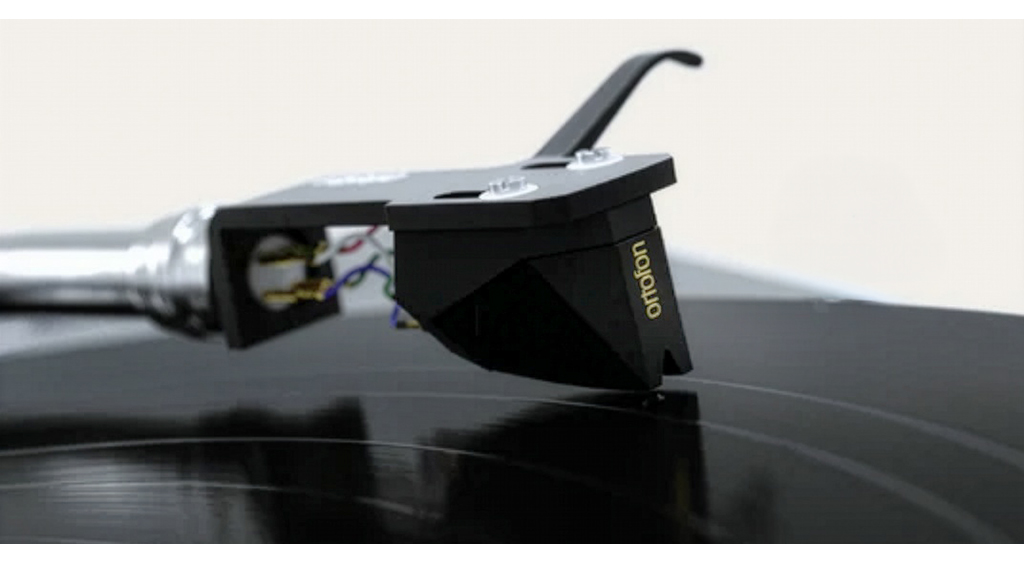
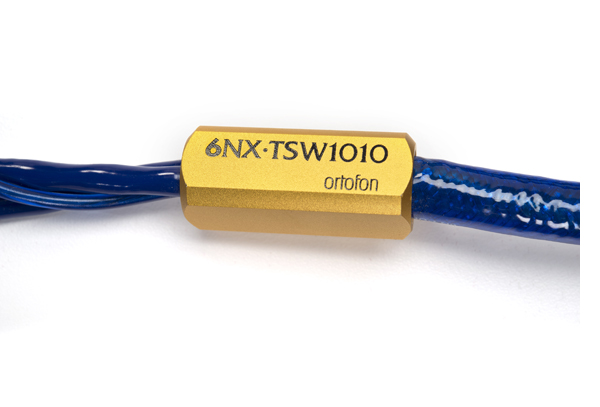
Many associate the Ortofon name with its legacy of phono cartridges, but the company’s product line includes a multiple of analog accessories, including headshells, tonearms, and high-end cables. The 6NX-TSW1010 tonearm cable, like Ortofon’s cartridges, is extremely well built.

The cable’s transparent blue casing showcases the shielding beneath, which surrounds seven conductor cores made of very pure copper. The main cable body is 5/8 inches thick and it is surprisingly flexible; the segments leading to RCA plugs are about 1/4 inch thick, and the grounding wire is much thinner. The whole cable is 1.2 meters long.

I’m surprised to see the forked grounding termination simply crimped onto its wire, given the rest of the cable’s build quality, but the connection is solid. Also, despite the gold-plated RCA covers, the plugs connecting to phonostage binding posts are not gold plated. Regardless, these design choices result in a nice-sounding cable.


While I listen to several albums on vinyl—with an SME 10 turntable and Dynavector 17D3 cartridge—a few consistent characteristics emerge. This cable offers a big sound, meaning that it supports a huge soundstage, with both width and height. Vocals sound very upfront, both as part of the perceived stage and in terms of their relation to the drivers.

Bass is deep but a touch reticent in the mix. This cable delivers a lot of detail without the sound becoming strident or sibilant. It brings the listener to the front of the auditorium. Those desiring a more laid-back and organic presentation might find this cable a bit much, but for those seeking a more upfront sonic delivery, the Ortofon could be just the ticket.  – Rob Johnson

Ortofon 6NX-TSW1010 Tonearm Cable

MSRP: €235 (about $325)

www.ortofon.com

Clones Audio 25i Integrated Amplifier

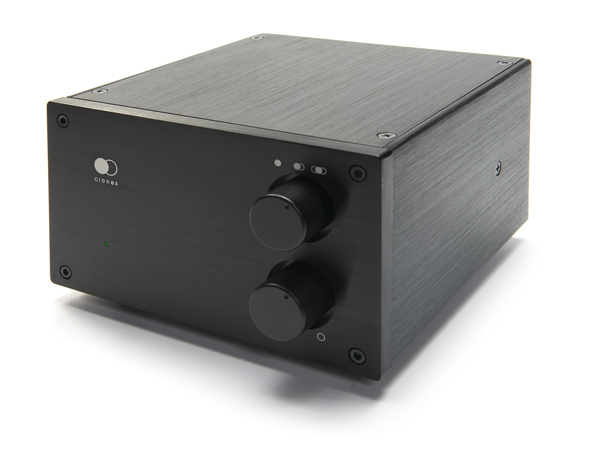
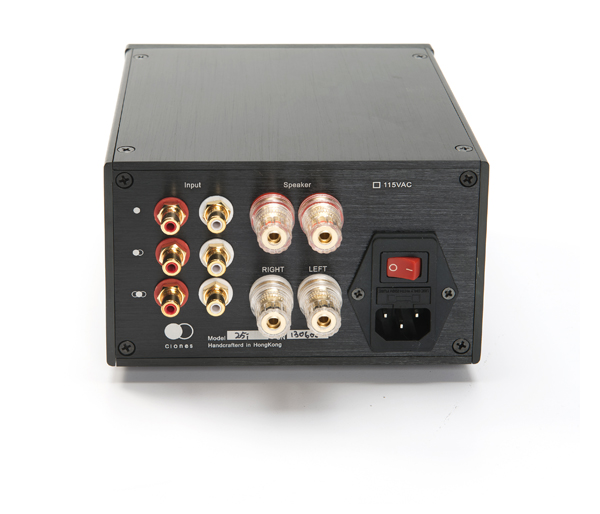
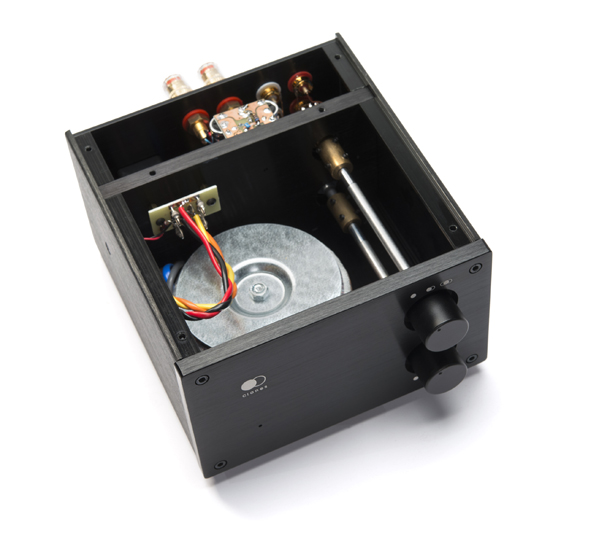
What started as a one-off unit intended as a family birthday gift has blossomed into a full-fledged audio equipment manufacturer. Hong Kong’s Clones Audio now counts monoblocks and a DAC among its product roster, but its 25i amplifier ($865/€629) is what jump-started the boutique manufacturer. The 25i, which is a 25 watts-per-channel integrated amplifier, was inspired by a 47 Labs’ circuit design that later landed in the public domain for the DIY crowd. After all, not everyone would see the $3,000-plus asking price of the 47 Labs’ Gaincard amp without wincing—and some might double over in pain upon seeing its internal part count.

This shoebox amplifier’s genetic connection to the circuit design from 47 Labs’ founder Kimura-San makes the 25i a proper Gainclone. Little wonder then that Clones founder Funjoe went with a brand name that connotes body doubling. His integrated amp mirrors the Gaincard’s short-as-possible signal paths and broader emphasis on circuit simplicity. None of the 30 dB gain comes from the pre-stage; it is only present for input selection, of which there are three. At the business end of the 25i is an in-house-designed board that houses Texas Instruments LM3875 amplifier on a chip.

Funjoe describes his clone as using “no protection print oil to enhance clarity of sound image and musicality.” That’s funny because clarity is also the first descriptor that comes to mind when trying to encapsulate the sound of the 25i. The other word that keeps surfacing is fruity. The 25i offers solid punch, dynamics and tonal color. It’s possibly not quite as zippy as Peter Daniel’s similarly Gaincloned Patek integrated amp, but the 25i fleshes out more acoustic mass to keep the trade-off seesaw perfectly balanced.

Comparisons

First up: the REDGUM RGi60, which is made in Melbourne and is somewhat of a reference at Darko HQ Down Under. The 25i trades in some acoustic mass for upper-midrange zip and caffeination, which lends it that sports-car vibe: a speedy ride with the top down. The REDGUM is warmer, more majestic and better suited to source material like the valium-drenched sound of Lampchop’s Nixon. Conversely, Morrissey’s Your Arsenal really benefits from the Clones’ keener energy with transients that, via the REDGUM, come across as softer and more rounded.

The 25i looks down its nose at the NAD D 3020. The little Gaincloner is an altogether more refined and nuanced listen that those with more luxurious transducers are likely to appreciate. This by no means negates the NAD’s far more impressive feature-driven bang for buck, but the NAD gets found out long before we call time on the Clones.

Playing week in and week out with Wadia’s 151PowerDAC Mini calls for intervention from of one of neatest budget thumb-DACs currently doing the rounds, one that won’t physically crowd out the 25i itself and keeps the DAC-amplifier combination costs within range of Wadia’s all-in-one unit. I lassoed Resonessence Labs’ Herus to the Clones integrated with a ZuAudio breakout cable. The Wadia and Clones/Herus pairing shares similar high-relief edge definition, but the latter steps forward with the larger soundstage. Similarly, the Clones plates up more body, but (crucially) it does so without bringing with it the fuzzier definition that could be attributed to the likes of Rega’s excellent Brio-R.

Loudspeaker Matches

With the French Atohm GT1.0 ($3,440/€2,500), things can get a little too bitey up top when less-than-stellar recordings are running higher SPLs. Thankfully, the Atohm has adjustable tweeter gain on the rear for such occasions. With the top end dialed back, this co-habitation proves to be one I could happily live with long term. I’m not saying the Clones is bright per se; that B word is too blunt an instrument and one that fails to connote this shoebox’s ebullient handling of subtlety. The abundance of micro-dynamic flair might not suit everyone, especially those whose systems are already strong on lower-treble caffeination.

As such, I’d peg the Clones integrated as ideally suited to lusher loudspeakers. Harbeth’s C7ES3 immediately springs to mind. And don’t think for a moment that a $1,000 integrated has no place driving loudspeakers four times its sticker—Funjoe’s shoebox is a genuine over-achiever.

Don’t have Harbeth money? Don’t fret. Wharfedale’s limited-edition Denton loudspeaker is one that channels a vintage vibe in both looks and, to a lesser extent, sound. They definitely lean towards a warmer, thicker-aired presentation and the 25i is just the (dream) ticket; it’s a match that’ll keep your total system cost under $2K. This Gainclone is the hot blade to slice through the Denton’s butter, keeping tight control on the mid-bass so that things don’t get too rich. With the electronic-infused world music of Banco De Gaia’s Maya, bass notes are tight but abundant with texture.

I like this amplifier a lot. It’s no powerhouse and perhaps that’s the reason why I found loudspeaker matching to be more crucial than usual during my three-month audition time. However, find the right dance partner and the Clones 25i brings the goods: acoustic mass, illumination and tonal color, all in one tidy solution. Like the sound of this but need more power? Clones’ 55pm monoblocks might be the answer.

Don’t be fooled by the budget pricing, though. Know that the Clones’ integrated is a bona fide high/er-end wolf dressed in entry-level sheep’s clothing.

Additional Listening

By Jeff Dorgay

Everyone I know who’s had the good fortune to hear this little Clones 25i has really jumped up and down about it, so after the photos were taken I proceeded to really put this little jewel through its paces in the context of a $200K system. Yep, that’s no misprint. Running the dCS Vivaldi stack directly into input one and the output to the Dynaudio Evidence Platinum speakers proves interesting.

While this is clearly insane with a source and speakers of this caliber, it’s pretty obvious exactly what the amplifier in question can and can’t do.  No, it won’t be replacing my $84,000 pair of Pass Xs300 monoblocks anytime soon, but this little amp makes a very impressive showing. It drives the Dynaudios not only with ease but great control. Bass is tight and tuneful, with the high end being smooth and extended.

What you don’t get here is the level of nuance and refinement that the big-dollar stuff offers, but the overall tonality is very neutral. When I swap the dCS and Dynaudio combination for the awesome OPPO 105 disc player and my 90-dB Vandersteen 1Ci speakers, this little amp really blows my mind. The level of clarity for under a thousand bucks is nothing short of amazing, and comparing it to my other favorite benchmark in the class, the Rega Brio-R, I concur with Mr. Darko 100 percent.

Whether you are a budding audiophile or looking for a cool yet compact second system, I highly suggest the Clones 25i. It’s got the right stuff.

www.clonesaudio.com

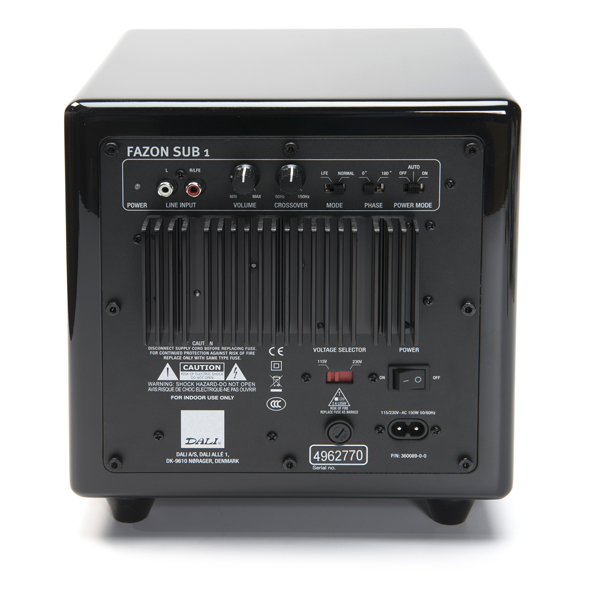
Dali Fazon Mikro 2 Speakers and Sub 1 Subwoofer

As the starship Enterprise explodes while I’m watching Star Trek: Inception, it’s clear that these miniscule satellite speakers from Dali deliver big sound. Working in concert with the tiny Fazon Sub 1, which utilizes a 6.5-inch long-throw driver, the speakers provide an equally solid bass response, as illustrated by the cannon shots in AC/DC’s “For Those About to Rock (We Salute You).”

Finding a balance between performance and aesthetics when integrating great sound into your living room is always a challenge. Danish manufacturer Dali does a better job than most at combining a modern, understated look with exceptional performance. In the case of the Mikro 2s, the company manages to deliver such performance in a small package that easily fits anywhere.

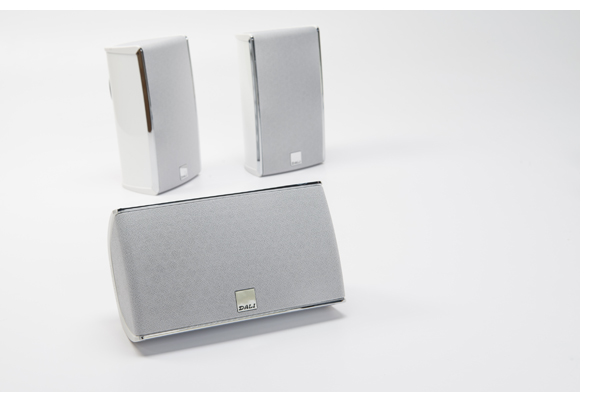
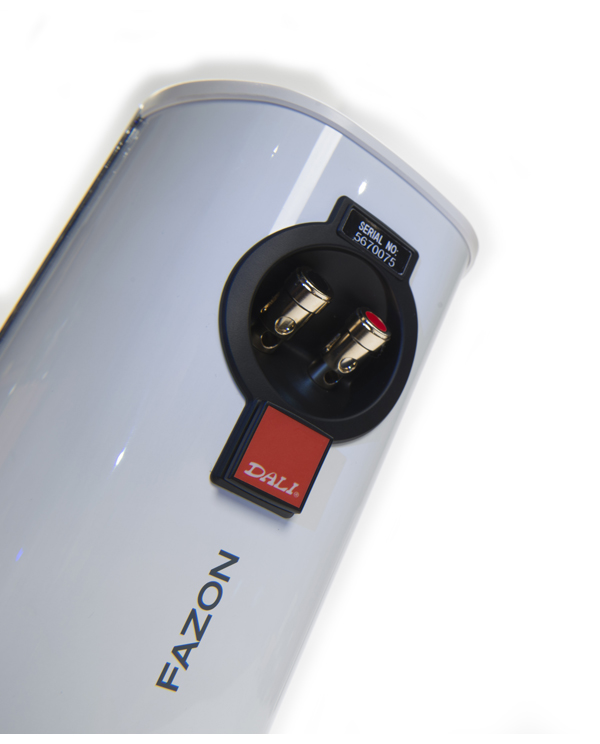
With an enclosure built of machined aluminum—like the Fazon F5 speaker we reviewed in issue 43—the Mikro 2s feature a slightly curved shape that looks equally at home on a stand mount, on your desktop, or mounted directly to the wall. I use them in a 5.1-channel system powered by the Anthem MRX 510 multichannel receiver that has become my reference workhorse, with 125 watts per channel. Dali also makes the Fazon Mikro Vokal, which is identical to the Mikro 2 but oriented for horizontal use as a center-channel speaker. The Mikro 2s have an MSRP of $650 per pair; the Vokal is $325; and the Sub 1 is $595—which makes for a very reasonably priced multichannel setup. All the units are available in gloss white (as pictured) or gloss black.

Easily Mounted

Thanks to the integral bracket and supplied wall mount, TONE staffer Rob Johnson and I were able to mount the five Mikros in my living room with ease. To angle the rear speakers, we improvised by making wall mounts from a 4-inch long piece of PVC that we painted white, cut in half, and glued to the wall with Liquid Nails. The end result is a very subtle install.

Those wanting stands for the Mikros can purchase accessory stands from Dali, which may better suit your needs if you don’t have speaker cables running through your walls. The stands ($199 per pair) are also available in black or white.

Should you be in tighter quarters, the Mikros can also serve as a kick-ass desktop 2.1 or 5.1 system, enveloping you in sound in a way that headphones cannot. In my small (7-by-10-foot) home office, a pair of the Mikros and the sub underneath my desk delivers prodigious sound surrounding my 30-inch Apple Cinema Display.

Bottom line: These exquisitely crafted speakers work well anywhere, especially if you’re limited on space but want big sound.

Natural Sound

Dali speakers all share a natural voice, and the Mikros continue this tradition. A two-way design with a 4-inch wood-pulp woofer and 1-inch soft dome tweeter, the Mikro 2s have a somewhat low sensitivity of 84 dB, but this does not prove problematic in any situation I am able to create. The 125 watts per channel of the MRX 510 is easily able to drive these speakers to their maximum output of 104 dB, which is louder than I need in all but extreme conditions.

While Dali states that the speakers’ low-frequency response is 90 Hz, placing the Mikro 2s on the wall and fairly close to the room corners takes advantage of room gain, giving the impression of much more powerful bass response than the specs indicate. Using the same strategy with the Sub 1 and setting the crossover at about 80 Hz turns out to be perfect in my listening room. Those craving more LF output might want to consider adding a second Sub 1 in an adjacent corner, though I would resist the urge to get a lone larger subwoofer, as it may not integrate as seamlessly as the Sub 1 does.

Setting the Sub 1 up by ear takes very little time and even a rank beginner should be able to achieve excellent sub/sat integration. The ARC 1M room correction of the MRX 510 takes this to another level, and really helps the Dali speakers disappear completely in the room, both visually and sonically. The speakers are so unobtrusive that almost none of my recent guests even notice them—a major triumph in aesthetics.

Dynamic Range

Because of this natural voicing, the Mikro 2s are a perfect choice for anyone needing their home theater system to pull double duty as a family music system. Operating the receiver in simulated surround-sound mode and cranking the volume makes Cheap Trick’s version of “Day Tripper” (from Found All the Parts) sound convincingly live, with the applause folded into the mix adding to the presentation’s illusion of spaciousness.

Staying in a Beatles groove, tracking through the new copies of the Beatles’ U.S. albums, recently remastered by Greg Calbi, proves equally compelling. The Mikro 2s’ ability to disappear only heightens the ping-pong, ultra-stereo quality of these recordings.

Through these little speakers, Elvis Costello’s vocals in “I’ll Never Fall In Love Again,” (from the Austin Powers: The Spy Who Shagged Me soundtrack) is positively dreamy, capturing the mid-1960s Burt Bacharach feel perfectly, with Costello’s unique vocal styling fully intact. Tegan and Sara’s “I Know, I Know, I Know” is equally enjoyable, with both vocalists able to happily coexist in the soundstage yet with each of their voices being easily discernable.

I run the gamut of rock and jazz favorites, and nothing throws the diminutive Danes a curve they can’t navigate. The only place these speakers come up a bit short is when the program material switches to heavy electronica. You won’t be able to play your favorite Skrillex or Chemical Brothers tracks at full throttle—one can only expect a 6.5-inch woofer (from any manufacturer) to go so far. But everywhere else, when keeping sound levels prudent, the Fazon Mikro 2s always satisfy.

The available bass from the Sub 1 goes down solidly to about 35 Hz and, while this is not the ultimate in extension, it is well defined. Personally, I’d rather have detail in a small subwoofer than just boom, and this is another area where Dali excels. It’s easy to follow the bass groove in Thomas Dolby’s “Hot Sauce,” which exhibits plenty of weight. The acoustic bass line in Stanley Clarke’s In the Jazz Garden is full of overtones, perfectly capturing the speed at which this legendary player moves up and down the neck of his acoustic instrument.

Beauty, Value and Performance

The Dali Mikro 2 system offers all three of these virtues in equal measure. There will always be the audiophile who wants a traditional floorstanding or stand-mounted speaker, but for those wanting their music system to less obtrusively integrate into their surroundings, I suggest the Dali Mikro 2 system. This small system’s service to musical truth makes for a convincing home-theater experience. You will not be disappointed.

Fazon Mikro 2 speakers

$650 per pair

Fazon Mikro Vokal center-channel speaker

$325

Fazon Sub 1 subwoofer

$595

MANUFACTURER

Dali

CONTACT

www.dali-speakers.com

OPPO PM-1 Headphones

Since I’m not much of a headphone guy, it takes something special for me to leave the comfort of my listening room and put a pair of cans on my head. Few ‘phones have ever given me big enough goosebumps to do so, and those that did have all been planar or electrostatic. No surprise, since most of my favorite speakers are panels. There’s just something about the open, airy presentation you get from a great pair of ESL speakers. OPPO’s new PM-1 planar magnetic headphones take me to that desired place.

By nature, headphones provide the same feeling of sound pressure offered by a pair of large speakers in a room. Still, the PM-1s deliver a degree of fine sonic distinction often mustered by six-figure speakers. If you’re a music lover considering plunging into audiophilia, a pair of PM-1s are your stairway to heaven.  And while you’re at it, grab OPPO’s matching HA-1 headphone amplifier/DAC. (Full review is in the works, but it’s equally enticing.)

Recent entries from HiFi Man and Audeze redefined the paradigm for what constitutes a great headphone obtainable without spending the megabucks required for top-of-the-line Stax headphones. Now, another name can be added to that elite group— OPPO, the folks that make one of the world’s best combination disc players at an incredibly reasonable price.

Sure, building world-class headphones requires a completely different skill set than manufacturing disc players, amplifiers, and DACs. But OPPO’s design ethos binds these products together. No detail is left unaddressed, and in typical OPPO fashion, the packaging is exquisitely refined without being ostentatious. The PM-1s offer performance concurrent with the worlds best ‘phones, yet are priced at a very reasonable $1,099.

That Good

Listening to Robin Trowers’ highly phased lead guitar on his For Earth Below album instantly reveals the delicacy the PM-1s can capably deliver. They play loud and clean, and throw a prodigious stereo image, making me feel like one of those guys on the fruit roll-up commercial whose head explodes when a grape-flavored candy gets ingested.

The PM-1s are so clean, dynamic, and undistorted, you will have to be careful with the volume control so you don’t hurt yourself.  If you pair these with a premium headphone amplifier capable of a lot of juice, you’ll be tempted to crank the PM-1s beyond the point of pain. I noticed a slight buzz in my ears after playing U2’s Rattle and Hum at a rather enthusiastic level, so don’t say I didn’t warn you.

However, playing loud isn’t necessarily as easy as playing soft. Squeeze’s classic Spot the Difference is full of stylistic departures from the original versions of the band’s top tunes. When listening closely via the PM-1s, it becomes much easier to hear differences in the mix. Glenn Tilbrook’s lead vocal on “Is That Love” is more stripped down, yet also throatier, with drums, rhythm guitar, and bass better separated as the piano sneaks in and out. Experience the same track on a budget pair of ‘phones, and the intricately woven ball of sound collapses into a flat, one-dimensional sketch. Even densely packed recordings, like the self-titled Audioslave album, reveal additional nuances (guitar fills, vocal layers) through the PM-1s.

Bottom, Top, and Middle

As it is in speakers, coherence is key to planar sound in headphones. There’s a natural ease to the sound of the PM-1s that I’ve never experienced with a pair of dynamic ‘phones. Call it a lack of grain (especially with acoustic instruments) that helps the listener forget they’re wearing headphones in the first place.

The upper register revealed by the PM-1s is smooth albeit extended. The gentle mix of drumming, keyboards, and Miles Davis’ horn on his classic Bitches Brew comes together in an alluringly homogenous manner to the extent the sound feels like it’s coming directly from your brain stem, deep inside your head, with a touch of tape hiss from the master tape floating out beyond your consciousness—but there to keep you aware you are listening to an analog recording.

Davis’ double-album effort is an equally good test for bass, as many tracks feature acoustic and electric bass guitars comprising the rhythm section. Most ‘phones reduce this information to a single bass line. The PM-1s have enough resolution to pluck both instruments from the mix and appropriately present them.

A wide range of acoustic test tracks underlines the PM-1s’ ability to nail musical fundamentals. Instruments sound stunningly correct from a tonal perspective, no doubt in part to the incredibly low distortion of the driver, which uses a double-sided design and more conductors than other planar magnetic models. OPPO claims that, in addition to additional sensitivity, it offers tighter damping, contributing even further to the natural response.

Efficiency is Key

The PM-1s’ additional sensitivity and nominal 32-ohm impedance make them a breeze to drive with your mobile device. While these headphones definitely benefit from a premium headphone amplifier, your high-end audio journey can start with an iPod. Tracks saved in Apple Lossless via the iPod Mini render headphone amplifiers unnecessary on an extended business trip.

In addition to electrical efficiency, the PM-1s are considerably lighter than competing planar ‘phones (395 grams vs. about 600 for my reference Audeze), making them easier for the un-headphone guy (and perhaps you) to enjoy more extended listening sessions.

Combining high electrical efficiency with benign impedance also means the PM-1s are simple to drive with any headphone amplifier. OPPO’s HA-1 might be the obvious choice, but we experienced great results with a number of different solid-state and vacuum-tube headphone amplifiers. Moving up the ladder to the new Cypher Labs Prautes ($3,695) and ALO Studio Six with Teflon capacitors ($4,995) proved breathtaking, and removed yet another barrier to sonic reality.

Nary a Misstep

Considerable time with the OPPO PM-1s reveals no shortcomings. While the hardcore headphone enthusiast will no doubt want to add the PM-1 to their stable, more monogamous headphone lovers will find simple sonic bliss. I know I did.

The PM-1s combine everything we find of high virtue at TONEAudio: high performance, aesthetic purity, and careful attention to detail. All at a reasonable price. This is the new benchmark for premium headphones.  – Jeff Dorgay

www.oppodigital.com

Musical Fidelity MF-100 Headphones

During my recent trip to the Sterling Sound mastering studio in New York City, where I visited with senior mastering engineer Greg Calbi, I had the rare privileged of listening to the new Beatles’ Yesterday and Today from Calbi’s chair. An uncompressed version of “Doctor Robert” comes through the MF-100 phones via my iPod Classic rather crisply.

This $199 pair of phones does a cracking job at capturing the essence of the music. As I track through some of the tunes on the U.S. Beatles albums that were just released, the MF-100s become even more endearing. I forget that I’m sitting in terminal 2 at LaGuardia airport, as I become lost in that happy, comfy space in between my ears.

I stay locked into my own Beatlemania, with Sgt. Pepper’s next on the list, and all the trippy psychedelia contained within this classic is lovely when played through the MF-100s. There’s plenty of bass rumble in the intro of the title track, with a soundscape that floats well beyond the left and right ear boundaries. The ping-pong stereo effect reminds me of the conversation that Calbi and I just had about why we like the stereo mix of this record after all.

Initial listening in the TONEAudio studio reveals a slight sound difference between the Alcantara ear pads and the leather set (both of which are provided with the phones), such that I prefer the former. Changing the pads requires a modicum of dexterity, so I suggest picking your favorites and sticking with them. Only those with surgeon’s hands should attempt performing this task in an airport lounge, but kudos to Musical Fidelity for offering a choice, especially at this price point.

While we’re talking price, it’s well worth mentioning that the MF-100s have a build quality above and beyond what you’d expect from headphones in this range—from the ear pads and sleek frames to the internal workings and sonic reproduction. For those who care, the packaging is equally snappy. Though some might argue that the packaging is a trifle, my experience has always been that careful attention to all the details, no matter how minimal, is usually backed up by care in design and build throughout. The MF-100s are no exception. The look, feel, and sound are exquisite, especially for a $199 pair of phones.

The MF-100 is My BFF

By the time I touch back down in Portlandia, I’ve listened to six solid hours of familiar tracks via a 160-gigabyte iPod Classic, full of uncompressed titles ranging from the Rolling Stones to Justin Timberlake. With the iPod as the source, the MF-100s offer a healthy upgrade over the stock ear buds and they have a compact enough form factor that they are easy to travel with. The MF-100s look like open-back headphones, but they are not—a fact that Musical Fidelity designer Antony Michaelson confirms when we discuss his latest creation. The MF-100s continue his ongoing design philosophy of offering maximum performance while keeping costs in line. Every one of my headphone-crazed friends peg the MSRP of the MF-100s to be about $100 more than the actual price.

A few online forums have made note that the MF-100 sound slightly bright in overall tonality. These phones do have more than enough resolution to reveal the differences not only in source material but also in the nuances between sound sources. Admittedly, after six straight hours with only an iPod to drive them, I was feeling a bit of user fatigue starting to creep in, but switching to the ALO Audio PanAm DAC/amplifier (adding a few vacuum tubes to the mix) makes for a great upgrade in the overall sound quality, particularly in the high-frequency spectrum.

Keep in mind that the 64-ohm impedance of the MF-100s makes them a breeze to drive with whatever source you have at your disposal—they are more than good enough to warrant an amplifier upgrade. And it doesn’t have to have valves: The equally affordable AudioQuest DragonFly 1.2 DAC ($149) is a lovely step up that easily takes the MF-100s to another level sonically, making for a great portable hi-fi setup that won’t require your entire tax refund check.

The MF-100s benefit from about 50 hours of break-in before the drivers really stabilize sonically, eliminating the last bit of glare out of the box. Fortunately, these phones suffer less of this effect than a number of others we’ve sampled, so the delta from good sound to great sound is short.

Further Listening

Once the MF-100s are broken in and my ears recalibrate to their sound, I pull out the big guns, including the Taurus headphone amplifier from AURALiC, ALO Audio’s Studio Six, and the latest signature amplifier from Coffman Labs. The MF-100s are indeed resolving enough to discern the nuances between these top-shelf headphone amplifiers, which offer a glimpse at the ultimate performance envelope of the MF-100s. But much like putting a $5,000 phono cartridge on a $500 turntable, this is indeed overkill for the $199 MF-100s.

However, the MF-100s are ideal headphones for the music lover on a tight budget, and if great sound and build quality weren’t enough, the signal cord of the MF-100 features a button that syncs to your mobile device. For iPhone/Pod/Pad users, this allows you to access Siri—a nice touch for the jet-setter.

It’s safe to say that Musical Fidelity’s first attempt at a closed-back, over-ear headphone is a massive success—enough that we happily award it one of our Exceptional Value Awards for 2014 and purchase the review sample for our permanent headphone collection. We’ll be curious to see what comes out of the mind of Michaelson when he decides to give a $500 pair of phones a go.

– Jeff Dorgay

www.musicalfidelity.com

Audio-Technica ATH-W1000X Headphones

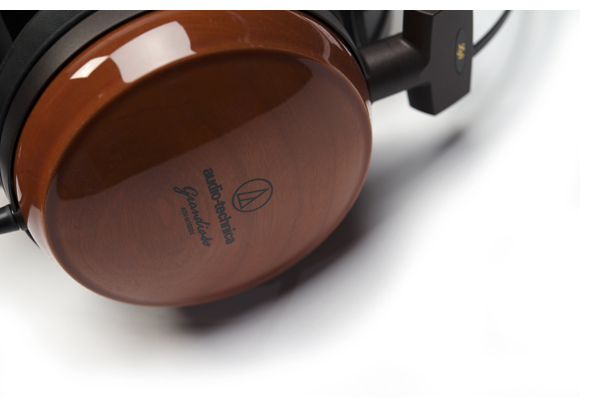
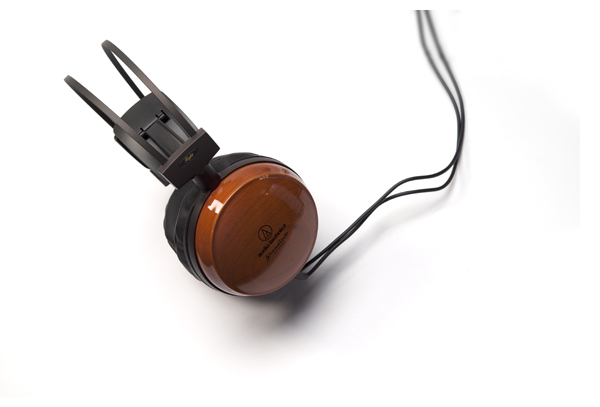
The Audio-Technica ATH-W1000X, which was introduced in 2011, is not a celebrity-endorsed headphone, nor does it come in a rainbow of colors. For $699, you get a headphone designed and engineered for discriminating listeners and music lovers, with ear cups made from American black cherry wood finished in an elegant violin gloss. A matching connector housing at the end of the cable completes the luxury experience, underscoring the attention to detail that has gone into these premium headphones.

For maximum comfort and ease of use, the ATH-W1000X features Audio-Technica’s self-adjusting 3-D wings-support housing, which automatically fits any wearer, with no need for adjustment. Those accustomed to traditional headphone headbands may find the feel a little strange at first, as if the headphones aren’t secure on your head. The entire headphone’s weight is distributed even across the headband, while the ear pads rest lightly, leaving some perceived space between the pads and the side of your head. But this fit actually helps give the music a more spacious and open sound than is typical for a closed-back headphone. It took me a while to get used to the fit, but now that it’s familiar, traditional headphones feel a little bit like C-clamps on my head.

With a 42-ohm impedance, the ATH-W1000X is easy to drive and works well with an A/V receiver or even an iPod/iPad—but like any premium set of phones, it responds even better to a high-quality headphone amplifier. I pair the phones with Sound Performance Labs’ new Phonitor 2 headphone amp, which employs SPL’s dual-channel 120-volt technology (a result of the company’s extensive work in the pro-audio world, where many consider the Phonitor a reference).

My main music source for this review is a MacBook Pro, with digital-to-analog processing handled by Wyred 4 Sound’s $499 μDAC-HD paired with Nordost Heimdall 2 cables. This palm-size USB-powered DAC can be hidden neatly behind the Phonitor 2 for a clutter-free workspace, a trend I’d like to see from more manufacturers.

On Girl Who Got Away by Dido, the ATH-W1000X exhibits a smooth tonal balance through the midrange, with Dido’s voice sounding relaxed, natural and uncolored. Overall presentation is bolder than the similarly priced MrSpeakers Alpha Dog phones, which I recently evaluated. Through the Technicas, mid bass blends nicely with the midrange without noticeable cross contamination. Treble is equally smooth and displays good extension. I play my music library in shuffle mode to get a variety of music through the headphones, looking for signs of sibilance—with none to be found.

The ATH-W1000X delivers a surprising amount of bass. (No, it is not the kind of heavy bass that bass-heads enjoy.) The album Settle by Disclosure does a good job giving the large 53 mm drivers a workout. There’s enough bottom-end to bring music to life. Soundstage on these headphones is respectable, though as not pinpoint accurate as the MrSpeakers Alpha Dog. Through the Phonitor 2, the ATH-W1000X exhibits better dynamics and speed than through the μDAC-HD, which reinforces that this headphone scales well with high-current power sources.

When at the TONEAudio office for photography, Jeff Dorgay (our publisher) put these phones through their paces with the ALO Audio Studio Six headphone amplifier. Jeff commented how neutral, dynamic and extended they are on the wide range of music being fed from his dCS Vivaldi stack.

Standout tracks ran the gamut from classic rock to old-school rap to electronica. “The alarm clocks in Dark Side of the Moon were larger than life,” Jeff noted. The bass response was also a big hit through the Vivaldi, shuffling through a number of discs from the famous Hôtel Costes series. Jeff was quick to point out that the ATH-1000X exhibits low audio fatigue and causes low physical fatigue for the wearer—so that 3-D mount is indeed highly effective.

Audio-Technica has done a phenomenal job building an elegant, versatile headphone that is not limited to any specific genre of music. A modest, benign load makes them easy to drive and easy to integrate into whatever your system happens to be right now. While the headphones resolve enough musical detail to warrant high-quality source and amplification components, you can start your headphone journey with just your smartphone and a pair of ATH-1000Xs. Whatever your source, these headphones will deliver a compelling presentation.  -Michael Liang

Audio-Technica ATH-W1000X

$699

www.audio-technica.com

Wireworld Mini Eclipse 7 Speaker Cables

One sure way to start a war is to mention cable on any audiophile discussion forum.  Yes, there are many who are convinced that cables are all crapola, conjured by sorcerers who want to separate you from your hard-earned money, offering nothing in return.  At the same time, others live and die by their cable, often plugging in wire products costing multiple times their components’ due in search of a certain sound.

However, like most things, a little moderation goes a long way, and a perfect example is the Mini Eclipse 7 speaker cables from Wireworld to do just that.  At $500 a pair, they will not break the bank, and to let the cat out of the bag, they will allow more music to pass on even a modest system.

Reviewer bias revealed, I’ve always had a fondness for Wireworld products and even back when I was working for The Absolute Sound, I had great results with their speaker cables.  Owner David Salz doesn’t wear a fez or a gold lamé jacket; he’s an engineer with a methodical approach to everything he does, and his goal has always been to produce cable “that doesn’t damage the sound.” The new Mini Eclipse 7 not only succeeds brilliantly, it does so at a reasonable cost.

The Minis come nicely packaged in a black textured case and are available in standard lengths, either terminated with banana plugs or silver-plated spades, in the case of our review sample.  These cables are extremely easy to use, nowhere near as stiff as my old Equinox IIIs, and not as monstrous in diameter as many of today’s premium cables, so those not wanting garden hoses on the floor should be able to work with them.

Blinding me with science

The Minis use a series of flat 14-gauge OCC copper strands in a quad conductor DNA Helix design to minimize the electromagnetic loss present in a signal cable.  Combined with Wireworld’s Composilex dielectric material is indeed a very high-performance speaker cable.  Like a number of other manufacturers, Wireworld pays close attention to the grain structure and signal directionality in their bare cable, orienting it for the best sound.

Non-believers in the crowd, take note: I have heard this effect demonstrated successfully more than once, and when at another cable manufacturer’s facility, was able to identify the difference correctly 10 out of 10 times, so this is real.  It’s not major, but it is there, and paying attention to the fine details is what makes your system sound its best.

Just to be sure, the Minis were given 100 hours of break in time, via our vintage system consisting of a Sansui 771 receiver and a pair of JBL L26 speakers.  Even at this level, fresh out of the box, the Minis were a major improvement over the standard Radio Shack wire that was in place in this very inexpensive system. Instantly, the bass response tightened up, especially in the upper mid-bass region, and the overall graininess of this old gear was substantially diminished.

Systems large and small

After logging a few hours on the Minis, they spent a fair amount of time in a modest system consisting of a Rega Brio-R integrated amplifier and a pair of Vandersteen model 1Ci speakers (reviewed last issue) with digital music streamed from a Meridian MS200.  This particular system happens to use Home Depot 12-gauge extension cords as speaker cables, to good effect for a budget system.

Again, the sonic signature – or in this case, lack of one – is immediately apparent.  The violins at the beginning of Anja Garbarek’s “Her Room” from the Smiling and Waving album have a natural tone, and the soundstage, filled with natural and artificial sound effects, is definitely more open.  Regardless of recording, the overall soundstage presented by this system is bigger, allowing the speakers to easily give the illusion of disappearing.

I moved the cable into my house system, where they work in concert with the Devialet 110 and a pair of MartinLogan Aerius i speakers, music again supplied by a Meridian Control 15.  Components with more resolution make it even easier to discern the difference the cables make.  The driving, funky bass line in Betty Davis’s “If I’m in Luck I Might Get Picked Up” now has more punch than before, and the Minis replace a set of more expensive speaker cables. I notice the same thing with Glenn Hughes’s rapid-fire bass playing on the self-titled Black Country Communion album.  Some cable, especially at this price point, tends to slow down the sound and introduce pace and timing issues – this is never the case with the Wireworld cable.

The vintage MartinLogan speakers are still very transparent (thanks to new panels from ML a few years ago) and easily reveal grain, yet the Minis help the system to reveal only the music, neither adding nor subtracting from the presentation.  Going back to an old audiophile classic, Michael Hedges’s Aerial Boundaries is chock full of plucky, acoustic guitar playing that can be easily muddled, yet never is through the Minis.  I notice the difference these cables make even more when I switch back to what I was using before.

Convinces the cable skeptic

These days $500 for a pair of premium speaker cables is a reasonable, but not major, investment; however the Wireworld Mini Eclipse 7 speaker cables proved a valid upgrade, even in a system only worth about $1,000.

As with any system, to reap the maximum benefit from any cable, make sure to optimize speaker placement and component setup before investing in anyone’s wire, so that you can more easily hear the difference.  And no, a $500 pair of speaker cables won’t make your $600 integrated amp sound like a pair of Pass Labs Class A monoblocks – that’s not being fair.

However, if you would like to take your current system to the next level, I highly suggest auditioning a pair of these at your local Wireworld dealer.   You’ll be impressed.  I’m impressed enough to buy the review pair for my Devialet system and to give these one of our Exceptional Value Awards for 2014.

www.wireworldcable.com

Issue 64

Features

Old School:
Acoustat 1+1 speakers

By Jerold O’Brien

Journeyman Audiophile

Stirling Broadcast SB-88 Speakers

By Jeff Dorgay and Mark Marcantonio

Personal Fidelity:

AURALiC Gemini 2000

By Jerold O’Brien

995:

MartinLogan Crescendo

By Jeff Dorgay

TONE Style

Wino:
Summer is the Reason for Rose!
By Monique Meadows

Sub Pop Record Store

Bosch EV Charger

Orange is the New Red:

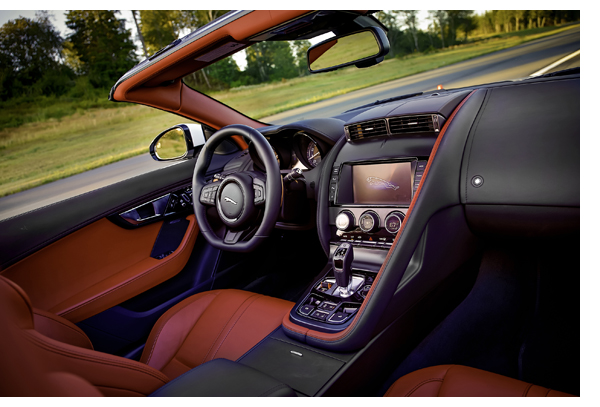
We sample the new Jaguar F-TYPE Coupe with
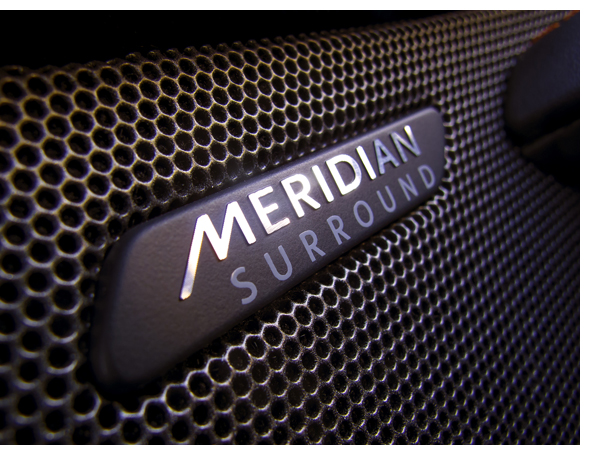
Meridian sound


Music

Current Releases:

Fresh Releases in the Pop/Rock World
By the TONE Staff

Audiophile Pressings

Jazz & Blues
By Jim Macnie & Aaron Cohen

LIVE:  Bob Mould in Chicago
By Bob Gendron

Snapshot: Gregg Allman
By Jerome Brunet

Previews

Conrad Johnson LP125sa Amplifier

VPI Nomad Turntable

Balanced Audio Technology VK-3000SE Integrated

From the Web

Boulder 865 Integrated

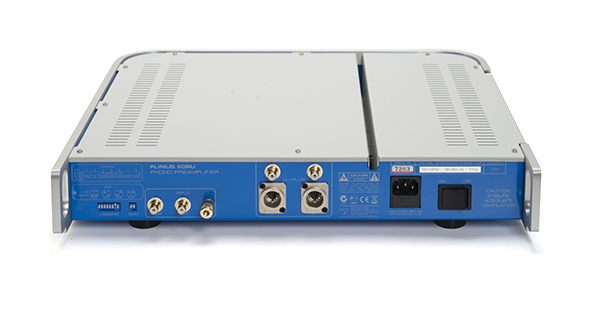
Plinisu Koru Phonostage

Reviews

Dynaudio Evidence Platinum Speakers
By Jeff Dorgay

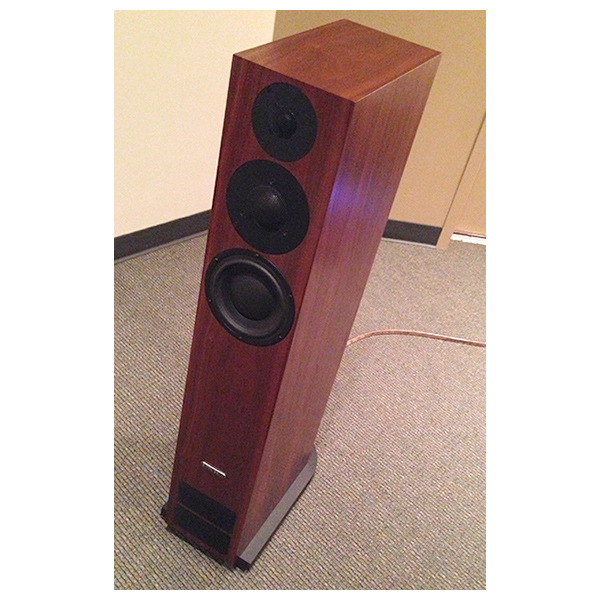
Morel Octave 6 Limited Speakers
By Rob Johnson

Golden Ear Triton Seven Speakers
By Mark Marcantonio

Penaudio Cenya Monitors
By Jeff Dorgay

Burmester B10 Speakers
By Jeff Dorgay

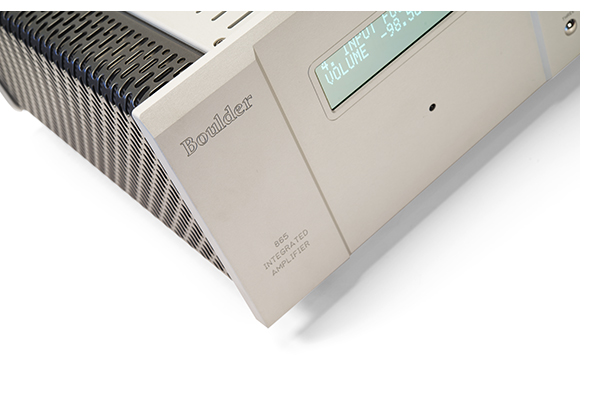
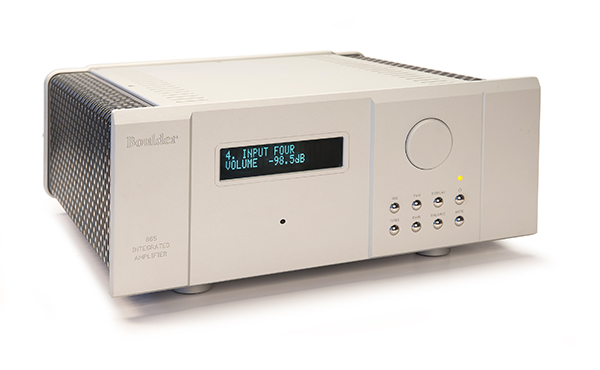
Boulder’s 865 Integrated Amplifier

Following Steve Martin’s vocal musings on “Late For School,” it becomes immediately apparent how well this integrated amplifier, Boulder’s entry-level piece, keeps track of pace and timing.

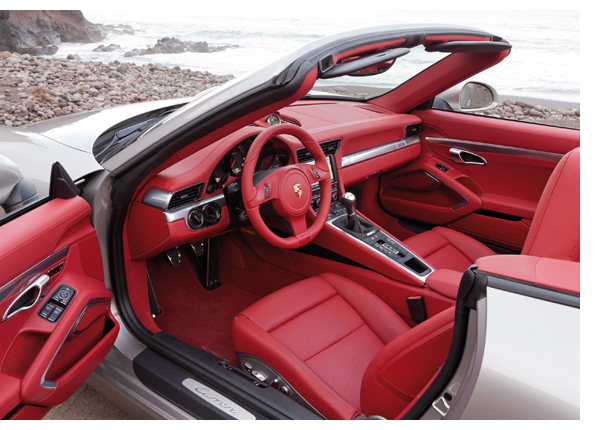
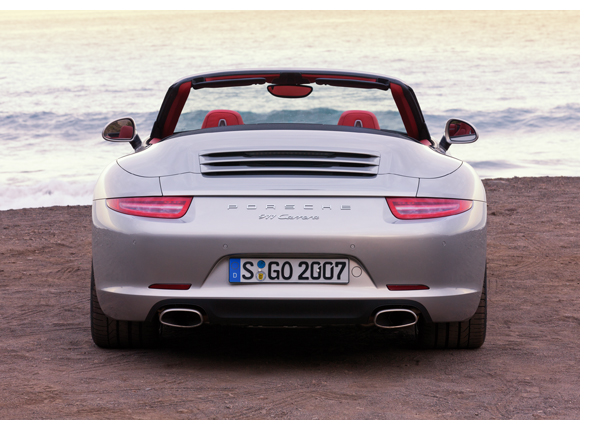
Martin’s voice meanders around the soundstage thrown between my KEF Blades, with banjos, bass and percussion all firmly anchored in place, with a hint of animal sounds for good measure.  Though this is the most affordable piece in the Boulder lineup, “entry level” doesn’t do it any more justice than calling a Cayman an “entry level” Porsche.

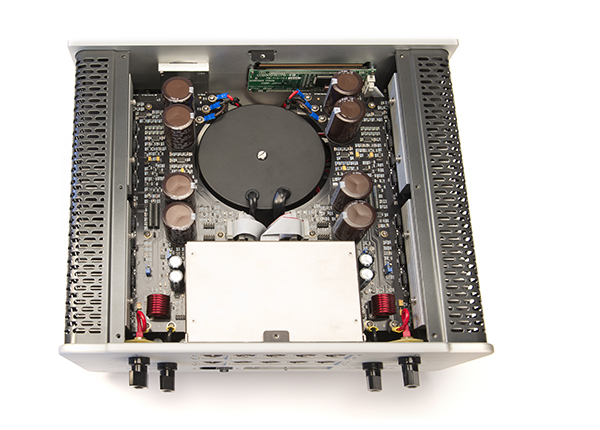
The 865 is truly a product only a company like Boulder can build, taking advantage of their design, build and production facilities – one of the very few North American companies that performs every speck of construction in house.  Their completely vertical process allows them the luxury to use much higher quality everything than you might expect in a $13,000 integrated, right down to one of their cool, machined remote controls.  Every detail is attended to perfection as it is in their $200,000 3050 monoblocks.  Should your audio journey take you no further than the 865, this is an amplifier you’ll be proud to hand down to one of your family members.  It lacks nothing in terms of sound or build quality in comparison to the Boulder flagship products.

The XRCD version of Jackie McLean’s Swing, Swang, Swingin’ proves equally illuminating.  Like every other Boulder product I’ve experienced, the 865 follows the family tradition by neither adding nor subtracting to the sound.  While this may bring slightly less to the presentation on poor quality recordings, that can benefit from a bit of warmth, what it does for stellar recordings is well worth the tradeoff.  Just like the 3050 monoblocks that we reviewed last year, the 865 is a wonderful conduit for music, never throwing the focus on itself; it’s always in the service of the music.

Even my worst recordings come to life when the 865 is part of the system.  Records lacking in tonal and dynamic range (like KISS Alive! or Then And Now…The Best of the Monkees) reveal layers of detail that never comes to life on a lesser amplifier, not to mention the tremendous dynamic slam on tap – the same experience I had with the 3050s.

Utilizing the same stepped volume control from the 800 series preamplifier, originally developed for the 2010 preamplifier, the 865 maintains perfect (within .5db) channel balance throughout the range, and all of the buttons and controls retaining the same feel you’ve come to expect in the top of their range. Even though the case work has been streamlined a bit, the feel is still there in spades.

All Boulder

If you’re wondering what you don’t get for the $13k pricetag, and why this amplifier is so compact compared to the larger Boulder models – the answer is simple.  Boulder founder Jeff Nelson likes to talk about watts being relative and that the bigger amplifiers, with their bigger power supplies are more about control than what their wattage ratings suggest.

Where the larger Boulder amplifiers are full class-A designs, the 865 is biased in class A mode for the first 17 watts per channel, then it gently transitions into class AB mode to its full power rating of 150 watts per channel.  But make no mistake, the 865 gives up precious little in ultimate fidelity and control.  Boulder has done a brilliant job of incorporating the maximum amount their essence into this compact, by comparison product.  The 865 is the heart of the 810 preamplifier and 860 power amplifier (which is half of the 1000 series amplifier) squeezed into a single chassis weighing just under 50 pounds.

The drum solo in Little Feat’s Day or Night, is rendered superbly, with plenty of attack, decay and texture.  If there is anything that I could characterize as the Boulder sound (or lack of it) is the way their amplifiers have an effortless transient response, and present a more realistic rendition of drums and percussion than any other amplifier I’ve experienced – and the 865 is no slouch.

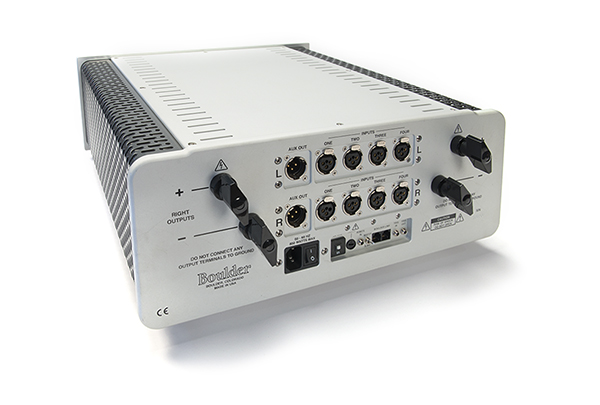
As with every Boulder amplifier, the 865 uses a fully balanced topography, so those with single ended ancilliary components will need to use adaptors to interface.  Though Boulder feels that balanced is the ultimate way to experience their components, we did have excellent luck with the single ended components at our disposal, mainly the Zesto and CJ phono preamplifiers in for review.  The 865 does not feature an integrated phonostage, so vinyl lovers will either have to choose one of theirs, and I highly suggest the awesome 1008 phonostage, or go to a third party.

Top notch throughout

While most listening was done via an analog front end consisting of the ARC REF Phono 2SE phonostage (balanced), AVID Acutus Reference SP turntable, SME V tonearm and Clearaudio Goldfinger v.2 cartridge, along with the dCS Vivaldi performing digital duties, the 865 was never the weak link in the chain, holding its own in the context of a six figure reference system.

Switching between the KEF Blades, the Dynaudio Evidence Platinum speakers and the GamuT S9, the 865 did its job-playing music effortlessly.  Moving it to room two with the Dynaudio Confidence C1s and the Sonus faber Guareri Evolution speakers, both extremely high performance, yet small speakers made an incredible case for stopping the audio journey right here and just enjoying the music.  The 865 reveals so much that if you don’t need to blow the windows out of your listening room and you just want to revel in quality – this is your amplifier.

Good as my digital front end is, the difference between great analog and great digital made itself known immediately as I queued up a 45 rpm copy of Peter Gabriel’s self titled album (known to others as the Security album) and played “Lay Your Hands On Me” at maximum volume.  At the beginning of the track, where the synthesizer comes in, sounding like something out of David Lynch’s Eraserhead, it holds steady inside the soundstage about four feet high, locked in as the rest of the track unfolds again – and then the explosive drumming is right there behind Gabriel’s voice.  Simply stunning.

In the end, fantastic

So if you’ve always lusted for Boulder amplification and thought it was out of reach, consider the 865 as either the Boulder for you, or your stepping stone into the Boulder range.  Either way you can’t lose.

The 865 took precious little time to truly warm up or burn in.  Approximately 48 hours after it was first turned on, it settled into its spacious, accurate sound; probably more a result of thermal stabilization than any kind of component “burn in.”  Because it’s not fully class-A throughout, you can leave it on all the time without feeling guilty.

With four balanced XLR inputs and a pair of balanced XLR outputs, the 865 will merge into any system with ease, allowing bi amplification or a powered subwoofer.  And the beefy speaker binding posts are not only user friendly, and accommodating of any audiophile cable you might choose to use with this amplifier.

It’s also worth mentioning that the 865 is one of the few amplifiers we’ve auditioned that didn’t really benefit from any kind of line conditioning, a further testament to it’s robust design.

While 13 thousand dollars is no pittance to spend on an amplifier, Boulder’s 865 represents the pinnacle of what a high quality component should offer, first rate sound and build.  For this reason, we are happy to give it one of our Exceptional Value Awards.  Well done.

www.boulderamp.com

Peripherals

Analog Source            Avid Acutus Ref SP/Tri Planar/Lyra Atlas

Phonostage                ARC REF 5SE

Digital Source                        dCS Vivaldi Stack

Speakers                    KEF Blade, Dynaudio Evidence Platinum, GamuT S9

Cable                          Cardas Clear

Lynn Hoffman’s “Private Sessions” Returns!

Indimusic.TV, the first “Social Media Broadcast Network” and the leading indie music 24/7 broadcast network worldwide, announced today that it is bringing back the Emmy Award-winning music and interview series “Private Sessions,” the best interview/performance music series of the last decade. Indimusic.TV will re-launch the series with Adam Levine and Maroon 5 this Fall.

“Private Sessions,” produced by A+E Networks and hosted by international radio and television host Lynn Hoffman, features exclusive performances and intimate conversations with top names in contemporary music and film from Rock, Pop, Country, and R&B. “Private Sessions” dedicates each one-hour show to the body of work of a single artist or group and features performances of not only their current releases, but also the songs that built and defined their careers.

“We are thrilled to bring this Emmy Award winning series and Lynn Hoffman to our network,” said Chris Pati, Chairman/Founder of IndiMusic TV. “Private Sessions’ was the best interview/performance series of the last decade and it is an honor and a privilege to reintroduce the series to a whole new audience and demographic.”

“I am beyond ecstatic to be able to help bring Private Sessions back to TV with the groundbreaking digital broadcasting/social media outlet known as IndiMusic TV.,” said Lynn Hoffman, host of the award-winning “Private Sessions” show. “I firmly believe that what Chris has created is not only the future model of overall television viewing and social media interaction globally, but more importantly, a place for quality music programming and a fantastic groundbreaking platform and media outlet for 99% of all artists and bands on a global scale ”

This joint venture between IndiMusic TV, Inc, A+E Networks and Lynn Hoffman Entertainment LLC, will no doubt blaze a trail for future content deals between traditional and Internet broadcast models.

Leonard Cohen – The Future

Leonard Cohen’s The Future first hit my audio radar as a result of the Natural Born Killers soundtrack. “Waiting for the Miracle” first captured my attention, but it didn’t take long for the rest of the songs to develop a tight grip on my senses. Cohen’s deep and commanding vocals, accentuating his contemplative and sometimes haunting lyrics, draw forth an unexpected range of emotion.

Previously, my sole exposure to this album came via 16-bit /44.1k CD-quality sound. Stumbling across Music On Vinyl’s analog reissue was a happy accident. The LP meets my high expectations in two important ways. It has more presence, and sounds as if I stepped a few rows forward in the auditorium. The second notable improvement pertains to the vocals. The digital glare on the CD pleasantly disappears. The range and texture of Cohen’s voice is beautifully rendered, and front and center in the mix. It’s also appropriately “sized” in the stereo image.

Disappointments exist, however. Like those on the CD, instruments still can sound repressed. While drums, piano, and guitar offer a reasonable level of realism on “Always,” the same instruments lack detail and presence on other fare. On the title track, for instance, cymbal strikes offer little impact, ring, and decay. The tambourine’s sparkle outshines them. Strings are also hit-and-miss. On the instrumental “Tacoma Trailer,” both piano and strings illustrate a step-up in sonics when compared the CD. However, it’s still not transparent enough to be mistaken for live sound.

Perhaps the source material has inherent limitations, and there’s little else to dig out of it. Or perhaps vocal quality remained the absolute top priority for the reissue, even if it meant some tradeoffs were necessary. Truth be told, the captivating vocals initially sold me on the album, so the latter scenario is an acceptable compromise. While the overall experience leaves me wanting more, having The Future available on a good vinyl pressing makes up for the deficiencies. –Rob Johnson

Columbia/Music On Vinyl, 180g LP

Kiss – Alive!

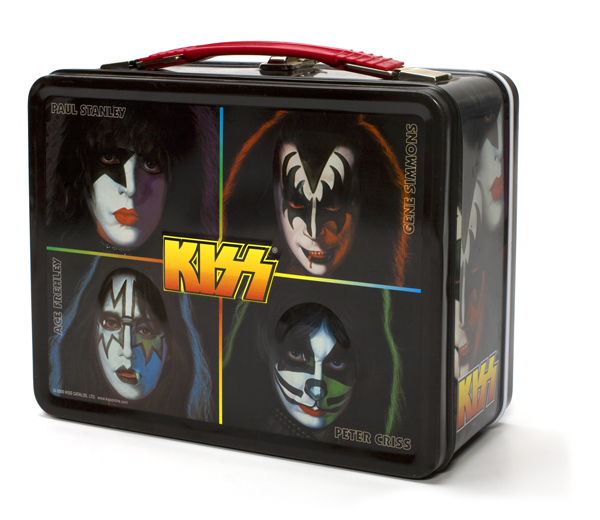
One of the things I’ve always admired about Gene Simmons is that he’s straightforward about being in the game for the money. Our pal Chad Kassem at Quality Record Pressings/Acoustic Sounds isn’t always quite so forthright, and I’ll cut him some slack because he wouldn’t know a great rock record if it bit him in the ass. But this is pure blasphemy. Sorry folks, I’ve been there from the beginning, and I have every pressing of Alive! around, and this one is a turd.  A $50 turd. no less, pressed at Kassem’s QRP plant.

Granted, Alive! has never been a sonic masterpiece, but the Japanese CD collection from a few years back does this classic major justice, revealing what little dynamics do exist. There’s also some halfway decent separation between lead guitarist Ace Frehley and rhythm guitar Paul Stanley’s playing, with a bit of soundstaging, to boot.

Pulling out the original Casablanca pressing to do a direct comparison, even the original, which you can usually find (albeit often well-worn) for a few bucks at used record stores, blows this remaster away in every sense of the word.

So to the very small subset of audiophiles that happen to love Kiss: If you want the best, you won’t get it here.  –Jeff Dorgay

Universal, 180g 2LP

Aztec Camera – High Land, Hard Rain

Among guilty pleasure albums from the 1980s, Aztec Camera’s debut High Land, Hard Rain maintains a surprisingly regular appearance on my turntable. Over the years, my copy of the 1983 LP from Sire Records sustained a fair amount of needle time and admittedly, isn’t the pristine pressing it used to be. When listening, I took the lyrical advice of Aztec Camera’s song “We Could Send Letters” by closing my eyes and waiting until things got better. Finally, patience persevered! Domino Recordings obtained the original analog masters to create a 30th anniversary reissue on 180-gram vinyl.

Compared with the original LP, the album art appears identical, except for the not-so-surprising omission of the tagline “also available on cassette.” The new pressing replicates the track listing of the original LP. For those seeking bonus songs, be sure to check out the digital download enabled via the vinyl purchase or pick up the CD.

Most importantly, the sonics get a significant upgrade. Domino made a concerted effort to give the album the respect and long-overdue update it deserves. Roddy Frame’s vocals boast inherent passion, and the reverb is more apparent. The perceived room around the vocalist also seems larger. Acoustic guitars, the driving force of the album, retain their energetic and upfront placement, and are flanked by deep, tight, and supportive bass. No, cymbals and tambourines don’t have all the subtle ring and decay I hoped to hear, but are on par with earlier releases. Perhaps the original recordings didn’t allow much more detail to be retrieved without the introduction of unwanted artifacts.

For High Land, Hard Rain fans, this reissue is a must. If you are not yet a fan of Aztec Camera, the pressing provides a great opportunity to start.   –Rob Johnson

Domino, 180g LP

dCS Vivaldi Digital Playback System

Spending four days with the Aston Martin DBS a few years ago was an enthralling experience to say the least—and beyond definition to say the most—but a brief time in the company of something outside of your means can often skew your perspective. When I return the silver beauty, a good friend who actually owns an Aston told me, “Yeah, she’s a beauty, but wait until the first oil change: $800. And let’s not even talk about the first major service…” Two years later, said friend ended up buying the Boxster S that I told him to buy in the first place—but that’s another story for another day.

Just like an Aston, Bentley or Ferrari, most mega-bucks hi-fi products have a way of seducing you that standard-issue gear does not. Unfortunately, the review process does not always make it feasible for a manufacturer to leave a six-figure component in someone’s hands for longer than a reasonable honeymoon, and this is why at times these reviews seem overly enthusiastic: The reviewer never gets a chance to move past the honeymoon phase.

So let’s talk about a $110,000 digital player—that’s not a typo. I thought I had lost my mind when I purchased the dCS Paganini four-box system a few years ago (and I felt equally crazy when buying the Naim CD555 a few years before that); yet, after even a few months it was very obvious that the Paganini performed well beyond anything I’d ever experienced. And it just got better the longer I listened to it with an even wider range of music. So how much better could a player costing almost twice as much as the Paganini be? As it turns out, quite a bit better.

A Brief Tech Brief

In the past year, much has been written about the Vivaldi’s technical prowess via Stereophile, The Absolute Sound and others, so if you’re looking for a more geeky perspective (and even if you aren’t), I suggest reading Michael Fremer’s and Robert Harley’s takes on this player. Should you be investing at this level, read everything you can and do some serious listening—one doesn’t want buyer’s remorse on a purchase like this.

Instead of focusing on the technical aspects, we’re going to concentrate more on the Vivaldi experience. What’s it like to truly live with a player like this for a whole year? Is it still exciting? Is it a fling or a long-term love affair?

To make an incredibly long story shorter for those not familiar with dCS, the British manufacturer takes a modular four-box approach to its top digital players, (separating the most critical parts of the playback chain as they see it: a CD/SACD Transport, DAC, system Master Clock, and what they see as the system hub, the Upsampler) with separate sections for the transport (which plays CDs and SACDs), DAC, master clock, and upsampler. This allows the user the ability to build a dCS stack one box at a time, starting with the DAC alone if you so desire, or to eliminate the transport entirely for those not using discs.

Where so many DACs rely on off-the-shelf hardware, the Vivaldi, like all other dCS products, utilize the company’s own “Ring DAC” technology, which is based around field-programmable gate array chips and the proprietary, discrete digital-to-analog converter circuit that runs dCS decoding software and gives the DAC its name. What does that really mean? On one level, it means that when dCS learns something new in the lab, your player can be reprogrammed with the latest software with ease, like having the software in your car’s ECU upgraded for more horsepower. Having gone through a couple of software upgrades with the Paganini, I can tell you that it is an exciting process. Each time, I felt as if I had purchased an entirely new component, with the updates providing a significant performance upgrade at no additional cost. I merely had to insert a disc, upload the data, and voila, I received a much better player than I had before.

Not only does the Vivaldi offer this same functionality, but because the gate array on the new digital main board only uses about 30 percent of its total processing power, there is plenty of room for whatever future upgrades the brainiacs at dCS come up with in the years to come. This future-proof approach goes a long way in terms of consumer confidence when writing a six-figure check.

The Vivaldi is capable of playing all file formats from 16 bit/44 kHz to full DSD, with the option of playing all files natively or upsampling to any higher data rate, as well as upsampling to DSD or DXD. Check the dCS website for all the fine details. Suffice it to say that the Vivaldi will play virtually any music format you throw at it with no issue, and as new formats become commercially relevant, upgrades are a snap.

Inputs, Outputs and Cables

As a four-(unit/box) system, the Vivaldi plays everything but Blu-ray Discs and DVD-A (however my MSB transport connected to the stack allows playback of these formats, giving me a fully functioning digital Death Star). The Vivaldi does play every known digital audio format, including DSD.  John Quick, of dCS North America, brought me a hard drive loaded with DSD files; however, comparing these files to the SACDs in the Vivaldi transport, the optical disc always comes out on top in terms of clarity and a natural presentation. For this reviewer, DSD files continues to be a major non-issue, but the Vivaldi is fully equipped to handle the format.

With a full bevy of every input you can think of, the Vivaldi accepts digital signals from every source imaginable, including iPods, iPhones, and iPads (because the Vivaldi is Apple approved). Even the 320-kbps feed from Spotify sounds amazing—never better, in fact—when played through the dCS stack, especially when upsampled to DSD.

The key to maximum performance is proper setup and connection, and making sure that all three boxes (transport, upsampler and DAC) are all properly set to talk to the master clock. If this is done incorrectly, the clock does not lock all four pieces of the stack together and playback suffers dramatically. On the subject of upsampling, many will argue that imaging and timbre suffer from this approach, but I will tell you that the dCS nails this without any sign of artifacts.

A total of 13 cables are required to connect the Vivaldi stack together, not counting four AC power cables. Like changing the spark-plug wires on a 12-cylinder car, do it one at a time, should you decide to upgrade the complete set of included stock cables (see sidebar). Better yet, have your dCS dealer, who will probably sell you the cables anyway, make a house call.

Are You Experienced?

The Vivaldi is not a plug-and-play device. After getting through the somewhat daunting process of connecting all the boxes together, and getting them all synchronized with the master clock, there are still choices. As all filtering is done via software, you have about six different digital filters to choose from. Like the Paganini, after months of driving myself crazy, I settled on the default settings. Those with ADD/OCD issues will go slightly mad here, because there are so many possible combinations—which leads us to the question of upsampling.

While I rarely hear much difference when upsampling high-resolution files to DSD, 16/44 files (especially MP3 files) benefit tremendously from upsampling, having more air and life overall. There are no instances where I prefer going straight 16/44 all the way through to output.

Should you be using a source like a Meridian digital-music server, which does not offer a word clock input, the proper adjustments will have to be made on the Vivaldi so that the system is not running unlocked, causing effects similar to tape dropout. When using my Meridian server, I go into its menu and disable internal upsampling (which normally yields a 24/88 output) and force it to output CDs at native resolution and let the Vivaldi do the rest.

Serving It Up

Instead of using an external server for delivering digital files, the way to really roll with the Vivaldi is using a NAS drive and the dCS application. You can also access files directly via an external USB drive (or thumb drive) plugged directly into the Vivaldi’s USB port. This provides the clearest, cleanest signal path and a major step up in reproduction quality over any of the servers I have on hand, which makes perfect sense. For my initial review of the Vivaldi, dCS had not fully sorted out the app, but now it is working rather nicely, and in addition to cataloging your music collection, it works as a giant remote control for the DAC and Upsampler, with the ability to control the entire stack in the works in an upcoming software upgrade.

As a music server, the dCS app gets a 7 for convenience (sorry, there still isn’t a server out there that can beat the Meridian for ease of use and speed), but an 11 for sound quality, so take your pick. Personally, I like the simplicity of having it all on one remote, but it is nice to know that if you purchase a Vivaldi, you won’t have to buy or configure an additional streamer—just plug an Ethernet cable into the Upsampler, find your NAS with the App, and roll.

All Digital? Forget the Preamp

While dCS’s digital volume control is excellent in the Paganini, it still sounded more lifelike going from the line-level outputs, with volume control set to its maximum level, to a great linestage. The Vivaldi closes this gap such that, if you are an all-digital music listener, you really don’t need a separate linestage, thanks to the increased low-level linearity of its volume control and the transparency of its output stage.

We put the Vivaldi through its paces with a wide variety of power amplifiers, from the $2,000 VanAlstine Ultravalve all the way up to the $88,000-per-pair Pass Xs 300 monoblocks, which are my current reference. Comparing playback with and without a linestage—including the ARC REF 5SE, Burmester 011 and Robert Koda K-10—we found that, while the Vivaldi doesn’t reveal more music without a linestage in the path, using one does not diminish the presentation either. So if you’re taking the “less-is-more” approach, I’d forget the linestage if you are going all digital. The Vivaldi can be set via its menu to deliver 2-volt or 6-volt output through balanced XLRs or standard RCAs and it will easily drive two systems.

In a Word: Natural

Granted, the price of digital perfection is not cheap, but the dCS Vivaldi achieves it. The Paganini was fantastic, but switching to analog playback via the AVID Acutus Reference SP (with either the Clearaudio Goldfinger or Lyra Atlas cartridges) still stole the day. This always left me thinking, “That’s damn good for digital,” but the Vivaldi offers playback on a completely different level. I don’t love analog any less than I used to, but 12 hour days listening to the Vivaldi instead of a turntable is never a problem. And after myriad comparisons of analog to digital files with various resolutions, not only can I easily live with the Vivaldi, half of the time the Vivaldi reveals more music than analog does in my system.

Listening to some high-resolution files of Neil Young’s Harvest, supplied by Quick, illustrates this succinctly, when compared to the recent Chris Bellman remaster (which is excellent). Young’s acoustic guitar intro is bigger and bolder and has more tonal richness. As the drums and piano enter the track, they have a more distinct space via high-resolution digital, and the sparse bass line and banjo are locked down into their own separate spaces in a way the LP just can’t match. Yet, on Peter Gabriel’s “Lay Your Hands on Me,” via digital and the 45-rpm Classic Records box set, the vinyl takes the lead for all the same reasons, though the full digital recording is still quieter.

Time after time, it’s easy to fool analog-loyal friends by spinning the LP and playing the Vivaldi at the same time, claiming to be playing vinyl. They would all chime in proclaiming analog’s superiority. But when the truth was revealed, they were shocked that they were in fact listening to digital—oh, the horror.

For those with world-class analog front-ends, the digital part of your music collection no longer has to take a back seat to your analog collection. And that’s the highest compliment I can pay the Vivaldi. If you don’t have analog, you don’t need it with this player. I am keeping it as my new reference digital component—and now that I’m 55 years old, it may be my last.

Minor Nits

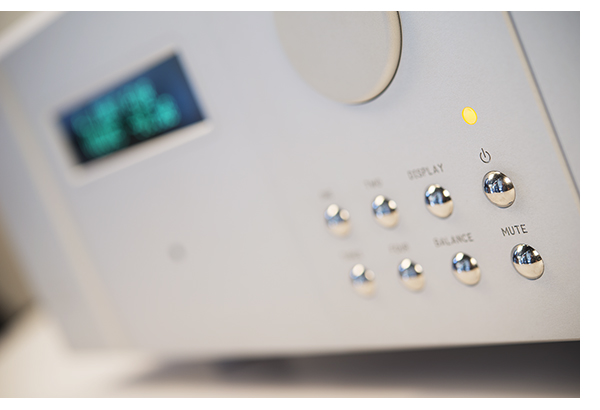
After a full year, the only complaint I have with the Vivaldi (and the Paganini suffered the same problem) is its human interface. While the new display screens on the Vivaldi are much easier to read, the writing above all of the buttons on the silver-faced units like mine are nearly impossible to read by anyone over 30. If I had to do this again, I would opt for the black version with the white type, only to be able to read the buttons better.

Fortunately, once you get used to the Vivaldi and get it configured the way you want it, you shouldn’t be doing much more in terms of fiddling. And controlling the stack via an iPad and the app does make it much easier.

Line in the Sand

Bottom line: If the office ever burns down, I’ll buy another Vivaldi and forget about rebuilding my record collection. It’s that good. After an entire year of 12- to 16-hour listening sessions daily, I’m still pinching myself over the level of performance this player achieves—and now even more so with the built-in app and server capability.

The dCS Vivaldi becomes more engaging the longer you listen to it and the more of your music collection you can experience with it. It is one of the precious few systems at any price that completely disappears and lets you fully enjoy the music.

Much like an Aston Martin DBS or Ferrari 458, the dCS Vivaldi delivers a level of elegance and performance that is unmatched by lesser players. But unlike with the four-wheeled toys, you can build a Vivaldi system one box at a time. And should you not require a disc spinner, the $68K price of a three-box Vivaldi is almost a steal for the performance it delivers, especially if you are an all-digital listener and can ditch your $10K-to-$40K linestage as part of the upgrade.

If you can afford a dCS Vivaldi, take it for a test drive; you won’t regret it. The most exciting part of adding this player to my reference system is that it remains enthralling after a year of intense listening and it definitely reveals substantially more music than the excellent dCS Paganini that it replaced. This is definitely a long-term love affair, not a fling.

The Vivaldi digital playback system

MSRP:

Transport: $39,999

Upsampler: $19,999

Master Clock: $13,499

DAC: $34,999

www.dcsltd.co.uk

PERIPHERALS

Preamplifier Robert Koda K-10
Power Amplifier Pass Labs Xs300 monoblocks
Speakers Dynaudio Evidence Platinum
Cable Nordost Frey 2
Power IsoTek Super Titan

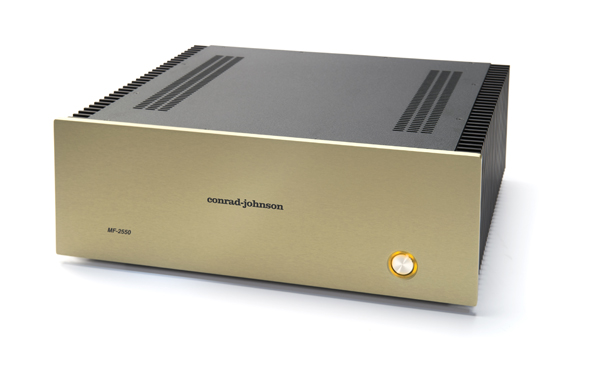
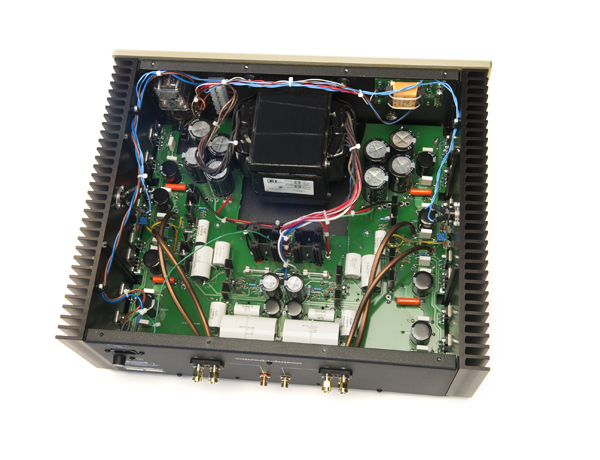
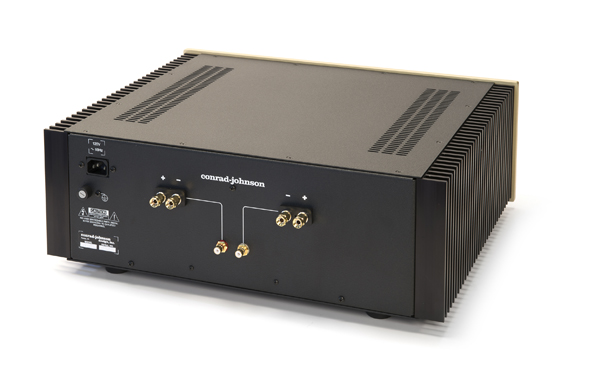
Conrad-Johnson MF2550 SE Amplifier

The generally accepted wisdom is that tube amps display a warm sound while solid-state amps offer more punch and control. But those lines are blurring, with great designs in both camps that defy past assumptions—and this is where Conrad-Johnson comes to mind. Compared to the company’s legendary valve-based gear, its MF2550 power amp takes a different approach—namely the fact that it’s solid state. The amp is available as a standard or special-edition (SE) version, the latter of which is priced at $7,800 and includes CJD Teflon hybrid capacitors and precision foil resistors. We did not have the opportunity to test these two versions side by side, but considering the outstanding performance of the SE version, it’s likely that the standard version is no slouch.

The MF2550 is rather nondescript and traditional in its appearance. The black metal chassis, which measures 16.25 inches deep, 19 inches wide, and 6.125 inches tall, features a faceplate made of thick aluminum with gold anodizing and a brushed-matte finish. Among my other black and silver audio components, the amp’s gold color—a signature of CJ—certainly stands out. The only feature interrupting the smooth faceplate is a power button the size of a quarter on the lower right corner. A gentle yellow LED halo illuminates the button when pressed. The only thing distinguishing the special-edition amp from the standard version is a small plate on the back of the unit that notes the serial number and the SE designation.

Connecting the amp could not be easier, with a set of RCA inputs and the requisite speaker binding posts; it takes only two minutes and a little finger strength to get the amp up and running. I appreciate the amp’s five-way metal binding posts, which effortlessly handle a post wrench. The posts easily accommodate two-banana adapters and offer plenty of space to connect spades and even bare-ended wire.

Pushing the gold-colored button to reveal the sonic prowess within, I first wonder if the amp is on, since it is silent. Even the ribbon tweeters in my Piega P-10 speakers do no hiss at the visiting power source.

Hidden Treasure

Much of the amp’s 52-pound weight comes from the hefty power supply fueling 250 watts into 8 ohms, or 500 watts into 4 ohms. On paper, the MF2550’s power output is a dead-ringer for my Mark Levinson reference amp, so it’s exciting to swap in the CJ. There are indeed many similarities between the two amps, as well as a few key differences.

Three-dimensional presentation is a dramatic strength of this amp. Music appears independent of the speakers and audible in all directions. Left-to-right imaging extends the music well beyond the speaker boundaries, with a very convincing central image. The amp also pinpoints other musical elements across the soundstage. Front-to-back layering leaves the vocalist up front, while allowing ambient background sounds to extend beyond the rear wall of my listening space. There’s no perceived vertical limitation either, as the music extends from floor to ceiling. On Lyle Lovett’s song “Church,” from his Joshua Judges Ruth album, the background vocalists are rendered well behind Lovett, who appears front and center. While my reference amp is quite good in its ability to layer musical elements, the CJ exceeds it.

The MF2550 takes command of my speakers with deep, rich and robust bass. Compared with my reference amp, the MF2550’s bass response is not quite as tight and punchy. Rage Against the Machine remains one of my guilty pleasures. The band’s song “Bombtrack” provides a good reference point for bass. Through the CJ, the bass portrayal is not loose or lacking depth, though there’s just a touch less immediacy and excitement compared to my Levinson.

Throughout my listening experience, there’s a very slightly warm tendency to this solid-state amp, which I wasn’t expecting. To be clear, the CJ does not overly romanticize the sound; it’s just a bit more forgiving than I’m used to. There’s a slight gentleness when listening to recordings that usually prove overly revealing. I’m able to turn the volume up higher for an immersive music experience without any hard-edged notes piercing my eardrums. At first, I wonder if some higher frequencies are rolled off, but after testing several frequency sweep tracks, all the highs are there. The CJ’s design just manages to somehow take most sting and vocal sibilance out.

Some live instruments can have an inherent bite. During live performances, it’s never pleasant to be in the blast zone of a trumpet, saxophone, snare drum, or cymbal crash. Nevertheless, that experience is the reality of the music. Through the CJ’s portrayal of music in my own system, while subtle, there’s just a touch less detail and realism. For instance, the sonic decay of the cymbal on the Dave Brubeck Quartet’s “Blue Rondo à la Turk” subsides more quickly than I’m used to. At the same time, the Civil Wars’ “Dust to Dust” on vinyl proves an utterly opulent experience. Minute sonic details aside, it’s easy to find oneself immersed in the emotion and beauty of the song.

I would not call this amp euphonic, but it leans to the side of forgiving musicality, as opposed to pure realism. Is this a bad thing? No. On a sunny day, many folks prefer to tame the glare with sunglasses, right? Similarly, if your system is a bit bright for your taste, or if you just prefer a portrayal that’s a tad relaxed, the MF2550 may provide the balance you’ve been looking for.

The Golden Ticket?

I thoroughly enjoyed the month I spent with the MF2550 SE in my system, as did several of my friends who regularly come over to listen. The MF2550 SE is something I could enjoy happily for a long time. On vocally driven performances, jazz and orchestral pieces, the CJ leaves little to desire. For those who prefer rock music with all its inherent aggression and vigor, the CJ stands more toward the polite end of the spectrum. In all cases, though, the musicality of the performance shines though.

With plenty of power and a non-fatiguing presence, this amp will likely pair well with many speakers and components. It certainly plays nicely with all my test equipment. Given its $7,800 retail price, the amp represents a long-term investment for many audio fans, but many rewards come with it.

Combining great sound with substantial build quality and a three-year warranty on parts and labor, the MF2550 SE could be something that you find at the end of your quest for sonic treasure. If these benefits sound compelling to you, definitely make a run to your local Conrad-Johnson dealer and hear for yourself what this amp can do.  

Additional Listening

By Jeff Dorgay

While so many audio enthusiasts think of Conrad-Johnson as a strictly vacuum-tube company, the brand has made some very impressive solid-state amplifiers over the years. The benchmark that comes to my mind is its Premier 350, which served as my reference amplifier for years. So when Lew Johnson told me about the MF2550 SE, this was the immediate comparison floating around in my head. But Johnson was quick to point out that the MF2550 SE is a “completely different amplifier” that would really surprise me.

And surprise it does. Thanks to a bevy of CJD Teflon capacitors, the ones that have been highly influential in the sound of CJ for the last 10 years or so, the MF2550 SE has a thoroughly modern sound. Bringing back my Premier 350, along with CJ’s ACT2 Series 2 preamplifier, makes it easy to compare and contrast the two amps.

Overall, the MF2550 SE has a very dynamic, extended sound. Those of you who remember the company’s early solid-state amplifiers and who did not experience the Premier 350 will be stunned at just how spectacular this new amplifier sounds, especially considering how well CJ is known for vacuum-tube amplifiers. The overall tonality is highly natural, with barely a hint of warmness. It’s not quite as neutral as, say, the top-of-the-line Simaudio Moon amplifiers that we’ve listened to or the Premier 350, but it’s not as warm as my Burmester 911 MK3 or the Pass XA series amplifiers.

Running the MF2550 SE through its paces with a wide range of speakers, including the Focal Maestro Utopia, Dynaudio Evidence Platinum, and even my old Acoustat 2+2s, reveals that this amplifier will drive any speakers comfortably, with power to spare. Whether rocking out with AC/DC, or relaxing with a string quartet, this amplifier presents a wide, deep soundstage and a level of nuance and control usually associated with a much more expensive amplifier.

As with the Premier 350, Conrad-Johnson’s MF2550 SE’s simple, elegant, and understated design delivers breathtaking musical performance in a compact package. And, as someone who has owned quite a few CJ products over the last 35 years, I will say that the Champagne-colored faceplate is just fine by me.

MF2550 SE amplifier

MSRP: $7,800

www.conradjohnson.com

PERIPHERALS

Digital source JRiver Media Center 19    Light Harmonic DaVinci DAC    Audio Research CD3 MK2
Analog source SME 10 turntable     Dynavector 17D3 cartridge
Preamplifer Coffman Labs G1-A
Power amplifier Mark Levinson No. 335
Cables Jena Labs interconnects and Twin 15 speaker cable
Power Running Springs Audio Haley    RSA/Cardas Mongoose power cords
Accessories ASC Tube Traps    Cathedral Sound room-dampening panels    Mapleshade Samson racks    Coffman Labs footers

MartinLogan Expands Their Motion Speaker Series

MartinLogan, the world’s leader in electrostatic & Folded Motion™ loudspeaker technology, proudly announces the addition of three new powerful speaker models in their award-winning Motion® Series; Motion 60XT floorstanding, Motion 50XT center channel, and Motion 35XT bookshelf speaker.

XT stands for extreme, and for good reason. The new Motion XT speakers play louder, lower, and with unflinching accuracy. Larger woofers and cabinets, paired with our most accurate Folded Motion™ XT driver, deliver an engaging and encompassing experience that cuts straight to the emotion locked inside your favorite recordings.

Motion XT speakers feature a ferocious combination of high-performance components; high-excursion, black aluminum cone woofers with low-turbulence, rear-firing, bass ports provide extended, powerful bass; larger more accurate Folded Motion XT tweeters boasts a radiating surface 40% larger than other Motion Series speakers for ultra-low distortion; and a dedicated mid-woofer on the Motion 60XT promotes an even more open, revealing and authentic sound in the critical midrange. The result is acoustic alchemy across the frequency spectrum, creating an unbelievably realistic musical experience.

Complementing their sonic accuracy is an elegant yet understated styling. Luscious high-gloss finishes, subtle angled-top cabinets with soft radius corners and signature MartinLogan perforated grilles accentuates their powerful elegance.

MartinLogan’s dedicated in-house engineering team carefully crafted the Motion Series to provide speakers with stunning dynamic range and jaw-dropping clarity, along with thoughtful simplicity. Additional refinements include custom 5-way bi-wire tool-less binding posts that allow ultimate connection flexibility, and reinforced solid internal bracing that eliminates internal resonances and standing waves.

The complete Motion Series comprises of four floorstanding speakers (Motion 20, 40 & 60XT), two bookshelf speakers (Motion 15 & 35XT) and two center channels (Motion 30 and 50XT). Each speaker is voice-matched, ensuring mix-and-match versatility to create the ideal system for any size room.

Motion 60XT, 50XT & 35XT pricing starts at $2,999.95 per pair (US), $899.95 each (US), and $1,199.95 per pair(US), respectively, in High-Gloss Piano Black finish. High-Gloss Black Cherrywood finish is also available, and all models will ship at the end of July 2014.

For more information on MartinLogan’s new Motion XT speakers, please visit their website at: www.martinlogan.com/motionSeries

Skooba Design Cable Stable Rollup Kit

Always losing USB cables, in-ear phones and those new small chargers that come with the iPod and iPhone?  The Skooba Design Cable Stable Rollup Kit barely takes up any space in your purse, briefcase or suitcase and holds four such items.  Perfect for your next trip, photoshoot, or off world endeavour.

$16.95

www.skoobadesign.com


New USB cables from Wireworld…

Wireworld Cable Technology, one of the world’s most respected manufacturers of high performance audio and video cables, is releasing their Series 7 reference USB Audio cables, Platinum Starlight® 7 USB and Silver Starlight® 7 USB.

The addition of Composilex® 2 insulation makes them dramatically quieter and their upgraded DNA Helix® design increases their transmission speed to a class-leading 10.2Gbps+. These advantages minimize jitter, which maximizes the musical realism of high resolution PCM and DSD music files.

“Critics and customers seem to agree that the Series 7 upgrades are our best ever,” comments Wireworld President and founder David Salz. “The pristine tonality and expressive musicality of Platinum and Silver Starlight 7 USB cables is a wonder to behold. Our previous series was widely considered the best available, and Series 7 outperforms it in every way.”

Both cables employ Wireworld’s patented DNA Helix design with six signal conductors — twice as many as other USB cables — arranged in a newly expanded symmetrical geometry that channels more electromagnetic energy to exceed 10.2Gbps transmission speed, dramatically faster than other cables and the official USB high speed specification. The Composilex 2 insulation reduces triboelectric noise in the signal conductors and it also triples the noise-absorption of the isolated power conductor to produce surprisingly lifelike tone color and imaging.

Featuring molded carbon fiber connectors and six solid silver conductors (3 x 23AWG) for uncompromised performance, Platinum Starlight 7 USB has a suggested price of $700 for one meter. Silver Starlight 7 USB features the same DNA Helix design with six silver-clad OFC conductors and aluminum connectors at $300 for a one meter cable. Both cables are available in lengths from .3 to 5 meters in A to B and A to mini B configurations.

Wireworld Cable Technology, which was founded by industrial designer David Salz in 1992, is the premier provider of leading edge digital and analog cable technology for home audio and video, from HDMI and USB audio to state of the art high-end interconnects and speaker cables. Wireworld earned its world-class reputation by producing superior cables based on the use of objective perceptual testing, innovative patented designs, premium materials, and exceptional manufacturing quality.  For more information, visit: http://www.wireworldcable.com/ or call 954-464-4474.

Maxboost Atomic Air External Battery and Case for iPhone 5

First the good news: the Maxboost significantly outperforms its published spec of doubling the battery life of an iPhone 5, it almost triples it.  And the integral hard case barely adds any weight or girth to the iPhone’s sleekness.  But now the bad news:  reception is cut by about 30% in weak signal areas, netting you additional hours of dropped calls.  Nice.

However, if you live in fairly strong signal areas, and take advantage of LTE, use the GPS dependent apps a lot or just have a motor mouth, this device will make your life better.

$99.95

www.amazon.com

Sennheiser HH10 Headphone Holder

The saying goes, “you can’t have everything, because where would you put it?”  The compact Sennheiser HH10 Headphone Holders go a long way at alleviating that problem.  Clamping on to a wall or shelf just about anywhere, you can safely hang your favorite phones anywhere.

$25

www.sennheiser.com

Nerf N-Strike Elite Retaliator Blaster

Who wouldn’t want one of these?  Whether attacking your kids, co-workers or spouse, this is the perfect way to take out your anger in a way that nobody gets hurt.  Just keep this thing away from your turntable, as it will take a Lyra Atlas out faster than you can say pointed stick.  Remember, we warned you.

$25

www.amazon.com

Canon EOS M Camera

We’ve been using Canon’s compact G-series digital cameras in succession since the G9, each one making incremental gains in performance over the last, both in terms of image capture and image processing.  The big jump came with the G1 X, which featured a much larger image sensor (APS-C; 22.3 x 14.9mm), giving that camera an edge in low-light situations, capturing images that rival many DSLRs.

The EOS M builds on this success, combining the high quality of the G1 X sensor, with the ability to change lenses.  Currently there are only two lenses available in the EOS M stable: a 22mm f2 lens (about 35mm equivalent with full frame sensor) and an 18-55mm f3.5-5.6 zoom.  Though MSRP on this combination is $599,  it can be had for about $340 online, making this an incredible bargain.

18 megapixel power

Pixels aren’t everything, but in the case of the EOS M, a sensor with larger pixels than the rest of the pack makes for high ISO/low noise images, allowing much cleaner photos in low light situations than the comparably priced point-and-shoot cameras at your disposal.  Thanks to great face recognition software and the sensor from the G1 X, shooting at ISO 1600 and up is now a breeze, making this the perfect camera to sneak into your favorite concert, where “professional” cameras are not allowed.

Average to high light level results are even better – pictures taken with the EOS M compare favorably, almost identically, to identical images captured with the Canon EOS 7D DSLR.  Those using the EOS system can mount their full complement of EOS lenses with a convenient adaptor ($199) and retain full auto focus and image stabilization, making the EOS M an ideal backup body. Mounting a 70-200mm f2.8D lens yields crisp results with no lack of functionality.

Highlights and shadows are clean and noise-free at all but the highest ISO rating. As for composition, the EOS M’s three-inch viewing screen is easy to compose with, even in fairly bright light.  As with every other compact camera, this is perhaps the only area where the EOS M falls down in comparison to a DSLR, as looking through the actual viewfinder in bright light is still the easiest way to focus a camera.

Those needing more viewing area can plug in an external HD monitor via the HDMI port, as you would with one of the higher-end EOS DSLR bodies.  Best of all, the EOS M allows you focusing and composition in real time, making this camera incredibly easy to use in a studio situation, especially with manual focus engaged.

Smashing ergonomics

Legacy G-series users will instantly feel at home, yet will notice the stripped-down feel of this camera in comparison.  Rather than having most of the buttons on the outside of the camera, nearly everything is menu driven on the EOS M, making for a sleeker camera.

Fully automatic mode delivers great pictures, yet the EOS M allows full manual control of everything for the advanced photographer who desires it.  Full HD video (1080 x 1920 pixels) is only a button click away and again, the results closely resemble that of an EOS 7D. Images are captured via SD cards, and if you plan on capturing a lot of HD video, purchase the fastest data transfer card you can find.

Taking advantage of Servo AF mode, the EOS M can capture photos at a rate of just under two frames per second, so it may not be the best camera for covering a Formula One race – but it should be more than adequate for the next birthday party or soccer match.  And remember, some of the world’s best photographers shot without motorized assist, so up your game accordingly…

Almost…

So whether you’d like a compact camera that will work in tandem with your DSLR, or a high-performance camera that can take advantage of a wide range of lenses, the Canon EOS M is worthy of the moniker. – Jeff Dorgay

Canon’s EOS M

$599 (with 18-55mm lens)

www.canonusa.com

Jaguar F-TYPE Featuring Meridian High-Performance Audio

The new F-TYPE is a seductive, capable addition to the Jaguar fleet. It delivers the raw, sensuous beauty of the E-Type from the 1960s and ’70s—considered by many, even the great Enzo Ferrari, to be one of the most beautifully shaped cars ever conceived—with 21st century performance and accouterments. Best of all, the F-TYPE sheds Jaguar’s 20th century reliability issues; the British manufacturer is a top performer in JD Power’s initial quality surveys.

With the F-TYPE, Jaguar has indeed produced a brilliant success. I have spent a lot of personal time with Jag’s retired S-Type—in both its 380 hp supercharged V-6 and 495 hp supercharged V-8 variants—and I found it to provide a highly enjoyable ride. For the automotive journalists assembled for the debut of the F-TYPE, the comparison between the new model and the S-Type polarized the group in terms of which car provides the ultimate setup. Both models weigh around 3,500 pounds, so these are big cats indeed, but they are so lithe that they hide their weight incredibly well.

Now it’s My Turn

Jaguar’s current ad campaign in the U.S. features the tagline, “Now it’s your turn,” with a fellow returning from a test drive and flipping the keys to the first person in a long line of people waiting to drive the car. Fortunately, Jaguar has plenty of cars available at this event—in both the 380 hp V-6 and 495 hp V-8 trim, and in a plethora of colors—so we don’t have to wait long. With a few of the cars on display in Firesand metallic (aka bright, shiny orange), I am assured that orange is indeed the new red. A surprisingly gorgeous variation on the classic British Racing Green, the trademark shade of the E-Typeis also available.

The new car is available in three trim levels: The base model, priced at $69,000, features a 340 hp supercharged V-6; the 380 hp V-6 Sport model, priced at $81,000; and the 495 hp V-8 Sport model, priced at $92,000. While this review should concentrate on the F-TYPE’s sophisticated Meridian sound system, the car’s active sport exhaust system, which essentially bypasses the mufflers briefly when you mash the throttle to the floor, uncovers a cacophony of enticing sound that is worth noting.

As the only audio writer in a crowd of automotive journalists, I am interested to hear their take on the car. Almost all of them favor the V-8 version, some claiming that 380 hp is just not enough—an interesting take, considering that many of these same journalists went bonkers over the 400 hp Porsche turbo about 15 years ago. It would seem that we remain corrupted by power, even in the day of $4.00-per-gallon gasoline in the U.S. and double that in Europe.

Not a 911

Throughout the course of the presentations, representatives from Jaguar repeatedly make comparisons between the F-TYPE and the Porsche 911. As a Porsche owner, I submit the F-TYPE is a wholly different car, more than deserving evaluation (and adoration) on a different level. The current 911 has become heavier and more posh over the years, especially in its latest iteration, with many core Porsche enthusiasts feeling it has become much more of a GT car in the process.

Where the 911 is a sports car with luxury aspirations, the F-Type is a luxury roadster that is highly sporty, if that makes any sense. Many of my acquaintances who own 911s lament the same thing—the car is rarely a big hit with wives or significant female friends. The F-Type, by contrast, strikes a perfect balance of personal luxury and coddling that the 911 can’t muster, yet the Jag’s claws come out in earnest the second you mash the gas pedal to the floor, proving that the car is indeed a sporty performer. Doing so clearly illustrates that the optional free-flowing exhaust on the test vehicle keeps the car very civil in tight traffic yet free to roar on the open highway.

And roar it does, the V-8 sounding more like a NASCAR engine at full song, encouraging inappropriate behavior and a major decrease in fuel consumption. As I pass a scowling Prius driver at full throttle, I casually glance at the “instantaneous mpg” figure on the Jag’s dashboard—it reads 5.3 mpg. But what an incredible way to dispose of fossil fuel.

In light of the conversations of those loving New York and hating Los Angeles, I love both coasts equally for different reasons. Similarly, if I had the cash, I’d have a 911 and an F-TYPE in my garage.

Just Posh Enough

The F-TYPE strikes a wonderful balance of cutting-edge design and fashion-forward styling, while achieving an exterior look that I suspect will be as timeless as that of the E-Type. I doubt this will be a car that long-term owners will ever tire of looking at. The only question mark is will all the hardware and software under the bonnet be supported 40 years from now? While the E-Type had a reputation for being somewhat unreliable, it can still be repaired today.

Automotive design aside, the star performer here is the optional 770-watt Meridian audio system. The 380-watt standard system is by no means rubbish, but it can’t be played as loud as the optional system. In real life, this means you can only blast Megadeth up to about 35 mph before road noise takes over, but with the bigger 13-speaker Meridian system, you can still rock the casbah at about 60 mph.

This is exactly what I did, using the title track of Megadeth’s Countdown to Extinction as my first test. Derived from Meridian’s system in the Range Rover Evoque (reviewed in issue 45), this audio system is optimized and custom-tuned specifically for the F-TYPE.

Meridian’s DSP (digital signal processing) experience works wonders here. The sound is dynamic, engaging and enveloping, even with the car’s top down and the throttle at a moderate position. But when you mash the throttle, forget about it. Top-down motoring and high-fidelity listening are two great tastes that don’t always taste great together. No offense to my friends at Meridian, but the F-TYPE is just too damn fun to drive fast with the top down to care about the audio system.

Jaguar has done a marvelous job with noise control on the soft top, so top-up motoring is highly enjoyable, making the F-TYPE almost as quiet as a fixed-roof car. This is when you can truly enjoy the marvel of the Meridian system. The cabin is quiet enough to listen to classical music in a meaningful way. When tracking through Brahms’ Symphony No. 1 in C Minor, I find myself easily swept into the grandeur of the piece, able to enjoy the quiet bits almost as much as I do in my home system, with precious little road noise creeping in. The soundstage is big, bold and very dynamic, reproducing the loudest kettledrums with authority and then seamlessly transitioning back to the moderate oboe passages. Rifling through a set of Blue Note XRCDs and a fair share of solo female and male vocalists proves equally compelling, with an excellent degree of stereo imaging throughout the front cabin—which, in the Jag, feels more like a large mobile set of headphones, while the system in the Range Rover Evoque provides a more cavernous experience.

Bottom line, the $1,200 for the upgrade to the top Meridian system is a pittance in terms of the total sticker price. And if you love music, I guarantee you will enjoy this car so much more with the Meridian system installed that you will quickly forget about the extra dough. It is wonderful to see Meridian doing its part to make a highly enjoyable sports car that much more enjoyable with a sound system worthy of the Jaguar marque. – Jeff Dorgay

www.jaguarusa.com

www.meridian-audio.com

Success is the Essence of New York

If you aren’t successful yet, you can at least smell like it, with the latest from Bond No.9 of New York. Reacting differently on men and women, this scent is equally enticing with both sexes. And thebottle features art by Andy Warhol, how rock androll is that?

50ml, 190.00

Power Squid

While not necessarily an audiophile product, we’ve had great luck with wire products from Home Depot in the past. The Power Squid is another product worth considering for the audiophile on a budget. With plenty of copper in its tentacles, it’s a great way to get power to multiple sources, whether in the listening room, computer room or garage.
$19.95

Samsung Galaxy Watch

If you’ve got one of the latest Samsung Galaxy phones, you have to get the companion watch. While some may view this as over the top nerdiness, and others the first step to wearing Borg implants, the Samsung engineers have done a remarkable job at streamlining what could have been a major dork move.

Available in stylish orange, bright yellow, black, white, and grey, the Galaxy Gear watch pairs
with your phone via Bluetooth and gives you multiple display options, from full on digital watch (complete with outside temperature) to the analog version you see here. And, it includes a wrist camera, whichis mega cool.

The downsides of this product are few, but significant. First, it has to be charged via the charging
cradle and wall wart, which is cumbersome. Having a watch that needs to be charged is inconvenient. Second, the watch face does not stay lit, you have to push the button on the side of the bezel to illuminate it. Hopefully, the next release (or software update) will address these issues. For now, we only suggest this one for the most obsessive mobile technology enthusiasts.
– Jeff Dorgay

iPad Air

Yes you need another iPad.  Now dubbed the iPad Air, Apple claims their new baby is “leaner and definitely meaner.”  Marketing hyperbole aside, it is 28% lighter, weighing in at a mere one pound.  While some find this new svelteness enticing, the beauty of the new iPad is truly skin deep.

Those stepping up from an earlier generation pad will immediately notice the crispness of the retina display.  Even if you’ve already had the retina experience, you’ll be excited by the processor upgrade, providing a big jump in overall performance.  Web pages load decidedly faster when comparing to the last model, and wifi performance seems improved as well, when transferring files.  Perhaps the biggest benefactors will be the gamers in the audience, which is where all of this functionality converges, but the new Pad is enough of a star performer, that those relying more heavily on the pad than a laptop should give this one serious consideration.  – Jeff Dorgay

$499-$999 (depending on configuration)

www.apple.com

Steidle Woodworking Record Crates

The ubiquitous milk crate serves many vinyl fans at some point during their lives. Any why not? It is inexpensive, sturdy, and offers an eerily ideal size to accommodate a record collection. It’s hard to imagine that anyone could taint such a perfect audio storage solution with actual milk bottles!

For those who want all the functionality of their much-loved milk crates, but who want a huge step-up in aesthetics, Steidle Woodworking Company in Vancouver, British Columbia, offers an exceptional solution. The company’s owner, James Steidle, hand builds each crate from reclaimed wood or trembling aspen with a birch bottom panel. While sizes and designs vary, the standard crate protects 70 to 80 LP-sized records in style. Different versions are made to embrace 7-inch records. With the natural grain and color variance inherent in wood, each crate has its own unique and beautiful appearance.

In order to accommodate a bulky, heavy load of vinyl, Steidle fortifies each creation with attractive and sturdy dovetail joints which bind sides and bases together with exceptional durability. This approach also eliminates the need for metal hardware which could otherwise detract from the organic aesthetics. Simple, ergonomically cut handles grace the sides, making these crates portable even when hauling a full capacity of records.  -Rob Johnson

James Steidle sells his handcrafted creations through Etsy.com. Designs start at $79. http://steidlewoodworking.com/

Tito’s Handmade Vodka

And just when y’all thought Austin, Texas was a place for music, it turns out they are getting equally famous for making vodka.  Proprietor Tito Beveridge (yeah, that’s his real name) left a career in the financial services industry to follow his passion for vodka, and we’re probably all better off for it.

Labeled a “sippin vodka,” Tito’s is smoother than anything we’ve come across, tasting almost like Vodka flavored wine.  Equally good mixed with your favorite combination; orange juice, cranberry juice or even Gatorade, Tito’s Handmade Vodka should be on your list if you’re a vodka aficionado.  – Jeff Dorgay

About $30

www.titosvodka.com

Range Rover Sport with Meridian Sound

As much fun as it was zooming around in the Jaguar F-Type—which appeared on the cover of our last issue and which is also equipped with a magnificent audio system from Meridian—the visceral experience of driving with the top and gas pedal down made it difficult to concentrate on anything but the sound of the engine. For this writer, the roar of a big V-8 always trumps whatever tunes are playing.

But the new Range Rover Sport is an entirely different animal. With a cockpit nearly as quiet as that of a Bentley, the Sport makes for the perfect spot to take advantage of what the Meridian system can deliver. It’s a $1,950 option that you should not be without.

Joining some of motoring’s most noteworthy journalists, we sit through a presentation that an outsider might think is comprised of a bunch of unlikely tourists being pitched on the idea of vacation time-shares. It’s awfully quiet in the room as Range Rover’s best and brightest share all the techie bits about what makes this new Sport model even more Range Rover-y. They also make a point to tell us that the Sport is backordered for months—which seems to impress the highly enthusiastic audience.

The design brief concentrates on the Sport’s ability to deliver more off-road capability than Range Rover loyalists might be used to, as well as more boulevard-friendly cruising abilities for those pursuing more civil driving (i.e. Kim Kardashian and the country-club crowd). The new Sport is nearly 800 pounds lighter than the model it replaces, which becomes immediately apparent at the gas pump. Friends with the departing model tell me that they struggle to get 12 mpg; the new model will deliver close to 20 mpg in mixed driving environments—a major improvement.

But this enhanced performance is not just due to weight loss; it also comes from higher efficiency in all areas, from the engine management to the new and improved transmission, combined with better software controlling the drivetrain.

Just Get the V-8

While I truly preferred the supercharged V-6 power plant in the Jaguar F-Type—feeling that it was more lithe overall and hardly worth the gas-mileage penalty for the 0.5-second quicker 0-to-60-mph time of the V-8 version—the exact opposite is true with the Range Rover Sport. The 1-to-2-mpg penalty you’ll pay for the big motor is a small price to pay for the posh feel that accompanies it. The 6-cylinder car feels fine at cruising speed, but when it’s necessary to overtake the car next to you, the weaker engine’s struggle is apparent in the cabin, feeling somewhat labored, whereas the V-8 version jumps ahead effortlessly.

And while the extra horsepower of the V-8 only shaves about 0.5 seconds from the 0-to-60 time in the Jag, it delivers a nearly 2-second quicker time in the Range Rover. Again, it’s more about the way the power is delivered than the power itself. You never think about the engine in the V-8 model, as it should be in a luxury ride like this.

Both the V-6 and V-8 engines are based on the ones used in the Jaguar, yet in the Range Rover they are tuned more for maximum torque and a broader response curve, which benefits a wider range of driving experiences. You aren’t going to be burning rubber when the tires are knee-deep in mud anyway—what you want is smooth, torque-heavy power delivery so you can leap out of the slimy spots with ease. Yet, where the V-6 feels fine most of the time, when you put the pedal down, you still feel the engine. By comparison, the V-8 has an effortlessness of power delivery that just seems oh so much more in keeping with the sporty ethos.

That’s what the Range Rover Sport delivers: No matter how steep a hill we chose to climb or how slippery the conditions, this damn thing does not get stuck—ever. As a neophyte to off-roading (though I’ve ridden my share of dirt bikes through hellish conditions), I’m flabbergasted at the capabilities of this 5000-pound vehicle, which can sprint from 0 to 60 mph in 5 seconds flat—something that the Porsche Boxster in my garage cannot accomplish.

If there was ever a vehicle that can do damn near everything, the Range Rover Sport is it. Now, if we could only have the 35-mpg turbo diesel model that our European neighbors enjoy…

The Ultimate Mobile Concert Hall

Thanks to 1,700 watts and 29 speakers, all tailored to the Range Rover’s interior environment, there is no better way to take the music to the street, or wherever. Most of our test vehicles have the standard Meridian system, which is no slouch, and adds $1,995 to the sticker. For all but the most die-hard music fans, this should suffice, but if you want to rock while you’re rolling, you need the top-of-the-line Meridian Signature Audio Enhancement Package, which adds $4,995 to the MSRP—a small price to pay to be a major player.

And rock it does. Thanks to all of the DSP modeling performed by Meridian, an expert in this technology, each one of those 29 speakers is custom tuned to the Sport’s luxurious cabin. Cranking up the new Nine Inch Nails album Hesitation Marks conveys the sheer industrial energy present on this disc, and even at near maximum volume, nothing in the Sport’s cabin rattles or makes any kind of mechanical noise.

Next up, it’s classic Scorpions—Love at First Sting. It might be a little bit out of character for this proper British vehicle to be blasting “Rock You Like a Hurricane,” but again the Meridian system delivers the goods, providing maximum SPL and minimum distortion. Seriously, this system can generate major sound pressure, so we’ll leave it up to you to establish your own definitions of reasonable and prudent while behind the wheel.

Because this is a surround-sound setup, those with 5.1-channel DVD-Audio discs can take full advantage of that functionality. The 1990s classic Toy Matinee is a ton of fun on this system, with vocals seeming to come up from between the front seats and with sprinkles of synthesizer fills coming from all over the cabin—brilliant!

You Know You Want It

I come away spoiled from my time spent with the Range Rover Sport equipped with the Meridian sound system—any other SUV now disappoints. I’ve driven them all and they pale in comparison. Nothing else has the versatility, the reputation or the panache. Granted, the Range Rover Sport may not be for everyone, but if I were writing a check for seventy large, this would be in my driveway in a heartbeat.  – Jeff Dorgay

www.rangerover.com

www.meridian-audio.com

Shinola Watches

Cars aren’t the only things being produced in Detroit these days. Earlier this year, Shinola began offering a variety of items including bicycles, leather goods and watches, all produced at its Detroit manufacturing facility. And its watches in particular caught our attention.

Named after the 1940s-era shoe polish brand, Shinola is backed by a larger Dallas-based company and has an ultimate production goal of 500,000 watches annually. Shinola has partnered with Detroit’s College for Creative Studies, which is helping to interject creative approaches in the company’s manufacturing process. And while not all the parts in Shinola’s watches are sourced from U.S. suppliers, the company hopes to bring more U.S.-based companies into the fold. As one example, a well-established watchband maker in Florida, Hadley-Roma, produces all the leather bands for Shinola’s watches.

It is not uncommon for U.S. manufacturers to buy parts from sources around the world and assemble them here. Many companies even have the entire assembly process done overseas where expertise and labor costs can make small-scale production more economical. Shinola’s manufacturing approach bucks this trend in order to create jobs locally. And Shinola’s watches have generated a strong following from those who favor the watches’ neo-retro designs.

Shinola takes special care in building its movements, which is kind of like a watch’s engine, allowing the watch to maintain time and date, and in some cases enabling stopwatch functionality. All the movements in Shinola’s current lineup are quartz-based and required the battery to be changed every few years. Companies like ETA (Swiss) and Miyota (Japanese) produce very reliable pre-built movements and are the go-to options for some U.S. watchmakers. Another large movement manufacturer is Ronda (also Swiss), and its movements serve as the basis of Shinola’s own Argonite series of movements, which Shinola assembles at its Detroit factory. Keep in mind that each Argonite movement requires 40 to 80 tiny parts.

To prepare the team in Detriot for such a large and delicate undertaking, Shinola brought in several experts from Ronda to get the process rolling and to help train the local team. A substantial amount of hands-on labor is required to build each movement—and considering the care and time that the team in Detroit puts into each Shinola watch, a price tag starting at around $500 is very reasonable. Given the quick growth and popularity of the company, it appears that many happy Shinola customers agree.  -Rob Johnson

www.shinola.com

Senz “Smart S” Folding Umbrella

For Portland, Oregon, residents like me, rain is a not just a common experience, it’s a way of life.  The word “rain” actually proves too generic and inadequate here because experiences with liquid precipitation vary so much. We’ve become accustomed to a creative system of rainfall classification based on the volume of water that clouds decide to unleash. In order of increasing wetness, descriptors include mist, drizzle, light rain, scattered showers, showers, rain, steady rain, heavy rain and, well, deluge. Portlanders generally don’t even notice the first two categories when they occur; more wet conditions, however, demand acknowledgement and some shield strategy when heading outdoors.

These weather conditions fuel my ongoing quest for the perfect umbrella, which must meet three requirements: a very compact folded size that fits into a computer bag, a deployed size that provides adequate water protection, and a durable design that allows use in fairly windy conditions. All this led to my experimental purchase of a Senz “Smart S” umbrella. “S” stands for “small” versus the larger sizes Senz sells.

Made for one person, the most eye-catching feature of this umbrella is its unconventional canopy design. While the Senz, compared to my other travel umbrella, has roughly the same square footage of rain protection the canopy shape is quite different. Unlike the traditional round umbrella shape the Senz sports a squared-off, teardrop-like shape with a roundish front, a wider shoulder section, and an elongated tail. In addition to water protection, Netherlands-based Senz describes the oblong shape as superior for use in windy conditions.

Closed, the Smart S is about 9.5” (24cm) long and it deploys manually. Once open, dimensions are roughly 34” x 34” (85 x 85 cm). For a foldable, the build feels quite durable with metal parts for added strength.

It didn’t take long for perfect wet and windy weather to hit Portland late this fall, so the Senz and I teamed up and embarked on a few errands. I’m accustomed to a round umbrella, so at first I was skeptical about the Smart umbrella’s shape and its theoretical benefits over a more conventional design.

The handle, positioned more toward the front of the teardrop, gives the umbrella an unusual and off-balance profile. During a brisk walk in the rain, however, the genius of the shape becomes clear.  The rounded front keeps the front of your legs and shoes dry. The wider shoulder section offers good shielding for the bulk of the body. The “tail” on the Senz directs runoff further behind me than a round umbrella does. Ultimately, this means the back of my pant legs stay drier.  In addition, the narrower overall shape accommodates pedestrian sidewalk traffic better than my round umbrella does.

The Senz also handles wind with aplomb just as advertised. Even in gusts, the umbrella never flipped or inverted.  Smart S is designed to withstand a 35 mph (60 km/hr) wind. I have not tested that yet, but in moderately windy conditions it does better than other umbrellas I’ve owned.

Because the Smart S is so compact, it works best when aimed in the direction of travel. I find that wind-driven rain, perpendicular to my walking direction, causes more of a challenge. For maximum dryness, I need to twist the Senz a bit so the leading edge angles toward the wind and rain, or else accept a damp side of my body. I’m sure a larger Senz model would reduce this problem. Repositioning the Smart S umbrella reduces rain exposure for me, but the elongated back creates a greater eyeball hazard for passers-by on busy sidewalks. However, most others were so intrigued by my unusual Senz silhouette that their eyes found the umbrella before it found them. If you are worried about visibility, the S comes in red as well as black and white.

The Senz Smart S is not cheap at around $40, and if you are prone to losing umbrellas, it could prove an expensive habit.  For all the use I’ll get from it, though, I feel the Senz offers price performance. This well-engineered umbrella is my go-to for city use. The unique canopy shape proves effective in more cases than does a round design. For those on-foot folks who want to be prepared for wet weather conditions, the compact size and durability of the Senz Smart S make it a great option.  –Rob Johnson

Senz “Smart S” Umbrella

See it on Amazon.com

MSRP: 24.95 Euros (about $35 USD) direct

BMW i3

The current, very limited crop of all-electric cars faces some mainstream acceptance, but BMW’s latest effort proves that progress is indeed being made. Promised to be in U.S. showrooms by May, the i3 SUV is already traveling European roads, and carries an entry-level price of about $41,000 (topping out at about $50K, depending on equipment and configuration).

The i3 is available with three levels of accouterment: The Mega, Giga and Tera World models can each be ordered completely electric, offering 80 to120 miles of range, and with a built-in “range extender,” which features an onboard gas-powered generator to augment the charge of the batteries, rather than using an engine configuration that switches between electric and combustion operation like most hybrid designs. This option adds about 300 pounds to the car and $4,000 to its price tag, while extending the range to beyond 200 miles.

Mission Impossible Meets ’80s Euro Design

Remember those goofy-looking European automobiles from the Miami Vice era, with their monochromatic paint jobs and odd interior surfaces? The i3 isn’t quite as bad as a 1980 Porsche 928, with its pop art, checkerboard seats, but it’s close. While the i3 utilizes a fair amount of carbon fiber throughout, there is some wacky recycled plastic in the driver’s cabin that wouldn’t even pass muster in a Kia.

Though BMW’s famous 3-series sedan is the epitome of ergonomic perfection, the i3 features a display screen that is about the size of a Samsung Galaxy Tab 3 tablet, hidden behind the steering wheel. Unfortunately, this small screen houses the speedometer and other related information, while the other LED panel (which is twice as big and displays geeky car function information) is in the middle of the dash in plain view. Though this is from the same company that gave us iDrive, it seems highly counterintuitive. The transmission control is equally tough to use and figure out, and it’s stuck on the right steering wheel stalk.

Drives Like a Dream(y) Golf Cart

Hybrid-car owners are familiar with dead silence at a standstill, but fossil-fuel fans will be surprised at the lack of engine sound when you push the go button on the i3’s dash. It doesn’t get much better when you press the go pedal. Though the i3 is very torque (scooting to 60 mph in 7 seconds), the lack of engine sound and gearbox action is somewhat unnerving. Perhaps the salesperson at the dealer summed it up best: “The i3 is very efficient, but soulless,” which is not necessarily what you want from the world’s ultimate driving machine. Though for owners making short hops, the i3 might be a pretty cool and certainly novel way to visit your favorite barista.

To Be Green or Not to Be

Here in the U.S., the dilemma we face is whether to be green (albeit at a premium price) or to enjoy driving excitement. The similarly priced BMW X1 SUV has a wonderful 3-liter, twin-turbo six-cylinder engine, but it only gets about 20 mpg. The i3, on the other hand, achieves the equivalent of about 110 mpg, when considering the amount of electricity required to keep it running.

However, the deal-breaker for this writer is the price penalty for going electric. My local BMW dealer was quoting about $725 per month on a four-year lease—ouch! Granted, you get a $7,500 federal tax credit when purchasing a car as efficient as the i3, and some states offer additional local tax credits, but when you can lease a loaded 328d (with a nearly 1000-mile range) for about $475 per month, pushing the eco button will give many prospective owners pause. An even more intriguing and more apples-to-apple comparison comes in the form of BMW’s X1 SAV (Sport Activity Vehicle), which features a twin-turbo four-cylinder engine that can achieve mileage in the mid 30s and can be leased for under $400 per month.

It’s a shame that BMW and others won’t step up to the plate and offer some incentive beyond a federal tax credit to encourage early adopters of this technology. But for now, while it’s close, the BMW i3 still misses the mark. – Jeff Dorgay

www.bmw.com

Keyport Slide 2.0

Okay, I admit it. I’m the guy with a key ring so big that it needs a backpack instead of a pocket. It’s laden with every key I have accumulated this century and I don’t even remember what some of them unlock. But I’m turning over a new leaf, and so I’m been on the search for a new and stylish keychain—which eventually led me to the Keyport Slide.

The basic idea is that six keys can be hidden within a small, lightweight device with color-coded buttons, or “nodes,” to identify the keys and slide them into and out of the rectangular encasing. While the first version of the Slide was made of metal, the Slide 2.0 is made from durable polycarbonate, and it can be ordered with a black, white, or transparent case.

Keyport, which is located in Las Vegas, says that using polycarbonate is less expensive and subsequently reduces the cost for the consumer. After using an original metal Slide myself for the last year, I will say that version 2.0 is lighter and the sliding action is smoother. Since Keyport’s aim is to reduce the weight of the device and the space each key requires, standard keys will not fit in the slim casing, which is less than 3 inches long, just over 1 inch wide, and about half an inch thick. Keyport’s solution is to utilize special “blades,” which are purchased in addition to the Keyport body. They are slim and light and don’t have the usual bulky key heads.

As you know, keys can vary widely in size and shape, so how do you know which Keyport blades will replace your normal keys? You just note a few details about the keys when placing your Keyport order online and print out a special form on which to place your normal keys and take a digital photo of them. You then upload the form to a secure site, which the Keyport team analyzes and gets back to you in a couple days with the specifics on the blades you need. You can disguise your original keys with tape or edit the digital photo if you’re extra concerned about security, as long as the key tip and handle are visible. Once you receive your order, you just take the blades to a hardware store or your local key cutter to have them shaped to match the original keys. The final easy step is sliding them into your Keyport.

For transponder-chipped car keys, special Keyport blades can be ordered, but they require an additional slot in the body. The Keyport doesn’t have a place to put garage remotes or special electronic fobs, unless you use Velcro to attach your security fob to the side of your Keyport like I do, which is not the most elegant of solutions.

If you don’t have six keys to occupy all the slots in the Slide, Keyport sells fun and useful accessories to fill the extra slots. Options include a USB memory stick, flashlight, or bottle opener. Now if only they could fit a wallet and a ChapStick, I’d be able to carry everything I need in one pocket—no need for a backpack.  -Rob Johnson

Keyport Slide 2.0

$29, plus $5 per standard key blade; accessories cost extra

See it on Amazon.com

Porsche 911 Carrera S Cabriolet Featuring Burmester Audio

As the new Porsche 911 Carrera S Cabriolet rockets out of an exit ramp at just under 150 kilometers/hour (about 90mph), with its 3.8-liter powerplant shrieking towards the 7900 RPM redline, I take full advantage of the 400 horsepower at my disposal and, for the moment, ignore the Burmester sound system installed in the vehicle. And, thanks to Porsche’s latest version of PASM (Porsche Advanced Stability Management), I’m not thinking about the rear end of the car wanting to step out and join the front end—as it could have easily done with my 1983 911 SC. Nope. I feel like Speed Racer.

A quick blip of the throttle, and another rapid gear change via the paddle shifters conveniently mounted on the steering wheel (my test vehicle is equipped with the 7-speed PDK transmission), nudge the speedo past 200kph and grab the attention of local police parked on the side of the highway. Fortunately, they just blink their headlights to see if I’ll get the message. Communiqué received: It’s time for some Skynyrd. In Terminator mode, cranking “Give me Three Steps,” I briefly entertain raising the cops’ dander, knowing their van no match for the 911’s 187 mph terminal velocity. As Hunter S. Thompson used to say, “Any day is a good day for a high speed chase.”

The PDK transmission allows drivers to shift faster than they can with a standard manual transmission, yet offers the convenience and smoothness of an automatic in tight traffic. The different driving modes, instantly available via the centrally located LCD touch panel, directly translate into more driver engagement, with gear changes becoming more positive and upshifts going to the redline with ease. Sport Plus, the most aggressive mode (utilizing Porsche’s “racing circuit” program), holds the car in the chosen gear just like a pure manual even as it permits faster changes than a manual. Then there’s the “launch control” option, which cuts .2 sec from the manual cars’ 0-62mph time. Playing Gran Turismo 4 does not prepare you for the 911 Carrera S experience.

I suspect the Sport Plus mode sacrifices fuel economy, but it’s as easy to inter thoughts of fuel conservation as it is to bury the tachometer needle. If you have the cash to afford one of these, buy a Prius for a daily driver. For those laden with eco-guilt, Porsche engineers note this is the most efficient 911 ever made, and can actually yield 30mpg when driven gingerly on the highway.

Back to Burmester

It’s time to concentrate on the real reason I’m visiting Spain’s Gran Canaria Island: to evaluate the Burmester Mobile Audio System. Slowing back down to the posted 60kph squelches the wind noise to a whisper and is more conducive to serious listening. The Supreme Beings of Leisure’s “I’ll Be Good Tomorrow” fits my brush with Johnny Law, and seizes upon the enormous bass capability in this system. Top-down motoring takes its toll on mobile music listening, with bass response suffering the most, as it’s cancelled out by road, air, and tire noise. When funneled through the 12 speakers integrated into the 911’s cabin, the 821-watt Burmester system easily overpowers nature.

Granted, environmental noise cuts dynamic range, and yet, something major is gained by removing the 911’s soft top. Doing so takes only 13 seconds and can be performed at speeds up to 60kph/40mph. Cabin resonances disappear, and if you’ve ever taken your speakers out into your backyard, you know what I’m talking about.

Tooling around at boulevard speeds, the 911 Cabriolet sounds like a gigantic pair of Stax Electrostatic headphones on wheels. And what a comfy listening room it is. Make no mistake, Porsche has not abandoned its racing heritage chasing creature comfort. The current 911 is almost 60kg (27 pounds) lighter than the previous generation.  And it now sports an interior on par with anything coming out of the Aston Martin factory. I can’t think of a better place to sit and listen to music.

The stereo system utilizes the same driver and AMT tweeters Burmester employs in its home speaker systems. When I asked Dieter Burmester how he’s able to achieve such a high level of performance for the $5,500 upcharge, he makes it clear that eliminating the stunning casework definitely factors into the savings, but that the big cost cutter stems from the power supply. “We put a lot into our power supplies. They are an integral part of the Burmester amplifiers, and make up a large part of the build cost. The car already has DC on tap, making our job easier in that respect.”

A standard stereo mode is available, along with a surround mode and an “adaptive” mode that adjusts the DSP controls on the fly in relation to driving environment—i.e. top up, top down, etc. Neither Porsche nor TONEAudio suggest fiddling with the stereo system while driving. Come to a complete stop before changing modes, or have your co-pilot handle the task.

The stereo mode sounds a bit more natural with the top up, throwing a good stereo image, which can be optimized from the control screen. The other two modes feel better suited to topless conditions. Surround mode throws the soundstage way out beyond the cabin boundaries, while the adaptive mode is more intimate.  Listening to the Fleet Foxes’ debut, I felt as if I were onstage attending an episode of “VH1 Storytellers, with Robin Pecknold singing in the passenger seat and the rest of the band surrounding me.  The effect is truly psychedelic, and this car too much fun. I suddenly realize my 105-horsepower Fiat 500 Sport and Bose system is going to suck when I get back home.

The Best Transformer Ever

The 911 Carrera S Cabriolet presents a constant challenge: enjoy music or spirited driving. There’s only a small speed window in which you can relish both. Of course, you could always put the top up. Nah. Unfortunately, most of Burmester’s hard work in optimizing the sound system flies out the window as the speed increases. But the symphony provided by the flat six is equally engaging, especially when zooming through a tunnel with the top down.

While the Porsche 911 Carrera S features multiple adjustments for the Burmester hi-fi system and the PASM, it really boils down to just two: thrill and chill, both equally enticing. – Jeff Dorgay

Great Solid State Phono – The Plinius Koru…

I fell in love with New Zealand after visiting the country a few years back. The people are some of the friendliest I’ve encountered, the diverse landscape is beautiful beyond expectation, and the local wine is dazzling. New Zealand is also home to the Plinius headquarters, located in Christchurch, the largest city on the South Island.

Aside from the Koru phonostage, the now-retired 8100 and an 8150 integrated amps were the only Plinius products I’d spent much time with. I remain impressed with the power and finesse that the Plinius gear provides. Although these amps are fully solid state and display tuneful bass punch, their slightly warm sound reminds me of tube equipment. Two close friends still use those very units as the hubs in their respective systems, and problems have never arisen despite daily use. Not too many companies commit to a 5-year owner warranty like Plinius’s—which speaks volumes of the confidence that the company has in its engineering ability and the build quality of its products. Based on my personal experience, I have no doubt that the Koru lives up to that standard.

Red or White?

As with Plinius’s integrated amps, the new Koru phonostage is solid state and a tribute to the legacy of Plinius phonostages, which began in the 1980s. Physically, the Koru maintains the beautiful simplicity of its predecessors but with modern improvements. Rather than a traditional flat faceplate, the Koru uses a seamless piece of thick, brushed aluminum with curved corners that wraps around the front from either side, giving the unit a sleek look that matches the current Plinius lineup. While our review unit sports a silver faceplate, owners can also choose anodized black. Other than the Plinuis logo milled out of the front and a tiny blue LED power indicator, the front is bare.

Popping the Cork and Letting It Breathe

At 3.5 inches high, 17.75 inches wide, and 15.75 inches deep, and weighing in at 12 pounds, the Koru slides easily into most audio racks. And because the side panels terminate at the back in a looped metal handle, the unit is easy to move without scratching it or even getting fingerprints on it that would taint its simple beauty.

An above view of the Koru with the hood up hints at the Plinius design approach. A division in the top panel indicates a two-chassis internal structure. The power section is separated from the delicate phono section to reduce potential interference between the two sides, which results is very quiet operation.

Typical of phonostages, the rear panel is simple and straightforward: a hefty power switch, grounding connector, and a set of gold-plated RCA inputs. Outputs include RCA and balanced connections.

The Koru also offers a wide variety of controls to optimize it for your turntable and cartridge. Using DIP switches on the back panel, you can set cartridge load to one of eight steps from 22 to 47K ohms and gain settings from 50 to 66 dB. With all this versatility, any cartridge should find a good match with the Koru, and it’s fun to experiment with the various settings.

Plinius recommends a full 24-hour warm-up for the Koru to sound its best, leaving it in standby mode all the time so it remains at the ready, and giving it plenty of space to remain cool. Our test sample remains on an open-air shelf and has been consistently powered up since its arrival a few weeks ago. Surprisingly, even after all that time, the Koru seems barely warm.

Taste Test

When using a piece of new equipment, the first few songs usually prove revelatory. Compared to my daily reference system, the Koru sounds neutral and organic, with perhaps a touch of forgiving warmth. Vinyl has its inherent snaps and pops, but through the Koru, even older records with many hours of play on them sound their best. The Koru reveals all that my old pressing of K.D. Lang’s Ingénue has to offer. The powerful highs of “Wash Me Clean” are free from harsh edges; grace, nuance and delicacy are all that remain.

The new pressing of Elliott Smith’s Roman Candle sounds extremely convincing through the Koru, both in terms of the intricate instrumentation and the melancholy vocals. Similarly, on Ben Harper’s “Alone,” the snare drum and triangle strikes remain easy to discern and offer very convincing presence and decay. Plinius manages to capture the perfect balance between neutral sonics and reigned-in euphony. The combination is beguiling.

Portishead’s Live in New York via the Koru illustrates the Koru’s ability to recreate live music. Cheers and applause come through clearly in the rear soundstage to contrast the upfront vocals, which extend beyond the plane of the loudspeakers. Similarly, through the Plinius, Ray LaMontagne’s Till the Sun Turns Black displays details in the left and right extremes of the perceived audio picture, with the piano notes floating in from the periphery creating an immersive experience for the listener.

Jasha Heifetz’s interpretation of Beethoven’s Violin Sonata No. 9 in A proves revelatory. It appears that the engineer of this older (but very good) RCA Red Seal recording placed the microphones extremely close to the violin. I’m surprised Heifetz had enough room left to wield the bow! The Koru creates a very plausible illusion of standing right next to Heifetz during the recording session. The combination of the recording, this pressing, and the Koru’s delivery extracts every nuanced stroke of the bow, with realistic detail retrieval and overall presentation, including a degree of inherent stridency from the violin, which the phonostage simultaneously tames a bit. That’s not to imply that the Koru truncates higher frequencies, or any other frequencies for that matter; instead, it manages to give the best of what it’s given back to the listener. Ultimately, the Koru is like a front-row seat, without somebody in the back row disturbing the concert with the occasional cough.

It’s a challenge to find the Koru’s shortcomings, especially at this price point. If anything, I will say that, while the bass delivered is very tuneful, on some tracks there seems to be a bit of bass accentuation—a slight bloat compared to the low-end portrayal I’m accustomed to. Experimenting with the various power cords and interconnects I have on hand, I’m able to fairly easily tweak the bass response back to neutral—a reminder of how important system synergy can be, just like pairing a great wine with the right food. The Koru is a treat on its own, but complementary peripheral pairings will reward you with even more wonderful sound.

Another Great Vintage?

The biggest question is whether or not the $3,900 that the Koru will cost you is commensurate with the quality you expect at that price point. It is guaranteed to provide years of reliable playback (so says a decade-long warranty). For those seeking a bit of purchase justification, think of it this way: that cost represents about $33 dollars a month for 10 years and what you get is worry-free performance for the duration—and beyond. I’m just sayin‘…

Is the Koru right for you? For those seeking a great phonostage as a partner for their turntable, do yourself a favor and put the Plinius Koru on your audition list. It offers fantastic sound, durablility, and a great brand behind it—now just to find a wine to pair with it.

-Rob Johnson

Additional Listening (and a few more pairings)

By Jeff Dorgay

Running the Koru through its paces with a bit wider gamut of phono cartridges still proves it more than worthy of the price asked. With such a void in phonostages between about $2,500 and $12,000, the Koru is the ticket for the analog enthusiast who wants a substantial helping of what world-class units offer but who only has one turntable and cartridge.

Like the rest of the Plinius gear we’ve sampled, the Koru offers understated elegance in terms of look and sound. I find it particularly suited to cartridges with outputs around 0.5 mV. Wonderful synergy is achieved with the $2,200 Ortofon Cadenza Bronze, $3,000 Grado Statement 1, and $3,000 Lyra Kleos. Thanks to its 22- and 47-ohm loading settings, the Koru is a killer match with Rega’s Apheta MC cartridge.

Those wanting vacuum-tube romance will be somewhat disappointed with the Koru; however, those after a more accurate sound and low background noise will be delighted. I’m highly impressed with how quiet the Koru is, as well with how quickly it responds to musical transients. Plus, you’ll never have to screw around with tube matching/rolling.

The more time I spend in the analog game, the more I appreciate a great solid-state phonostage that you can set, forget and enjoy. The Plinius’ Koru is one of the best one I’ve sampled at this price.

Plinius Koru Phonostage

MSRP: $3,900

www.pliniusaudio.com

PERIPHERALS

Digital Source

JRiver Media Center 15, Light Harmonic DaVinci DAC, Audio Research CD3 Mk2

Analog Source

SME 10 with 10 tonearm and Dynavector 17D3 cartridge

Preamplifer

Coffman Labs G1-A

Amplifier

Mark Levinson No. 335

Cables

Jena Labs interconnects, phono interface, USB cable, and Twin 15 speaker cable

Power

Running Springs Audio Haley, RSA/Cardas Mongoose and Golden power cords, Shunyata Python Alpha power cord

Accessories

ASC Tube Traps, Cathedral Sound room-dampening panels, Mapleshade Samson racks, Coffman Labs footers

First look: Cypher Labs Prautes Headphone Amp

As the headphone craze continues to gain momentum, there are a rash of new and varied headphone amplifiers available, with budget to sky’s-the-limit pricetags.

At the upper end of the scale, Cypher Labs new Prautes hits the market at $3,900, catering to the mega enthusiast. Nope, this probably won’t be your first headphone amplifier, but chances are it could certainly be your last.

We managed to get our hands on one for a few days right before the Munich High End Show, and ran it through its paces with a handful of headphones, including the HiFi Man HE-6, the Audeze LCD-3 and the new OPPO PM-1s – some of the hottest high end phones going.  Hard core headphone enthusiasts know how tough the HE-6 can be to drive, so this was the first test combination. The Prautes passed with flying colors, providing more than enough drive to make your ears bleed.  Everything else was gravy, and the OPPO PM-1s, the easiest of the lot to drive, being the most efficient of the group.

The highly textured beginning of Matthew Sweet’s “You Don’t Love Me,” puts Sweets vocal way out in front of the soundfield, feeling as if it’s almost coming from the speakers in my listening room, instead of the cans on my head.  A similar effect is had with Elvis Costello on the Austin Powers: The Spy Who Shagged Me soundtrack.  Spinning the Burt Bacherach classic, “I’ll Never Fall In Love Again,”  this amplifier is a master of rendering musical texture and inner detail.  That’s what separates the thousand dollar headphone amplifiers from the four thousand dollar ones.

What’s in a name?

Many manufacturers name their products after their wives, girlfriends, and kids (ugh).  We’re not far off here, going to the ancient Greeks for a word that means “a character where strength and gentleness are perfectly combined.”  For those of you that feel less whimsical about your amplification, suffice to say that being an all vacuum tube design, the Prautes serves up a tremendous amount of resolution without ever being harsh.

Designed by Damon Coffman of Coffman Labs, the Prautes has a similar sonic character of their G1-A preamplifier, which is still a reference component here at TONEAudio.  Utilizing 50L6 (vintage NOS RCA) and 12AU7 (vintage NOS Sylvania) tubes, along with a combination of new and old stock capacitors and resistors, the end result is nuanced, like the world’s finest tube gear, yet never slow and veiled as some vintage gear can come across.  And to his credit, the Prautes won’t be expensive to re-tube when the day comes. Damon Coffman always manages to hit a perfect balance between the two realms and he succeeds brilliantly again with the Prautes.

What makes it cool?

You’ll either love the styling of the custom casework, built in Coffman’s home town of Portland, Oregon.  This writer is in the love category and the new, updated (from the G1-A) tube shields are a masterpiece of modern industrial design, yet totally functional.

But for almost four grand, you want more than just aesthetic purity, and the Prautes delivers in spades.  Much of this is in it’s ability to be fine tuned to your headphones.  With impedance settings for low, medium and high impedance designs, allowing perfect power transfer between the amplifier and your phones.  A good impedance match also makes for the best possible frequency response too.  Going through the gamut of planar phones, on to dynamic phones from Sennheiser, Grado and AKG, the Prautes continues to impress, via standard and balanced connections.  If the impedance selector wasn’t enough, there is a “bass boost” switch, with six positions, that slightly shelves up the LF response.  The best thing about this control is the subtlety at which it works.  Most of the time, you’ll probably need it, but when listening to a notoriously thin recording like Todd Rundgren’s Something, Anything, it really comes in handy. Worked pretty well fleshing out the bottom end of KISS, Alive! too.

If you happen to be a high efficiency speaker fan, the Prautes incorporates a pair of speaker output posts on the rear panel, and works well with high efficiency speakers, or even modestly efficient speakers in a desktop situation.  Combining them with the awesome little Blumenstein Audio Orcas on my desktop was a wonderful combination when you crave a bigger auditory space than just a pair of headphones. On one level, the Prautes/Orca marriage felt like having a superhuman pair of headphones on. The single driver Orcas reveal so much information, they are a perfect match for the Prautes on your desktop.

Equally exciting results were obtained with a pair of Zu Audio Soul speakers, which have a sensitivity of over 100db/1 watt.  Even when cranking some of the new Zeppelin remasters, the power of the Prautes had enough juice to keep the pace in a modest size room.

If that’s not enough
The Prautes features a pair of line outputs, so you can use it as a preamplifier.  Compared to a few other things we’ve heard in this price range, the Prautes is good enough to stand its ground with any $4,000 linestage you might come across, and the headphone amp is a bonus. While you’ll probably buy it as a top of the line headphone amplifier, it’s nice to know that you can press it into service should your system requirements expand in the future.

Pairing it up with power amplifiers from Pass, Simaudio and Burmester all provided highly convincing results, even using adaptors to interface with the balanced inputs on the Burmester 911 mk.3 ($32,000). Driving a system consisting of the dCS Vivaldi (reviewed in issue #63) and the Dynaudio Evidence Platinum speakers ($85,000/pair, reviewed in issue #64) the Prautes holds its own, working the same magic in my reference system as it does with a pair of headphones on.

Do you need one?

In my opinion, if you’re going to do something, do it all the way.  If you love personal audio and you want everything your phones are capable of delivering, put the Prautes on your must have list.   We’ll be doing a little more in-depth listening in the months to come and report back, but for now, it’s a provisional winner.  And worth every penny.

www.cypherlabs.com

US Premier! PMC’s new twenty.26 loudspeakers

For those of you that didn’t get a chance to see PMC’s new twenty.26 floor standing loudspeakers at the Munich HiFi Show, they are making a trip across the United States, with some help from PMC’s Mike Picanza and David Carr of The Sound Organisation – PMC’s US importer.

Their journey began in California, and I managed to catch up with the guys and the speakers here in Oregon at Chelsea Audio/Video, where the twenty.26s were expertly set up in a room approximately the size of my own reference room (approx. 16 x 24 feet) with a full complement of McIntosh gear.

A variation on the Fact series, the twenty.26 is the top of the twenty range, utilizing the same engineering concepts and voicing from their legendary studio monitors.  Picanza points out “the twenty series is designed specifically for the home environment, without a matching speaker in the studio monitor series.”

A quick listen reveals wide dispersion, coherence rivaling that of an electrostatic, and thanks to PMCs transmission line bass system, provides powerful, punchy bass response in a compact cabinet, available in four different finishes that should be at home in any listening room. PMCs hand made soft dome tweeter and midrange drivers make for crystal clear vocals and high frequency response.  The twenty.26s disappeared in the room, letting the music flow effortlessly.

Once this pair has made its rounds, TSO promises a pair for further evaluation.  But for now, this $11,000 pair of speakers is very impressive. Stay tuned.

www.soundorg.com (US importer)

www.pmcloudspeakers.com (Factory)

Musical Fidelity V90-AMP and V90-DAC

When it comes to achieving big sound, small components can usually only get you so far. But in a world where smartphones have become entrenched in our daily lives, big things are expected nonetheless. For many non-audiophiles, something that takes up one square foot is better than something that takes up 20 (not including cables). With that in mind, the new V90 series of mini-components from Musical Fidelity offers the opportunity to enjoy music in a limited amount of space while achieving quality commensurate with that of a primary audio system.

When assigned the new V90-AMP and V90-DAC from Musical Fidelity, I immediately grabbed the keys to my truck, assuming they were going to come in big packages. Instead, I was handed two white cardboard boxes no bigger than high school textbooks. In addition to the amp and DAC models ($300 each), V90 lineup includes the similarly sized V90-LPS phonostage, V90-HPA headphone amp, and V90-BLU Bluetooth receiver. (We will be featuring the phonostage in the next issue.)

The V90 products, which are assembled in Taiwan, feature custom casework with rounded corners and brushed aluminum faceplates. Their heft is noticeably more substantial than that of similar products from companies such as Lepai. And even when paired with full-size power cords, interconnects, and speaker wires, the V90 products won’t tip over backwards when plugged in.

V90-AMP

Opening the box for the V90-AMP, I’m immediately struck by the sight of an actual power cord instead of a power adapter. The Musical Fidelity design team has somehow managed to squeeze an actual power supply into a case no bigger than a paperback novel that also contains an integrated amplifier. This is huge with us at TONE, as wall warts are akin to a deep-space satellite dishes when it comes to electrical interference. (And our publisher also has a tendency to lose them.)

The silver-colored faceplate of the V90-AMP is reminiscent of full-size Musical Fidelity integrated amplifiers but with just two LED lights, for power and status, on either side of the click-step volume knob. The one omission is the power button, but as the V90-AMP’s Tripath chips use so little energy at idle, it can remain on all the time without ruining your carbon footprint.

The back panel is a model of efficiency; from left to right it features an asynchronous USB input, an on/off volume control switch, a combo optical/mini headphone input (a mini-to-RCA converter is included), right/left speaker cable ports, and the three-way power cord socket. Chances are, the V90-AMP is going to be used on a bookshelf or similar surface with 16-gauge speaker wire or thinner, so its spring-loaded speaker connections make perfect sense.

The Tripath chipset puts out 20 watts per channel at 8 ohms, with speakers having a nominal 6-ohm load being recommended. I spent the first half of the review period listening to the amp via the Harbeth Compact 7ES-3 speakers. Granted, this isn’t a realistic pairing due to their 85db sensitivity rating, but they give me solid insight into the capabilities of these two V90 products. The latter half of my listening is done through Totem Acoustic Rainmakers. Prior to engaging the DAC, the V90-AMP performs best through its analog headphone input, playing lossless files from either my MacBook using iTunes with Pure Music or my iPod Classic. In my experience, the amp’s USB input struggles with higher distortion, no matter what cable I use, though other listeners should test to see which inputs achieve the best experience, as results can vary.

Taking a listen to Blind Pilot’s “We Are The Tide,” I find that the Musical Fidelity signature of palpable bass exists with this amp, though at 20 wpc it offers just a taste rather than being truly impactful. Typical of Tripath-chip output, the initial punch is fast and tight. With the volume cranked, the V90-AMP stays solid and clean until the mid-90-dB range, when the soundstage collapses, but getting to that level is pretty impressive for a $300 mini-amplifier.

When delivering something with more of a rock vibe, the V90-AMP maintains the distinct, edgy electric guitar in Sahara Smith’s “The Real Thing.” In a home office, the V90-AMP has no problem sending enough energy to move air. It will never let you forget the impact that its mighty brother, the M6 integrated, can create, but it does offer a high level of contentment with appropriately sensitive speakers.

V90-DAC

As nifty as the V90-AMP is on its own, adding the matching V90-DAC takes the listening experience to a new level. Even the crunchiest recordings sound a magnitude or two better with the V90-DAC, which is able to upsample to a resolution of 32 bits/192 kHz. A Linn HD download of the Eagles’ “Desperado,” performed by singer Susan Wong, exudes a level of emotional ache I’ve never felt before via a budget DAC. A live recording of Amos Lee’s “Shout Out Loud” at just 16 bits/44 kHz recreates the intimacy of the small recording space.

The front panel of the V90-DAC, with its two small toggle switches, is a reminder of the 1980’s classic Apt Holman preamplifier. The left switch is for power and the right one offers the input choices of USB, coax/optical 1, and optical 2. The rear panel is divided between the RCA output jacks, the asynchronous USB, coax, optical 1, optical 2, and DC output. Unlike the matching amp, the V90-DAC uses a wall wart.

At the center of the V90-DAC’s design is the Burr-Brown 1795 chipset. The component immediately recognizes the bit-level differences between various files and adjusts without delay. Musical Fidelity claims that the V90-DAC’s jitter rate is just 15 pulses per second, with a distortion rate of 0.0003 percent. Money is spent where it matters with this product. Listening to live recordings reveals how well the V90-DAC resolves such sharp sounds as the tambourine in the Feeling’s “Sewn” that there are no fuzzy remnants to distort where the hand impact takes place.

The pleading, emotional vocals of Bruce Cockburn’s anti-war anthem “If I Had a Rocket Launcher” resonate with the V90-DAC in such a way that playing the laptop directly into the V90-AMP just can’t duplicate. Near the end of the live recording, the DAC picks up Cockburn’s deep but subtle breath, which the amp misses on its own, justifying spending the extra cash for the outboard DAC if you can make the stretch.

Sultry soprano Kathleen Edwards’ “Change the Sheets” sounds surprisingly smooth for this price point. In comparison to my reference $1,300 Simaudio 300D, the V90-DAC doesn’t have such lush detail, but for 25 percent of the cost, the V90-DAC justifies its $300 price tag just fine, thank you. The V90-DAC does what it does well, instead of reaching beyond its capabilities and weakening the overall presentation.

For those of you demanding a speedy transient attack, listening to Mumford and Sons’ “Holland Road” provides ample proof that the V90-DAC can handle quick sonic movements without a hiccup. The reproduced banjo sounds rich and resolved. Steve Martin’s impressive banjo fingering in “The Crow” confirms how well this unit handles quick transient attack.

Switching gears to complex symphonic music, I find that the Linn HD recording of the Scottish Chamber Orchestra’s rendition of Mozart’s “Requiem in D Minor” presents a few challenges to budget DACs: a beautiful high soprano and violins, followed by the intense impact of the full orchestra, which can easily become harsh and clouded, due to the timbrel complexity. The V90-DAC passes with flying colors, keeping both voices and instruments well sorted.

Final Score

Finding musical satisfaction away from one’s main system is a hit-and-miss proposition. The combination of Musical Fidelity’s V90-AMP and V90-DAC makes that time more pleasant. The V90-AMP, with its modest 20 wpc when paired with reasonably efficient speakers, creates an emotional connection to the music. It also offers a significant helping of the Musical Fidelity sound that is found in the company’s larger amplifiers: solid, well-controlled bass performance, and a natural tonality across the frequency spectrum without ever sounding harsh.

Fleshing out details otherwise missed is what any worthy budget DAC does best, and the V90-DAC performs this admirably. With this DAC, Musical Fidelity chose to focus on musical fundamentals, thus avoiding the budget trap of doing one thing great at the expense of others, and creating an excellent balance. Upper frequencies are particularly well resolved, even with the most difficult musical presentations. The V90-DAC’s performance makes it a piece of gear worthy of serious consideration, regardless of budget. Don’t let the diminutive size fool you!

Overall, these components make for an excellent, practical, and small-footprint solution for the home office, or for those with serious space constraints.  — Mark Marcantonio

www.musicalfidelity.com

Hall and Oates – Voices

Hall and Oates’ ninth album is brought to life like never before on this Mobile Fidelity pressing.  The group’s first self-produced work, Voices presents the duo embracing a more commercial sound defined by the addition of slightly more pop and funk interacting with the harmonies that made the pair famous.

Moving straight to side two and cueing up “You’ve Lost That Loving Feeling” reveals how desolate the original RCA pressing sounds. Bereft of dynamics, the old LP sounds like an mp3 file.  This new version is awash with depth and nuance, and the comparison makes it easy to hear the truly great musicianship Hall and Oates brought to the songs.

The piano on “Kiss On My List,” nearly gone on the original, now occupies plenty of space just to the left of center, right behind Hall’s lead vocal. Throughout, you can noticeably hear the vocal banter between Hall and Oates, with the latter having more presence than before.  Here’s an enjoyable trip down memory lane, especially with the sonics returned to what they should have been all along.  — Jeff Dorgay

Mobile Fidelity, 180g LP

Carole King – Tapestry

Here’s an interesting pressing of a major classic.  Of course, books have been written about Carole King, her genius, why this record is a landmark, so there’s no need to blather on about those topics here.

Bottom line: Mobile Fidelity hits upon an excellent compromise with this version by putting it all on one slab of vinyl. Remarkable dynamics remain, even though they aren’t quite as abundant as on the out-of-print Classic Records reissue.  However: This LP provides an open, natural top end that no other Tapestry offers to such an extent, save the recent ORG pressing, which was limited to 2000 copies and is getting tougher to find.  All the other copies of this record I’ve heard possess a slightly to moderately rolled-off treble.  For this reviewer, bringing this quality back makes the album, and makes this Mobile Fidelity reissue the version to own if you don’t want to go the 45 route.  — Jeff Dorgay

Mobile Fidelity, 180g LP

Billy Joel – The Stranger

I’d give Mobile Fidelity a swab of my DNA if the label would work its magic on Billy Joel’s Streetlife Serenade, but I don’t think it’s going to happen. So we’ll need to settle for the Grammy-winning The Stranger. Part of the imprint’s ongoing Joel reissue campaign, this 45RPM edition of The Stranger sounds incredible.  If this record—ranked by Rolling Stone among the 100 Greatest Albums of All Time—is your jam, call Music Direct right now.  Dragging out the Columbia original from my archives instantly reminds me how dreadful the original sounds: two-dimensional, lifeless,  flat.

A two record set, this version of Joel’s biggest-selling record (it was available on 8-track, back in 1977!) lords over the original. The 45RPM platters really make transients jump.  Where the original is congested, Mobile Fidelity’s edition does justice to Joel’s piano playing by giving it more of its own space and texture. In addition, his band is much better represented. Now, it’s easier to give Joel and producer Phil Ramone credit for the arrangements.

By record’s end, it becomes clear MoFi ticked all the boxes. Big, big sound. Super-quiet surfaces. Excellent artwork.  Another boomer favorite reborn.  –– Jeff Dorgay

Mobile Fidelity, 180g 45RPM 2LP

Rickie Lee Jones – Rickie Lee Jones

Three times a charm for Rickie Lee Jones. Back in the 1980s, Mobile Fidelity released the eponymous album as one of its earliest productions. While the original Warner Bros. pressing is pretty damn good, the reissue quickly became the record that many audiophiles dragged into their favorite high-end audio shop. Between radio stations playing the hell out of “Chuck E’s In Love” and customers at the local hi-fi store that signed my paycheck, I came to dread anyone I saw walking in the door with the record under their arm.

But like Pink Floyd’s The Dark Side of the Moon, time heals all wounds.  A 25-year hiatus has made this debut record listenable for me again, and last year, Mobile Fidelity produced a single-LP remaster.  Remarkably similar to the original Mobile Fidelity version, albeit slightly noisier, the recent LP offers a bit more dynamic range. However, because the grooves now go almost all the way to the label, increased inner-groove distortion arises on the last track of each side.

This new 45RPM version takes care of the problem and boasts a more solid foundation, with a solid bass groove that doesn’t exist on the other MoFi pressings or WB original.  No substitute for sheer groove volume, this copy really swings, with significantly more drive and a more expansive soundstage, to boot.

While a tad noisier than the original, the delicacy by which the acoustic bass gets reproduced on “Easy Money” should surprise those who have heard this record countless times. The percussion floats in with a gentleness that comes damn close to the experience provided by tape.  All the acoustic instruments tout more space and shape. Yes, this is analog done to perfection.

For those wondering, “Chuck E’s In Love” still gives me an anxiety attack, but it sounds better than ever.  If you love this record, you will not be disappointed.  – Jeff Dorgay

Mobile Fidelity, 180g 45RPM 2LP box set

Plinius Tiki Network Audio Player

New Zealand firm Plinius has a long history of producing excellent sounding components that also please the eye. Founded in the mid-1980s, it has a legacy of cutting edge products with exotic names. The brand is now distributed in 35 countries, and it continues to bring new products to market. In every previous encounter with Plinius electronics, these ears have come away no less than highly impressed.  The brand today enjoys dedicated North American support and a solid dealer network.

With digital audio moving away from optical disc playback, nearly every company in the high end is scrambling to offer up solutions of every flavor. Those solutions range from USB DACs, music servers with onboard storage, network media players, and file players, as well as hybrids of all these approaches.   The task of standing out is a difficult one for digital source component designers due to the lack of any consensus as to the best approach, the myriad of variables, and the constantly changing landscape.

Enter the Tiki:

Plinius has entered the fray with its own spin on things.  It has introduced the Tiki network player, priced at $4775, in a purist approach.  It has decided to eliminate all unnecessary parts and so-called features that have the potential to harm sonics. This means there is no WiFi and no display. This is commonly known as a “headless” approach, with control exclusively via smart device.

On the back panel there is an Ethernet jack, a pair of RCA and XLR outputs, an IEC inlet, and a ground switch. That is it. No digital inputs or outputs. One could call this a “closed” approach. Admittedly, one can also be forgiven for being a bit skeptical at this design, but as you will see, based on performance of the Tiki, Plinius clearly is on to something.

The Tiki handles PCM up to 192 Khz, 24 bits and is compatible with FLAC, AIFF, WAV, and MP3. The unit is DLNA compliant and can be used with a variety of server software.  One can use a number of free and paid controller apps for Android, iPad, or iPhone. Plinius offers its own unique app called Arataki, which is available for sale at the iTunes store. More on that later.

The Tiki is ruggedly built, with clean lines and a beautiful half-inch thick curved front and side panel. The top panel is ventilated, so the unit still runs cool if left on 24/7. The Plinius logo is engraved on the front, and there is a single blue LED power indicator.  The Tiki is available in black or silver. The review sample was finished in a chic matte black.

Plug ’n’…Play:

The Tiki takes all of five minutes to install. It is truly plug-and-play. Attach an Ethernet cable, analog interconnects, power up, and one is ready to stream music. I  have terabytes of music in FLAC format on drives attached to a 2011 Mac Mini. With MiniMServer and Twonky software installed, the well-organized library is accessible within seconds. A variety of apps is used with the Tiki for the review, including mConnect, Kinksy, and Plinius’s own Arataki. Tap the artist folder you desire, then the album, and the file plays. The Tiki works with a NAS attached anywhere on your network running DLNA software as well.

To get right to the big question, the Tiki offers superb sound and may be one of the best digital source components auditioned in the reference system. It offers truly remarkable transparency and unveils new layers even on very familiar recordings. It is astonishing to hear more depth and recorded detail on classic Pentangle, Fairport Convention, and Steeleye Span albums, all well recorded.  Jacqui McShee’s voice on Pentangle’s classic Soloman’s Seal was silken, and and Bert Janch’s acoustic guitar was all wood and steel.

The Tiki provides wonderful soundstage width and depth, with a tonal balance that is as natural as we have experienced from even more expensive digital players. The Sun Dogs, the debut album by progressive revivalists Rose Windows on the Sub Pop label sounded epic. Their stunning blend of acoustic instruments, electric guitar, and orchestral sweep was well served by the Tiki. Bass was deep and taut, and dynamics were standard setting.

The Tiki shows its true potential with high resolution material. The 192 Khz, 24 bit files of various classic Blue Note jazz titles proved a revelation. Beautifully recorded and well-mastered albums from Art Blakey & The Jazz Messengers, Wayne Shorter, Freddie Hubbard, and Lee Morgan are a joy to experience via the Tiki, and the natural timbres of the horns, piano, drums, and acoustic bass were stunning. The Tiki managed to stay out of the way, and just let the natural flow and rhythm of the music take center stage.

At the other end of the spectrum, the 192 Khz studio discography of Texas blues rock legends ZZ Top positively explodes out of the speakers. The fuzzed out guitars, sleazy grooves, and funky bass lines are rendered with aplomb and show the Tiki is no one-trick pony. If the ultimate purpose of a source component is to connect the listener to the music, the Tiki hit the mark without a doubt.

Using the Arataki app to control the Tiki is snap. It is one of the more elegant control apps I have used, and the graphical interface is attractive. However, it is a work in progress.  With engineers still trying to keep with iOS updates and market demands, it is difficult to keep up. The Arataki will prove frustrating for those with large libraries as currently the only way to select music is by tapping an album cover. Other apps offer a folder structure which allows for quick, pinpoint access to particular albums or songs. As noted the Tiki can be controlled by a number of other apps.

The dead quiet backgrounds, flawless operation, quick file access, and headache-free set up make enjoying music priority one. The Tiki is firmware upgradeable, and that provides peace of mind to the purchaser in a changing digital landscape. The Tiki may just be an anti-tweaker’s paradise.

Conclusion

Plinius is banking on potential customers who are sophisticated enough to set up a home network, but who also have little patience for computer audio and its endless variables. Simply plugging in an Ethernet cable gets you halfway there. Of course, there will be audiophiles confused by the lack physical interface with the Tiki, but this is its strength. With no display, and no noise-generating WiFi and digital inputs to spoil things, the sonics shine brilliantly.

Plinius thinks the network approach is best since there is total isolation between the computer or NAS and the DAC, and it provides for multi-room capabilities with one library. No need to have a bank of hard drives and a laptop in your HiFi rack. The Tiki works exactly as advertised and sounds superb. If a “set it and forget it” digital source component floats your boat, your ship has has come in.

Plinius Tiki

MSRP: $4775

http://www.pliniusaudio.com/

PERIPHERALS

Speakers Thiel CS2.4    Genesis G7c
Amplifier Audio Research VS 55    Rogue ST 100    Hans Audio 300B SE
Preamplifier Channel Islands Audio PLC-1  Mk ii
DAC Bryston BDA-1   Simaudio Neo 380D
SACD Player Marantz SA-14S1
Cables Kimber    Transparent    DH Labs    KingRex    Acoustic Zen
Accessories Audience adeptResponse    Shakti Stone    Symposium

Simaudio Neo 380D DAC

Simaudio is one of the elite companies in the high end audio industry today with over three decades of history. The Canadian company’s MOON brand products are among those that continually impress Tone reviewing staff. Simaudio’s MOON gear is hand-crafted in Quebec, Canada, and a recent factory tour by Tone made obvious the company’s obsessive attention to detail and the pride they take in every product that gets shipped. A ten year warranty on MOON components shows a level of confidence in their design and execution.

MOON is known for it’s powerhouse amplifiers, transparent preamplifiers, and their unique and rather stunning industrial design. They recently have been getting accolades for their cutting edge digital products, including disc players with digital inputs, DAC’s, and network streamers. In for review is the MOON Neo 380D Digital to Analog Convertor. The 380D is a unique product with a dizzying array of features and enough technology to make your head spin.

It would be impossible to cover all the techie notes about the Neo 380D, but we will try to summarize. First, the unit uses the ESS Technology SABRE32 Ultra DAC / Digital Filter (ES9016) “working in 32-bit Hyperstream™”.  Simaudio goes out of their way to stress their efforts to reduce jitter with what they call their “Dual Jitter Control System” that they say is responsible for producing a “virtually jitter-free digital signal below 1 picosecond for ultra-low distortion, and ensuring compatibility with virtually any connected digital device.”

There is an array of eight digital inputs including AES/EBU, USB, Coaxial, and TosLink.  The Neo 380D handles PCM signals up to 192 Khz. Interestingly there is also digital output and a digital monitor loop. There are separate digital and analog power supplies,  The design is fully balanced, and there is a pair of XLR and RCA outputs.  Care is taken in regards to chassis resonance. The Neo 380D is available in silver, black, and two tone, by the way.  A remote control is supplied to control virtually every function.  The front panel display is large and easy to read from the listening position, displaying input selection and sampling rate.

The review sample is supplied in black, which makes for a beautiful contrast with the silver function buttons and red LED readout on the front panel.  There is much more. The Neo 380D came equipped “fully loaded” with the optional volume control, and the MIND (MOON Intelligent Network Device) module which allows for network streaming. The volume control is the same circuit found in the reference level Evolution Series, knowns as M-eVOL.  The basic Neo 380D retails for $4400, with volume control costing $600, and the streaming module adding $1200.  The total cost of the review unit is $6200. The MIND module is also available as a stand alone purchase in it is own chassis.  It should be noted the 380D is firmware upgradeable via the network. A firmware upgrade did take place during the review period, and it was seamless.

The Neo 380D is tested in my system first with fixed outputs into a passive controller, then for the majority of the review period, driving a power amplifier directly using the variable outputs.  To get things started  Simaudio’s MiND iPad app is installed, with MiniMServer and Twonky server software running on my Mac Mini, where attached drives house the music library. Plugging in an Ethernet cable into unit and selecting the Network input gets you streamed music from a remote networked computer or NAS in seconds. There is also WiFi capability as well, however the unit defaults to Ethernet on startup if a network cable is attached.

From the first few albums streamed over the network, it is obvious the Neo 380D is an exceptional  digital source component.  Recordings are rendered with an ultra natural presentation with body and a sense of natural flow. The 380D seems to extract the maximum from great recordings but does not flatter less than stellar sounding albums. The 96 Khz, 24 bit remaster of the Velvet Underground’s seminal White Light/White Heat is raw, rough, and primitive in the best possible way. The 380D lets you hear how well mastering engineer Kevin Reaves preserved what was on the original master tapes. You can practically see the tape spinning.

Another catalog getting proper remastering is the Black Sabbath 1970’s output. The Neo 380D  unleashed the mayhem found on such classic albums as Paranoid, Sabbath Bloody Sabbath, and Vol. 4.  The 96 Khz digital transfers are superb, and again the SIM creates more texture and immediacy than one would have thought possible on these thirty five year old recordings.

On more nuanced material, such as CD remaster of Miles Davis’ Seven Steps To Heaven, the 380D shines bright, presenting Davis’s horn, and the superb accompaniment from Ron Carter, Herbie Hancock, Tony Williams and others in a glorious light. The piano, bass, and drums fill the room with life like dimensionality one experiences rarely in a home system.

On large scale orchestral pieces, like the amazing Telarc CD of Stravinksy’s Rite Of Spring, the 380D creates an enormous soundstage and plumbs the depths. For fetishists who enjoy hearing the “recording space”, it was there is spades, with Telarc’s minimalist, natural recording technique paying dividends.

As a stand alone with other digital sources, the Neo 380D is beyond reproach.  Connecting my Squeezebox Touch optically yields excellent results.  The 380D also worked with the Squeezebox via USB (with Triode Applet installed).  A Jriver 19 loaded laptop also connected via USB sounds superb as well. To cover all bases,  I connected several disc transports via AES/EBU and coax and the 380D shows that all of it’s digital inputs are of a very high standard.

The Neo 380’s volume control proves to be the ace in the hole. It is utterly transparent to these ears with an excellent usable volume range and fine gradations in 1 dB steps.  This option is highly recommended if the 380D will be the only digital source in the system and you connect directly to a power amp, as is the case with our reference system.  The optional MIND module and SIM app were flawless, never failing to connect to the network. Browsing the library is a pleasure, especially one with properly tagged and with an organized folder structure.

Perhaps the only place to nit pick is the smallish, cluttered layout on the supplied remote control unit. It would be nice to have the volume control buttons somewhat enlarged. Aside from this minor complaint the Neo 380D integrated into the system without flaw, and provided endless hours of hassle free operation.

Simaudio has a real winner with the Neo 380D, especially in the “fully loaded” edition, with streamer and volume control on board. As a stand alone DAC it easily attains reference status. The 380D will remain a Tone staff reference for some time to come, and sets a benchmark at this price point. Highly, highly recommended.

Additional Listening

With so much excitement in the stratosphere of digital design, it’s easy to lose track of some of the more real world products that have benefited highly from recent technological advances.  Some might squeal that $4,400 is still a ton of money for a DAC, but in the realm of my $110,000 dCS Vivaldi, it is not.

Yes, there are a lot of great DACs in the $1,000 – $1,500 range, and they are getting better all the time, but there still is nothing we’ve heard for a grand that makes us want to forget about spinning records.  Simaudios Neo 380D, when placed in the context of a nice $20,000 system is so well implemented that all but the most hard core analog enthusiast just might want to think twice about all the vinyl bother.  If nothing else, when listening to well mastered files, you won’t be facing quiet desperation when you switch from analog to digital.  This one, like the AURALiC Vega that we’ve recently reviewed, raise the bar for musical reproduction at this price.  And they raise the bar pretty damn high.
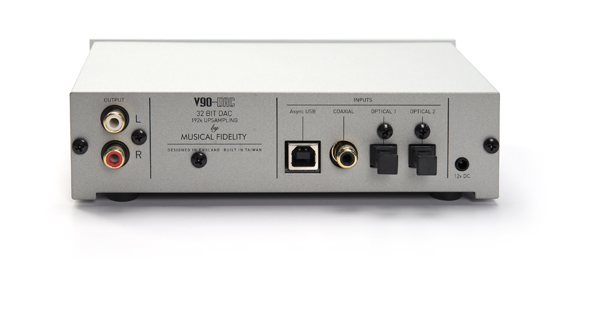
Though I didn’t concentrate a ton on the MiND setup, I did stream a lot of files from my Sooloos Control 15 and Aurender S10 servers, with fantastic results.  While so much emphasis is put on the reproduction of high-resolution files (with good reason), what impressed me the most about the 380D is the stunning job it does with well recorded 16/44.1 files.  Let’s face it, if you have a massive music collection, I’m guessing that the majority of it is ripped at CD resolution.  And while tip-top high res performance is important, 16/44.1 performance is paramount, and this Simaudio DAC does not disappoint.  As a matter of fact, it delights.

One of the worst CDs I own has to be The Monkee’s Here and Now, The Best of the Monkees. Yet, through the Neo 380D, “Daydream Believer” makes a believer out of me.  Moving along to KISS Alive!, the same thing happens, I’m drawn into the music and my Japanese pressing of this rock classic sounds pretty damn good.  While the worst files in my collection sound great, the great ones sound sublime, and that’s what really turns my crank about the Simaudio Neo 380D.  Adding the MiND on board, just makes it so much easier to integrate your digital files into the mix, not having to add a digital cable, power cord, or take up more valuable shelf space.

This mix of sound, function and style, backed by a manufacturer known for high build quality means exceptional value, and we have awarded Sim thusly, with one of our 2014 Exceptional Value Awards.  -Jeff Dorgay

Simaudio Neo 380D

MSRP: $4400,  $6200 as tested.

www.simaudio.com

PERIPHERALS

Amplifier Audio Research VS55
Preamplifier Audio Research SP16L    CIAudio PLC-1 MkII
DAC/Streamer Marantz NA-11S1    Squeezebox Touch
Speakers Thiel CS2.4    KEF R700
Cables Stager Silver Solids    Darwin    Transparent    Acoustic Zen
Accessories Audience aDeptResponse ar6    Shakti Stone    Symposium Acoustics   Rollerblock Jr.

Rogers PA-1A Phono Preamplifier

Last year, we had a ton of fun listening to the Rogers EHF-200 MK2 integrated amplifier, which combines high-tech design, tubey goodness, and old-school American build quality. And it comes at a price commensurate with its components and performance.

Roger Gibboni’s newest creation is a phonostage that takes his design ethos a step further. While it’s no small feat to produce a great amplifier, the minute signal that a phonostage has to work with is a challenge for any designer. And the Rogers PA-1A exceeds all of my expectations in terms of sound quality and the absence of noise.

Immediately Great

The PA-1A has me pinned to the listening chair from the first track of MoFi’s recent remaster of Los Lobos’ Kiko. Insert your favorite adjective here, and maybe add very in front of it. In short, if you don’t need more than one MC phono input, your search ends here. It’s that good—and it’s only $7,400.

Having lived with the $65,000 Indigo Qualia and the $55,000 Vitus phonostages, I admit that you don’t need to spend anywhere near that much money to achieve analog nirvana.  We’ve been through a pile of excellent phonostages from Audio Research, Pass, Simaudio, Naim and Burmester, to name a few. As great as these all have been (and the Burmester, Pass and ARC all offer two inputs, a definite advantage for those with multiple tables or tonearms), the Rogers raises the game for what is possible without taking a second mortgage on your house.

To look at it another way, for the $60K that one of those top-of-the-mountain phonostages will set you back, you can pick your favorite $30K turntable/tonearm combination, a great $10K cartridge and the Rogers for $7,400.  That still leaves a lot of cash left over to add some great records to your collection.

Of course, $7,400 is not pocket change, but for someone taking a run at a state-of-the-art analog front end, this is incredibly reasonable. It’s like getting a tricked-out Porsche GT3 for the price of a Boxster. I knew I was in for something good when discussing the Rogers with Harry Weisfeld of VPI; we share a similar aural aesthetic and Harry knows great analog when he hears it. Plus, we both have a similar amount of respect for the Lyra Atlas cartridge, which we both use as a reference transducer. Bottom line, when Harry is excited about something, my ears perk up.

I was not disappointed in the least when firing up the PA-1A for the first time. The review sample had been burned in for a while at the factory, so I did not notice much of a change in its sonic character during the review period.

Wow, Wow and More Wow

What puts the PA-1A in the world-class neighborhood is the ease with which it paints the sonic landscape. Spinning the new MoFi 45 RPM two-record set of the self-titled Rickie Lee Jones album is spectacular. While a certain amount of kudos go to MoFi for producing the quintessential copy of this classic, playback comes alive through the Rogers and in the space between the Dynaudio Evidence Platinum speakers—themselves masters of pinpoint-imaging performance. This is the quality I noticed most with the Vitus and Qualia stages: the way they allow the music to swell and diminish with such seamless tonal gradation, and the Rogers does the same. It’s analog at its finest.

Moving up tempo to Laurie Anderson’s Big Science, I find the level of micro detail revealed to be amazing. The little percussion and synthesizer bits that are slightly obscured via my Audio Research REF Phono 2 SE now float around the speakers, whereas they all lined up on one flat plane before. Anderson’s voice has more body and her quirky vocal inflections are now more pronounced than before, while at the same time the main synthesizer line is firmly locked in place. Fans of pace, rhythm and timing will freak out at the massive picture painted.

Again, the word ease just keeps popping into my consciousness. If you’ve ever had the chance to drive the Z06 and standard versions of Chevrolet’s Corvette, you know what I’m talking about. Both cars effortlessly cruise along at 100 mph and lunge with nearly equal enthusiasm when you put the pedal down, but that extra horsepower offered by the Z06 makes the experience of speed surreal, where the standard car is still working a bit to go from 100 to 150 mph.

No matter how much great tribute bands try to cover Led Zeppelin, they just can’t recreate the nuance, sonic complexity, or the sheer texture with which Jimmy Page plays, even though the correct notes are often hit. This is the final piece of the analog puzzle that the Rogers unequivocally nails. The reverse tracks on the Beatles’ Magical Mystery Tour are sublime, almost dilating in the way they separate from the rest of the mix. The bell in “Penny Lane” is not only correct in terms of timbre, but the width and height information is so stunningly reproduced that it feels like there’s an actual fire truck in the room ringing its bell.

Three Flavors

The PA-A1 uses three tubes per channel, a 6GH8, a 12AX7 and the final gain stage uses either a 12AX7 or 12AU7. Rogers supplies both so you can adjust the gain to your taste. With the 12AU7, the PA-A1 has 58 dB of gain, which will be more than enough for MC cartridges having an output of around 0.5 mV. The 12AX7 provides about 10 dB more gain, but it’s slightly noisier, so it is a tradeoff.

Don’t hang too much on the ultimate gain figures, though; take total system gain into consideration before dismissing 58 dB as “not enough gain.” When using the Robert Koda K-10 preamplifier and the ARC REF 5 SE—which both feature 6 dB gain via the single-ended inputs (the PA-1A is a single-ended design)—I find myself cranking the volume a bit higher than I would normally with the ARC REF Phono 2 SE, but both of these linestages have a very low noise floor. The Burmester and CJ linestages at my disposal have 18 and 21 dB of gain, respectively, so the PA-1A’s 58 dB is enough even with low-output MC cartridges.

However, there is a Goldilocks solution. That second tube can be substituted for the NOS 12AV7, which offers a bit more gain than the 12AU7 and a lower noise floor. “The 12AV7 is a great tube,” says Gibboni, “but I didn’t want to build a product around tubes that are not readily available. I can sell you a pair of 12AV7s for about $90 while my supply lasts.”

All three variations sound good, so those leaning more towards the OCD side of the fence will probably be driven to madness trying to decide on the ultimate choice for that third tube. The 12AU7 proves excellent as a daily driver, and the 12AV7 is very intriguing in my system, offering a touch more top-end extension. The Clearaudio Goldfinger is a perfect partner for the 12AV7, while I prefer the stock 12AU7 with the Lyra Atlas. The slightly forward Lyra Titan i pairs well with the 12AX7’s warmer sound, especially when swapped for a pair of NOS Telefunkens. Crazy good fun I say, but it is nice that analog aficionados can really fine-tune the sound exactly to their liking. Gibboni says you can probably expect that the tubes will last 5,000 to 10,000 hours with this phonostage, so try and settle on something you like, and buy a second set!

Good with MM too

While the PA-1A technically has one input, if you were using a second table with a moving-magnet cartridge, you could plug two tables into the PA-1A—which is exactly what I do. Going vintage with the Thorens TD-124 turntable, SME 3009 tonearm and Ortofon 2M Black provides an excellent alternative to my reference table.

Thanks to front-panel loading and capacitance adjustments, it’s a snap to dial your favorite MM cartridge to your liking. The heavier presentation of the vintage Thorens is a natural for the tubey goodness of the PA-1A. Tracking through a number of the current Blue Note remasters from Music Matters Jazz is wonderful.

Though the Atlas provides a clearer picture, the Thorens/Ortofon combination is warmer, with perhaps even a bit more jump on these jazz classics. Horns have a little more attack and cymbals linger a bit more and have more smokiness—not necessarily correct, but a ton of fun. It’s a great option to have, whether you decide to use that second table as a tone control, or just an option to save wear and tear on your megabucks cartridge.

Very Enthusiastically Suggested

We’re keeping the PA-1A here as a permanent reference component to run through its paces even further. We’ll report back in a year, with a long-term follow-up once we’ve had time to do a little more tube rolling and try some additional cartridges. It should be a great journey.

As high-end audio continues to get higher priced, it is refreshing to find a company that is offering world-class sonics and state-of-the-art build quality at a reasonable price. Every Rogers component is built by hand, lovingly packaged, and even includes a nice card from the person who built it. The Rogers PA-1A is a great reminder that quality manufacturing is not dead in America.  –Jeff Dorgay

Rogers PA-1A Phonostage

MSRP: $7,400

www.rogershighfidelity.com

PERIPHERALS

Turntables AVID Acutus REF SP    TriPlanar arm    Thorens TD-124    SME 3009 arm   SME 10   SME V arm
Cartridges Clearaudio Goldfinger    Lyra Atlas    Lyra Titan i    Lyra Kleos    Ortofon SPU   Ortofon 2M Black    Dynavector 17D3    Grado Statement 1
Preamplifiers Burmester 011    ARC REF 5 SE    Robert Koda K-10
Power Amplifier Pass Labs Xs300 monoblocks
Speakers Dynaudio Evidence Platinum
Power IsoTek Super Titan

Ortofon Cadenza Bronze

Spinning Anya Garbarek’s Smiling and Waving on staffer Earle Blanton’s system, I’m blown away by how neutral, clean and airy Garbarek’s voice flows through his towering Magnepan 20.1s.  Why a remote review, you ask?   After purchasing[1] the cartridge for reference duty at TONE, Blanton took a real liking to the cart, and it never returned to the mothership.   But it’s a system I’m well familiar with:  Conrad Johnson ACT2/series 2, McCormack DNA-750s, an AVID Volvere SP and the luscious Mangnepans, beefed up on the bottom end with a pair of JL Audio 112 subwoofers.  It’s a killer system in a big room, making for a soundstage that’s slightly exaggerated, but oh so inviting.

Overall tonal balance on the system is smooth, fast and extended, so the Bronze is a perfect fit, mirroring the same characteristics.  The electronic effects on the Garbarek record float distinctly a few feet in front of the speakers, feeling much like something from a David Lynch movie, almost eerie in their effect, with Garbarek gently cooing in the background.

Next up, the MoFi copy of Aimee Mann’s Lost in Space. Again, this favorite puts Mann slightly left of center, but much larger than life, the massive 20.1s disappearing completely, and again, the fun ethereal background sounds now zooming past my head, feeling like I’m listening to a surround mix – but I’m not.  The distorted guitar at the beginning of “Guys Like Me” has just the right amount of texture and bite as multiple layers of Mann’s voice enter the mix.

The Cadenza Bronze excels at throwing a very deep, three-dimensional soundstage, with a generous helping of decay to further create the illusion that Ms. Mann is right here in the room with us.  Female vocals, check.

Moving on to some classic rock, the self-titled Santana gives the Cadenza Bronze a bit more of an obstacle course, mixing in Santana’s complex guitar work with a wide range of acoustic instruments and percussion.  Thanks to the extreme speed of this cartridge and its ability to start and stop cleanly and precisely, bongos sound like bongos, and the drums are locked solidly down.   As the drums pan back and forth during the intro to “Evil Ways,” all of the overdubbed vocals are easy to pick out of the mix, while the Hammond organ is well out on the periphery.  Often a great track to play while listening to headphones (especially if one is slightly herbally challenged) a similar, spacey, otherworldly experience is within your grasp with the Cadenza Bronze.

However, the parlor tricks are meaningless without accurate rendering of tone and timbre – another area in which the Cadenza Bronze excels.  The cymbals in the same Santana recording come across as neutral and correct, yet fade into nothing with an extremely fine tonal gradation.  This is the analog magic at its best, my friends.  This recording also demonstrates the Cadenza Bronze’s ability to unravel a dense studio recording, revealing all of the buried treasure within, something that does not come easy to all MC cartridges.  The Cadenza Bronze can deliver the goods on heavy rock recordings.  A similar experience is achieved with this cartridge mounted on the SME 10/SME V tonearm combination; the Bronze is able to extract minute details at both loud and soft levels without the soundstage collapsing.  Impressive.

While many rely on female vocals to judge a component’s mettle, I submit that the male voice is often tougher to reproduce accurately because of the additional weight and increased range at times.  Sinatra’s reissues on MoFi provide an excellent obstacle course here, especially apparent when one observes the difference in recording quality between the title track on his Nice and Easy album and the second track, “That Old Feeling” – with the second track having more depth and body, Sinatra’s voice smoother than ever.

The piano and strings on this album are reproduced exquisitely. Swapping through a range of phonostages from the Monk Audio, all the way up to the $65k Qualia Indigo, (which the Ortofon mates with quite spectacularly, though perhaps a bit overkill) the sonic signature of the Cadenza Bronze remains constant.

Perhaps the only aspect of this cartridge that may be off-putting to some audiophiles is its lack of embellishment, one direction or the other.  It does not offer a lush midrange like the Grado Statement 1 (or Ortofon’s own SPU cartridge), nor does it render an overly detailed presentation like my Lyra Titan i.  The Cadenza Bronze is really a “just the facts, ma’am” transducer.  It neither romanticizes the presentation nor adds an artificially goosed high end, suggesting a false sense of resolution.  As one who sees the cartridge in an analog system as the ultimate tone control, the Cadenza Bronze will probably be more at home in a system somewhere between a neutral tonal balance and one that leans slightly to the warm, romantic side.

With a .4mv output, the Cadenza Bronze works well with any phonostage you might have on hand with about 60 – 65db of gain.  Of course it is a perfect match with my ARC REF Phono 2SE and the Simaudio MOON 810LP, yet we achieve equally good results with the Monk phonostage and even the Lehmann Black Cube currently under review.

The range of tracking force is 2.2 – 2.7 grams, with Ortofon suggesting 2.5 as optimal.  This proves perfect in the SME tonearms at my disposal, however 2.6 gram is the ticket in the Rega RP8.  As always, we suggest making small adjustments up and down from 2.5 grams to achieve the best balance of high frequency response and trackability.

Which leads to the final aspect of the Cadenza Bronze: in the true tradition of Ortofon MM cartridges, the MC Cadenza Bronze is a fantastic tracker, showing no signs of inner groove distortion, or an inability to handle highly complex musical passages.  This should be a delight to classical and heavy rock music users alike.

For $2,199, the Ortofon Cadenza Bronze is tough to beat.  Most other cartridges offering this level of performance, revealing this much music in such an unobtrusive way, tend to cost at least a thousand dollars more – hence our willingness to bestow one of our Exceptional Value Awards.   While not offering as much resolution as a few of our favorite cartridges with a five-figure price tag, the Cadenza Bronze gives you more than a peek into what the mega cartridges offer without an insane price tag.  I suggest an audition.  –-Jeff Dorgay

Ortofon Cadenza Bronze

$2,199

www.ortofon.com

Vandersteen 1Ci Loudspeakers

Listening to the Beatles’ “All You Need is Love,” I’m thinking that you also need a great hi-fi system. (And a cool car, but I digress.) Fortunately, a pair of Vandersteen 1Ci speakers and some decent electronics can be had for a reasonable cost, putting a great system in reach of just about anyone: $1,149 for a pair of full-range floorstanding speakers is a steal in today’s hi-fi world, where you could pay 10 times that for a pair of interconnects.

Vandersteen’s higher-priced Model 2 speaker is quite possibly high-end audio’s all-time most popular speaker, with almost 100,000 pairs sold. That’s a major achievement in the context of some of today’s speaker manufacturers, many of which haven’t even sold 1,000 pairs. And if the Model 2 isn’t the most popular, it certainly has the most longevity, having been produced since the late 1970s – now at 2CE Signature II status.

While the 2 has gotten much of the spotlight, I submit that the Model 1—now the 1Ci—is the way to roll for so many reasons, the main one being its 90-dB sensitivity. Sure, the 2’s three-way design delivers deeper bass, but the simplicity of a two-way speaker has always been highly appealing to me. And that extra 3 dB of efficiency makes a much wider range of amplification choices possible. Unlike another great American speaker, the Magnepan, the Vandersteen 1Ci comes alive with 25 to 35 watts of clean power, making it the perfect choice for the music lover on a modest budget.

What the 1Ci offers perhaps better than any other speaker at its price point is balance. Everyone at TONEAudio is convinced of the brilliance of the KEF LS50, and while that speaker delivers more holographic imaging and ultimately more resolution than the 1Ci can muster, it lacks on the bottom-end, and requires a fairly powerful amplifier to deliver its best performance. For someone listening in a smaller room, or a closer field situation, the diminutive Brit speaker is still the one to beat on a tight budget, but if you have a larger room or prefer a fuller-spectrum frequency response, the 1Ci is the ticket.

Best of all, the 1Ci is resolving enough to make it easy to discern amplifier differences, so if you fall in love with a pair early in your system’s history, they will probably be the last component you upgrade. I know more than one audiophile who has progressed from the Model 1 all the way up to Model 5, as well as a few using 1C’s with some fairly expensive electronics.

Cliché but True

If there was ever a speaker that fit the definition of “greater than the sum of its parts,” the Vandersteen 1Ci is it. Richard Vandersteen has always believed in putting the money into high-quality drivers and crossover components rather than the cabinetry. Back in the late ’70s when Vandersteen hit the scene, his approach was revolutionary. Where so many of the major manufacturers were putting so much money into speaker cabinets, Vandersteen took a performance-first approach with the Model 1 and 2, concentrating on the internals, with a first-order crossover, minimum front baffle, and time-aligned design.

The results are stunning, and while other speakers have come in and out of fashion, Vandersteen audio keeps making solid, musically accurate speakers that don’t break the bank. The 1Ci features improvements to the dome tweeter and crossover network, along with eliminating the banana jacks on the rear panel, now using the same screw terminals as those featured on the Model 2. Interestingly, these terminals connect directly to the crossover network, eliminating the need to use premium wire—again, simplicity rules the day. While a tweeter contour (level) control is provided, the speakers perform best in the middle position in all three of my listening rooms. Should you need to slightly modify the tweeter output level, the control offers a 2-dB boost or cut, which is highly effective.

The Rake is the Key

To the company’s credit, Vandersteen provides one of the best instruction manuals in the industry. It takes even a complete novice through the finer points of speaker setup. Starting with the “thirds” method that has always served me well with Vandersteens over the years, I have the 1Ci speakers singing in my 11-by-13-foot room in no time at all, with just a few fine adjustments.

Vandersteen speakers have occasionally received a bad rap on various Internet forums for being “slow and dark” sounding. If this has been your experience with any Vandersteen speakers, it’s because they were improperly set up. Because of the speakers’ time alignment, getting the proper rake angle is critical. Every pair of MartinLogan speakers I’ve owned requires the same care. Get it right, and the speakers disappear in the room. Get it wrong and everything sounds a bit muffled—much like when you finally nail proper VTA with your phono cartridge.

Again, the manual gives you the perfect method to optimize this, and Vandersteen has done the work for you. Follow the guidelines in the manual, starting with its suggestions, and then alter the rake ever so slightly to fine tune. (and I’m talking less than an inch here) Having a friend help you will make the process go much quicker, and it is critical that you match the angle as closely as you can on each speaker. Five extra minutes spent here will reward you with a larger stereo image and an airier, more extended treble.

Richard Vandersteen is quick to point out that with some other speakers, adjusting the rake angle will tame a hot tweeter, but it is critical with his speakers to follow the setup parameters as the listening height and distance from speaker to listener coalesce for flat frequency response, at the specified point.

How Do You Want to Play?

These speakers totally rock, providing a high level of musical involvement. Regardless of the amplifier you choose, the 1Ci speakers throw a big and well-defined soundstage into the listening room. Thanks to the speakers’ natural character, your choice of amplification will let you easily tailor the sound to your liking.

I use four different amplification setups during of this review: A new old-stock Sansui 771 vintage solid-state receiver ($299); the Rega Brio-R solid-state integrated amplifier ($995, our 2010 Product of the Year); a factory-refurbished Conrad-Johnson MV50 vacuum tube power amplifier and matching PV-12 vacuum tube preamplifer (about $2,500 the pair); and the Devialet 110 DAC/streamer/integrated ($6,400).

The 1Ci speakers not only work flawlessly with each combination, they also easily resolve the nuances between each amplification type. If you prefer things more on the warm and romantic side, the easy load that these speakers present is a perfect match for your favorite tube amplifier. Even my 25-watt 845 SET monoblocks drive the Vandersteens with ease, offering an enveloping sound that, while the least accurate of anything else in my arsenal, proves highly seductive.

Spinning some vintage and remastered Blue Note selections is pure heaven. Drums explode from the 1Ci speakers, with a soundstage that not only feels beyond the speaker boundaries, but also beyond the boundaries of my modest listening room. Listening to acoustic instruments and, of course, solo vocals through vacuum-tube electronics and the 1Ci speakers easily convinces non-audiophile and audiophile alike that these speakers are indeed something special.

With 110 watts per channel of hybrid power, the Devialet 110 offers presentation that is 180-degrees different from those of the SET monoblocks. While the Devialet renders a more accurate presentation, the sheer grip of its Class-A/Class-D hybrid design provides a major low-frequency extension and control that the vacuum tubes cannot. Mickey Hart’s “The Eliminators” is full and deep, with forceful bass notes that punch you in the stomach—and the 1Ci speakers capture this wonderfully with the Devialet. Kraftwerk’s classic “Autobahn” also brings a big thumbs up from an informal listening panel, who are all amazed what could be accomplished with such a modestly priced yet well-executed speaker system.

No Wrong Moves

Stereophile once said about the Model 2 that “the only sins this speaker commits are ones of omission,” and 20-plus years later, the same description applies to the 1Ci. It offers a highly neutral tonal balance, wide dynamic range and a full frequency response—for $1,200 a pair! They nail the musical fundamentals better than some speakers I’ve heard that cost 20 times as much.

After living with the 1Ci speakers for a couple of months, I’m buying them—they are a fantastic reference for what can be accomplished on a tight budget. And they’re great speakers to use as a building block when auditioning ancillary components in the $1,000-to-$3,000 range.

We are very pleased to award the Vandersteen 1Ci one of our Exceptional Value Awards for 2014. These speakers are so enjoyable that, if your high-end journey stopped right here, you’d be a pretty happy human being. Even if you are a highly experienced audiophile and you haven’t heard these, you owe it to yourself to check them out. I guarantee you’ll be very surprised for the better. They redefine what is possible for a modest price.

The Vandersteen 1Ci speaker

$1,149/pair

www.vandersteen.com

PERIPHERALS:

Digital source Meridian MS200    AURALiC Vega DAC
Analog source AVID Ingenium TT    SME 309 arm    Lyra Delos cartridge
Phono stage ARC PH8
Cable Cardas Clear

Threshold CAS 2 Power Amplifier

Nelson Pass has never been one to hang his hat on just one type of amplifier topology.  During his time at Threshold, Pass Labs and First Watt, he always pushes the envelope in what can be achieved in solid state amplification.  He was one of the first to popularize Class A amplifiers in the 1970s when most manufacturers were striving for massive power output, and the Threshold 400A and 800A were landmark designs.  The Stasis amplifiers that followed, sought to satisfy those wanting higher power output while retaining the musical qualities of Class A.  I have many a fond memory of listening to Stasis amplifiers on the high end speakers of the late ‘70s and early ‘80s.

Pass continued his quest for better and better solid state sound when he formed Pass Labs.  The early Aleph models with their odd but functional cosmetics have stood the test of time well with their glorious sound quality – and they are still highly coveted.  At this year’s Consumer Electronics Show Pass pushed further with the introduction of a pair of extremely limited edition Vfet amps which were shown in the SONY suite.  I’m not the only one who remembers how impressive SONY and Yamaha Vfet amps sounded when they were first introduced and these were glorious.

The subject of this article is one of Nelson’s lesser-known models, the CAS 2.  This amp was manufactured along side some of the Threshold Class A and STASIS models from 1979 to 1981.  It came to be manufactured as the result of a white paper that Pass wrote about cascode circuit design. This design seeks to offer similar results to pure Class A operation but without the high cost of such designs. In essence it seeks to achieve a lack of signal compression by eliminating nonlinearities in the power transistors due to voltage changes in the circuit.  The result gives one very low distortion and very wide bandwidth. I guess one could refer to this circuit topology as a “proto” Stasis design.  In its day, this was the amp to buy if you couldn’t afford a 400A.

The technical highlights of the CAS 2 are as follows:  full dual mono design, twelve high-speed output devices per channel, stout power supply and high current capability.  It delivers 125 watts per channel and rated distortion is a mere 0.03%. Weighing in at a hefty 28 pounds, the CAS 2 is relatively compact and it features the double row of LED power output indicators, which you will either love or hate.  Our publisher and I have been arguing this over many a pint since the day these amplifiers were introduced – he loves em, I hate em.

Jay Leno says “you don’t find the cars, the cars find you.”  And so it goes with vintage hifi equipment. I came by this example almost by accident and for a very low price. It was a bit rough around the edges and obviously had never been cleaned or serviced.  Nevertheless, I put it into the system to find out what I had stumbled upon. After a requisite warm-up I soon got what the fuss is about. It produces a big sound stage with a fair degree of transparency.  I did detect a bit of haze in the treble region and a some roughness in the bass region but my suspicions were that after thirty plus years since being manufactured, some parts were probably past their prime. Excited with the first listen, I immediately shipped it to Jon Soderberg of Vintage Amp Repair in Citrus Heights, CA.  Soderberg has a reputation for working wonders on old Threshold amps,  and indeed he worked wonders on this one. In addition to the usual replacement of all capacitors and output devices, we did a bit of tweaking and upgrading in the form of Cardas billet copper speaker binding posts, Cardas rca connectors and Audience pcocc internal wiring. While he had the hood up I all but the 0dB and above LEDs which now only indicate the onset of clipping. In addition, I did some chassis and casework damping.  Our publisher gave out a heavy sigh when I told him of this during the photo session.

I was pleasantly surprised returning the CAS 2 back into the system. The soundstage and transparency that I mentioned earlier were enhanced even further, the treble haze was gone, replaced by a pristine even-handed quality. The lower register was equally satisfying: the roughness in the bass region had been replaced by detail and grip.  I let it burn in for a week before I did any critical listening.

As I did listen, it became increasingly obvious that this amplifier is something special. No matter what I threw at it, it never put a foot wrong nor was it completely overshadowed by some serious competition on hand. My reference Coda S-100 and the Burmester 911 on loan from the mother ship provided different sonic flavors and bettered the CAS 2 in some areas. The Coda exhibits a sweeter mid treble and has a slight edge in the air around instruments. The Burmester is warmer in overall character and has more control in the mid bass area. However, while listening to the Threshold, I never felt compelled to substitute one of the other amps, I merely appreciated it for what it could do.

Since the soundstage was so big, I tried a lot of big music. First up was Rachmaninoff Symphonic Dances (Eiji Oue, Minnesota Orchestra, Reference Recordings).  The massed string sounds were sinewy and muscular while horn sections were presented with authority.  Similarly, Mephisto & Co. (Same conductor orchestra and label) with its multiple crescendos provided that orchestral wallop which can cause some amps to fall apart. Not so the Threshold even though I managed to light the clipping indicators a few times. The CAS 2 never sounded strained or out of control.

Moving on to a pop vein, I tried Prince’s N.E.W.S (NPG). The punishing horn inflected funk on fourteen minutes of “South” gave the CAS 2 a workout but it plumbed the bottom with forceful abandon.  This managed to get the CAS 2 fairly warm, but never hot, a testament to its fundamental design.  And while we were getting funky, Liquid Soul’s “Sure Fire One” from the album Here’s The Deal (Shanadie) with its polyrhythmic blend of rock, soul, rap and funk made my whole household want to get up and party.

Jazz recordings sounded equally fine with the Threshold in the system.  On McCoy Tyner’s  “Three Flowers” from the album Today And Tomorrow (Impulse!)

Tyner’s piano sounded crisp and clean while the cymbal work of Elvin Jones either shimmered with delicacy or splashed with force.  On “Root Down ( and Get It )” from Jimmy Smith’s Jimmy Smith Live! Root Down the Hammond B3 sound is unmistakable and the attack of Buck Clarke’s conga set is fast, meaty and percussive.

I feel lucky at having acquired this amp.  I didn’t know what to expect from it but now that it’s in fine fettle, I’m keeping it. For the mere $1,200 invested, it can stand in at a moment’s notice when I want to hear something a bit different from the system. Moreover, the basic design is such that it’ll probably last another thirty years or so.  In an era of near class D preeminence, good old fashioned heavy metal amps certainly have their place, especially ones with ground breaking design parameters. This model along with the CAS 1 (featuring 75 w/ch ) are out there but a bit hard to find.  If you’re looking for innovation from the past, look no further.  Now to find a Pass-designed preamp to go with it.  — Jerold O’Brien

Resources:  www.vintageamprepair.net https://passlabs.com/articles/cascode-amp-design