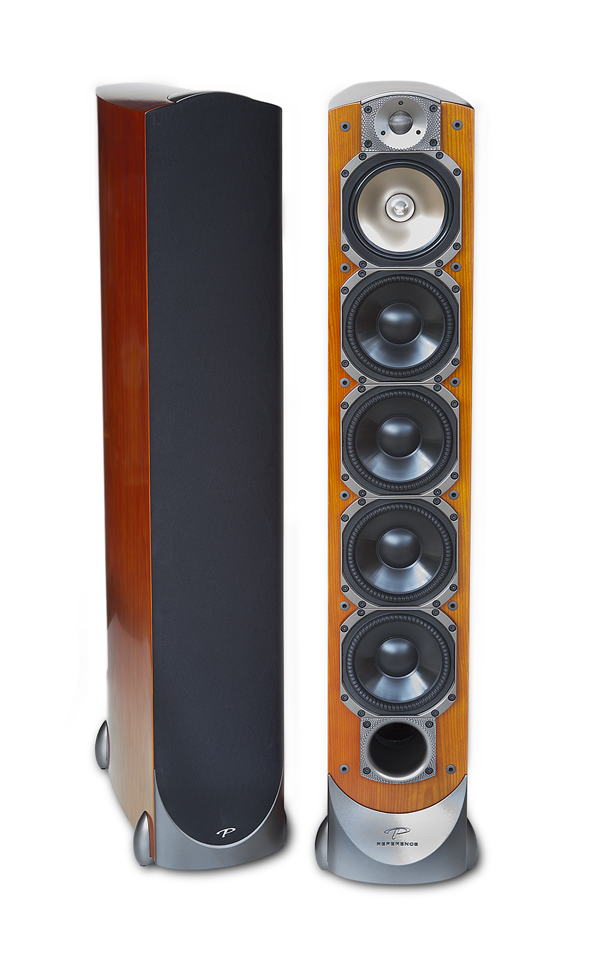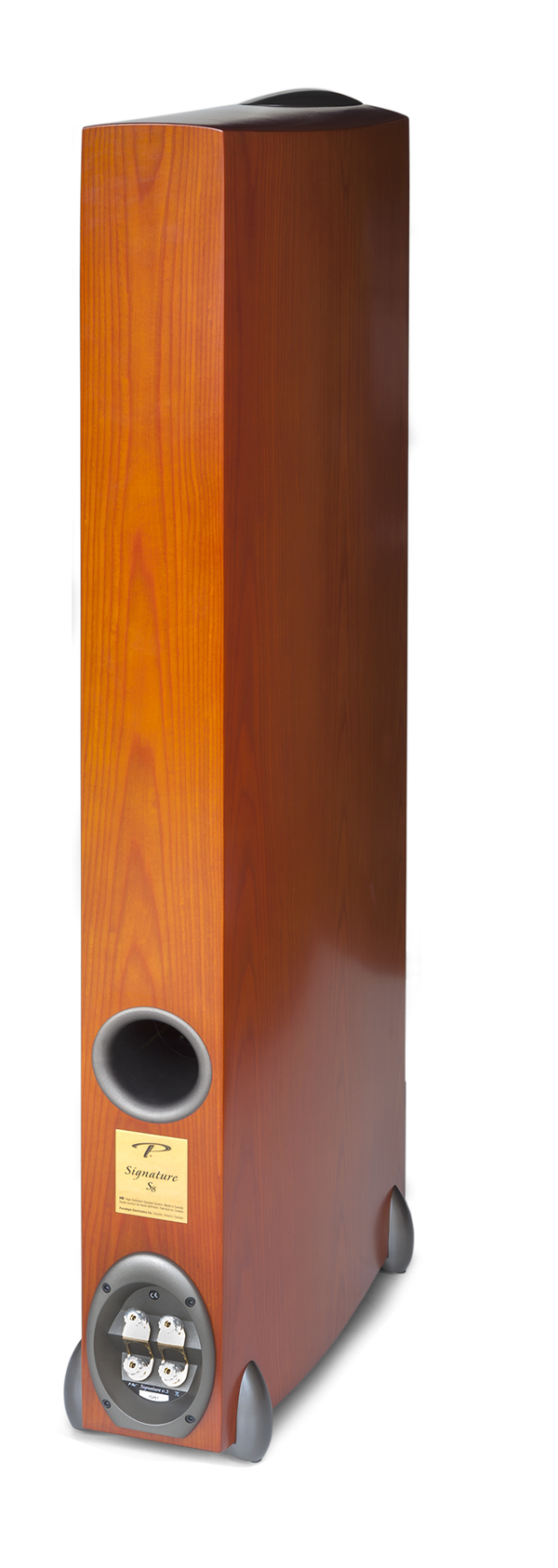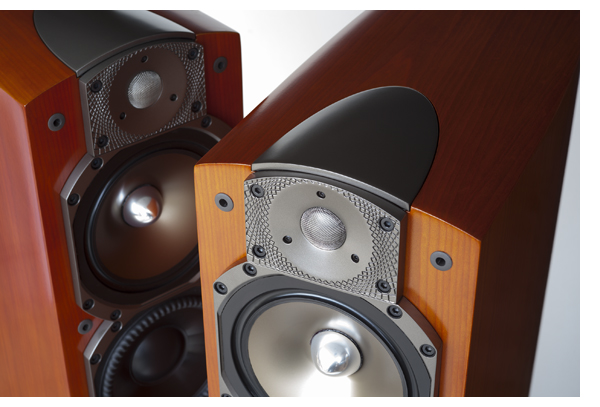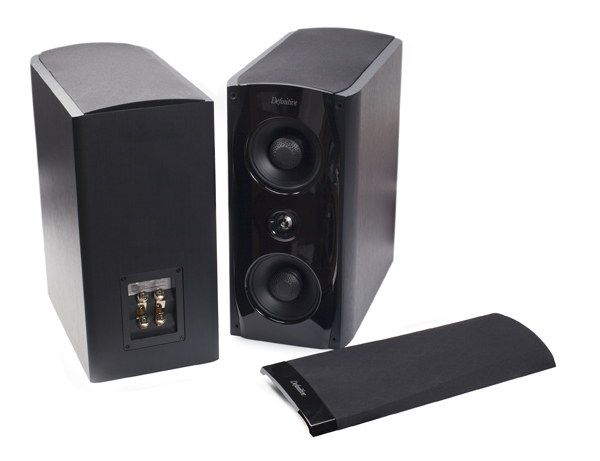





Totem Acoustic Mani-2 Signature Speakers

If you believe that it’s possible for good things to come in small packages, then mini-monitors are right up your alley.  These little fellas warm the hearts and ears of space-constrained audiophiles everywhere.  Besides having room-friendly sizes, mini-monitors simply disappear once you toss in decent amplifiers, cables and stands.  Montreal’s Totem Acoustics has been building great compact loudspeakers for two decades.  CEO Vince Bruzzese seems to have applied Native American spirits, or some such supernatural force, to his speakers, which should not come as a surprise to the Totem true believers who have always known that Bruzzese and company were on to something.  I bought my first-edition Mani-2s in 1996 and they have graced my smaller listening room ever since.  More than a decade later, Totem has completely rethought this speaker, with the new Signature version.

House Spirits

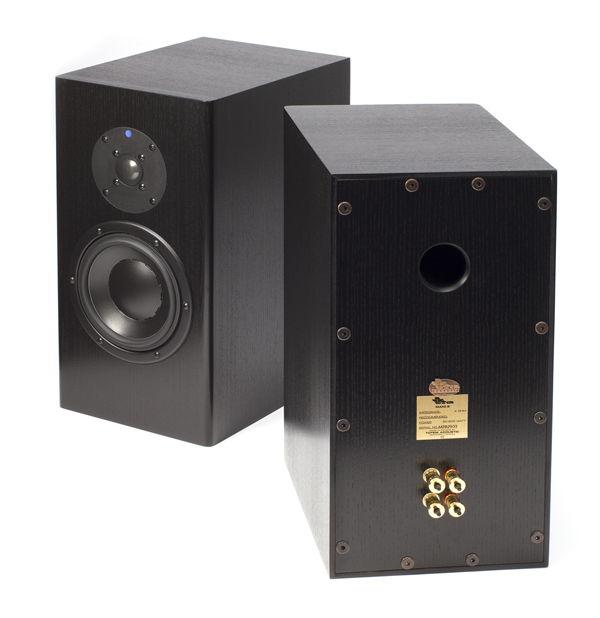
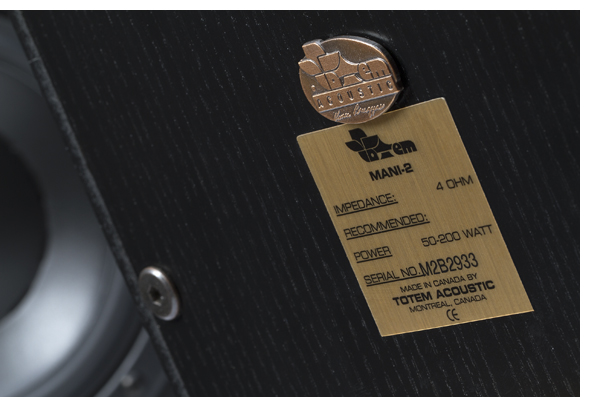
The exteriors of the Sigs resemble those of their predecessors, but these speakers are all new on the inside, from internal bracing to crossovers and drivers.  There are two new distinctive aesthetic features: a little blue dot above the tweeter and a plaque on the rear.  Similar to the original Mani-2s, these are 4-ohm speakers that measure 16.4 inches tall, 8.5 inches wide and 12 inches deep, and they weigh 23 pounds apiece.

Each speaker features a 1-inch aluminum tweeter and two 6.5-inch woofers in an Isobarik formation—meaning that one driver faces into the cabinet and the other faces the outside world.  Each rear panel is ported and has two sets of terminals for bi-wiring.  Totem offers an optional grille, but the company openly prefers that you listen to the Sigs in their birthday suits.

After easing the Blu Tack off of my Mani-2 originals, I place the new speakers on the same lead-filled Target stands.  My room dimensions being on the small side (15 by 10 by 8 feet), I locate the speakers 3 feet from the short wall and 2 feet from the sidewalls, with 5 feet of space between each speaker.  My listening distance was 8 feet.  As the sensitivity of the Sigs is relatively low (85 dB), Totem recommends amplifiers for them that can crank out at least 40 watts per channel.  Advice notwithstanding, I have zero trouble driving them to satisfactorily clean listening levels with two different integrated amps, rated at 30 and 35 watts.
Man, Oh Mani-2

Totem suggests a minimum 200-hour break-in period and I willingly comply.  Two relatively low-powered integrated amplifiers, the PrimaLuna Premium Prologue (35 wpc) and the Pass Labs INT-30A (30 wpc) provide the juice.  A PS Audio PerfectWave Transport with MKII DAC and a Logitech Squeezebox Touch, armed with a USB drive, serve up the music.  Since extended low bass was an original Mani-2 “calling card,” I go straight to Patricia Barber’s “Constantinople” from Modern Cool (Premonition Records).  Midway through this jam session, Michael Arnopol cuts loose on his acoustic bass in jazzy yet articulate fashion.  The Sigs give a true-to-form account of this solo, right down to the resonances of the bass’s soundboard.  Continuing the low-frequency session, I go to the Pipes Rhode Island CD (Riago) for Stephen Martorella’s masterful handling of the Widor Adagio.  The low pedals on this piece prove little problem for the Sigs, whose little woofers move considerable air in my listening room.

From my perspective, voice reproduction separates loudspeaker contenders from pretenders, so I toss the Sigs Tony Bennett, in an XRCD2 remastering of The Tony Bennett Bill Evans Album (JVC).  Bennett’s slightly raspy voice has a remarkable way of drawing you into each song.  One listen to “Some Other Time” reassures me that the Sigs can really do vocals.  To add more fuel to this fire, I play Isaac Freeman and the Blueblood’s “Beautiful Stars” (Lost Highway Records).  Freeman’s deep-bass vocals resonate like the voice of God, a quality captured by the Sigs, minus the mid-range coloration often found from small speakers.

Ultimately, speakers get their cardio workouts from large-scale orchestral works.  I administer this last treadmill test with a 24-bit/96-kHz download of Stravinsky’s Firebird Suite turned in by Japanese conductor Eiji Oue and the Minnesota Orchestra (Reference Recordings).  This piece’s no-holds-barred finale has all the forces wailing away at fortissimo levels.  The next best thing to the players actually leading a frontal assault into my room is having the Sigs give me a good wallop, and they do so without a hint of strain.
The Ancestral Voices Have Spoken

In the past decade and a half following the arrival of my original pair of Mani-2s, there have been three Washington administrations, two foreign wars, and, in case you missed it, a massive market tanking.  Surprisingly, the high-end audio industry has managed to rock on.  Some companies, like Totem Acoustic, have actually flourished and expanded their loudspeaker lines.  Each generation of Totem speakers has drawn from the wisdom of its ancestors.  This makes the company’s decision to issue a second Mani-2 generation an interesting one, since many of the newer Totem speakers have been larger floorstanders.

Comparing the Sigs to their forebears shows how much the Totem design team has invested in product reinvention.  The sonic strengths of the originals, such as good imaging and bass extension, have been further improved.  The soundstage is noticeably broader, deeper and taller.  The bass is better articulated, while highs sound more natural, courtesy of the new tweeter.  Most importantly, midrange clarity, not a strength of the original Mani-2s, is dramatically better.

Midway through my review, I noted that Totem offers an accessory that, for obvious visual reasons, is called the “Beak.”  This is a custom-milled 2-inch-high aluminum cone with “micro-ribs.”  According to the product literature, Beaks are meant to “control parasitic vibrations that occur on top of a speaker cabinet.”  Totem further suggests that Beaks help produce better imaging and high-frequency performance.  They can be placed atop each enclosure, either singly or in pairs.

While I am not a big-time tweaker, I did experiment with these curious devices.  Having the Beaks on and diagonally aligned from front to back produced smoother highs and a more coherent soundstage—maybe not to a shattering degree, since the Sigs are already so good, but the result was certainly noticeable and could be reproduced on repeated listenings.

Conclusions: Is the Mani-2 for you?

So what does $5,295 (plus an additional $300 to $400 for high-quality speaker stands) get you?  It won’t get you the huge soundstage of large panels or the subterranean bass of a separate subwoofer.  It will get you compact speakers that fit easily into most listening rooms.  It will get you intensely musical sound from all the sources at your disposal.  As a bonus, you will not need monster amps to drive these guys.  In a modest-sized listening room with two integrated amps, each rated at less than 40 watts per side, I got great sound aplenty from the Sigs, although their bass response seemed slightly plumper with the Pass than the PrimaLuna.

The jungle of $5,000-plus speakers is the natural habitat for many species of widely differing designs.  Most speakers in this price range will provide pleasurable listening if mated with proper electronics, cables and, most critically, a room with the appropriate dimensions.  When it comes to getting the most sound in a modest-sized room, the Mani-2 Sigs will give you just about as much as you can hope for in terms of imaging, smooth highs, clear mids and extended bass that has to be heard to be believed.  If this is not enough to sell you, you should note that my 15-year-old Mani-2s, while clearly bettered by the Sigs, still sound pretty darn good (i.e. I’m not throwing them away), which is a testimony to the build quality of Totem speakers.

Totem Acoustic Mani-2 Signature Speaker

MSRP: $5,295 (USD)

www.totemacoustic.com

Peripherals

Digital Source Logitech Squeezebox Touch    PS Audio PerfectWave Transport and DAC MKII
Integrated Amplifier Pass Labs INT-30A    PrimaLuna Prologue Premium
Power Conditioner Running Springs Audio Elgar\
Cables Nordost Valhalla and Frey
Power Cords Nordost Valhalla, Brahma and Vishnu

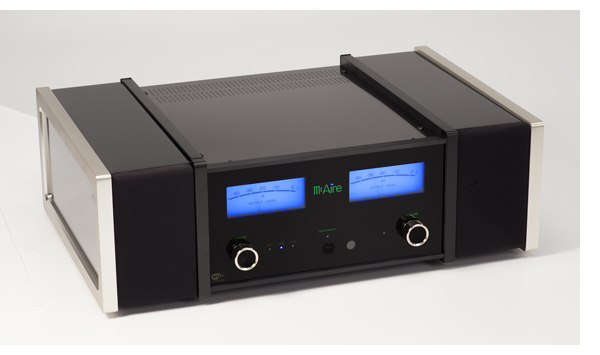
McIntosh McAire

As I unbox the new McAire wireless music system, from that other apple of my eye—the one in Binghamton, N.Y.—the similarities between it and something from the Apple of Cupertino, Calif., are uncanny.  Mixing old styles with new styles, the McAire’s outer packaging and quick-start guide look suspiciously West Coast, but I’ve opened enough McIntosh hi-fi gear to recognize the owner’s manual instantly—and this one is pure McIntosh Labs.

A few years ago, with its F80, British manufacturer Meridian broke the price barrier for a high-performance compact audio system.  Now a serious American brand offers an alternative to the Bose Wave radio, and the McAire is equally as intriguing as the F80, both in terms of performance and aesthetics.

McIntosh’s Ron Cornelius says, “It’s expensive for a dock, but it’s a really affordable McIntosh system. The McAire retails for $3,000

It’s Heavy and It Rocks

While the McAire is an amazing wireless player for your iPhone, iPod or iPad, it’s so much more than that.  This 31-pound one-piece system features the same titanium tweeters and inverted-dome midrange drivers with NRT magnet structures found in the brand’s flagship XRT speakers.  In the McAire, McIntosh couples these to a pair of 5-inch slot-loaded woofers that produce formidable bass.  The system features Class-D amplification, but McIntosh doesn’t list a specification for power output.  Suffice it to say the McAire really rocks.

I begin the audition with “Who,” the lead track from the new David Byrne & St. Vincent album Love This Giant, which instantly establishes the bass response of the McAire.  The tabletop quakes, as the big, blue McIntosh meters swing merrily to the beat.  This thing fills the room with sound!

Next up: “Hail Bop,” from the self-titled Django Django album.  With so much spacey, synthesizer sounds, twangy guitars and ethereal harmonies, this track shows the McAire’s ability to set a gigantic soundfield—doing so on our art director’s desktop.  The sound is so big that she takes control of the remote to slow the pace down a bit, switching to some classic Michael Hedges.  The McAire proves equally adept with acoustic guitar, before we take a walk on the wild side with Marc Ribot’s Silent Movies, a record full of empty space, feedback and distortion.  I end the first of many listening duals with AC/DC’s “Rock ‘n’ Roll Damnation,” leaving everyone in the office impressed with the McAire.

Well Connected

The McAire is Apple-certified, so you can connect any iDevice via USB cable or wirelessly via AirPlay.  The initial setup is straightforward, requiring just your device and the small supplied remote.  The Ikea-like quick-start guide walks you through the process in a few minutes.  Those not wanting to have their device floating around on the tabletop, or in their pocket, can take advantage of the McIntosh ST-1 stand (sold separately; $50), which fits any of Apple’s portable devices.

You can stream music to the McAire using your home’s Wi-Fi network and iTunes on your Mac or PC—but why bother when you can utilize the McIntosh app for your iPhone or iPad?  Using the app gives you similar functionality to iTunes, but turns the screen of your device into yet another McIntosh blue meter!  What could be cooler than that?

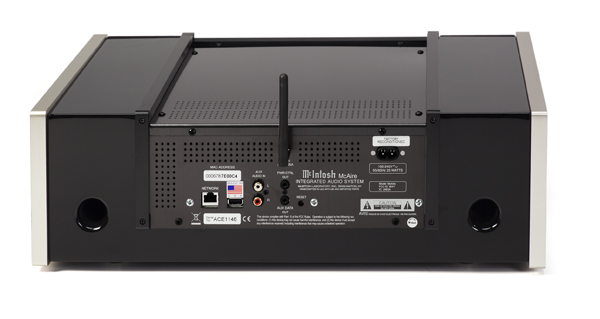
An auxiliary audio input on the back panel lets you get really wacky if you want, by connecting a turntable or other source unit to your McAire system.  We didn’t take things that far, but we did plug in a vintage McIntosh MR-71 FM tuner.  This requires a bit more shelf space, but the tube tuner is a nice addition to the system, if you’re listening to FM radio.

For seasoned McIntosh aficionados, or those discovering the brand for the first time, the McAire compact system is an excellent idea for adding high-performance audio to any room in the house.

McIntosh McAire

$3,000

www.mcintoshlabs.com

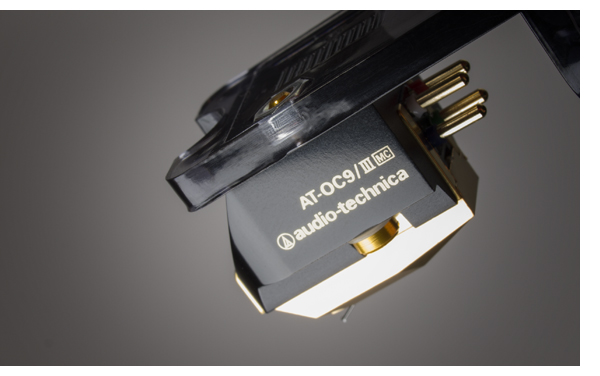
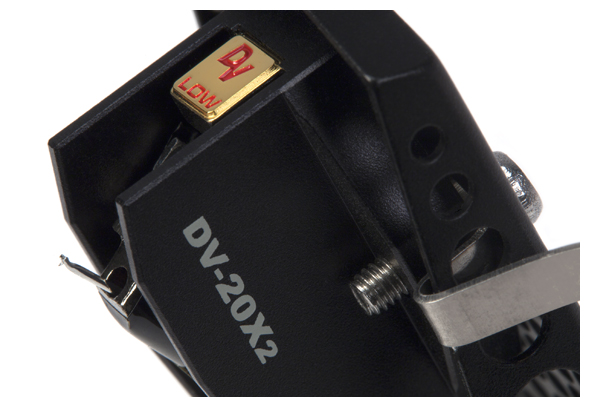
Audio Technica AT-OC9/III Phono Cartridge

Audio Technica celebrates its 50th anniversary this year, and part of its new-product lineup includes the brand’s reimagined flagship phono cartridge, the AT-OC9/III.  Audio Technica, founded in 1962, initially designed and produced phono cartridges for direct supply to original audio-equipment manufacturers within Japan.  Since then, Audio Technica has expanded its product line to include turntables, microphones, headphones and, as its website states, “other problem-solving audio devices.”  The first-generation AT-OC9 was launched in 1987.  Audio-Technica’s website lists the current retail price for the newest iteration as $1,129; however, a quick web search reveals street pricing around $799.

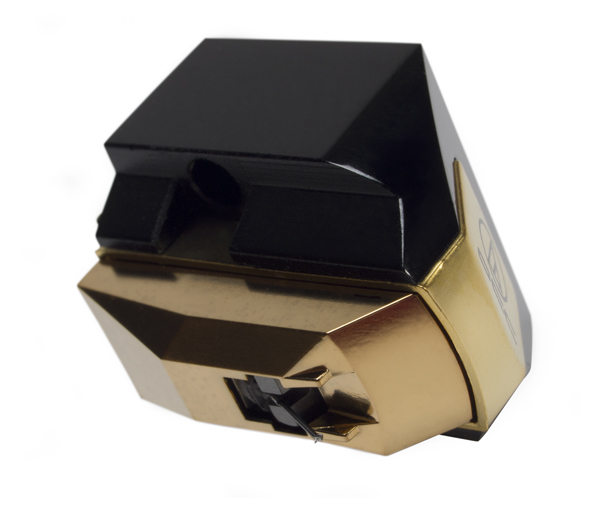
This cartridge arrives nicely packaged, but recipients should resist the temptation to just tear into the box, because the protective stylus guard is not in place during shipping.  The cartridge could be easily damaged if you aren’t careful.

Your MC Journey Begins

The OC9/III is the perfect cartridge with which to enter the world of moving coils, if you’ve got the interest and wherewithal to begin your journey by dropping nearly $1,200 on a cartridge.  It has a slightly low output (.4 mV) and will require a step-up device capable of around 60 dB to achieve the best balance of dynamics and low background noise.

Installation and mounting on the VPI Classic 3 proves very easy, with minimal time to optimize tracking parameters.  Audio Technica suggests a range of 1.8 to 2.2 grams and a minimum load impedance of 100 ohms.  Varying the tracking force in small increments reveals that 2.0 grams is the optimum balance on my table.  The handy remote on my Aesthetix Rhea phonostage also makes it easy to examine various loading and gain options, settling here on 250 ohms and 60 dB of gain.

The OC9 sounds good out of the box, but does open up slightly after about 30 to 50 hours are on the clock.  As with any cartridge, it’s an excellent idea to double check VTA and tracking-force settings as the suspension settles after the initial break-in process.  The Classic 3’s easily adjustable VTA has me back to perfection in no time, with only a slight touch up required.  If the cartridge sounds slightly dull from the outset, check this adjustment first.

Spin the Black Discs

The new Beatles Stereo Box Set on vinyl arrived shortly after the OC9, so plumbing the depths of Fab Four’s catalog with this new cartridge seemed a perfect place to start.  Beginning with Sgt. Pepper proves the new pressing to be a winner compared to the Capitol and Parlophone discs in my collection.  The OC9 immediately renders great bass dynamics and overall presence.  Controversy aside, switching back to my reference cartridge, the Lyra Atlas, confirms that the new pressings are excellent overall.

It also confirms that the OC9 has a tonal balance that is slightly on the warmer, more forgiving side of neutral, much like the AT33EV reviewed last year in TONEAudio.  The OC9 is not a bad idea for those collecting a lot of used records or listening to music produced in the mid ’90s and beyond, much of which is sourced from digital masters anyway.  In essence, the OC9 is an excellent daily driver, with a great balance of dynamics and detail retrieval.  If this cartridge is lacking anywhere, it might be in ultimate bass tautness and control, but this is more a personal preference than an overall judgment.

After most of the Beatles Stereo Box Set, Ryan Adams 2011 release Ashes and Fire clearly illustrates the performance of this cartridge with more modern material.  It is one of my favorite purchases from that year, more reminiscent of Whiskeytown and his first solo release, Heartbreakers, which is a more raw, gritty record.

The opening “Argument With David Rawlings Concerning Morrissey,” is a fun track, showing off how well the OC9 does with solo vocals in a BBC kind of way.  The first track on side B, “Invisible Riverside,” is a slow pop-rock tune that opens with guitar and is followed quickly by bass and drums—a perfect place to catch an emotional response when the stars line up.

This fleeting moment is captured quite well with the OC9, reproducing the essence without being too loose or overly analytical either.  This studio recording is also an excellent imaging demo and the OC9 has great focus, though the image portrayed does not extend well beyond the speakers, with the speakers themselves disappearing with a more refined cartridge.  But the OC9 takes good care of the fundamentals and is a great step up from the graininess usually present in the average MM cartridge in the $400-to-$600 range

Additional Listening

By Jeff Dorgay

Auditioning the OC9 on an identical VPI Classic and the VPI Traveler showed that this cartridge is perhaps best suited to rock and jazz.  I concur with Mr. Moyers that it is ever so slightly on the soft side, particularly with leading transient edges.  Piano and violins are pleasant with the OC9, but lack a little bit in terms of ultimate texture.

However, this is just what the doctor ordered when rocking out—be it Metallica, Slayer or Hendrix—making many of these recordings sound better than you remember them, especially for those utilizing the OC9 in a table like the Traveler, an RP6, a Pro-Ject or something similar.

Comparing 24-bit/192-kHz digital captures of the AT33EV I reviewed last year to captures made with the OC9 reveals the top AT cart having a similar natural tonality, but with more extension on both ends of the frequency spectrum.  There is definitely a “family sound” going on here.  Much like with the AT33EV, I found that the OC9 is a bit better suited to any one of the excellent solid-state phonostages in the $1,000 range, like the Lehmannaudio Black Cube or the AVID Pellar.  The slight softness of the AT cartridge is a perfect balance to these phonostages, which can sound a little etched with the wrong front end.   -Tim Moyers

AT-OC9/III Moving Coil Cartridge

MSRP:  $1,129

www.audio-technica.com

Peripherals

Turntable VPI Classic 3
Cartridge Lyra Atlas    Lyra Dorian
Phonostage Aesthetix Rhea Signature
Preamp Aesthetix Calypso Signature
Power Amplifier Ayre MXR monoblocks
Speakers Vandersteen 5A
Cable AudioQuest WEL Sig    Wild Blue i/c    WEL Sig Power
Power Furman Reference
Accessories VPI SDS    VPI HW17 SRA Isolation bases    Billy Bags Rack

Sonus faber Aida Loudspeaker

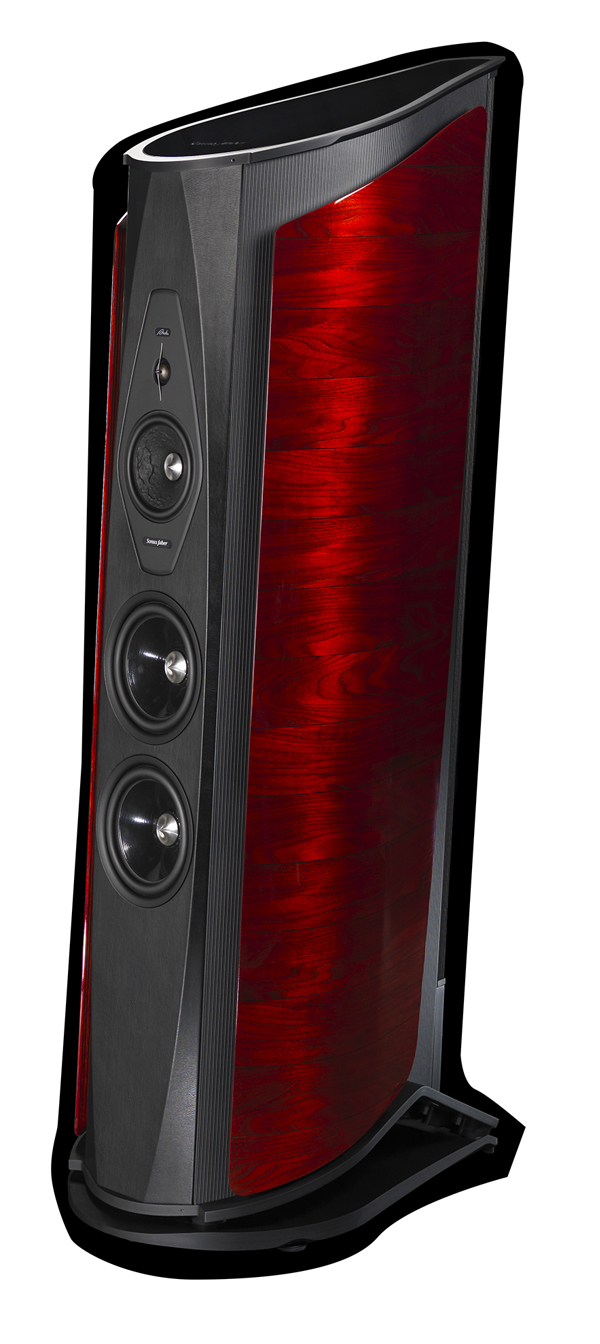
How many times have you heard a fellow audiophile or music lover say, “For that kind of money, those speakers should wash your car” or, “They should be better than sex”—or something to that effect? A pair of Sonus faber Aida loudspeakers cost $120,000 and are better than sex. Spend a few minutes immersed in a serious listening session, and you won’t care if your luxury car is dirty. Play a few more tunes, and you might not even notice your significant other beckoning you to the bedroom for some intimate time. They are that good. Indeed, the Aida is as close to perfection as I’ve experienced, and I’ve spent a lot of time listening to the world’s finest speakers. These, however, do nothing wrong.

Steve Martin once said, “First, get a million dollars.” Perfection doesn’t come cheap, and that’s the only bad news concerning the Aida. This speaker caters to an exclusive club, yet sales are steady, especially now that the $200,000 “Sonus faber” is no longer on the market. And while these gems flawlessly perform no matter what they’re connected to, the better your source components, the better the end result.

Listening to an old favorite, 10cc’s Bloody Tourists, the heavens align, as they do every time I listen to the Aidas (pronounced Eye –ee-dah). Regardless of the recording material or recording quality, I’m hearing more music than I’ve ever experienced on familiar recordings—and my reference GamuT S9 speakers aren’t exactly slouches. Passages decay more than they did before. There’s an extra guitar overdub here I hadn’t noticed, and an extra layer of vocals. If you audition the Aida, prepare to invest in coffee. You’ll be shutting off the lights at 2 a.m. just because you have to hear just one more record.

These rewarding experiences, my friends, are what the pinnacle of high-end audio is about. Sound so good, so real, you can just reach out and touch it. If you like smooth vocalists like Diana Krall, the Aidas offer you the opportunity to have a sonic lap dance. If you want to rock, and have enough amplifier power, the Aidas put Slash and a wall of Marshall cabinets in your room. And if you like electronica, the Aidas deliver Deadmau5 to your door, mouse mask and all. Acoustic music lovers are in for the biggest treat. The Aidas present a tonal accuracy and contrast that, by far, are the most natural and convincing I’ve ever witnessed.

When covering a Deadmau5 show with Music Editor Bob Gendron last year, he remarked, “Your system can’t do that…” Yet, on a recent visit to the TONE studio, he had recalibrated his perspective. Playing “Raise Your Weapon” from 4×4=12, and twisting the level control on the ARC REF5SE up to 80, a monstrous grin came over his face.  Switching the program to the Slayer Vinyl Conflict box set, he admitted, “These speakers play at concert-hall levels with none of the distortion and fatigue you get at a live performance. I’ve never heard a stereo system sound like this.” Another convert.

Posh Treatment

Every pair of Aidas comes with a visit from Sonus faber to make sure the speakers are optimized for maximum performance. If you live in North America, chances are high that Sumiko’s Bill Peugh will make the journey. Having heard Peugh work his magic at countless dealers and audio shows, it was a pleasure to have him take the time to set up the Aidas here.

For a speaker that weighs 365 pounds each, the Aida is a svelte tango partner. Thanks to the enclosed collapsible trolley, they are easily moved about. And the job can be done with one person, making it easy to place the speakers in a listening room. Another example of how no stone has been left unturned by Sonus faber.

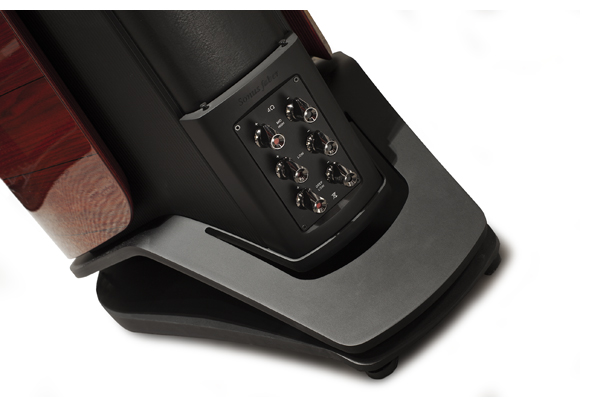
After a brief listen to a single speaker in the room so we could get a handle on bass response, we introduced the second speaker into the system and found the pair beginning to optimize. The Aida uses a rear-firing midrange and tweeter, each having their own controls on the rear panel. The “Sonus faber” introduced this concept, and it’s used to great success here. For now, the Aida is the only other speaker in the Sonus faber range with this function.

Having set up the speakers for the best combination of imaging, frequency smoothness, and bass response, we turned to fine-tuning the rear firing drivers. It’s an illuminating process: The level coming from the drivers isn’t terribly high, yet when adjusted, it causes a profound difference to the overall sound. Setting the level too high destroys the Aidas’ precise imaging performance by way of brightness. Not enough, and the speakers lose some airiness and coherence. Much like fine-tuning VTA, the speakers disappear when a perfect balance is obtained. No small feat for six-foot-tall models.

How quickly the Aidas settle into a groove. We are listening in earnest by the end of the first afternoon. My review models boast very few hours of prior listening time, so they are—for all practical purposes—a fresh pair. Like those on any speaker, the drivers require a certain amount of physical break-in to open up and achieve full body. The Aida is no different, although in retrospect, it merely sounds smaller and less extended after the initial uncrating. Bass is not completely fleshed out, and coherence between drivers is not as good as it is with a couple hundred hours on the clock. By the next day, after 24 hours of continuous play, they begin to relax.

Sumiko’s John Paul Lizars assures me the speakers change character during the break-in period, but it must have happened while I was sleeping. To be clear, I left them playing 24 hours a day during the review period; they had to be back in time for the 2013 Consumer Electronics Show.

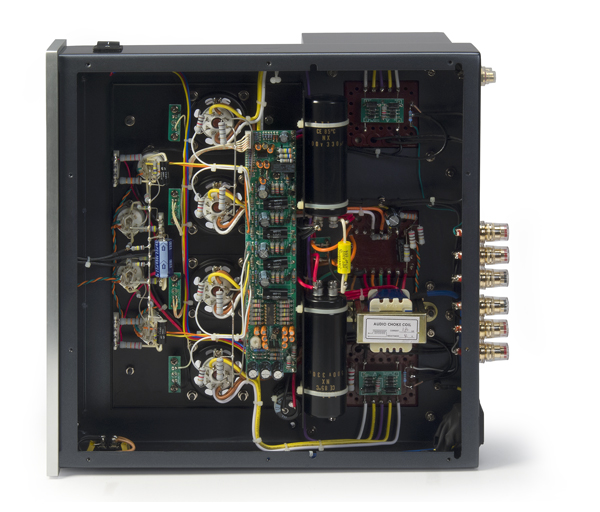
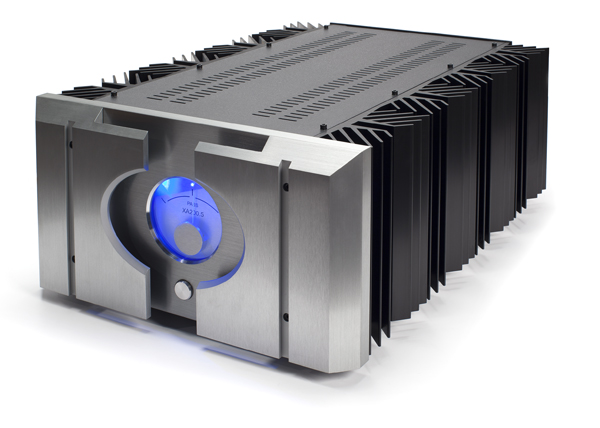
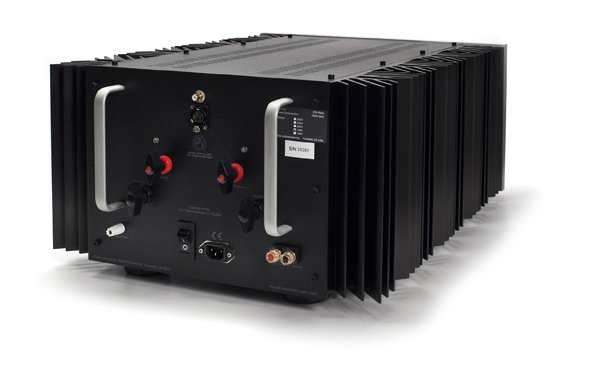
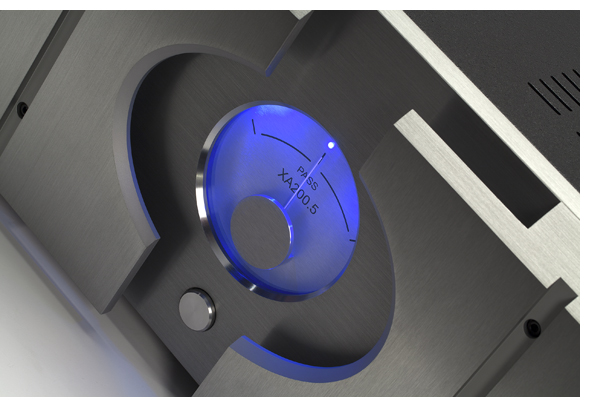
As tests evolved, all I noticed was a slight fog, which progressively dissipated.  Leaving the Pass XA200.5s Class-A monoblocks powered-up for nearly a month had consequences on my electric bill; I used three times more electricity as the average house in my neighborhood. Yikes. I’ve had a few paranoid delusions of the DEA showing up at my house with a SWAT team wanting to know where I’m growing the marijuana crop, only to give them a tour of my studio. “Sorry officers, no drugs in here, just these big amplifiers.” If I’m not at CES in January, you’ll know why.

I spent the bulk of my listening time utilizing the Pass monoblocks and Octave Jubilee monoblocks, which offer 250 watts per channel of vacuum tube power.

Under Pressure

The Aidas are polite company at low to modest listening levels. But as the volume goes up, they do an even better job at disappearing in the room. Sumiko representatives often discuss the concept of “pressurizing the room,” and I’ve never heard it better illustrated than with these speakers. Interestingly, I found myself (and guests) listening to the Aidas at higher levels than normal. Once the volume hits a certain point, the aforementioned effect becomes hypnotic, drawing you further into the presentation than you might have thought possible.

Fatigue that accompanies twisting the volume control to the upper regions? It’s just not there with the Aidas. Instead, it feels as if you can just keep turning up the volume forever, or at least until your amplifiers run out of power.

Tied to a chair and given truth serum, I’ll confess my love of the sound of a great electrostatic speaker like the Quad 57 or the MartinLogan CLX. Coherency is my hot button. It’s not so much midrange magic, but midrange correctly rendered. With no crossover in the path, the associated distortions, by design, do not exist. And distortions are a big part of what convinces your brain that you’re listening to a stereo system instead of the real thing.

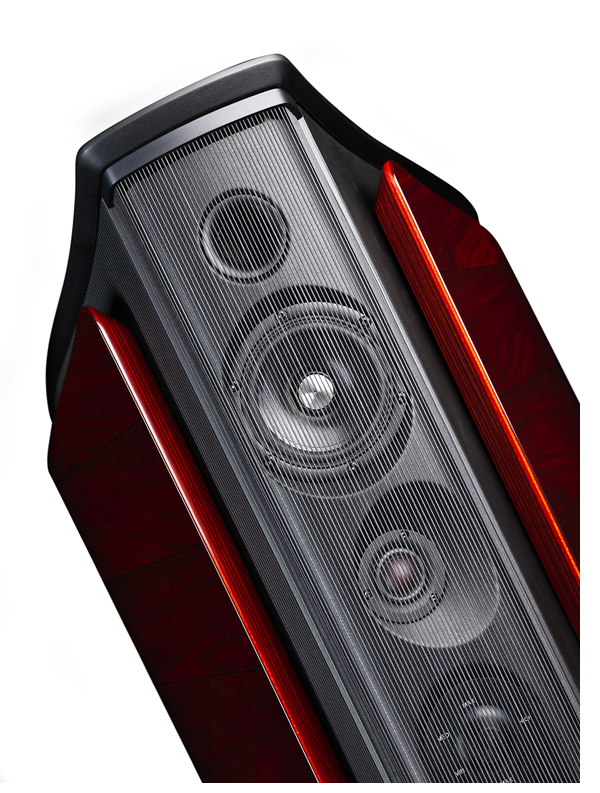
Again, the Aidas do the seemingly impossible, providing a seamless soundstage that never sounds like a woofer, tweeter, and midrange in a cabinet (even though their complement of drivers has crossover points at 55, 180, 250, and 3,000Hz). There’s so much new technology incorporated in this speaker, it would take a whole book to cover depth. And that’s precisely what’s included with the Aida— a 200-page tome, illustrating every facet of the speaker’s philosophy, design, and construction. Not to mention a massive collection of great photos, beautifully printed.

The Aida’s downward-firing 13-inch woofer produces bass with incredible texture and grip. I also suspect it heavily plays into its ease. The bass isn’t as aggressive, gut-punching, or pants-flapping as that of a few favorite audiophile darlings, but it possesses a presence that provides a true musical foundation, as it should. Just like when you listen to a musician playing a stand-up bass in a club.

Vide, the acoustic bass line in Stanley Clarke’s In the Jazz Garden is rich with decay, texture, and pace. Clarke’s instrument does more than maintain a separate space from piano and drums; it projects a three-dimensional effect that bass rarely manages in a recording. When changing the program to Dan Deacon’s America, the growling synth bass line shakes my room. These speakers move serious air when required.

The high-frequency spectrum is equally well represented. Older Sonus faber speakers, while providing highly pleasing sound, are often criticized for a midrange glow that borders on coloration. The Aida retains a high degree of utter tonality and soul, and provides a high degree of resolution and the ability to render musical detail without harshness, distortion, or fatigue. It yields a greater degree of loud-to-soft gradation than anything I’ve heard shy of the world’s finest horn systems.

Moving away from the ring radiator design of the former flagship, the Stradivari, a new, 29mm “arrow point” tweeter gets incorporated in the Aida. The intriguing albeit delicate bar is a very specific wave guide. Nothing in the Aida is without function. Peugh states the soft dome allows for a more natural response as well as more even and natural room dispersion. Experiencing the Aida is remarkably similar no matter where you sit in the listening environment, contributing to the notion of musicians playing in another room when listening from afar.

While the Aidas have a sensitivity spec of 92db with one watt, they give more with tons of clean power on tap. A sampling of lower-powered amplifiers in the 25- to 50-watt-per-channel range proves acceptable. Still, small amplifiers run out of juice when called upon to really rock. And I can’t imagine an Aida owner not wanting to take advantage of as wide a range of music as possible.

Ooh, the Cabinet

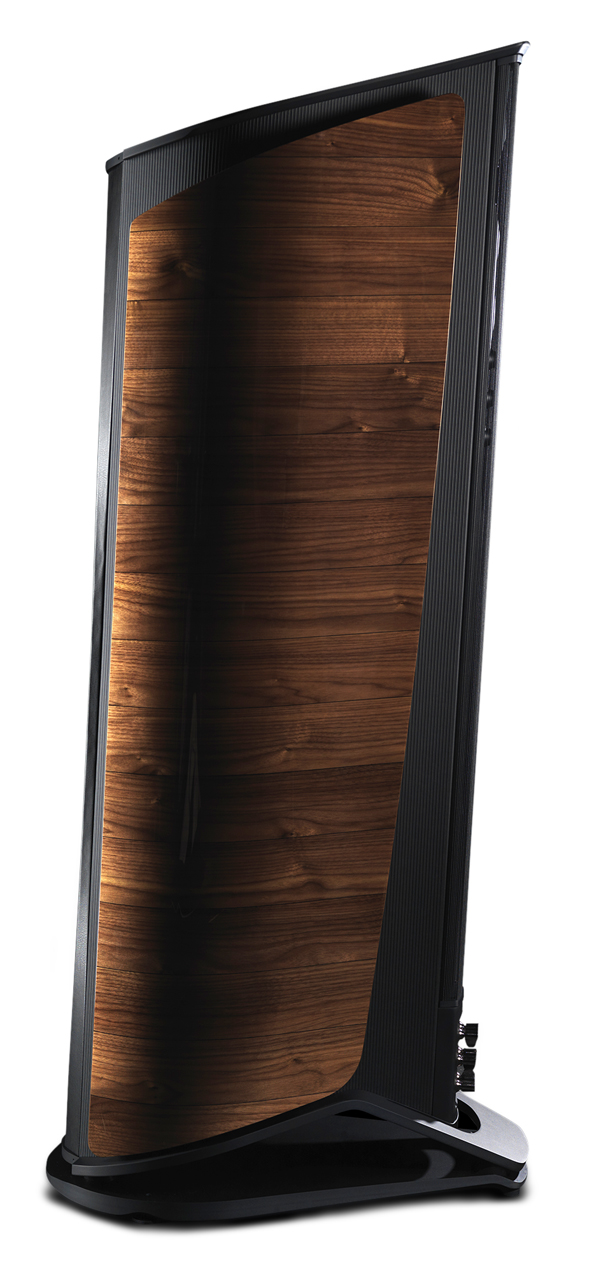
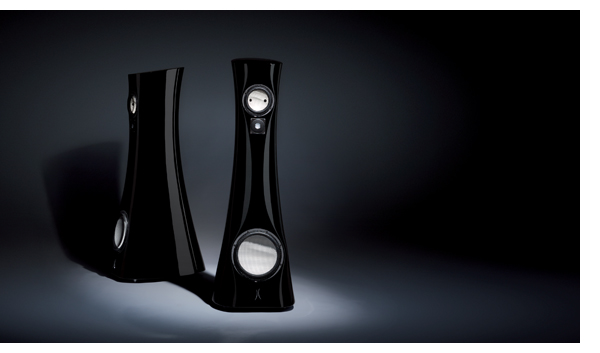
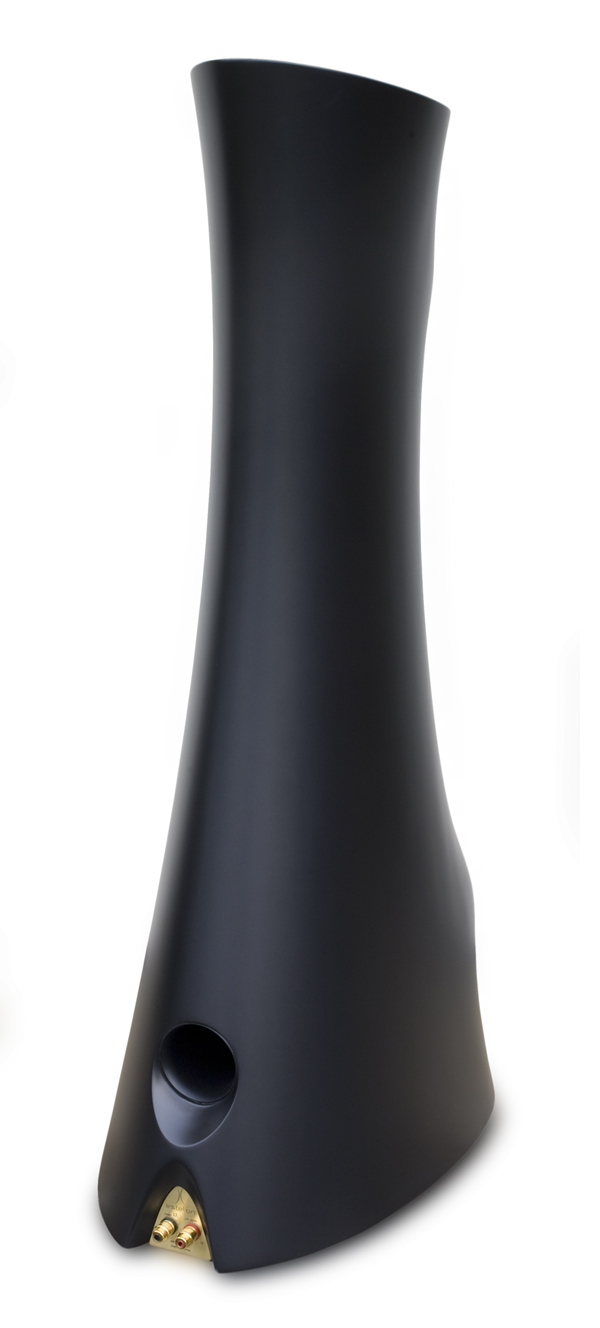
Much of the Aida’s sound can be traced to the cabinet and Sonus faber’s approach. A visual tour de force, these speakers arouse and impress, coated with layer upon layer of hand-applied and hand-polished lacquer. The metal bits receive the same amount of attention to fine detail, right down to the exact formulation of the bath used to apply the anodized coatings. Words and photos do not do justice to these audible works of art.  The booklet states the processes used in the speakers’ construction is “like that in an Italian supercar,” and it isn’t kidding.

Many current speaker manufacturers live and die by the sword of completely eliminating any resonance from the enclosure. However, Sonus faber looks at speaker design like an instrument manufacturer would, working with resonances and fine-tuning to achieve a more musical result. If you like the Wilson/Magico/YG Acoustics approach, I doubt you will love the Aida—just as I wouldn’t expect an automobile enthusiast that loves the Aston Martin DBS to be equally excited about the Porsche 911 GT3. High performance, different approach.

As for the emotional connection the Aidas engender? A non-audiophile friend, who is a cabinet maker by trade, was in awe of the enclosures that take nearly three weeks to complete. Before I put Mobile Fidelity’s recent 45RM remaster of The Freewheelin’ Bob Dylan on the turntable, he was explaining “no one listens to vinyl anymore.” Then, when the needle dropped, he teared up. “I used to go to the Village and see Dylan all the time. This puts him right in the room.” We switched back to the same album on CD, even played through the fantastic dCS Paganini, and the magic diminished. How can you ask for a better, more emotionally engaging experience?

Listen to Get the Rest of the Story

If you were hoping for a treatise on specs, measurements, and speaker configuration, that’s not what matters here. And none of it will matter to you after you’ve spent 60 seconds listening to one of your favorite pieces of music through the Aidas. I can’t think of a more sublime example of high technology serving fine art.

Should a $120k pair of speakers not be on your short list, try and experience the Aida anyway. And have your Sonus faber dealer demonstrate the new $2,498 Venere 2.5 speakers. A staggering amount of technology trickled down to the company’s entry-level speakers, and is only be made possible by an enterprise that has the resources to build an Aida.

Just as Verdi’s Aida took his art to its highest level, Sonus faber’s Aida takes the aesthetic and acoustic art of speaker-building to an equally lofty level. While it can be tough to justify the value with products so expensive, having spent plenty of time with most of the top models in the six-figure bracket and a considerable number of great speakers in the $20k- $50k range, I can say with absolute certainty that Aidas offer sound and build quality commensurate with price. They have provided one of the most enjoyable musical experiences of my career.

Sonus faber Aida

MSRP:  $120,000/pair

www.sonusfaber.com (Manufacturer)

Peripherals

Analog source AVID Acutus Reference turntable    TriPlanar tonearm    Lyra Atlas cartridge   AMG V-12 turntable    AMG arm    Clearaudio Goldfinger
Digital source dCS Paganini stack    Aurender S10 music server
Preamplifier ARC REF5SE    Robert Koda K-10
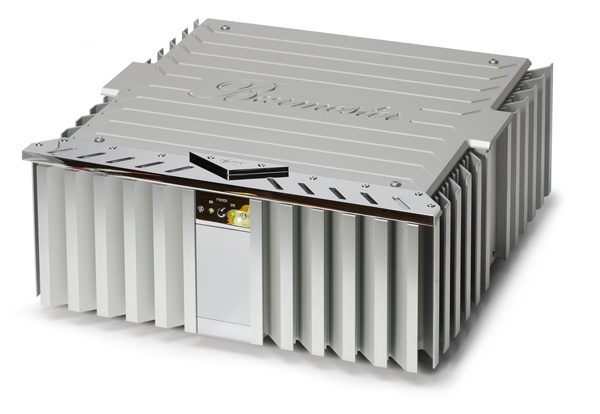
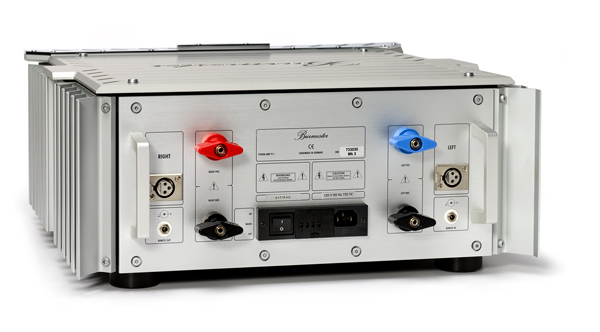
Power amplifier Burmester 911 mk.3    Pass Labs XA200.5 monoblocks    Octave Jubilee monoblocks
Cable Cardas Clear
Power cords Furutech PowerFlux
Power conditioning  Running Springs Dmitri and Maxim
Accessories GIK room treatments    Furutech DeMag and DeStat    Audio Desk Systeme record cleaner    SRA Scuttle rack

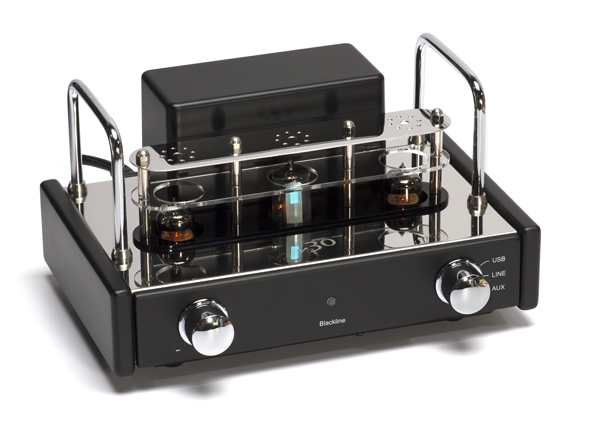
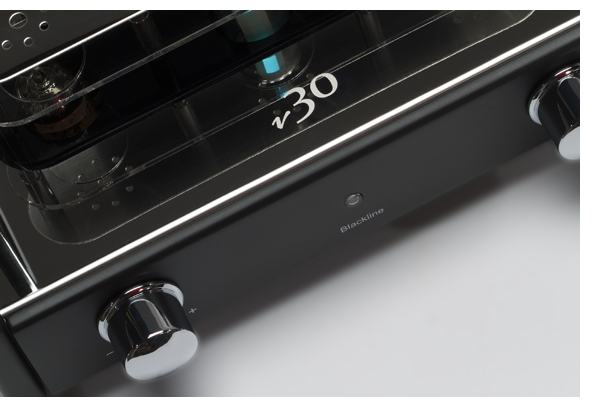
Blue Aura v30 Blackline Integrated Tube-Amplifier System

With the burgeoning number of adults working from home, the office-audio category has become an industry bright spot.  Filling this space is Blue Aura’s $549 v30 Blackline music system, which satisfies the craving for vacuum tubes and matching speakers, and does so in a space-conscious package.

The handsome, three-piece system looks sharp wherever I place it in my office—I tried both my bookshelf and credenza—but the system’s striking aesthetics never dominate the décor.  Los Angeles–based Blue Aura wraps the speakers and the body of the amp in black faux-leather, and accents the amp with chrome trimmings.

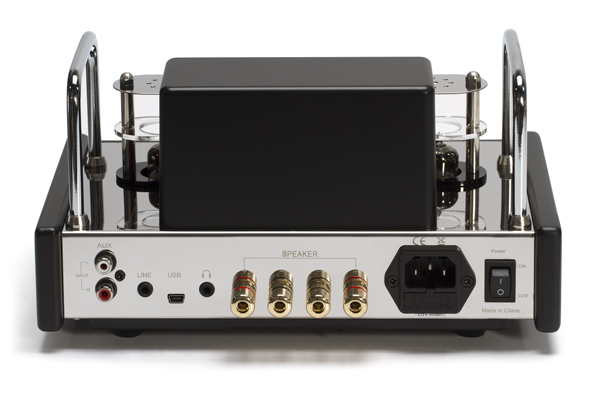
The amp is 10 inches wide, 7.5 inches deep and 5.5 inches tall, and the plated handles on either side of it double nicely as bookends.  Adorning the front panel is a pair of matching chrome knobs—one for adjusting the volume and one for selecting from the three inputs (USB, LINE, and AUX).  Two 6N1 tubes flank the taller 6e2 tube, with its decorative but unnecessary green glowing light filter.  A four-post tube guard with a plexiglass-and-chrome top shelf protects the tubes from inadvertent fingers or the common office mishap.  On the back panel, from left to right, are three inputs (RCA, mini-headphone, and mini-USB B), followed by a mini-headphone output jack, four brass speaker jacks, the power-cord socket and power switch.

The 5.5-inch tall speakers look similar to the Audioengine A2s, with forward-facing slits towards the bottom of each speaker serving as bass ports.  The 3/4-inch tweeter and 3.5-inch paper driver surprised me from the outset with some obvious low-frequency grunt and detail.  With the speakers set on their over-sized-hockey-puck stands and with the bookcase as an additional cabinet, the sexy, sultry vocals of Sade fill my 11-by-10-foot office.  Changing out the included 18-gauge speaker wire for some 12-gauge wire further defineds the speaker’s impressive resolution.

Dishing It Out

Forget the typical tinny computer sound and irritating fake subwoofer output—the v30 avoids that pitfall.  This is a setup I find enjoyable listening to for several hours, which helps me grade papers without becoming restless.  When playing rounded sharp-edged recordings, such as Donald Fagan’s Kamakiriad, the v30 settles down nicely.  I then play some lossless recordings, with my laptop and Audioengine D2 wireless DAC system on my desk and the v30 on the bookcase, and intoxicating sound fills the office.  Even with the speakers just 30 inches apart, the system offers impressive instrument placement.

It’s obvious that the Blue Aura engineers understood that the typical home-office setup limits how far apart speakers can be placed.  The result is a nice, expansive soundstage and subsequent enjoyable listening experience.  Even stepping down to my MacBook’s analog output and running a wire to the v30 yields worthwhile results.

The system excels at reproducing jazz music, and quickly makes Vince Guaraldi’s classic Charlie Brown Christmas a playlist favorite.  The v30’s ability to recreate the individual bass notes in “O Tannenbaum” bests the budget bookshelf speakers that normally occupy my office—and those are more than three times the size of the v30’s speakers.  Guaraldi’s piano matches the glow that the three tubes adds to the keystrokes.  The slight loss in absolute detail is easily made up by the system’s warmth and rich decay.

As the days pass, the v30 becomes the reason to listen to music, the goal being to see what it can handle musically.  While blasting Slayer at house-party levels isn’t realistic, the unit has no problem getting into the 90-plus-dB range before hitting its sonic wall.  It delivers more complex rock with ease.  John Mellencamp’s Lonesome Jubilee, with its multitude of instruments, sounds open and uncongested—a neat trick for such a diminutive setup.

As expected, the v30’s three glowing tubes make the midrange beguiling.  Female vocals and instruments are lush and warm, and void of the syrupy slow quality that creeps into many budget tube systems.  In this price range, the v30 is downright first-rate, especially in the level of clarity it brings to Pink Martini’s “Mar Desconocido,” with its tempo-leading bongos, and to the plucked guitar and xylophone in the next track, “Taya Tan.”

Just For Fun

One Sunday afternoon, I pair the 20-wpc integrated amplifier with the 92-dB-efficient Verity Audio Finns.  The v30 does itself proud here, powering the Finns with confidence.  Though the amplifier section won’t make one forget PrimaLuna’s resolution, particularly in the higher register, it does move some serious air, representing the basics of tone and balance remarkably well.

Even in larger spaces, such as my 13-by-19-foot family room, the v30 delivers open sound.  With the amp and speakers on the rock fireplace hearth with the angled puck speaker stands tilted upward, the room fills with warm holiday sounds.  Even with the sliding door to the kitchen closed, I was still able to enjoy the details emanating from the system.

For those that desire tunes but need focus on work in their office, the musicality of the v30 Blackline make it a top-tier choice for the home office.  Looking to add a source wirelessly? Just add Blue Aura’s WSTxR wireless transmitter/receiver kit for $149.

www.blueaura-audio.com

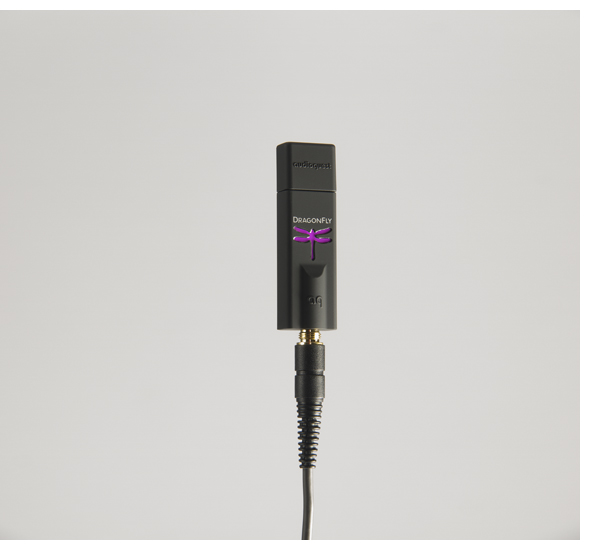
AudioQuest DragonFly

I’ve been having way too much fun with the AudioQuest DragonFly—so much fun that it’s taken me all year to write the damn review.  This nifty little device has quickly become a must-have travel accessory.  And although I’m perhaps not as sexy as George Clooney, I am on an airplane these days almost as much as his character in Up in the Air—but fortunately I never have to fire any of the people I’m visiting.

Here’s how it usually goes:  The minute we hit 10,000 feet and the pilot signals that personal electronics can now be used, I pull out the DragonFly and whatever phones I’ve brought along for the ride.  Before I can even get the cans on my head, the passenger in the seat next to mine asks, “What is that? I’ve never seen one of those. Is it expensive?”  And I’ve had just as many female as male passengers inquire.  On the flight home from the Munich High End show, I just happened to be sitting next to an audio nerd who was terribly impressed.  “How did you get one of those?” he asked.  It turns out that he was a loyal TONEAudio reader, which always makes for great conversation.

After a quick listen, everyone comes away convinced that they need a DragonFly—even Bose noise-cancelling headphones users, and that’s saying a lot.

What Makes It So Awesome?

We could go on and on about all the techie bits that make the DragonFly so special—like its 24-bit/96-kHz Sabre DAC, on-board headphone amplifier and built-in digital volume control—but that would be kind of boring.  (For those wanting such techie bits, read Art Dudley’s excellent review in the October issue of Stereophile.)

Beyond its technical achievements, the DragonFly succeeds on many levels.  It sounds way better than its $249 price tag suggests, but the real triumph of the DragonFly is that it’s accessible.  You don’t have to be a mega-nerdtron to understand it (or use it, for that matter), but if you are a true audio enthusiast, you’ll immediately grasp its gestalt.  Among the 100-plus parts inside this tiny music machine, which is barely bigger than a USB jump drive, are Sabre ESS DAC chips, a pair of clocks and a 60-step digital volume control.  The USB connector even uses the same silver coating as AQ’s premium USB audio cables.

But you’ll forget all of that the minute you plug it in.  I’ve used a couple of excellent portable DAC/headphone amplifiers, but none of them are conducive to traveling light.  The DragonFly requires no power adaptor, cables or accessories; just plug it right into your laptop’s USB port, direct your computer to use it as the sound output and you’re rolling.  It works equally well with Mac or Windows operating systems.

My review of the DragonFly begins with my current traveling companions, the Sennheiser PXC 450 noise-cancelling headphones.  Starting with Bombay Dub Orchestras’ 3 Cities, in straight 16-bit/44.1-kHz mode via iTunes, there is a major jump in sound quality that instantly eliminates some of the fog that always accompanies noise-cancelling phones.  With the already spacey vibe of this album, the presentation is definitely more hallucinogenic via the DragonFly.  Driving guitars, courtesy of Black Sabbath’s Paranoid, quickly nudges me back into audiophile mode, as I listen to the big improvements the DragonFly makes to Apple Lossless files through noise-cancelling headphones.  The cymbals in “Fairies Wear Boots” have a smooth, natural timbre through the DragonFly that make me want to goose the volume up a bit higher than might be prudent—so be careful:  The lack of graininess and distortion catches you off guard at first.

Flying always makes me impatient, so I often bounce back and forth between music, movies and Angry Birds, but thanks to the DragonFly’s virtual elimination of listener fatigue, I’m listening to complete albums—something I rarely do on a plane.  I save the playlist from this trip so I can compare tracks when back in the office with a full compliment of other headphones.

Better Phones, Better Results

With the impressive performance that the PXC 450s turned in, I’m not prepared for what the DragonFly is capable of with my cache of over-ear headphones.  Should I start at the bottom and work up, or the other way around?  Decisions, decisions.  Patience gets the best of me and I jump right in with the Audeze LCD-2 planar phones and upgraded Cardas Clear headphone cable.

Yeow, this is incredible!  Even with 16-bit/44.1-kHz files, it’s like strapping a pair of Magnepan 1.7s onto my head, with a First Watt amplifier on my back—which would not be convenient or fashionable.  School Food Punishment’s Air Feel, Color Swim gives the LCD-2s a great workout, with layer upon layer of well-sorted vocals and synthesizers.  Switching back to the headphone jack on the MacBook Pro is now unacceptable—the additional resolution provided by the bigger phones is too much fun to be without.

There’s more texture and decay everywhere.  The bongos at the beginning of William Shatner’s rendition of “Space Truckin,” from Seeking Major Tom, now feels like it’s being played through a great pair of loudspeakers, and I find myself forgetting that I even have headphones on.

High-Resolution Files: The Final Frontier

Upping the ante to recently downloaded files from HDtracks shows just how much the DragonFly is capable of.  The latest version of Pure Music software is a night-and-day upgrade from the standard CD-quality files I have on hand of Herbie Hancock’s classic album, Head Hunters.  The beginning of “Watermelon Man” now has air on the acoustic instruments that wasn’t there before, and the bass line now has plenty of it’s own space and texture.  Those not convinced of the validity of higher-resolution digital files need not purchase a five-figure digital rig; the DragonFly and a great pair of headphones will make you an instant believer.

As my next-door neighbor, who knows nothing about audio, shouted while listening to the 24-bit/96-kHz version of Fleetwood Mac’s Rumours, “I like this a lot better!” (Funny how people shout when wearing headphones, isn’t it?)

Having auditioned a wide range of great DACs in the $1,000 range, I can tell you that the DragonFly easily competes.  It has a decidedly “un-digital” sound, with an ease that should appeal to even the most hardcore analog lovers.  At the risk of offending the analog loyalists, I will say that if I were putting together a system on a modest budget, I’d much rather listen to even Red Book CD files through the DragonFly than cobble together a $249 analog solution and play gnarly records found in the budget bins.

Eliminating the casework and power supply from the parts count (and no doubt some profit margin) goes a long way at getting the price down.  Bravo to AQ for delivering this product for such a down-to-Earth price.

Anchor Your Audio System

If the DragonFly were only a headphone amp, it would be a major bargain at $249, but it’s equally exciting used just as a DAC.  Mated to the Sansui receiver and JBL speakers (covered on page 77), and an earlier-generation Mac mini purchased on eBay for about $100 bucks, I managed to create an amazingly musical system for just under $1,000 total.  In this case, the fixed analog output of the DragonFly works well, taking the digital volume control out of the equation.

Picking out the ethereal Fairlight sounds on the Tubes’ Completion Backwards Principle is an exercise in trippiness.  Things were floating all around the imaginary soundstage in my head.  Not able to stop there, Eno’s Ambient 4: On Land dragged me further into the world inside my head—one that is typically only provided by listening to headphones.

Moving further upscale, to the system in room two, which is now configured with a Conrad-Johnson PV-12 preamplifier, Krell KSA-50 power amplifier and a pair of Dynaudio Confidence C1 II speakers, the DragonFly still cuts the mustard.  On a recent visit to the KEF factory in the UK, I had the pleasure of experiencing the DragonFly in KEF’s reference system with a pair of its flagship Blade speakers ($30,000/pair). Impressive!

No Longer Outside Looking In

There’s no better gateway drug for the world of high-quality sound reproduction than the AudioQuest DragonFly:  Just add the laptop and the headphones you already own and prepare to be blown away.  Or plug it into your current hi-fi system and use it as a high-resolution DAC—it’s all good.

If you spend as much time on a plane as George Clooney and I do, or if you are just an avid headphone listener, you need a DragonFly.  If you aren’t an avid headphone listener, I’ll bet you quickly become one with the DragonFly on hand.  And playing Angry Birds has never been more fun.  Bahooonga!

I am very happy to announce that the DragonFly is our Product of the Year in the digital category.    -Jeff Dorgay

The AudioQuest DragonFly

MSRP: $249

www.audioquest.com

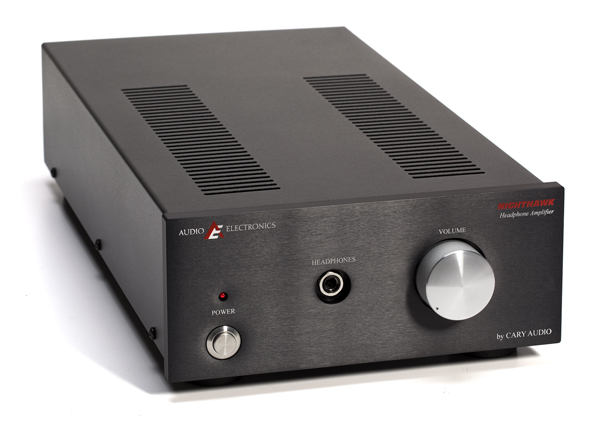
Audio Electronics Nighthawk

Unless you’ve been in the audio community since the early 90’s, chances are you haven’t heard of Audio Electronics by Cary Audio. Audio Electronics (AE) was created in 1993 as a way for Cary to reach out to budget minded music lovers and audiophiles. AE offered award- winning products that are still highly regarded to this day. In 2009, Cary Audio put Audio Electronics into hibernation concentrating on their core brand. Today, Audio Electronics is back – offering new products with a focus on sleeker designs, smaller footprints, and superb performance still at an affordable price point as in the past. The first product to hit the streets is the Nighthawk headphone amplifier – at $1,199.

The Nighthawk is considerably larger than the average portable headphone amplifier at 14.5” L x 8.5” W x 4” H, but don’t let the size scare you. It is well designed and easy-to-use featuring only the basic neccessities – inputs, output, power.  A silky smooth volume control, and a rock solid ¼-inch headphone jack adds to the feeling of quality, but an additional 1/8-inch jack would have been good for added flexibility, especially considering how many phones are showing up on the scene with the smaller plugs.

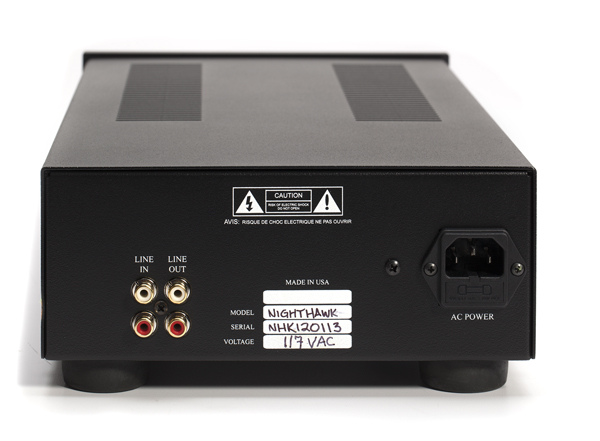
There are two pairs of outputs on the rear panel, one of them a pass through.  The five second soft start/mute circuit is a nice touch – nothing worse than hearing a headphone amp make a loud click when you have your phones on!

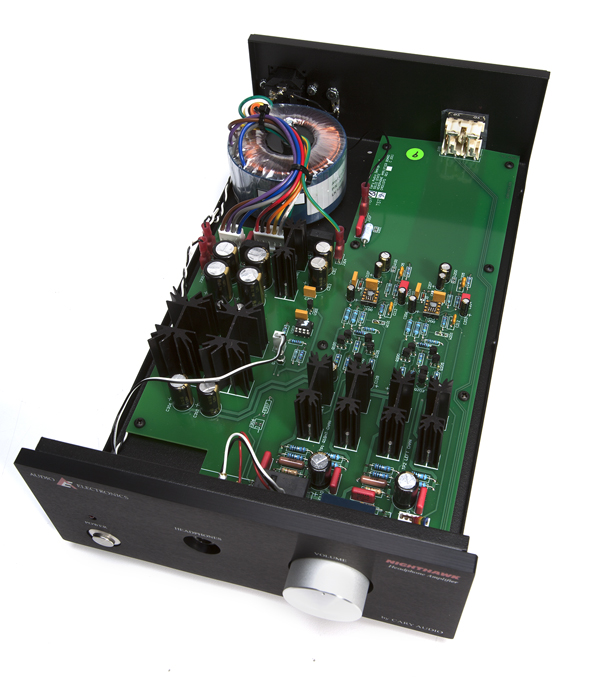
Unlike the more expensive Cary HH-1 headphone amplifier ($1,595) which is a hybrid design, utilizing a pair of 6922, the Nighthawk uses a Class-A solid state circuit with no feedback.  We’ll be revewing the HH-1 at a future date for comparison, but the Nighthawk proves no slouch with a wide range of headphones.

Test drive

A Mac Mini serving up CD rips through the McIntosh C50 preamp/DAC was used for all source files.  Even after three solid days of 24 hour operation, burning in another pair of headphones for another report, the Nighthawk remains cool, generating less head than my iPhone.  A great thing for those keeping their headphone systems in tight quarters.

Listening with everything from entry-level cans to the higher end models like the Denon D7000, Beyerdynamic T1, the Nighthawk proves clean and natural, adding no discernable flavor to the sound. However, system synergy is everything in headphone world, and with some phones more difficult to drive than others, the Nighthawk is not a perfect match with the Sennheiser HD800s.  A much better match is my reference Lehmann Audio Black Cube Linear – similarly priced but totally different sound.

The Nighthawk pairs well with the mid priced phones in my stable.  The AKG K550, Sennheiser HD600 and Pioneer SE-MJ591 all proved a breeze to drive.  Synergy rears its head again, with the AKG 550s a sweet match.  I went back to these phones repeatedly and have never had a better experience with the K550.  Natalie Merchant’s Ophelia album proved highly satisfying with rich vocals and well controlled bass response, yet no hint of bleeding into the vocals or background instruments.

This versatility makes the Nighthawk a perfect choice for the budding or seasoned headphone enthusiast.  Even my $99/pair Sony MDR-XB600 (Extra Bass) phones that sound mediocre at best with my iPhone really came to life with the Nighthawk.  A playlist of Deadmau5 favorites showed how well controlled and powerful the bass response could be even with budget phones.  All I wanted to do was turn it up!

Pub note:  Those with Audeze LCD-2 and LCD-3 phones can also rest assured that the Nighthawk is an excellent match with these planar favorites, which can be tough to drive.  -Michael Liang

The Audio Electronics Nighthawk

MSRP:  $1,195

www.caryaudio.com

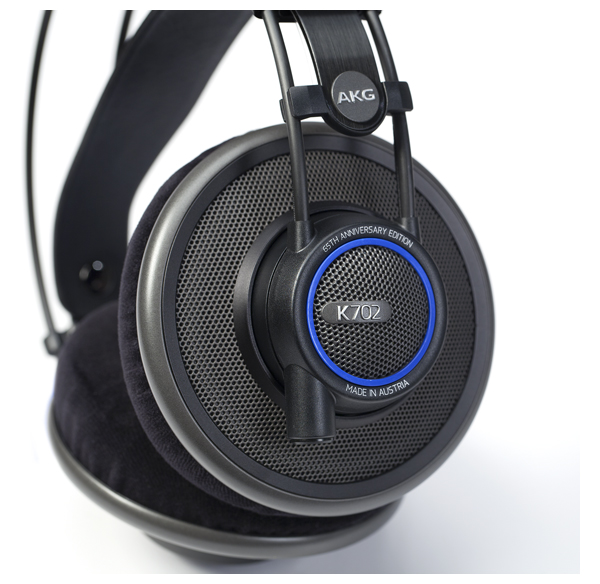
AKG K702 65th Anniversary Edition Headphones

To celebrate its 65th anniversary, Viennese manufacturer AKG introduced two limited-edition versions of older products: the C451 condenser microphone and K702 headphones.  In this review I will focus on the new K702 65th Anniversary Edition headphones (K702-65).  Building upon the solid foundation laid by AKG’s K701, K702 and Q701 models, the K702-65th promises to be the pinnacle of a popular and prestigious family. It carries an MSRP of $499.

Visually, the K702-65 is similar to its current production sibling, the K702.  Both models feature an open design that utilizes flat-wire voice coils and AKG’s patented Varimotion two-layer diaphragm.  For connectivity, it features a mini-XLR cable, which is detachable for extra versatility.

The K702-65 is handcrafted in AKG’s facility in Vienna, and has a limited production run of just 3,000 units worldwide, each of which are individually tested and numbered to ensure the highest quality.  For the new phones, AKG didn’t just give us a re-badged K702; the company updated the design with a “TITAN-Look” finish, a redesigned genuine leather headband and soft velour ear pads with memory foam inside them for improved comfort.  The material changes are subtle, but they go a long way.

As you might imagine, some of these changes have also affected the sound signature.  The K702-65 pairs well with the Musical Fidelity M1 DAC and X-Can V8 tube headphone amplifier that I used for the bulk of my test listening.

After 72 hours of burn-in, the K702-65 begins to distinguish itself as more than a mere twin of the K702.  Even though the two models share a common sonic signature, the anniversary version addresses some of the standard K702’s sonic shortcomings (which are often perceived to contribute to thinness overall.)

Sampling tracks by Sixpence None the Richer and from Bruce Springsteen’s Greatest Hits album, I find the midrange on the K702-65 to be slightly smoother, with more body and texture than the K702.  While still not overly warm or lush, the K702-65 still provides the fairly neutral midrange present in the original, without being so forward or analytic. The highs on the K702 are prone to sibilance, but this is much less noticeable on the new model, particularly when listening to cymbals and percussion.  Sampling some of the recent Blue Note XRCDs is much more relaxing through the newer phones, which also offer a level of refinement that doesn’t give up the transparency this model number is famous for.

The new ear pad material makes the biggest difference for the better—not just in terms of comfort, but also in terms of the quality of low-frequency reproduction.  Tracking through Michael Jackson’s 25th Anniversary Edition of Bad, I find that the weight and dynamics of the bass line in the title track have better definition and texture, as well as more apparent speed.  Fortunately, AKG has not turned these phones into skull-shaking “bass monsters.”

I’ll stick my neck out and suggest that if you love your K702 originals than these will be a welcome upgrade.  AKG’s 702-65 is the company’s best effort to date in the K701/702 series, improving on every aspect the range has to offer without making any sacrifices.  -Michael Liang

AKG K702 65th Anniversary Edition Headphones

MSRP: $499

www.akg.com

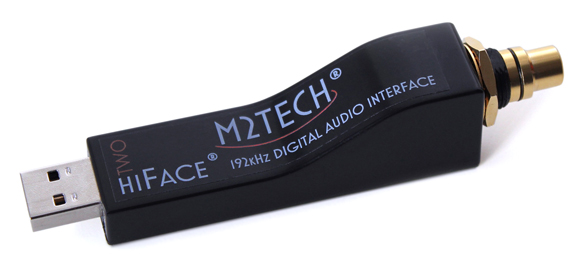
M2TECH hiFace Two

A lot can happen in two years in the world of digital audio.  Back in early 2010, USB-to-S/PDIF converters for the masses were a bleeding-edge concern.  Italy’s M2TECH changed all that when it introduced the hiFace, a $185 digital-audio interface not much larger than a standard USB thumb drive.  This nifty little device transforms one’s computer into a digital-audio transport by giving users a simple and seamless way to deliver high-resolution music files from their computer to their playback system.  With the advent of the original hiFace, M2TECH effectively brought the benefits of USB data clocking out from the cold and into hands of computer audiophiles everywhere.

Since then, the hiFace’s existence has been more than justified.  The sonic performance of most budget USB DACs doesn’t even come close to that of the hiFace, when feeding it a steady S/PDIF diet.  A comparison between many models offering a direct USB connection and the hiFace will unmask the direct USB as relatively lifeless and anemic.  This is often the reason that newcomers to digital audio complain that their incoming computer rig doesn’t compete with their outgoing CD player.  We call this jitter: timing errors in the digital data flow that, in this instance, aren’t corrected by the USB DAC—sometimes the USB DAC itself is what introduces these timing errors.

A few DAC manufacturers, including Lenehan Audio, Metrum Acoustics, Eastern Electric, have wised up to the inherent weaknesses of more-vanilla USB receiver chips and are now employing M2TECH’s USB technology in their newer models.  Meanwhile, the number of USB-to-S/PDIF converters coming to market has expanded considerably in the past two years:  Anedio, April Music, Bel Canto, Channel Islands Audio, Halide Design, Human Audio, KingRex, Lindemann, Musical Fidelity, Quad, SOtM and Wavelength Audio now all offer models around the $500 mark.  M2TECH itself also offers an Evo version of the hiFace ($499) that can be tricked out with optional battery PSU ($499) and master clock ($499)—but purchasing all three of those units puts you in the financial territory of Empirical Audio’s beastly $1,299 Off-Ramp USB DAC.

The original hiFace’s wide user base can likely be attributed to its agreeable retail price.  But clocking devices are as important as the DAC itself, particularly at the budget end of the DAC market, where sophisticated jitter-rejection circuits (found at the high-end) are precluded by the manufacturer’s intended street price.  Adding a $1,500 USB converter to a $500 DAC might not make intuitive sense to many people—adding a $200 device does.

USB-to-S/PDIF converters don’t just convert one digital-transfer protocol to another.  They seek to better clock the data and thus minimize jitter.  Some take an axe to the detrimental effects of EMI/RFI by deploying improved power-supply regulation and galvanic isolation.

As 2010 tipped over into 2011, I recall the audible improvements brought by the original hiFace as being small: a shade more definition here, a little more soundstage focus there.  It wasn’t until Ireland’s John Kenny infused the hiFace with battery power that this reviewer really sat up and took notice.  Exposure to the Audiophilleo1 and Audiophilleo2 drove the need for a USB converter home, took it inside and made it a nice cup of tea.

Another annoyance with the original hiFace was its need for proprietary drivers, which introduced a small lag into the audio-playback chain that meant video would run slightly out of sync with audio and dialogue running through the hiFace.  This was a deal-breaker for some users.

M2TECH has eliminated this issue with the hiFace Two.  Based around an XMOS receiver chip, it complies with USB Audio Class 2.0 (UAC2) and therefore works with native-mode USB audio drivers.  This allows plug-and-play operation for Windows, OS X and Linux operating systems.  (As it’s not UAC2-compliant, Windows requires additional drivers to handle anything above 24/96.)  Like its predecessor, the new hiFace Two parses data up to 24/192 with each sample rate family—44.1/88.2/176.4 and 48/96/192—which is handled by its own oscillator.

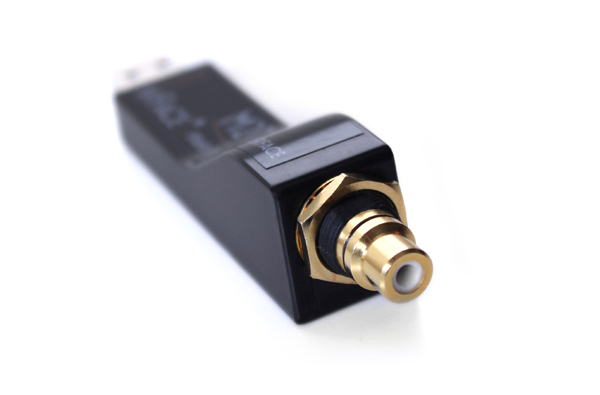
For the hiFace Two, M2TECH has moved the shell cover from white to black, held the recommended retail price at $185 (dropping the price of the original unit to $150) and made coaxial and BNC models available.

The Setup

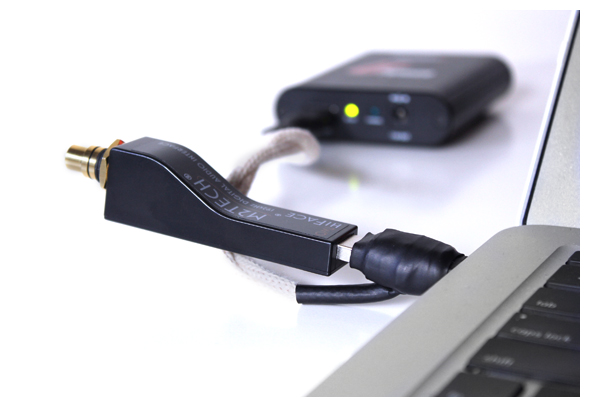
The thumb-drive sized unit is 10 cm long and suspends somewhat precariously when plugged into a vertically situated USB port on the back of a Mac mini.  The connection to a MacBook Air’s horizontal USB port allows one’s shelf or desk to better support the hiFace Two’s 50-gram weight (as well as the additional weight of the coaxial cable).  That said, neither host computer dropped audio due to physical conditions.  Even the Mac mini held fast during the review period.

The Sound

Experience has taught me that one of the key signs of jitter minimization is bass propulsion and definition.  Tonally, if a straight USB feed into the Audio-gd NFB-2.1 is a watercolor and the Audiophilleo is a portrait in oil, the hiFace Two paints somewhere between the two.  That’s commensurate with its pricing, as it’ll run you less than half the cost of the Audiophilleo2 ($579).  You get what you pay for and you pay for what you get.

Listening to this new model is reminiscent of spending a week or two with Musical Fidelity’s original V-LINK: a small improvement over the USB implementation found in the Peachtree iNova, but not as musically emphatic or engaging as Philip Gruebel’s little grey box.  The Audiophilleo also scores another point over all the competition by negating the need for (and expense of) a digital coaxial cable.

Once you accept the halfway-house nature of the hiFace Two solution, the fun begins.  Meandering through Leonard Cohen’s much-underrated 2001 “comeback” album, Ten New Songs, a sense of player space is more apparent with the new M2TECH device than without.  Better clocking (i.e. less jitter) takes the listener deeper into the music.  Even at this less-expensive end of the USB-converter market, improvements can be heard in terms of micro-dynamics and vitality—Cohen’s aging croak simply sounds more human.

Switching to something of an edgier ’80s mastering job with R.E.M.’s Green exposed an over-enthusiastic lower treble in brighter systems.  This was easily dialed back, thanks to Hannes Fricke’s adjustable tweeter gain on his WLM La Scala floorstanders, but the titanium dome tweeter in a pair of (vintage) Celestion Ditton 11 required a more creative solution.

The Splitter Cable and the Battery

Elijah Audio’s $105 BPM (battery-powered module) splits the input to any USB device such that data and power are fed independently.  The BPM cable nixes the 5-volt host computer feed and only allows the data to reach the piggybacking hiFace.  For this review, I hooked the BPM’s 20-cm tail into KingRex’s rechargeable U Power Li-on battery module ($189).

Sonically, this amended hiFace setup took the music a step backwards into a pool of warm water, eradicating that lower-treble glare.  In the context of digital-audio tweaks, this one rated as substantial—so much so that I had a friend stop by to corroborate my findings.  He agreed that the BPM/U Power appendage massaged the tense shoulders from VCMG’s bleepy Aftermaths EP and Depeche Mode’s Violator.

The Wrap

Hearing the benefits of adding battery power to the hiFace Two, it’s easy to see how John Kenny arrived at doing the same for his all-in-one solution.  So, with the cost of these modifications running past the $400 mark, why wouldn’t you just opt for his roughly $420 JKSPDIF USB-to-S/PDIF battery-powered converter?  Two reasons: Linux compatibility and audio lag.  The former will be of keen interest to Squeezebox Touch users who have installed the Enhanced Digital Output app, which it turns the USB input on the rear into a digital-audio output.  But that’s a story for another day…

For the cash-strapped computer audiophile the hiFace Two is a suitably priced intermediary that will wipe away some jitter between you PC/Mac and budget DAC. -John Darko

M2TECH hiFace Two

MSRP: $185

www.m2tech.biz

Logitech UE 9000 Headphones

In 2008, when Logitech acquired Ultimate Ears, an industry leader in custom in-ear monitors, the Newark, Calif.–based conglomerate significantly expanded its line of personal audio products.  Today, a full array of headphones and portable speakers are available under the combined name, Logitech UE.  Having experienced success with its in-ear monitors, Ultimate Ears paved the way for the Logitech UE 9000s, a $349 pair of wireless Bluetooth headphones.  With so many companies getting in on the wireless game these days, the UE9000 is a solid contender.

Stylish Good Looks

The UE 9000 is the company’s flagship model.  It features elegant styling, and you won’t need a pair of zippered Sammy Hagar “I Can’t Drive 55” pants to go along with them.  Build quality is excellent, with nary a squeak or rattle.  Oversized ear cups surround your ears with form-fitting memory foam, while the headband has just the right amount of padding, lending an unobtrusive feel to these headphones.

And for those on the go, the ear cups swivel and lay flat in the included hard-shell case, making for a low-profile package that fits easily in your briefcase or luggage.

Broad Feature Set

Logitech packs so many features into these headphones that the $399 MSRP seems like a bargain.  The UE 9000 has an around-the-ear closed-back design.  It does a good job of passive noise isolation, but Logitech also adds active noise canceling for maximum outside noise rejection.  Wireless streaming via Bluetooth supports A2DP and apt-X for lossless CD-quality audio (though not all Bluetooth devices support this codec).  Battery life in wireless (Bluetooth) mode is said to be around 10 hours, with a three-hour recharge cycle.  The phones also have a passive mode so the music doesn’t have to stop when the battery is dead.

Kudos to Logitech for including an audio cable with an in-line remote for wired mode.  Having to dig for your music player to change tracks or adjust the volume is often cumbersome.  More manufacturers should follow Logitech’s lead on this one.  The integrated three-button remote controls most modern Apple portable devices, and offers play/pause and next/previous functionality, and the ability to adjust the volume.

Listening on the Go

I audition the UE 9000s in three distinct modes: wired with active noise canceling off; wired with active noise canceling on; and wireless Bluetooth with active noise canceling on.  The AudioQuest DragonFly USB DAC running iTunes on my MacBook Air sets the baseline for using the UE 9000s as standard wired phones, before moving on to the more “mobile” options.

Listening to Alicia Keys’ As I Am reveals a well-balanced tonality, with nothing jumping out from any particular part of the audio spectrum to distract the listener.  Her voice sounds natural and organic, while the highs have enough oomph and crispness, without causing fatigue.  This album has a heavy bass groove, yet the UE 9000s sail right through, keeping the bass track in place without boom or, even worse, bleeding into the midrange.  There’s just enough weight to keep your foot tapping.  I found myself seduced the most by the UE 9000s smooth midrange.

Jumping over to American Idiot (Original Broadway Cast recording featuring Green Day) again underscores the midrange prowess of these phones.  The UE9000s exhibit excellent stereo separation and a relatively wide soundstage—uncommon in a closed-back headphone.

Noise Be Gone

The active noise canceling works in both wired and wireless modes.  With the electronics on, the overall sound signature remains roughly the same.  The most noticeable difference is a tad more kick in the bass ranges and slightly more snap in the highs, which should please most listeners.  This gives music a bit more presence, especially when listening through an iPad, iPod, iPhone or laptop.

Now let’s cut the cord!  Pairing the UE 9000 is as easy as hitting the switch and clicking a couple of onscreen buttons on the MacBook Air.  I was wire-free within seconds.  Using apt-X confirms that the stream is rock-solid.  The audio quality exceeds my expectations, though it lacks some of the refinement to be had in wired mode.  But that’s a small price to pay to be untethered.

The apt-X codec is unavailable to Apple’s portable devices, but I find the A2DP streaming of sufficient quality for general mobile use.  The UE 9000 is a very capable headphone for home and mobile use and is a solid buy, considering its combination of sound quality and versatility. -Michael Liang

Logitech UE 9000 Headphones

MSRP: $399

www.logitech.com

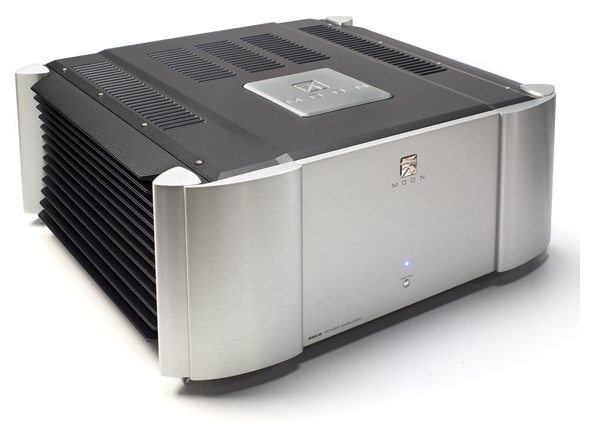
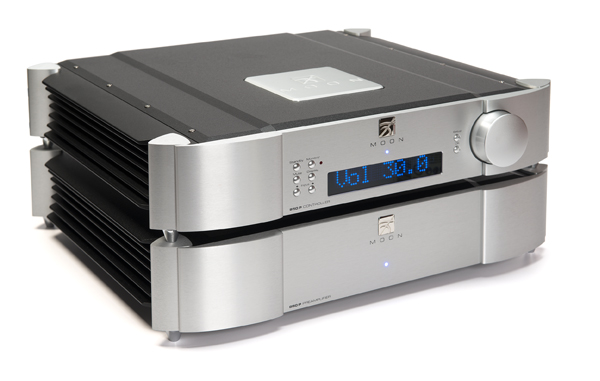
Simaudio MOON 880M Monoblocks

Revisiting Dave Grusin’s classic audiophile album, Discovered Again!, brings back frustrating memories of how amplifiers in the early ’80s didn’t have enough horsepower to do justice to a record with wide dynamic swings.  The same dilemma exists when playing many of today’s carefully remastered records with ultra-wide dynamic ranges:  Even though there is no obvious distortion, something is still missing.  And you don’t know it until you hear what a mega power amplifier can achieve.

Forget “simpler is better,” “lower power is better” or whatever other mantra you’ve let yourself be convinced by to avoid making the step up to a high-quality, high-power amplifier.  You’re in for a shock the first time you plug the MOON 880Ms into your system.  It’s a “space, the final frontier” kind of thing, with the 880Ms opening up a parallel universe where the Enterprise now goes to warp 13, instead of only warp 9.7.

At $42,000 per pair, these amplifiers are not for the faint of wallet—but the only other amplifiers I’ve heard with this kind of jump factor are the $205k-per-pair Boulder 3050s.  Instead of spending that kind of cash, you could go with a pair of the 880Ms, Simaudio’s $28,000 MOON 850P preamplifier, your favorite $25k digital front end, a similarly priced analog front end, and maybe $40k for a great pair of speakers. You’ll still have enough cash left over for European delivery of a new Porsche Cayman S and a trip to the Montreux Jazz Festival for a week to take in some great live music.  To the right buyer, the MOON 880Ms are a major bargain—it’s all relative.

The Un-Compressor

Thom Yorke’s The Eraser is a fairly compressed recording, as is Supreme Beings of Leisure’s album 11i. The recently remastered Deluxe Version of Thin Lizzy’s Jailbreak feels tighter still. The MOON 880Ms bring these dense albums to life in a way the other amplifiers at my disposal simply cannot do.  It’s like driving a high-revving, high-horsepower V-12 supercar that produces its power without the help of a turbo or supercharger—there’s an immediacy to the throttle response that a boosted car never has, even though it may have more torque.

When it comes to amplification, reserve power is essential if you love metal or large-scale orchestral music.  Distortion is the enemy of tweeters, and playing metal at high volumes will easily liquefy your speakers if your amplifier can’t deliver massive amounts of ultra-clean power.  I don’t think I’ve ever played System of a Down’s single “B.Y.O.B.” as loud as I did with the MOON 880Ms, and it never became painful.  These amplifiers are without practical limit, even with my 89-dB speakers.  If you have a more sensitive speaker up in the range of 93 to 95 dB @1 watt, like the Focal Grande Utopia EMs, Wilson XLFs or Verity Lohengrins, I’d highly suggest a good calibrated level meter to protect your ears from damage.  The extra dynamic range of the MOON 880Ms produces a listening experience so free of artifacts that you’ll likely catch yourself playing music a lot louder than you normally do.  And dammit, that’s really cool.

Even at modest levels, the MOON 880Ms sound clearer and more spacious.  On Liszt’s Hungarian Rhapsodies for Orchestra, 1-6, from the recent Mercury CD set, the initial attack on the string bass at the beginning of the first piece, combined with the glorious hall ambience, only begins to prepare you for the excitement in store as the full orchestra kicks in about three minutes later.  And the tone?  Fantastic.  Oboes and violins just float silky and softly through the listening space, and are never the least bit grainy.  These amplifiers simply do not impose a sonic signature on the music, and they always get out of the way of the presentation.  The MOON 880M does run in Class-A mode for the first 10 watts, and the transition to Class-AB at higher levels and power peaks is achieved seamlessly.

The Amplifier or the Egg?

Visiting the Simaudio factory last summer, I had the privilege of listening to the MOON 880Ms for the first time, driving a pair of Dynaudio Confidence C1 II speakers in Simaudio’s listening room, which is about 20 feet by 30 feet and expertly tuned to take the room out of the equation.  Upon returning home, my own pair of C1s was somewhat disappointing in comparison.  As one who loves a good rationalization, I chalked it up to the better room tuning and went about my business.

After properly treating my listening room, that experience was still missing by a substantial margin.  The MOON 880Ms in my room convince me that it’s the amplification making the big difference.  Though it may come across as controversial to some, especially those who think that speakers are nearly everything, I propose that the amplifier affects the system’s overall sound just as much as the speakers do, if not more.  Pairing the MOON 880Ms with some excellent but modestly priced speakers (like the splendid KEF LS50s or the Harbeth Compact 7ES-3s) makes for a bigger, more spacious and detailed sound than connecting a $50k pair of speakers to the best $1,000 integrated amplifier you can find.

Playing Thievery Corporation’s The Richest Man in Babylon is a revelation through these amplifiers, even though I’m sure you’ll be buying a better pair of speakers for the 880Ms in your house.  Yet, these great compact speakers, which sound spectacular paired with a Rega Brio-R or a PrimaLuna ProLogue integrated, offer a breathtaking experience with the MOON 880Ms.  They now have real bass weight where there was barely any before.  Like any of the large floorstanding speakers used for this review, these amplifiers’ enormous power reserves redefine control.  This kind of current is not swayed by the reverse EMF generated by the loudspeakers to anywhere near the extent that it is with a small amplifier.

Moving back to my reference GamuT S9s, tracking through DJ Cheb i Sabbah’s La Ghriba: La Kahena Remixed is a religious experience for those worshipping at the temple of mega bass.  The throbbing, tribal beats in this record compress my spinal column as the volume approaches club level without a trace of strain, and as the final notes fade to extreme black, it’s tough to find where my room boundaries lie, even with my eyes open.  You don’t need to dim the lights to get into a deep, deep, listening experience with these amplifiers.

Of course, the better recordings at your disposal will benefit even further.  Aphex Twin’s 26 Mixes for Cash features a broad sonic landscape in all directions, deriving much of it from all the low-frequency bass texture—an area that the MOON 880Ms enhance considerably.  Tracking through a large stack of audiophile workhorses, the gestalt of the MOON 880Ms is crystal clear:  These amplifiers provide incredible resolution; yet, even after 12-hour listening sessions, they are never fatiguing.

Right Brain, Left Brain

The MOON 880Ms feature top-quality casework, with aluminum enclosures produced in Simaudio’s Montreal facility on its own five-axis CNC mill and anodized to last a lifetime, perhaps longer.  (Those wanting a more in-depth view of the company’s operation can click here for our recent visit: <<<INSERT LINK>>>.)  Simaudio’s engineers feel that the effort spent on solid casework not only eliminates vibration from the electronic environment, but also makes for stunning aesthetics—again an emphasis on quality and value.

As an added bonus, all this power comes in a relatively compact package.  These monoblocks will fit on any rack capable of supporting about 100 pounds each.  Simaudio’s high-biased, Class-AB design runs barely warm to the touch, even at high volume levels, and the company uses standard 15-amp IEC sockets.  As with the other giant monoblocks reviewed in this issue, the 880Ms will work on a single 15-amp circuit, but will perform even better with a dedicated 20-amp circuit, preferably a pair of dedicated 20-amp circuits.

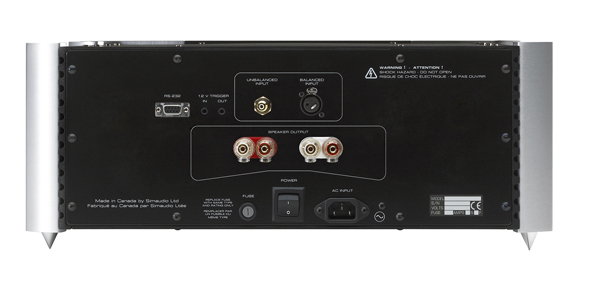
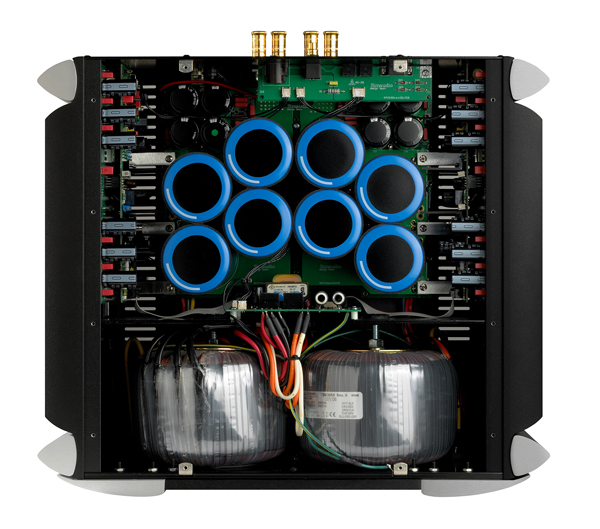
Lifting the cover reveals a fully balanced design that also has an RCA input for those not having a fully balanced preamplifier.  Each amplifier utilizes 32 matched Motorola output devices, along with a pair of 1.3-kV power transformers and 240,000 uF of power-supply capacitance—all contributing to the complete lack of noise in the 800M’s presentation.  This is an amplifier that music lovers and technology geeks can both cuddle up to; all the right boxes are ticked.  Those wanting a further technological analysis, click HERE.

Call Me Crazy

But don’t call me Shirley.  Though a pair of the Simaudio MOON 880M amplifiers costs as much as a 3-series BMW, consider this:  These amplifiers will easily last 20 to 30 years without any attention.  If you leased a new 3 series every three years for the next 20 years, you’d have spent just over $100,000 and still not have a fixed asset at the end of the term.  Considering that over 90 percent of all the Simaudio components ever made are still playing music without effort (and have a 10-year warranty), that pair of 880Ms you buy today will probably still be worth $5,000 to $10,000.

Jay Leno once said that car enthusiasts are either check writers or wrench turners, which also applies to many audiophiles.  Taking it a step further, one faction of audiophile is on a quest to swap gear nearly constantly in search of an elusive grail, while another diligently assembles an excellent system and pursues music exploration with fervor.  While we won’t pass judgment on either camp here, if you fall into the latter, a pair of MOON 880Ms can be your final destination—even if you swap speakers a few times on your journey, there’s nothing they will not drive.

Factoring that into the equation, the Simaudio MOON 880Ms represent an exceptional value, and are highly deserving of one of our Exceptional Value Awards for 2013.  They provide a sonic experience that few amplifiers can match, at any price, and they are built to the highest levels of quality.

Simaudio MOON 880M Mono Reference Power Amplifiers

MSRP: $42,000 per pair

www.simaudio.com

Peripherals

Analog Source VID Acutus Reference SP turntable     TriPlanar arm    Lyra Atlas cartridge    AMG V-12 turntable    AMG arm    Clearaudio Goldfinger cartridge
Phonostage Simaudio MOON 810LP    Indigo Qualia
Digital Source dCS Vivaldi stack    Sooloos C-15    Aurender S10   Simaudio MinD
Preamplifier Simaudio MOON 850P    Audio Research REF 5SE    Robert Koda K-10
Speakers Dynaudio Confidence C1 II    Sonus faber Aida    GamuT S9
Cable Cardas Clear

PrimaLuna ProLogue Premium Stereo Power Amplifier

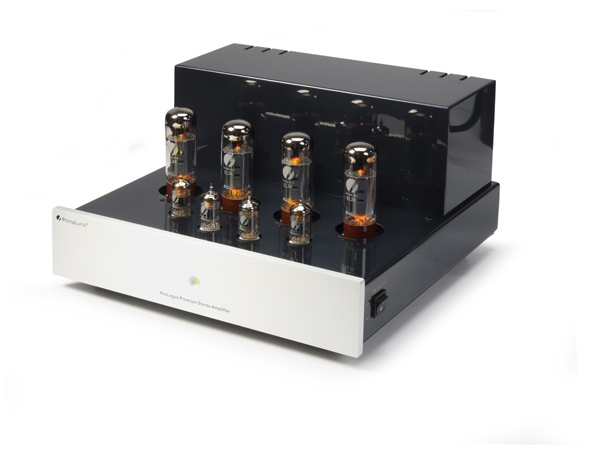
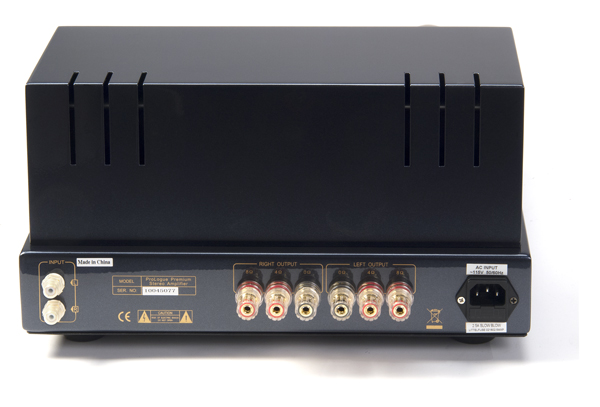
So what exactly makes this a premium PrimaLuna product?  Like all products from the Dutch brand, the ProLogue Premium Premium Stereo Power Amplifier has a certain aesthetic appeal: a gunmetal-colored finish, which wouldn’t be out of place on an AMG Mercedes, set off by an anodized-aluminum faceplate (available in silver or black).  Also like the rest of the company’s lineup, the ProLogue Premium stereo amp offers serious levels of performance—this is where the amp’s premium designate becomes apparent.

Popping off the bottom cover reveals ceramic tube sockets and Nichicon and Solen capacitors flanked by premium resistors, along with newly designed output and power transformers.  Wiring is all point-to point and meticulously done by hand, which is one of the reasons PrimaLuna amps have earned such a high reputation for their reliability.  All this precision comes wrapped in a somewhat compact package that weighs nearly 50 pounds, and has an MSRP of $2,299.

Hassle-Free Tube Power

PrimaLuna amplifiers have long been known for their Adaptive AutoBias circuitry, a PrimaLuna trademark that makes traditional tube biasing a thing of the past.  This design allows a wide range of tubes to be used in the output sockets:  KT88 or EL34 tubes work equally well—every ProLogue Premium Series amplifier comes with either set of tubes installed.  (The KT88s produce 36 watts per channel; the EL34s produce 35 watts per channel.)  The new premium version of the amp adds a switch on the side of the chassis, allowing you to optimize the amplifier to your choice of tubes, in order to achieve the lowest possible levels of noise and distortion.

I’m immediately struck by the lively sonic response that the ProLogue provides, with a quick, organic and natural sound that spans all frequency ranges.  This amplifier always feels ready and able to take on whatever you can throw at it—which is exactly what I did.  The ProLogue Premium eliminates the hassle of owning a vacuum-tube-powered amplifier.  It even has a PTP circuit (for Power Transformer Protection) that will protect the amp’s output transformers, should you have an accidental, catastrophic tube failure, which can happen with today’s tubes.

PrimaLuna has updated the front-end circuitry for this amp, which now uses 12AU7 tubes instead of the 12AX7s in the company’s earlier amplifiers.  The inveterate tweak-geek in me could not resist fooling with those 12AU7s, even though the amp sounds great with stock tubes.  New old stock GE tubes render a smoother top-end response, but offer a different listening perspective, as if I had moved back about five rows in the orchestra.  Next, a set of RCA clear tops (with side getters, for the tubeophiles in the audience) provides a big jump in frequency extension, as well as more transparency and a more palpable midrange.  Best of all, Kevin Deal, the owner of Upscale Audio (and the PrimaLuna importer) has a massive cache of these tubes in stock, so you can experiment at will; the 12AU7s aren’t nearly the cost of the 12AX7s. When asked, Deal said that he has “over 10,000 rare and NOS 12AU7s.”

Be aware, I achieved these results with my system; so don’t take them as an absolute, as results will vary on other systems.  But that’s the fun of an amplifier like this:  You can experiment as much or as little as you want—and we haven’t even talked about swapping output tubes.  Don’t forget to save those stock tubes just in case you find yourself lost in the vacuum-tube jungle.

Love at First Listen

Brian Bromberg’s closely miked contrabass in “The Saga of Harrison Crabfeathers,” from his Wood album, instantly confirms the level of full-bodied bass definition the ProLogue Premium provides.  In addition to the solid low-end response, you can clearly hear the creaking and groaning of the instrument, as well as the strings being plucked and slapped on the fretboard.  I’ve never heard this kind of resolution from a vintage Dynaco Stereo 70 (or modded variation on the theme).

Muddy Waters’ album Folk Singer proves a perfect midrange showcase for this amp, which places Waters’ voice firmly at center stage, while simultaneously revealing the ambience in the recording studio present on this intimate performance.  Perhaps the best showcase of any tube amplifier is its ability to convey the sultriness of the female voice, which is another test that the ProLogue Premium passes handily.  I listen to the entire disc of Renée Fleming’s Haunted Heart without pause.  The track “When Did You Leave Heaven?” gives Fleming and the accompanying guitar, courtesy of Bill Frisell, plenty of space without missing a lick of subtlety.

And Secondly

It’s usually a given that vacuum-tube amplifiers excel at revealing low-level detail and vocal tonality, but the ProLogue Premium performs equally well with larger-scale music.  Nelson Riddle’s Nice ‘n’ Easy: The Music of Nelson Riddle is a classic big-band record full of massed horns, which the ProLogue Premium sails through, keeping the horns sorted without becoming harsh or buried in the mix—impressive.

The acid test comes via the Minutemen’s “One Reporter’s Opinion,” from the Double Nickels on the Dime disc.  D. Boon’s AK-47-style guitar playing is present in all its force, Mike Watt’s fluid bass is easy to follow and drummer George Hurley’s seems to punch a hole in my forehead—the PrimaLuna delivers all of this while giving the track the precision and grit on the scale it deserves.  No matter how complex the musical selections, this amplifier does an excellent job keeping pace.


I’m a Fan!

I’m taken with this little but heavy amplifier, and can see why our publisher has been an advocate of PrimaLuna since day one.  This amp takes everything I throw at it in stride—always musical, always eager and always evenly balanced in overall presentation.  As with the other PrimaLuna products, the Premium stereo amp represents good value.  This is the perfect power amp for a music lover wanting to assemble a high performance system on a tight budget.  The ProLogue Premium is worth every penny.

I will say that one must be realistic when pairing the Premium with his or her speakers and listening environment.  Although the volume levels I’m able to achieve with this amp in my largish room are quite satisfying, 35 watts only go so far—even great watts such as these.  The amp does clip slightly when I get lead-footed with the volume.  To its credit, when the amp does clip, it does so with gentle compression instead of just falling apart.  To this point, speakers that are in the 90-plus-dB category will make for optimum system synergy in most rooms.

Additional Listening

By Jeff Dorgay

As Jerold mentioned, I’ve been listening to PrimaLuna amplifiers since the company introduced the original ProLogue One almost 10 years ago.  It’s almost like TONEAudio and PrimaLuna have grown up together.  That original amplifier is still in my family and, with a replacement set of power tubes, it keeps playing music on a daily basis without bother.

It’s been fun watching the PrimaLuna products evolve over the years into a more fleshed out line, with each model revealing more music than the one before.  Putting the ProLogue Premium stereo power amp through its paces is a joy, with the matching preamplifier and a few other examples I have on hand.  If you don’t need a built-in phonostage (and like your garanimals to match), the $2,199 ProLogue Premium Preamplifier makes for killer a setup with the Premium power amp.  The preamp is perfectly matched to the power amp electrically and stylistically, and pairing the two together will easily fool you and your friends into thinking you spent a lot more scratch on your system.  Many of my old-school buddies were having visions of vintage McIntosh in their heads, when I had this PrimaLuna combo connected to a mint pair of JBL L100 speakers.

Cranking up Judas Priest’s Screaming for Vengeance (on the matching PrimaLuna CD player we reviewed a few months ago) is a little slice of heavy-metal heaven—for a minute I was worried I might just blow up those JBLs, like I did back in the day.  The smooth sound of this PrimaLuna front-end package does not disappoint.
Another, more modern speaker that is a spectacular match with 35 watts per channel of tube power is Vienna Acoustics’ Mozart Grand.  The speakers have a 90-dB-sensitivity rating and a very gentle first-order crossover, but the ProLogue never runs out of gas when powering them.  And at about $3,500 a pair, the Mozart speakers won’t put you in the poorhouse.  Those on a tighter budget, consider a pair of Vandersteen 1Cs, which have the same high sensitivity, but are only $1,200 a pair.

Back when Kevin Deal and I sold mid-fi gear in stereo shops reminiscent of the one in the movie Ruthless People (1986), we used to describe gear as being more suited to rock or classical, etc., etc.  But the PrimaLuna electronics are a little bit of magic:  They play everything well, yet they inject just enough of that tubey warmth to make the bulk of your music collection sound much better than you’d expect it to.  This is a godsend for those having a mostly digital music collection, MP3s or CDs.

For this amp, I took the time to swap output tubes.  A set of super high zoot NOS 6550s or a new set of EAT KT88s, both of which will set you back about $1,500, but fear not, there are tons of great new EL-34 tubes in the $25-$50 range that sound fantastic. The extra midrange warmth and liquidity they provide will have you wondering if you ever need another amp.  And should a tube fail at an inopportune moment, the Adaptive AutoBias will even keep the amp purring along with a mixed set of output tubes. You’d be surprised at how many hardcore audiophiles have gone full circle back to the simplicity of an EL-34 amplifier paired with moderately efficient speakers.  This is an amplifier you can either start your tube journey with, or live with happily ever after.

With vintage Luxman, Marantz and McIntosh tube amplifiers fetching crazy money on the used market these days (not to mention their questionable reliability), make your life easy:  Put a PrimaLuna Prologue Premium between your speakers and just dig it.  You’ll be glad you did.

PrimaLuna ProLogue Premium Stereo Power Amplifier

MSRP:  $2,299

www.primaluna-usa.com

Peripherals

Digital Source PrimaLuna ProLogue Premium CD Player    dCS Debussy
Analog Source Rega RP6w/Exact    Monk Audio Phono Pre
Preamplifier PrimaLuna ProLogue Premium    VTL TL-5.5Mk. II
Speakers Lawrence Audio Violin    Dynaudio Confidence C1 II
Cables AudioQuest King Cobra    Furutech LineFlux and SpeakerFlux

Pass Labs XA200.5 Monoblocks

All things must eventually come to an end, but this time the breakup is not sweet sorrow.  Living with the Pass Labs XA160.5 Class-A monoblocks has been a wonderful experience, and the heat that these massive monoblocks let off is a small drawback compared to the glorious sound they produce.  In a year and a half of flawless performance, driving every kind of loudspeaker imaginable, I didn’t jot down a single complaint in my mental logbook.  The XA160.5s even proved more engaging than a number of vacuum-tube power amplifiers parked here for various reviews and personal auditions, supporting Nelson Pass’ claim that listening to his amplifiers are like “listening to tubes, but without the hassle.”

But then the XA200.5 monoblocks arrived.  “More devices and more power equals more control,” says Pass Labs’ Desmond Harrington when asked about the difference between the XA160.5, the XA200.5 and the soon-to-arrive XS amplifiers.  If there was ever a case of specs not telling the whole story, this is it.  You might think there would be barely any difference between these two amplifiers—one delivering 160 watts per channel and the other delivering 200 per channel—but fire up the drum solo in Zeppelin’s “Moby Dick,” and the XA200.5 paints an entirely different picture.  “Stairway” is pretty damn good, too.

Hey, Ho, Let’s Go

Tony Levin’s bass playing on the Black Light Syndrome album, from Levin, Steve Stevens and Terry Bozzio, illustrates this perfectly.  This album offers some of the heaviest prog rock available; a dense, driving orchestral soup in which these three virtuosos repeatedly lay down notes like they’re firing automatic weapons.  Levin is solidly anchored, while his bandmates careen off to the far edges of the soundstage from start to finish.  Keeping all three musicians straight without blur is a tough task, but the XA200.5s handle it effortlessly, even at high levels.

The low, grumbling undercurrent of Burial’s “In McDonalds” takes on a more visceral feel through these amps, helping the listener truly feel the track’s deep bass and low-level texture in a way few amplifiers can muster.  The overblown bass in Cash Money and Marvelous’ “Ugly People Be Quiet” loses none of its rawness and boom, while rumbling the woofers in the GamuT S9 speakers as if a subwoofer has been added to the system.  Many audiophile amplifiers suffer from too much control and damping in such instances, taking the soul of the music with it, but the XA200.5s are true to the music, no matter what the genre.  Even a lousy-sounding record like Teenage Fanclub’s Bandwagonesque is better sorted through these amps—this thick, compressed recording actually gives up some dynamics, with a little help from the dCS Vivaldi source.

With two pairs of world-class reference speakers at my disposal (the GamuT S9 and the Sonus faber Aida), these amplifiers play to a painfully loud level without distortion.  Whether using the S9 (89 dB sensitivity) or the Aida (92 dB), the XA160.5s can be driven to a point of compression; the XA200.5s have no limit in my system.  But man cannot live by bass alone—transient prowess is another area at which the XA200.5s excel.  Romping through the title track from Carsten Dahl’s Bebopish Rubbish Rabbit, these amplifiers provide not only control, but also acceleration.  They equally render drum transients and brushwork with the proper scale and finesse.

On one level, a component can really only be evaluated in the context of a system, and it’s tough to attach a sound to said component without seeing how it reacts to the known performance of a number of other preamplifiers and speakers.  Having lived with a variety of Pass amplifiers for a few years now, I would characterize their overall sound as ever so slightly on the warm and harmonically rich side of the scale.

The XA200.5, like all of the other XA-series amplifiers I’ve auditioned, paints a big, spacious, three-dimensional soundstage—again, much like your favorite tube amplifiers do, but with considerably more dynamics, grip and control.  On the title track from Leni Stern’s album Smoke, No Fire, the XA200.5s capture her delicate guitar playing with every bit of the gradation she presents in a live show, while layer upon layer of overdubbed vocals hang in mid air, meticulously spaced between each other.  Too often, mediocre solid-state amplifiers fail musically when presented with these kinds of recordings, because their inability to resolve spatial information results in an overly flat and sterile picture.  Modestly powered tube amplifiers excel at this kind of thing, but are unable to produce the giant dynamic swings required to capture a large orchestra or driving rock band.  The XA200.5s excel here, providing the best of both worlds.  Thanks to their massive power supplies and big banks of output transistors, these amplifiers retain inner detail while simultaneously carrying a heavy bass line or the roll of a kettledrum.

A is A

The Pass Labs website simply states in the FAQ section that the reason the company produces Class-A amplifiers is “because they sound better.”  I love this firmness of conviction.  I must also admit to a bias towards high-powered Class-A solid-state power amplifiers in the same way someone might prefer tubes, SET amplifiers or a pair of Quad 57s.  At the end of the day, we all have a preference, and I won’t apologize for this one.  Pass’ large Class-AB amplifiers, as well as a few other massive AB amplifiers I’ve experienced (like the Simaudio 880Ms also reviewed in this issue), still have slightly faster acceleration and ultimate dynamic swing, but this always comes at the expense of that last bit of inner sweetness.  That being said, one person will always prefer the slightly softer ride of a standard Mercedes to the AMG version with sport suspension.

Pass Labs’ relatively recent .5 series of Class-A amplifiers come as close to offering it all as anything I’ve experienced.  While I still treasure my Pass Labs Aleph 3 (from the ’90s) and Threshold 400A (one of Nelson Pass’ first Class-A designs from the late ’70s—also a big favorite), comparing them to the XA200.5s clearly illustrates where Mr. Pass has built on his initial strengths, constantly refining the sonic delivery of today’s models.

Romping through a plethora of recorded male and female vocalists underscores these amplifiers’ combination of power, delicacy and tonal accuracy.  Anne Bisson’s gentle vocal stylings on the title track of her recent Blue Mind album are reproduced perfectly though the XA200.5s, as are the piano and soft drum work that accompany her.  If not for the enormous heat sinks on the side of each amplifier, you’d swear that the grain-free tonal texture that the XA200.5s provide is due to some vacuum tubes inside the box.  And that’s the entertaining paradox:  These amplifiers have too much sheer grunt to be tubed.  Like Nelson Pass said…

Setup and Synergy

During our time with these amps, we had the opportunity to power about 30 different sets of speakers, from a pair of freshly refurbished MartinLogan Aerius i speakers to Sonus faber’s flagship Aidas.  Nothing poses a challenge to these amplifiers or affects their performance.

The amp’s balanced XLR and single-ended inputs have an impedance of 30k ohms, which makes them easily mated to the preamplifiers at our disposal from Audio Research, Burmester, Conrad-Johnson, Robert Koda and Simaudio.  Cardas Clear cabling was used for the bulk of our listening tests, yet both speaker cables and power cords affect the XA200.5 less than many other high-powered amplifiers in recent memory.

One thing the XA200.5s benefit from, if you have the luxury, is dedicated power.  Drawing 700 watts each all the time, they will work connected to a standard 15-amp circuit, but will work better with a 20-amp line and better still with a pair of dedicated 20-amp circuits—one for each amplifier, if you really like to twist the volume control.  I’d suggest having your electrician install a pair of 20-amp outlets for your XA200.5s before you drop a few thousand dollars on exotic power cords.

Fortunately, these 159-pound monsters have conveniently placed handles on the rear panel, though (unless you’re incredibly buff) you will still need a friend to help you unpack these amplifiers.  Once you’ve installed the amps, be sure they have plenty of ventilation, because they do get warm.

The Big, Big Money

This extra power and control doesn’t exactly come cheap.  The XA200.5s have an MSRP of $34,100 per pair, compared to $24,000 per pair for the XA160.5s.  It’s always easy for me to spend your money, but if you can find a way to come up with the extra $10,000, you will not be disappointed—this is truly a case where absolute power corrupts absolutely.  The XA160.5s are no slouch by any means, and tonally identical to the XA200.5; yet, even at modest volume levels, the effortlessness provided by the bigger, beefier output stage and larger power supply is instantly evident.

If you are looking for a pair of monstrous Class-A amplifiers that take no prisoners, consider the Pass XA200.5 monoblocks, or stick around for a few more issues—the XS two-box monoblocks have just arrived for review!

Pass Labs XA200.5 Monoblocks

MSRP: $34,100 per pair

www.passlabs.com

Peripherals

Analog source AVID Acutus Reference SP turntable    TriPlanar tonearm    Lyra Atlas cartridge    AMG V12 turntable    AMG tonearm    Clearaudio Goldfinger cartridge
Digital source dCS Vivaldi    Meridian Sooloos Control 15    Aurender S10
Phonostage ARC Reference Phono 2 SE    Indigo Qualia
Speakers GamuT S9    Sonus faber Aida    Sonus faber Elipsa SE
Cable Cardas Clear
Power IsoTek
Accessories Furutech DeMag and DeStat    Audio Desk Systeme RCM    GIK room treatments

Electrocompaniet ECI 3 Integrated Amplifier

Norwegian manufacturer Electrocompaniet has produced highly regarded electronics going on four decades now.  My first vivid audio memory from childhood is of my father reading a glowing review of an Electrocompaniet amplifier in the The Audio Critic.  As I recall, he mentioned that the reviewer loved the way the amplifier sounded with the Rogers LS3/5A, which he also owned.  Why my father was telling me this I don’t quite know, but I’ve always maintained a curiosity about this seemingly exotic Nordic brand.  The company currently offers a full line of products, including speakers, amplifiers and cutting-edge digital sources, like wireless and USB DACs.

The 70-watt-per-channel ECI 3 integrated amplifier, priced at $3,400, is the entry-level integrated amp in Electrocompaniet’s Classic line.  And it’s a stunner, with copper-tinged buttons adorning a heavy-duty acrylic faceplate against black casing—the signature look for the entire line—plus ice-blue LED lights, which lend the amp a futuristic feel when the lights in the listening are dimmed.  Its connector and speaker terminals are high quality, and its 26.5-pound weight inspires confidence in its build quality.

The ECI 3 is fully balanced, with six inputs, and it offers two tape outputs.  There is also a balanced output, an Electrocompaniet trademark, for driving an external balanced amp.  Electrocompaniet touts its motorized volume control as being virtually transparent.  The company also claims that its proprietary Floating Transformer Technology is unique, allowing greater current reserve than other conventional power supplies, and that the amp can drive virtually any loudspeaker.

All of its functions are accessible via the supplied remote, which has the ability to control multiple Electrocompaniet components.  Setup is simple and straightforward, which makes it easy for me to use the ECI 3 in two separate systems with three different pairs of loudspeakers, including the MartinLogan Ethos, the Thiel CS2.4, and the Harbeth Compact 7ES-3.  My sources include various CD transports, as well as Logitech’s Squeezebox Touch decoded by Bryston and PS Audio DAC units.

The ECI 3 is an excellent match with the MartinLogan and Harbeth speakers, but not so much with the Thiels, which just sound too dry and lifeless when paired with this amp.  As superb as the Logans sound with this amplifier, the Harbeths prove to be the proverbial match made in heaven, with an incredibly wide soundstage and a tonal beauty that makes walking away from listening sessions difficult.  This combination displays an almost tube-like quality in terms of harmonic richness.  But don’t get me wrong:  This is not a soft-sounding amplifier obscuring musical detail in a haze of warmth.  There is plenty of energy and presence, which the amp delivers in the most musical way.

Specifically, I truly enjoy the superb delicacy in the treble and the wonderfully clean and smooth midrange, with plenty of bass weight and articulation.  These qualities are found across the board, regardless of musical genre.  I call up a slew of Ben Harper albums, which are always a great test for gear, since he bounces between earnest acoustic stuff and blazing Zeppelin-influenced rock, as well as soul, punk and alternative.  His sublime Diamonds On the Inside, from 2003, even throws in some hardcore ’70s-style Bob Marley jams and ballads.  I am very impressed with the ECI 3’s ability to navigate these winding musical waters with absolutely no effort, and its ability to render the music with zero mechanical artifacts.  This is not a mechanical sounding solid-state amplifier by any means.

Digging deeper into my music collection leads me to Gábor Szabó, the hugely influential Hungarian jazz guitarist.  His ’60s and ’70s albums are littered with pop tunes of the day and standards in mind-bending psychedelic arrangements.  His album 1969 sounds exactly as the title suggests, with quaint embellishments in the fashion of the time, like sitars, tablas and Eastern modalities.  The ECI 3 keeps Szabó’s tone creamy and fluid, yet it maintains a high level of resolution all the while.

I decide to pull a joker from the deck, cueing up Shine a Light, the soundtrack to the 2008 documentary on the Rolling Stones.  Mick and the gang are unusually energetic in this show, but the CD mix tends to come off as a bit messy.  This is not the case when listening to it through the ECI 3.  I hear Bob Clearmountain’s mix in a whole new light, so to speak:  The guitars bite, the drums crack with authority and there is plenty of bottom end.  Jagger’s vocals are dead center in the mix, with the horns and backup singers positioned well across the soundstage.  The ECI 3 rocks out, and does so with class.

Operationally, the ECI 3 is plug-and-play all the way and a pleasure to use.  Careful listening reveals the balanced input has a slight edge on the single-ended inputs in terms of clarity, but this of course will depend on the source component. As the PS Audio NuWave DAC is truly balanced, it showcases the ECI 3’s balanced design.  Furthermore, the ECI renders amazingly quiet backgrounds and excellent dynamics—it easily handles the most dynamic of orchestral crescendos, which supports Electrocompaniet’s claim that the company uses top-quality parts and execution for this piece of gear.

As a self-admitted remote-control junkie, my only complaint is the plastic remote, but this is a minor issue.  I’m sure most users would prefer that Electrocompaniet instead allocate its resources to the parts affecting sound quality.

With a crowded field of integrated amplifiers in the $3,500 range, it is difficult to stand out.  The example does stand out, combining elegant sound and aesthetics, with the support of Electrocompaniet’s long and respected pedigree.  We are so highly impressed with ECI 3 that it will be an in-house reference component for the TONEAudio reviewing team going forward, because it offers such high value and flexibility.  With plenty of power on tap, more than enough inputs to satisfy, a fully balanced design, superb build quality and cool Scandinavian aesthetics, the Electrocompaniet ECI 3 is a product that we highly recommend.

Electrocompaniet ECI 3 Integrated Amplifier

MSRP: $3,400

www.electrocompaniet.com

Bob Carver Black Magic 20 Stereo Amplifier

To say Bob Carver is a legendary amplifier designer would be a major understatement.  Without going into historical detail, suffice it to say he has produced a few gems in his day.  And now it’s back to the future, with Carver again producing amps under his own name.  The Cherry 180 (reviewed HERE) and the Black Beauty 305 monoblock amplifiers have both received universal praise from reviewers and happy customers alike, for their build-quality, stylish good looks and plenty of power on tap.  But with the $2,100 Black Magic, Carver takes a different direction.

This small amplifier, model designation VTA20S, is finished in black with a “silver-fleck” chassis and brushed-silver trim.  It is outfitted with 12AX7B tubes for the input stage, and a quartet of EL84Ms for the output stage.  According to Carver, the “M” variant of the EL84 was selected because it has a higher plate-voltage rating, allowing for maximum power output within safe operating conditions.

Setting up the Black Magic is amazingly simple.  There is no need to bias the tubes, which is done automatically with one set of speaker binding posts, optimized for a 4-ohm load.  There is, quite interestingly, a volume pot at the top-front area of the chassis.  (More on that a bit later.)  I drive the Black Magic with a Rogue Ninety-Nine preamplifier for the bulk of my listening sessions, and in turn drive my Thiel CS2.4 speakers.

After giving the Black Magic ample warm-up time, I’m rewarded with startling clarity, a liquid-smooth midrange and, most impressively, floor-shaking bass.  Carver says that the amp is “conservatively” rated at 20 watts per channel—it definitely sounds more powerful than its published rating suggests.  For my review, I go directly from my Audio Research VS55 amplifier (rated at 50 watts per channel) to the Carver with no immediately discernible decline in dynamic performance, power output or bass quality.

The Black Magic’s imaging specificity is impressive, with little of the “tube haze” surrounding the vintage sound of the EL84 tubes.  The Black Magic easily handles music of any scale, including orchestral crescendos.  The Direct-Stream Digital SACD of Semyon Bychkov conducting Rachmaninoff’s Symphonic Dances is simply ravishing in the tone colors of the strings and woodwinds, and the full impact of the orchestra’s power is there in all its glory.  I am continually stunned at just how much of a wide dynamic swing this little amplifier can muster.

The sublime SACD pressing of the Moody Blues classic album, In Search of the Lost Chord, plays to all the strengths of the Black Magic.  The melancholy melodies and vintage arrangements on such tracks as “The Actor,” “Visions Of Paradise” and the album’s centerpiece, “Legend Of A Mind,” are breathtaking in their majesty.  Lead vocalist Justin Hayward’s voice is a holographic presence in my listening room, and the amp delivers more than enough resolution to hear long-buried recorded details—just the thing you call on a tube amplifier to perform.

Staying with the vintage vibe, the Carver brings sparkle and life to the iconic ’60s recordings by Smokey Robinson & the Miracles, from the well-mastered compilation, The Definitive Collection.  The Black Magic commands attention on such classic tracks as “Going To A Go-Go,” “The Tears Of A Clown” and “Mickey’s Monkey.”  The rhythmic incisiveness is top notch, with a keen ability to get a track moving.  This inner detail and delicacy is always a key factor with an amplifier based on the EL84 tubes, and the Carver has the best balance of new- and old- school sound that I’ve experienced in this genre.

Moving on to modern times, U2’s “Electrical Storm,” from The Best of 1980–2000 collection, simply rocks when playing through the Carver, which highlights the shimmering acoustic guitars, jagged electric lead lines, throbbing bass line and, of course, Bono’s passionate lead vocals.  On this track, all of the separate elements of the recording are made into an organic whole, providing some rare goose-bump moments.  The remix of “Gone,” from U2’s Pop album, is another standout track providing such moments.

An now, more about the amp’s volume pot I mentioned earlier:  Connecting the Marantz SA-11S3 SACD player/DAC directly to the Black Magic and adjusting the volume level directly from the amp provides additional transparency to the source and bass articulation.  The volume control has an excellent range of attenuation, never going past the 12 o’clock position.  Most modern line sources, like a CD player or DAC, output 2 volts, which is more than enough to power an amplifier with sufficient gain.  For those only utilizing a DAC and multiple digital sources, I suggest eliminating the linestage altogether—the Carver is that good.  However, for those using a linestage/preamplifier, I would leave the volume control at full, effectively taking it out of the circuit.

With the Black Magic, Bob Carver has done it again.  In addition to all of its positive sonic attributes, the Black Magic ships with a seven-year warranty on parts and labor, along with a generous one-year warranty on the tubes.  (Most manufacturers only offer 90 days.)  It is made entirely with point-to-point wiring in Carver’s Kentucky facility.  You can read more about Carver’s manufacturing process HERE.

While 20 watts per channel isn’t the solution for every system, a modestly sized room matched with sensitive speakers will deliver a rocking performance using this modern EL84 marvel.

Additional Listening

By Jeff Dorgay

Blowing the dust off of my Dynaco SCA-35 integrated amp reveals just how far Bob Carver’s classic design has come.  The vintage Dynaco is a pleasant listen, but switching to the Black Magic, even with vintage speakers like the JBL L26s, is a revelation.  Where the vintage amplifier has loose, flappable bass, the Carver is taut.  An equal paradigm shift is experienced in the upper registers—the HF roll-off that I’ve almost come to expect with this tube doesn’t happen, which is a testament to the quality Carver’s circuit and transformer design.

The only speakers in my arsenal that prove a challenge for this amp with heavier music are the Dynaudios, which have a somewhat low 84-dB sensitivity rating.  Thanks to a single-order 6-dB/octave crossover network, the speakers work well with the Black Magic, as long as not asked to play extremely loud—you can always pick up a second one, if need be.

Much like when listening to a top-notch mini-monitor, the Carver Black Magic excels at throwing a three-dimensional sound space that feels almost like wearing a gigantic pair of headphones.  It also delivers a tonal balance, falling more on the romantic side of the scale.  The Carver is certainly not vintage, but it does embellish slightly—for those using primarily digital source material, this should be a very good thing.

Lastly, to probe the absolute limit of the Black Magic, I insert it in my main reference system while finishing the review of the $120,000 Sonus faber Aida speakers (92-dB sensitivity).  This makes for a great showing, as the little amp is able to control these gigantic speakers incredibly well.

Andre and I agree:  If you’ve been wanting to try tubes, this is the perfect place to start your journey!

Bob Carver Black Magic 20 (VTA20S) stereo amplifier

MSRP: $2,100

www.bobcarver.com

Peripherals

Analog source,”Rega RP6 turntable    Exact cartridge    Lehmannaudio Black Cube phonostage”

Preamplifiers,”Rogue Audio Ninety-Nine    Conrad-Johnson PV-12″

Digital sources,” Marantz SA-11S3 SACD player/DAC    Logitech Squeezebox Touch    Meridian Sooloos Media Core 200/Rega DAC”

Speakers,”Thiel CS2.4    Dynaudio Confidence C1 II     Definitive Technology SM65    JBL L26    Sonus faber Aida”

Cables,”Darwin Cables Silver interconnects    Transparent Audio Super MM2 interconnects    Transparent Audio Plus MM2 speaker cable”

Power cords/conditioners,”Acoustic Zen Tsunami II power cables    Audience Adept Response power conditioner    Running Springs Audio Haley”

[/table]

Meshell Ndegeocello – Pour Une Ame Souveraine: A Tribute to Nina Simone

Meshell Ndegeocello’s latest record pays homage to Nina Simone in a rather obtuse but nonetheless excellent way. Where Simone was always a fusion between jazz and blues, Ndegeocello explores a wide range of styles here. There’s plenty of R&B, funk, soul, and gospel added to the soufflé.

Upon hearing the delicate rendition of the opening “Please Don’t Let Me Be Misunderstood,” it’s tough to believe this is the same woman that wrote “If That’s Your Boyfriend, He Wasn’t Last Night.” Female collaborators including Toshi Reagon, Valerie June, and Sinead O’Connor all add their voice to Ndegeocello’s in tribute. The record is consistently good throughout, and “Nobody’s Fault But Mine” is a standout.  Ndegeocello exercises excellent taste in the company she keeps.

Sonically, the vinyl is much better than the CD (included free with the 2LP set) in every way, yet it the analog version sounds like a 24/96 recording mastered to LP. The recording is big and spacious, with great attention paid to capturing Ndegeocello’s powerful bass playing. The giveaway: a hint of crunchiness on top and slight haze to the overall presentation that tells you it’s not all analog.  -Jeff Dorgay

Naïve Records, 2LP

Lynyrd Skynyrd – Pronounced Leh-Nerd Skin-Nerd

Lynyrd Skynyrd built the genre of Southern Rock, brick by brick, with clever songwriting, badass lead guitar playing (with three lead guitarists), and sheer grit. Legendary producer Al Kooper created a masterpiece here, and it finally gets the treatment it deserves.

The gold band at the top of the record jacket, marked “Original Master Recording,” means the original master tape was used for the reissue. It only takes a cursory listen to an early MCA pressing, which sounds like a CD in comparison, to hear the increase in sound quality on this MoFi edition. Much like early Van Halen records, there is almost a non-existent bass line in the original, now replaced by a big, fat sound that anchors the rest of the rhythm section and provides a proper foundation. And yes, there’s more cowbell too.

It might have been easier to dismiss this band if listening to the poorer original, but with so many sonic treats liberated from the mix, it’s great fun finding all the tidbits you’ve never heard over the years.  The bongos in “Gimme Three Steps” are but one example. The overall sound is so much more clean and dynamic, you just can’t turn this one up too loud. You haven’t lived until you hear the reverb-laden guitars on “Freebird.”  -Jeff Dorgay

Get out your lighter and boogie.  Do it.

Mobile Fidelity, 180g LP

Scottevest Fleece 7.0

TONE STYLE

Scottevest (aka SeV) produces specialized, tech-enabled clothing laden with the company’s signature pockets.  Its Fleece 7.0, for example, features a remarkable 23 pockets that vary in shape, size and purpose.  With seemingly endless storage, SeV jackets facilitate hands-free functionality for audiophiles and techies wishing to take their favorite portable devices and accessories on the go.

In the Fleece 7.0, a magnetically sealed pocket underneath the left hand-warmer pocket offers a clear, touch-sensitive fabric window inside the jacket to allow control of electronic devices, making it a breeze to navigate songs and playlists without removing the audio source.  While the pocket is sized to accommodate an iPhone, an iPod classic also fits nicely and is easily viewed in the window.

The Fleece 7.0 also includes SeV’s Personal Area Network, which allows the wearer to thread audio and headphone cables within the lining of the coat.  With a little finagling, wires can connect electronic items through and between many of the pockets, ultimately enabling headphone wires to exit the collar for convenient access.  Each side of the collar contains a mini-pocket to store ear buds out of sight when not in use.

Among the Fleece 7.0’s 23 pockets are a few specialized ones.  For instance, there is a soft-lined glasses pocket that includes a built-in, tethered cleaning cloth, which proves handy for cleaning touchscreens.  This pocket also features a map of the jacket to help the wearer navigate any audio accessories potentially lost in the maze of pockets.  There’s even a built-in water-bottle holder to reduce risk of dehydration during long listening sessions while on the go.

Taking into account all this onboard gear, the Fleece 7.0 arranges pockets so that telltale bulges from carried objects are minimized, even eliminated in many cases.  Is that an iPad in your pocket?  Yes, ahem, we’re happy to see this capability.

With devices galore, weight is also a consideration, which SeV addresses with the jacket’s weight-management system.  This design element distributes the jacket’s weight evenly across the wearer’s shoulders so that no one side of the body bears the sole burden of carrying all that gear—a vast improvement compared to carrying a laptop bag or briefcase with a shoulder strap.  While encased in pockets of plastic-and-metal electronics, the wearer may feel bulletproofed, but with this clever design, at least he or she won’t feel encumbered with armor.

If breaking a sweat from a vigorous walk to the pace of the crescendo of Queen’s “Bohemian Rapsody,” wearers will appreciate the fact that the sleeves are removable.  And, as you might have guessed, they can be placed in a back pocket, leaving wearers free to dance in the streets unbridled.

The Scottevest Fleece 7.0 comes in black or red. Load it up and get ready to rock!

Scottevest Fleece 7.0

MSRP: $160

www.scottevest.com

Resonessence Labs CONCERO

Following the success of their statement INVICTA DAC(CA$3,999) Resonessence Labs have fired their first salvo into budget territory.  They’ve come armed with two-for-one ammunition:  a USB-S/PDIF convertor and DAC packed into a single unit (CA$599).  You can purchase direct from Resonessence themselves or via their dealer network.  An additional $50 bundles Apple remote (for playback control and filter selection) and USB power supply (required for S/PDIF DAC mode) into the bargain.  Accessories aside, the whole shebang is manufactured and assembled right there in Canada.

Custom coding

On paper, basic expectations are comprehensively met: separate clocks for 44.1 kHz and 48 kHz sample rate families and an in-house coded asynchronous USB solution.  Concerned that it will introduce jitter, Resonessence Labs have dispensed with PLL circuitry.  No, it’s not another XMOS implementation.

A DAC’s sound isn’t uniformly influenced by the decoding silicon – there’s I/V conversion and output stage to consider – but its sticker price certainly is.  The CONCERO is the digital guts of the INVICTA wedded to a cheaper ESS Sabre chip – the 9023.  Remember: the INVICTA runs a pair of Reference ESS Sabre 9018 and sells for CA$3999.

Resonessence combines their own custom (FGPA) code and the Cypress CY7C68013 chip in a USB receiver that uses their own asynchronous code and handles remote functions.  Their designer Mark Mallinson emphasizes that “they spent a lot of time making sure that the speed differences between the computer’s clock and the high quality/low phase noise reference of their DAC’s don’t cause issues – the code is written to handle when the computer is both faster and slower than the source. This required a custom solution.”

Remote control, up-sampling and filters

Team Resonessence have pulled some neat tricks with the CONCERO’s functionality.  Hi-jacking an Apple remote control is a clever trick.

The up/down buttons toggle on/off states for digital and analogue outputs; useful if you’re keen to minimize internal processing but I could discern no audible benefit when doing so.  Play/pause and fwd/next sends the same signal back down the USB cable to your host computer; a real boon if your existing PC or Mac has no existing remote control receiver.  Windows users will require the USB Class 2.0 driver (downloadable from the Resonessence Labs website).  Windows 8 compliance is now in the bag.

Unlike the price- and function-matched rival UD384 from Taiwan’s KingRex, no external power brick is required for the CONCERO to get going.  It runs on 5V USB fuel.  Engineering smarts have been deployed here too: connect the CONCERO (via USB cable) to a host computer to enable USB DAC mode OR plug the same USB cable into a power-only ‘phone charging’ brick (supplied in the power pack) for S/PDIF DAC mode.

USB DAC

Julian Cope’s epic and sprawling Peggy Suicide is presented as full, smooth and rich.  It’s a sound that’s free from digital glare and metallic sheen.  Not as obviously detailed or airy as the Micromega MyDAC , the CONCERO is much more conducive to longer listening sessions.  Build quality on the Resonessence Labs unit underscores the toy-like appearance of the Micromega.

There’s more.  Pressing the menu button on the Apple remote cycles through three filters: native mode (logo blue), IIR filter (logo magenta), apodizing filter (logo magenta).  The latter two 4x up-sampling filters work their magic only when fed 44.1 and 48 sample rate material.  I preferred the IIR filter.  It demonstrated greater heft with lower frequencies and was more rhythmically self-assured than both native mode and the apodizing filter.  The latter revealed more air in recordings but strayed into brightness on occasion.

Whichever filter is preferred for one style of music might not be suited to another.  Spinning (an ALAC rip of) the original CD of Thomas Dolby’s Golden Age Of Wireless, the IIR filter tamed some of the needling transients and added a little body and drive.  On the other hand, the lighter, crisper native mode filter dials back some of the bass on already-beefy techno: Sigha’s Living With Ghosts or Surgeon’s Fabric mix being two such examples.  The take away here is that the user can tweak the sound to balance out their existing system’s sonic characteristics.

Higher sample-rated source material – or digital music already software up-sampled  to 88.2kHz, 96 kHz, 176.4 kHz and 192 kHz – is passed bit-perfectly down the chain; the filters remain dormant and the logo holds fast to blue.

The gift that keeps on giving

There aren’t too many combo currently units doing the rounds.  One could applaud Resonessence Labs for packing filtering flexibility into a six hundred dollar DAC and then go home.  But no.  There’s USB bridge mode too.

As a USB-S/PDIF convertor, the CONCERO is utterly superb.  The jitter-reducing sauce that got poured into the recipe brings greater fluidity to Peachtree’s Nova125.

In this reviewer’s broad experience with USB convertors, the CONCERO is the next device to join the Audiophilleo and John Kenny’s battery-infused modified Hiface as the goto models at their price point. If you find the Audiophilleo too dry or the JKSPDIF too smooth, a happy medium might be found with the Resonessence box: glabrous with excellent tonal saturation.  There’s less transient bite than the Audiophilleo.  Think black coffee laced with a few drops of cream.  Yum.

The same up-sampling filters are available in USB bridge mode but with some volume drop-away in all but native (blue light) mode, a necessity to avoid filter distortion on the digital output.

Note: both filter and native modes are level matched at 1.2V on the analogue outputs.  The Concero is quieter than rival units and possibly isn’t for ideal for those lacking headroom in their amplification chain.  Conversely, a cooler analogue output is suited those with too much headroom or those with more sensitive inputs on vintage amplifiers and receivers.

In a recent experiment to extract audio from an iPad with Camera Connection Kit and iFi’s iUSBPower, the CONCERO and iFi’s own iDAC were the only DACs to meet the challenge without issue.  A USB clocker and DAC for the iPad.  No other unit currently offers this one-two at any price.

A keeper

I could easily live with the Concero as a long-term decoder; its eloquence and articulation of musical spirit is simply terrific.  Selectable filters lift its flexibility when applied to different music genres (and listener mood) whilst the USB bridge operation is up there with the best of them at this price point.

For those wondering: yes, the Concero is a superior-sounding unit to the Schiit Modi.  It offers more refinement and tonal depth.  Modi aside, I can think of no greater bang-for-buck currently available in the budget digital space.  Hands down a triumph of innovation and sonic flair, Resonessence Labs’ CONCERO exceeds expectations by a healthy margin and then some.

Resonessence Labs CONCERO

$599

www.resonessencelabs.com

AVA Media Maestro-50 Digital Amplifier

The Maestro-50 digital amplifier from AVA Media is about the size of a hefty paperback novel and is aimed at the computer- and desktop-audio worlds.  This diminutive amplifier takes the approach of keeping the audio signal in the digital domain until the last possible step before it crosses over into analog.

The simple configuration of the $359 Maestro-50 begs the user to power it up first and examine it later.  I begin by connecting the amp to my MacBook using the TOSLINK cable, with a Shunyata Venom 3 power cord delivering the juice and Cardas speaker cables connecting it to a pair of Harbeth Compact 7ES-3s.  The solo piano of a live version of Jamie Cullum’s “Wheels” pops forth with all the quickness one would expect from ICE-powered amplification.  Having listened to live music in the lounge where this recording was made, I’m impressed by how the Maestro-50 gets the basics of the room’s tonal quality correct right out of the box.

Revisiting this track after a week of burn-in reveals less edginess and a more open high end.  The rolling keystrokes accompanying this catchy tune rapidly move from calm to intense, with Cullum’s slightly hoarse vocals now more clearly dominating the track—a definite improvement.

Simple, but Not Too Simple

The Maestro-50 is a basic-looking but handsome piece of equipment, with an enclosure sculpted from aluminum and anodized in a brushed black finish.  The CNC millwork is hand-finished with rounded edges.  The box measures 7 inches wide, 4.6 inches deep and 1.75 inches tall, with the front panel showing only an off-white LED and a small push-button volume knob—the ultimate in simplicity.  The back panel is just the opposite.  AVA was able to maximize this tiny bit of real estate to include a horizontal power-toggle switch, three-prong power-cord receptacle, S/PDIF, TOSLINK, subwoofer RCA out inputs and left and right female banana connections for the speaker outputs.  A USB-to-S/PDIF convertor can be ordered for an additional $62.

The Maestro-50 produces 25 watts per channel into 8 ohms, doubling into 4 ohms, which is plenty of juice to give impressions via the relatively inefficient Harbeths.  I incorporate a pair of ACI Emerald XL speakers (86 dB/watt) for the remaining listening sessions via my desktop system, also with excellent results.

The Maestro-50 is designed and manufactured in the United Kingdom by AVA, which is careful to point out that there is no built-in DAC in the amp’s conversion process.  The company use a process similar to that used by Steinway Lyngdorf, NAD and a few others, demodulating the signal right before it goes to the speaker outputs.  A full technical explanation is available at the website of Pure Audio Stream, a division of AVA Media that provides direct supply of AVA Media’s digital amps: www.pureaudiostream.com/technology.

The Maestro-50 is all about conveniently accessing music in a manner consistent with 21st-century convenience.  Users with an Apple AirPort Express can merely set up the Maestro-50 as a zone to be accessed with his or her iDevice, or even a Windows machine.  As with all digital amplifiers, electricity usage is minimal, so leaving it powered 24/7 will barely impact your electricity bill.

Further Listening

Sampling some Blue Note favorites, I find John Coltrane’s epic album Blue Train highly satisfying.  Coltrane’s signature sax sound is open, albeit slightly dry, but not enough to be a deal-breaker.  The Maestro-50’s quick transient response allows me to appreciate

Coltrane’s masterful finger work in the title track.  Lee Morgan’s trumpet is deliciously clear, making for foot-tapping fun.

The vocal harmonies of Lady Antebellum’s “American Honey” come through smooth and clear, with plenty of country twang.  The only place the Maestro falls short is with rich, resonant and more robust male vocalists like Johnny Cash.  The test speakers at my disposal all had a somewhat thin presentation here.

The amp’s lower bass output is respectable, with some punch, but those desiring a more robust bass response would do well to take advantage of the subwoofer output, adding the powered sub of their choice to the mix.  Our publisher reveals that the Maestro-50 does perform well with a more sensitive pair of speakers, like those from Zu Audio or Klipsch, so consider that as another option, should you really like to rock.

Final Score

The Maestro-50’s fresh design makes it an intriguing amplifier for the desktop and convenience-driven crowds.  By staying in the digital domain for inputs, it targets users who crave computer-based audio, and its sound quality makes for enjoyable all-day listening.

AVA Media Maestro-50 Digital Amplifier

MSRP: $359

www.ava-media.com

www.pureaudiostream.com

Burmester 909 MK5 power amplifier

Just as mega sports cars all offer different approaches to performance, giving the Aston Martin driver a completely different experience than the Ferrari, Porsche or Corvette driver, so do mega power amplifiers.  I’ve spent a lot of time these last few months with some of the world’s top amplifiers and it’s amazing how different from one another they sound.  But each amp, in its own way, defines state-of-the-art audio performance.

Burmester’s smaller 911 MK3 has been a reference amplifier here for almost four years.  Surviving a fall from the FedEx truck in the middle of a busy intersection, the 911 has played nonstop for the duration, rarely being powered down, always providing fantastic performance.

But even considering the 911’s prowess as an amplifier, more power changes the game.  Beyond the obvious ability of bigger amplifiers to achieve higher sound-pressure levels, they also offer more control at all power levels.  Most, if not all, speakers present a treacherous load to an amplifier’s output terminals, changing impedance with frequency and generating back EMF—some speakers are even highly capacitive to boot.  The dynamic load a speaker presents does not adversely affect a massive amplifier like the 909 MK5, with substantial power reserves and a high-damping factor, in the same way it does a small amplifier.  The end result?  A spacious sound, free of fatigue.

Big Power, Big Price Tag

Merely swapping out the 911 for the 909 provides an immediately noticeable and revelatory improvement—which it should for $73,495.  The German Physiks speakers I’ve been auditioning for the last month appear to grow in stature, feeling like someone snuck in overnight and moved them about 4 feet farther apart; the effect is not at all subtle.  And that’s starting with the amazing Burmester 911 as a baseline!  The instant Alex Van Halen’s drum stick hits the opening cymbal in “You’re No Good,” there’s more decay, more weight and more meat on the bone.  Right from the first power cord, the guitar has a much fatter sound, feeling more like a wall of amplifiers at a live performance, with a feeling of unlimited power.

The bass line underneath Radiohead’s “In Limbo” not only has more texture, but there’s also more space between everything—said bass line, the ethereal guitars, keyboards and dreamy, over-processed vocals.  This tune can sound compressed, as if the musicians are too close together and crowded, but the 909 opens it right up, giving the music room to breathe and keeping the pace of the rhythm section solidly anchored while everything else floats around the room.

Burmester’s 911 MK3 produces 350 watts per channel into 4 ohms; the 909 MK5 pumps out 600 watts per channel.  With 20 precision-matched outputs per channel and an enormous 3.5-kV power transformer, the 909 doesn’t have much empty space inside its mammoth enclosure, which measures 19 by 19 by 20 inches and weighs in at 170 pounds.  Fortunately, it comes in a padded road case with wheels—another sign of the care that goes into its production.  It’s worth noting that all Burmester power amplifiers are burned in at full power for seven days continuously before they are released to customers.  Though Burmester suggests that the 909 sounds its best after 200 hours, it’s damn good straight out of the (aluminum) box.  Those with tough to drive speakers take note: the 909 mk.5 will produce 1250 watts per channel into a 1 ohm load – indefinitely.  I needed one of these back when I had Apogee Scintillas!

The Loud and Quiet of it All

Playing Rachel Macfarlane’s Hayley Sings through the 909 MK5 provides a perfect example of the silky smoothness that the amp presents.  It’s not all about brute force.  Backed by a Sinatra-esque big band, her lead vocals deliver a strong timbre that the 909 effortlessly renders.  As her voice goes quickly from loud to soft, it never gets lost in the blaze of horns accompanying her.  Equally delicate is the opening bass line in Rage Against the Machine’s “Calm Like a Bomb.”  The 909 captures every bit of texture, until the song goes full tilt, with distorted guitars bombarding the listener from every angle. Again, this monster amplifier handles it all in perfect stride.

Switching speakers to the GamuT S9s and giving the volume control a twist towards the maximum, on Fear’s “New York’s Alright if You Like Saxophones,” sheds new light on this classic punk cut.  The 909 provides an otherworldly, out-of-body experience, transporting me right back to when I followed the band in 1981.  It’s as if the 909 reproduces the sound and the sweat.  There’s an extra dimension at work here.

With the volume up to brain-damage levels, it just wouldn’t be a proper Burmester review without a few Scorpions tracks, so out comes the 45-rpm maxi singles.  Tracking through “Rock You Like a Hurricane” has those present for the audition reaching for lighters and brings the police to our front door—the ultimate testament to the 909’s brute force.

Those of you in the audience who are more proper audiophiles will be pleased to know that the 909 MK5 does a smashing job on your favorite acoustic tracks, female vocal pieces and, of course, large-scale orchestral recordings.  The cannon shots at the end of 1812 Overture really come to life with this much power on tap, and if that’s not enough, you can bridge the 909 to produce a monoblock capable of 1,930 watts per channel.  You’ll probably need an electrical-supply upgrade to a pair of 20-amp dedicated lines; Burmester makes note that your power must be up to the task in order to achieve this high output.  Bridging can be done via external adaptors, as with the 911, or your 909s can be ordered directly from the factory this way.

Unshakable

While it’s just so much fun to explore an amplifier that has no real dynamic limits (at least in the context of my room and system), the true magic of Burmester’s power amplifier is twofold:  It has an almost silky sonic texture that is unique, nestled right between the “just-the-facts” sonic signature of the Boulder 3050 or the Simaudio MOON 880M, as well as the slightly warm and inviting, almost tube-like sound of the Pass XA200.5.  Heavily biased, but not fully Class A, the 909 generates precious little heat, even after a long listening session.

Anyone attending Burmester’s after-hours party at last year’s New York Hi-Fi Show witnessed a pair of these mighty amplifiers playing to a crowded room that was easily the size of a small club with a 30-foot ceiling.  By the end of the night, the 909s remained barely warm to the touch, and were not damaged by the DJ plugging and unplugging things with the volume turned up, making a hateful sound through the enormous Burmester speakers in the process.

Exquisite Build

This brute force is packaged in a stunning box.  From the extrusions on its heat sinks, to its subtle bits of chrome plating, to the Burmester logo machined in script on its top cover, the 909 goes to show that no one produces better casework than Burmester.  I spend a lot of time removing the last few dust specs in post-production and can’t help but be blown away with the quality work of Burmester’s machine shop.  Even with the images blown up 1000 percent on screen, there are no machining, engraving or plating flaws to be seen anywhere.

This is truly a luxury product that delivers the goods sonically and is also a joy to look at, even when turned off.  The 909 MK5 is built to a standard that should allow you to leave it for the next generation—a true value in a society where so many products are easily discarded.

The back panel has two large carrying handles, and the speaker binding posts have large winged knobs, making it easy to attach any type of speaker cable you might be considering.  Even though there are banana plugs in these gigantic twist terminals, Dieter Burmester himself suggests spade-lug termination on your speaker cables for the best connection and transference of such high power.

The only problem with the Burmester 909 MK5 is that once you have the experience, it’s tough to go back.  As we spend more time with this remarkable amplifier, we will do a proper head-to-head comparison between it and the 911 MK3 with a wide range of program material, and will report back in the Comparo section of our website, so please check back shortly.

For now, suffice it to say the Burmester 909 MK5 will handle any challenge.

The Burmester 909 MK5 power amplifier

MSRP:  $73,495

www.burmester.de (factory)

www.rutherfordaudio.com (North American Distributor)

Peripherals

Analog source AVID Acutus Reference SP Turntable    TriPlanar arm    Lyra Atlas cartridge
Phonostage Indigo Qualia
Digital Source Light Harmonic DAC    Meridian Sooloos Control 15
Preamplifier Burmester 011    Robert Koda K-10    ARC REF 5 SE
Speakers GamuT S9    German Physiks Unlimited MK II
Cable Cardas Clear
Power IsoTek

Issue 58

Features

Old School:
Pass Labs Aleph 5

By Jerold O’Brien

995: Sounds that Won’t Break the Bank
Peachtree Audio’s Deep Blue Music Player

By Rob Johnson

Journeyman Audiophile

Naim’s Uniti QUTE2 All-in-one

By Jerold O’Brien

Personal Fidelity:

Grado Labs Factory Tour

By Ian White

Astell & Kern AK120 Portable High Resolution Music Player

By Bailey S. Barnard

TONE Style

Book Report:  The Power of Punk

By Kristin Bauer

Wino:
Vini Italiani!
By Monique Meadows

The Jaguar F-TYPE featuring Meridian Audio

By Jeff Dorgay

Handcrafted Vinyl Crates

By Rob Johnson

More Stylish HiFi


Music

Current Releases:

Fresh Releases in the Pop/Rock World
By the TONE Staff

Audiophile Pressings

Jazz & Blues
By Jim Macnie

Live Music:

Mudhoney at Mayne Stage

The Pixies and the Replacements at Riot Fest Chicago

By Bob Gendron

Previews

Simaudio Neo 380 DAC

Dynaudio Evidence Platinum Speakers

Gato Audio DIA250 and DIA400 Integrated/DAC

From the Web

ELAC FS249 Speakers

Wadia Intuition Integrated/DAC

Reviews

Nagra 300p Power Amplifier
By Jeff Dorgay

A Year With The KEF Blades
By Jeff Dorgay

D’Agostino Momentum Stereo Power Amplifier
By Jeff Dorgay

The Devialet 110
By Jeff Dorgay

KEF R300 Bookshelf Speakers

Full-line speaker manufacturers, like Focal, B&W and the brand featured in this review, often deliver the most bang for the buck in the middle of their product ranges.  These products may not have the ultimate performance of the flagship, but they don’t cut corners either, as can often be the case with entry-level models.  And while KEF has been garnering a lot of justified praise on its specialty speaker models, like the Blade and the LS50, the potential buyer looking for a relative audio bargain would do well to investigate the KEF R Series.  There’s some fine stuff happening in this range, folks.

The R300 is the larger of the two bookshelf models in the R Series.  And unlike its smaller sibling, the two-way R100, the R300 is a three-way bookshelf, which is not the most common of layouts for a stand-mounted speaker.  It is interesting to note that the smallest speaker in KEF’s Reference Series, the 201/2, is also a three-way stand-mounted model.  I’ve heard the Reference 201/2 on a number of occasions and have always been really impressed with its honest presentation of music.  I’m here to tell you that the R300 gets within a stone’s throw of the 201/2, doing so at a much more reasonable price; the R300s cost $1,800 per pair, compared to $6,000 for the 201/2s.

Technology and Performance

Unlike KEF’s former middle range, the XQ Series, which were great sounding and gorgeous to boot, these R Series products won’t win any beauty contests.  They are simple-looking boxes, albeit ones that are superbly finished and constructed.  The review pair of R300s arrives in a nice black-gloss finish.  (Rosewood and walnut veneers are also available.)  The beauty of this range is in the technology and performance.  Some nice touches with this line include the magnetically attached grilles and the strapless bi-wire capability, which makes for easy bi-wiring and lets you forget about losing the gold-plated brass strap usually supplied with speakers in this price category.

The R300 features yet another generation of KEF’s Uni-Q driver, which is central to most KEF products, giving them their signature coherent sound.  For those unfamiliar with the Uni-Q, it is KEF’s way of making the midrange and treble drivers into a point-source radiator—the often sought-after but rarely attained ideal for a lot of speaker manufacturers.  This generation Uni-Q benefits from the same technology in KEF’s flagship Blade speakers.  The midrange cone is made from an aluminum-magnesium composite, which makes for much-desired lightness and stiffness.  Ribs across the surface of the driver cone minimize resonance, while the surrounding material provides further dampening.  The tweeter, which is made from the same material, is rear vented to reduce backward pressure, minimize distortion and increase power handling.  KEF’s tangerine wave guide fits over the tweeter diaphragm to further control the already wide dispersion characteristics, particularly those at the highest frequencies.

The 6-inch bass driver is also a stiff and strong aluminum affair, anodized with a satin-like material, with a large aluminum voice coil and a vented magnet assembly behind it.  One quickly realizes that this rather conventional-looking box is anything but—there is a lot of technical sophistication packed into this small cabinet.

Initial Assessment

I play music through the R300s for 80 hours before optimizing them up for serious listening, with perfect placement via a pair of 26-inch Sound Anchor stands to put the Uni-Q driver at ear level relative to the sitting position from my couch.  With this placement, the front plane of the speakers is 3 feet from the back wall, with each unit 3.5 feet from the sidewalls.  A slight 5-degree toe-in puts the optimum listening point with the most-stable imaging just over 9 feet from the speakers.

Serious listening begins with some small-ensemble jazz selections.  First up, the self-titled Bill Frisell, Ron Carter and Paul Motian Trio, from three musicians needing no more introduction.  On the album’s Miles Davis/Ron Carter bluesy composition “Eighty One,” the R300 captures the interplay of these musicians in a seemingly large acoustic space.  The speakers reproduce Carter’s muscular acoustic bass without bloating, but with a tightness, depth and scale that is surprising given the small stature of the speaker.  Drums appear dramatic, with a snapping snare that shows off the quick acceleration of the Uni-Q driver.  Cymbals sound physically higher in the mix and have a textured shimmer with plenty of decay—this tweeter is indeed a honey.  In the midst of all this, Frisell’s quirky guitar stays locked front and center, as occasional biting chords punctuate the mix.  The R300 paints an engaging and natural portrait of this trio playing at the top of their game.

Next up, the Tord Gustavsen Quartet’s newest CD, The Well, on ECM; the soulful R&B composition “Circling” proves highly satisfying.  The R300 puts Gustavsen’s piano squarely between the speakers in a very deep space, keeping the recording well organized amongst the rest of the players.  The brushwork on drums emphasizes the low distortion of the Uni-Q driver—there is some real magic going on in this small cabinet.

The Best for Last

I turn to vinyl for some female vocals, starting with Ella Fitzgerald’s “Black Coffee,” from the soundtrack to the 1960 film Let No Man Write My Epitaph.  This sparse ballad is no more than Paul Smith on piano accompanying Fitzgerald, and brings to the forefront the precise imaging capabilities of the Uni-Q.  Fitzgerald’s lead vocals are focused dead center, yet you can hear her moving around the mic during the tune, with soft piano dancing in the background all the while.  This level of realism keeps me riveted to the chair for the entire album.

Patti Smith’s voice is a tough one to capture without it sounding overly harsh or shrill, and can go awry with speakers based on metal drivers, degenerating her vocals into a ball of harshness.  The ease with which the R300s handle this intricate voice instantly reveals just how effectively KEF has tamed stray resonances.  Howard Tate singing his 1960s hit, “Get it While You Can,” illustrates the integration of these drivers, with the rise and swell of his raspy, wide-ranging voice revealing no anomalies.  Rocking out with Television’s album Marquee Moon is just good fun, yet playing this rock classic louder than is prudent demonstrates how much punishment these speakers can handle—they are much like the Blades in this respect.  And it does get the juices flowing!

As with all small speakers, the R300s do a fantastic job spatially with large-scale orchestral music.  They excel at delivering the timbre and tonal richness of The Reiner Sound via Classic Records’ 200-gram reissue of this Living Stereo classic.  And while the fundamentals of the plucked double bass remain true to sound and texture through the R300s, there is definitely a limited reach to their low-frequency abilities.  Should your musical taste require more extension, consider KEF’s R400b powered subwoofer, a perfect companion to these stand speakers.  But that’s another review…

With so much attention focused on KEF’s amazing LS50, the R300 holds its own surprisingly well.  It shares the LS50’s Uni-Q driver technology and to some extent its voicing, but it is a different animal indeed.  The LS50 offers a slightly wider frequency response, with a smidge less midrange purity.  However, it does appear to play slightly louder, so each will appeal to a different user.  Think of the LS50 as a European version of the Lotus Esprit, and the R300 as its slightly heavier yet slightly more-comfortable U.S. sibling.

It should be noted that the R300’s reasonable 88-dB sensitivity means anything over about 25 watts per channel is a go—depending on your room size, of course.  Tubes or solid-state power amplifiers work equally well, and the R300 is more than resolving enough to illustrate the differences.  In the end, the R300 is proof positive of an exciting product from a legacy company that understands vertical integration.

KEF R300 Bookshelf Speakers

MSRP:  $1,800 per pair

www.kef.com

Peripherals

Analog Source VPI Classic 1/Sumiko Blackbird
Digital Source  Simaudio MiND streamer    Rega DAC
Preamplifier PrimaLuna ProLogue Premium    Klyne SK5-A
Power Amplifier PrimaLuna ProLogue Premium    Krell KSA-50

Polk Audio LSiM703 Speakers

Polk Audio has been making high-quality products since 1972.  Over the last few years, the company has been stepping up its game at the high end of its product line, beginning with the LSiM707 floorstanding speakers, which we reviewed back in issue 42.  The $1,500-per-pair LSiM703 bookshelf speakers reviewed here capitalize on the same technology and driver advances as the larger 707s, but do so in a smaller package.  And like the $4,000-per-pair 707s, the 703s perform well beyond what their modest price tag suggests.

The three-way LSiM703 employs a rear port and Polk’s Dynamic Sonic Engine design, which places the 3.25-inch midrange driver and 1-inch ring radiator tweeter in separate chambers within the speaker enclosure, further isolating the driver units from the acoustic vibrations produced by the woofer.  The midrange and woofer cones are constructed of polypropylene, which is injected with air to form a honeycomb structure that combines the benefit of low mass, stiffness and high damping.  The crossovers include both Mylar and polypropylene capacitors, as well as non-magnetic air-core inductors, which are less prone to electrical-signal disturbance and thus deliver improved transparency.  This construction provides a good balance between sensitivity and smooth frequency response, and is indicative of the speaker’s build quality in general—from the flush grilles, right down to the high-quality jumpers between the binding posts, which can be bi-wired.

Our review samples are finished in an attractive cherrywood veneer.  (Ebony is also an option.)  The speaker’s MDF-based enclosure is exceptionally inert, which a classic knuckle-rap test confirms.  I leave the grilles off for all listening sessions, though they will come in handy wherever prying fingers or noses lurk.  I find that the LSiM703’s bass response and imaging focus benefit from inert stands, and my 26-inch-tall Sound Anchors prove a perfect fit.

Engineering Excellence

The detail paid to the time alignment, transparency and coherency comes through the LSiM703s immediately, allowing the heart and soul of the music to shine, regardless of musical genre.  Malian vocal legend Salif Keita’s album Papa, with its modal melodies and deep grooves, is a magical experience through the compact Polks, which require proper toe-in to create a convincingly holographic presentation.  I suggest the classic equilateral triangle configuration for optimal results.

The Stranglers’ classic track “Golden Brown” is a great reference, combining a dry but well-recorded lead vocal and great melody with intricate interplay between bass and drums.  Lesser speakers homogenize these elements, but the Polks shine, keeping the pace and keeping the individual elements separate from one another.  I put this tune on repeat for more than a few plays.  On the title track of Lisa Hannigan’s Passenger album you can hear every breath and lip purse on her closely miked vocals—a tough accomplishment for a speaker in this price category.

While the LSiM703s are not an overly analytical or strident speaker, they are precise in the way that their realistic presentation draws you into the music, and then holds you there.  Music lovers will have a difficult time using them strictly for background music.  They start and stop transient musical events on a dime, with no overhang, confusion or timing issues.  The Polks sometimes even seem to have the authority and realistic weight in the bass region of floorstanders, with the bass guitar and bass drum having real impact and definition.  The only trade offs that become apparent after extended listening are the sudden falloff of the deepest bass notes and the last bit of midrange refinement that far costlier speakers offer.

To their credit, the LSiM703s always stay out of the way of the music, allowing the distinctions between different masterings of classic albums to come through with ease.  The speakers also spotlight newer recordings that fall victim to the “loudness wars,” and give recordings with excellent dynamic range plenty of breathing room.  In this regard, they remind me of my Thiel CS2.4 floorstanders; that’s pretty good company, considering that the Thiel’s cost four times what the Polks do.

The LSiM703s work equally well with solid-state or tube amplification, making them an easy fit for whatever you have on hand.  I fall smitten when pairing them with the Carver Black Magic 20 stereo tube amplifier I just finished reviewing; combining EL84 tubes and the smoothness of the Polks makes for a seductive, user-friendly system.

A Superb Value

The overall feel of the Polk LSiM703s is one of a more relaxed ease, mixed with high-quality construction; nothing screams budget in their sound or appearance.  That’s the advantage of going with speakers from a company with 40 years of engineering and manufacturing expertise.  Polk has hit the bull’s-eye with the LSiM703, proving that a big company can easily compete with (and even excel beyond) what a smaller artisan company can accomplish, and do so at a moderate price.  These speakers are on my suggestion list for friends on a reasonable budget in the market for quality bookshelf speakers.  We are happy to award the LSiM703s one of our Exceptional Value Awards for 2013.

Additional Thoughts

By Jeff Dorgay

Visiting the Polk factory in 2010 and seeing a full complement of ARC REF components in the demo room, I knew the company was serious about “getting back into the audiophile market.”  Touring the factory and getting a chance to talk to the engineering staff, it’s clear that Polk really wants to make a mark with the LSiM series, which the company has done with great success.  On many levels, I’d even compare Polk to Hyundai in the sense that it is making a reasonably priced product that scores as high or higher than Lexus on the J.D. Power surveys.  Another great parallel is the KEF LS50 mini-monitor.  It’s amazing what big speaker companies can accomplish when they apply their design and manufacturing expertise to a real-world pricing structure.

Before shipping the LSiM703s off to Andre, I was anxious to see just how much of the 707 floorstanders sound was available here.  Because the 707, 705 and 703 all share the same components in their Dynamic Sound Engine driver design, you really only give up low-frequency weight and dynamics as u come down the range, so those listening in a smaller room aren’t really sacrificing much.  In my smaller (13-foot-by-16-foot) room, these speakers really rock the place, and a little bit of room gain goes a long way.

While these speakers can illustrate the differences between amplifiers incredibly well, I share Andre’s excitement for using them with tube amplifiers.  I have excellent results with the PrimaLuna ProLogue Premium integrated, as well as with my vintage Conrad Johnson MV50.  Combining the speakers with the Rega Brio-R integrated amp, a Rega DAC and a Mac mini makes for a smoking system for about $3,500—which is a perfect place to start your audiophile journey, or just stay there happily ever after.  There’s never been a better time to be a music lover and an audio enthusiast.

Polk Audio LSiM703 Speakers

MSRP: $1,500 per pair

www.polkaudio.com

Peripherals

Amplifier McIntosh MA6600 integrated amplifier
Digital Only C700R CD Player    Logitech Squeezebox Touch with Keces XPS   Rein Audio X3-DAC
Cables Transparent MusicWave MM2 speaker cable   Darwins Cables Silver interconnects    Kimber Kable Opt-1 TosLink

Paradigm Reference Signature S8 Loudspeaker

Spoiler alert:  The Paradigm Reference Signature S8s are amazing speakers that don’t cost a small fortune.  They offer performance way beyond what you’d expect for $8,998 a pair.  Many of us know the Canadian company for its smaller speakers and great home-theater systems, but the Signature S8s have major audiophile cred.

Eddie Jobson’s Theme of Secrets paints an enormous sonic landscape in all directions, with low-level detail and spatial cues galore.  It’s a fantastic yet obscure audiophile freak-out record that, in a great system, feels like a surround-sound mix from two channels, which is a test that the Ref Sig.S8s pass handily.  The beryllium tweeter and line-array-type configuration give the speakers a high degree of coherence, which is a major contributor to their ability to reproduce vocals—male or female—with such lifelike ease.

The ’80s club classic “Sex (I’m a…)” from Berlin encourages twisting the volume control.  The Ref Sig.S8s keep the driving disco beat firmly anchored without losing track of the seductive lead vocals, while also keeping all of the backup vocals sorted, as they pop in from all over the soundscape, mildly suggesting what our lead vocalist might be.  The cranky, out-of-phase lead vocals in Sheep on Drugs’ version of “Waiting for the Man” takes a similar turn, with a great mix of vocal layers and spacey electronic effects zooming all over the listening room—further showcasing the fact that these speakers possess extraordinary imaging abilities.

Those with more traditional tastes, take notice:  The Paradigms perform equally well rendering the delicate shadings of Anne Bisson’s “Dragonfly” or Annie Lenox’s strong lead vocals in “No More I Love You’s.”  Tracks like these reveal that the integration of the tweeter and midrange driver directly below it is fantastic.

Thanks to their 92-dB sensitivity, the speakers barely budge the power meters of the 200-watt-per-channel D’Agostino Momentum stereo amplifier that I’m currently enjoying.  The Momentum really grips the Ref Sig.S8s’ four 7-inch woofers, proving that you won’t likely need to pair these speakers with one of Paradigm’s massive subwoofers.  Justin Timberlake’s “Let the Groove Get In” is the only track with which I can actually push the multiple woofers to their boundaries, with the Momentum’s needles moving in earnest to the song’s opening bass riff.

Taking further advantage of the powerful low-frequency abilities of the Ref Sig.S8s, I demo some Aphex Twin—and there’s loads of low-end rumble, but everything else is smooth sailing.  If you really need to rattle the foundation of your house, or love your movies loud, ­by all means peruse the Paradigm catalog.  However, most of us will be thrilled with the bass response that these speakers deliver.

Best of all, the high sensitivity of these speakers allows a wide range of compatible amplification, making them a fantastic anchor for your system.  We can continue the tired chicken/egg argument of whether one should prioritize the speakers or source components—but I suggest building around a pair of speakers that you love, because they ultimately require more effort to interface with your environment, visually and audibly.  And what’s not to love here?

Quality is Key

The Ref Sig.S8s may have a relatively small footprint—about 4 feet tall, with a base measuring 8.5 inches by 20.5 inches—but they are massive on quality.  Paradigm creates such high-value speakers by designing and building all of its drivers in house at its factory near Toronto in Canada.  Unlike many lesser speaker companies, which are often forced to work with off-the-shelf drive units—and sometimes make up for a driver’s inadequacies by tweaking the crossover network, and thus produce a substandard result—Paradigm builds it all from the ground up.

Visiting Paradigm last year revealed what a large proportion of its factory is devoted to research and design.  Paradigm is one of a very small group of speaker companies that not only builds their own drivers, but also only builds drivers specifically to meet the needs of a speaker, once that speaker’s objectives are finalized.  And because the company has such a large operation—the factory is almost 260,000 square feet—there are tremendous economies of scale in terms of the raw materials they can purchase.

Even Paradigm’s tiniest Atom mini-monitors ($398 per pair) feature these same levels of design and engineering excellence and attention to construction detail.  I’m sure that a company outsourcing all of these components would have to charge twice as much for a similar speaker—and many do.

The Cradle Will Rock

Near the end of this review, HDtracks announced the release of the first six Van Halen albums on 24-bit/192-kHz download.  What better way to evaluate the performance limits of the Ref Sig.S8s than to crank Van Halen for an afternoon?

I start slow, with David Lee Roth on “Ice Cream Man,” and the speakers illuminate the delicate vocal stylings of this track, which is full of echo and reverb, with S8s reproducing Eddie Van Halen’s acoustic guitar flawlessly.  Midway through the track, as the rest of the band chimes in, the Ref Sig.S8s have no problem accommodating the driving bass line and the drums.  The amount of clean, undistorted sound these speakers produce is as impressive as the finesse with which they deliver it.

These are far from just being rock-and-roll, brain-damage speakers.  They do finesse as well as they do loud, making them a fit for whatever music you enjoy.  Bill Bruford’s The Sound of Surprise, for example, is an album that bridges classic jazz patterns with some great prog rock riffs.  On the track “Half Life,” piano floats amidst Bruford’s slower interludes, but the Ref Sig.S8s can instantly accelerate when the program material dictates.  Playing acoustic fare also underlines the speakers’ worthiness of great amplification.  The beryllium tweeter strikes a perfect balance of resolution, clarity and timbre that benefits from being fed thusly.  These speakers easily reveal the subtle differences between the megabucks power amplifiers we had in for issue 53.

Having used these speakers with a wide range of amplification, I’d suggest going the tube route if you have to compromise your amplifier budget.  The slight softness of a modestly powered tube amplifier will provide a more musical result overall than an inexpensive solid-state amplifier.  For those of you closed to the idea of a metal-domed speaker, I submit that it was probably the amplification used that ruined the experience for you, not the speaker.

The Rega Brio-R integrated amplifier proves an excellent low-price, high-performance partner for the Ref Sig.S8s, as does the PrimaLuna ProLogue Premium integrated tube amp.  And it just gets better as you go up the food chain.  The new 200-watts-per-channel Plinius Hautonga integrated amplifier that we are currently auditioning is a brilliant combination with these speakers, offering wonderfully lifelike sound and limitless dynamics.  With these speakers, those with amplification in the $5,000-to-$10,000 range might even be scratching their heads, wondering why their more well-heeled audio buddies bothered spending more.

Under the Hood

Beneath the veneered cabinets, which are available in beautifully finished cherry or gloss black, lurks the best technology that Paradigm has to offer (though the company has just released a 30th anniversary model that looks very intriguing…).  The 1-inch pure-beryllium dome tweeter of the Ref Sig.S8 is coupled to a 7-inch cobalt-infused aluminum midrange, which utilizes a dual-layer voice coil and an enormous die-cast basket that acts as a heat sink—critical for a driver that takes the bulk of the bandwidth in this three-way speaker system.

Four 7-inch woofers round out the package, with an on-axis spec of −2 dB at 39 Hz, and a typical −3 dB at 24 Hz in an average room.  Our trusty Stereophile Test CD confirms that the speakers can deliver on a strong 30-Hz track, with a dip at 25 Hz and then quickly fading off after this point, even with the massive Pass Xs 300s driving them.  This is very impressive performance for a pair of $8,998 speakers.

Don’t let the compact footprint fool you:  These slim speakers weigh 100 pounds each, so unless you turn green when someone makes you mad, get some help to unpack and move them into place.  The Ref Sig.S8s come with small rubber feet, and a full set of spikes.

Paradigm suggests that you use the speakers with grilles on, as this is the way they were voiced.  Always one to follow directions, I go this route and concur that this is a slightly smoother sound, though it makes the high-frequency response slightly more pronounced if you remove them, especially when using a tube amp.  Plus, there’s so much craftsmanship here that it just seems a pity to hide it all beneath those grilles!

Setup is straightforward, beginning with the speakers about 9 feet apart on the 15-foot short wall of my main listening room, with a slight toe-in to make the listening position about 10 feet back.  As with any speaker, I like to key in on the bass response first—going for the best combination of power and locking them into the room, and then making slight adjustments for imaging later.  The Ref Sig.S8s are not terribly fussy speakers to work with, thanks to their great power response and wide dispersion, so even those with modest skills will be happy with the results.  But, if you’re so inclined, 30 minutes of serious geeking out will reward you with a more three-dimensional soundstage.

If you’re looking for a pair of speakers that offers serious five-figure performance without a five-figure pricetag, consider the Paradigm Reference Signature S8s.  In the scheme of today’s wacky audio world, where $100k speakers are no longer rare, these are refreshingly great—and we are happy to give them one of our Exceptional Value Awards for 2013.

The Paradigm Reference S8 Signature Speakers

MSRP: $8,998 per pair (available in cherry or piano black)

www.paradigm.com

Peripherals

Analog Source AVID Volvere SP turntable    SME V tonearm    Koetsu Urushi Vermillion cartridge
Digital Source Light Harmonic DAC    Sooloos Control 15 server
Preamplifier ARC REF 5 SE
Amplifier ARC REF 150    D’Agostino Momentum stereo    Rega Brio-R integrated   PrimaLuna ProLogue Premium integrated    Plinius Hautonga integrated
Cable Cardas Clear

Definitive Technology StudioMonitor 65 Speakers

The market for sub-$1,000 speakers continues to get hotter.  Combining modern design tools and talented engineers with manufacturing in Asia allows more great-sounding loudspeakers to occupy this price range.  Products from Definitive Technology always come up at the top of friends’ and reviewers’ lists.  The SM 65 speakers reviewed here retail for just $900 a pair.

The SM 65 stands 20 inches tall and measures 18 inches from front baffle to back panel.  Weighing in at 22 pounds apiece, this is no “mini monitor.”  The speaker’s gloss-black front baffle is attractive and features a D’Appolito array, with Def Tech’s proprietary 5.25-inch midrange driver above and below a specially treated aluminum dome tweeter.  Interestingly, the speaker combines a top-firing passive radiator with a phase-coherent crossover network and heavy internal bracing on the cabinet—this is top-quality stuff for a speaker at this price.

Simple Setup

The SM 65s are finished in black, and each speaker comes equipped with two sets of high-quality binding posts to allow for bi-wiring.  I single-wire the speakers with a pair of Transparent MusicWave cables.  Def Tech supplies a set of attractive grilles with the speakers, but all of my listening was done without them.  The speakers benefit from high-quality stands; I use stands from Sound Anchors for my review.

Toeing-in the SM 65s at about 20 degrees works perfectly in my room, and because of the speakers’ small size, they are easily adjusted to achieve the ideal balance for your room and taste.  The review pair arrives with a few hours on the clock, so it only takes an hour or so for the speakers to settle into a groove that keeps me in the listening chair for hours.

The SM 65s’ 92-dB sensitivity makes them incredibly easy to drive; they require very little power to rock the house, which makes them a good fit for low-power tube amplification.  They are an excellent match for the 20-watt-per-channel Bob Carver Black Magic 20 stereo amplifier I reviewed last issue.  Our publisher even mentions that he has excellent results pairing the SM 65s with his 25-watt-per-channel 845 SET amplifiers and the EL-34-powered Ultravalve amp from AVA.

Getting Down to Business

After just a brief listen, I quickly discover the areas in which SM 65s are superb.  First and foremost, they excel at presenting soundstage depth, providing the best I have experienced from a sub-$1,000 speaker, with the recording space extending well behind the speakers.  The soundstage width these speakers provide is equally enticing, as they spread the performers across my listening room.  Even more exciting is the tonal purity through the midrange that the SM 65s deliver; vocals are beguiling, as are acoustic instruments.  Piano, strings and acoustic guitar are well represented, which is a tough mark to hit at this price.

Thoroughly satisfied with speaker position, I turn first to the sublime new release from Nick Cave and the Bad Seeds, Push The Sky Away, which I have been listening to a lot recently.  This is one of the most melodic and focused recordings of Cave’s amazing career.  Midway through this dramatic song cycle, it becomes clear to me that I’m experiencing a performance, rather than merely listening to a home playback system, which is a rather rare occurrence for a speaker of this size.  Through the SM 65s, Cave’s voice is as present and dimensional as one could hope for, especially within the context of the sparer arrangements—a definite goose-bump moment.

The excellent 2002 remaster of Lou Reed’s classic album, Transformer, is a blast through these speakers, with all the elements of the mix coming together as a coherent whole.  Key tracks like “Satellite Of Love” and “Walk On The Wild Side” sound fresh and lively.  It’s easy to hear why this album was so hugely influential.

Marvin Gaye’s overlooked masterpiece, In Our Lifetime, is equally revelatory.  The genius of Gaye’s catchy melodies, funked-up rhythms, dense arrangements and famous vocals (which are clearly at their peak at this point in his career) all feel as if they are framed in a halo, while the speakers easily keep pace with the snappy bass lines and syncopated beats—pure magic.

Staying on the Marvin Gaye kick, I turn next to his sprawling masterwork from 1978, Here, My Dear.  This R&B/funk classic sounds otherworldly through the SM 65s, which never single out any obscure detail at the expense of overall musical flow; it feels like I am sitting at a mixing console in a smaller room.  The StudioMonitor lives up to its title.

By Comparison

Though my reference Harbeth Compact 7ES-3s are considerably more expensive than the SM 65s, both pairs share aspects that I enjoy—primarily seamless driver integration and tonal purity.  Even after a short time, it’s obvious that the SM 65s make great music.  They are highly balanced speakers that make extended listening sessions a breeze, while eschewing fireworks for timbral clarity.

The $900 SM 65s use the same mid-woofer and tweeter as the $400 SM 45s, which TONEAudio recently reviewed, as well as an identical cabinet design.  The simple enclosure is perfectly acceptable at $400, but as we approach the $1,000 mark, there are a handful of competitors providing better aesthetics.  I’d happily pay another $100 to see the SM 65s in a cabinet more worthy of their sonic performance.  (Perhaps a Signature series is in order?)  The same goes for the binding posts and jumpers, which seem to be plaguing a number of other speakers these days.  The SM 65s’ binding posts are difficult with beefier speaker cables.

However, these are minor points.  In the end, the sound quality of Def Tech’s SM 65s proves paramount.  These are a great pair of speakers around which to build a high-performance yet reasonably priced system.

Definitive Technology StudioMonitor 65 Speakers

www.definitivetech.com

Lounge Audio Phonostage

A $200 Miracle.  The prudent audiophile always has the DIY path as a reasonable alternative to the ever-increasing cost of hi-fi equipment.  While the option is certainly a valid one, if you don’t really know what you’re doing, it’s all too easy to spend the cost of a factory-assembled unit and still have a pile of wires that sounds like hell—though, as some of my obsessed DIYer friends say, “That’s the fun.”

Over the years, companies offered kits to help bridge the gap, allowing you to save on labor costs and keep uniform quality of parts, in addition to giving you the emotional reward of actually building your own component.  The best companies even had technical support, offering repair services if you strayed too far off the path.  The famous Dynakits of the 1960s are a perfect example of this, and many of these components are still playing today.

But what if you just aren’t good at being a backyard engineer or soldering components to a PC board?  Having more knowledge than a mere hobbyist is especially important when it comes to producing a phonostage, whose high gain and delicate signal makes it even easier to screw up than wiring a power amplifier.

Enter, Robert Morin, who after working for Harman, Alesis, and Hovland, decided to design his own phonostage—one that wouldn’t break the bank.  He explored the LCR option for phono equalization, consisting of an inductor (L), capacitor (C) and resistor (R) network.  As this was often used on some of the early cutting lathes to achieve the proper RIAA curve when making the record, it made perfect sense to mirror this on playback.

(For those not familiar with any of this, click to this Wikipedia article for a decent explanation of how the RIAA curve works)

To make a long story short, when a record is made, the treble is boosted and the bass is attenuated.  Upon playback, the opposite of this equalization curve is applied to level the frequency response back to flat—at least in theory.  The better job a phonostage can do with this, the more lifelike and musical your records sound.

Morin claims that his tenure at Alesis gave him the “design-for-the-common-guy bug.”  His Lounge phonostage succeeds beyond measure on so many levels.  It’s even packaged in a nice wooden case, with a cool, glowing-blue LED placed in the Plexiglas top plate.

A LOT of Music in a Little Box

Morin mentions that when he was on the final design stage of this project, a few of his colleagues mentioned that the Lounge had a “nice, rich sound.”  The Lounge reminds me of the Thorens TD-124, which I’m currently using it with, via a freshly refurbished SME 3009 tonearm and NOS Ortofon VMS 20 Mk II cartridge.

I was not immediately floored when I put the tonearm down on the first record; but once powered up for 48 hours, the Lounge really blossoms.  Listening to the MoFi remaster of Elvis Costello’s Imperial Bedroom is utterly fantastic.  This little preamp has pace in spades, with a nice solid bottom end, which is something budget phonostages always lack.

Revisiting the Doors box set proves equally illuminating.  I start with the original self-titled album.  The organ on “Twentieth Century Fox” floats between my recently refurbished Acoustat 1+1s, powered by the Octave Jubilee monoblocks.  The driving bass line is reproduced with a texture that sets me back in my listening chair.  That’s right, I’m using the Lounge in the context of a six-figure system, and it’s delivering the goods in a major way.  The soundstage is expansive in both directions, with a delicacy that belies its modest price.  This is just way more music than you’d ever expect from a $200 box.

Even in a modest system, the Lounge excels.  We’ve set up a great “real world” system, consisting of a used Pass Labs Aleph 3 power amplifier ($700), used Conrad Johnson PV-12 linestage ($600), a pair of KEF LS50 speakers ($1,500) and Rega RP3 turntable with Exact cartridge ($1,200).  Compared to a handful of phonostages in the $200-to-$500 range from Cambridge, Rega, Naim and Lehmann, the Lounge is miles ahead in every way: dynamics, tonality and frequency extension.  It’s on par with the rest in terms of having a low noise floor, as they are all solid-state designs.

What really separates the Lounge is the ease with which the music just flows.  There isn’t a hint of grain anywhere.  The big-bucks phonostages at my disposal certainly have more dynamic slam, with more HF extension, etc., but the Lounge gives you such a big slice of the pie that you won’t be sitting in your listening chair feeling like you’re missing out on anything.

It also performs well with a wide range of cartridges.  While the VMS 20 Mk II is one of my favorite go-to MMs (and can be had for about $150 with a little luck), I also use the Ortofon 2M Blue, Grado Master moving-iron and Shure V15mxVr cartridges with equally good result.  Sumiko’s Blue Point and Blackbird high-output moving-coil cartridges, which have a lower 2.5-mV output (all the others are in the 5-mV range), still prove excellent matches for the Lounge.  It’s worth noting that the Blackbird can sound a little thin with the wrong phonostage combination, but it gives a robust performance with the Lounge—one of the best I’ve experienced.

The Analog Bargain of the Millennium

Here’s where you get to take advantage of a single man’s passion.  The average $200 phonostage has about fifteen bucks worth of parts under the hood.  Add casework, shipping, a cool box, overhead, dealer network, etc., and pretty soon you’re looking at 200 clams.

As I’ve got nothing against the mainstream manufacturers for earning their dues, the Lounge cuts out all the middle steps and essentially gives you what you’d have to pay $1,000 for, because Morin doesn’t have a distribution network or the overhead of a big manufacturer.  And God knows how many hours of development lurk in this little box that will probably never be amortized.

Of course, Mr. Morin is only one man, and he’s only going to produce so many of these, so companies like Cambridge Audio won’t be shuttering the plant anytime soon.  But for those of you in the audience that truly love music and are on a tight budget, this one will blow you away.

The bad news is that I might just be spoiling all of this by telling you about it.  Should Morin ever take this to the next level, you’ll never be able to buy a Lounge for $200.  If this were packaged in a little bit fancier case and on the rack at your favorite dealer with a $1,500 price tag, you’d still be telling your Internet-forum friends what a killer deal the Lounge is.  I originally purchased the Lounge with the intent of making it a Facebook contest giveaway, but I’m keeping it as a permanent reference in room two.  This is one of the most enjoyable hi-fi components I’ve listened to in a long time.  Buy one now, while you still can. -Jeff Dorgay

The Lounge Audio Phonostage

MSRP: $200

Lounge Audio

loungeaudio.com

The Lounge Store on eBay

http://stores.ebay.com/loungestore?_trksid=p4340.l2563

Boulder 3050 Monoblock Amplifiers

What do you get for a whopping $205,000 dollars?  You get real music, provided you have speakers and ancillaries up to the task.  Each of Boulder’s massive 3050 monoblocks weigh 450 pounds and supply 1500 watts of Class-A power per channel, delivering an experience beyond anything I’ve ever heard.  The price tag of awesome is rarely a small one.

You also need a dedicated 220/240-volt line for each monoblock amplifier.  My wimpy 20-amp dedicated lines are not enough for me to commandeer a pair of these for review, so I go to the mountains of Boulder, Colorado, home of Boulder Amplifiers.  Forget the usual audiophile excuses about how a review can’t be written without the product being in your own system, because in this case the Boulder listening room features a pair of Focal Grande Utopia EM speakers, a model I am very familiar with.

“We haven’t sent these out for review because no one has enough AC power in their listening room to accommodate these,” laughs Boulder’s Rich Maez as we tour the factory.  And I’m guessing that only a privileged few also have floors stout enough. For those with enough power on tap and hefty floors (and the wherewithal to afford a pair), the 3050s arrive with Colorado-mined black granite bases that perfectly match the asymmetrical shape of the amplifiers.

The Epitome of Craftsmanship

The visit begins in the machine shop, where the exquisitely machined parts that make up a Boulder amplifier come to life.  Each 3050 heat sink is machined from a 115-pound solid billet of 6061-T1 aluminum alloy.  Once through Boulder’s various CNC machining centers, the amps undergo a series of final finishing operations, ending with bead-blasting and clear-anodizing processes.  As impressive as the chassis and heat sinks are, perhaps the coolest part of each Boulder 3050 is the massive power switch, which features a highly polished paddle machined from stainless steel.  It’s actuation feels like the clunk of a Bentley door.  (Click HERE to visit our website for more pictures of the Boulder factory.)

Shop foreman Ian Balmforth has been with Boulder for over 15 years, having inherited the job from his father, and he takes a tremendous level of pride in his work.  The rest of the employees in the Boulder factory share the same level of enthusiasm for their work, often putting their efforts and expertise into different phases of component production and for different models.  When orders are ready for a batch of 3000-series components, they work on nothing else until the run is complete.  Whereas so many products are built in hours, the Boulder 3050 monoblocks take approximately four weeks each to complete, from the time the raw metal enters the dock until the finished, tested and safely crated amplifiers leave.

Fully balanced, differential power amplifiers from start to finish, the 3050s offer only balanced inputs, and the driver stage consists of Boulder’s latest discrete 99H modules.  A giant metal tunnel runs through the center of the amplifier chassis, with four separate, potted transformers inside, which helps drop all mechanical and electrical noise to the theoretical minimum.

Power and Control

The Boulder 3050s have more power than anything else you can buy, but sheer watts are not the whole story.  Boulder’s president Jeff Nelson explains it as a “factor of control,” telling me that the more power available and the more devices to distribute the load—there are 120 output transistors in each 3050—the easier and more precisely the amplifier can control the movement of the speakers’ drivers and the EMF that the woofer cones generate.

Rich Maez begins my listening session of the 3050s with an introduction to the range.  Everything is driven by Boulder’s 2010 preamplifier and 1021 network disc player.  The 1008 phonostage we reviewed back in issue 27 sits on another rack with a SOTA turntable.  AC/DC’s “Rock and Roll Ain’t Noise Pollution” plays through the 800-series monoblocks (also reviewed in issue 20) with good results.  Everything Boulder is famous for is here in spades with this $12,000 pair of amplifiers:  Bass weight and control, lightning-fast dynamics and a big soundstage—impressive and duly noted.

Switching the cables to the 1050 monos and then to the 2050 monos clearly illustrates the progression.  Tonality remains the same, but each pair of amplifiers reveals more music than the models before.  Going up the range brings a lower noise floor, more weight and more dynamic jump.  And the 2050, which has been Boulder’s flagship for years, is indeed impressive, with the Grande Utopias turning in a truly grand performance.

For those not familiar with the Focal Grande Utopia EMs, they are one of the world’s finest loudspeaker systems, but their stunning level of resolution can disappoint if the rest of the system doesn’t deliver the goods, and I have heard this speaker turn in more than one lackluster performance over the years with mediocre systems.  (That’s my polite way of telling those of you who don’t like the Grande Utopias to shut your pie holes…insert smiley face.) They excel here.

Music’s New Definition

Wonderful as the 2050s are, the 3050s are a quantum leap in every aspect of performance.  Revisiting the AC/DC track is a stunning experience.  The Grande Utopias simply liquefy in the room now that the 3050s are powering them; there seem to be no speakers whatsoever, just music.  Tonality remains the same, but soundstage width and depth jumps to another level with the 3050s.  The Grandes become even more coherent, fading further into nothingness.  I’ve been listening to Back in Black since the day it was released in 1980, and I’ve never heard it like this.  The drums now have the force to convince you that you’re listening to the real thing, along with the right texture and tonality of the various drumheads.

Miles Davis’ “Freddie Freeloader” stretches out between the speakers, with natural-sounding cymbals and endless texture present in the recording; it feels as if you can hear all the way inside his horn.  This speaker-amp combo delivers a similar effect with the piano, which just floats directly out in front of the left speaker and is rendered to perfect scale, as a drumstick cracks down on the rim of the snare and Miles’ trumpet glides in so gently you don’t even notice it until the sound is there in full force.

These amplifiers deliver unbelievably tight pace and texture in the low-frequency register, regardless of volume level, again giving a feeling of being in the performance instead of just listening to it.  Acoustic bass is fleshed out perfectly, with just the right amount of resonance and texture, while electric bass growls as it should.

Unlimited Dynamics

Revving up the tempo with a dose of hard bop, Rich goes for some Freddie Hubbard, whose horn on “Philly Mignon” blows me back in the listening chair—Maxell-man style.  The complete lack of clipping or compression continues to amaze me as the hours roll by.  The opening bit to Pink Floyd’s “Welcome to the Machine” feels as if you are in an elevator 6 feet under the floor, moving up through solid matter to listening level and then up another three stories.

The bongos in Bob Dylan’s “Everything is Broken” take on a life of their own, sounding much larger than life.  While I’ve often dismissed Dylan’s Oh Mercy album as flat and uninvolving at the standard 16-bit/44-kHz resolution, it comes alive in all three dimensions in this system.  I don’t even want to listen to vinyl!

More time goes by as I investigate countless tracks that I’ve heard time and time again on many systems.  I’m continually amazed by the new experiences these amps deliver—from the Beatles to Metallica.  As Ella Fitzgerald and Louis Armstrong run through “Isn’t this a Lovely Day,” I feel as if the room’s walls are missing and the performers are walking around me as they sing.

Playing music through the Boulder 3050 monoblocks is hallucinogenic.  Continually stunned by everything I choose, I don’t want to leave the listening chair, but by now it has become dark and everyone but Maez and Nelson have long gone home for the day, so it’s time to call it a night.

Boulder achieves the ultimate with the 3050s:  They resolve more detail than anything I’ve ever experienced, yet they are never harsh or off-putting in any dimension.  As I listen to quite a few albums I am infinitely familiar with (some of which are not known for their sound quality) the music comes alive through the Boulder/Grande Utopia combination in a spectacular manner.  I’ll go on record to say that this is the most musically lifelike system, coming the closest to the real thing I’ve ever had the pleasure of listening to.

Meeting the Goal

Boulder president Jeff Nelson claims his company’s ultimate goal is to produce an amplifier devoid of sonic signature, one that lets the music come through as it may.  For this reviewer, Boulder has succeeded fantastically.  In the early 1990s, in his review of Boulder’s original 500AE power amplifiers, Stereophile editor at the time, J. Gordon Holt, said that the amplifiers “are just not there.”  Though incredible progress has been made in 22 years, this still remains the essence of the 3050s.  They truly disappear, becoming a conduit of music unlike anything I have experienced.

The paradox of the Boulder 3050s is twofold:  Hearing them will reset your bar in terms of what is possible in the world of reproduced sound, even if you only listen to average recordings.  They will also spoil you for anything else.  You don’t really need that 401k, do you?  You’ll be too old to enjoy it anyway, right?  For our readers fortunate enough to afford a pair of 3050s, I guarantee you will not be disappointed.

In addition to otherworldly sonic performance, Boulder amps come with a level of craftsmanship that is also beyond anything else I’ve experienced.  Most Boulder amplifiers produced over the company’s history are still in use, and most are still owned by the original owners.  Boulder doesn’t do “mid-model updates,” and a quick glimpse at eBay shows only a couple pieces for sale on the secondary market, and they command high prices.  (Three of the six sellers say their reason for selling is that they bought the next piece up in the Boulder line.)  I can’t imagine where you would go after owning a pair of the 3050s.

Those a little less well heeled might consider the 900-watt-per-channel 3060 stereo amplifier, which sells for $115,000.  It will still require a single 30A 240-volt outlet, but Rich Maez assures me that it offers up a very enticing experience.

Having spent plenty of time with some of the world’s top amplifiers, I can tell you that the Boulder 3050s deliver the goods.  This is not a case of paying three times as much for a miniscule increase in performance; this is a mind bender.  You’ll never be the same.

Boulder 3050 Monoblock Amplifiers

MSRP:  $205,000 per pair (including granite bases)

Boulder Amplifiers

www.boulderamp.com

Unison Research Phono One Valve Phonostage

Vinyl lovers have no lack of choices these days when it comes to purchasing a phonostage.  Whether you’re an analog beginner or a veteran, your needs are covered from the entry-level price point all the way to the mega-buck region.  But when narrowing down the characteristics and features that are of particular importance, the choices start to thin out a bit: outboard power supply, check; great build quality, check; great cosmetics, check; tube based, check; good cartridge-loading options, check; Class-A zero-feedback design, check; Italian, check.  Italian?  If you’ve checked all of those boxes then you’ve arrived at Unison Research.

The $3,295 Phono One is a rather attractive product from the Italian firm.  Unlike the usual aluminum box, this beauty features a black-powder-coated steel case, along with a wood front panel and a sculptured wood accent panel on the top—which gives the phonostage a unique look and provides damping.

The power supply is housed in a separate enclosure, which an umbilical cord connects to the main chassis.  This separation is very critical in phono applications where the signal is delivered at such low levels; in a tube-based product it becomes even more important.  Using an external power supply is not the cheapest way to build a phono preamplifier, but it insures low noise and prevents the delicate phono signal from being contaminated by power-supply noise.

Peeking inside the main chassis reveals nicely laid out circuit boards populated with quality parts.  The board containing the tubes is separate from the RIAA EQ section, and isolated from the chassis via four rubber grommets—a nice feature that reduces any sort of vibration coming from outside the unit, and damps any possible microphonics coming from the tubes themselves.  The five tubes in this section are new production Tung Sol 12AX7s.  I did all my listening with the supplied tubes, eschewing my usual enthusiasm for tube rolling, because all of my favorite matched 12AX7s are quads!

Easily Adjustable

The back panel of the main chassis offers gold-plated RCA connectors for input and output, along with DIP switches for cartridge loading.  MC-resistive loading options are set at 20, 50 and 100 ohms, which is enough to cover most of today’s MC cartridges.  For moving magnet, the ubiquitous 47k ohm is the only option, though capacitance can be set at 100, 200, 320 and 420 pF.  An Ortofon MC 20 Super 25th Anniversary and a recently restored Lyra Clavis provide the basis for most of my MC listening, with a NOS Acutex 412 STR and a tried-and-true Shure V 15 Type IV for MM duties.

Beginning with the Lyra Clavis loaded at 100 ohms proves palatable (even though this cartridge usually requires a higher load) in concert with the latest Audience Au24SE phono cable, which is a favorite here at TONEAudio.  This cable is optimized for cartridges with low internal impedance, such as the Lyra and Ortofon.  When I switch to the Shure and Acutex MM cartridges, I use an AudioQuest King Cobra cable from the tonearm to the phonostage, achieving outstanding results with both setups.

The first LP on deck is Nina Simone’s Pastel Blues.  The song “Chilly Winds Don’t Blow” showcases her distinctive voice, which can be irritating unless everything in the chain is near perfect.  In this case, her generally high-pitched tone comes through in great detail but with a welcome smoothness in the higher registers.  The Ortofon proves best at the 20-ohm setting, but both of these extremely low-output MC carts expose the noise floor in the Phono One—our publisher has better results with MC carts in the .5-MV range.  (See “Additional Listening” below.)

Next up is The Soundtrack of Our Lives, with “In Someone Else’s Mind” from the Behind the Music album.  This Pink Floyd-ish tune features double vocals that the Phono One easily unravels and separates in the sound stage, with background percussion and droning sound effects placed way back, even behind the music.  Peter Gabriel’s debut solo album, a Direct-Disk Labs reissue of the original Atco Records release, again proves that the Phono One is a natural performer.  The phonostage easily handles the soaring crescendos at the end of “Humdrum,” separating the various instruments and studio effects while keeping the vocals completely intelligible, even at the highest levels.

Act Two

When I switch to my MM cartridges, the Phono One really starts to shine.  I don’t know whether the MM stage received extra attention during the engineering phase or whether my MC cartridges simply did not have complete synergy with the product.  In any case, the big bang comes from the lowly Shure cart for the rest of the evaluation period.  As in all things vinyl, you never know what’s going to sound best until you’ve run down all the options.

Esperanza Spalding’s Junjo begins the second round of evaluations in earnest.  On the leadoff composition, “The Peacocks,” the Phono One presents the instruments in space and in a beautiful front-to-back fashion.  The drum kit exhibits tremendous attack, while the cymbals show intricate detail without distracting from the rest of the mix.  And, of course, Spalding’s bass lines are muscular and clearly delineated.

Anne Bisson’s album Blue Mind serves as the obligatory female vocal demo.  The song “Camilio” is a mournful, quiet ballad.  The Phono One conveys the full emotion of the song through Bisson’s breathy voice, which floats exactly between the speakers, while the phonostage presents the acoustic bass as a strong foundation.  If you’ve had the chance to hear Bisson sing up close and personal at any of the recent hi-fi shows, you’ll recognize this instantly.  My final choice is Steve Miller’s Born 2 B Blue album.  The tune “Ya Ya” is a wonderfully recorded affair and sounds fantastic through the Phono One.  The highest compliment I can pay this phonostage is to say that it will allow you to take off your audiophile hat and let you just get into the music—no chin-stroking analysis required here.

The inner tweakazoid in me experiments with a few power cords at the end of the evaluation, just to see if more performance can be wrung from this Italian beauty.  After four tries, I settle on the Crystal Cable Ultra, which provides the best combination of speed, dynamics and musicality.  After getting used to this combination, I switch back to the stock cord, and quickly realize that a good power cord is a worthy upgrade for the Phono One.

With so many phonostages vying for your dollar, the Phono One is at the high side of the price range for what it offers; but, with an excellent electrical and physical design, the Phono One is a wonderful alternative to another stamped-out black box.  And now, with Colleen Cardas added to the dealer network as the U.S. importer, this Italian wonder is easier than ever to experience outside of a hi-fi show, and that’s a good thing.

Additional Listening

By Jeff Dorgay

I was instantly drawn to the visual style of the Phono One, but then I’m a sucker for all things Italian.  And the price doesn’t put me off either; I’ll always pay a few extra bucks for style points.  That’s why I drive a Fiat Abarth instead of a Hyundai Veloster.

Following Mr. O’Brien’s lead, I try a handful of MC cartridges with slightly higher outputs.  Sticking with Ortofon, the Cadenza Bronze MC, with its neutral tonal balance and .4-MV output, proves perfect in room two; I mount the Cadenza on an SME 10 turntable with SME V tonearm (and this cartridge works incredibly well when loaded at 100 ohms).  The Rega Apheta MC, which works best at lower loading, provides incredible synergy loaded at 20 ohms via the Phono One, which delivers what is perhaps the best performance I’ve ever experienced with this cartridge.

The Grado Statement 1 also proves fantastic with the Phono One; its .5-MV output and 47k loading requirements are no problem at all, underlining the fact that you can mate this phonostage with a premium cartridge in the $2,000-to-$3,000 range.

Finally, swapping the factory tubes for a full set of EAT tubes transforms this great preamplifier to an exceptional one:  Dynamics improve and noise drops, so I’ll go out on a limb and suggest tube rolling with this one—just make sure you get five matched tubes.

The Phono One is certainly good enough to be purchased for our ever-growing fleet of phonostages, so we will report back towards the end of the year, with a long-term follow-up, after it has been used with an even wider range of phono cartridges. – Jerold O’Brien

Unison Research Phono One Valve Phonostage

MSRP: $3,295

en.unisonresearch.com (Factory site)

www.colleencardasimports.com (US Importer)

Simaudio MOON 850P Evolution Preamplifier

The Simaudio MOON Evolution series 850P has a number of interesting technical elements that make it an amazing preamplifier.  If you happen to be the type of audiophile who is swayed solely by technical expertise and specs, you should mosey down to your MOON dealer to buy an 850P right now.  If you’re the type of audiophile who craves a component that is both completely musical and free from coloration and grain, you should also head down to your dealer, if only to demo the 850P, which I think you will find more than worthy of your equipment rack.  In Brief: the 850P is wondrous.

The argument continues as to whether or not vacuum tubes exceed the performance of transistors in terms of retrieving more information from the source and why.  As the boundaries are pushed on both fronts, the results are equally excellent.  I’ve always liked the wonderful midrange and airiness of vacuum tube preamplifiers—that holographic image they are known to provide.  Many call this a sort of euphonic coloration, and for whatever reason, I enjoy it.  Especially with digital sources, a bit of that tube magic always seems to go a long way.

Lately, at the extreme high end of the price spectrum, I have found that a handful of solid-state preamplifiers provide a magic that I’ve never heard from tubes.  I’ve recently had the good fortune of listening to some excellent (and high-priced) examples from Indigo/Qualia, Burmester and Robert Koda, all of which deliver top-quality sound from a solid-state design.  You can add the Simaudio MOON 850P to that short list of preamps that offer a combination of cleanliness, dynamics, resolution and quietness unsurpassed by their vacuum-tube brethren.

Considering that a fully matched and optimized set of NOS tubes for one of my favorite tube preamplifiers commands about $2,000 these days (with no guarantee on the tubes), I breathe a sigh of relief knowing that the 850P will work effortlessly for decades, always plugged into the wall and always ready to go.  And the 850P only draws 27 watts from the line in the process, so there is no eco-guilt associated with leaving it on continuously.

I’m still not ready to abandon the glowing bottle entirely, if for no other reason than the fact that sometimes different is good, if not downright enjoyable.  But for those becoming tired of chasing down NOS vacuum tubes (and I for one am tired of vacuum tubes that now cost more than my first car), the 850P is liberating.  Yet, after a few months with the 850P and the companion 880M power amplifiers that we reviewed recently, I’m convinced that these new MOON pieces belong to an elite group of components that offer their owners a no-holds-barred level of performance.

The two-box, 72-pound 850P is priced at $28,000.  One of the boxes is for the power supply and the other is for the gain, control and switching circuitry.  The two chassis’ are tethered together by three umbilical cords; two 4-pin XLR  cables (for left and right channel DC power) and an 8-pin RJ45 etherCON cable (for data communications). The cost of this level of high performance is concurrent with the price tag; if anything, compared to other units I’ve auditioned costing consistently more, it’s really quite the bargain.  Should you desire blue LEDs on the front panel, rather than the standard red, it can be done for an additional $625.  When we visited the factory, they explained that the blue LED’s are quite a bit more costly than the red ones.

Truth in the Listening

Like every other Simaudio product we’ve auditioned, the 850P needs about four or five days of being continuously powered up before it blooms into its final sound.  With no capacitors in the signal path, it will not require hundreds of hours of break-in time, so you can get down to business straight away.

Serious listening begins with the Rolling Stones live album Brussels Affair (Live 1973), with the classic track “You Can’t Always Get What You Want,” which seems a bit ironic, as the 850P really does offer it all.  Feeling the band spread out on stage in front of me—through the $120k-per-pair Sonus faber Aida speakers, with a pair of 880M monoblocks—I’m instantly immersed in the performance.  With the 850P, I get what I want and what I need: a highly resolving musical performance with an absence of noise and grain.

It goes without saying that the 880Ms are a perfect match for the 850P, and in the context of a mostly MOON system (I use the 810LP phonostage for analog source material and the dCS Vivaldi for digital duties), you’ll forget that you’re listening to a stack of solid-state gear.  As I hinted at in the beginning of this review, the 850P is truly without a sound of its own, and when mated to the other MOON components, it’s dead quiet.  Even when putting my ears directly up to the Aida tweeters, there is no background noise coming through.

Digging Deep

Even an average recording, like Run-DMC’s King of Rock, comes alive through the 850P.  This linestage offers up layer upon layer of texture, with atomic clock-like pace.  The slightly wavering analog synthesizer in “Can You Rock It Like This?” is firmly anchored, while the other keyboard floats in and out of the mix, as Run and DMC assault the soundstage.  Their shouts from the left and right channels echo well into the background.  All of this remains on top of some massive bass beats that go deeper than I’ve experienced before.

On a quest for even more bass, I turn to SBTRKT’s self-titled album, which underlines the sheer drive and control that the 850P can deliver.  When pushed to near-live sound pressure levels, the Aidas feel as if we’ve added a pair of subwoofers to the system, shaking everything in my listening room that isn’t nailed down.  The soundfield now extends well past the speakers, almost seeming to extend past the walls themselves.  A quick dose of heavy rock, care of the Scorpions smash album Love at First Sting, reveals more treasure.  This early digital recording, which is somewhat densely packed, still has it’s digital edge, but is much more open, with depth in all three dimensions.  The two lead guitarists now have plenty of space between them, where on a lesser system they just feel like the same guitar overdubbed.  This is a subtle enhancement, but an exciting one.

It’s these small details, from records that you’ve listened to hundreds of times, that makes the 850P amazing and worth the scratch—if you’ve got the space on your Visa card.  The way the pedal steel gently enters the mix at the beginning of Matthew Sweet’s “You Don’t Love Me” feels like a Navy SEAL rising up out of the water slowly, never drawing attention to himself.  Whether it’s the gentle swish of a brush on a cymbal, the plucking of a violin string or the sound of fingers sliding up the neck of an acoustic guitar, the clarity of the 850P provides subtle insight into any musical performance, going the extra step towards creating the illusion of real music in your listening room.

Revisiting Herb Alpert’s disco classic “Rise,” from the album of the same title, is simply a blast.  Even though the MoFi LP has somewhat of a “smiley faced” EQ curve, the bongos at the beginning of the track explode out of the speakers with tremendous texture, again bringing something new to the sonic picture.

Considering how much more music the 850P illuminates from tracks with average production values, the really great recordings in my collection come alive in a big way.  Solo vocals prove irresistibly silky.  Tone and timbral accuracy are also perfect.  Aficionados of classical and jazz will be floored at the additional amount of information now available.  While this preamplifier does not embellish, fatten or sweeten the sound at all, it maintains tonal richness, with lifelike renderings of acoustic instruments.

If the rest of your system is of equal capability, the MOON 850P will take you to an even higher level.  In addition to Simaudio’s own 880M amplifiers, I pair the 850P with a few other fantastic amplifiers and achieve equally satisfying results: the vacuum-tube-powered Octave Jubilee monoblocks, the solid-state Burmester 911 MK3, the Xs 300 monoblocks from Pass Labs and the D’Agostino Momentum stereo amplifier—all of which prove an equally capable match for this stellar linestage.  If your system isn’t in the stratosphere yet, the 850P is the perfect building block to start down that path.

Under the Bonnet

Those with multiple program sources will love the 850P.  With four single-ended RCA inputs, three fully balanced XLR inputs and a monitor loop (RCA inputs), control flexibility is the name of the game.  But it doesn’t stop there.  With a pair of balanced XLR outputs and another pair of RCA outputs (one fixed and one variable), the 850P can accommodate any combination of multiple power amplifiers, crossovers or powered subwoofers.   Like every MOON product, the foundation of the 850P begins with the power supply.  In this case, its massive, dual mono supply is in a separate box with transformers custom built for this application only, rather than relying on off-the-shelf parts.

In addition to the overbuilt power supply, the 850P also utilizes Simaudio’s M-Octave damping system, which suspends the circuit boards via an eight-point suspension to minimize the amount of internal mechanical vibration and external environmental vibration—and the system works well.  Placing the 850P on an HRS platform proved pointless; there was no change in sonic character.

We rarely use the “B word” here at TONEAudio, but the volume control on the 850P is the best one we’ve encountered from a mechanical and electrical standpoint.  Using the control manually reveals a highly damped feel, and the precision attenuators are so tightly matched that the level increases in .1-dB increments.  Twisting the volume control a bit more vigorously then allows 1-dB changes.  Nice!

Thanks to careful, high-quality component choices, the 850P should provide years if not decades of trouble-free service.  And don’t forget Simaudio’s 10-year warranty.  With so many garage builders, whose total yearly output rarely reaches double digits, it’s nice to know this is a company with years of history to support a product of this caliber.  You can revisit our Simaudio factory tour here, to get a glimpse of what goes into making the MOON components.

Indeed Special

The 850P is a rare product, in the sense that the typical audiophile adjectives don’t really apply.  It doesn’t destroy or annihilate, it just gets out of the way.  And while that may sound simplistic and devoid of fanfare, if you’ve been on a quest for an ultimate preamplifier, you know how tough this is to achieve.  This is a rare component in the way it disappears, revealing nothing but the music carried through it.  Those still wanting the tube sound might not be convinced, but regardless of what your built-in prejudices are, anyone in the market for a destination preamplifier should audition the 850P.  I’ve yet to hear one that reveals more music.

Simaudio MOON Evolution 850P Preamplifier

MSRP: $28,000

www.simaudio.com

Peripherals

Analog source AVID Acutus Reference SP turntable    TriPlanar tonearm    Lyra Atlas cartridge    SME V tonearm    Clearaudio Goldfinger cartridge
Digital source dCS Vivaldi digital playback system    Sooloos Control 15    Aurender S10 server
Power amplifiers Simaudio MOON 880M monoblocks    Octave Jubilee monoblocks    Pass Labs Xs 300 monoblocks    D’Agostino Momentum stereo amplifier    Burmester 911 MK3 stereo amplifier
Speakers GamuT S9, Sonus faber Aida    KEF Blade    Sonus faber Guarneri Evolution   Dynaudio Confidence C1 II
Cable Cardas Clear
Power IsoTek Super Titan
Accessories GIK room treatment    Furutech DeStat and DeMag    Audio Desk Systeme RCM

Oppo BDP-105 Universal Player

After a few months with the Oppo BDP-105, I’ve reached the conclusion that it’s the perfect digital anchor for just about any system.  If you’re a music lover, this player will allow you to listen to anything your heart desires on any kind of media.  If that weren’t enough, it’s also a 24-bit/192-kHz DAC that lets you play all the digital downloads in your music collection—I can’t think of a better DAC for the price.  Those collecting music files in the DSD format are also covered, the BDP-105 can play DSD files from any optical or USB storage too. And if you’re a movie nut, Oppo throws in an awesome DVD/Blu-ray player with the deal.

But that’s just scratching the surface.  If you’d like to get back to listening to music, just go online and order a BDP-105.  It rules.  I’ve auditioned a lot of great digital players over the years, with reasonable to ridiculous pricetags, and the BDP-105 makes the entire process so painless; it’s a wonderful thing indeed.  It’s hard to believe that the MSRP is only $1,199.

The earlier Oppo players of just a few years ago came across as slightly lacking in mechanical finesse, though they represented an excellent price/performance benchmark.  But you can forget whatever you thought you knew about Oppo.  The BDP-105 is a world-class product, from the casework to the thoughtful packaging.  If you didn’t know any better, you’d swear that you were unpacking a $20k Meridian player, right down to the nice bag that the case is wrapped in.  Also included is a concise owners manual that easily guides you through all of the setup procedures—an essential read for those using both the audio and video portions of this player.

The remote is straightforward and all business.  This is where the $1,199 Oppo differs from the $20k Meridian player (and even trumps the mighty Meridian).  In addition to the standard-issue backlit remote, Oppo also provides a free, downloadable app for Android or iOS users, allowing you to leave the remote in the box.  For someone always losing remotes (like me) or despising clutter (my wife), this is an outstanding solution.  The menus are easy to read, and the app separates functionality into two screens: one that acts as an express remote, and one with the full feature set of the remote.  This is a brilliant move that I wish more manufacturers would duplicate.

Getting Down to Business

Those wanting to skip the manual and just concentrate on playing with their new shiny thing (or in this case, matte black) can get pretty far without the manual.  CDs and SACDs play without needing the user to access the remote control or external monitor.  Playing the discs in your DVD-A or video collection requires a monitor, so that you can set the correct multichannel aspects for your system.

While I’m not much of a videophile, it’s worth mentioning that this player integrates fantastically with my Anthem MRX 700 home theater receiver.  (Be on the lookout for this combination being mentioned frequently in upcoming concert-disc reviews.)  The video performance of the BDP-105 is simply stunning, and I’d happily pay the 1,200 bucks asked for just the video section of this player.  Operation is quick, color rendition is excellent and the noise floor is supremely low, resulting in a very saturated picture.  But that’s another review for another day.

Regardless of disc chosen, the BDP-105 plays them quickly and effortlessly with no long boot-up sequence required.  When listening to audio discs, users can access a “Pure Audio” mode from the remote to shut down all of the video processing circuitry, providing optimum audio performance—and this is worth doing.  On the extended “Mountain Jam,” from the recent MoFi release of the Allman Brothers classic album Eat a Peach, the midrange frequencies open up, and the Pure Audio mode removes a layer of grain from the high frequencies.  The extended drum solo on this record reveals good attack and transient response, while the audience mixed in confirms an excellent sense of the three-dimensional spatial perspective.

For someone with a wide range of music, all in different formats, the BDP-105 helps to bring the fun back to music collecting.  Now, when you’re shopping at the local used music store, or eBay, it won’t matter what the format is.  While this reviewer is not on the DSD-download bandwagon yet, it’s nice to know that new BDP-105 is already equipped to handle this format, and the other Oppo player I have needed only a quick firmware download/install to be fully capable; perhaps at a later date we will explore this option.  For those interested in the full media capabilities of the BDP-105, please click here.

Ins and Outs

Those moving away from optical discs will enjoy the DAC performance of the BDP-105.  With coaxial, Toslink, asynchronous USB and HDMI inputs, the BDP-105 is a perfect digital hub for any source, whether it’s a computer or a transport.  RCA, HDMI and balanced XLR outputs (along with full 7.1 outputs) make the BDP-105 equally easy to merge into any system.  Those just starting to assemble a component system can even take advantage of the BDP-105’s variable outputs and work without a preamplifier or linestage.  Stepping up to the main system in room one, utilizing identical Cardas Clear interconnects, I find no difference in sound quality between the RCA and XLR outputs, and the BDP-105 has no problem driving long interconnects of either style.

The BDP-105 works well in the context of a system built around a PrimaLuna ProLogue power amplifier and a pair of Dynaudio Confidence C1 II speakers.  Nothing in the owner’s manual specifies whether the volume control is in the analog or digital domain, but the volume control works effortlessly from the remote or phone app.  Those wanting to build an all-digital system could easily live with the Oppo player and a power amplifier.

My reference Sooloos Control 15, via the S/PDIF input, provides excellent synergy, as do high-resolution digital files played from the Aurender S10.  I use the Meridian Audio Core 200 to sample the Toslink input, and a MacBook Pro for the USB input, running iTunes and Amarra.  All inputs work without a hitch, providing good fidelity and the ability to easily switch between them without noises or glitches.  This player is positively painless to use, no matter what the source!

To make sharing music even easier, there is a USB input right on the front panel that lets you plug a USB stick directly in, provided the music files are in standard formats.  When the player is hooked up to a video display (which you’ll need for DVD and Blu-ray formats anyway), you can even stream music files from your NAS.  If there’s a format that the BDP-105 can’t handle, I haven’t got it.

Comparisons Big and Small

The BDP-105 does so much right and nothing wrong.  Unless you put the player head-to-head with something like a dCS stack or the DaVinci DAC (on a world class system), you won’t even miss the resolution that these flagship players offer—and those comes at a much higher price.  While the following is a somewhat silly comparison, it does outline the boundaries of the BDP-105’s performance envelope:  Jumping into a friend’s Ferrari F430 immediately reveals what my little Fiat Abarth is incapable of; yet, when I’m back in the Abarth’s drivers seat for 10 minutes, happiness returns and I’m not missing the F430 one bit.  And let’s not even talk tune-ups.

Comparing the BDP-105 to similarly priced hardware, and even players costing twice as much (some even more), the Oppo is ahead by a country mile.  There are a few DACs in the $1,000-to-$2,000 range, the Rega in particular, that sound slightly more “analog-like,” revealing a smidge more music than the Oppo, but none of these players have the format diversity that the Oppo offers.  It even has an onboard headphone amplifier that works as well as anything you’ll pay a couple hundred bucks for; the Oppo headphone amp proves compatible with all of the headphones at my disposal.

Whether rocking out with Alice in Chains or a peaceful Mozart symphony, this player always delivers a highly musical experience.  Highs are well rendered, and, if anything, the tonal balance of the BDP-105 is ever so slightly on the warm side of neutral, which is a good thing with most digital files.

Fans of acoustic and vocal music will be thrilled with the natural sound quality that the BDP-105 reveals.  Even after a few months, I remain impressed with just how much performance is here for this price.  The title track from Dessa’s 551 sounds fantastic, with the combination of vibes, her husky voice and the deep bass beats.  The mix stays coherent with the lead vocals well out in front while the vibes occupy a larger-than-life, diffused part of the recordings space.

A Fantastic Buy

The BDP-105 feels substantial when lifted from its box, and removing the cover reveals a tidy layout.  A miracle of surface-mount efficiency, the Oppo has separate boards for power supply, analog circuitry and the DAC section, all tied together with flat cables.  The construction suggests Mark Levinson–level quality more than anything else.  This player is a benchmark for sound at its price, as well as for build quality.  I’ve seen more than a few $5,000 players that are mostly air under the hood.

While we are more than happy to award the Oppo BDP-105 one of our Exceptional Value Awards for 2013, it is worthy of even more.  This is a rare component that ticks all the boxes from both a sonic and an engineering perspective, and that is tastefully designed and luxuriously packaged to boot.  No, you don’t get a dCS Vivaldi for $1,195, but you do get a digital player that can deliver every format imaginable, doing so at a level better than every one of its peers.  And there’s that free video player thrown in with the deal.  It doesn’t get any better than this.

For an encore, we will be comparing the BDP-105 to its lower-priced sibling, the $499 BDP-103.  Watch the Comparo section of our website.

Oppo BDP-105

MSRP:  $1,199

www.oppodigital.com

Peripherals

Music servers Apple iMac w/Amarra    Sooloos Control 15    Aurender S10
Preamplifier Nagra Jazz
Power Amplifier D’Agostino Momentum Stereo
Speakers Sonus faber Guarneri Evolution
Cable  Cardas Clear
Power IsoTec Super Titan

Music First Audio Classic v2 Preamplifier

Music First Audio, based in Hastings, East Sussex, in the U.K., has been making passive “preamplifiers” for a number of years.  Technically, it may be a stretch to call these products preamps, since they are 100 percent passive in nature, providing no active gain.  (Referring to Music First Audio products as passive linestages may be more technically correct.)  It is worth noting for those needing more than unity gain that there is a +6-dB switch on the rear panel of the Classic v2.

The transformers have dual primaries, allowing them to be connected in series as a step-up device offering the +6-dB option, or parallel as a 1:1 transformer.  Bear in mind that selecting the +6-dB option does cut the range of attenuation by an equivalent amount, but it also allows pairing with older components with lower outputs. It can still drive your power amplifier to full output, and sound quality is not compromised in the least by selecting this option.

Before getting to the heart of the product under review here, the Classic “Preamplifier” v2, it is appropriate to discuss the product category of passive linestages in general.  A preamplifier in the classic sense provides input switching among sources, a signal boost to drive a power amplifier and, of course, volume attenuation.  An active preamp also gets involved in impedance matching, which can be critical.  Purists, however, claim that the extra gain stage is unnecessary in most cases, since most modern sources can drive a power amplifier directly.  The issue then becomes volume control, so you don’t blow up your amp and speakers.

There a several ways volume control can be engineered into a passive linestage.  The most common is a resistor-based attenuator.  This approach, while valid, does have some possible disadvantages, like frequency-response aberrations and issues with interconnect length.  A far more technically advantageous approach is the transformer solution, sometimes referred to as a TVC-based design (for Transformer Volume Control).  This allows for a total decoupling of your sources from the power amp, avoids impedance mismatching (which can lead to a loss of HF information and/or dynamics) and maximizes transparency.  The Classic v2 uses two transformers, one per channel.  However, this approach is more costly and complex.  The unit is priced at roughly $4,000 (or £2,200).

Direct to the Source

Music First Audio’s parent company, Stevens & Billington Limited, has been around since 1963.  The company’s transformers are highly regarded for quality and tight tolerances in both the high-end-audio and broadcast industries.  In describing the differences between the Classic and the company’s higher-end Baby Reference, company owner Harry O’Sulivan said, “The Classic features our original transformer design, honed over the years and first finalized in late 2002.  In the years that followed, we realized that an even better transformer offering the pinnacle of performance would take time, and proved to be an even costlier process—resulting in the transformers used in the Reference and Baby Reference models.”

This new transformer features a core that is 25 percent larger, and delivers improved low-frequency response and high-level power handling.  The transformer in the Classic v2 also uses a 25-percent-larger core but retains the winding structure of the original—a clear trickle-down effect.

The Classic v2 drives both Audio Research VS55 and Bob Carver Black Magic power amps, using Darwin Ascension Silver interconnects, for the duration of this review, in place of my Audio Research SP16L active tube preamp.  The connected source is a Bryston BDA-1 DAC.  A quick comparison instantly reveals that the Classic v2 removes subtle layers of thickness and grunge, and the most transparent to-source sound I’ve ever experienced with these amplifiers.

With the Classic v2, music emerges from noticeably quieter backgrounds than my tube linestage can deliver.  While I have used some excellent active linestages over the years, the Classic v2 offers more resolution everywhere, with more distinct details, where in the past many of these details were more homogenous.  This effect feels much like the difference between master tape and a second-generation copy.

Further Listening

The DVD-A of Seal’s Best 1991–2004 sounds huge via the Classic v2, offering up bass performance on this disc that sets new standards for control and articulation in my reference system.  Yet at the same time, the subtle, exotic textures that are a hallmark of this performer are now much easier to distinguish.  While “Killer” and “Kiss from a Rose” have been my reference tracks for years, the Classic v2 offers a fresh perspective—which is always an exciting experience with a new component.

A new reference recording, Steve Earle’s recently released The Low Highway, clearly illustrates Earle’s inspired playing.  Textural cues—like the wood and steel of Earle’s acoustic guitar, the snap of the snare drum, and the creative accompaniment of fiddle, piano, banjo and mandolin—are a cinch to identify in the mix, convincingly showcasing the muscular backing band of this troubadour.

The incredibly low noise floor of the Classic v2 serves quieter, more intimate music well, perhaps best of all, again allowing more of the lowest-level details to come through.  The spacious, minimal arrangements of Tunisian oud master Anouar Brahem stretch out and breath at a much lower listening level, freed from the electronic noise of an active linestage.  The Classic v2 brings these performances closer to life, with an enormous sound stage projecting the instruments in the stereo image well beyond my speakers’ boundaries.  This masterful imaging performance and the low noise floor are the Classic v2’s greatest strengths.

The Fine Points

Four RCA inputs and two balanced XLR inputs should suffice for most users.  The standard Classic only offers a single pair of (switchable) RCA or XLR outputs, but for those requiring a second set of outputs to drive a powered subwoofer or additional amplifier, this can be added to your unit at modest cost, as can other customizations.  Keeping with the purist approach, Music First ships the Classic v2 without a remote, but one is offered for an additional $1,000.  The fairly elaborate remote includes a rear-mounted stepper motor, so there is no interaction with the signal path.

So the major question is, “Do you want just the facts or a preamplifier that can perhaps embellish somewhat?”  As we well know, some preamplifiers can do just that, adding some dynamic weight and even a sweetness of tone, which can be a good thing in many cases.  The Classic v2 allows the music to come through with an addicting sense of purity.  Most modern sources have enough output to drive power amps and all but the most insensitive speakers to satisfaction.  So the need for an active preamp can be a preference more than a necessity in many cases.

The other question to be raised is whether to take advantage of Music First’s silver or copper transformer wiring.  The company admits on its website that it does not consider the silver a premium sound option, though the silver wire is more costly and tougher to work with.

If transparency, a virtually non-existent noise floor and quick transient response are priorities, the Classic v2 should be high on your short list for linestage auditions.  A nice bonus is that it feels like a luxury component, and is made with precision and an attention to detail that can only be accomplished with low-volume, bespoke components.

The Classic v2 is a revelation, providing performance that will only be limited by the source components driving it.  How much better is the company’s Baby Reference, with the full-blown transformer design?  Stay tuned, as I’ll be reviewing one shortly!  If you’re tired of exotic power cords and tube rolling, this is the linestage for you—enthusiastically recommended.

Music First Audio Classic v2 Preamplifier

MSRP: Approx. $4,000 (£2,200)

www.mfaudio.co.uk

Peripherals

Speakers Thiel CS2.4
Preamplifier Audio Research SP16L
Power Amplifiers Audio Research VS55    Bob Carver Black Magic
DAC Bryston BDA-1
Transport Musical Fidelity M1 CDT"
Server Mac mini/Squeezebox Touch
Cables Transparent    Audience    Darwin    Element    DH Labs
Accessories Audience aDept Response aR6 power conditioner    Symposium Rollerblock Jr. ball-bearing isolation    Shakti Stone electromagnetic stabilizer

Funk Firm Little Super Deck

Things that reference hallucinogenic drugs tend to pique my interest.  And the Little Super Deck (or LSD) from the Funk Firm will indeed take you on a trip to vinyl bliss, doing so for a lot less money than you’d expect—$1,995 to be exact.  Our review unit arrived in a very THX 1138–esque shade of white, but the table is also available in black or red, or with a black top and wooden base.  You can also dress it up with a different colored Achromat for an extra $99.  Brian Tucker of Pro Audio Ltd., Funk Firm’s U.S. distributor, suggests using only the 3-mm Achromat, as the 5-mm version raises the arm too far for the correct vertical tracking angle to be established and bumps the arm up against the dust cover.  A standard felt mat, similar to the one on a Rega or Linn table, is included at no charge.

Dropping the stylus on the record is a revelation, pure and simple.  After a few long evenings of playing records until the wee hours, I still find myself shaking my head, wondering how this much performance can be had for two grand.  As I listen to the records from the large pile of my Music Matters Blue Note collection, it becomes clear that this table gets to the heart of the music—it’s a master of tone.  Whether I’m listening to Herbie Hancock or Lee Morgan, the LSD delivers acoustic instruments with a level of tonal body and contrast that I’m not used to from a $2,000 turntable.

Though the sky is the limit for turntables these days, the $2,000-to-$3,000 range has so many excellent choices, with the playing field being upset on a regular basis.  Rega, Clearaudio, AVID, VPI and Pro-Ject (just to name a few) all have strong offerings that provide a major improvement in performance over tables costing about half as much.  With so much competition at this level, it’s a pretty exciting time for analog lovers who have a bit of spending money but who don’t want a table costing as much as a new car.

Some Assembly Required

A cursory look at the LSD doesn’t arouse suspicion, meaning that it looks fairly generic from a distance.  Closer inspection reveals just how much engineering has gone into this little marvel.  The LSD does not provide the same plug-and-play install that a Rega deck does, and there isn’t much similarity between the LSD and a Rega beyond the glass platters.  And, unless you’ve got good mechanical aptitude and are fairly intuitive, have your dealer set this baby up.

Unfortunately, the instructions for the LSD, which requires a fair amount of unintuitive assembly, are somewhat dreadful.  I understand that the cost of printing a manual like the one that accompanies a pair of Sonus faber speakers is prohibitive for a $2,000 turntable, but a high-resolution PDF file showing some actual pictures of the damn thing during each stage of the setup process should be considered essential.  I’m not singling out Funk Firm here, though:  I’ve yet to read a great turntable setup manual.

The photo included in the manual does illustrate the three-pulley “vector” system, which uses two additional free-spinning pulleys, so that the drive belt goes around the platter in a triangular formation, minimizing the need for multiple motors.  This is an ingenious solution for a table at this price, and a further example of how over engineered this product is—not to mention he fact that this system provides tremendous benefits when reproducing stringed instruments, particularly the violin.  Keep in mind that this is the same system used in Funk Firm’s flagship table, as well as the company’s $4,500 upgrade to the Linn LP12.

Just to see if this was all marketing hype or not, I used a shorter belt, driving the platter only with the motor pulley (returning to the Jung Trio for the same violin passages).  While you might not notice the difference the pulleys make when listening to your favorite rock records, those loving acoustic music will really appreciate the additional pitch stability this setup provides.

The LSD features a DC motor, similar to what designer Arthur Khoubesserian introduced decades earlier with his highly successful Pink Triangle table, powered by a small wall wart.  You can change speeds between 33 and 45 rpm using the switch on the plinth, which is handy for those having large record collections.

Moving Right Along

Those who are Jedi master enough to assemble the LSD will be highly impressed with how it implements some of its features.  Funk Firm takes a unique approach (patent applied for) to setting the anti-skate, using a weight attached by fishing line to a sliding rod. This allows for ultra-fine tuning of the anti-skate force, which couldn’t be achieved by simply putting the loop in a rung marked in ¼-gram increments.

Funk Firm also has a unique way to set the tracking force:  Using a combination of an under-hung counterweight and a vertical-track-force slider, located right on the arm tube, allows for a better optimization of mass on the table than merely adjusting the weight on the back end of the tonearm.  You can slide the collar up towards the headshell to increase effective mass for your favorite MC cartridge, and slide it back for the opposite effect when using MM carts.

The single screw holding the headshell in place allows adjustment of overhang and azimuth, and it is also a little tricky.  Keep the screw snug but not tight while making minor adjustments, or this will drive you bonkers.

This worked perfectly with my favorite MM, a NOS Ortofon VMS 20 Mk II, and the Lyra Kleos MC.  Dialing in the mass optimizes each cartridge better and ultimately eliminates that “thin” feeling that seems to accompany most budget turntables.  On the other side of the spectrum, my standard-issue late-’80s LP12 sounds slow and out of time by comparison—it lacks the sheer jump and acceleration on musical transients that this table possesses.  Some of this can be attributed to the F5 arm using the same Swiss Abec 7 bearings that my $5,500 SME V arm does.

Because of the F5’s ability to extract information from the black grooves, mating it with a cartridge that costs 50 percent more than the table still makes sense—though a cartridge at this level is probably at the limit of what most LSD owners will consider purchasing.  Lyra’s more reasonably priced Delos ($1,695) is a super partner for the F5 and LSD, as is the $850 Dynavector DV-20X2 and the $1,195 Sumiko Blackbird.  I also had excellent results with the $379 Denon DL-103R cartridge; the variable mass aspect of the F5 tonearm really comes in handy with this classic cartridge.

A Great Pickup Arm, All by Itself

As the F5 pickup arm is available separately for $1,295, the LSD seems like the ideal upgrade for a Rega table.  And, as we just happen to have a pair of P3s on hand, it makes perfect sense to take one for a spin, mounting an Exact 2 on each table. Those of you possessing a P25, P3, or P5 and wanting a serious upgrade should seriously consider an F5—everything improves dramatically.  The arm (sold separately) features the newer, three-point Rega mount.  The one supplied with the LSD is compatible with older Rega tables, and the mounting plate is similar to those of AVID tables.

My P3, already equipped with a Groovetracer subplatter, is now somewhat of a “Frankentable” with the F5 installed, but it’s a blast.  Bass weight increases dramatically:  Going back to The Art of Noise’s Who’s Afraid of the Art of Noise? reveals bass that goes deeper and hits harder.  However, the biggest improvement is that of inner detail.

When listening to George Harrison’s guitar on “Taxman,” there is definitely more bite and decay compared to the standard Rega arm, and overall pace is improved, as well—no more cowbell required.  A similar effect is realized with “Eleanor Rigby,” in that the violins now have more separation and body, and less grain.

Finally, we gave the F5 a spin on the new AVID Ingenium, with similar results.  As good as the LSD is, the F5 is the star of the show.

It’s Like Buying a Pickup Arm and Getting a Free Turntable.

Putting the Funk Firm LSD through its paces with a handful of cartridges proves that this table is a steal for $2,000.  When compared to equally priced competitors from SME and Rega, the F5 pickup arm makes the LSD an even better bargain, with some innovative features that the competition doesn’t have.  But remember, this table will need a good dealer or good skills to set up properly.

But once it was setup, I could not find fault with the LSD, no matter what kind of music I listened to.  Going back to a few of the higher-dollar tables in my collection, I could see what I wasn’t getting in terms of dynamics and resolution, but the LSD combines it all so well, it won’t leave you wanting much more, no matter how good your system is.

The LSD strikes such a good equilibrium of basic, balanced aesthetics and the ability to reveal a lot of music that it may actually be a destination turntable for many analog aficionados.  Those stepping up from anything in the $500-to-$1,000 range will be shocked at how much music is lurking in their record collection.

And because of this, we are happy to award it one of our Exceptional Value Awards for 2013.  -Jeff Dorgay

The Funk Firm’s Little Super Deck

MSRP:  $1,995

www.thefunkfirm.co.uk

Dynavector DV-20X2 Low-Output Moving-Coil Cartridge

Dynavector has been a household name in the phono-cartridge business since the mid-1970s.  I have fond (albeit slightly faded) memories of an early generation Dynavector moving-coil cartridge that set me back a couple of C-notes (big bucks for that era).  That cartridge’s ability to extract inner detail and provide sheer musicality from my treasured LPs opened up new vistas for my then-youthful ears and made me a moving-coil fanatic for life.  In the following three-plus decades, I have had dozens of MC cartridges in my sound systems, but the DV-20X2 represents my first return trip to the Dynavector domain.

Getting the Lowdown on Low Output

An increasing number of MC cartridges are being offered in high- and low-output versions.  The DV20X2 cartridge comes in both high-output (2.8 mV) and low-output (0.3 mV) versions; the latter is discussed here.  This well-made cartridge features a 6-mm aluminum pipe cantilever with a Micro Ridge nude diamond stylus and neodymium magnets.  Weighing in at 9 grams, it will be compatible with most available tonearms.

Whether phono inputs are already included in a preamplifier or come installed on freestanding phonostages, they are often optimized for either moving-magnet or moving-coil cartridges.  Meeting the specifications of these inputs is critical for optimum performance.  High-output MC cartridges are usually intended for inputs capable of handling a much higher signal without overloading (a feature typical of MM inputs).  Low-output MC cartridges are designed for phonostages that have step-up capability for their much lower signal amplitude.

Over the years, there has been much discussion about the comparative virtues of high-output versus low-output MC cartridges.  While these two types of cartridges differ in the number of coil windings and often in their weight, die-hard vinyl fans tend to prefer low-output versions, citing their alleged greater purity of sound.  However, before going with a low-output MC option, particularly one with the output level of the DV-20X2, it is vital to know if your phono preamp has sufficient gain, so you can avoid a significant noise penalty.

Get Moving

For this review, I used a modified VPI Aries turntable with outboard flywheel, a Nordost-wired VPI 10.5i tonearm and a Pass Labs XP-15 phonostage.  Having considerable experience with other low-output MCs, I set the XP-15 at its highest gain (76 dB); and after some preliminary listening, I settled on an impedance of 100 ohms (within the range recommended by Dynavector) and tracking force of 2 grams.  Installation was non-fussy, and with my linestage gain turned up to normal listening levels in the absence of a source, there was, blessed be, no noise.

For the past two years, I have become obsessed with a cut from Esperanza Spalding’s Grammy-winning Chamber Music Society (Heads Up).  On the snappy Brazilian tune “Inútil Paisagem,” Spalding exchanges lines in English and Portuguese with noted jazz singer Gretchen Parlato.  This song not only tests a cartridge’s resolving ability to distinguish between the two female voices singing in the same range, it also tests how well the cartridge keeps the background acoustic bass notes in focus.  No problems here, as the two women (and Spalding’s bass) get right into my room with great pace and pitch.

Whether or not you are a Patricia Barber fan, her albums are consistently blessed with great sound.  For its full panoply of vocals, lively percussion, throbbing baseline and intermittent trumpet riffs, the track “Constantinople” on Modern Cool (Premonition Records, OOP) is tough to beat.  A cartridge is sorely taxed to keep up with these proceedings, letting us hear all of the interweaving lines, and here the Dynavector definitely keeps its cool.

I have always been a sucker for live recordings that eschew the artifice inherent in most sound studios.  There is a delightful little holiday record (sadly no longer in print) called The Christmas Revels (Revels, Inc).  This LP features a talented community music group in live performance of traditional music of the season.  The stage action is constantly shifting as the musicians move around, there is the expected assortment of background noises and listeners get a real sense of an organic performance.  I feel that DV-20X2 gives me most of what I expect when compared to the previous representations from my other (and far more expensive) cartridges.

A supreme test for any cartridge is the closing scene from Wagner’s Das Rheingold, in which a huge storm gathers (in the orchestra) and the god Donner delivers a lightning bolt with the strike on an anvil.  The only recording that I have ever heard that does this piece justice is the 1958 Decca LP (recently reissued as “The Golden Ring” Highlights disc, a part of a deluxe Decca vinyl box set).  The Vienna Philharmonic Orchestra, under the baton of Sir Georg Solti, delivers the music, and an actual anvil was used for the onstage sound effect.  A huge wall of sound just blows out of the speakers and this cut tests a cartridge’s ability to resolve complex instrumental voices and its ability to stay in the grooves when the music goes fortissimo.  I’m happy to report that the Dynavector never flinches on this one; had Wagner been in my listening room, I’m certain that he would have smiled.

A Dynavector to Die For?

One sign of a great cartridge is its ability to draw listeners in and, in so doing, compel them to play entire LP sides rather than stopping after a single cut.  And the DV-20X2 cartridge is just that kind of analog transducer.  At its $850 asking price, it’s not nearly as steep as the top of the Dynavector price line—or, for that matter, any of my current reference cartridges, the least expensive being the $1,995 Lyra Helikon (also a low-output star).  What the Dynavector does well is convey a palpable soundstage, retrieving much of the detail that resides in the groove (without being overly analytic).  It also easily handles complex sound signals without getting swamped.

If not the ultimate word in any of these categories, this MC cartridge will still provide substantial listening enjoyment with terrific musicality.  Provided your phono preamp is up to handling low-output MC cartridges, this is an easy one to recommend to serious vinyl lovers.

Dynavector DV-20X2 Low-Output MC Cartridge

MSRP: $850

www.dynavector.com

Peripherals

Preamplifier Pass Labs X-30
Phonostage Pass Labs XP-15
Amplifier Pass Labs XA100.5
Speakers Martin Logan CLX
Power Conditioner Running Springs Audio Dmitri and Maxim
Cables and Power Cords Nordost Valhalla and Odin

Elac’s FS249 Black Edition Loudspeakers

As I unbox the Black Edition versions of ELAC’s FS 249s, I become enthralled with their simplistic, rectangular tower design and sheen black finish.

Once getting the speakers standing tall (3 feet 8.5 inches tall, to be exact) with their cloth grilles removed, I am intrigued by the sight of the geometric patterns forming their black driver cones and the small, horizontal lines displaying their golden ribbon tweeters. And these ELACs are even more appealing sonically than they are aesthetically.

In fact, after several weeks of listening, I have to double-check the speakers’ price to make sure that Robb Niemann of Rutherford Audio, ELAC’s North American importer, hadn’t forgotten a zero. The FS 249 BEs are priced at $8,000 per pair. Having demoed my fair share of speakers 10 times that value, I am shocked to find that this level of quality can be had for a relatively inexpensive eight grand.

(NOTE: You can skip ahead to “On with the Show” toward the end of this article to read the listening notes, if you’re not interested in company background information and technical nuts and bolts.)

Up to Snuff

I must confess that I conduct the entirety of my review of these speakers with a front end sooner found mated to a pair of much costlier speakers. The Burmester 089 CD player/preamp and 911 stereo power amplifier, priced at about $30,000 each, deliver the goods in my system and push the ELACs to the peak of their performance envelope. The 911’s 350 watts per channel of juice is way more than enough to power these speakers, which have a sensitivity of 90 dB and a nominal impedance of 4 ohms. Users so inclined can bi-amp these speakers.

Having heard this Burmester duo with several five- and six-figure speaker pairs, I will say that the FS 249 BEs are not out of place here. I would have to conduct a careful side-by-side comparison to discern a separation in sound quality that would justify the leap in price to the much costlier speaker I’ve demoed. The ELACs offer a very high value proposition indeed.

Much of this bang-for-your-buck performance can be attributed to the fact that ELAC designs and builds the majority of its speaker components in house. Founded in Kiel, Germany, in 1926, the company—then called Electroacustic GmbH—has a long history of technical innovation to rival that of today’s most highly regarded German manufacturers. The company originally focused on sonar and acoustic signal technologies and, following World War II, shifted its attention to producing a variety of consumer goods, from sewing machine to car parts.

It soon entered the audio realm, first with radios and then with turntables and phono cartridges. The company changed hands a number of times over the years and began designing and building speakers in the 1980s, releasing its first true innovation in 1985, with the omnidirectional 4Pi tweeter, which put the company on the loudspeaker map. Then, in 1993, ELAC purchased a patent for a version of the Air Motion Transformer (AMT), a folded-diaphragm tweeter designed by German electrical engineer Dr. Oskar Heil in 1972 that had gained popularity as an alternative to traditional tweeter designs.  And this is where my sonic adoration of the FS 249 BEs begins.

Guts and Glory

ELAC calls its version of the AMT tweeter the JET (for Jet Emission Tweeter), and the FS 249 BE speakers use the third iteration of this design. The company supplies its JET tweeters to a number of manufacturers and, although those companies remain undisclosed, the JET design is easily recognizable. (It should also be noted that a number of manufacturers have copied this design, but few attain the level of sonic success of the JET.)

This tweeter comprises a folded foil membrane driven by a series of neodymium-magnet rods, forgoing the traditional voice-coil assembly. The materials used for the tweeters, according to ELAC, can withstand operating temperatures of 180 degrees Celsius, whereas others break down at 60 degrees. The result is a reduced loss of electrical-current energy, which is also partly due to the tweeter’s large membrane—which, because of its folded design, has approximately the same surface area as a cone driver with an 8-inch diameter—and its lighting-quick speed. The foil membrane’s low mass requires considerably less movement to generate the same audio response as a dome tweeter. According to ELAC, the JET tweeter is accurate to within 1/100th of a millimeter (which is 10 times thinner than a human hair).

The so-called “crystal cone” diaphragms of the speakers’ driver units are also notable in their design. The FS 249 BEs feature three of these drivers: one 5.5-inch midrange driver below the tweeter, and two 7-inch bass drivers stacked below the midrange. The diaphragm cones of these drivers, which can be found throughout much of the ELAC range, are extremely lightweight and rigid.

The driver cones are constructed from an aluminum-paper composite foil that has been stamped with dozens of little triangles. This design follows the same principal of structural dynamics as Buckminster Fuller’s geodesic spheres—which most people will recognize from the giant Spaceship Earth globe at Walt Disney World’s Epcot center in Orlando, Fla. This design makes the diaphragms extraordinarily rigid, with high “tensional integrity,” as Fuller liked to say, so that they are virtually free from resonance and sonic coloration. The diaphragms are affixed to the driver’s voice coil at both the neck and the base, helping to extend their frequency response by nearly an octave, according to ELAC.

In the Black Edition version of the speakers, the cones are (you guessed it) black instead of the silver used for the standard 240-series speakers. The BE speakers also feature a number of non-aesthetic upgrades, including bigger and better voice coils, refined crossovers and capacitors, and high-grade internal wiring from the signal-transmission wizards at the Dutch firm Van den Hul, which specializes in cabling, phono cartridges and phono preamplifiers.

ELAC is so confident in the construction of its speakers that they come with a full 10-year factory warranty. Knowing all of the technological expertise and high-quality componentry that goes into the FS 249 BEs, I am chomping at the bit to get them set up and singing.

Getting Situated

After several days of positioning the speakers—countless OCD adjustments extend the duration of tweaking into weeks—I find that the speakers perform best in my listening room when they are a little more than 2 feet from the back wall, with the speakers just over 7 feet apart and the listening position about 8 feet from the speakers. Much experimentation results in a 15-degree tow-in providing the optimum imaging in my listening space, which is 12 feet deep and about 16 feet wide, with the right side open to the dining area.

I am quick to admit that my listening space is not ideal—but whose is? Luckily, the FS 249 BEs ship with a pair of rubber plugs to quell the air released from the rear-firing bass ports in the upper portion of the speaker cabinets. (The speakers also have a larger down-firing port in the underside of the cabinets.) I find these plugs useful when listening to music with louder-than-usual bass responses—the low frequencies of some hip-hop, techno, and booming classical recordings can be a little overwhelming in my room. The speakers also come with two little foam disks that can be placed around the tweeters to help control the high-frequency dispersion in smaller rooms. For most music, I prefer the sound without the foam disks, but the tightened dispersion is immediately noticeable when the disks are applied.

On with the Show

The speed and pinpoint imaging of the JET tweeters make complex and detailed music a lot of fun to listen to. And so I turn to Sufjan Stevens’ Come on Feel the Illinoise (Asthmatic Kitty Records, 2005), which is a meticulously made album, with loads of ambient musical details filling up the periphery of the soundstage. The title track begins with a rhythmic piano in the right channel that the full band matches after two bars. The 5/4 time signature in the first part of the song, paired with a smorgasbord of sounds that includes a xylophone panning across the soundstage, make this a difficult song to track, but the ELACs keep up with great success—these tweeters are indeed speedy. And all instruments are given the proper weight, with the imagining of the tweeters accurately placing them across a spacious three-dimensional soundstage that displays ample depth and height. The trumpets enter the mix front and center during the chorus and then, without overpowering Stevens’ airy vocals, the brassy cry begins to rise above the mix, showcasing the vertical capabilities of the JET tweeters.

These tweeters also bring to light the delightful idiosyncrasies of subtler music. At first listen, Alexi Murdoch’s Time without Consequence (Zero Summer Records, 2006) is a very delicate album, with Murdoch’s baritone voice layered softly atop the minimalistic mix. But, at elevated volumes, the depth of the music emerges. On “Beathe,” Murdoch’s palm mutes on his acoustic guitar have substantial precision and weight, while the JET tweeters illuminate the mix’s various background minutia: distant cymbal crashes, slow pulls of a cello, and even what sounds like rhythmic amplified breathing at the right side of the soundstage. This is a seemingly simply mix, but the ELAC speakers reveal the magic lingering beneath the surface.

Similarly, these tweeters provide an abundance of headroom—up to 50 kHz, according to ELAC—which is especially noticeable when reproducing the female vocalists whose albums are common audiophile references. These listeners, however, may find themselves wanting a bit more midrange fullness from such eerily clear recordings. But I find that the speakers deliver vocals from Ella Fitzgerald, Carole King and Adele with all the breadth and gusto I would ever want. My go-to jazz albums from Miles Davis, John Coltrane, and Herbie Hancock also sound as good as they ever have: Dueling solos remain separate but equal, with brass and keys having ample brightness without being overbearing, while strings and drums keep their precision and tightness as they climb down the frequency spectrum.

With most music, I do not find myself wanting for additional bass grunt—the FS 249 BEs dip down as low as 28 Hz, according to ELAC. String- and percussion-heavy classical recordings from Igor Stravinsky and Béla Bartók have the appropriate amount of room-filling boom, giving the illusion of sitting in the middle of a grand concert hall with a 50-foot ceiling.

On “Stinkfist,” the first track on Tool’s Ænema (Zoo Entertainment, 1996), the bass is plenty heavy through the ELACs—even too heavy. This is a key example of when inserting the bass-port plugs is a major plus. Doing so subdues the bass enough to allow the rest of the mix to come through in its full and terrifying glory.

On rap and hip-hop recordings—including examples from Dr. Dre, Jay-Z, and the Roots—the beats are full and punchy when listening at moderate levels. But when cranking the volume to club levels, some listeners may find themselves a bit disappointed that the ELACs don’t rattle their rib cages out of their chests. The same goes for dance and electronica music. But if bone-rattling bass is what you seek, then I imagine you’re more in the market for speakers with a couple 10-plus-inch woofers. For those of you not throwing dance parties at your home, these speakers will more than satiate your need for bass bump and general musicality.

Hooked on Teutonic

This all-German system is indeed a harmonious package. The Burmester front end enables the FS 249 BE speakers to perform at their absolute peak—and, as I mentioned earlier, these speakers are a bargain at just $8,000 per pair.

Their highs, courtesy of the remarkable JET tweeters, go above and beyond expectations, with clarity, precision and a three-dimensional soundstage on par with those of speakers costing two or three times this price. For 98 percent of listeners, the midrange and bass responses—thanks to well-conceived and well-built driver units with superior designs and electronics supporting them—will prove full and sharp, and will meet all of their musical needs.

ELAC FS 249 Black Edition loudspeakers

MSRP: $8,000 per pair

MANUFACTURER

www.elac.com

U.S. IMPORTER

www.rutherfordaudio.com

Viola Labs Bravo Power Amplifier

As I tear through some of my favorite reference tracks, I’m not only taken by the Viola Bravo stereo power amplifier, which I’ve heard sound fantastic at a number of recent hi-fi shows, but I’m also amazed at how much it shares with the best solid-state amplifiers I’ve heard, particularly the big Boulders.  We have here a new contender for the top of the mountain, complete with glowing green power indicators.

Rather than opt for a monoblock design, Viola takes a different tack by going with a dual-chassis configuration.  One of the boxes holds the majority of the power supply, including a 2-kV power transformer, and the other contains the amplification circuitry, with strategically placed 80,000-uF capacitors located near the output-stage nodes to keep power close at hand.  This setup works brilliantly; the Bravo produces a fast, clean sound, without sounding harsh or grainy.

This approach also makes for a sound not unlike that provided by a pair of monoblocks: a huge soundstage combined with amazing stereo imaging and precise placement.  As Prince walks between the channels on “Shy,” the speakers momentarily melt as the volume of the guitars gently increases and the other instruments join in.  This is a special amplifier indeed.

Viola Labs’ principals Paul Jayson and Tom Colangelo spent part of their early careers at Levinson, and the Bravo definitely has the trademark solid bass response of the best Levinson designs of yore, but with a much more palpable midrange and even more natural highs.  The bass line in the title track of George Michael’s Older goes straight to the gut, controlling my KEF Blades as few amplifiers in recent memory have.  Only the massive Pass monos have more grip in my system, but it’s really a close call.  Viola claims that the Bravo needs a 25-amp line to deliver the absolute maximum power, but we only have dedicated 20-amp circuits here, so we’ll take them on faith.  It is worth noting that the Bravo never feels strained in the least, even on a dedicated 20-amp line.

Put On Your Kidney Belt

With the power supply weighing in at about 125 pounds and the amplifier weighing about 90 pounds, you’ll need a friend to help you unpack and place these fairly large enclosures (17 inches wide by 9.6 inched high by 26 inches deep).  The duo also tips the price scale at $58,000, so if you are paying in small coins, you’ll need strong biceps there, as well.

These tidy enclosures eschew exposed heat sinks in favor of fan-cooled operation, with a massive umbilical cord joining the two boxes.  These two elements are the only shortcomings of the design.  The umbilical cord, which is connected via spade links on each box, can present a problem, especially if you’re among the 8 percent of people with some form of color blindness.  Either way, attach the umbilical carefully, one wire at a time, to avoid a loud (and costly) boom at turn on.  As far as the fan goes, it’s not completely silent.  Those living on a steady diet of rock, jazz and hip-hop (like yours truly) will never notice it, but if your taste turns more towards string quartets at low volume, the fan will be invasive.  The Bravo’s fan is not as quiet as the one in my ARC REF 150, so I’d say it could use some improvement.

The Bravo delivers 350 watts per channel into 8 ohms.  If that’s not enough juice for you, the power easily doubles as the load is halved, thanks to the Bravo’s true-voltage-source design.  Taking things a step further, the amp’s fully balanced design allows it to be configured in bridged or parallel mode for higher power.  The bridged mode is better for situations requiring higher voltage output (i.e. higher impedance speakers), while the parallel mode is better for speakers with higher current demands.  You can even link four pairs of amplifiers together to get 3,600 watts per channel into one ohm!  Viola certainly gets big points for being infinitely flexible with this amp’s configuration options.

Because it is a fully balanced amplifier, the Bravo offers only XLR inputs, which do not present a problem for the reference preamplifiers at my disposal from Simaudio, Nagra, Burmester, Robert Koda and Audio Research.  Whether running through a short length of Cardas Clear cables or a 20-foot pair, the Bravo works flawlessly.

The manual could use some photos to better describe the differences in operation, but it is well written.  One would think that paying almost 60 large for the amp would warrant a little more thought in this area (à la Sonus faber), but Viola is no more guilty on this front than most.  However, a well-written and well-illustrated manual is an essential part of the ownership experience at this level.

Nits Aside

You’ll forget about these minor points the minute you begin listening.  And while you’ll forget about the 40 matched output devices, you won’t be able to lose track of the control this amplifier brings to bear on your favorite music.  From the first track, you can tell this one is very special.  Where my Pass Xs amplifiers take on an almost tubey sound, the Bravo is extremely neutral, with no detectable sonic signature.  It is part of a miniscule subset of solid-state power amplifiers having no character, no grain and no coloration whatsoever.

All of the large speakers at my disposal (GamuT S9, Dynaudio Evidence Platinum, KEF Blade, and Sonus faber Aida) are phenomenal matches for the Bravo, and thanks to its highly resolving nature, it easily showcases the differences in character between said speakers—making it a true reference-quality component.  The S9s and the Aidas in particular both have potent low-frequency reach and they both play to the Bravo’s strong points of extension and control.

A quick trip down memory lane to Pink Floyd’s Dark Side of the Moon and Wish You Were Here proves highly illuminating.  The heartbeat at the beginning of DSOM bores into my soul at high volume; the elevator at the beginning of “Wish You Were Here” is equally overwhelming as it blasts across the soundstage, reminding me just how great these recordings still sound, even after all these years.  I had an equally fun experience listening to the Bravo in January at the Consumer Electronics Show, when Genesis speaker designer Gary Koh was playing Infected Mushroom at discotheque levels.  Awesome!

We can go on and on about the complete lack of background noise present with the Bravo, but that’s selling it short.  What you really notice instantly is the tremendous dynamic swing that it is capable of producing.  Several major Music Matters Blue Note listening sessions keep me coming back for more.  The explosive nature of these records, not held back in the least by the Bravo, makes drums, percussion and horn blasts all the more exciting and all the more real.  I’ll even go as far as to say that it sounds better than when I was listening to a few of these albums via the master tape at Kevin Gray’s studio.

This astonishing level of dynamic clarity is even more persuasive with music that is limited in this area.  Records that you thought were somewhat limited (like the recent Slayer box set) still are, but with this much range at your disposal, they do come more alive than ever before.  And thanks to the Bravo’s effortless delivery of high power, you can really blast these tracks without fatigue.

Of course, lovers of big orchestral music will be in heaven playing their favorite large-scale masterpieces through the Bravo.  Make sure your speakers are capable, though!  While it is not an audiophile classic by any means, the Chicago Symphony Orchestra’s rendition of Pictures at an Exhibition on DG is still a fun test track, with the end of the first movement coming to a major crescendo that almost always has the extreme dynamic peaks compromised.  Here, the Bravo sails through effortlessly.

All About Power

Again, thanks to the amp’s complete lack of grain, the level of timbral accuracy that the Bravo provides is incredible; yet, its ability to resolve the minutest details gives the last bit of realism to recorded music, doing so in a way that few amplifiers can match.  I firmly believe that this is what allows your brain to stop thinking about the gear, the system and the presentation, and just get further into the music and the performance.

Whether listening to Van Halen or Vivaldi through the Bravo, I never find myself entering the analytical reviewer mode.  This is something only the world’s finest components can do, and it is a rare treat.

Having spent a lot of time with great amplifiers large and small, I still prefer large—just as I’d rather drive a car with massive horsepower than one without.  Big power done right tends to eliminate many of the shortcomings of various speakers, because of the control it provides.

It’s also worth mentioning that the Bravo is one of very few amplifiers we’ve tested that does not respond to any kind of power-line conditioning whatsoever.  Its massive choke-based supply has a power-factor correction of .96 (very close to the ideal PF of 1), providing plenty of current on musical peaks.  Connecting the amp to a dedicated 20-amp line is more than sufficient, and adding the Running Springs Maxim line conditioner or IsoTek Super Titan offers no improvement—a major testament to the Bravo’s power-supply design.

Top of the Heap

The Viola Labs Bravo power amplifier is, in every way, one of the finest we’ve had the opportunity to audition; it is definitely a destination product.  If your mindset is in sync with the Viola design ethos of the amplification being dead neutral, neither adding nor subtracting anything, this is a droid you should audition.  Build quality is equally superb and the amp carries a prestigious design pedigree, brought to life by two of high-end audios most respected men.  Just get a good workout in before you unbox it!

Viola Labs Bravo Power Amplifier

MSRP:  $58,000

www.violalabs.com

Peripherals

Analog Source AVID Acutus Reference SP turntable     TriPlanar tonearm    Lyra Atlas cartridge
Phono Preamplifier Indigo Qualia
Digital Source dCS Vivaldi stack
Preamplifiers Audio Research REF 5SE    Burmester 011    Robert Koda K-10    Nagra Jazz    Simaudio 850P
Speakers Dynaudio Evidence Platinum    GamuT S9    KEF Blade    Sonus faber Aida

Rogers EHF-200 MK2 Integrated Amplifier

It’s easy to build a tube amplifier, relatively speaking.  I did it in high school electronics class.  It played music and buzzed like hell, but it sounded fairly good compared to the JVC receiver my parents owned.  There was just something unmistakably yummy about the way acoustic instruments and vocals sounded through my old-school AR speakers that hooked me on tubes forever.

It’s not so easy to build a great tube amplifier, though.  I’ve got no skills in that arena.  Many of today’s tube-amplifier manufacturers follow one of two paths: rebuild a classic from the vintage era (1940s and 1950s) with good success, or embrace more modern technology and tubes to produce an amplifier with the best characteristics of legacy and current thinking.  Put the EHF-200 MK2 from Rogers High Fidelity squarely in the latter camp.

This amplifier takes full advantage of company principle Roger Gibboni’s years of engineering expertise in the world of communications and radar technologies.  The amp combines solid circuit design and meticulous point-to-point wiring with high-quality current parts, like a massive 1100VA toroidal power transformer and beefy output transformers, to create an instant classic.  Gibboni says on the Rogers website that one of the company’s goals was “to create an amplifier that your kids will fight over when you’re gone.”  And with a lifetime warranty, the EHF 200 MK2 should outlive you.

He has succeeded brilliantly, and if the beautiful casework doesn’t convince you, then remove the bottom cover and gaze at the workmanship.  It’s instantly obvious that this amplifier is built with a lot of TLC—and built to last more than one lifetime.  Only the highest-quality, tightest-tolerance parts lurk under the hood.  MSRP for the MK2 model, which includes preamplifier inputs and a variable-level output, is $14,000 even.  (The standard EHF-200 model does not have this flexibility and so it is priced slightly less at $11,500.)  The MK2 features three single-ended RCA inputs on the rear panel, along with another set on the front panel.

Spacey Indeed

The Radiohead classic “High and Dry” instantly reveals the spatial abilities of this amplifier.  Lead singer Thom Yorke is firmly anchored in the mix, with some strong guitar bits and a few layers of synthesizers perforating the mix in a highly obtuse but effective and three-dimensional way.

Springsteen’s “4th of July, Asbury Park (Sandy)” comes through my vintage Acoustat 2+2s with a fervor that I’ve never experienced since having the speakers expertly rebuilt.  There’s an unmistakable magic that has always existed between tubes and electrostatic panels that always seems to make the world stop for a while as you drink it in.  Thanks to the drive this amplifier possesses, triode mode rules the day, and so young Springsteen’s voice is buoyant between the 8-foot-tall panels.  And thanks to the subwoofer outputs, driving a pair of powered subs is a cakewalk—a valuable feature often overlooked on many integrated amps.

Major Style Points

The EHF-200 oozes style, from the deep red color of the chassis to the cool blue power meter on the front panel.  And, of course, glowing vacuum tubes are always a hit with music lovers and audiophiles alike.  The amp comes with a billet remote that is a piece of sculpture, and Rogers also includes a microfiber towel with the company on it logo to keep your amplifier free of fingerprints and scratches.

From the amp’s carbon fiber and rhodium speaker binding posts to the finely machined controls, it’s clear that the amount of thought that went into this product is indeed high.  Its built-in headphone amplifier works symbiotically with the usual suspects in my headphone arsenal, which includes Grado, Sennheiser and Audeze phones.  Each Rogers amplifier even comes with a handwritten note from the person who assembled it, telling you to enjoy your purchase—a nice personal touch.

It’s worth noting that there is a pair of RCA input jacks on the front panel, a reviewer’s dream if there ever was one!  No more fishing behind the equipment rack to find the remaining input.  Active audio hobbyists who switch and compare gear on a regular basis will really appreciate this feature.

Every aspect of the EHF-200 operates with extreme silence, from the subtle clicking of the volume attenuator to the switching back and forth between triode and ultralinear modes.  Some amplifiers we’ve auditioned clunk fairly dramatically when changing modes, requiring the amplifier to be turned off every time, but the EHF has no such problem.  You will immediately notice more gain in ultralinear mode, but this reviewer finds the extra sweetness of triode operation to be worth the small increase in gain required for full output.  My reference dCS Vivaldi has 6 volts of output, so this was no problem at all.

Major Performance, Too

Style without substance is meaningless—and when the pedal goes down, the EHF-200 MK2 fires up.  With a quartet of KT120 tubes, (two per channel), the EHF produces 117 watts per channel into 4 ohms in ultralinear mode and 80 per channel in triode mode; just flip a switch on the top panel to change modes.  The power tubes are all biased automatically, so there is no need to worry about adjustments or scouring the earth for matched quartets.  This should make the EHF as trouble free as a tube amplifier can get.

The applause in Cheap Trick’s “Day Tripper” hints at the EHF’s ability to reproduce a large soundstage.  This amplifier paints a musically accurate picture that still renders a hint of tubeyness.  The EHF’s overall tonality reminds me of the much more expensive Octave Jubilee monoblocks that we recently reviewed.  The EHF is not as warm as a Conrad-Johnson amplifier, but it’s not quite as reserved as my Audio Research REF 150.  And though the REF 150 has a bit more power (150 wpc versus 117 wpc), the EHF is a thousand bucks less for a full integrated.

Though the Acoustats have a sensitivity rating of only 82 dB per watt, the EHF has no trouble driving them to more than adequate levels, even in triode mode, which again is absolutely dreamy.  The rest of the speakers at my disposal are all considerably more efficient, so the EHF never runs out of steam, unless I play music so much louder than is reasonable and prudent.  And even then, it clips so gently that there is only a slight compression of the soundstage to warn you that you’ve gone too far—that is, if you aren’t paying attention to the little blue meter on the front panel.

Wendy Lewis’ lead vocal on the Bad Plus’ For All I Care is positively goose-bump inducing, especially her detached rendition of the Bee Gees classic “How Deep is Your Love.”  The EHF is a tonemeister, always straddling the line of perfection, never embellishing too much, yet it is always musical and engaging.  The subtle harmonics on both ends of the frequency spectrum from Charlie Hunter’s eight-string guitar on his Bing, Bing, Bing! album bounce around the room in a spectacular manner, with decay that seems to go on forever—another hallmark of a great tube amplifier.

I move the EHF to room one and pair it with the 90-dB-per-watt KEF Blades, and it continues to dazzle with it’s ability to generate serious low-end grunt.  Cranking the latest effort from Kanye West illustrates how well this amplifier not only generates serious LF information, but how much control it also exhibits.  Keeping the party rolling with Genghis Tron’s Board Up the House disc adds layer after layer of highly distorted guitars to the driving beats, neither of which cause any difficulty for the EHF.

Tonality is beyond reproach, as hours of listening to audiophile classics will verify.  Those living on a steady diet of female vocalists and plucky acoustic guitar records will surely wet themselves over the EHF’s presentation.  And those who like to rock (I salute you) will dig the dynamics that the EHF brings to the table.  Its robust power supply allows it to play louder than its size and specs would suggest.  Cranking up the live version of the Tubes’ “I Was a Punk Before You” is exhilarating, as is Jeff Beck’s album, Live at Ronnie Scott’s.  There’s just something about tube amplification that lends itself to raucous rock—and the EHF delivers in spades.

Tube Choices

Some will argue about the sonics of the KT120; yet, after living with this tube in a number of other amplifiers, I am in the love it camp.  The EHF works well with the KT120, offering more than enough delicacy to make the most devout tubeophile happy.  It offers better dynamic contrast and impact than the KT88/6550 is able to muster.  And we’re only talking four power tubes here, so when it is time to re-tube, it won’t cost a fortune.

With the 12AX7 in good supply, the sky is the limit for those feeling the need to tube roll.  The EF86 tube is NOS with no major substitutions, so if your taste doesn’t go to the exotic, re-tubing the EHF will be painless.  After trying a handful of different 12AX7s at my disposal, sticking with the stock JJs proved a great place to hang my hat.  Stick with the stock tubes and enjoy, I say.  And stick with the packaged Quiet Cable power cord too – this would easily set you back a thousand bucks, for something equivalent from one of the majors.  I tried my favorites from Shunyata, Cardas and Audience with no improvement whatsoever, so use the one in the box with confidence.

An Elegant Solution

With so many people trying to simplify their lives, the Rogers EHF-200 MK2 is a refreshing solution.  Of course, $14K isn’t exactly play money, but the sound quality delivered by this amp easily equals or betters most amp/preamp combinations that are similarly priced.  And remember, going with a combo solution will require at least one premium interconnect and a pair of power cords, so if you’re playing at this level, plan on dropping at least a few extra thousand on wire just to be on par.

With the EHF-200 MK2, Rogers offers a world-class solution in one box.  Add your favorite digital and analog sources (should you be so inclined) and you’ve got a super system that fits on a single rack.

This is an amplifier we thoroughly enjoy.  If you’ve been looking for something a bit out of the ordinary and a bit more bespoke that offers the full-on tube experience, look no further.   The EHF-200 MK2 is fantastic.

Rogers EHF-200 MK2 Integrated Amplifier

MSRP:  $14,000

rogershighfidelity.com

Peripherals

Analog Source SME 10 turntable    Sumiko Palo Santos cartridge    Aesthetix Rhea phonostage
Digital Source dCS Vivaldi stack    Sooloos Control 15
Speakers Acoustat 2+2    KEF Blades    Dynaudio Confidence C1 II
Cable Cardas Clear Light
Power Running Springs Dmitri

Wilson Benesch Full Circle Turntable

You could save up what it would cost to buy yourself a Porsche Cayman S or a two-week holiday in the Bahamas, and still not be able to afford a set of Wilson Benesch’s top-of-the-range Cardinal speakers.  So when the British manufacturer offered its Full Circle turntable up for review, I was initially wondering just how many circles would be on the price tag—surprisingly, not many.  In fact, the Full Circle (complete with the company’s A.C.T. 0.5 tonearm and Ply MC cartridge) turned out to be a relatively low-cost, high-value bundle.  It’s priced at about $4,400 (£2,795).

And, while some decks look like they are all elbows and sharp angles, the Full Circle is all curves—so much so that I half expected it to launch into a chorus of “Happy Birthday, Mr. President” once I got it out of the packaging and put it together.  The assembly took about 30 minutes.

The Full Circle follows a lineage chock-full of careful research.  The deck is a direct descendent of the company’s first turntable effort, which it released in 1990 as the first deck to feature carbon-composite structures and which Wilson Benesch soon followed with the world’s first hyperbolic curved tonearm.  To create the current iteration of the table, the company upgraded the motor and dropped the sprung suspension, which it replaced with a combination of compliant rubber and carbon-fiber cantilevers.

In terms of the chassis design, the Full Circle “is constructed of two component parts,” says Craig Milnes, Wilson Benesch’s Design Director.  “The lower part has the motor attached to it.  The upper part is where the vinyl is transcribed and so it has to be isolated from the vibrations of the motor.  The task was to link the two systems but isolate them at the same time.  Between the top sandwich and the bottom sandwich, you have rubber compliant feet that deal with the load frequency coming from the motor.”

A secondary system, says Milnes, tackles the high frequencies, utilizing thin carbon-fiber rods that sit between three aluminum pillars, which are on top of the second sandwich.  A stainless-steel sub-platter features a phosphor-bronze bearing and also serves as the host for the belt.  A piece of felt lies on top of the acrylic platter.

The 0.5 tonearm sits on a carbon-infused steel rod and utilizes an intriguing kinematic bearing system, which is formed by three captive ball bearings, with a fourth bearing dropped into the center to locate the arm.  This system, says Milnes, is superior to a normal ball-race system, because it removes the stiction problems that require a force to change the bearing’s state from stop to go, and also eliminates the unipivot design, which can suffer from excess wear around the bearing tip.  “Even if the kinematic balls wear,” says Milnes, “the rate of change will be the same on every one of the balls and will have no effect on the center of the point of movement.”

But perhaps the most integral feature of the tonearm is its carbon-fiber tube.  While carbon fiber is a popular design material, it is often poorly implemented, according to Milnes.  “Off-the-shelf carbon rods might be stiff, but they’re not damped,” he says.  “To do it correctly, it has to be optimized.”  For the 0.5, doing it correctly entailed creating a one-off tool that enabled the company to produce an arm with a homogeneous, integrated headshell and enhanced dampening by allowing the carbon fiber to flow in a twin-walled, overlapping, double-helix pattern.  “Everything about the tonearm is unique,” says Milnes.  “We went out on a limb to prove that the result was possible.  The headshell has to have different characteristics than the arm.  It requires super stiffness and super damping, but you also want it to flow naturally into the tube so that the energy that flows from the headshell goes into the rest of the tonearm, where it can be absorbed and damped.  This is the stiffest tonearm in the world and it’s the most highly damped tonearm in the world.”

The final part of the Full Circle package is the Ply cartridge, which utilizes a generator from Benz Glider.  Wilson Benesch then adds its own carbon-fiber body.

Sounding Off

There are two reasons to buy a Full Circle: to invest in a new midrange system, or to take the first step in a hi-fi upgrade.  For the latter, I wanted to find out exactly what a Full Circle offers, so I hooked up a Rega RP3 turntable, Rega Brio-R integrated amp and Spendor S3/5R2 speakers with Tellurium Q Blue speaker cables.

Mounting the Full Circle on its pedestal stand (about $770), I played “Tribal Statistics,” from Manfred Mann’s Earth Band 1983 album Somewhere in Afrika.  Attempting to replicate a bare-bones upgrade, I temporarily shunned a phono amp and plugged the Full Circle directly into the Brio-R’s phono section.  I immediately detect a dramatic reduction in distortion, an increase in clarity and an ordered, structured soundstage, while each instrumentalist now has space to maneuver.  The music flows, rather than sounding squeezed out of the speakers.  The bass is not necessarily weightier, but it is full of character and integrated within the mix, while synths have a textural, informative presentation.  The vocals prove to be nuanced and delicate.

I then add the roughly $630 Trichord Dino phono amp to better support the Ply moving-coil cartridge, and the music jumps from very good to spectacular.  The entire soundstage opens up, with the bass roaring from the Full Circle with both mass and authority, while the percussion provides a forceful rhythm that grounds the entire track.  The vocal performance is full and rich, and the midrange is dynamic, offering greater breath and reach.

Turning to Ella Fitzgerald’s “Bewitched,” via Speakers Corner’s reissue of the Rodgers & Hart Songbook, I find the smooth tones of the vocals both clear and free from stress, while the lazy percussion, which normally sits hidden behind the piano, is now visible, adding depth to the mix.  The piano now dances around the soundstage with a syncopated swing, as the bass provides a steady underpinning in contrast to the flighty keys.

So how far can the Full Circle go?  I integrate it with my reference system, replacing the Circle stand with a Decent Audio wall stand (approx. $440).  Starting this time with Fitzgerald, I notice a new layering within her intonation changing the focus of the delivery.  The track’s guitar, which was almost unnoticeable previously, now emerges like a butterfly from a cocoon, providing added depth and complexity to the overall performance.  The piano also has a new grandeur that takes nothing away from its jazz tones but that does give the song added gravitas and weight.  Meanwhile, the bass offers a low-frequency tone and shade that extends the melodic range of the song, with the overall soundstage now showing a new depth and height.

When I move back to Manfred Mann’s Earth Band, the Full Circle almost pins me to the rear wall.  The bass is shatteringly powerful, pushing me to the rear of my chair with its drive, while extending the range of the lower frequencies.  The vocals finally reveal the multi-tracked nature of the recording in clear tones, providing new focus to the delivery.  The upper midrange, supported here by the synth backing and guitar, is now calm and smooth, without a hint of brightness.  Superb instrumental separation also allows the ear to hear each instrument from different angles as each settles into the soundstage.

Tweakable

The Full Circle proves that it is highly tweakable.  For example, I replace the supplied felt mat with an Oyaide BR-12 mat (approx. $140), which opens up the soundstage further, tightens up the bass, reduces the distortion and improves clarity, while adding focus to the overall presentation.

Topping the Full Circle off with an Oyaide STB-MS vinyl stabilizer (approx. $250) gives the music a sharp emphasis and adds to the weight of the lower frequencies, providing much greater stability to the overall presentation.  The whole delivery of the soundstage exudes control and solidity.

Elegantly designed, well made and easy to install, the Wilson Benesch Full Circle gives a typical hi-fi system a confident and commanding suite of lower frequencies, with an airy midrange that oozes detail.  Showing that it also responds well to tweaks and other improvements, the Full Circle will prove an ideal purchase for beginners, audiophiles and hi-fi enthusiasts.  -Paul Rigby

Wilson Benesch Full Circle Turntable

MSRP: Approx. $4,400 (£2,795)

wilson-benesch.com

Peripherals

Analog Source Avid Acutus turntable    SME IV tonearm    Benz Glider cartridge
Preamplifier Aesthetix Calypso
Speakers Quad ESL-57 electrostatics with One Thing Audio upgrade
Power IsoTek Super Titan    IsoTek power cords
Cable Tellurium Q Blue and Black

AVA Ultravalve Vacuum Tube Amplifier

The finger snaps on Thomas Dolby’s “The Ability to Swing” hang in midair between the speakers, as Dolby’s highly processed yet ethereal vocal enters the mix.  “It isn’t worth a bean, if you haven’t got the ability to swing,” he declares.

Indeed, the six-figure system assembled in room two is in full swing right now, but the amplifier powering the Sonus faber Guarneri Evolution speakers is the humble AVA Ultravalve, not the $65,000 Octave Jubilee monoblocks I’ve been using for some time.  This is truly an amazing amplifier.  If I powder-coated the chassis a certain shade of blue-green, slapped an Air Tight badge on the front panel and told you I paid five figures for this little jewel, you’d believe me—it’s that good.

With so much excitement about the vinyl resurgence of the last few years, some of you have forgotten how popular vacuum tubes have also become lately.  Yet, in the midst of these newer products sprouting up, it’s easy to forget some of the players that have been around for quite a while.  Audio by Van Alstine (AVA) is that “other” amplifier company in Minnesota—Audio Research is located nearby—and it is a perfect example of a manufacturer that has quietly gone about its business making great products without a ton of fanfare.  And you rarely see products from AVA for sale on the secondary market.  The company obviously has a legion of loyal customers,

No matter how much time I spend with mega-dollar power amplifiers, I always love a variation on the Dynaco Stereo 70 theme.  While I’ve never heard one that I didn’t like, there are big differences between them.  Some have a softer, warmer presentation and definitely embellish more than others; the original ST 70 is the prime example of that voicing.  With these types of amps, your best recordings don’t sound much better than your worst, but everything sounds somewhat liquid and dreamy—not a bad place to hang your hat if you have a modest system, or a lot of MP3s.

Tube Through and Through

Frank Van Alstine has been at this game for a long time.  He started out modding and repairing Dynaco electronics 30-plus years ago, and revamped the ST 70 circuit so much over the years that it is now truly his own design now.  The Ultravalve is still based on a pair of 6CA7 output tubes (EL34 or KT77 tubes can be used as well), but it does not have a switch for triode mode, fancy power output meters or anything that distracts from the amplifier’s performance.  And its price is right: $1,999 puts one in your hot little hands.

Like the original ST 70, the Ultravalve uses a 5AR4 rectifier tube and a pair of more readily available 6GH8A small-signal tubes in place of the now long-obsolete 7199 tubes in the ST 70, which is fetching premium prices online.  The Ultravalve is one of the first power amplifiers I’ve listened to with which I just don’t feel the need to roll tubes.  It sounds just fine as is, and a little bit of research shows that there aren’t a lot of variations on the 6GH8A tube anyway.  Perusing Mr. Van Alstine’s board on the AudioCircle forum shows him to be a practical man, so I just enjoyed the amp’s stock tubes.

I do upgrade the power cord to a Cardas Clear cord for my review, only because that’s what I use with everything else and we value consistency here.  The Ultravalve does benefit slightly from the upgraded power cord and from being plugged into a Running Springs Dmitri power conditioner.  But keep in mind that none of this is necessary to enjoy the Ultravalve.

Removing the bottom panel of the highly polished stainless steel chassis reveals tidy workmanship throughout, again showing that AVA sticks to the basic layout of a ST 70: driver circuitry on a well-thought-out PC board and the rest of the amplifier wired point to point.  There is a switch on the rear panel to float the ground, as well as three binding posts for 4-, 8- and 16-ohm speakers; this is my only gripe with the Ultravalve.  It really could use some beefier binding posts for those of us with bigger speaker cables.  My solution is just to re-terminate with bananas plugs.

Ace of Bass and Dynamics

Bass control is a big part of the equation here.  The original ST 70 has a puny power supply and it shows up in the playback, with the bass response lacking dynamics and sounding wild and wooly.  An original Conrad-Johnson MV50 isn’t much better.  An original Marantz 8B has a more liquid midrange but still falls short down under.

As brilliant as the Sonus faber Guareri Evolution speakers are, like any high-performance Italian product, they are a bit picky about what you feed them.  Just like my Fiat Abarth getting grumpy when filled with anything less than premium gas, the Evos need current and control to give a stellar performance and sound as big as they should.

And when delivering Nine Inch Nails’ “Help Me I Am in Hell,” the Ultravalve sounds big. I move the amp out into room one, with the KEF Blades (with their 90-dB-per-watt sensitivity), and it sounds damn big, with guitars floating around the soundstage and the heartbeat at the end of the track filling the listening room.  Upping the game with a much more densely recorded track, “Mr. Self Destruct” from NIN’s album The Downward Spiral, I find that the Ultravalve not only keeps the groove of the driving synth bass well intact, but it also does not lose the focus.  The amp starts and stops on a dime as Trent Reznor brings the music to barely a whisper, only to audibly assault us again and again with a huge ball of sound and dynamics.

It’s still hard to believe I’m listening to a $2,000 amplifier.  For those of you in the audience thinking that it’s sheer insanity to put an amplifier like this in a system like this, I submit that it’s the only way to see what its performance envelope truly is.  Daft Punk’s Homework lights up the Blades and I can turn the volume up to the point where I feel like I’m back in New York at Fashion Week.  All that’s missing is the catwalk.

The Ultravalve carefully follows Stanley Clarke as he rips up the fretboard on “Bass Folk Song No. 7,” clearly demonstrating its ability to keep the Blade’s 9-inch woofers in control.  The amp reveals Clarke’s delicate touch on the fretless bass, and it never gets sloppy, slow or wooly.

It’s also Got Top

The Ultravalve is ultra quick, even when playing a less-than-superb recording, like The Stooges self-titled album, on which the amp keeps its composure, provided you don’t turn the volume past the point of soft clipping.  Rather than getting harsh, like many other low-powered tube amplifiers we’ve auditioned, the Ultravalve begins to suffer from a collapsed soundstage.  This degradation is slow at first, but the amp then quickly slides into the same flat, brick-walled sound that plagues many of today’s digital recordings.  But if you keep the Ultravalve within its comfort zone, you’ll be handsomely rewarded.

Miles Davis’ “Diane,” from Steamin’ with The Miles Davis Quintet, proves open and spacious, with Philly Joe Jones’ brushwork on the drums exquisitely rendered, as Davis floats through the soundstage.  This amplifier becomes more convincing the longer you listen; about an hour is required for it to open up completely, but it is still damn good two minutes after initial turn on.

Perhaps the only stretch for the Ultravalve while paired with less than highly efficient speakers comes when asking it to reproduce large-scale orchestral pieces or electronica at club levels.  Prokofiev’s suite from The Love for Three Oranges taxes the Ultravalve as the large kettle drums reach full throttle, requiring listening at less than what might be considered a live level—but how often do you do that?

Back to Earth

Using the Ultravalve with similarly priced components is highly rewarding.  It is fully capable of anchoring a modestly priced but high-performance system.  Mating the amp to a Conrad-Johnson PV-12 preamplifier (with CJ’s recent capacitor updates), an Oppo BDP-105 universal player and the Rega RP6 turntable, with a pair of KEF LS50 speakers, proves breathtaking—especially for a relatively inexpensive system like this one.  But you’ll be surprised just how damn good the Ultravavle sounds as part of a no-holds-barred system.

While the 35 watts per channel of the Ultravalve may not be enough juice for everyone, if that much wattage will work for you, I cannot recommend this amp highly enough.  The level of resolution, tonality and bass control this amplifier offers for $1,999 is unmatched by anything I’ve ever experienced at this price point.  I am very proud to award the Ultravalve one of our Exceptional Value Awards for 2013.  I’m keeping this one!

AVA Ultravalve Vacuum Tube Amplifier

MSRP: $1,999

Audio by Van Alstine (AVA)

www.avahifi.com

Peripherals

Analog Source SME 10 turntable    Sumiko Palo Santos cartridge    Aesthetix Rhea phonostage
Digital Source dCS Vivaldi stack    Oppo BDP-105
Preamplifier Conrad-Johnson PV-12c1    Nagra Jazz    Robert Koda K-10
Speakers Dynaudio Confidence C1    KEF LS50    KEF Blade    GamuT S9    Sonus faber Guarneri Evolution
Cable Cardas Clear

Estelon XA Speakers Loudspeakers

For a number of reasons, it’s always tough to get a full read on any speakers’ performance at a show, although the Estelon XA was the most interesting new speaker I heard this fall at the Rocky Mountain Audio Fest.  The seductive, curvy shape immediately caught my eye, and I paused on seeing the ceramic drivers.  No sooner had my mind passed judgment that these were just another set of ceramic driver speakers that wouldn’t rock, I heard some fairly dynamic music and drew a different conclusion.

Estelon designer and founder of the company Alfred & Partners, Alfred Vassilkov has been creating speakers and crossover networks for other companies for the past 25 years, and he is finally bringing a product to market under his own name that is 100 percent his vision.  When the concept for these speakers was born in 2006, Vassilkov faced a dilemma: there was no enclosure material available that would suffice for his ultimate design.  Now, with a new marble-based composite material that Vassilkov has patented, his concept has been born.

This exotic, computer-modeled shape is cast as one solid piece, much like the monocoque tub for a Formula 1 car, and then coated with multiple coats of an automotive finish.  The Estelon speakers are available in gloss or matte black. Our review pair arrived in the matte finish, which looks similar to the matte finish on the newest models from Lamborghini and Range Rover.  While robots were initially employed to apply the finish, they could not produce cabinets that were up to Vassilkov’s high standards, so the robots were abandoned in favor of some highly skilled humans.  The photos truly do not do these cabinets justice; the matte finish is seductive in person.

The Estelon XA is a three-way design, using all-ceramic Accutron drivers, a 1.2-inch tweeter, a 7-inch midrange and the latest 11-inch woofer.  They have a single set of binding posts and weigh about 190 pounds each.  MSRP is $43,900 per pair, which  includes delivery, setup and a pair of custom-made flight cases that are laser cut on the inside to fit the speakers snugly.

Simple Setup

Though the XA’s are a little tougher to move than a traditional wood speaker because of their curvy shape and slippery finish, they shouldn’t take long to place in your room.  My listening room is 16 feet deep and 24 feet wide, and while I began my listening where my GamuT S-9’s normally reside, the final placement ended up just slightly further apart, with the Estelons just over 10 feet from each other (tweeter center to tweeter center) and the front of the tweeters about 40 inches from the rear wall. Vassilkov and his European representative, William McIntosh, were kind enough to visit my studio and double check my setup.  After about an hour or so of their attention to detail, we were all convinced that the speakers were performing to the best of their ability in my room.

Their large base made them easy to slide around on my carpeted floor, and once the optimum spot was found, fitting the spikes gave the anticipated last bit of bass performance.  Minor movements of an inch here and there during the next few days after Alfred’s visit only confirmed that we had the speakers in the right spot in the first place!

The XA’s have a sensitivity of 89db/1watt, 4-ohm impedance and a suggested range of amplifier power from 20 to 200 watts.  They are indeed very easy to drive and I had no problem getting great sound with my freshly restored C-J MV50 tube power amplifier that only produces 45 watts per channel.  Again, thanks to the chameleon-like characteristic of these speakers, you will be able to enjoy whatever kind of amplification you have, so you won’t have to go amplifier shopping to accommodate your new speakers.

While about eight different amplifiers were used in the evaluation, the majority of my listening was done with the solid-state Burmester 911 mk.3 (and later a pair of 911’s) and the all-vacuum-tube Octave ME 130 monoblocks.  I found these amplifiers to be extremely tube friendly and easy to fine tune with different cable.  I tried the latest from Kubala Sosna (which is also used for internal wiring), Cardas Clear, AudioQuest Sky and my reference Shunyata Aurora cable, all with excellent luck.  Each cable set exhibited its own characteristics, and each seemed to suit a particular amplification choice slightly better than the other, making the XA’s easy to fine tune to perfection.

The Sound

I found their lack of coloration, while maintaining a high level of coherence, the XA’s strongest suit.  As a panel-speaker enthusiast, coherence is one of my biggest hot buttons,  and the XA’s delivered this in spades.  Precious few cone speakers that I’ve heard at any price can truly pull this off, so I came away highly impressed with this aspect of these speakers’ performance.

In the past, other speakers I’ve heard with the Accuton drivers have never floated my boat, for lack of a terribly technical description.  They either have sounded too forward or somewhat restrained; great with classical music at moderate level but not a speaker that could really rock out with conviction.  The Estelon’s shattered this belief; they always maintained a balance between being resolving yet natural with the ability to play any music as loud as I wanted to.

As someone who typically listens to music in 8-12 hour shifts, a fatiguing speaker will reveal itself quickly, and the XA’s passed this test with flying colors.  This is a wonderfully open speaker that you can listen to for days on end.  I was reminded of the MartinLogan CLX’s time and time again because of the XA’s transparency and ease of delivery.

The Bottom

One of the first test tracks queued up was Tom Jones’ “What Good Am I,” from his current album, Praise and Blame. Jones’ voice is closely miked and this is one of those recordings in which you can hear him breathing in the room, full of emotion.  It’s a sparse arrangement, with Jones accompanied by acoustic guitar and a pounding kettle drum that will rattle your ribs if your system is up to the task.  The XA’s excelled, reproducing this drum with the necessary texture to avoid the “one-note bass” effect, capturing the attack and decay with ease.

Before investigating a few more of my favorite bass-laden tracks, one more Tom Jones cut was in order, “Style and Rhythm” from his last album, 24 Hours. Though not as exquisitely recorded as his current record, this is a great track to crank up loud and dole out some speaker punishment.  With a pair of Burmester 911 mk. 3’s in monoblock mode and about 800 watts per channel on tap, it was no problem even at ear splitting levels.

After running through the usual bass test/torture tracks, including everything from the Telarc 1812 overture LP to my favorite electronica tracks, the Estelon XA’s remained unrattled.  There was nothing I could throw at these speakers that caused them to stumble.

The Top

Because the ceramic tweeter is very revealing, you may find that less-than-exceptional electronics are not up to the task.  I assure you that after living with these speakers for some time and auditioning everything from a vintage Pioneer receiver all the way up to the Burmester 911 monoblocks, I could hear exactly what my gear is capable of producing, especially in the upper registers.

I would categorize the upper-frequency tonality as revealing and perhaps ever so slightly forward, yet without grain. A little too much zip in the cable or amplifier realm might be too much of a good thing with the XA’s, but warm and gooey isn’t the answer either; this only makes the speakers sound slow and muddled.

Again, the ESL-like speed of the XA’s gave cymbals the correct amount of tone and decay without sounding harsh or overly brilliant. Art Blakey’s drumming on Lee Morgan’s Tom Cat was sublime through these speakers. I was grinning ear to ear after listening to a large selection of my favorite Blue Note remasters; these speakers definitely reveal the truth.

The Middle

Every audiophile has their hot button. Some want pinpoint imaging, others want subterranean bass and 10 others want something entirely different. But for me, a speaker lives and dies with correct midrange.  Of course, all of the other aspects of HiFi reproduction are great fun; I just can’t live with a speaker long term if it can’t get the midrange as close to perfect as possible.

Without a boring you with the minutiae of a long punch list of favorites, suffice to say that these speakers nail the midband, another testament to a perfect integration of cabinet, crossover design and careful choice of drivers.  Upon listening to “Lay Your Hands on Me” from the 45 rpm, 200-gram Clarity Vinyl pressing of Peter Gabriel’s Security, Macintosh remarked, “I”ve never heard that track sound this good.”  This is the level of tonal accuracy that justifies the five-figure price tag.

Low and high level dynamics

The Estelon XA’s provide engaging performance at any volume level, another aspect that can be attributed to the world’s finest speakers.  Even when listening to music that you could easily speak over, the stereo image does not collapse and there isn’t a volume level that the speakers suddenly “come alive.”  While there is a definite level at extremely high level that the speaker finally starts to compress, it is much higher than is reasonable and prudent for 99 percent of us.  The one thing that could lead to trouble with these speakers is that they are so clean right up to the point where the stereo image starts to flatten; they might be damaged by an amplifier that does not have a lot of clean power in reserve.  If you really like to rock, pay careful attention to your choice of amplifier and err on the side of too much rather than too little power.  Come to think of it, when rocking out, can you really have too much power?

The outstanding MoFi pressing of Marvin Gaye’s “What’s Going On?” will tell you everything you need to know about the low-level dynamics of these speakers.  At the beginning of the track as Gaye is starting his intro rap, you can hear a number of other people in the background, all on different layers, and when he starts to sing, the myriad vocal layers are easily distinguishable.  Again, this is in full effect from low to high volume.

The lack of grain and overhang that the combination of drivers, crossover and cabinet contribute (or perhaps distract from) the presentation is instantly apparent while listening to violin and piano.  One of my favorite test records of recent months is The Jung Trio: Dvorak Trio In F Minor Op.65, available on SACD or 45 rpm LP from Groove Note Records.  The speed and tonal purity required to reproduce the violin and piano are one of the greatest challenges to a speaker system, provided the electronics are up to the task.  The XA’s played this recording flawlessly and was one of a very short list of speakers that almost fooled me into thinking these ladies were performing in my room.

Depending on whether your taste in music takes you to a heavy-rock band or a full-scale orchestra, you will not be disappointed in the XA’s with either type of program material.  I had just as much fun listening to Mahler as I did Van Halen, and I never felt that the speakers were running out of juice.

A very special addition to the high-end loudspeaker world

Though Alfred & Partners is a new company, it comes built on years of experience in the field.  The fanatical attention to detail shows what can be accomplished when a great driver set is combined with cutting-edge materials and design.  We give these speakers our highest recommendation and look forward to listening to some more of Estelon’s creations in the months to follow.  This is a pair of speakers that I could not fault in any way, no matter what music I listened to.

And if you’d like to get a substantial helping of what I heard during my evaluation, stop by Estelon’s room in Las Vegas at this year’s Consumer Electronics Show, where the speakers will be showed with the same Burmester 089 preamplifier and 911 mk. 3 power amplifiers that were used for this review.

The Estelon XA Speakers

MSRP:  $43,900  per pair (US)

€ 29.900 per pair (Europe)

Alfred & Partners, Estonia

www.estelon.com

Peripherals

Analog sources Oracle Delphi V w/SME iV.VI and Koetsu Urishi Blue    Spiral Groove SG-2 w/Triplanar and Grado Statement 1
Digital sources dCS Paganini Stack    Sooloos Music Server    Naim HDX
Preamplifier Burmester 089    Burmester 011    McIntosh C500
Phono Preamplifier Audio Research REF 2 phono    AVID Pulsare
Power Amplifier Burmester 911mk. 3 (pair)    Octave ME130 monoblocks    McIntosh MC 1.2kw monoblocks    McIntosh MC275    Conrad Johnson MV-50C1    First Watt M2
Cable Various from Shunyata Aurora    Kubala Sosna Emotion    AudioQuest Sky    Cardas Clear
Power Running Springs Dmitri, Maxim and Duke power conditioners    RSA and Shunyata Power Cords    Shunyata SR-Z1 Outlets

Burmester 911mk.3

I’ve probably listened to a thousand amplifiers in the past 25 years and have easily owned at least 75-100 in search for the perfect balance of tonality, dynamics and reliability.  Proponents of every different amplifier topology have their reasons why their pet choice is “the best,” forsaking all others in the process. But the main argument usually comes down to the tube camp vs.  the solid-state camp.

While I’ve always loved vacuum tubes, I have different requirements than the average listener who may only turn on his or her system for a few hours a week.  With a reference system that is usually playing at least 12 hours a day, the tube game can get tiring in a hurry, especially when you’ve chased down some unobtanium tubes for your pride and joy.

If you’ve fallen under the spell of a great vacuum-tube power amplifier, it’s hard to wipe the experience out of your memory bank; that tonal delicacy and three-dimensional, airy presentation is indeed seductive.  It’s the same for the best examples of the solid-state camp with bottomless dynamics, weight and bass grip that you can’t get on the other side of the fence.

I’m happy to report that you can have it all in one box: the Burmester 911 mk.3.  It’s not inexpensive.  Current MSRP on a 911 mk.3 is $29,995.  If you’re anything like me, you’ve already thrown half of that price tag away over the past 10 years, swapping amplifiers in and out of your system.  A couple of thousand here, another thousand there, and pretty soon you’ve flushed a year’s worth of your kids’ college tuition down the drain. And you’re still not quite happy.  I know that feeling all too well, and I’m right there with you.

Sixty seconds to music

The 911 mk.3 couldn’t be easier to set up.  This 90-pound amplifier is covered with heatsinks on all four sides, so don’t play catch with it.  The powder-coated silver aluminum case has a pair of handles on the rear panel that makes it easy to move into place on your rack of choice.

There is a pair of balanced XLR inputs, a 15-amp IEC socket for the power cord of your choice and binding posts with gigantic plastic wing nuts that make it a snap to attach the beefiest speaker cables you can imagine.  A pair of 12-volt trigger outlets is provided to allow the 911 mk.3 to be turned on from your preamp, if it is so equipped.  I’ve never shut off the 911 mk.3 since it’s been here, so while handy, it’s not been necessary.  The front panel has a single power switch with power-on and standby LED’s.  Plug it in, turn it on and enjoy.

Built to take it

Much like the black Porsche 911 turbo in Bad Boys, the Burmester 911 mk. 3 crashed into my life.  While awaiting the delivery of the 911 and the companion Burmester 011 preamplifier, I received a phone call.  “Is this TONEAudio Magazine?”  “Yes…” “Great, I have a damaged palette that I found in the middle of the street with your companies’ name on what’s left of the label.  Give me your address and I’ll be right over.”

At this moment I was horrified that the 911mk.3 and the 011 were destroyed and my relationship with Burmester was not getting off to a great start.  Twenty minutes later, a very nice man from Northwest Gas arrived with a palette in the back of his pickup truck that looked as if it had been dropped out of an airplane.

Upon inspection, the 011 was without a scratch and the 911 mk.3 only had a slight dent in the left corner of the top faceplate.  Nothing sounded loose internally, and upon plugging them both in, they worked perfectly!  When I told Burmester’s Robb Neiman about my experience, he said “Oh yeah, we had a pair of our speakers get dropped out of the cargo plane at CEDIA this year.  They fell 30 feet and only had a tiny scratch.  They played fine.”  If this doesn’t speak volumes about the rock-solid build quality of Burmester, take a peek inside the chassis where everything is massively built and tidily tucked in place.

The essence of musicality

During the past six months, I’ve had the opportunity to use the 911 mk.3 with about 20 different pairs of speakers, all with excellent results. But the bulk of the review listening was done with the Verity Audio Sarastro II, the MartinLogan CLX, the GamuT S-7 and recently the YG Acoustics Anat II Studio.  All world-class speakers in their own right and all of them have given their best performance with the 911 mk.3.

I’ve also had about 20 amplifiers come through my listening room, either for review by me or on their way to someone else on the TONEAudio staff.  All great amplifiers to be sure, but every time I put the 911 mk.3 back in the system, I always felt like I was back home.

The best way to describe the 911 mk.3 (and for that matter all the Burmester electronics I’ve heard) is complete neutrality and complete lack of grain.  As I’ve mentioned in the 082 integrated review, everyone who has heard the 911 mk.3 always makes the comment that it does not sound like solid-state amplification, nor does it sound like tubes.  I’ve never heard an amplifier that does a better job of getting out of the way of the music than the 911 mk.3.

The bass is powerful and articulate, the mids seamless and smooth, and the highs are extended, not harsh, grainy nor forced in any way.  When working on a review of the vintage Mark Levinson no.23, it reminded me of how that amplifier had a midrange that was pushed slightly forward.  A few other solid-state amplifiers exhibited an artificial quality to the midrange or high frequencies that always left me thinking “pretty good for solid-state.”  This thought never went through my head while listening to the Burmester amplifier.

Three of my favorite large solid-state power amplifiers – the CJ Premier 350 (my previous reference for almost five years), the McIntosh MC1.2KW monoblocks and the SimAudio Moon W-7 monoblocks – each have more power than the 911 mk.3. But at the end of the day, none had the complete neutrality, lack of grain and smoothness that the Burmester has.

When playing my MartinLogan CLX’s at insane levels, I found my self wishing for a touch more power, but that was really pushing it.  Should you find yourself at that point, you can use the 911mk.3 as a mono amplifier and just add a second one.  I experienced a very similar CLX-based system that used a pair of 911’s, and that was the ticket for those who need the ultimate push over the cliff. Or perhaps the top-of-the-line 909 power amplifier …

Richly detailed

Dynamics are big fun, and so is bass grip and slam; that’s what large solid-state power amplifiers are famous for.  What continues to hold my interest so strongly after six months with the 911 mk.3 is the way this amplifier continues to unravel records I’ve been listening to my whole life on a countless variety of systems.

Even with records that aren’t known for killer sonics.  One day while stuck in an early 70’s groove, I was listening to Three Dog Night’s Seven Separate Fools CD and noticed a few layers of violins and mellotron that I’ve never heard on “Pieces of April.”  Sure, that’s a crazy music choice, but the point is that while the 911 mk.3 is an extremely high-resolution component, it is not one that sacrifices musicality for ultra detail, it blends both.  My favorite aspect of the Burmester gear is that it does not transform your system into something that you can only listen to a limited number of “audiophile approved” pressings. It brings more enjoyment to your entire music collection.

Same thing with DEVO’s Q: Are We Not Men?, A: We Are DEVO? While evaluating the original to the current remaster, this record took on a whole new dimension, with the soundstage expanding in all three dimensions.  Fast forward to current releases, “Adrien” on Peter Kruder’s (of Kruder and Dorfmeister fame) new disc, Private Collection, starts with chimes that just float slightly to the left of the soundstage, but the echoes travel all the way right and sound as if they trail off behind the listening chair.  Indeed, very trippy.

Another favorite disc that features very densely packed music is The Word is Out, by Jaco Pastorius and his Big Band.  This is a killer fusion album that has a great mix of acoustic and electronic instruments with a lot going on simultaneously.  Even at high volume, Pastorius maintains his space just slightly left of center without his bass line becoming flabby, with the drums miked somewhat behind the plane of the speakers, while the horns float in front of the mix, going all the way from left to right.

While at times almost impossible to describe, the 911 mk.3 is very linear in its performance, regardless of where you have the volume control set, until you push it so far that the soundstage flattens out, ever so slightly.  Even at this point, I wasn’t hearing any harshness or clipping.  Though the 911 mk. 3 is claimed to be heavily biased into class-A operation, it didn’t get overly warm during normal listening, and no matter how hard I pushed it, would not shut down.

I continue to draw the same conclusion with the 911 mk. 3. It has a huge, three-dimensional soundstage that I would normally associate with tubes, with the pace and drive I would normally associate with solid state, yet the weaknesses of neither.

As good as it gets

After six months of listening day in and day out, I can find no fault with the Burmester 911 mk.3 and am happy to say that this will become my new reference amplifier.  It was dropped off of a truck on its way to me and I’ve often played it continuously for 24 hours day after day when breaking in new speakers, and it’s never let me down in any way.

The 911 mk. 3 offers perfect balance in my book; it is highly detailed and articulate, yet not harsh, and it is tremendously musical without being dark or rolled off in any way.  This is truly the best power amplifier I have ever experienced.  I can’t recommend it highly enough.

The Burmester 911 mk. 3 Power Amplifier

MSRP:  $29,995

www.burmester.de

Peripherals

Analog source Spiral Groove SG-2 turntable w/Triplanar arm and Lyra Skala cartridge
Digital source Naim CD555/PS555    Wadia 781I   SimAudio 750
Phono preamplifier Nagra VPS w/VFS isolation base and Red Wine Audio Black Lightening power supply
Preamplifier Burmester 011    Conrad Johnson ACT 2/series two    Nagra PL-L
Speakers Gamut S-7    Harbeth Monitor 40.1    Martin Logan CLX    Verity Audio Sarastro II YG Acoustics Anat II studio

Nagra PSA amplifier

Just in case you are wondering, PSA stands for Pyramid Stereo Amplifier.  If you were like me and were drooling over those cool pyramid-shaped monoblocks from Nagra a couple of years ago, this is the next step in their product line.  The PSA delivers 100 watts per channel, as opposed to the 200 watt per channel PMA monoblock amplifiers and is priced at $6595.

If you want an amplifier that not only sounds great but is a show stopper, along the lines of a Ferrari Enzo, the PSA is the ticket.  I guarantee anyone that sees this in your home and has even a passing interest in aesthetics will be intrigued by this amplifier that can easily pose as a piece of modern artwork.  Everyone that saw it in my studio was fascinated by its stunning good looks.

I first saw the PSA at the Rocky Mountain Audio Fest in October, where the head of U.S. Sales for Nagra, John Quick was showing it off with Nagra’s new CD player and a new pair of Verity Audio (another favorite of mine) Rienzi speakers in a huge room.  The PSA had no problem driving these speakers as loud as I needed to hear them.  I made it a point to drag each one of the TONE staffers in attendance down to the Nagra/Verity room to hear this system!

As someone who grew up with giant amplifiers from ARC, Krell and a few others, I definitely went through massive amplifier phase of my audiophile life.  Granted, I worship great sound above all else, but when I can get great sound in a beautiful package it’s a huge bonus.

Setup

The PSA is not a terribly large pyramid, with a base of 15” x 15” and about 10” high.  It weighs 35 pounds, so you can actually think of it as your personal pyramid.  All kidding aside, this is a serious amplifier and though it possesses a switching power supply, it is a traditional audio amplifier, not Class D.

It will run comfortably on a 15 amp circuit, as it only draws 500 watts at full output. It features a pair of WBT binding posts on the rear panel along with a pair of XLR input connectors.  Nagra is kind enough to supply a pair of RCA adaptors, so if your system does not have a balanced input you are covered.  Please note, in the interest of keeping a compact rear panel, there is only the single pair of balanced inputs.

As our vintage columnist Kurt Doslu likes to say, “Don’t play catch with this one!”  However, I liked the shape so much; I actually put the PSA up on a pedestal.  I had an old concrete pedestal that looked like a column from the porch of one of the houses in Gone With the Wind, but this was not the optimum setup for the ultimate sound quality.

I had great luck using the PSA on a large Symposium Ultra platform that I often use as an amplifier stand.  Once connected to my Aesthetix Callisto Signature, we were ready to begin listening. My test unit had already had some hours put on it at the RMAF, so I can not accurately tell you how long one takes to break in; this one sounded great after two days of continuous play.  The rest of my system was rounded out with the Penaudio Serenades, Wadia 581 and the AVID Volvere turntable with a Sumiko Celebration cartridge installed.  I used a pair of Cardas Golden Reference interconnects with XLR termination and left the PSA balanced from the Callisto with excellent results for the majority of the review period.  I tried it both ways, but with the Callisto, could not hear a difference between the two.

Due to the close proximity of the speaker binding posts, I would suggest having the ends that go to your amplifier terminate with banana plugs.  I did manage to get some spade lugs in the terminals, but if you are looking for the most aesthetically pleasing setup, go for the bananas, it looks much tidier.

Lurking underneath the cool pyramid top panel is a set of jumpers to adjust the input sensitivity for the PSA.  You have a choice of 1V or 2V sensitivity.  My Callisto has a lot of gain, so I chose the 2V setting and that was perfect, keeping maximum volume right around the 12:00 position on the volume controls, just how I like it.

Does the sound live up to the fashion forward design?

Definitely.  I was very impressed with what I had heard at the RMAF, so I figured if they could get sound that good at a show, it would be considerably better in my more reasonably sized room and I have not been disappointed.  If I were to sum up the PSA in only one word, I would call it precise.  Ah, but it comes from Switzerland, so why would you expect anything else but precision from the Swiss?

To expand this definition a bit more closely, what I noticed immediately about the PSA is that it has a very dynamic sound, but never out of control.  The highs are extended without being exaggerated or grainy.  The bass has weight and texture, but you will never mistake this one for a Krell amplifier, either.  It’s just right.

If you are an audiophile that wants an amplifier that is very tonally accurate and has the punch of a solid state amplifier over tubes, this is one to put on your short list. (especially if you are a person that is design conscious)

Some people will make fun of this amplifier for having a tiny blue LED for power output and a tiny red LED to indicate clipping in the lower right corner of the front panel.  I say it’s a lot of fun and a very useful device.  But fear not, there is a switch beneath the amplifier under a small cap to turn the blue level LED off of you prefer. If you had to judge clipping by ear, you would be melting tweeters by the bucketload, because on the rare occasion that I did see that red LED light up, I was listening to music WAY TOO LOUD and it sure didn’t sound like the amp was going into clipping at all.  I also found the gently pulsing blue light coming from the base of the pyramid to be very soothing.

As I was in the middle of the Charlie Hunter interview while working on this review, I listened to the PSA with a lot of jazz in addition to the whole Charlie Hunter catalog. The PSA always did a fantastic job with revealing the most minute details and the trailing edges of percussion instruments.  Cymbals had great air as well as attack on Charlie’s first album Bing, Bing, Bing!  Not to worry though, when things got a little bit beefier on his current release, Copperopolis (especially the first cut) this amplifier did not flatten out.  Taking this groove to its ultimate conclusion, I went for broke, put Joe Satriani’s The Extremist (back in the day, Charlie used to take guitar lessons from Joe…) in the player and really cranked it up.

Even with very dense rock guitar music, the PSA held its poise and did an outstanding job of preserving that precious space between the notes.  Exceptional quality from a solid state amplifier indeed.  Then I sharpened all my razor blades.  Just kidding.

Very neutral…  just like Switzerland

The really handy thing about a power amplifier that has this neutral of a sound is that you can do your system tuning elsewhere.  Because my Callisto is a bit on the slightly warm and slightly wet side of the presentation, for me it was the perfect match to the PSA.  I did try it with a number of different preamplifiers, but I kept coming back to the Callisto with this one.  I haven’t had a chance to sample the excellent Nagra PL-L or PL-P linestages yet (which are both tube units), but again I really enjoyed what I heard at the RMAF, so watch for a future review.

Some of you may have the burning question as to whether 100 watts per channel is enough.  Always a tough call, but I think that in most cases it should be more than adequate. It depends on the side of the room and what speakers you are pairing it with.  The 87db Rienzi speakers were playing in a room that was 22’ x 26’ (with an 11’ drop ceiling) and the sound was very big and involving, so I would think in a moderate sized room with speakers in the 87-90db range, you should have more than enough power to spare.

My main listening room is 16’ x 24’ and I never ran out of power with the PSA with my 87db Penaudio Serenades, or the 84 db ACI Sapphire XL’s.  The only speakers that did give it some grief were my Apogees, but they give almost every amplifier grief due to their 82db sensitivity and 3 ohm load.

A very interesting alternative to the box

In my book, the Nagra PSA’s performance justifies its price.  Add their legendary build quality and outstanding mechanical aesthetics and you have a pretty interesting little amplifier.  If your listening requirements demand good sound, high quality and intriguing looks, this is the amplifier for you!

Nagra PSA amplifier

MSRP: $6595

www.nagraaudio.com

Peripherals

Preamplifiers Conrad Johnson ACT2/series 2    Aesthetix Callisto Signature
Speakers Tetra 506 Custom    Penaudio Serenade    DeVore Gibbon Super 8
Analog Sounce Avid Volvere w/SME V arm and Sumiko Celebration cartridge    BAT VK-P10SE phono stage
Digital Source Wadia 581
Interconnects Cardas Neutral Reference
Speaker Cable Cardas Neutral Reference
Power Cords Running Springs Mongoose
Power Conditioning Running Springs Jaco
Vibration control Finite Elemente Pagode Signature Rack with Cerepucs and Cereballs   Symposium Ultra Platform and Rollerblock Jr.s

B&W Zeppelin

The quandary we’ve had was to put the Zeppelin in the iPod section of our website or review it as a regular hifi component.  After spending quite a bit of time with it, we’ve all come away with the same conclusion:  this is so much more than a fancy set of iPod speakers with a dock, it’s really a high performance portable audio system.  You can add another digital component via the combined digital/optical input jack, just like the ones on an Apple Power Book.  For iPod Video users, there is an S-Video out, so you can place your Zeppelin right below a plasma screen and watch your favorite episode of Desperate Housewives with amazing sound quality!

I don’t know how B&W is making a penny on these.  With the retail price at $599, the Zeppelin is more than an exceptional value; it might be the hi-fi deal of all time.  Where else can you get a pair of 2-way powered B&W speakers with a powered sub in a package like this for such a low price?  The demand for these is so high, I couldn’t even buy the review sample!  They are selling every one they can get their hands on and I know everyone who got one of these under the Christmas tree freaked out.

I had to do this review in stealth mode the minute I found out I couldn’t get one for my daughter in time for Christmas…

Tech stuff

As I said, the Zeppelin uses a pair of 3 ½” glass fiber midrange drivers along with a pair of dome tweeters that are claimed to be very similar to the ones in B&W’s legendary 800 series. Each individual midrange/tweeter combination has it’s own 25 watt amplifier  Bringing up the bottom is a 5- inch bass driver with a 50-watt amplifier, so this system has a total power of 100 watts!  You can find more information here.

This will give you the complete story of the engineering behind the Zeppelin as well as some great photos.

The Zeppelin is definitely a case of where a picture isn’t worth a thousand words. The photos don’t tell you is what a substantial piece of hardware this is.  When I first unboxed the Zeppelin I was not prepared for how well this is built and how heavy it was!  Again, this is not an entry-level piece of gear that’s been jobbed out to meet a price point.  The Zeppelin is built to the same high level of fit and finish that B&W’s flagship products possess.

The Zeppelin plugs into a standard AC outlet and uses a two-prong AC cord, so it does not have an IEC jack. Just to go over the top, I used an ICE Cube adapter and plugged in a new Shunyata Helix Alpha/VX power cord. This $1600 accessory takes the Zeppelin a bit out of the “budget hifi” column but it did allow it to be all it can be.  Spectacular. For the rest of you with a more level head, rest assured, the Zeppelin sounds fantastic with the stock power cord as well.

The Sound

The comparison to the 800 series is a great one.  I just happen to have a pair of B&W 805S speakers in my living room, powered by a stack of Classe components and there is more than a slight family resemblance going on, especially in the tonality department.  For those of you that have B&W speakers somewhere else in your home you can now take it with you.  I’d seriously consider having a lined road case built, so I could take one of these with me wherever I go!  (That is if there is ever one in the store to purchase!)

With the big connection between B&W and Abbey Road Studios, it just seemed right to make the first thing I played on the Zeppelin a Beatles song; Eleanor Rigby to be precise and the violins sounded fantastic, the timbre was spot on.  This is serious hifi.

B&W claims that the Zeppelin is down 6 db at 47hz and 22khz.  I imported my Stereophile test disc into my iPod and ran a low frequency sweep.  Without actually measuring it, I can’t completely verify this, but the output on the 50hz track was very strong, with some output at 40hz still, so I’d bet they are right on the money.  Listening to some of my favorite discs by Tosca, Kruder & Dorfmeister and Mickey Hart, the Zeppelin has plenty of bass that not only has good extension, but good texture and definition.

The biggest compliment I can give the Zeppelin is that when using uncompressed tracks, this system sounds like you are listening to at least a couple thousand dollars worth of gear.  Thanks to that long, Zeppelin shape, the tweeters are far enough apart to give you a very good stereo image.

Highs are extended, possessing plenty of detail, but not crunchy.  Listening to acoustic instruments was very pleasant and never fatiguing.  I felt that there was a lot of air and texture that again was way beyond what I’d expect for this price.  The only bad news is that the Zeppelin has more than enough resolution to reveal the difference between compressed and non-compressed tracks with ease.  I suspect many iPod users will have a new music experience should they re-rip some tracks in Apple Lossless format or uncompressed.

Conclusion

Usually when someone asks me to suggest a hifi system under a thousand dollars I want to take a shower, because I always feel terrible about what I’ve suggested.  No more, the B&W Zeppelin is a wonderful piece of gear that I have already happily suggested to more than one friend.  I am also very happy to give the Zeppelin one of our Exceptional Value Awards for 2008.

The Zeppelin does it all. It’s well built from a company you know and trust.  Its design is stunning, fits anywhere and only requires one power cord to make it work.  Best of all, the sound quality is phenomenal and should put a smile on the face of even the fussiest audiophile. There is no better accessory for the iPod than the Zeppelin if you want an all inclusive system.

B&W Zeppelin

MSRP: $599

B & W  Group North America

http://www.bowers-wilkins.com

Symbol Audio Tabletop HiFi

Symbol’s new Tabletop HiFi offers a refreshingly attractive alternative to the more traditional form factors of audio equipment.  In essence, the HiFi is a powered music playback system, but the console’s unique nuances make it so much more than that.

The HiFi, which measures 28.75 inches long by 9.5 inches high by 8.5 inches deep, offers an absolutely clean and modern-looking appearance free from visible knobs, controls or indicators.  All the owner sees from a listening position are two 4-inch, full-range drivers set widely apart on the HiFi’s face.  A built-in Class-D amplifier provides 8 watts to the front drivers and 15 watts to the 5.25-inch subwoofer.  Symbol hides the down-firing woofer beneath the cabinet, which has dual rear ports.  With so much hardware crammed into a small space, the HiFi tips the scales at a substantial 30 pounds.

On the rear of the unit, the HiFi offers a master volume knob as well as a separate control for the subwoofer, allowing the owner to tailor the sound to his or her preference.  The rear-facing controls require the user to lean behind the unit to visually locate them, until the placement of the controls becomes familiar, but the volume knob is easy enough to reach over the top of the unit.  The HiFi offers only one input, a 1/8-inch minijack.  If a user intends to switch between multiple sources, a cable splitting adapter or other manual intervention is needed.

When ordering a HiFi, soon-to-be owners have the opportunity to customize the appearance of the face and cabinet.  Options for the front include a walnut or oak finish, or a clean white or gray; cabinet finish options include walnut wood grain or a minimalist black, white or orange.  For families with young children, it’s probably a good idea to go with the protective, poke-proof metal grille option for the drivers.  The grilles match whatever finish you chose for the rest of the unit.  The many custom options allow the HiFi to be either a striking visual element for a room, or a chameleon blending into the background.  Either way, those houseguests who do notice it will find both its aesthetics and its sonics appealing.

Symbol Audio’s HiFi is available for $1,800, regardless of finish choices.  Given the unit’s single-box, single-input design, it’s clear that the Symbol Audio solution is a purist one that’s not trying to complete directly with full-blown component stereo systems.  It’s designed to fill a room with sound from a single source, and do that job very well.  Those audio enthusiasts seeking multiple input options, pinpoint stereo imaging and a broader soundstage may be served better by more traditional stereo equipment.  But for those who prioritize the appearance of a beautiful, stylish and unobtrusive audio system, and who also want good sound to complement it, the HiFi is an elegant solution.

Symbol Audio Tabletop HiFi

MSRP: $1,800

www.symbolaudio.com

Pass Labs Xs 300 Monoblock Amplifiers

Even with a track that is not bass heavy, the Pass Xs 300 amplifiers immediately show their superiority.  Sinéad O’Connor’s luscious voice on “Bewitched, Bothered and Bewildered,” from her album Am I Not Your Girl? lingers in the air between the KEF Blades in a way that it never has before—her voice is bigger and airier, with a higher degree of “reach out and touch it” than I’m used to.  And when Michael Jackson takes us through a time warp with minimal accompaniment, courtesy of The Stripped Mixes, he truly feels right in the listening room about five feet in front of the couch.  The realism is staggering.

In the world of high-end audio, where Internet-forum pundits loudly proclaim that expensive gear is not worth the money and that its curve of performance versus diminishing returns is incredibly steep, I must strongly disagree in favor of the Xs 300s.  Having lived with Pass Labs’ $22,000-per-pair XA160.5s monoblocks for over a year, and then having stepped up to the $34,100-per-pair XA200.5s (a huge jump in performance) and now taking the leap to the $85,000-per-pair Xs 300 two-chassis monoblocks, I’m still staggered at how much more of everything is available with Pass’ flagship amplifiers.

Here in Portland, Oregon, one of America’s greenest cities, my aging hipster friends would mess themselves if they knew I had a pair of amplifiers that draw 1,000 watts each, all the time.  Okay, so I’ve thrown concerns about my carbon footprint out the window with these amps, but I do walk to work and I’ve replaced all 22 of the 50-watt halogen bulbs in my studio ceiling (along with the 15 in the house) with LEDs that only draw 7 watts each.  That just about makes up for the power that these massive monos consume.  I’d light the place with candles and eat dirt before I’d give up these amplifiers!

As TONE staff member Jerold O’Brien helps me unpack these super-sized beasts, which weigh in at 168 pounds for the power supply and 130 pounds for the output stage, we become awestruck:  The Xs 300s have six banks of output devices per channel and Pass has increased the bias current by a factor of 10 compared to the XA amplifiers.  And as Pass Labs’ Desmond Harrington is fond of saying, “This means more control.”  Interestingly enough, Jeff Nelson of Boulder Amplifiers says the same thing, and both the Boulder 3050 monoblocks and the Xs 300s are definitely the two most incredible amplifiers I’ve ever heard (for those of us who are not worried about the price tag).

Where the mighty Boulders take more of a “just the facts, ma’am” approach, the Xs 300s sound more like a gigantic tube power amplifier with tighter grip and more bass grunt, while retaining the airy character and ravishing tonality that you would normally associate with vacuum tubes.  I’d happily put the Xs 300s up against any vacuum-tube power amplifier on the market, regardless of price, and I’d still prefer them to tube power.  The Xs 300s are equally yummy, and knowing you’ll never have to forage for power tubes again is a major bonus.

Love at First Listen

O’Brien and I are both equally stunned when we begin to hook up the Xs 300s.  Way too anxious to just let one stack sit there while taking the photos for this review, we connect one of them to the GamuT S9s.  We look at each other and O’Brien exclaims, “Dude, your system sounds better in mono with one of these than it does with the pair of XA200.5s.”

Strong words indeed; this is the level of performance increase that comes with spending twice as much money with a reputable company.  If you’ve ever fallen deeply in love at first sight then you know how this is.  The Xs 300s are love at first listen.  (After months of using them with an incredibly wide range of speakers, from the $1,500-per-pair KEF LS50s to the $150,000-per-pair GamuT S9s, I’m even more smitten with them now than the day I unpacked them.)

By the time we have the photos done and the second channel connected, it’s time for some shut-eye, so the Xs300s are left to play all night, and we’ll reinvestigate them in the morning.  As is the standard procedure with massive class-A power amplifiers if they are going to be on all night, no heat is needed in the studio.

The next day’s listening session begins with a comfortably toasty listening room, but more importantly, the amplifiers are now thoroughly warmed up.  Normally, we always leave solid-state power amplifiers on 24/7, but this is just not practical with the Xs 300s, because they produce such a prodigious amount of heat.

Boxes Ticked

The amount of sheer control the Xs300s provide is unbelievable—there is truly nothing they won’t do.  When we swap out a few of the other amplifiers we have on hand for the Xs300s (even the awesome XA200.5s), it feels as if a subwoofer has been added to the system, even with the tiny KEF LS50s—which, incidentally, sound amazing through these four-box wonders.

It isn’t just all power and punch, though:  These amplifiers offer the magic of incredibly high resolution, without throwing delicate tonality out the window.  You’ll notice tasty little nuances in your favorite well-worn recordings, prompting the desire to revisit as many of them as possible.  I predict many late-evening listening sessions once you get these fully broken in.

A perfect example is Ornette Coleman’s Ornette on Tenor. This straightforward bop record features great interplay between Coleman on sax and Don Cherry on trumpet, backed up with bass and drums—a sparse mix to be sure.  The sax and trumpet tear it up across the wide stereo mix, with the drums and bass exploding from the left and right channels, respectively.  The scale at which all of this takes place, especially in the way the Xs 300s render height, makes it all sound so convincing.

The Hammond organ sounds fabulous as it creeps into the mix at the beginning of War’s “The World is a Ghetto.”  The Hammond is barely there, just skating in and out of your consciousness, but it adds an unmistakable texture to the track—all the better in 24-bit/192-kHz resolution courtesy of HDtracks.  All the while, the funky, wah-pedal-laden guitars segue in over layer upon layer of horns.  Backing up to “The Cisco Kid” proves equally enlightening.  When a piece of gear can render a track that you’ve heard way too many times and still keep you riveted, you know you’re onto something special.  This is what the top of the mountain looks like, or rather sounds like—and it’s good.  No, it’s wonderful.

Those who live and die by the sword of pace and timing will be equally enthralled with the Xs300s.  The needle in the gigantic round meter on the front panel of the amplifier chassis stays firmly planted in the center, indicating that the amp is staying in single-ended class-A operation.  Until pushed well past reasonable and prudent levels, the needle barely ever budges, as is the case when powering the 90-dB-per-watt KEF Blade speakers.

Jazzman Marc Ribot’s Silent Movies is a collection of atonal tracks that exhibit laser-sharp focus through the Xs 300s.  The decay of Ribot’s heavily processed guitar on “Natalia in Eb Major” is so realistic that I’m magically transported back to the 10th row at the Montreal Jazz Festival as I soak it all in.  As Ribot switches from distorted electric guitar to clean acoustic, the Xs 300s allow the notes to just linger in the air so that you can feel the strings resonate.

Comfortable at All Levels

Even at practically intolerable volume levels, the Xs 300s hold their poise completely, with no soundstage collapse whatsoever.  Audioslave’s “Gasoline” is by no means an audiophile darling, and it’s actually somewhat compressed; yet, on a great system this track can be unraveled.  With the meters just beginning to budge from their stops, I can feel my brain rattling around inside my head from the sheer sound-pressure level, but the pounding drums and lead guitars stay in place and Chris Cornell’s high-octane scream stays anchored, drilling itself into my being.  These amplifiers remain composed, even at these elevated levels.

Yes, this kind of listening is bad for your eardrums, but being able to pressurize your listening room at near concert levels (no matter what kind of music you enjoy) is enthralling to say the least, so use the Xs 300s with care.  A sound-level meter would be an apt accessory for these amps.

In the end, every aspect of music reproduction sounds more convincing with these amplifiers.  Pass Labs founder Nelson Pass has always been a proponent of the “first watt” methodology (i.e. if the first watt doesn’t sound great, why bother with the rest?), and he went so far as to built a pair of small power amplifiers bearing that name.  We’ve reviewed most of the First Watt amplifiers and they are superb; the massive Xs 300s manage to retain that same level of delicacy while still providing major power.  There are just some speakers with which 15 watts per channel simply won’t cut it.

Setup and Stuff

If you think you really don’t need 300 watts per channel of class-A power, think again.  The combination of speed, control and bone-crushing dynamics offers an experience you just don’t get with less power, even at low listening levels—it’s more about the control these big amplifiers provide than just power.  Incredible acceleration is an added benefit of all this power, along with the ability to stop instantly.  The Xs 300s are lightning fast with no hangover or fatigue.  They’ve been playing nearly nonstop since they arrived, and at the end of a 16-hour day I can still keep going back to the record rack for just one more.

Like the other Pass amplifiers we’ve used, the Xs300s require about 100 hours of play to be all they can be, but they are damn good straight out of the box.  Once you become intimately familiar with them, you will notice that they sound slightly hazy at first turn on, and gently yet linearly they come out of the fog over the course of about 90 minutes.  Everything just gets easier as they reach operating temperature.

Because of the heat they generate, these amplifiers need ventilation, and Pass confirms that you can stack the chassis one on top of the other, but be sure to give them plenty of room.  And if you are in tight quarters, make sure you have decent HVAC.

The Xs 300s can be used with balanced or RCA inputs, though they are fully balanced amplifiers.  The ARC REF 5 SE and Robert Koda K-10 preamplifiers work fantastic, as do the Simaudio MOON Evolution 850P and Burmester 011.  Even my vintage ARC SP-11 Mk. 2 works well, but the high resolution of the Xs 300s does reveal the limitations of this great vintage piece.  The only real downside to the Xs 300s is that you’re likely to find yourself wanting linestage and source upgrades.

A pair of enormous cables connects the chassis with the biggest Neutrik connectors I’ve ever seen.  I plug each monoblock set into a dedicated 20-amp line, even though the power cords are of the 15-amp variety—there’s no point in putting regular gas in your Aston Martin, right?  The four speaker binding posts are the super-coolio Furutech carbon-fiber jobs that ratchet tight and click when you’ve reached the proper torque, which is a nice touch.

The $85,000 Question

Though saying so may result in some hate mail, the Pass Xs 300s are worth every penny of their $85,000 price tag.  Considering a few other amps on the market that I’ve sampled, Pass could probably charge an even 100 grand for them and easily get away with it.

But you have to ask yourself a couple of questions before making this kind of a purchase decision:  Do these amplifiers take you somewhere you’ve never been before, giving you an experience that you just can’t get with a lesser product?  Are they built with a level of precision, care and attention to detail commensurate with other products at a similar price?

Yes and yes—and then some.  Fortunately, I’ve had the privilege of listening to a lot of fantastic amplifiers in the $20k-to-$40k range over the last few years, and the Xs 300s are considerably better.  They reveal more music and are more transparent, with bottomless dynamic power and they present no problem driving any of the speakers I have at my disposal.

So if you’ve got the system, the software and the scratch, buy these babies—you won’t regret it one bit.  And the couple of readers I’ve talked to who have jumped off the cliff agree with me.  These are indeed very special amplifiers.

Pass Labs Xs 300 monoblocks

MSRP: $85,000 per pair

Pass Laboratories

www.passlabs.com

Peripherals

Analog Source AVID Acutus Reference SP turntable    TriPlanar and SME V tonearms    Lyra Atlas and Clearaudio Goldfinger SP cartridges
Phono Preamplifier ARC REF Phono 2 SE    Indigo Qualia    Pass Labs XP-25    Simaudio MOON 810LP
Digital Source dCS Vivaldi    Sooloos Control 15    Aurender S10
Speakers GamuT S9    KEF Blade    Sonus faber Aida    Sonus faber Guarneri Evolution
Cable Cardas Clear
Power IsoTek Super Titan

Peachtree Audio nova125 Integrated Amplifier

In the world of hi-fi audio, some equipment just begs to be stared at, like gear with the big blue McIntosh power meters, or a brightly glowing 845 output tube.  Others, like classic 1970s Pioneer receivers, welcome being pushed, touched and turned.  In the case of Peachtree Audio’s nova125, this little integrated amplifier inspires anyone within arm’s reach to caress its real-wood casing.  The appeal is instantaneous.

Classic curves aside, the nova125 is a 21st-century integrated amplifier designed for the digital-audio enthusiast.  With USB, Toslink, and two coaxial inputs, the nova125 has one’s preference for music-server output covered.  Just a single analog input joins the digital quartet, leaving room for those needing a vinyl fix, with the help of an external phono preamp.  A set of RCA preamp output jacks are included if you desire to move up to separates, or want to add a powered subwoofer (or two) to your system.

My nova125 review unit arrives with a dark rosewood veneer case—cherry wood and high-gloss black are also options.  The amp measures 14.8 inches wide, 11.5 inches deep and 4.4 inches tall.  It weighs in at just under 15 pounds.  While diminutive compared to my reference Simaudio Moon i-7 integrated, the nova125 is solid in stature.  Its elegant yet understated front face, with rounded buttons outlined in blue light when engaged, accentuates its curvy look.  Even the tube window has rounded edges.  The smooth, damped action of the volume control, should you choose not to use the remote, has the feel of an amp twice the price of the nova125, which has an MSRP of $1,499.

What’s in a Name?

True to its model designate, the nova125 delivers 125 watts per channel into 8 ohms (or 220 watts into 4 ohms).  This integrated begs to be pushed to the limit, easily pressurizing my 13-foot-by-18-foot listening space through my reference Harbeth Compact 7ES-3 speakers.

The thundering bass lines on Led Zeppelin’s “Immigrant Song” pulsate through the room, with the nova125 keeping the woofers well controlled—the Harbeths are speakers that need major current drive to sound their best, and the nova125 delivers.  Keeping in the Zep groove, I turn to “Since I’ve Been Loving You,” the bluesy fourth track on Led Zeppelin III.  The nova125 reproduces John Bonham’s legendary drumming with incredible finesse at the beginning of the track, while Jimmy Page’s guitar eases in slowly and later screams with authority.  The Hammond B3 shines through very convincingly and with plenty of weight.

I then challenge this little amp with a pair of Magnepan 1.6s, which are notorious for easily absorbing the output of most amplifiers, driving them into fits of clipping.  The nova125 is up to the challenge, and proves its mettle.

Next up are various orchestral works, which the nova125 reproduces honorably.  Filling the room with “Jupiter,” from Gustav Holst’s The Planets, which I play at high volume, the nova125 stays with the musical score, and the soundstage never collapses—my ears give up first.  Surviving this torture test proves that the amp has a robust power supply and the ability to drive a wide range of speakers, something that, until recently, was a problem for many Class-D amplifiers.

ICE amplifiers are known for their solid bass response and drive, and the Nova 125 does not disappoint.  The deep, sinister bass beats on Kanye West’s “Hold My Liquor,” from his recently released Yeezus, rattle everything in my listening room that isn’t nailed down.  A few classic tracks from Pink Floyd prove equally compelling.  The quality of the bass response that the nova125 delivers is as impressive as the quantity, with more texture than I would normally expect from an integrated amp at this price.

The 6N1P vacuum tube that lurks behind the nova125’s front panel can be used as a buffer stage, and it can be easily switched in or out of the circuit via the supplied remote.  Offering a bit more smoothness, the tube really adds some warmth to MP3-based selections, and it is also nice to have on hand for a bit of system tuning.  This isn’t necessary with the already forgiving Harbeths (though still enjoyable for this listener), but it makes a huge difference taming the edges on budget speakers.

The critical midrange region is perhaps the only area where the nova125 can’t really escape its price point and topology; though, to be fair, this is the downfall of all ICE designs.  Mumford & Sons’ “Hopeless Wanderer,” for example, is full of powerful acoustic guitar work, and it feels a little congested coming through the nova125 in comparison to my reference Simaudio i-7 (which, to again be fair, is priced new at $6,000, making it four times the cost of the nova125).  Luckily, the Peachtree amp’s tube buffer goes a long way to mitigate this.

I borrow one of Peachtree’s original Decco integrated amps from a friend for comparison, which reveals the tremendous progress that the company has made in a just few years.  The design of the nova125 is miles ahead in every respect.

Doing Digital

Connecting an Apple MacBook via the amp’s USB input allows me to compare how the nova125’s built-in ESS Sabre 9023 DAC chip handles 16-bit/44-kHz files versus 24-bit/192-kHz files.  S/PDIF and Toslink inputs are also available, so the nova125 should accommodate whatever source you have at your disposal.  Using iTunes with the Amarra upgrade works perfectly, and you can save $100 on a copy of Amarra when you register your nova125.

Dialing back from the hard rock of Led Zeppelin, I go with the Indigo Girls, whose stunning harmonies reveal that the nova125 is a cut above other ICE amplifiers.  The buttery smooth vocals on “Watershed” illustrate the openness and lack of glare that the nova125 provides when powering the Magnepans.  It’s a perfect example of clarity without the edge.  This amplifier is a non-fatiguing delight.

Just Add Analog

A well-rounded integrated amp, the nova125 offers a single analog input, making it easy to add a turntable.  Pairing the amp with the $200 Lounge Audio phonostage we reviewed in issue 55 and the $400 Pro-Ject Debut Carbon turntable (with Ortofon 2M Red cartridge) makes for a synergistic low-cost, high-performance system.  For those craving a richer analog experience, the nova125 is not out of its league paired with the Rega RP6 turntable with Exact cartridge (though this duo has a higher price tag than the nova125), easily illustrating the increased resolution that the Rega combination has to offer.  As great as the nova125’s DAC is, the recent Mobile Fidelity 45-rpm remaster of The Freewheelin’ Bob Dylan underscores the palpability that this amp is capable of, capturing a lot of the space and decay in Dylan’s voice, along with the texture of his harp.

For the headphone crowd, the nova125 comes with 1/4-inch jack on the front panel.  The amp’s headphone section is far from an afterthought, delivering a sonic signature through a pair of Sennheiser HD800s that stays true to that of the speaker output.  The sharp percussion hits on R.E.M.’s “Shiny Happy People” stay quite even, with no edgy boost to break the smoothness.  Vocals lack the last bit of resonance that a dedicated headphone amplifier provides, but as a part of a multipurpose unit, the nova125’s headphone offers worthwhile private listening when speakers aren’t a viable option.

The Final Score

Aristotle said, “The whole is greater than the sum of its parts,” a phrase that suits the Peachtree nova125 perfectly.  Great sound, contemporary industrial design and incredible flexibility make this amp a tough one to beat.  We are pleased to award the Peachtree nova125 one of our Exceptional Value Awards for 2013.

And it really appeals to this Portlandia resident that Peachtree has taken a major green initiative with its products.  The California Air Resources Board has certified the MDF used for Peachtree cabinets, its packing materials are recycled and the company’s veneers are sourced from Forest Stewardship Council–approved suppliers.  Well done, Peachtree!

Peachtree Audio nova125 Integrated Amplifier

MSRP: $1,499

www.peachtreeaudio.com

Coincident Statement Phono Preamplifier

Even the most dedicated analog enthusiast might want a digital option now and then, if for no other reason but convenience.  Should you be a minimalist analogophile craving a line-level input, the Coincident Statement Phono Preamplifier will be your dream come true.  While many of the audio world’s famous preamplifiers include a high-performance onboard phonostage, the Statement takes it a step further by including a line-level input along with a world-class phono and linestage.

The Coincident offers a perfect balance of performance, elegance and simplicity that, for $5,999, won’t break the bank.  That would be a great deal for a linestage or phono preamplifier alone, but getting them both on one chassis for this price has to be one of the best audio bargains going.  And those chassis are highly polished stainless, so they will never tarnish or pit, staying beautiful forever. Don’t forget that combining both functions on one chassis eliminates the need for another expensive interconnect and power cord, sweetening the deal even further.

Mega Quality

Every aspect of this preamplifier exudes quality, but it also takes an old-school approach that suggests the people at Coincident truly savor music.  Absent is a microprocessor display or remote control, and you must adjust the volume for each channel individually, because vacuum tubes, by design, require taking things at a bit slower pace—but this is a good thing.

You’ll probably want to get this chrome-plated beauty rocking right away, but should you have the patience, remove the bottom panels from each of the two chassis for the power supply and preamplifier.  The power supply alone weighs 41 pounds, which is more than a lot of power amplifiers we’ve reviewed!  The preamplifier chassis reveals an equally enticing attention to detail, with precision attenuators, Teflon coupling caps, Teflon tube sockets and meticulous point-to-point wiring throughout.  A supplied umbilical cord that is easy to connect couples the two chassis together.

While there is only one line-level input, there are two line-level outputs, so the Statement can be integrated into a system with more than one power amplifier.  Whether your system is multi-amped or utilizes a powered subwoofer, you’ll find this to be a nice touch.

Thanks to its use of four 12AX7 tubes, the Statement should play music until the Earth cools, unlike a few other vacuum-tube designs that rely on exotic NOS tubes.  The new factory-supplied Mullard tubes work incredibly well and for all but the most fanatic tube roller these will be the only tubes you’ll ever need—much like with the current Nagra preamplifiers.  However, should you really have the itch, a set of EAT tubes or custom-matched Telefunkens will extract a few more molecules of music from this high-quality preamplifier—or it may just sound different to you.  I suggest sticking with the factory tubes and calling it a day.  I never find myself wanting to swap tubes other than for mere investigative purposes, but I’m a lazy tube roller, even on a good day

But I did use a wide range of phono cartridges to investigate compatibility with the Statement.  When utilizing a precision-wound transformer that has four loading ranges (available separately for $2,499, for those of you requiring an MC step-up)—with impedance loads of 3 to 10, 11 to 30, 31 to 100 and 101 to 300 ohms—the only high-performance cartridge the Statement was not compatible with was my Grado Statement 1 moving-iron cartridge, which possesses a 0.5 mV output, but still needs to be loaded at 47k ohms.

The sound of the Coincident Statement is unmistakably vacuum tube with step-up transformer: delicate and resolving yet ever so slightly softer in comparison to the best solid-state and hybrid designs.  And it’s worth mentioning that my solid-state reference happens to be the 65-thousand-dollar Indigo Qualia, so the Statement is in damn good company.

Neither is wrong, any more than preferring a Ferrari over an Aston Martin or vice versa, and the sound of your overall system will determine if this is a perfect match for you.  Having listened to countless Coincident demos, it’s more than safe to say that in the context of an all-Coincident system, with the company’s speakers (which are highly resolving, lightening fast and extended), the match is heavenly.  Coincident consistently presents some of the most musically revealing sound out on the show circuit.  Its gear always proves musical, dynamic and highly engaging.

Getting Down to Business

I begin listening with an old classic, Tommy Bolin’s Private Eyes, and the Statement instantly reveals the nuances lurking in the grooves of this average recording.  Even though the drums are highly processed, they have more weight and particularly more decay than I’m used to on this record.  If I had to sum up the Statement in only one word (though I have plenty of other kind words for the Statement), that word would be decay.   This preamplifier does a phenomenal job at reproducing the subtle decay present in analog recordings—much like that feeling you get when playing back a great analog tape.

Examining a Japanese pressing of Springsteen’s The Wild, the Innocent & the E Street Shuffle proves immersive.  Listening to “The 4th of July, Asbury Park (Sandy)” through the Statement puts a new perspective on this classic.  Not only does the bass line of this tune emerge from the mix, but the accordion also now permeates the track with it’s own voice and Clarence Clemmons’ signature sax floats in the space between the speakers, where it often loses its pace.  And, of course, there is more rawness and more immediacy to young Springsteen’s voice, along with a few more layers of background vocals that I swore were not there before.

I then switch program material to a more recent vintage, Low’s latest album, The Invisible Way, which the Statement renders forcefully, capturing the dynamics of drummer Mimi Parker’s big kettle drum on “Waiting” in a manner close to that of experiencing the band live.  Iggy Pop’s latest record still sounds dreadful, so the Statement will not create magic where there is none—this isn’t a vintage Mac or Marantz tube preamplifier.

What it does do highly successfully is achieve a near-perfect balance of musical resolution, without being harsh, and tonal contrast that is slightly on the warm side of neutral, yet it is never slow, rolled off or plodding.  This is a pretty tough thing to achieve, even for a five-figure preamplifier, and impossible for a $5,995 unit—until now.

The recent ORG pressing of Marianne Faithfull’s Strange Weather clearly illustrates the finesse with which the Statement handles the female voice.  Faithfull’s voice, now seasoned by years of abuse, comes alive through the Statement, this time through the Lyra Atlas cartridge, via the AVID Acutus SP Reference turntable with TriPlanar arm.  Moving to my other Acutus Reference SP, utilizing the SME V arm and Clearaudio Goldfinger cartridge, I discover that the Statement easily resolves the difference between these two premium cartridges, which possess very different yet equally enthralling characteristics:  The Lyra proves the closest to neutral sounding that I’ve had the pleasure of using, while the Clearaudio is slightly robust and equally exciting.

The Statement is also the perfect anchor for someone at the ground floor of assembling a music system based around a high-quality analog source.  Even if a high-dollar table isn’t in your budget or on your rack now, the Statement has the capability to grow with your needs, no matter how you want to go.  Moving downstream a bit to the VPI Classic 1 and Dynavector 17D3 proves equally satisfying, as does the Rega RP8/Apheta combination.

As with many transformer-based phono setups, the Statement is a particularly good match with the Denon DL-103R and Ortofon SPU cartridges, so even audiophiles on a relatively modest budget will enjoy this one.

True to the owners manual, the Statement needs about 100 hours to sound it’s best, so a couple of weekends and you’re good to go.  That being said, it sounds damn good cold, right out of the box.

Digital if You Must

As part of a minimalist system in room two, fed by the wonderful, four-box dCS Vivaldi digital playback system, the Statement is not outclassed in the least, its tube topology adding a bit of extra depth to digital recordings, even those reproduced via the Vivaldi.  The rest of the system in room two is no slouch either: a pair of Sonus faber Guarneri Evolution speakers ($22k/pair), the D’Agostino Momentum stereo amplifier ($30k, also in this issue) and the SME 10 turntable with SME V arm, sporting a Sumiko Palo Santos Presentation cartridge.

The Bad Plus’ Blunt Object: Live in Tokyo provides one of my favorite acoustic torture tests, with its driving, atonal rhythms, massive drums and thundering piano crescendos, punctuated with applause.  Listening to the trio romp through their version of Blondie’s “Heart of Glass” is a sheer delight, with the drum kit sounding larger than life and all of the delicate piano work reproduced flawlessly.  Another great word for the Statement is texture.  Acoustic instruments sound incredibly natural and lifelike, with an abundance of timbre and tone, in a way that fools you into thinking you are actually hearing the real thing—the true test of any component, and the Statement passes it easily.

Another relatively benign recording that really comes alive through the Statement’s line-level input is the self-titled debut from the Wallflowers.  Granted, the dCS stack does its part extracting as much sound as could possibly be buried in that limited bit stream of a Red Book CD.  Yet, there is much more separation between bandleader Jakob Dylan’s voice and the rest of the band than is normally there, with acoustic guitars fleshed out better, occupying their own distinct space better than before.  There’s no question that the Coincident Statement can hang in the context of a six-figure system comprised of some of the world’s finest components.  Interestingly, it’s easier to confuse young Dylan with a young Springsteen on a lesser system, in terms of texture and vocal styling.  The Statement reveals the difference between these two vocalists with crystal clarity, as it does when comparing Seal to Peter Gabriel—the differences in phrasing between them is now night and day.

Award-Winning Performance

Not only did I purchase the review sample of the Coincident Statement, but we are also awarding it one of our Exceptional Value Awards for 2013.  This product defines what we’re after for the category: top build quality and performance for which you’d expect to pay a lot more.  I pulled the wool over the eyes (and ears) of a few of my audiophile buddies, who weren’t aware of Coincident, telling them that this preamplifier cost 25 grand—and they all believed me.  I know I promised that I’d use my powers for good instead of evil, but it’s tough to resist with this one.

Bottom line, if you are an analog lover searching for the perfect anchor to a high-performance system, you need look no further than the Coincident Statement Phono Preamplifier—and you certainly need not spend any more money.  We suggest this one very enthusiastically.  -Jeff Dorgay

Coincident Statement Phono Preamplifier

MSRP: $5,999

www.coincidentspeaker.com

The Allman Brothers Band – Eat a Peach

We positively reviewed the SACD version of this album in Issue #54. All the same sonic attributes apply, but this one goes to 11.  Whisper-quiet backgrounds, and thanks to an analog master tape, this classic sounds better than ever. We’ll even argue that this is the definitive edition, save those with a rare white-label promo.  -Jeff Dorgay

Mobile Fidelity, 180g 2LP

Carole King – Tapestry

Another well-ridden audiophile warhorse, Tapestry has been remastered a number of times on multiple formats. Do you need this one?  Not if you have one of the others cut in recent years. Classic Records’ 33RPM single-LP still gets the nod for overall clarity and a stronger, more well-defined bottom end. However, the collector market pushed its price to as high as $400 for an unopened copy.

Expertly mastered by Bernie Grundman and pressed at Pallas in Germany, this freshly minted edition is one of the better versions available. However, the loss of high-frequency information and smoothness makes itself known, suggesting that perhaps these tapes are ready for retirement.  -Jeff Dorgay

ORG Music, 180g 45RPM 2LP

Sly and the Family Stone – There’s a Riot Going On

On initial spin, if you think this record is not really up to audiophile standards, dig out your original and you’ll be surprised at just how terrible the latter sounds.  While this pressing still sounds somewhat hot on the top end (part of which might be the result of Mr. Ludwig’s mastering), with distortion artifacts present, the new version sounds like butter.

Skip right to the single “Family Affair,” and you’ll instantly get the groove and see why this record topped the charts.  The female backing vocal has much more presence, and more distance between it and Stone’s heavy lead vocal. Cymbals still sound buried, but there is a bevy of groovy, funk-laden guitars out in the open.  The other hit. “(You Caught Me) Smilin,” is also well represented, with a much larger stereo image than the original Epic pressing.

The surfaces on this double 45RPM set are incredibly quiet, whereas the originals are awash in tape hiss and sound like an 8-track in comparison. Surprisingly, even though the LPs are cut at 45RPM, the tracks still only take up about a half of each LP side, respectively, so ultimate dynamics remain lacking.  -Jeff Dorgay

ORG Music, 2-45 rpm LPs