The Ultimate Rock Speaker:
AV123’s LS-6
By Jeff Dorgay
Back in the 70’s, we used to talk a lot more about the “sound” of a speaker. Speakers had an “East Coast” sound or a “West Coast” sound. Some were labeled as “Classical Speakers” and others “Rock & Roll Speakers”, no doubt due to their overall tonal balance. Giant amplifiers hadn’t been invented yet, so dynamics wasn’t usually part of the criteria. However, the soon to be invented Phase Linear 700 would soon change all this, and leave a trail of blown tweeters in its wake.
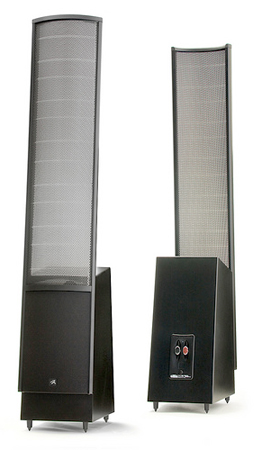
In today’s world with plenty of power on tap, (and speakers that can handle it) dynamics are a valid part of the equation and this was exactly what I had in mind as staff member Jerald O’Brien and I unpacked the mighty LS-6’s from AV123. About 200 pounds each, standing 68 inches tall, no matter how ripped you are, these speakers will probably be too large to get in the house by yourself.
Yes, we are talking about a line array speaker here folks. Believe it or not, AV123 even offers a bigger speaker, the LS-9 (which I was very impressed with at the Rocky Mountain Audio Fest two years ago), but these are just too big for most households and have been in short supply. AV123 has been concentrating more on LS-6 production recently. The LS-6 features 8 custom 6.5-inch woofers and 6 planar magnetic tweeters, crossed over with a gentle slope at 1000hz, resulting in an easy to drive 8-ohm speaker with an efficiency rating of 90db. Standard finishes include Rosewood, Moho in addition to the Cherry Satin our review pair arrived in.
Because AV123 ships factory direct, the cost of the LS-6 is only $4,495. (Plus about $500 for shipping, about 500 lbs. on a palette) That’s right, for a small pair of ProAc or Spendor mini monitors; you can have the Monsters of Rock in your living room.
If you want em to run hard, you have to break em in hard
That’s what a buddy of mine used to say when we were building cafe racers in the 70’s. He wasn’t a fan of taking it easy on anything, so as we were setting up the LS-6’s and staring at all the nice 50-70 watt tube amplifiers that were at our disposal, we decided to go for broke, hook up the 350 watt per channel Burmester 911mk. 3 and crank it up.
No Patricia Barber or polite string quartets here, the first track punched into my Sooloos Music server was AC/DC’s “Let’s Get It Up”, from For Those About to Rock, We Salute You. A quick check of the sound level meter revealed 120db peaks. Impressive, but in order to keep our canine hearing intact, we had to turn the volume down to more reasonable levels, but somehow just knowing these speakers will deliver 120db without strain is very comforting. After a few more tracks of Deep Purple, Kiss and Audioslave, we got down to fine tuning the speakers to the room and listening to some calmer music. (But still no Patricia Barber)
I practically got crucified online two years ago, because I posted somewhere how much I liked the LS-9’s with a pair of 50 watt tube amplifiers. Everyone chimed in to comment that I couldn’t possibly know what the speakers sounded like, because that clearly wasn’t enough power to work with the speakers. Towards the end of this review, the enormous McIntosh MC1.2kw monoblocks arrived, with 1200 watts per channel and we had great fun. But seriously, these speakers will work just fine with your favorite 50-watt tube amplifier. Just don’t expect to play AC/DC at 120 db.
Setup
Physical assembly of the LS-6 is somewhat frustrating. The base requires inserting about a dozen long TORX screws to fasten the base to the speaker column, so make sure you have TORX bits for your power drill. In future models, I would be very impressed if AV123 included at least a TORX tool and perhaps even a bit in with the spikes. I would also suggest adding a few pilot holes with matching pins so that you can easily attach the base, as you will be up on a ladder to assembling them. After a few unsuccessful attempts, we found it best to get the middle screws in first and then move to the periphery, but this was still a very cumbersome process.
That’s the difference between a $4,500 pair of speakers and a $40,000 pair of speakers though, and at this level, I’d rather put up with some assembly hassles and have as much of the cost of the speakers go into performance, which AV123 has done.
Once the assembly monkey business is out of the way, the LS-6’s are very easy to position in your room. With their large bases, you should be able to slide them around on a carpeted floor to get initial positioning without trouble. If you have hardwood or tile floors, I’d suggest a pair of four wheel piano dollies with heavy-duty wheels. The only disadvantage with this approach is that it will raise the speakers about four inches off the ground, so this will affect the sound slightly.
If you like to listen in the extreme nearfield (say, six feet from the speakers or less), you will have to adjust your listening habits, and plan accordingly. In order for all of those drivers in the line array to integrate properly, you really need to get back about eight feet from the LS-6 and if you can go about ten feet, that will offer more coherence to the presentation.
Working in my 16 x 24 foot (4.9 x 7.3 meters) listening room, I deviated from my normal setup of having the speakers about 4 feet (1.2 meters) from the wall with the couch about 9 feet (2.7 meters) away on the long wall. Moving the speakers to the short wall, I found nirvana with the speakers seven feet (2.1 meters) apart and just over 3 feet (1meter) from the rear wall with the couch 11 feet (3.4 meters) back. This gave the best balance of imaging, integration and bass performance.
One of the handiest features that I wasn’t able to take advantage of was the crossover adjustments that allow you to fine-tune the bass response of the speaker to your room. It’s a small door, by the binding posts. While I did investigate the settings, the LS-6’s worked perfectly in my room at the factory settings, though I do feel these will help those with smaller or larger rooms to dial in the bass output.
More than just a big mouth
Sure, it’s tons of fun playing Motorhead at ear splitting levels, but rest assured that the LS-6’s will do a fantastic job with whatever kind of music you like; this speaker can handle nuance as well. Auditioning some recent 45 r.p.m. Blue Note’s fresh from Joe Harley’s Music Matters project was a joy on the LS-6’s. Jackie McLean and Art Mobley never sounded better; the tonality of acoustic instruments was quite good but these speakers really excel at presenting a realistic size in the stereo image.
If you have a good-sized room and an amplifier with some drive, these speakers help to really recreate the size of a jazz group playing in your living room. Moving along to Jethro Tull’s Live at Montreux, 2003 on a recent pressing from Audio Fidelity was fortuitous, as I had just returned from the Montreux Jazz Festival with the sonic signature of their famed Stravinsky hall still fresh in my memory. Again the LS-6’s did a tremendous job of recreating the space of that legendary hall. (Great bit of vinyl to pick up of you like JT…)
A healthy dose of finesse
Last but not least the LS-6’s offer up quality and quantity in the bass department, going down solidly to 25hz in my room. I could coax more out of them, fiddling with those woofer controls, but I wasn’t willing to sacrifice the speed and texture of the bass produced for that last bit of weight. Besides, what $4,500 speaker offers up this kind of bass response anyway? I was most excited about the amount of detail and texture the LS-6 was able to deliver; these were not “one note bass” speakers by any means.
The LS-6’s were not embarrassed when hooking them up to primo gear, but for the average audiophile that’s going to be building a 10-30k system around them also has a lot of great choices as well. While the speakers did just fine with a few medium powered tube amplifiers (the BAT VK-55SE, McIntosh MC275 and PrimaLuna Dialog Monoblocks), the amplifier I really loved with these speakers was the new Moscode 402au. This 200-wpc hybrid amplifier really grabbed the LS-6’s and offered up a spacious, yet inviting perspective.
While I had done a fair amount of listening to the LS-6 in my reference system, the combination of the Moscode power amp, the new SP-17 preamplifier from Audio Research (includes a phono stage for $3,495) and my Technics SL-1200 with Sound HiFi mods made for an outstanding real world system that is more along the lines of what the typical audiophile might pair these up with.
What you don’t get
Buying speakers is always a compromise, especially at this price point, but the LS-6’s offer up so much musical enjoyment for the dollar, they are tough to beat. No, they aren’t as resolving as my GamuT S-7’s or Verity Audio Sarastro II’s, nor are they as exquisitely finished but they don’t have the $40,000 pricetag that comes with either of those speakers either.
As I said earlier in the review, I feel that Mark Schifter has made all the compromises in the right places to make this a true budget high performance loudspeaker. The LS-6 has only a few minor drawbacks; as with every line array speaker, there is a bit of diffusion that happens in the imaging, due to so many drivers interacting. And I must admit that I have never been a fan of line array speakers because of this issue. However, having heard the much more expensive Pipe Dreams, Epiphany and Audience line array speaker, The LS-6 does a better job of expressing this design than any other line array speaker I’ve yet heard.
They won’t disappear in the room like a pair of ProAc Tablettes, but they will present the scale of a symphony orchestra much better. The sheer visceral experience that the LS-6 offers, provided you have the proper amplifier is unmatched at this price point. Or if you have an even bigger room, the LS-9’s, which have three more woofers and four more tweeters per channel!
In the end a fantastic value
So, if you have the physical space at your disposal and you like music with large dynamic swings, put the LS-6 at the top of your list of speakers to audition. I can’t think of anything I’ve heard in years that does what the LS-6 does for this kind of money. For many audiophiles living in that $10k – $30k system range, this could very well be your destination speaker. I am happy to give the LS-6’s one of our Exceptional Value Awards for 2009.
And don’t panic, though I had a blast rocking out with these speakers, they’ll do a great job with female vocals too.
Manufacturers Information
The AV123 LS-6
MSRP: $4,495
AV123
Longmont, Colorado 80501
(USA, toll free) 877-543-7500
(International) 303-543-7500
Peripherals
Analog Sources Technics SL-1200 w/SME309 arm, Sound HiFi Mods and Sumiko Blackbird cartridge, Spiral Groove SG-2 turntable w/Triplanar arm and Lyra Skala cartridge
Phono Preamplifier Nagra VPS, Naim Superline w/HiCap 2, Montana Olympia PX phono
Digital Sources Naim CD555/PS555, Wadia 781i SE, Sooloos Music server
Preamplifiers Conrad Johnson ACT2/series 2, Burmester 011, Audio Research SP-17
Power Amplifiers Conrad Johnson Premier 350, Burmester 911mk. 3, Moscode 402au, Nagra PSA, BAT VK-55SE, McIntosh MC275, PrimaLuna Dialog 7 monoblocks
Cables Shunyata Aurora Interconnects and Stratos SP Speaker cables, Furutech AG-12 tonearm cables
Power Running Springs Dmitri and Jaco power conditioners, RSA Mongoose power cords, Shunyata Anaconda power cords, Shunyata Hydra 2 power conditioner
Accessories Burmester racks, Finite Elemente Cerepucs and Cereballs, GIK acoustic treatments, Sonex Classic, Clearaudio Simple Matrix record cleaner and record clamp