Mini Music Powerhouse
$995.00
fiio.com/k17
Nestled in between my mighty Klipschorns, with ROON playing “Paranormial” by The Art of Noise, it amazes a few of my audiophile buddies that the source is the tiny FiiO K17 DAC. And it’s not just a DAC, it’s a full-blown streamer, preamplifier (though I am only using it as a DAC/Streamer here), and headphone amplifier. It even has a 31-band digital parametric EQ built in!
The bass is extended, defined, and full of texture. Mids are natural and clean. The treble range is well represented, perhaps a touch grainy when compared to much higher priced kit, but completely livable. And the Khorns are a bit extended on top as well, so it’s all good. Going from here to Tom Waits’ “What’s He Building?” reveals just how much midrange detail, texture, and depth this digital front end is capable of. Following it up with Lou Reed’s “Vanishing Act” and Allan Taylor’s rendition of “Tennessee Waltz” confirms it. This is an incredible product.
With so many people out on YouTube complaining about the cost of things hifi, I submit the FiiO K17. To put this in perspective, I own a dCS Vivaldi ONE that is currently being updated to APEX spec, so that’s about a $100k digital player. I’m not saying this to boast about my system; I want you to know that I have an incredible digital front end, and yet at $995, the K17 is not only a tremendous value, but it delivers tremendous performance and amazing flexibility.
Why is this so exciting? At $995, the K17 gives budding audio enthusiasts a great jumping-off point, and for those wanting to build a great system that won’t require refinancing the house, an incredible anchor. Or, if you are a deeply committed audio enthusiast, it is the perfect building block for a second or third system.
Using the K17 in concert with a vintage Proceed PDT CD transport and streaming via ROON, Qobuz, and Tidal makes for a digital music center that is out of this world good. Taking advantage of some pretty advanced tech, both in circuit design and sheer engineering might, assembling all of this in such a small (about 8” x 8” x 2”) package is a masterpiece of execution.
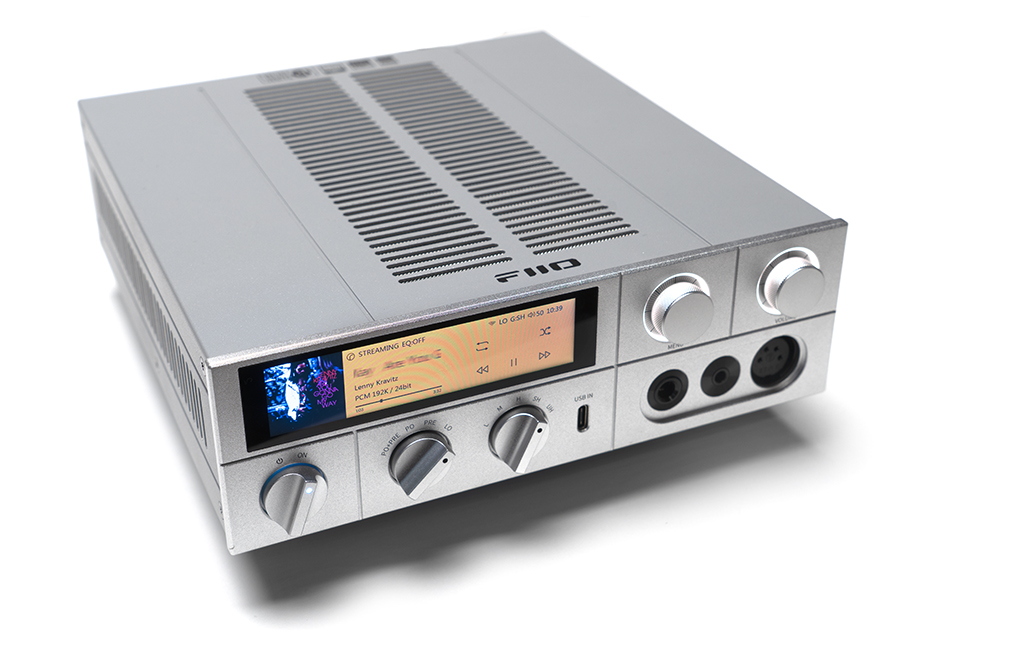
A quick look at the FiiO site shows everything they’ve packed into this small enclosure. The K17 is truly a masterpiece of miniaturization – there is no wasted space anywhere. Around front, there is a 3.93-inch high-resolution touch screen, making it easy to see what is going on and control everything from the front panel. It’s a smartly attractive piece with a slightly retro style, almost like early Mark Levinson gear, albeit a small one!
In addition to volume and menu controls, there are three headphone jacks and multiple selectors for power, function, and gain. Our review sample arrives in silver with black lettering but is slightly difficult to read because the type is so small. I’d buy mine in black, for the additional legibility, but that is truly the only complaint I have about the K17.
As a DAC/Streamer
You really need to head over to the FiiO site to see everything that the K17 is capable of. In the context of this review, it was primarily used as a DAC/streamer, as a ROON endpoint. The K17s analog stage has RCA and balanced XLR outputs. They say it is a fully balanced design, but since my ampsandsound preamplifier is RCA-only, most listening was done with the RCA outputs.
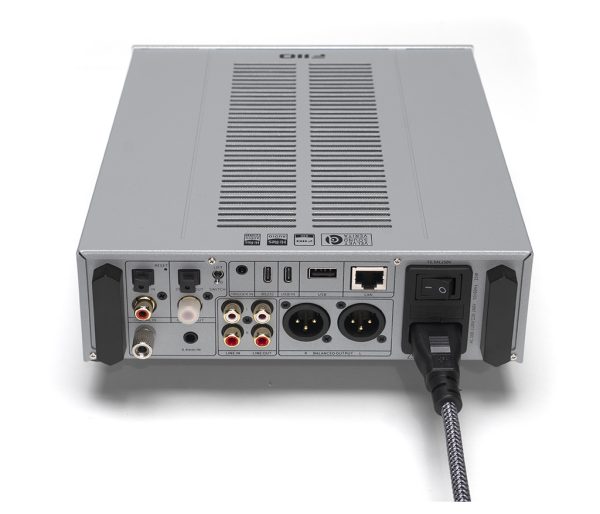
Thanks to multiple inputs around back, any source can be accommodated. There are digital inputs for coaxial SPDIF, optical, and USB sources.
Being able to stream anything from anywhere makes the K17 incredibly flexible. It even decodes MQA files if that is still a thing for anyone. Bluetooth playback with Spotify from my iPhone is exceptionally good, too.
As mentioned in the spec sheet, the K17 decodes everything. I was able to decode everything in my library with ease, and again. It works flawlessly, using it as a DAC with my vintage Proceed transport to play CDs via the coax SPDIF input. If you’ve got an older player that still functions fine, this is a great way to breathe new life and functionality into an old deck.
As a headphone/PRE
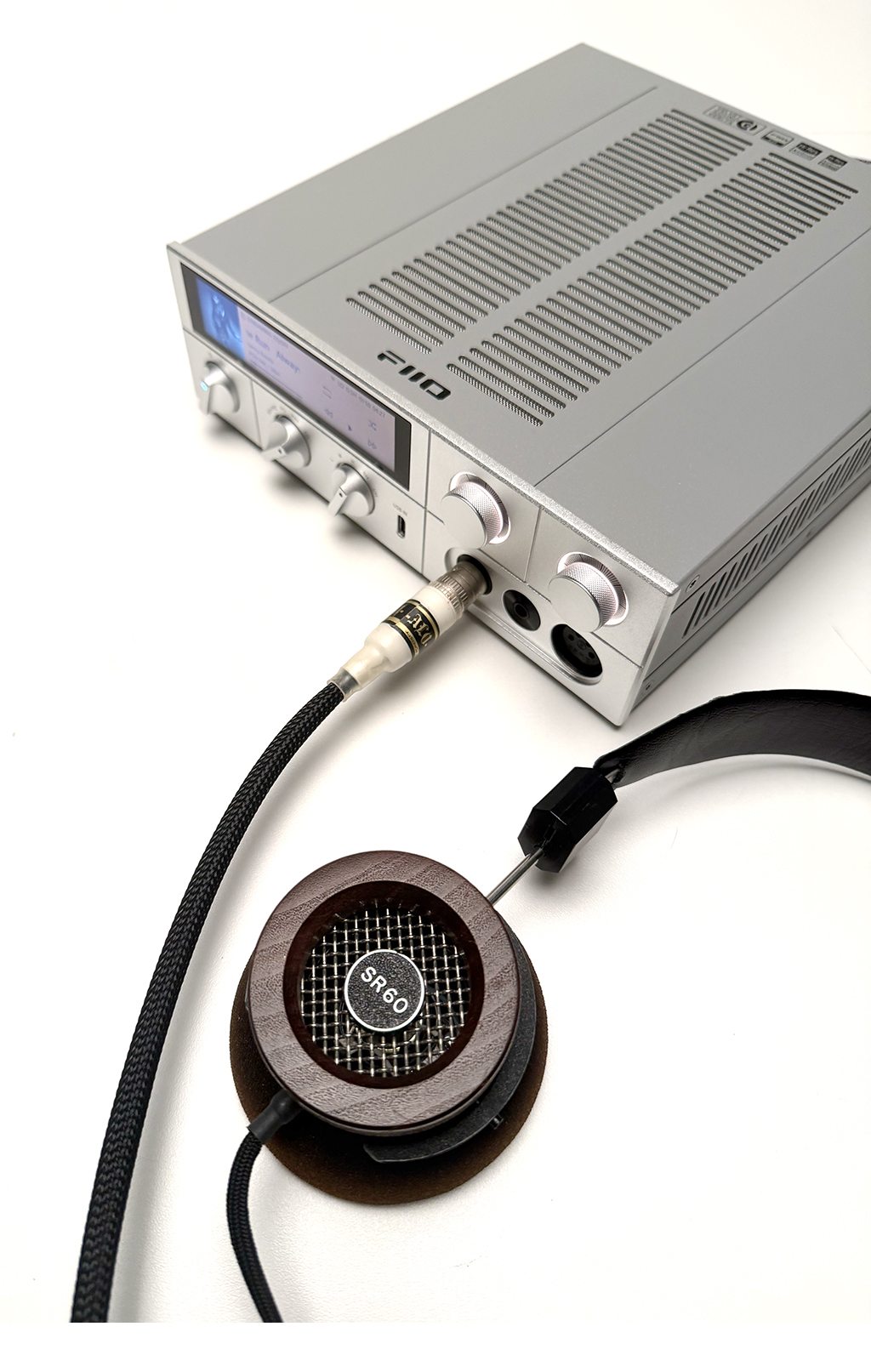
Not being a big headphone user these days, I still keep a couple of good phones around just in case, so putting the K17 to work strictly as a headphone amplifier proves this component is more than worth the asking price if that’s all you use it for.
FiiO claims 4 watts of power, with discrete output devices in the headphone amplifier section. Listening sessions with the Focal Clear MG, original Audeze 2s, and a pair of Grados all prove musical.
Back to that EQ for a minute. As you head-fi’ers know, there is so much variation in the way different phones mate with different amps, and having the ability to make minor adjustments over this wide of a frequency range is helpful. Best of all, this can be adjusted with your phone or tablet using their app. Everything else can be controlled here as well.
While my studio is a pretty good-sounding room without major issues, my living room is dreadful. Being able to surgically cut out a bit of boom here, and boost a bit of cloudiness in the upper mids goes a long way at making that room a lot more listenable. That may grate on your audiophile sensibilities, but it is great to have available. And we all know not all records are created equal.
Thanks to its fully balanced design, you can easily place the K17 where it’s convenient and run a long set of balanced interconnects to a power amplifier and speakers elsewhere in the room. I tried this in my living room, running a 6-meter pair of Ranger XLRs to a Pass Labs XA30.8 power amplifier. Back in the studio, the K17 is the anchor for System 3, but is only used as a DAC. You can choose fixed or variable outputs from the front panel. There’s even a handily placed USB-C port there, and around back, a ground lift switch. FiiO hasn’t missed a thing to make the K17 easy to integrate into your system.
However, using it as a line level preamplifier, direct to amplifier works well, making the K17 a fantastic building block to a modestly priced, yet high performance two-channel system. Thanks to the single analog input, it’s easy to add a turntable. Connecting the Hagerman Trumpet MC to a vintage Technics SL-1100 makes for an excellent combination, using the Vera-Fi A40 class–A power amplifier, driving vintage Acoustat 2+2 speakers. Because there is no loss of information at low volume, I am assuming that FiiO has implemented the volume control in the analog output stage.
The $100k question
So, is the K17 a dCS killer? Nope. But it’s core sonics are excellent, and the level of sonic refinement it does offer is way beyond what I suspect you’ll find at $995. Doing some side by side comparisons with players from Advance Paris, Naim, and Marantz with price tags nearly double – the K17 holds its own.
Beyond that, considering it’s unique set of features, it outperforms everything else I’ve encountered at over double the price. That’s great value. It may not be a dCS Vivaldi or an Esoteric Grandioso, but that’s not who this is intended for. I think putting the K17 in the context of a $3k – $10k+ system, you will be thrilled. I know I am.
I definitely want one
At $995, the FiiO K17 is one of the best values I’ve ever encountered in high-end audio in a long time. It’s more than worth the price asked, even if you were merely using it as a preamplifier, headphone amplifier, DAC, or streamer alone. That you get all four in one neatly executed box is incredible.
I’m happy to give this our first Exceptional Value Award of 2026. Regardless of where you are in your hifi journey, this is one to check out. I’m keeping the review sample. And we’ll have a little more up on YouTube in the weeks to come, too.
Peripherals
Digital source(transport) Madrigal Proceed PDT
Analog source Technics SL-1100/wSME 3009 and Denon DL-103r
Phono pre Hagerman Trumpet MC
Amplifier Pass XA30.8, VeraFi A40
Speakers Klipsch AK7 Klipschorn, w/ SVS 5000 sub
Cable Ranger signal and power